


Pomace on Boots
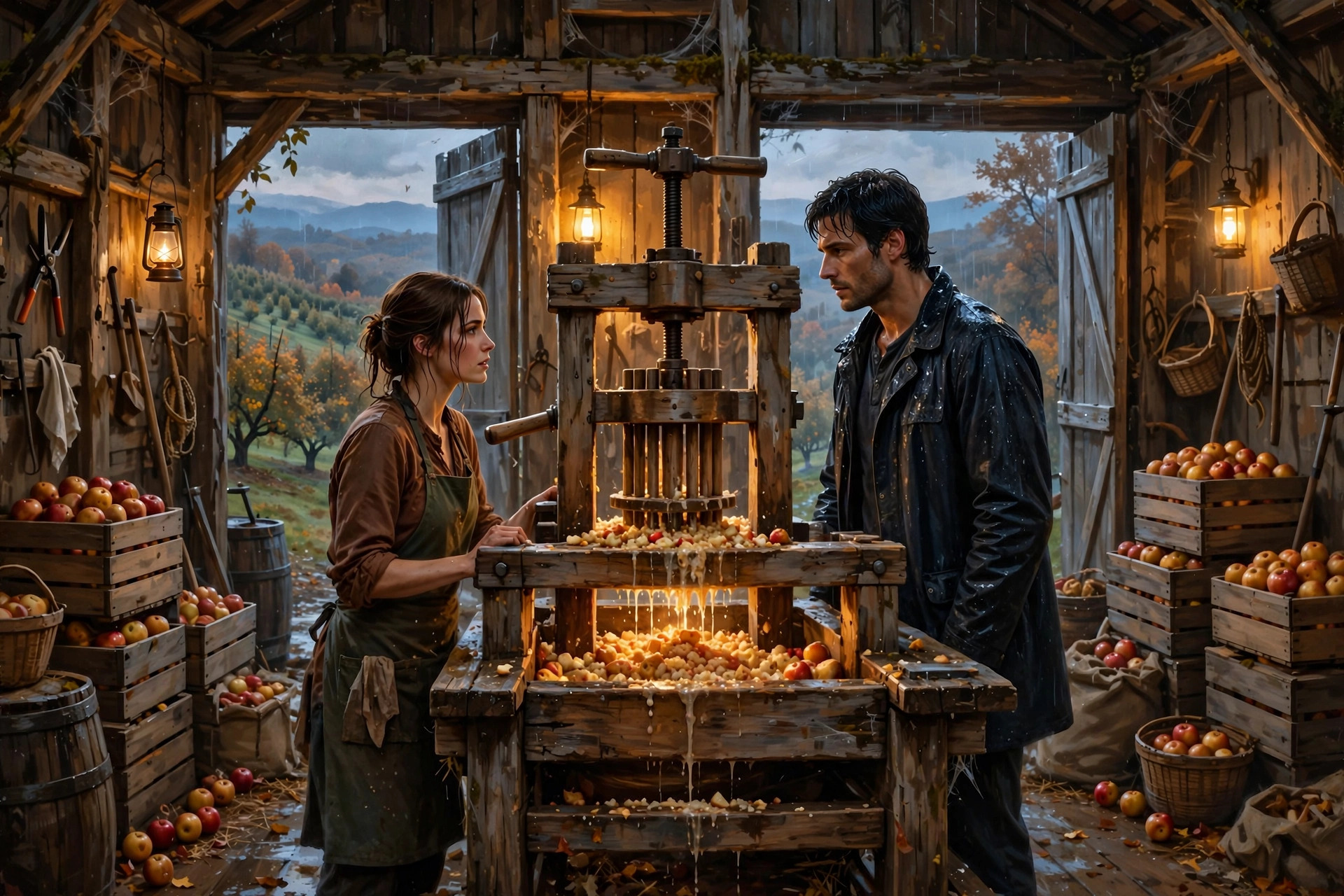
"You can't put that there," Agathe said, before the stranger had even set the folded cot down.
He set it down anyway, square in the dry corner of the press house, between the stacked crates and the wall where her grandfather had nailed up a calendar from a feed store that no longer existed. He was tall, rain-dark at the shoulders, and he looked at the floor the way some men looked at a horse they meant to buy.
"Rafe Dunmore," he said. "Your insurer sent me. I'm told you were told."
"I was told someone would check the locks." She wiped her hands on her apron. Pomace clung to her boots in brown, sweet-smelling clumps, and the old oak press behind her creaked as the last cloth of the batch gave up its juice. "Not that someone would move in."
"Somebody cut your hoses and poured bleach in a fermenter. Locks didn't stop that." He snapped one leg of the cot into place. "So I sleep here through harvest. That's the policy."
"That's your policy."
"It's yours, actually. Page eleven. Rider you signed in the spring."
From the far end, where the stainless tanks stood in their row like patient soldiers, Hattie laughed out loud and didn't bother hiding it. She'd been rinsing a hose for the last ten minutes, which meant she'd been listening for the last ten minutes.
"He's got you, love," Hattie called. "I watched you sign it. You said, and I quote, 'Fine, whatever, give me the pen.'"
Agathe shot her a look. Hattie returned it with the serenity of a woman who'd been in Ashby Falls since before Agathe could drive.
"There's a perfectly good guest room in the house," Agathe tried.
"Up the hill. Quarter mile." Rafe snapped the second leg. "Nobody's cutting hoses in your guest room."
"You don't know that."
That got the corner of his mouth, barely. "Fair."
She hated that it got the corner of hers too. She turned back to the press before he could see it and cranked the screw down another half turn. Steel groaned against oak. Her grandfather had built the thing by hand in 1974, joined and bolted, and it still pressed truer than anything she could afford to replace it with. The juice ran gold into the trough. Good apples this year. Good, if she could get enough of them into tanks before the distributor's deadline.
Four thousand gallons. She'd promised four thousand gallons to a regional buyer who'd finally, after years of her driving samples to trade shows in a car with no heat, said yes. That contract was the whole year. Maybe the whole orchard.
She didn't say any of that. She tightened the screw.
Behind her, she heard him walking. Not the aimless walk of a man killing time. He went along the wall, tapping the sliding door's track with a knuckle, crouching at the drain, tilting his head at the window latch. Then he stopped.
"What's this?"
She knew without looking. Her stomach went cold anyway.
"Spare bin," she said. "Leave it."
He didn't leave it. He'd already hooked his hands under the lip of the big plastic picking bin she'd shoved against the end tank that morning, the one she'd draped with a tarp as if tarps were ordinary decoration, and he dragged it a full foot sideways across the concrete. The tarp slid off.
Behind it, low on the curve of the tank, ran a seam of fresh weld. Ugly. Hers. Patched at two in the morning by headlamp after she'd found the puncture and the puddle and sat on the floor for a minute she would never tell anyone about.
Rafe crouched and ran a thumb along it. "This isn't in the claim."
"Because it's fixed."
"Is it?"
"It holds."
"Did someone do this?"
"A forklift did this." It came out too fast. Hattie had gone very quiet with her hose.
Rafe looked up at her from the floor, and for a moment she saw him decide something, file it somewhere behind his eyes. She'd seen that look before, years ago, on a man across a kitchen table who'd already signed papers she hadn't been shown. Her jaw tightened until her teeth ached.
"Put it back," she said.
He stood, slowly. "Ms. Moreau--"
"Agathe. And put it back."
He held her gaze a second longer than was polite. Then he pushed the bin back into place, exactly where it had been, and laid the tarp over it with a care that somehow felt worse than an argument.
"I'm not here to make your life harder," he said quietly.
"Then you're in the wrong line of work."
Hattie cleared her throat. "Press is dry, Agathe."
It was. The cloths had gone pale and flat. Agathe reached for the dented pewter cup that lived in her apron pocket, the one her grandmother had bought at some county fair in the fifties, and dipped it in the trough to taste. Her hand wasn't quite steady. The cup knocked the steel lip of the press hard, with a flat little clang, and when she pulled it back the old dent had a new one beside it, a fresh crease across the rim.
"Oh," she said, and hated how small it sounded.
Rafe was beside her before she'd noticed him move. He didn't take the cup. He just held out his palm, and after a moment, for reasons she couldn't have defended in court, she set it there.
He turned it toward the work light. "Pewter's soft. Wooden dowel and a little patience, that'll mostly come out."
"You do metalwork too?"
"My grandmother had one like it. I dented hers about once a month." He handed it back. "She made me fix every one."
Agathe tipped the cider into her mouth. Bright, sharp, honeyed at the back. The year's best batch, and she could barely taste it for the man standing a step too close, smelling of rain and road and the cot's canvas.
"Hattie," she said, not looking away from him, "where's the spare pillow?"
Hattie's eyebrows went all the way up. "Linen closet. Same as always."
"He'll need it. Concrete gets cold." Agathe tucked the cup back into her apron. "You stay in that corner. You don't touch my tanks, you don't touch my bins, and you don't move a single thing in here without asking me first."
"I can ask," Rafe said.
It wasn't quite a yes. She noticed. She let it go, because the next batch of apples was waiting in the yard and because she was suddenly, ridiculously tired of standing alone at two in the morning.
"Coffee's at six," she said, and stomped out, scattering pomace off her boots.
She didn't look back. She was fairly sure he was smiling anyway.
The Cut Hose
"Don't," Agathe said, before Rafe's hand had even reached the hose.
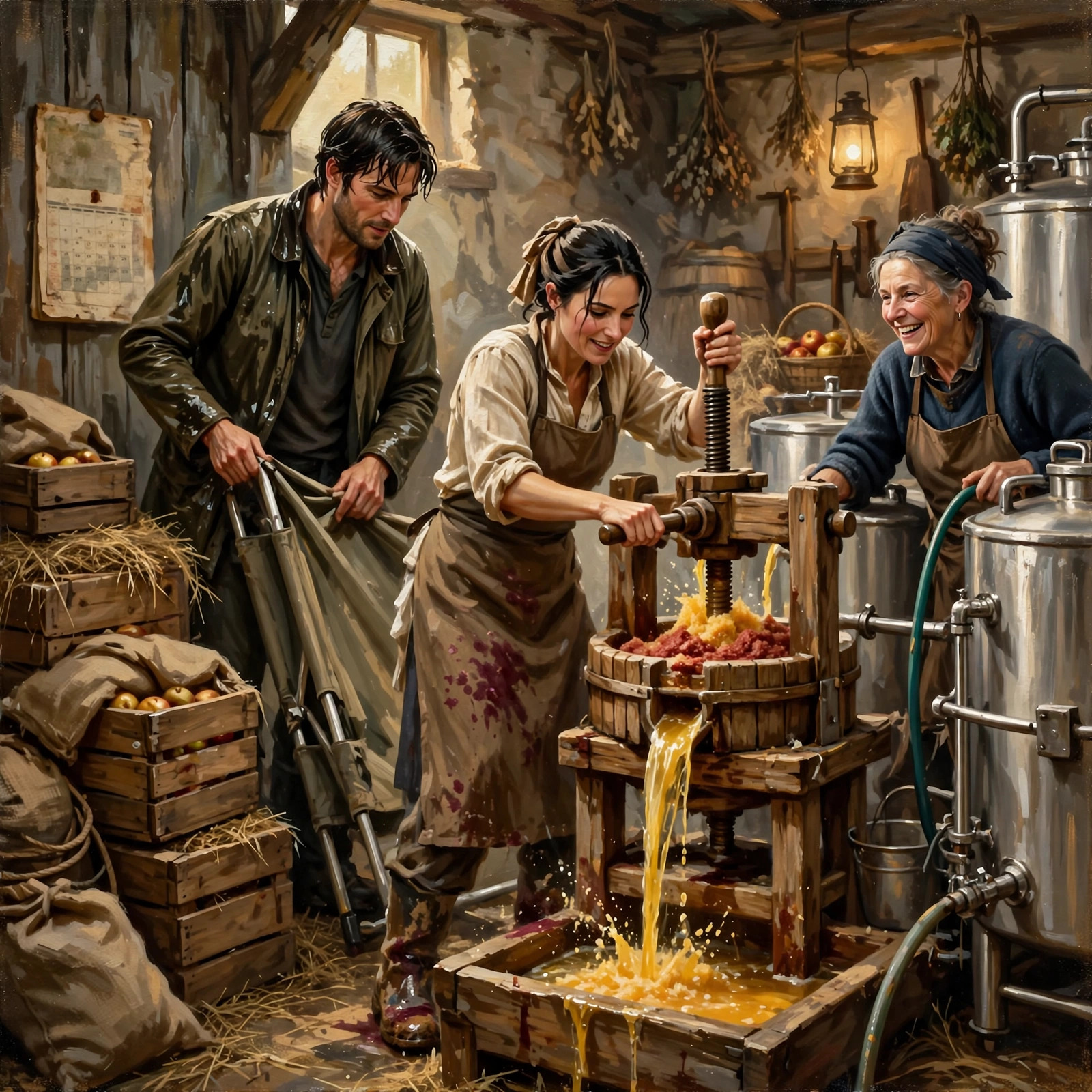
He stopped, palm hovering over the long black coil that ran from the press trough to the fermenting tanks. Cider pooled beneath it on the concrete, gold and wasted, spreading toward the drain in a slow, sticky fan.
"I'm asking," he said. "Can I touch it?"
"You can look at it."
He crouched and looked. She made herself do the same, knees cracking, apron dragging in the spill. The split sat a foot from the coupling, a clean diagonal through the reinforced wall.
"That's not wear," Rafe said.
"Hoses crack."
"Hoses crack along the curve. They don't cut themselves straight with a utility blade." He tilted his head toward the light. "See how the edges are smooth? Somebody leaned into it. Could've been last night after I turned in, could've been this morning while we were in the yard."
Agathe stood too fast. Her coffee had gone cold an hour ago and her stomach had gone with it. Four thousand gallons promised by the end of the season, and every hour the press sat idle was an hour she didn't have.
"I've got a spare."
"Where?"
"Shed." She was already walking. "I'll handle it."
The spare was there, hanging on its hook where it had hung for most of a decade. It was also, when she pulled it down, brittle as old licorice, sun-rotted from the window she'd meant to cover. It cracked in her hands at the first bend.
She stood in the shed for a long moment and did not swear, because swearing felt like admitting something.
When she came back, Hattie was mopping the spill and Rafe was standing exactly where she'd left him, hands in his jacket pockets as if he'd put them there to keep them out of trouble.
"Bad?" Hattie asked.
"Spare's shot."
"Supply place in Ashby Falls opens at nine."
"And that's an hour there and back, and the afternoon load's already sitting in bins." Agathe pressed the heels of her hands into her eyes. "Fine. Fine. I'll drive."
"Or," Rafe said.
She dropped her hands.
"Or we cut out the bad section and splice it. Barbed coupler, two clamps. You've got food-grade fittings in that drawer by the sink, I saw them yesterday." He paused. "I didn't open it. Label's on the outside."
Hattie made a small noise into the mop handle that might have been a cough.
Agathe looked at the drawer, then at him. Asking for help was a door she'd nailed shut years ago, the morning she'd found the signed buyout papers on the kitchen table and realized the man she'd married had been planning a life without the orchard in it, without telling her a word. She'd sworn then that nobody else would ever hold the pieces of this place but her.
But the apples were softening in the yard, and she had two hands.
"You hold," she said. "I cut."
"Deal."
She got the fittings and her good knife. They knelt together on the damp floor, the hose stretched between them. Rafe held it taut on either side of the split, his grip easy and sure, and she sawed through the wall above and below the damage. Rubber squeaked. Juice dribbled over his knuckles.
"You've done this before," she said.
"Fire hoses, a long time ago. Summer job." He shifted his thumb to give her room. "Warm the end a little before you push the barb in. It'll go easier."
"I know how to splice a hose."
"Then you know about warming the end."
She glared at him. He looked back, mild as milk, and the corner of his mouth gave him away. She dipped the cut end in the kettle water Hattie silently set beside her, then shoved the coupler home. It slid in clean. She wasn't going to tell him that.
His fingers were right there when she reached for the first clamp, steadying the joint so she could tighten it. Their knuckles knocked. Neither of them moved away. She was aware of the warmth of his hand under hers, the rough edge of a scar along his thumb, the fact that he was breathing slowly on purpose, like someone trying not to startle a horse.
"Other clamp," he said, low.
She tightened it. Her pulse was doing something ridiculous.
A truck door slammed in the yard.
Agathe knew the sound of that engine the way she knew weather. She sat back on her heels. "Wonderful."
Lyle Brannock came through the open bay door like he owned the frame, wide in a canvas coat, boots too clean for a man who claimed to work an orchard. He took in the hose, the mop, the stranger kneeling on her floor.
"Trouble, Agathe?"
"Morning, Lyle. We're busy."
"I can see." His gaze slid to Rafe and stayed there a beat too long. "Insurance fella, I heard. Word gets around Ashby Falls. Folks say you've had a run of bad luck."
"Folks talk."
"They do." He rocked on his heels. "I'll just say it again, since nobody else will. Six hundred thousand, cash, and you walk away clean. Water rights and all. That's more than this hill's worth with a busted press and a contract you're never going to fill."
"Who told you about the contract?" Rafe asked.
It was quiet, almost friendly. Brannock's smile didn't move, but something behind it did.
"Small town."
"Sure," Rafe said.
Agathe got to her feet, wiping her hands on her apron. "The answer's the same as last year, and the year before. Get off my hill, Lyle."
He lifted both palms, all reasonable neighborliness, and backed out into the gray light. Across the yard, one of the seasonal pickers was crossing toward the path that ran uphill past the spring cistern, and Agathe saw Hattie's eyes follow him, narrow and thoughtful, before she went back to her mopping without a word.
The truck pulled away. Agathe exhaled.
"He always that charming?" Rafe asked.
"Since I moved here. He wanted this land before my grandfather was cold." She crouched and tugged the splice. It held. "You asked him a question."
"I did."
"You didn't ask me first."
He considered that. "No. I didn't."
She ought to be angry. She found she mostly wasn't, which worried her more.
They ran the hose back to the tank and Hattie threw the switch. The pump hummed, the line stiffened, and cider moved again, bright and steady through the joint they'd made. Not a drop at the clamps.
Agathe watched it for a long minute. Then she pulled the pewter cup from her apron, the new crease still catching the light, and filled it from the trough tap.
She held it out to him.
"First of the day," she said. "Go on. Before I change my mind."
Bolt in the Screw
"Don't," Agathe said, and Rafe's hand stopped an inch from the screw.
"I was asking."
"You were reaching. Those aren't the same thing."
He pulled his hand back and tucked it into his jacket pocket, which somehow looked more like a question than the reaching had. The work lights hummed overhead. Past the open bay door the orchard was black, and the press house smelled of crushed fruit and wet oak and the sour edge of a day gone wrong.
The press stood between them, her grandfather's oak frame dark with decades of juice, the steel screw rising from the crossbeam like a spine. Six racks of ground apples sat stacked under the platen, each wrapped in its cloth, waiting. They'd been waiting since supper, when she'd thrown her weight on the bar and felt it stop dead halfway down, as if it had hit stone.
"Okay," Rafe said. "May I look at the screw, Agathe?"
She hated how polite he made it sound. She hated more that she'd needed him to say it. "Look. Don't turn."
He climbed onto the press bed in his boots and crouched, pulling a small flashlight from his pocket. He didn't touch the threads. He only bent close and moved the beam slowly along the steel, the way she'd seen him study the slashed hose yesterday, patient and a little grim.
"There," he said. "Two turns up from the nut. Come see."
She climbed up beside him. The racks squelched under her knees and cold juice soaked straight through her jeans. In the circle of his light, wedged hard into the thread where screw met nut, sat the round head of a carriage bolt. Somebody had greased it first. She could see the shine.
"That didn't fall in," she said.
"No."
"Somebody put it there while I was at the orchard store. With the pickers in and out all afternoon." She heard her own voice going flat and careful. "It'll have chewed the thread."
"Maybe. Maybe not, if we back it off slow instead of forcing it." He clicked off the light. "That's a two-person job. One on the bar, one on the bolt with pliers, easing it out as the screw comes up."
She could call Hattie. Hattie's knees were bad and it was past ten, and Hattie would ask questions in that mild voice that always got answers. Agathe looked at the bar, then at him.
"You take the pliers," she said. "I know how much this screw will give. You don't."
"Fair."
It wasn't fast. She leaned on the bar a quarter turn at a time, feeling the press resist and groan, while Rafe lay half across the racks with his arm up under the crossbeam, working the bolt with needle-nose pliers and murmuring numbers. "Little more. Stop. Okay, again." Pomace squeezed out the sides of the cloths and ran down his sleeve. A rack shifted under him, spat a sheet of sweet brown juice across his chest, and he swore with real feeling.
She laughed. It surprised them both.
"Glad I'm entertaining," he said, not looking up.
"You've got apple in your hair."
"I've got apple in places I'm going to discover tomorrow. Again, please."
The bar bit into her palms. Her shoulders burned. Then something inside the nut gave with a gritty click, and the screw came up free, and Rafe sat back holding the bolt up between the pliers like a pulled tooth.
She dropped onto the press bed beside him, breathing hard. He set the bolt in her hand. It was warm from the friction and heavier than it should have been.
"Thread looks okay," he said. "You'll want to dress it with a file, but it'll press."
"He built this in 1974. My grandfather." She turned the bolt over. "Bolted every joint himself. He used to say a press is the only honest thing on a farm, because you can't lie to it about what you put in."
Rafe didn't answer, which she was learning was how he left room.
"I almost lost it once," she said. "Before. There was a man. We ran this place together for a while, after my grandfather passed. I thought together." She pressed her thumb against the bolt's thread until it hurt. "A buyer came around. Not Lyle, a company. He signed a letter of intent without telling me. Took their money for his share, and they meant to use it to pry out mine. I found out from a lawyer's envelope on the kitchen table."
"How'd you keep it?"
"Borrowed against everything I had. Paid them off. Paid him off." Her mouth twisted. "So now I don't hand anybody the keys. Not the bank, not the neighbors. Not a man the insurance company sends."
"That's why you didn't want me touching the screw."
"That's why I don't want anybody touching anything."
He was quiet a moment. Juice dripped from the platen in slow, thick drops. "I had a client once," he said. "She told me her place was fine. Locks were fine, nobody was bothering her. I had a bad feeling and I took her word over it anyway, because it was her property and her call." He looked at his hands. "She wasn't fine. So now I don't ask as much as I should."
"You asked tonight."
"You made me." The corner of his mouth lifted. "I'm working on it."
She looked at him then, really looked: soaked to the collarbone, pomace on his jaw, eyes tired and steady on hers. She thought about the bolt, about the grease somebody had put on it, about how alone she'd meant to be when she found it.
She set the bolt down on the crossbeam. Then she leaned in and kissed him.
He went still for a single second, long enough that she nearly pulled away. Then his hand came up to her cheek, sticky and cool and careful, and he kissed her back like he'd been waiting to be asked. He tasted of apples. Everything did, on this hill, in this season, but this was different, and she knew it, and that was the trouble.
When she drew back, his forehead stayed against hers.
"Was that you asking?" he said.
"That was me telling."
"Noted." He sounded a little hoarse.
She climbed down before she could do it again. Her knees were shaking, which she blamed on the bar. She pulled the pewter cup from her apron, ran it under the trough tap, and drank. The two dents caught the light. Her grandmother would have had words about the state of it.
"Go wash up," she said. "There's a hose by the cooler and a clean towel in the office. I'll start the first pressing."
"Now? It's nearly midnight."
"The fruit won't wait for decent hours. Go on."
He went, dripping, glancing back once from the doorway. She listened until the water started running outside.
Then she walked to the far row of tanks, the ones beyond the work lights, and crouched by the third. She'd found it at dusk: a hairline crack low in the weld seam, weeping cider in a thin, shining line onto the concrete. Too straight to be age. She'd told no one.
She pulled an empty bin across to hide the stain, dragged a folded tarp over the seam, and stood back to check that nothing showed from the cot in the corner. Nothing did.
Her lips still tingled. She wiped her hands on her apron and went back to the press, and when Rafe came in toweling his hair, she was already turning the bar, and she smiled at him like there was nothing in the dark behind her at all.
Inspection Notice
The inspector had a clipboard and an apology in his voice, which made it worse.
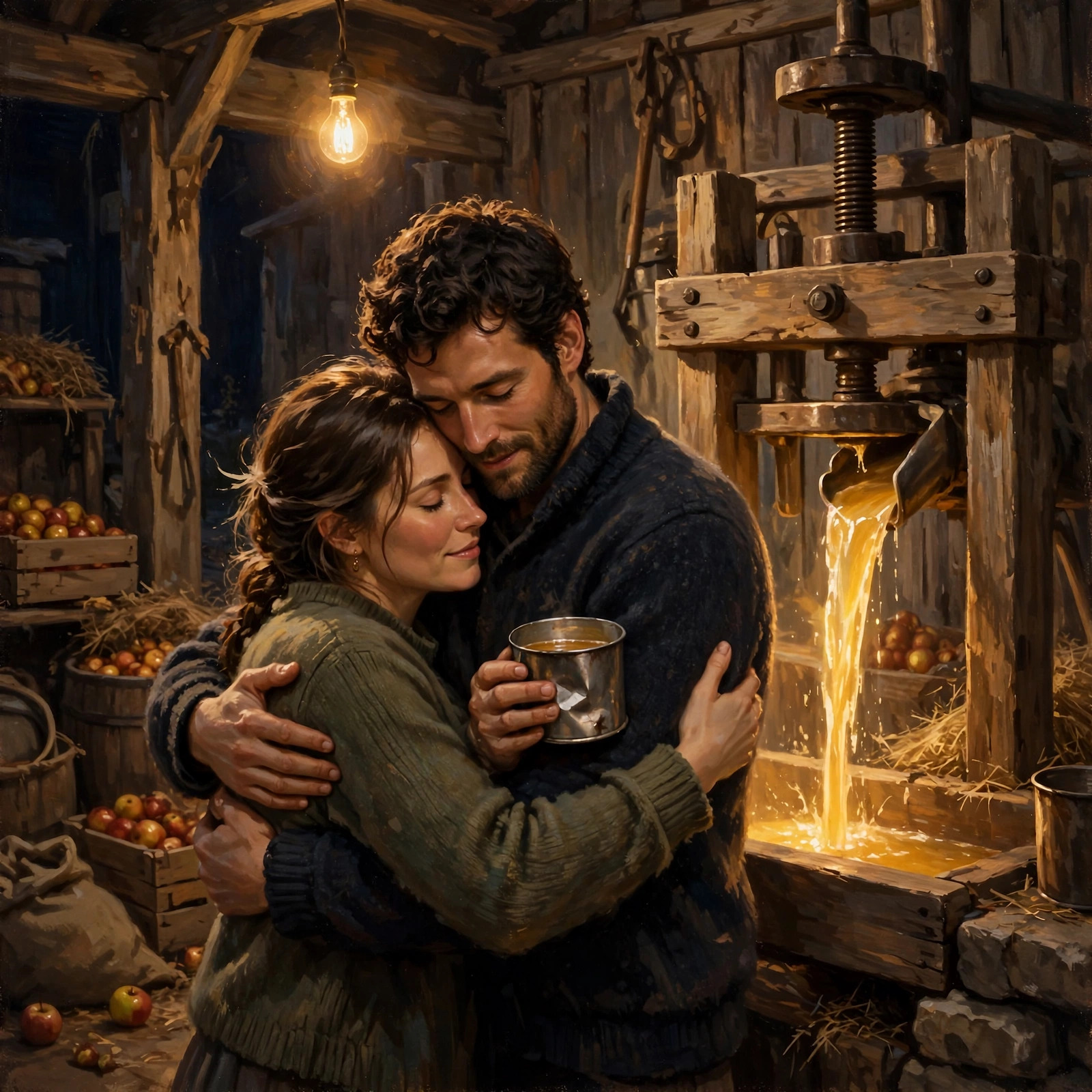
"I'm sorry, Ms. Moreau. Until the tanks are assessed, nothing gets pressed or transferred. Insurer's orders." He peeled a yellow notice from its backing and smoothed it onto the steel housing of the press, right over the place her grandfather had carved his initials.
Agathe stared at it. Behind her the morning's fruit sat in bins, sweating in the sun, going soft by the hour.
"Who called you?"
The inspector glanced past her shoulder. He didn't have to say it.
Rafe stood in the doorway of the press house with his hands at his sides. He didn't look away. That was the only thing about him she could have forgiven, and she didn't.
"Hattie," she said, without turning. "Walk him through the far row, would you? Show him everything."
Hattie wiped her hands slowly on a rag, eyes going from one of them to the other. "Everything," she repeated. "Come on, then, son. Mind the drain."
The inspector followed her out, clipboard tucked under his arm. Their footsteps faded toward the tanks. The bin scraped. A tarp rustled. Somebody whistled low.
Agathe waited until she couldn't hear them anymore.
"When?"
"Last night." Rafe came a few steps in. "After you went up to the house. I photographed both tanks and sent them to the adjuster."
"Both."
"The welded one from my first day. And the one under the tarp in the far row." His voice was even, careful, the voice of a man reading a report aloud. "Agathe, that crack's too straight. Somebody scored it. If whoever did it comes back and opens it all the way while you're pressing, you lose a full tank and maybe your floor drain, and your claim gets denied because you hid prior damage. I've seen it happen."
"You've seen it happen." She laughed, and it came out wrong. "You saw a tarp, and you decided."
"I decided you'd get hurt worse if I didn't."
"You didn't ask me."
"You'd have said no."
"Yes," she said. "I would have. It's my no to say."
He opened his mouth and shut it again. A muscle moved in his jaw. For a second he looked less like a consultant and more like a man who'd had this exact fight before and lost it in some way that still cost him.
She didn't let herself care about that. She couldn't afford to.
"Do you know what that notice does?" She pointed at it without looking. "I've got a distributor expecting four thousand gallons. Not three thousand eight hundred. Not 'sorry, the insurance man had a feeling.' If I miss the delivery window, they walk, and if they walk, the bank stops being polite. And there's a man next door who'd be thrilled to make the bank's day."
"I know about Brannock."
"You know what I told you." Her throat was tight. "Two nights ago I stood on that crossbeam and told you about the last person who decided what was best for this place without telling me. And you listened. You said 'noted.'"
"That's not the same."
"It's exactly the same. He thought he was saving me too."
That landed. She watched it land. Rafe's hands closed and opened once.
"I trusted someone's word over my own read once," he said quietly. "She told me everything was fine. It wasn't. I'm not doing that again."
"So you don't trust anybody's word."
"I trust yours about cider."
"Just not about my own life."
He didn't answer. Somewhere outside, a crow landed on the roof and walked along the tin, loud as boots.
Agathe turned to the hook by the trough. The pewter cup hung there by its handle, where she'd started leaving it so he could rinse it and drink from it too. Somewhere in the last few days it had stopped being only hers. She took it down. The two dents caught the light from the doorway.
She walked past him to the corner, to the folded cot with his duffel tucked under it and his jacket over the foot. She set the cup on his pillow, square in the middle, upright.
"I want you off the property by tonight."
"Agathe."
"Your employer can send someone else. Someone who asks."
"Whoever's doing this isn't finished."
"Then I'll handle it."
"Alone."
"That's how it's always been handled." She made herself meet his eyes. "That's how I like it."
It was a lie, and she could see he knew it, and that made her angrier than anything else that morning.
Hattie came back in first, alone, rag still in her fist. She took in the cot and the cup and Agathe's face, and her mouth went thin.
"He's writing," she said. "Says it'll be a day, maybe two, before anyone with the authority to lift it comes out."
"Fine."
"It isn't fine, and you know it." Hattie looked at Rafe a long moment, then back at Agathe. There was something else behind her eyes, something weighing on her, but she only shook her head. "I'll get the fruit under shade. No sense letting it cook."
"Thank you, Hattie."
The older woman paused at the doorway. "Girl, there's a difference between holding on to a thing and choking it." Then she was gone, calling for a hand truck.
Rafe hadn't moved.
"Pack," Agathe said.
He crouched by the cot. He didn't touch the cup at first. He rolled his sleeping bag, zipped the duffel, folded the jacket over his arm. Only then did he pick up the pewter, turning it once in his fingers, thumb finding the newer dent. He set it down on the crossbeam of the press, beside the yellow notice, gently, the way he'd once held her face.
"It's yours," he said. "It shouldn't leave with me."
She didn't trust her voice, so she said nothing.
He walked out into the glare. She heard his boots on the gravel, then the truck door, then the engine catching. She stood by the silent press with her hand flat on the oak and listened for the sound of him reaching the county road.
It didn't come.
When the afternoon had stretched long and the inspector's car had finally pulled away, she went out to move the last bins. Down at the bottom of the drive, past the rows, his truck sat idling at the gate. He hadn't gone through. He hadn't come back either. He was just there, parked half on the shoulder, windows down, facing the hill like a man who'd been told to leave and couldn't quite make his hands do it.
She turned her back on it and kept working. Every time she looked up, it was still there.
The Spring Cistern
The adjuster's car was back at the gate by nine, parked nose to nose with Rafe's truck, and Agathe walked down the drive with a banker's box against her hip before she could talk herself out of it.
Rafe got out when he saw her. He'd slept in the cab; his collar was creased flat on one side and he hadn't shaved. He didn't come toward her. He waited, hands loose at his sides, the way he'd waited outside the press house that first afternoon for her to say he could come in.
She didn't look at him. She looked at the adjuster, a tired man in a fleece vest, and at the county deputy leaning on the second car.
"You want to know why I hid the tank." She set the box on the hood. "This is why."
The adjuster lifted the lid. Ledgers, printouts, the line of credit statements she'd never shown anyone, the distributor contract with its four thousand gallons and its late-delivery clause circled twice in red.
"I'm behind. Badly. If that contract slips, I can't cover the note, and the only offer on the table is Lyle Brannock's." Her voice stayed level, which surprised her. "Mr. Dunmore didn't hide anything from you. I did. He sent you what I wouldn't. Whatever's in your file about him, take it out."
The deputy whistled softly through his teeth. The adjuster turned a page, then another.
"You understand this goes in the claim record," he said. "Your lender can request it."
"I understand."
She felt Rafe move then, one step, gravel shifting. "Agathe. You don't have to--"
"I know I don't." She finally looked at him. "That's the point."
His throat worked. He didn't say anything else, and she was grateful, because one more word from him and her level voice would have gone.
Hattie's cart came rattling down the drive before anyone could answer. She was driving too fast for the ruts, a hand truck bouncing in the bed, and she braked hard enough to spray dust over the box.
"I should've said it Tuesday." Hattie climbed down stiffly. "I'm saying it now. That picker with the green cap. Second day of harvest I saw him heading up to the spring cistern at lunch, carrying a jug. Told myself he was filling water. Nobody fills water up there."
Agathe went cold from the scalp down. "That's the whole supply. Wash water, the rinse lines, the house."
"I know what it is, girl. Why do you think I drove like that?" Hattie's mouth trembled once and firmed. "He went back up just now. Same jug."
Rafe was already moving. He didn't ask. He went up the slope between the rows at a run, and for one hot second the old anger flared in her, the way he decided things and simply went. Then she was running too, because he didn't know the path cut left at the stone wall, and she did.
"Left!" she shouted. "At the wall!"
He took it without breaking stride.
The cistern sat in a hollow of ferns under a slate lid, older than the press, older than anything on the hill. The lid had been dragged half aside. A young man in a green cap knelt at the gap, a plastic jug tipped in both hands, something milky beginning to pour.
Rafe hit him low and clean. The jug flew, bounced off the slate, and glugged its contents into the ferns. The picker swore and kicked, and Rafe pinned his arm behind him with an ease that told Agathe this wasn't the first time.
She dropped to her knees at the cistern lip and peered down. The water below lay dark and still. She cupped her hand under the drip of the jug's spout, sniffed, recoiled. Sanitizer concentrate, the caustic kind. A cupful would have spoiled every tank she rinsed for a week.
"It didn't go in," Rafe said, breathing hard. "Not much. Is it bad?"
"It would have been." She dragged the slate back across the opening with both hands, scraping her palms, and sat on it.
The deputy arrived red-faced, Hattie puffing behind him with the adjuster. The picker had stopped struggling. He looked very young under the cap and very frightened.
"Who's paying you?" Rafe asked. Not loud. He had his read on the boy and he was using it.
"Nobody."
"Nobody buys a gallon of commercial sanitizer on picker wages." Rafe eased his grip a fraction. "You're about to be charged with tampering with a water supply. Somebody else did the planning. You can carry that alone or not."
The boy's eyes slid downhill, toward the fence line and the neat rows beyond it. "Brannock," he whispered. "Mr. Brannock. Cash, every couple days. The hose, the bolt in the screw. The tanks. He said she'd sell by October and nobody'd get hurt."
Hattie made a sound like she'd been struck.
And there he was, as if summoned, coming up from his side of the fence in a clean barn jacket, reading glasses pushed up on his head. Lyle Brannock had heard the shouting. He took in the deputy, the jug in the ferns, the boy on the ground, and his face did something slow and careful.
"Agathe. Everything all right? I saw a car."
"Your picker just told a deputy you paid him to wreck my tanks." She stood up off the slate. Her palms stung. "And poison my well."
"That's absurd. Boy's lying to save himself."
The boy fumbled in his jacket and held out a phone with shaking fingers. "He texts me. Says when."
The deputy took it, scrolled, and looked at Brannock for a long moment. "Mr. Brannock, I'm going to need you to come down to the car."
Brannock looked past him, at Agathe, and for the first time since she'd come to Ashby Falls he didn't bother to smile. "Six hundred thousand was generous."
"It was never for sale," she said.
They walked both men down through the rows. Agathe stayed by the cistern with her scraped hands, and Rafe stayed a few feet off, not closing the distance. Hattie stood between them, wiping her eyes with the rag.
"I'm sorry," Hattie said. "I thought he was just a boy getting water. Then I didn't want to be the one who cried wolf on a kid. I should've told you."
"You told me today." Agathe took her hand. "That's the day it mattered."
The adjuster came back up the slope alone, phone pressed to his ear, nodding. He lowered it.
"Criminal sabotage by a third party, confessed, with a police report. That changes the claim entirely." He looked at the box he'd carried under his arm, then handed it back to her. "Keep these. I've seen enough. The inspection hold's lifted, Ms. Moreau. You can press."
First Clean Run
"You're standing on my hose," Agathe said.
Rafe looked down, stepped back, and the water coughed out of the nozzle and onto the slats of the rack. She'd scrubbed the press twice since dawn, once because the inspection notice had left her feeling the whole room was dirty and once because her hands needed something to do. The oak gleamed dark and wet. The steel screw had been wiped down until it showed her a bent little reflection of the lamp.
"Sorry." He didn't sound sorry. He sounded like a man trying very hard not to smile in a room where smiling might get him thrown out a second time.
She coiled the hose and hung it on its hook. Hattie had gone home an hour ago, after the last bins came up from the north rows. She'd squeezed Agathe's arm once on her way out and said nothing, which from Hattie was practically a speech. Now it was just the two of them, the cloth-wrapped cheeses of ground apple stacked on the rack, and the press waiting.
"You don't have to stay for this," she said. "The adjuster signed off. Nobody's paying you to watch me turn a crank."
"Nobody's paying me at all, as of this morning." He leaned a shoulder on the doorframe. "Contract's closed. Claim's closed. I'm a civilian loitering on private property."
"Then make yourself useful, civilian. Take the other side."
He came. That was the thing about him she still hadn't gotten used to. He came when asked, and he didn't ask what for. They set their hands on the bar together and began to bring the plate down.
The first pressure was always the loudest. The rack groaned, the cloths tightened, and then the juice found its way out, a thin amber sheet running down the slats and into the trough, then a steady stream into the receiving tank. The smell came up at once, sharp and green and sweet, and she felt her throat close in a way that had nothing to do with apples.
"There it is," Rafe said quietly.
"There it is."
They turned another quarter. Her grandfather had built this press with bolts he'd forged on a borrowed anvil, and it had never once failed her until someone put a greased bolt in its throat. Now it ran smooth. No catch, no shudder. She kept her palm flat on the oak and felt the work pass through it.
"How far behind are you?" he asked.
"Two days, give or take." She did the math she'd done fifty times since the hold lifted. "If we run late every night this week, I'll have the four thousand gallons in tank before the distributor's truck comes. Tight. But I'll have it."
"We."
She glanced at him. "What?"
"You said 'if we run late.'" He kept his eyes on the trough. "Just noting it. For the record."
"Don't make a thing of it."
"I'm a security consultant. Noting things is the whole job." He eased off the bar as the plate reached its stop. "Was."
She let go too. The juice kept coming on its own now, the weight doing the work. In the quiet she could hear it chuckle into the tank, and the lamp ticking as moths knocked at it, and her own pulse, which was being ridiculous.
The pewter cup sat on the crossbeam where he'd left it the night she'd ordered him out. Neither of them had touched it since. She reached up, took it down, and held it under the spout until it filled. The dent in its side caught the light. Her grandmother had bought it at a county fair a lifetime ago and used it to taste every first run on this hill.
She drank half. It was good. Better than good; it was bright and clean, with nothing in it but fruit. She held the cup out to him.
He looked at it and didn't take it. "Agathe."
"Drink it before it warms."
He drank. He made a small sound, and his eyes closed for a second, and she found she had to look at the press instead of his face.
"I shouldn't have gone behind you," he said. "With the tank. I told myself I was protecting you. Really I was protecting me. The last time I took somebody's word over my own read, she got hurt. So I stopped asking. I just decided." He turned the cup in his hands. "That's not protection. That's just a different way of not trusting someone."
"I hid a cracked tank under a tarp." She laughed, short. "I didn't exactly give you a reason to trust my word."
"You gave the adjuster your books."
"I did." Her lender had called twice since. She hadn't answered yet. She would, tomorrow, and it would be an ugly conversation, and she would survive it. "Turns out the sky doesn't fall when people know you're in trouble. It just gets crowded."
"Crowded's not bad."
"No." She wiped her hands on her apron, though they weren't wet. "It isn't."
The stream into the tank was slowing. Soon they'd have to back the screw out, break the cheeses, and build the rack again. A long night. A long week. She thought about doing it alone, the way she'd done it every harvest since the man she'd almost married signed away a future behind her back, and she found she didn't want that anymore. Not the work. The alone.
"I can't pay you what the insurer paid," she said. "I can barely pay Hattie. But there's the room over the cellar, and it has a real bed instead of that cot. And next year I want to put in a second press, and I don't know the first thing about locks or cameras, and Brannock's land is going to go up for sale with him in that much trouble, and somebody's going to have to walk this fence line who isn't me."
He was very still. "Are you offering me a job?"
"I'm asking you to stay." It came out rougher than she meant. She made herself hold his eyes. "Past the harvest. Past the contract. I'm asking."
He set the cup carefully back on the crossbeam. Then he took her hands, apron and all, and his thumbs found the scrapes on her palms from the cistern slate.
"I've never stayed anywhere," he said. "I show up, I fix the thing, I leave before anybody needs me to be more than that. I parked my truck at your gate because I couldn't make myself drive past it." His voice dropped. "I love you, Agathe. I'd stay if you paid me in apples."
"Don't tempt me. I've got a lot of apples." But her eyes were stinging, and she didn't bother hiding it. "I love you too. I'm terrible at saying it. I'll get better."
"You just did fine."
She stepped into him, and he wrapped his arms around her, and she pressed her face into his shoulder where his shirt smelled of cut fruit and the cold night. Behind her, the last of the first clean run trickled into the tank. The old oak creaked as it settled. She stayed there beside the press, held and holding, and let the work wait a little longer.
The cup would go back in his hand in the morning. This time, to keep.
Get notified when new stories drop

Serena Blake
Serena writes romantic suspense and dark romance for readers who want pulse and payoff. Her stories chase trust as hard as they chase danger.
Leave a comment
Comments