


The Silent Cage
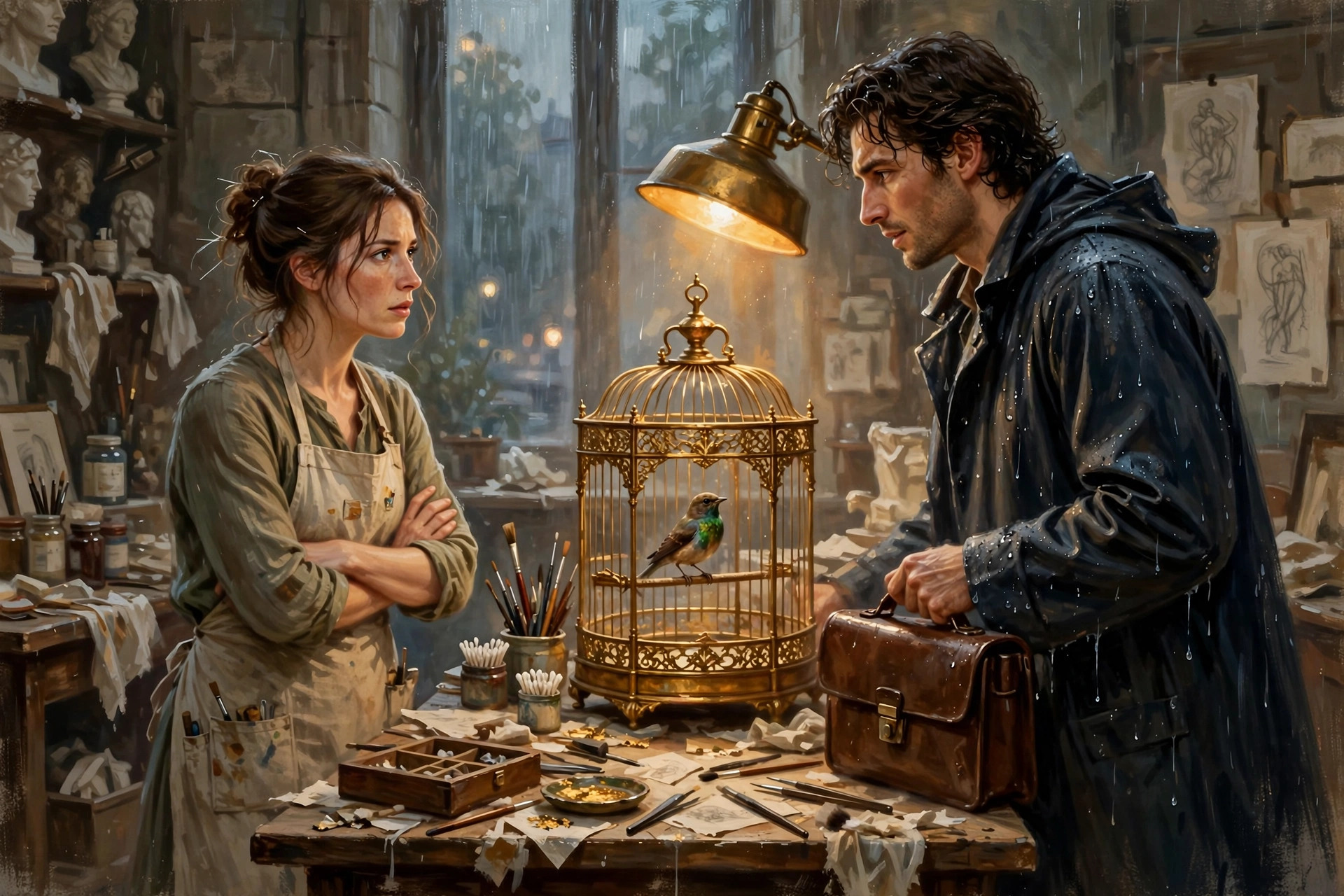
"You can't take the cage off," Agathe said. "Not with your bare hands, and not today."
Silas Marchbanks had his fingers on the gilded latch already. He paused but didn't step back. He was tall in a way that made the workshop feel lower, his coat still beaded with rain from the walk up from the Brennick Falls station, a leather case tucked under one arm like a sworn statement.
"I'm not taking anything off. I'm asking you to open it."
"That's the same thing with better manners."
Beatriz Lowell cleared her throat from the doorway, where she'd been hovering since she brought him in. She'd worn her good scarf, the green silk one. Agathe had only ever seen it at donor dinners.
"Agathe. Mr. Marchbanks is here for Granger Mutual."
"I know who he's here for."
"Then you know what he's here to decide."
Agathe did know. Everyone in the building knew. The songbird sat on her workbench under the angled lamp, about the size of a teapot, a brass-and-gilt cage with a bird inside no bigger than a lemon. Its feathers were real, faded to the soft brown of old tea, with a breast of iridescent green that still caught the light when she turned it. Swiss, around 1880. Hand-cut gears. A bellows-and-piston whistle that had once sounded like a nightingale on a summer evening.
It hadn't made a sound since the spring.
Silas let go of the latch and set his case on the stool beside the bench. "Ms. Roux. My report says whether this piece is original and whether it works. If it's both, I can value it at forty thousand dollars, and your museum gets its insurance and its traveling loan. If I can't see inside it, I can't say either."
"You can see it from here."
"I can see a cage."
"It's a very good cage."
Something moved at the corner of his mouth. It wasn't quite a smile. He looked like he'd forgotten how the rest of one went. "I'm sure it is. I still need the movement."
Agathe crossed her arms. Her apron pocket bumped against her ribs, the weight of her father's loupe inside it, brass and glass, turned by an optician in Lyon before she was born. She touched it through the canvas without meaning to.
Strangers didn't open her pieces. Strangers looked at a thing for an hour and wrote down a verdict that followed it for the rest of its life. She'd watched that happen once, from the back of a workshop that smelled of oil and solder, while a man in a good suit turned a clock over in his hands and said the word fake as if he were reading a price tag. Her father never got the shop back. He never got the word back either.
"The bellows is torn," she said. "That's why it's silent. If you go poking around the mechanism, you'll catch the leather and make it worse."
"Then you open it, and I'll watch."
"I'm in the middle of something."
"You're in the middle of standing between me and a bird."
Beatriz made a small noise that might have been a laugh she'd swallowed. Agathe shot her a look. Beatriz fixed hers on the ceiling.
"The crate ships at the end of the week after next," Beatriz said gently. "He's here until then. You can fight him every morning, or you can fight him once."
Agathe pressed her lips together. The lamp hummed. Rain ticked against the high workshop windows, and down the hall one of the gallery automata, the tin acrobat probably, clattered through its hourly flip for no one.
"Fine," she said. "But I lift it. You don't touch anything until I say."
"Agreed."
He said it too fast, like a man who'd negotiated harder rooms than this and didn't need to win the small points. That annoyed her more than arguing would have.
She pulled on her own cotton gloves, slid the base pins free, and eased the cage up from its plinth. The bird came with it, bolted to its perch. Underneath sat the movement: a nest of brass wheels, a tiny fusee chain coiled like a sleeping snake, and the bellows, folded leather between two thin boards, no bigger than a matchbook.
Silas leaned in. He didn't crowd her. He just went still, the way people did in front of paintings they actually loved. She hadn't expected that.
"Hand-cut," he murmured. "Look at the tooth spacing on that wheel."
"I've looked at it."
"I'm sure you have. I meant it as a compliment to the wheel."
She ignored that. With a pair of fine tweezers she loosened the two screws holding the bellows frame and lifted it out. It came free with a soft, dry sigh. The leather had split along one fold, a pale crescent where air had been leaking for who knew how long.
She held it on her palm under the lamp. Silas looked at it, then at her face, longer than he looked at the leather.
"That's original?"
"The boards are. The leather was replaced once, maybe a century ago. It's in the file."
"What else was replaced?"
"Nothing."
"You're certain."
"I've had my hands in this bird for most of a year." She set the bellows on a square of clean linen. "I'm certain."
He nodded slowly, but his eyes stayed on the movement, on the cam stack near the back, a set of shaped discs that told the whistle when to rise and fall. One of them caught the light oddly. Agathe saw him see it, and she slid the lamp a few degrees to the left.
"I'll need to examine all of it," he said. "Properly. Over the next few days."
"You'll break something."
"I've been doing this a long time, Ms. Roux."
"So has everyone who's ever broken something."
That got the almost-smile again, gone as fast as it came. He rubbed his jaw. "I signed my name to a piece once that I shouldn't have. A long time ago. I don't sign anything now unless I've seen every part of it with my own eyes. That's not about you."
It sounded like he hadn't planned to say it. He looked faintly irritated with himself afterward, the way she felt when a screw slipped.
Agathe studied him. Rain on his shoulders. A watch on his wrist with a scratched crystal he clearly hadn't bothered to replace. Hands that had stopped an inch from the brass without being told twice.
Beatriz was watching her. Agathe could feel it, the director's steady patience, thirty years in this town and fourteen running this building, and every one of those years riding on a bird that wouldn't sing.
Agathe sighed through her nose. She opened the drawer beneath the bench, found a fresh pair of cotton gloves, and held them out to him at arm's length, as if they might bite.
"Wash your hands first," she said. "And you touch what I point at. Nothing else."
Silas took the gloves. His fingers brushed hers through the cotton, and neither of them mentioned it.
"Thank you," he said.
"Don't," Agathe said. "I haven't decided to like you."
Borrowed Loupe
"That's the third time you've squinted at the same gear," Agathe said.
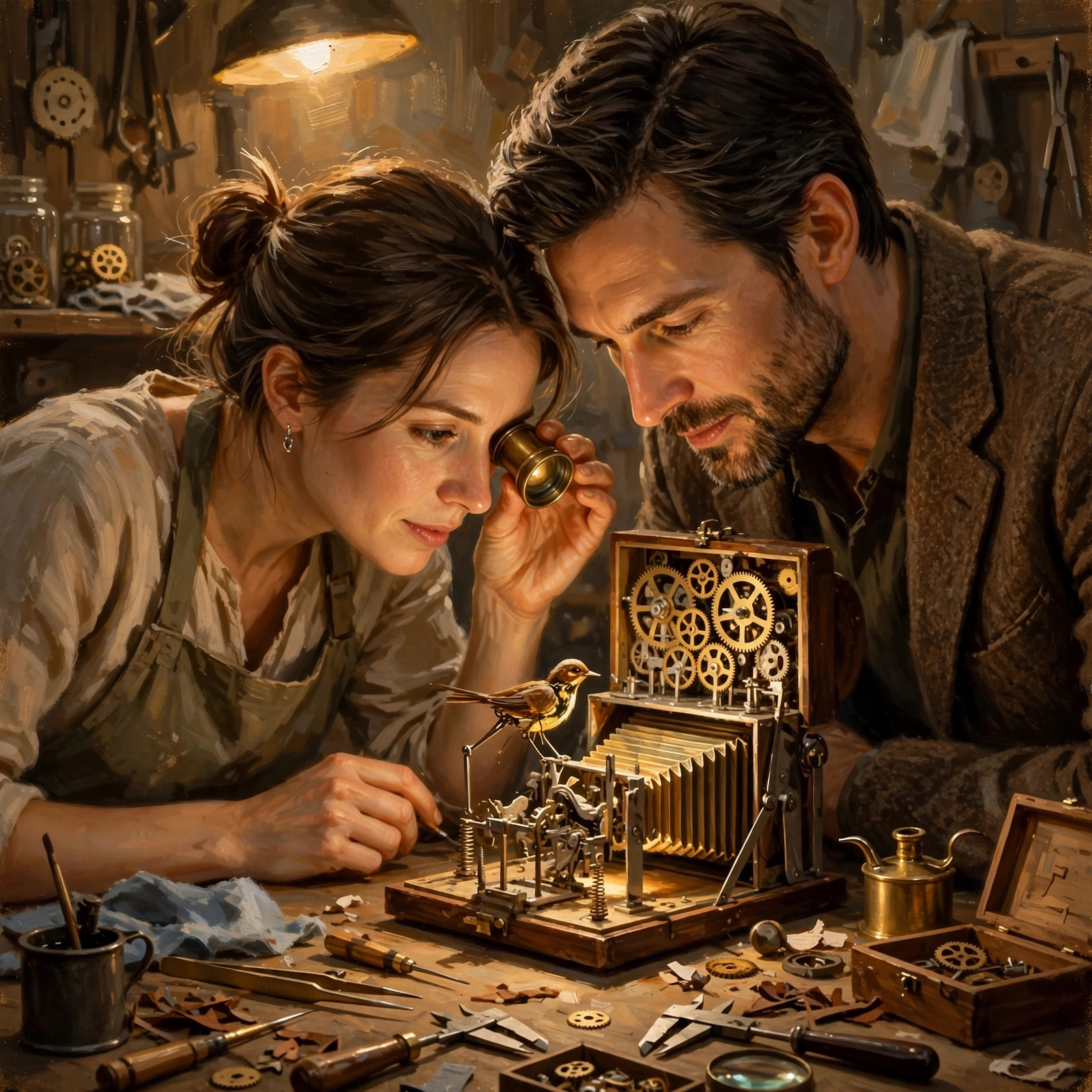
Silas didn't look up. He was bent over the open movement, gloved fingers resting on the bench edge where she'd told him to keep them. "It's the second. The first time I was squinting at the one beside it."
"Your eyes are bad."
"My eyes are thirty-eight years old and it's after nine." He straightened, pressed a thumb to the bridge of his nose. "Also your lamp is a crime."
The lamp was not a crime. The lamp had been angled with great care, and Agathe had spent two days not thinking about why she kept angling it. The museum had gone quiet around them hours ago. Beatriz had left with her coat over her arm and a look that said be civil. The galleries beyond the workshop door were dark, all those automata frozen mid-bow, mid-pour, mid-wink behind their velvet ropes.
The songbird sat on its stand under the light, cage lifted off and set aside, its little gilt body tipped forward as if listening. Without the bellows it looked hollow. It was hollow. That was the whole problem.
"What are you using?" she asked.
He held up a plastic magnifier, the folding kind they sold at pharmacies.
Agathe stared at it. "You value collections for a living."
"I value them with a very good one that is currently in a hotel room in Brennick Falls, because I forgot it this morning." He set the magnifier down with the faint dignity of a man who knew he'd lost. "I was distracted."
"By what?"
He didn't answer. He looked at the bird.
She put her hand in her apron pocket before she'd decided to. The loupe was where it always was, warm from her hip, its brass barrel worn smooth on one side where a thumb had turned it for decades before hers ever did. She took it out and held it a moment.
Then she set it on the bench between them. Not in his hand. On the bench.
Silas looked at it, then at her. He didn't reach.
"It's a ten-power," she said. "Lyon glass. Don't drop it."
"This isn't museum equipment."
"No."
He waited, the way he'd waited all through yesterday, letting silence do the asking. It was an annoying habit. It was also, she was discovering, a hard one to resist.
"It was my father's," she said. "He repaired clocks. Music boxes, a few automata when he could get them. He had a shop in a town you've never heard of."
"Had."
"Had." She picked up a brush, though there was nothing to clean. "A buyer said one of his restorations was full of new parts passed off as old. It wasn't true. It didn't matter. The buyer had money and a loud voice, and people stopped bringing him things. He sold the lathe first. Then everything else."
Silas was very still.
"He kept that." She nodded at the loupe. "Said it was the only tool nobody could argue with. It just shows you what's there."
"And you've carried it since."
"Every day for nine years. Since I came here." She brushed the bench. "So don't drop it."
He picked it up then, carefully, the way she'd seen him lift the bellows boards, both hands at first before he settled it into his right. He turned it under the light. The brass caught gold.
"That's why you didn't want me touching anything," he said.
"I didn't want you touching anything because you're a stranger with a clipboard."
"I don't have a clipboard."
"You have the soul of one."
That got a real laugh out of him, short and surprised, and he looked down quickly afterward as if he'd dropped something. Agathe found she was smiling at the movement and stopped.
He fitted the loupe to his eye and bent to the gears. She guided him with the tip of a wooden pointer: the great wheel, the fusee chain, the little governor that kept the song from racing. He followed exactly where she pointed. He didn't drift.
Near the back, the pointer passed over the cam stack. She didn't stop there. She moved it on to the piston housing, a little faster than she meant to.
"Slow down," he murmured.
"That's just the cams. They're fine."
He lingered a breath longer anyway, then followed her pointer to the piston. Her pulse was doing something stupid. She told herself it was the late hour.
"Your turn," she said.
"For what?"
"You said you signed something once. You don't get to say that and then go quiet for two days."
He lowered the loupe. For a while he just held it, turning it the way she did, and she wondered if he knew he'd picked up the habit in under an hour.
"I was young," he said finally. "Two, three years in. A dealer brought in a mantel clock, French, gorgeous. Supposedly original movement. My senior was out sick, and I wanted to prove I didn't need him." He shrugged, one shoulder. "It was a marriage. Old case, newer works, very good aging on the plates. I missed it."
"Everyone misses things."
"The client sold it at auction on the strength of my report. The buyer's expert caught it in about four minutes. It made the trade papers." His voice stayed even, which was somehow worse. "My name was in the second paragraph. I was the cautionary tale at a conference that year. Nobody said my name in the talk. They didn't need to."
Agathe set down the pointer.
"So now I look at everything," he said. "Every screw. I don't take anybody's word, including mine. People find it tiresome."
"I find it tiresome."
"I'd noticed."
"I didn't say I didn't understand it."
He looked at her then, properly, and the lamp was between them and suddenly far too bright. She could see the scratch on his watch crystal. She could see a fleck of brass dust caught on his cuff that she wanted, absurdly, to brush away.
She didn't. She took the bellows boards off the linen instead and showed him where she'd scored the new leather pattern in chalk.
They worked like that until past midnight, and again the next evening, when he came back without being asked and without his own loupe, and she noticed he hadn't fetched it from the hotel. Neither of them mentioned that either. She cut the new leather while he read the old file aloud, the century-old repair notes in faded copperplate. He was a good reader. He paused in the right places. When she glued the first fold he held the board steady without her pointing, and she let him.
The crate would ship at the end of the following week. Every time she thought of it, the bench seemed to tilt.
Near eleven on the second night, she stretched until her spine cracked and reached for the loupe on the bench.
His hand was already there. He held it out to her.
Agathe looked at it. Brass and glass and every day of her father's working life.
"Keep it," she heard herself say. "Till you're finished. Your pharmacy thing is an insult to the bird."
"Agathe."
It was the first time he'd used her name. She busied herself with the glue pot.
"Just until you're done," she said. "Then I want it back."
"You'll get it back." Quiet, certain. The way she'd said I'm certain about the bird.
She glanced, without meaning to, at the cam stack under the lamp. Then away.
Silas wrapped the loupe in a clean square of linen, folded the corners in one by one, and slid it into the inside pocket of his jacket, over his heart, as if it might break if he breathed wrong. He pocketed it carefully.
Off-Key
"Don't touch it," Agathe said.
"I wasn't going to touch it."
"Your hand was moving."
"My hand was resting." Silas lifted both palms off the bench and held them up, a man surrendering to a small brass bird. "See? Resting. Very still. Statue hands."
She ignored him and bent over the bellows. The new leather had cured overnight under weights, and this morning it had come up supple and even, the folds crisp where she'd scored them. She'd spent the afternoon seating the boards back into the base of the movement, screw by tiny screw, while the museum emptied and the cleaners came and went and the light in the high windows went from gold to grey to nothing.
Now it was only the lamp, the bench, the bird, and him.
The songbird lay on its side in its cradle of folded felt, cage set aside on a cloth. Even unhoused it was beautiful. Gilt feathers on the wings, real plumage at the breast, faded to the color of weak tea. A beak no longer than her smallest fingernail. She'd stopped counting how many times she had looked at it and forgotten to breathe properly.
"Pass me the driver. The smallest one."
He passed it without looking for it. He'd learned where everything lived on her bench in a few evenings, which annoyed her more than she could reasonably explain. She took the last screw from the tray and set it, and turned it down until she felt the leather give its faint, honest resistance.
"That's it?"
"That's the bellows." She sat back. Her neck ached. "The whistle's clean. The piston moves. In theory, if I wind it, it breathes."
"In theory."
"Everything's in theory until it isn't."
He leaned in, careful, his shoulder not quite touching hers. The jacket was off tonight, hung over the back of the second stool, and she could see the faint square shape of the linen-wrapped loupe through the lining of the inside pocket. He hadn't taken it out all evening. He'd used it twice, wrapped it again both times. She had pretended not to notice.
"Are you going to wind it," he asked, "or do we just admire the theory a while longer?"
"I'm deciding."
"Deciding what?"
"Whether I want you here when it doesn't work."
That came out more plainly than she meant. Silas didn't laugh at it. He looked at the bird, and then at her, and his voice went low.
"I'll look at the ceiling if you like."
"Don't be ridiculous."
"I'm offering."
"Sit there," Agathe said, "and be useful, and if it fails, you're not allowed to write anything down."
"Nothing goes in the notebook. Understood."
She fitted the key. It was the original, a little steel butterfly worn smooth by fingers she would never meet. Three turns. Four. She felt the mainspring take the tension and hold. Then she lifted the bird in its cradle upright and slid the stop lever.
The movement woke. She heard it before anything showed: the soft tick of the governor finding its pace, the whisper of the bellows drawing in. The bird's head turned left. Its tail lifted. The beak opened.
And the songbird, which had been silent for most of a century, let out a sound like a kettle being stepped on by a goose.
It wasn't a note. It was three notes having an argument. It climbed, cracked, slid sideways, and ended on a wheeze so offended that the bird seemed to snap its beak shut in embarrassment.
The governor ticked down. The tail lowered. Silence.
Agathe stared at it.
Beside her, Silas made a small, strangled noise. She turned. He had one hand pressed hard over his mouth and his eyes were wet.
"Don't," she said.
"I'm not."
"You are."
"I'm being very professional." His shoulders shook. "That was... that was a sound. It made a sound."
"It sounded like a broken accordion."
"It sounded like an accordion that owed somebody money." He lost it then, properly, head bowed toward the bench, and the laugh that came out of him was nothing she'd heard from him before. Loose and helpless and young.
She meant to be furious. She had spent most of a week on that leather. She opened her mouth to say so and what came out was a laugh of her own, cracked and wheezing as the bird's, and once it started she couldn't put it back. She laughed until her ribs hurt. She laughed so hard she had to grip the edge of the bench, and he grabbed her elbow to steady her, still laughing, and it took a long time for either of them to notice he hadn't let go.
"It breathes," she managed. "It breathes, Silas."
"It breathes terribly."
"It breathes. Do you know how long since anyone heard it do anything?"
"Longer than either of us has been alive." His thumb moved once against the inside of her arm. "You did that."
The laughter went out of her slowly, leaving something warmer behind. The lamp sat between them again, but lower now, and he was much closer than the bench should have allowed. She could see the brass dust on his cuff, the same fleck or a new one. This time she reached over and brushed it away.
He went very still.
"There was dust," she said.
"Was there."
"You'd have tracked it everywhere."
"Agathe." Her name again, careful, a question in it.
She answered it by leaning across the bench, over the felt cradle and the tray of screws and the bird lying quiet in its gilt, and kissing him.
It was clumsy for a second. The bench edge pressed into her hip; his knee knocked the stool. Then his hand came up to her jaw, so lightly she might have been something old and valuable, and he kissed her back with a patience that undid her far worse than the laughing had. He tasted faintly of the terrible museum coffee. She didn't care at all.
When they broke apart she found her hand fisted in his shirt. She let go and smoothed the creases, which made it worse.
"Well," Silas said, a little hoarse.
"Don't put that in the notebook either."
"I wasn't going to." He smiled, and it reached all the way up. "I'm not sure there's a column for it."
She turned back to the bird because she had to look at something that wasn't his mouth. Her face was hot. Her hands, for once, were not quite sure of themselves.
"It's flat in the middle," she said, mostly to the bird. "The whistle's fine. The pitch is set by the cam. If it slid like that, something's skipping."
"Show me?"
She tipped the movement toward the lamp and eased the side plate free. The cam stack sat in its column, a little tower of brass discs, each edge cut with the bird's song in tiny hills and valleys. A follower arm rode against them. She'd cleaned them the first day. She had looked at them, she'd thought, carefully.
She bent closer. Silas, without a word, unwrapped the loupe and placed it in her palm.
She lifted it to her eye. Her father's glass. The edges of the third disc swam up sharp and gold.
And there, running from the hub almost to the rim, fine as a hair, was a crack.
Agathe stopped breathing quite normally. She turned the stack a fraction. The crack turned with it. Not dirt. Not a scratch. The brass had split, maybe decades ago, and every note the bird would ever sing passed over that line.
"What is it?" Silas asked.
She lowered the loupe. She didn't answer. She sat looking at the little brass tower in the lamplight, and the warmth of a minute ago went somewhere far behind her, and the workshop was very quiet.
A Perfect Song
"You're doing it again," Silas said from the doorway. "Hiding the movement with your elbow."
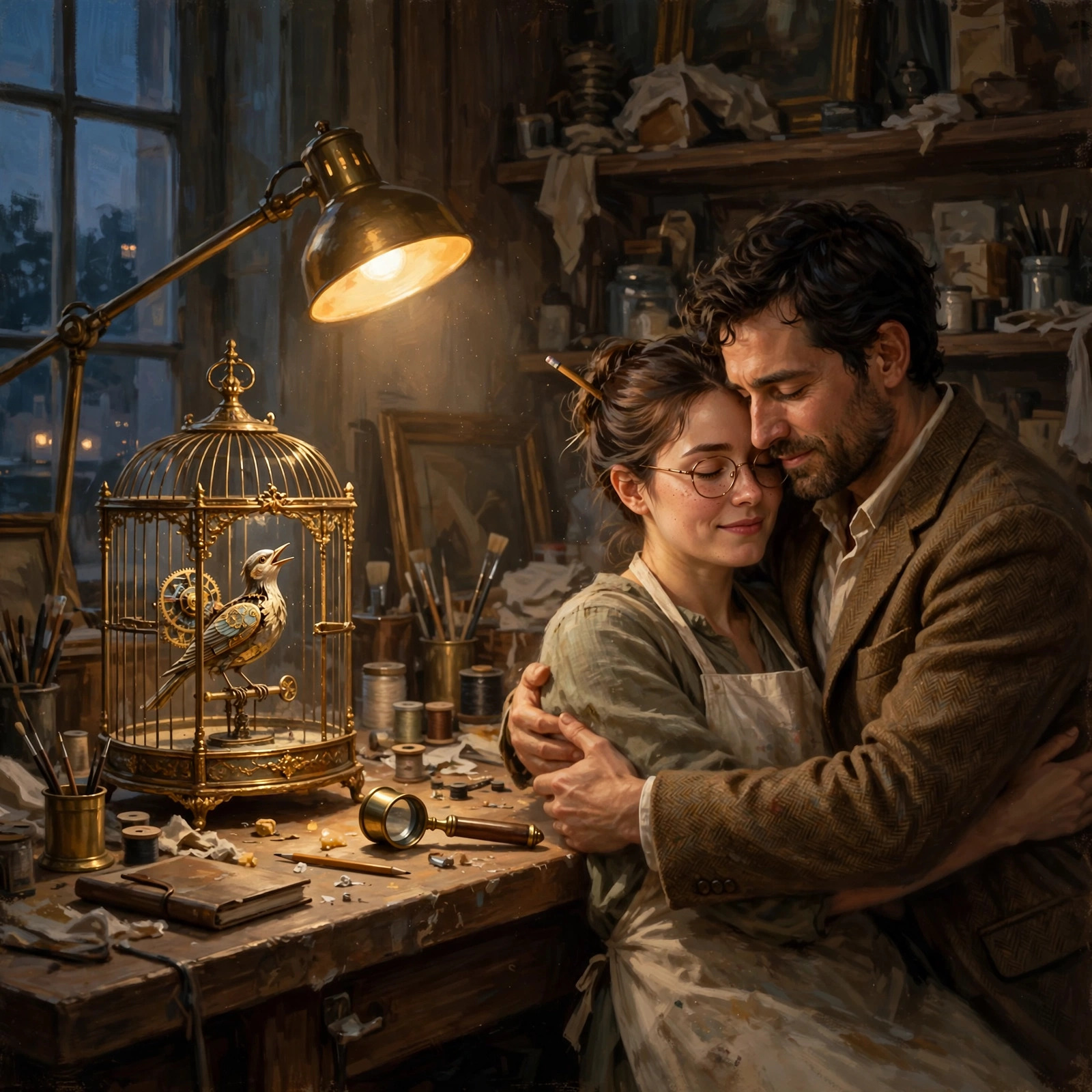
Agathe didn't move her elbow. "I'm resting my arm."
"On the one thing I came to look at." He set two paper cups on the end of the bench, the terrible coffee again, and pulled the stool over with his foot. "You said this morning you'd have news on the flat note."
"I said I might."
That had been the morning after the crack. She'd told him it was a scratch, a tooling mark, nothing to note. He'd looked at her a moment too long and then let it go, and she had spent the evening alone at the bench with her father's loupe and a sick, cold feeling she knew from childhood. The third disc wouldn't hold. One more season of winding and the split would open, and the bird's song would break off halfway through every time.
The crate shipped at the end of the week after next. A crack meant a damaged movement. A damaged movement meant no forty thousand dollars on his report, no insurance, no loan, and a museum with its lights off by spring.
So the following night she'd cut a new disc.
She had done it from measurements, tracing every hill and valley of the old edge under magnification, filing the profile in modern brass on the small lathe in the back. It had taken two nights and most of a third. She'd aged the face with a little ammonia fume until it was nearly the right dull gold. Then she had lifted out the cracked disc, wrapped it in tissue, and put it in the bottom drawer of her tool chest, under the old invoices nobody read.
Nearly the right gold. She told herself nearly was enough for anyone without a reason to look.
"Well?" Silas said.
She took her elbow away. The bird lay in its felt cradle, the side plate back on, the tiny feathered body tipped toward the lamp. She fitted the key and turned it, counting under her breath.
The bird lifted its head. Its beak opened. The tail flicked once, the wings shivered, and the song came out of it, bright and climbing and whole, every note in its place. It turned on its perch and sang the phrase again, then settled, and the workshop rang faintly in the quiet after.
Silas didn't say anything for a while. Then he laughed, a short, surprised sound, and pressed the heel of his hand to his mouth.
"That," he said, "is the most beautiful thing I've heard in years."
She felt it in her chest, how much she'd wanted to hear him say it, and how wrong it was to hear it now. "It just needed adjusting."
"The crack?"
"There isn't a crack. I told you. It was a scratch on the face. The follower was riding high." She picked up a screwdriver she didn't need. "It's original. All of it."
He nodded slowly. He believed her. She watched it happen, the small loosening across his shoulders, the way he reached for the coffee as if a weight had gone off the table. That was worse than doubt would have been.
"Then I'll want to do the full internal on Friday," he said. "Photographs, every component. Under your direction, the way we agreed."
"Of course."
He touched her wrist on his way out. Just two fingers, there and gone.
She didn't sleep much the next night.
On Friday afternoon he came in with his camera case and a clean cloth folded over one arm, and she had the bird ready on the felt with the plate already off, because if she opened it herself she could choose the angle of the lamp. She talked him through the train of gears, the fusee, the little piston that pushed air through the whistle. He photographed and wrote. He was careful, slow, a little pleased with himself when he spotted a maker's punch mark she'd missed in the first week.
"Hand me the loupe?"
She gave it to him. Her father's glass, brass gone soft-edged with handling. He'd kept it on a cord in his breast pocket all week.
He bent over the cam stack.
She kept her eyes on her own hands. Somewhere in the building a door closed. The radiator ticked.
"Agathe," he said.
Just her name. Not loud. She knew that voice; she'd heard it the night he told her about the mantel clock, about the auction room and the dealer who'd laughed at him in front of everyone.
"The third disc's been cut on a lathe with a carbide tool. You can see the chatter on the edge. Nobody in 1880 had a lathe that did that." He didn't lift his head. "And the brass is the wrong color under the fuming. It's paler at the hub."
"Silas--"
"Is it yours?"
She could have said a hundred things. A previous restorer. A repair from the fifties. He'd have had to choose whether to believe her, and he would have. That was the terrible part. She could see in his face how badly he wanted a reason to.
"Yes," she said.
He set the loupe down very gently, the way he'd once held her jaw.
"And on Tuesday, when I asked you about the crack."
"I needed it to sing."
"You needed me to sign." He stood. He wasn't angry, or if he was, he'd put it somewhere she couldn't reach. "You know what I'd have written if you'd shown me? A cracked original. Disclosed. I'd have found you a way."
"You don't know that."
"No," he said. "I suppose now neither of us will."
She stood too, and her stool scraped. "You'd have taken one look and called it damaged. Everyone does. My father had a buyer who--" She stopped, because her throat had closed on it, and because it wasn't an answer. It was an old excuse.
Silas looked at her for a long moment. Then he packed the camera into its case, one strap and then the other, and folded his cloth over his arm.
"I trusted you with the one thing I don't hand anybody," he said quietly. "I let you tell me what was real."
He went to the door. He didn't slam it. Somehow that made it unbearable.
Agathe stood alone in the lamplight with the bird open on the felt, its new brass shining slightly too bright. When she finally made herself look down, it was there beside the cam stack, on her bench, where he'd put it: her father's loupe, returned.
Director's Office
Beatriz didn't look up from the cracked disc when Agathe set it on the blotter. She turned the tissue back with one fingernail and studied it, then the bright modern cam lying beside it, then Agathe.
"You made this one."
"On the lathe downstairs. Tuesday night." Agathe kept her hands flat on the edge of the desk because they wouldn't stay still otherwise. "I told Mr. Marchbanks the bird was all original. It wasn't. He found it Friday."
"And left."
"And left."
Beatriz leaned back. Her chair complained. Behind her, the window showed the wet roofs of Brennick Falls and the river beyond them, flat and gray. She'd hired Agathe on a handshake once, in this same office, and Agathe had spent most of the years since trying to deserve it.
"I've called him," Agathe said. "He's coming at ten. I wanted you to hear it from me first, not from Granger."
"That's generous of you." Beatriz's mouth thinned. "The crate ships at the end of next week. If they don't approve, there's no loan, and if there's no loan, I'm closing the east gallery by summer. You understand that."
"Yes."
"And you understand I may have to let you go."
Agathe had known it all night. Hearing it aloud was different, a cold drop low in her stomach. "Yes."
A knock. Silas stood in the doorway in yesterday's coat, his case in his hand, his face shut like a ledger. He saw the two discs on the blotter and something moved behind his eyes, quick, then gone.
"Ms. Lowell." A nod to Beatriz. To Agathe, nothing.
"Sit down, Mr. Marchbanks. Agathe has something to say."
He didn't sit. Agathe didn't either. She made herself turn toward him.
"The original third disc has a hairline crack from the hub to the second lobe. I found it the day after the new bellows went in. I didn't tell you because I was afraid you'd write it up as damage and the valuation would drop below forty thousand. So I cut a replacement, fitted it, and lied to you." She swallowed. "I've taken mine out. It's there. I'm going to put the original back and try to stabilize the crack. It might not hold. If it doesn't, the bird won't sing at all."
The radiator under the window hissed. Silas looked at the cracked disc a long time.
"You took yours out before you called me," he said.
"Last night."
"Knowing I'd already seen it. Knowing the report's mine to write either way."
"It wasn't about the report." Her voice snagged. She let it. "It was the wrong part in the right bird. I couldn't leave it in there."
He finally sat, slowly, setting the case across his knees. He opened it, took out a folder, and laid it on the desk in front of Beatriz without looking at Agathe.
"I drafted this Saturday," he said. "It says the songbird contains a modern replacement cam of undisclosed origin. It recommends Granger decline coverage." He took a pen from his breast pocket and uncapped it. "I'm going to rewrite it. Original movement, one cracked cam, repair disclosed by the conservator before filing, original part retained and reinstated. Value contingent on function."
Beatriz's eyebrows rose. "Contingent."
"If it sings on the original disc, it's worth what I said. If it doesn't, it's worth a good deal less, and you'll have to argue that with them." He wrote while he talked, small, fast lines. "But it'll be true."
"They'll call that soft," Agathe said. "They'll ask why you didn't flag her."
"They'll ask." He capped the pen. "I'll tell them."
He made the call from Beatriz's desk phone at half past eleven, with the speaker on because Beatriz insisted. Agathe stood by the bookcase and listened to a tired voice in a distant office ask him to repeat himself twice.
"You're telling me the restorer swapped a part."
"I'm telling you she disclosed a part she'd swapped, removed it on her own, and is reinstating the original. I've seen forged movements. I've signed off on one, which you know, because it's in my file." Silas's knuckles were pale on the receiver cord. "This isn't that. This is the most honest bench I've walked into in years. Put my name on it."
A pause long enough that Agathe heard the clock in the hall tick four times.
"Your name's always on it, Marchbanks."
"Then you know what it costs me if I'm wrong."
Another pause. Paper rustling. "Send the revised report. If the functional test passes before the crate ships, we approve the policy and the loan goes through. If it fails, we revisit."
The line clicked. Beatriz let out a sound that wasn't quite a laugh and pressed her palms to her eyes.
The next afternoon the approval came by email, two lines long, conditions attached. Beatriz printed it, as she printed everything, and carried it down to the workshop herself.
"You still have a job," she told Agathe, laying the page on the bench. "Barely. Don't ever do that to me again."
"I won't."
"I know." Beatriz glanced at Silas, who was standing across the bench with his coat still on, as if he hadn't decided whether to stay. Then she went out, leaving the door ajar.
Agathe had spent the morning on the crack. A fine bead of conservation adhesive, a hairline brass splint pinned behind the second lobe where it wouldn't touch the follower. Now she lifted the disc on her tweezers and slid it onto the arbor. It seated with a faint, tired click.
Silas hadn't spoken since Beatriz left. He watched her fit the side plate, turn each screw a quarter at a time.
"Will it hold?" he asked.
"I don't know." It was the first time she'd said those words over this bench without flinching. "It might sing. It might break the first time I wind it."
"When will you try?"
"Not tonight." She set the screwdriver down. Her father's loupe lay where he'd left it days ago, beside the empty space where the cam stack had been. She picked it up and held it out across the felt.
He looked at it, then at her. He didn't take it. He didn't leave, either.
The bird sat closed and silent in its cage between them, the old cracked brass back in its heart, and neither of them knew yet if it would ever sing again.
Under the Dome
"You're winding it with your eyes closed," Silas said from the doorway.
Agathe opened them. "I'm listening."
"To a key?"
"To the spring. It tells you when it's had enough." She stopped a half turn early and set the key on the felt. The workshop was dark except for the lamp over the bench. The museum had gone quiet an hour ago, the last of the guards' footsteps fading somewhere past the hall of dancing figures. "I didn't think you'd come."
"You texted me one word."
"It was the right word."
"'Tonight' isn't a word, it's a summons." He came in and shut the door behind him. He'd left his coat somewhere this time. His sleeves were rolled to the elbow, the way they'd been the first afternoon he'd leaned over her shoulder and asked what a fusee was, then corrected her pronunciation of the Swiss maker's mark. She'd hated him for most of an hour.
He stopped across the bench from her, exactly where he'd stood yesterday. The cage sat between them, gilt wires catching the lamplight, the little bird perched inside with its feathers smoothed and its beak closed.
"Granger wants the functional test filmed," he said. "Before the crate ships."
"I know. This isn't the test."
"Then what is it?"
She rested her fingertips on the base. Under them she could feel the spring, coiled and waiting. "It's me finding out alone. If it breaks, I'd rather it break in front of somebody who already knows the worst thing I've done."
Something moved in his face. He pulled out the stool on his side and sat, slowly, as if the bench might object.
"So I'm the audience."
"You're the witness. You like that better."
That got the corner of his mouth. "Marginally."
She reached for the glass dome on the shelf behind her, the one that had kept dust off the cage for most of a century, and lowered it over the whole piece. It settled on the base with a soft ring. Silas raised an eyebrow.
"It changes the sound," she said. "It was built to sing under glass. Somebody's parlor, a mantel, a family pretending not to be impressed."
"You've heard it like this before?"
"Never. Not even when I cheated." She made herself say it plainly, and the words didn't scrape on the way out the way they would have a week ago. "My cam ran too clean. It sang like a recording. I told myself nobody would ever know the difference."
"I knew the difference." He said it quietly, without heat. "That's what made me go looking."
"I know."
She slid her hand under the edge of the dome to the start lever, a sliver of brass no longer than a fingernail. Her father used to say the hardest part of any repair was the moment you took your hands away. You could fuss with a thing forever. At some point you had to let it run and see who you were.
She pressed the lever.
For a second, nothing. The faint whir of the governor, the tick of the train. Then the bird turned its head.
It turned left, then right, the way a living thing does when it hears something in the garden. Its tail dipped. Its beak opened.
The first note came out thin and uncertain, and Agathe's whole body went tight, waiting for the splint to slip, for the follower to jump the crack and the song to collapse into a rattle.
It didn't.
The second note climbed. The third trilled and held, a little wavering, a little warm, a sound with grain in it, like wood under varnish. The dome caught it and rounded it, so the song seemed to come from everywhere at once. The bird bobbed and fluttered and sang the phrase someone had cut into brass by hand in a Swiss workshop around 1880, and at the place where the cracked lobe passed the follower there was the smallest hitch, a breath before the high note, as if the bird were gathering itself.
Agathe pressed her knuckles to her mouth.
It was imperfect. It was exactly right.
Across the bench Silas wasn't looking at the bird. He was looking at her.
"There," he said. "That catch, before the top."
"That's the crack."
"I know what it is." He leaned in, close to the glass. "Don't you dare fix it."
She laughed, and it came out wet. "Granger will hear it."
"Granger will hear a bird that's been through something. So will everybody who stands in front of it in every city on the tour." He laid his hand over hers where it held the loupe, the brass worn pale where his thumb had rubbed it for thirty years. "It stays where it belongs. Yesterday I couldn't say that."
"Why not?"
"Because taking it meant I'd decided. And I've spent most of my life making sure I never had to decide about a person." His jaw worked. "I decided anyway. Somewhere between you pulling that cam and you telling Beatriz before I could. I just hadn't caught up."
She picked up the loupe. It was warm from his pocket. She turned it over once, then stood and came around the end of the bench, because she couldn't say the next thing across a table like a negotiation.
He rose to meet her. Up close he smelled of cold air and the cheap coffee from the hotel in Brennick Falls he kept complaining about.
"You put your name on me," she said. "To people who already doubted you once."
"I did."
"What if I'd let you down again?"
"Then I'd have been wrong about you, and I'd have lived." He paused. "But I wasn't. I'm not. That's what I came here to tell you, if you'd stop interrogating me."
"I'm a conservator. It's how I listen."
"Agathe." He took her hand, the one with the loupe in it, and folded his fingers over both. "I love you. I don't need you to be flawless. I need you to be the person who'd tell me. You are."
Behind her the bird was still singing, slower now, the spring easing.
"I love you," she said. It was so simple she almost didn't trust it, and then she did. "I've been scared of being judged my whole life, and you're the one person whose judgment I'd actually want."
"That's a terrible thing to want."
"I know. Hold me anyway."
He did. His arms came around her and she pressed her face into his shoulder, the loupe caught between them against his chest, and she felt him exhale like a man setting down something heavy he'd carried a long way. She kissed the edge of his jaw. He kissed her hair, then her mouth, briefly, and then just held on.
Under the dome the song wound down. The trill stretched, the notes spaced out, the little hitch before the high one came and went once more, and the bird turned its head a final time, left, then right, listening, as the last note faded into the glass and the two of them stood there, holding each other, not letting go.
Get notified when new stories drop
Noah Carrington
Noah covers sports romance and forced-proximity heat: rivalries, road trips, and the quiet moment after the crowd goes home.
Leave a comment
Comments