


Toll Chain
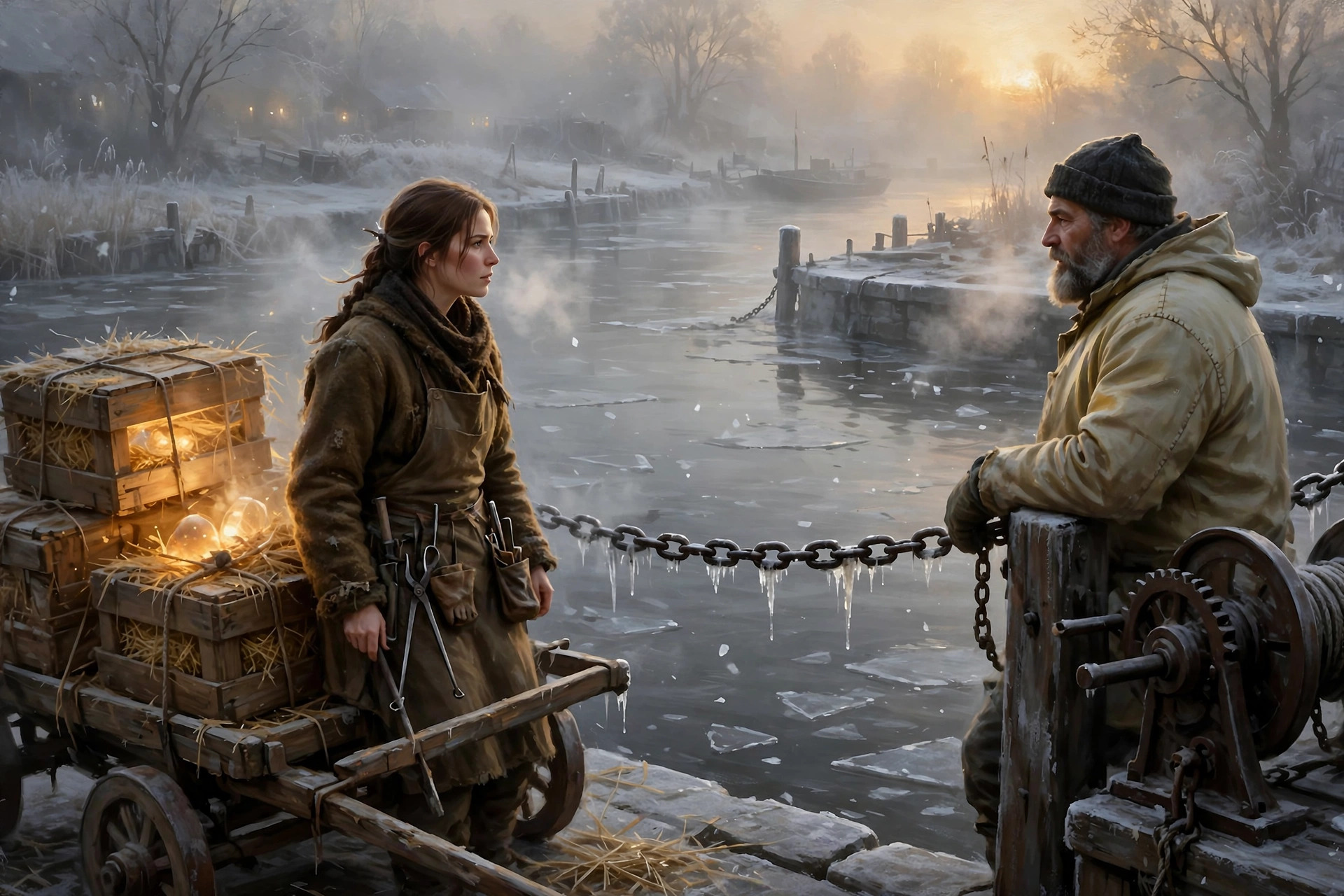
"The chain stays up," Siward Mallow said, and he didn't even look at her coin.
Aurelie Danforth set the purse on the toll post anyway. It made a small, sad clink. "You haven't heard what I'm carrying."
"Don't need to." He leaned on the winch handle, a big man in an oilskin gone pale at the seams, his breath smoking in the grey air over the Brindle Cut canal. "Guild seal on your cart's been scraped off. That means exile. Exiles don't cross my water."
"It's not your water. It belongs to the Lockmasters."
"And they pay me to keep it." He finally glanced at the purse, then at her. His eyes were the colour of the canal, brown going to green. "Take that back before somebody sees it and thinks I'm for sale."
Behind her, the handcart creaked as the wind found it. Twelve crates, packed in straw and sacking, each holding a lantern she'd shaped and bound herself. She'd pushed them three miles of frozen rut to the ferry landing. Her shoulders still had opinions about it.
"I'm expected in Furrow," she said.
"By who?"
"The glassworks."
That got a sound out of him, half a laugh. "The glassworks that threw you out."
"The glassworks that'll take me back if I bring them ice-lanterns before the Cut freezes." She heard how her voice climbed and pulled it down. "Seven nights. That's what the lock keepers are saying. Seven nights and then nothing moves till spring, and I've got three years of nothing behind me already."
He didn't answer. The heavy iron chain across the landing swung a little, dripping. Out on the water, thin plates of ice turned slowly, like coins nobody wanted.
"There's the long road," he said at last.
"Round the marsh. Four days with a cart, if the bridges hold." She folded her arms. "And they won't."
"Then you've got a problem." He said it quietly, without any meanness, the way a man tells you it's going to rain. "It isn't mine."
She looked at him properly then. He was standing between her and the chain as if it mattered where his body was. Red knuckles. No gloves. He kept flexing his fingers and shoving them under his arms when he thought she wasn't watching.
"Where are your gloves?"
He blinked. "What?"
"Your gloves. It's bitter, and you're working iron."
"Lost one in the Cut last week." A shrug. "No point wearing half a pair."
"There's every point in wearing half a pair."
"Are you going to argue with me about gloves now?"
"I might." She was already at the cart, working the cord loose on the nearest crate. Her own fingers were stiff, but she'd had worse. Glass burns had made her hands into something tough and ugly that didn't mind cold much.
"I told you," he said behind her. "No crossing."
"I heard." She lifted the lantern from its straw.
It was a modest thing, no taller than her forearm, the glass faintly blue, like the inside of a mussel shell. She'd blown it in a borrowed hut on the marsh edge and set the binding while it was still soft, pressing heat into it the way you'd press a thumb into bread. There was no flame inside. There never was. Just warmth, held in the glass because her hands had made the glass.
She breathed on it once, out of habit, and it woke. A low gold glow climbed the walls of it. The air around her face softened.
Siward took a step back. "What is that?"
"Payment."
"I'm not taking payment."
"Not for passage. For the gloves you haven't got." She held it out. "Go on. It doesn't bite."
He looked at it the way people look at a dog of uncertain temper. Then, slowly, as if his hands had decided before he had, he reached out and closed them around the glass.
She watched it reach him. His shoulders came down first, a fraction. Then his jaw. His breath went out of him long and slow, and the frost on his eyelashes began, very slightly, to bead into water.
"Hell," he said softly.
"It'll hold heat till midwinter if you keep it out of the wind. Longer if you talk to it."
"Talk to it."
"Everybody talks to their lanterns. They just don't admit it."
He turned the thing in his palms. In the glow his face looked younger and more tired at once. "This is what Furrow wants?"
"Twelve of them. For the ice-cutters on the river. A man with warm hands doesn't drop his saw through the ice." She tucked the straw back over the empty crate. "Now it's eleven. I'll make another tonight."
"You just gave away part of your way home."
"I'll make another," she said again, firmer, because that was what she did. You made another. You didn't ask anyone to carry the gap.
He was quiet long enough that she thought he'd simply gone back to staring at the water. Then: "Why'd they banish you?"
"A fire."
"You set it?"
She tied the cord. Pulled it tight. "I said I did."
He heard the difference. She saw him hear it, a small pause in the way he held the glass. He didn't push, and she was more grateful for that than she wanted to be.
"The chain stays up," he said.
"I know."
"It's not about the guild seal." The words came slow, as if he were dragging them up through ice. "Water this time of year. It looks like it'll take a boat. It won't always."
Something in the way he said it made her stop with her hands on the cart handles. He was looking past her at the far bank, where the reeds stood stiff and white, and for a moment he wasn't talking to her at all.
"Then I'll wait," she said. "And I'll ask you again tomorrow."
"Answer'll be the same."
"Then I'll ask the day after." She set her feet and pushed. The cart groaned out of its rut. "I'm very boring that way."
That almost-laugh again, rough, caught in his chest. "Where are you sleeping?"
"There's a furnace hut by the old sluice. Nobody's using it."
"Roof leaks."
"Then I'll be a warm, wet exile instead of a cold one."
She was a dozen steps down the towpath when he called out.
"Danforth."
She turned. He was still standing by the toll post, her purse untouched beside him, the chain swaying across the landing behind him like a closed door.
"You'll want this back," he said, and lifted the lantern an inch.
"No," she said. "I won't."
He looked down at it. The gold light moved over his scarred knuckles, his frayed cuffs, the bare skin of his wrists. He opened his mouth like he'd argue. Then he closed it, and drew the lantern in against his chest, under the flap of the oilskin, where the wind couldn't reach.
He kept it.
Cobalt Cullet
"You're letting the heat out," Aurelie said, without looking up from the flame.
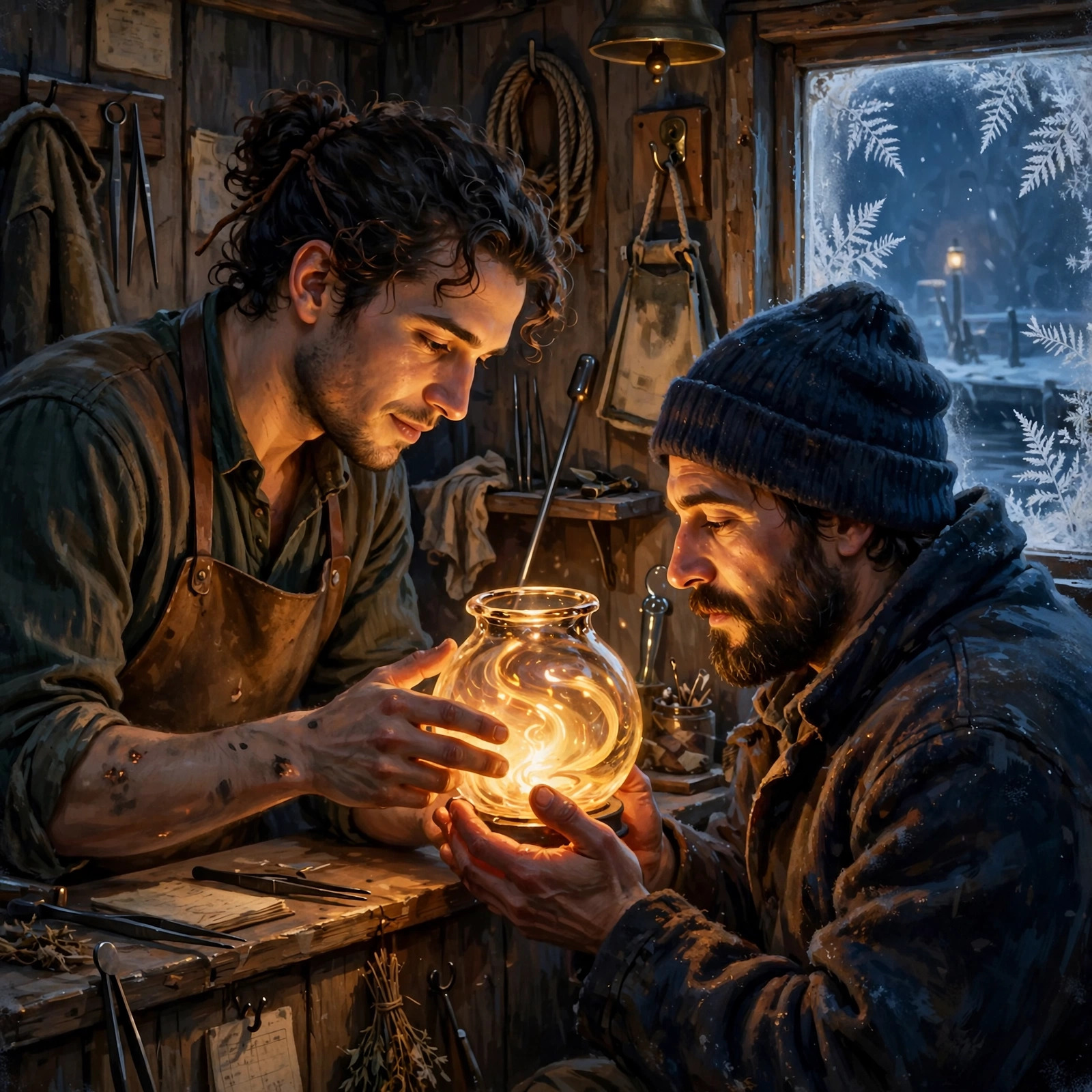
Siward stood in the doorway of the furnace hut with snow on his shoulders and the door held half open behind him, as if he hadn't decided yet whether he was coming in. "Roof's letting more out than I am."
"Then come in and shut it, and we'll only have the roof to blame."
He came in. He shut it. He had to duck under the lintel, and he stayed ducked a moment longer than he needed to, eyes going over everything. The bucket under the worst drip. The straw pallet pushed close to the brick. The crate of lanterns, eleven gold glows nested in straw, and the twelfth half-made on the marver, waiting for her to finish its neck.
"You said you'd ask again," he said. "Yesterday. You didn't come."
"I was busy." She turned the rod slowly in the flame, keeping the gather round. "And you'd have said no."
"I would have."
"So I saved us both the walk." She glanced at him then. His bare hand was red to the wrist, the knuckles split in two new places. "You still haven't found your glove."
"It's in the canal. It's not coming back."
"There's a bench by the bellows. It's warm."
He didn't sit at first. He looked at the bench like it might charge him a toll. Then he sat, slowly, and held his hands out toward the furnace mouth, and she watched his shoulders come down an inch from where they'd been living near his ears.
She finished the lantern's neck, cracked it off into the annealing box, and reached for the small tin on the shelf.
"Why did you come, Mallow?"
He was quiet a while. The drip hit the bucket. Hit it again.
"The ice set early by the second lock last night," he said. "Thin. I went out on the plank to check it and couldn't tell by looking. Couldn't tell by the sound. I used to be able to." He rubbed his thumb along a split knuckle. "My hands are too cold to feel the water through the pole anymore. I can't read it."
"So you can't tell if it's safe."
"I can't tell if it isn't." He said it flatly, but something underneath it wasn't flat at all. "Same thing, to me."
She pried the lid off the tin. Inside, a handful of broken blue glass caught the furnace light, the scrap she'd swept up at the glassworks the night they sent her out. She hadn't meant to keep it. She'd found it in her apron pocket on the road and couldn't make herself throw it in a ditch.
"What's that?"
"Cobalt cullet. Offcuts." She tipped a few pieces into a small crucible and set it in the heat. "Hold out your hand."
"Why?"
"Because I asked nicely."
He held out his bare hand. She put her own palm against it, flat, just for a moment. His skin was cold enough to sting. Hers, she knew, ran warm; it always had, from years of breathing fire into glass. She felt him register it, a small flinch and then a stillness, as if he'd decided not to pull away and was holding himself to it.
"Heat-binding," she said, and took her hand back. "It only holds in glass I've shaped myself. I can put a little of mine into it. If I make it right, split it while it's still molten, the two halves remember each other. You'd carry one. I'd carry the other."
"And then what?"
"And then you go out on your plank. You put your hand on the ice. And my half goes cold or it stays warm, and I'll know what you know, and you'll feel me knowing it." She shrugged, which was harder than it looked with a crucible in the tongs. "Two people reading the same water. Better than one with frozen hands."
He stared at her. "You'd feel it every time I touched the ice."
"Every time you touched anything cold enough. Yes."
"That'd wake you up at night."
"I don't sleep much in a hut with a waterfall in the corner."
He almost smiled. She saw it start in one corner of his mouth and get put away. "What does it cost you?"
She lifted the crucible out. The cullet had gone soft and bright, a deep molten blue, like the sky just after the lamps get lit. "Nothing, if it stays whole."
"And if it doesn't?"
"Then don't break it." She gathered the glass onto a thin mandrel and began to turn it in the flame, shaping it with small breaths and the flat of a paddle. "That's all you need to know."
He didn't like that. She could tell by the way he leaned forward, elbows on his knees, and watched her hands instead of her face. But he didn't ask again, and she let the quiet sit between them while the bead came round under her fingers.
It was a small thing, the size of a hazelnut. She pressed her breath into it the way her master had taught her, years ago, in a workshop she couldn't walk into anymore. Not air, exactly. Warmth. The part of herself that went into lantern glass and stayed there.
"Now," she said. "Hand me the blade. The thin one, by your knee."
He passed it over without fumbling, though his fingers were still stiff. She took the bead off the flame, laid the edge to it while it glowed, and cut it clean through.
Both halves flared. For a heartbeat the whole hut seemed lit blue, and she felt the binding take, a tug under her ribs, like someone had tied a thread to her and pulled once to test it.
Siward had gone very still.
"Did you feel that?" she asked.
"Something." His voice came out lower than before. "Like a coal under my shirt."
"That's me." She set both halves on the marver to cool and wiped her face with her sleeve. She was sweating, and shaking a little, and she hoped he'd think it was only the furnace. "Give it a few minutes. Then don't lose it in the canal."
She threaded a bit of leather through each half while they were still warm enough to work a hole into. Her hands were not quite steady doing it, and when she dropped the awl, he picked it up before she could, and held it out to her, handle first.
"You do this often?" he asked. "Tie yourself to strangers?"
"Never." She took the awl. "You're the first person who's ever told me he couldn't feel something."
He looked at her for a long moment, long enough that she forgot to be embarrassed about having said it. The firelight moved in his eyes. He looked, she thought, like a man standing at the edge of a plank over water he couldn't read.
She picked up her half and slipped the cord over her head. The cobalt settled warm against her breastbone.
Then she held out the other one.
He didn't take it right away. He looked at it on her palm, the little blue curve of it, the leather loop hanging down. When he finally reached for it, his fingertips brushed the inside of her wrist, and she felt the warmth go out of her, through the glass, and into him, and come back a beat later, a little cooler, a little rougher, unmistakably his.
"Danforth," he said.
"Mm."
"If it gets cold. Your half. You'll tell me."
"You'll already know."
He nodded slowly. Then he bent his head, lifted the cord with both bare, cracked hands, and tied his half on.
Furnace Hut
"You're holding it like it owes you money," Aurelie said.
Siward looked down at the blowpipe in his hands. He had it gripped near the far end, both fists tight, as if the gather of glass might lunge at him. "It's heavier than it looks."
"Everything in here is. Turn it. Slowly. Keep turning, or it sags."
He turned it. The orange bulb at the end swung once, wobbled, then settled into a lazy round as his wrists found the rhythm. She'd half expected him to refuse when he'd turned up at her door that afternoon with a sack of dry alder and an expression that dared her to ask why. She hadn't asked. She'd handed him the pipe.
The furnace hut smelled of wet thatch and hot iron. Rain had found the old crack over the sluice side again, and a tin cup under it caught the drip with a small, annoyed sound every few seconds. Eleven lanterns stood along the back shelf, cloudy white, each one holding a sliver of trapped summer that would keep a room above freezing through a hard night. The twelfth was on the ferry landing, in his toll house. She thought about that more than she should.
"Now bring it here." She tapped the marver. "Roll it. Don't press. Let it do the work."
He rolled. The glass whispered against the iron slab. His bare knuckles were still split across the backs, but they moved easier than they had two days ago, and when he leaned in, she caught the faint blue glint of his half of the bead swinging out from his collar.
Her own half warmed against her skin. Not from the furnace. From him, from whatever he was feeling, concentration and a little pride, coming through the glass like a hand laid flat on her sternum.
"You're smiling," he said, without looking up.
"I'm not."
"I can feel it." He did look up then, and the corner of his mouth went crooked. "It's a sort of fizz. Like cider."
"That's indigestion."
"It's you." He went back to rolling. "Same as the coal under my shirt. Only lighter."
She took the pipe from him before he could see her face properly and swung it back into the glory hole. The heat slapped her cheeks. Fine. Let him think it was the fire.
They worked like that for the better part of an hour. She shaped, he turned and fetched and handed her the jacks, the tweezers, the wet paddle, learning their names on the second asking. He was quiet the way the canal was quiet, all the movement happening underneath. When the lantern body was ready, she set the pipe on the yoke and laid her palm an inch above the hot glass and pulled the binding in.
It went the way it always did. A long drag under the ribs, warmth spooling out of her and settling into the curve of the glass, then the click of it catching. The lantern's shoulder flushed gold and faded.
Siward exhaled. "Every time?"
"Every time."
"Does it hurt?"
"It tires." She cracked the lantern off the pipe into the annealing box and shut the lid. "Twelve's a lot for one woman in a leaking hut."
"Then why aren't there more of you?" He wiped his hands on his trousers. "Furrow had a whole glassworks. I've seen the barges. Crates of the stuff."
She busied herself with the furnace door. The latch stuck. It always stuck. She worked it anyway, longer than she needed to.
"Danforth."
"There were more of us."
"And?"
The latch gave. She sat down on the upturned crate by the wood stack, because her knees had decided for her, and looked at the cup under the drip instead of at him.
"There was a fire," she said. "At the works. Middle of the night, in the east shed. A whole store of potash went up, and half the roof with it. Nobody died. Two men got burned pulling the crates out."
He didn't say anything. He crouched instead, an arm's length away, forearms on his knees.
"My apprentice left a binding open. She'd been practicing after hours, which I'd told her not to do, and she'd fallen asleep with a lantern half-charged on the bench." Aurelie rubbed her thumb along a burn scar on her wrist, an old one, nothing to do with that night. "She was a good girl. Is. She was terrified. And she'd have been turned out of the works with nothing, no letters, no trade."
"So you said it was yours."
"I said it was mine."
"And they believed you."
"I'm very believable." She tried a smile. It didn't hold. "The guildmistress signed the order the same week. Three years out of the works. If I come back before then, I come back with something they need badly enough to forget."
"The lanterns."
"Furrow freezes worse than here. The old ones are failing. If I put twelve good lanterns on her table before the canal shuts, she'll have to take me back." She shrugged. "Or she'll throw them in the river. Either way I'll know."
The drip hit the cup. Hit it again.
"You never told anyone," he said. "Did you."
"You're the first."
"Why?"
"Because then it's still mine." She heard how it sounded and winced. "If I hand it to someone, it's theirs to carry too. I'd rather just... keep it."
Siward was quiet a long while. Through the bead she felt something move in him, heavy and slow, like a barge shifting its weight against a mooring. Not anger. Something older. It sank and stayed sunk, and she didn't know him well enough yet to ask where it went.
"I know about keeping things," he said finally.
That was all. He didn't explain, and she didn't make him. She knew what it was to stand at the edge of a story you couldn't tell.
He stood and held out his hand. She took it and let him pull her up. His palm was rough and finally warm, really warm, the warmth she'd tied into the glass coming back to her through skin as well as cobalt.
"You've got ash on your face," he said.
"So do you."
"Mine's honest ash. I carried the wood."
She laughed, and he reached up and brushed his thumb along her cheekbone, slowly, as if he wasn't sure he was allowed. The bead at her chest went hot. Not a coal now. A whole hearth. And under his collar she saw his half answer it, the blue lighting from within until both pieces glowed the same deep color, like two ends of a single flame.
He saw it too. He looked down at his own chest, then at hers, then at her mouth.
"That's not indigestion," he said.
"No."
"Tell me to go stack wood."
"Go stack wood," she said, and caught the front of his shirt in her fist, and pulled him down.
He kissed her like a man who'd decided to cross after all. Careful at first, then not careful at all, one cracked hand sliding to the back of her neck, the other flat against the small of her back. The furnace roared behind them. The drip went on hitting the cup. Between them, pressed together through two layers of damp wool, the halves of the bead burned bright and steady, and for once she didn't feel like she was carrying anything alone.
Cold Water
The chain was already across the cut when Aurelie reached the ferry landing, the crate of glass dragging at her arms. It wasn't the usual slack loop he let down for carters. It was pulled tight, iron on iron, and padlocked to the post.
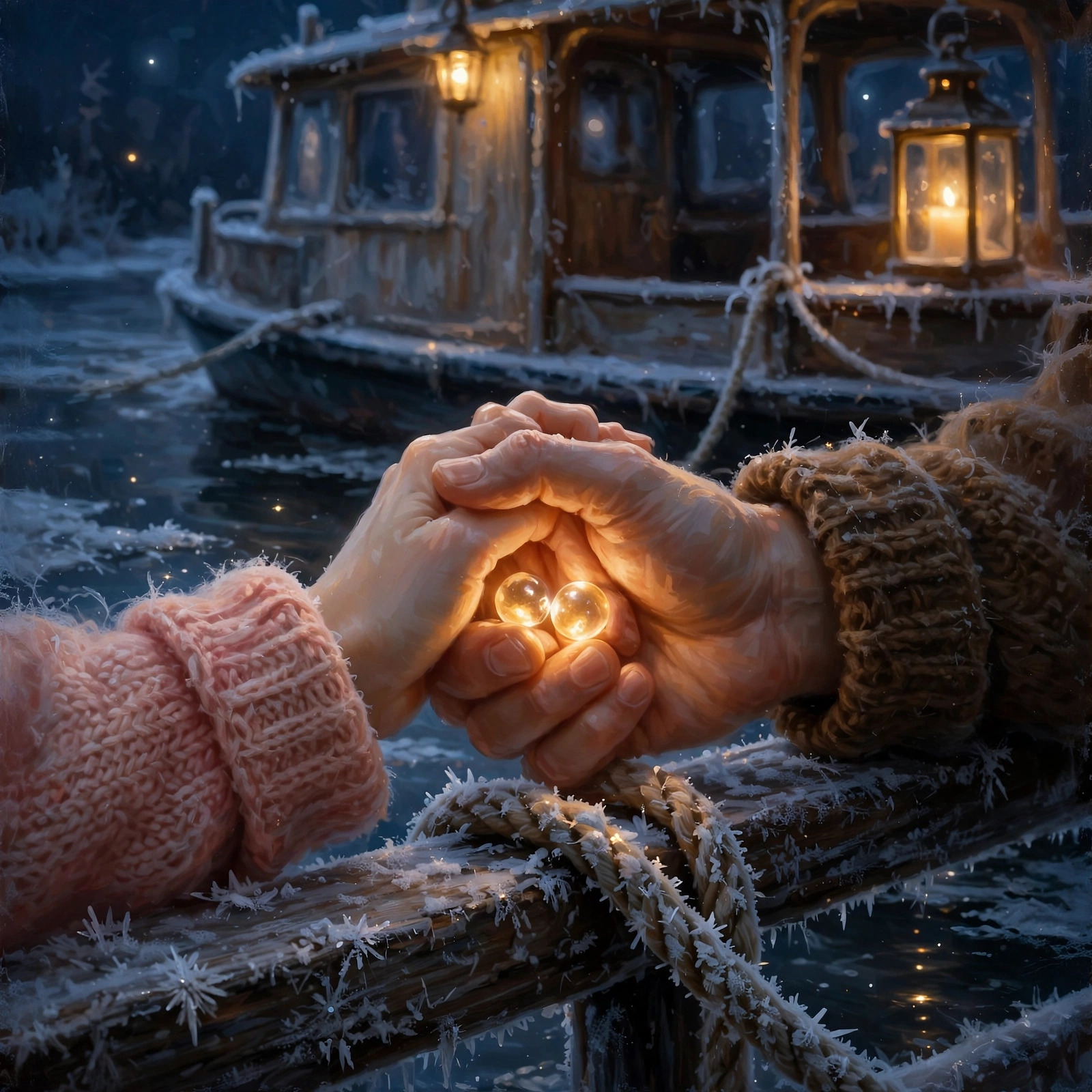
Siward stood beside it with his bare hands shoved under his arms. He didn't look surprised to see her. He looked like a man who'd been waiting on the cold planks long enough to rehearse.
"You locked it," she said.
"I did."
"We said dawn tomorrow. You said dawn tomorrow." She set the crate down on the boards, carefully, because careful was the only thing her hands knew how to be. "I've got eleven finished and the twelfth is cooling. I came to ask if we could load tonight."
"There's no crossing tomorrow." He nodded at the water. "Look at it."
She looked. The canal had gone the dull gray of pewter, and along both banks a skin of ice reached out toward the middle like fingers that hadn't quite touched. A dead leaf sat on it without sinking.
"It's still open in the channel."
"It's open where you can see. You can't see the rest." He finally took one hand out from under his arm and pointed downstream, to the bend by the old sluice. "There's a shelf out there that'll hold a gull and not a hull. I've watched it three mornings. It's thickening wrong."
"Then we go around it."
"There is no around. That's the cut. That's the whole of it." His voice stayed level, which was worse than shouting. "I sent word to the lock this morning. Ferry's closed till spring."
Aurelie felt the floor of herself drop. "You sent word."
"Yes."
"Without asking me."
"It's not yours to be asked. It's my ferry." He heard it, she could see him hear it, and he didn't take it back. "It's my post."
"Hester has to have them before the freeze. You know that. If they don't reach Furrow, there's no reinstatement. There's nothing. I go back to sleeping in a hut that rains on me, and in spring I find some other town where nobody's heard of me." She was talking too fast. She made herself stop. "You told me you'd take me."
"I told you I'd think on it."
"You kissed me."
That landed. His jaw went tight and he looked away, at the chain, at anything.
Under her collar the bead was warm, but the warmth was wrong. Not a hearth. Something knotted and churning, the way a pot hisses before it boils over. She pressed her palm flat against it without meaning to, and across the landing his hand moved to his own chest, the same place, as if they'd both been stung.
"Don't," he said.
"I'm not doing anything."
"You're feeling it. I can feel you feeling it." He pulled the cord out from under his shirt and held the half in his fist, knuckles split and raw. "That's the trouble with this thing. I can't stand here and be sensible with you knocking about inside my ribs."
"Then tell me why. The real why. Not the shelf."
The wind came down the cut and rattled the toll sign on its hooks. He didn't answer for a long while. When he did, he spoke to the water.
"My brother ran this ferry before me."
She hadn't known that. She hadn't known he had a brother at all.
"I was the toll-warden. He was the boat. That's how we split it. One winter there was a doctor's man on the far side needing to get over to a lying-in, and the ice was like this. Just like this." He turned the bead in his fingers. "My brother asked me. He stood right where you're standing and asked me if it'd hold. And I'd been reading that water half my life and I wanted to be the kind of man who said yes. So I said yes."
Aurelie didn't move.
"They found the boat at the sluice gate in March. Found him later." He breathed out, a short white cloud. "I could read ice then. Hands were good. I just didn't listen to them. I listened to what somebody needed instead."
"Siward."
"So, no. I'm not ferrying you over a shelf I can't trust, with my hands too numb to tell me if I'm wrong, because you need it. That's exactly how it goes."
She wanted to cross the boards and take his face in her hands. She also wanted to shake him. Both feelings went through the bead at once and she saw him flinch.
"You could have told me," she said quietly. "Two nights ago, by the furnace. When I told you mine. You said you knew about keeping things."
"I did know."
"And you decided this for both of us, alone. You didn't even ask what I'd risk."
"I know what you'd risk." His eyes came back to her, and they were wet and furious. "Everything. You'd risk all of it and carry it off by yourself and not tell a soul, because that's what you do. You'd drown smiling so nobody else had to hold the rope."
It was true enough that she had nothing to throw back at him. She stood there with her mouth open and the crate at her feet.
"And this," he said, lifting the bead, "this means I'd feel it. Every second. I'd feel you go cold."
"Don't."
He had already turned. He drew his arm back and threw.
The cobalt flashed once, a spark of blue against all that gray, and struck the thin ice near the middle of the channel. It skittered, spun, found the open black water, and was gone without a sound.
The leather cord trailed after it, and then that was gone too.
Aurelie's hand closed on her own half so hard the edge bit her palm.
She waited for something. The churning heat, the hiss, the knot. Him, knocking about inside her ribs.
Nothing came. Not anger, not grief. The glass sat against her skin like a pebble picked up from a riverbed, smooth and blue and empty, and under it something in her own hands went quiet, as though a fire she'd tended for twelve years had been banked without her permission.
Siward stood with his arm still half raised, staring at the place where the water had closed. He looked like he'd surprised himself.
"Aurelie," he said.
She picked up the crate. Her arms shook, and she didn't let them.
"Go stack wood," she said, and walked back toward the sluice.
Halfway there she opened her fist and looked down. The bead was cold.
Furrow Gate
"You'll put that fire out if you keep feeding it like that."
Siward stood in the doorway of the furnace hut with an armload of split ash. His bare knuckles were red and cracked. He had stacked the wood, as she'd told him. He'd stacked all of it, by the look of the pile outside, and then come back with more because he didn't know what else to do with himself.
Aurelie didn't turn around. "It's my fire."
"It's my wood."
"Then put it down and either help or go."
He put it down. He didn't go.
She had been at the furnace since before the light came gray through the gaps in the boards. Her cold half of the bead sat on the marver beside a little heap of cobalt cullet, the last of what she'd carried out of the glassworks. Not much. A few blue chips, enough for one small thing.
"What are you doing?" he asked.
"Making you another."
He was quiet long enough that she glanced back. He was staring at the cullet as if it might bite.
"Aurelie. I threw it in the canal. You don't owe me--"
"I'm not doing it because I owe you." She gathered the chips onto the end of the rod and held them into the glory hole. They slumped and glowed. "I'm doing it because I can't do it without you, and I'm tired of pretending otherwise."
That stopped him. She felt it stop him, even without the bead, the way a room goes still when someone sets a cup down too carefully.
She turned the rod. The blue went soft, then amber at the edges. She brought her own cold half up with the tongs and pressed the molten glass against its broken face, and they took each other, the old and the new, hissing faintly.
Then she reached for the binding.
It was like reaching into a well and finding the bucket already at the bottom. She pulled anyway. She pulled until her palms ached and her teeth hurt, until the heat came up out of her slow and grudging and went into the glass. Something left with it. She felt it go, the way you feel a tooth come loose.
"There's a price," Siward said. His voice had changed. "Isn't there."
"There's always a price."
"What is it?"
She shaped the bead round. She split it while it was still bright, a clean stroke of the blade, and both halves fell glowing onto the marver. Only then did she let her hands drop.
"When a binding breaks, the one who made it pays to remake it," she said. "My craft goes quiet until spring. I can blow glass. I can't put heat in it. Not for a season."
He crossed the hut in two strides. "You didn't tell me."
"No."
"When I threw it, you didn't--"
"No. I didn't tell you that either." She looked up at him. "I kept it, the same as you kept your brother's crossing until yesterday. We're a pair of misers, Siward. I thought we might stop."
He looked at her hands. They were trembling a little now, and she couldn't stop them, and for once she didn't try.
The bead halves cooled from orange to blue. She threaded a fresh cord through one and held it out.
He didn't take it right away. Then he did, and the moment it touched his skin she felt him. Not a flood. A thread. Warmth, and fear under it, and something under the fear she didn't have a word for yet.
"The lights are packed," she said. "They were bound before. They'll hold. Today's the last day the Cut is open, and I'm not asking you to let me go." She swallowed. "I'm asking you to come with me."
He closed his fist around the bead. Outside, the wind worked at the boards.
"I can't read the ice," he said. "Not with these hands."
"You can read it with mine."
He laughed, a short, raw sound, and pressed the heel of his hand against his eyes. When he lowered it, he was already reaching for the crates.
The chain came off the ferry with a sound like a dropped bell. He didn't look at the lock or the warden's board or the notice he'd nailed up himself. He looped the chain over a post and stepped down into the boat, and then he held a hand up for her.
The skim ice had thickened overnight. It ground against the hull as he poled them out, white plates turning and knocking. In the middle of the channel he went still.
"Left," Aurelie said. She didn't know how she knew. She felt his uncertainty come through the cord and hit something in her that was sure. "Left, toward the reeds. It's darker there. It's thin."
He swung them right instead, away from it, and the ice to the left cracked and folded under its own weight a moment later. He let out a breath that fogged and hung between them.
"Again," he said.
So she told him, and he listened, and between them they found the black water all the way across.
The Furrow glassworks sat behind its iron gate as it always had, chimneys smoking, yard churned to frozen mud. A gatekeeper squinted at Aurelie and then went running. She stood with the crates at her feet and Siward a pace behind her, his hand resting on the small of her back, and she let it stay.
Hester Quaine came down the path in a gray wool coat buttoned to the throat. She had signed the paper three years ago without looking up. She looked up now.
"You're late," she said.
"The canal closes tonight. I'm on time."
Hester's mouth thinned, which on her might have been amusement. She knelt in the mud, which Aurelie had never once seen her do, and pried the lid off the first crate.
Warmth rose out of the straw. Hester lifted one of the globes and held it up against the gray sky. It glowed soft gold from the inside, steady, the frost on the gatepost already beading wet beside it.
She lifted another. And another. She went through every one, turning each in her gloved hands, and Aurelie stood and let her, and did not explain, and did not apologize.
"One of these isn't all yours," Hester said at last. She held up the last globe, a little lopsided at the shoulder.
"He helped me work it."
Hester looked past her at Siward. Her eyes went to the bead at his throat, then to the matching blue at Aurelie's, then back.
"The apprentice came to me in spring," Hester said. "Told me whose fire it really was. I'd already signed. I didn't know how to unsign a thing." She set the globe back in the straw with great care. "I'm told this is how."
She stood, brushed the mud from her knees, and held out her hand.
"Your bench is where you left it. Your name goes back on the board tonight." The faintest pause. "Reinstated."
The Ferry Landing
Siward was trying to pry the ferry loose from the ice with a boathook, and losing.
Aurelie watched him from the top of the landing steps for a while before she said anything. The canal had closed in the night exactly as promised. Where yesterday there had been black water threading between gray plates, there was now one long white road, flat and creaking, running back toward the Brindle Cut and the hut she'd left cold. The ferry sat locked in it at a slight tilt, as if it had stopped mid-thought.
"You'll snap that hook," she called.
"Then I'll have snapped a guild hook." He set the iron point against the hull and leaned. Nothing moved but his breath. "They can bill me."
"They've already billed you."
"Yes." He straightened and looked at her, cheeks red from the cold, hair standing up on one side where he'd slept on it badly. "They have, haven't they."
The rider had come to the glassworks gate an hour past dawn, a lock clerk in a stiff coat who'd read the notice aloud in the yard as though Siward might not be able to manage it himself. The ferry had crossed after closure. The toll-warden had carried a guild exile, or what had still been one when they'd pushed off. The post was vacant as of this morning. Siward had listened to all of it with his hands in his pockets and said, "Thank you for riding out," and the clerk hadn't known what to do with that.
Aurelie came down the steps. The boards were furred with frost and she took them carefully, one hand on the rail. Her fingers felt strange in the cold now. For twelve years she'd been able to touch a thing and know its heat the way other people knew the time of day, and since the remaking there was only her own skin, ordinary and unhelpful. She kept reaching for the sense and finding nothing, like a stair that wasn't there.
"Leave it," she said. "It's not going anywhere till spring."
"Neither am I, apparently." He leaned the boathook against the mooring post. "I don't know what I was going to do with it. Row back across the ice, maybe."
"Please don't."
"I wasn't going to." He rubbed the back of his neck. "I wanted my hands busy."
She understood that better than she'd ever say. She'd spent most of the night at her old bench in the glassworks, not working, only sitting, moving tools from one side to the other and back. Her name was chalked on the board again. Two apprentices had come by to stare at her and then gone away whispering. Hester had brought tea and set it down without comment, which was the kindest thing Hester had ever done.
The mooring post had a brass plate screwed into it at chest height, stamped with the Lockmasters' crossed keys and the word WARDEN underneath. Siward looked at it for a long moment. Then he took a knife from his coat, fitted the tip into the first screw, and began to turn.
"What are you doing?"
"They'll want it back." The screw came out and he dropped it in his palm. "Nine years I've polished this thing. I'd rather hand it to them than have them come pull it off."
She stood beside him while he worked the second screw. It was stubborn with rust and he swore at it under his breath, softly, the way he'd sworn at the ice yesterday when it wouldn't show him anything. When the plate came free he held it up. There was a clean rectangle on the post where it had been, paler wood the frost hadn't touched.
"There," he said. "That's that."
"Siward."
"I know."
"I didn't ask you to--"
"You did, though." He turned the plate over in his hands. "You stood on my landing with a bead you'd ruined yourself to make and asked me to take you across. That's asking."
She looked down at the ice. "I meant I didn't ask you to lose this."
"No. You just went and lost your whole season of craft for me without saying a word about it first." His voice wasn't sharp. It was something closer to wonder, and that was worse. "I had to work it out from your face when you couldn't feel the kiln."
"It's only till spring."
"So's the ice."
That stopped her. She'd been ready to argue that hers was smaller, that a season was nothing, that she'd lived with worse. She'd been ready to carry it quietly the way she'd carried the fire, the banishment, all three years of borrowed sheds and cold hands. And here he was setting his down right beside it, out in the open where she could see the shape of it.
"I chained that ferry because I was frightened," he said. "I didn't ask you. I decided for you, like I decided for him." He didn't say his brother's name. He didn't need to. "And then I threw half of you in the canal."
"Half of a bead."
"Aurelie." He looked at her. "Half of you."
She had nothing ready for that. Her throat did something complicated.
He held out the brass plate. She didn't understand at first, and then she did, and she took it. It was colder than the air and heavier than it looked.
"You'll give it to the clerk?"
"You will. If you don't mind. I'd like someone to hand it over who doesn't think it was a mistake."
"I don't think it was a mistake."
"I know. That's why."
She slid it into her coat pocket. The weight of it pulled the cloth crooked. Then, because her hands needed something too, she reached for the cord at her throat and drew the bead out from under her collar. The cobalt caught the low sun, deep as the water had been before it froze. She couldn't feel its warmth the way she used to, as a living, measurable thing. But she could feel it the plain way, against her fingers, the way anyone could.
"Hester's offered you work," she said. "Did she tell you? The furnaces need a man who can haul coal and won't complain about the hours."
"I complain about everything."
"Quietly. She likes quiet."
He laughed, short and surprised. "And you? Back at your bench, your name on the board. Is that what you want?"
She thought about it honestly, which she hadn't let herself do in a long time. "I want the bench. I want the work, when it comes back." She turned the bead over. "And I want to stop carrying everything by myself, and I don't know how. I'm terrible at it."
"I've noticed."
"You're not much better."
"No." He stepped closer, close enough that the frost on his coat brushed hers. "We could be terrible at it together. Practice."
The ice creaked out on the canal, a long low note that traveled away from them toward the Brindle Cut. Neither of them turned to look.
"I love you," Aurelie said. It came out plainly, without any of the bracing she'd expected to need. Just the words, set down between them like a tool on a bench.
Siward's face did something she'd never seen it do. All the watchfulness went out of it at once.
"I love you," he said. "I've known since you told me the ice was thin and I believed you."
She went into his arms, or he pulled her in; she would never be sure afterward, and it didn't matter. His coat smelled of canal water and woodsmoke and she pressed her face into his shoulder and felt his chin come down on her hair. His arms closed tight across her back, and he held on the way a man holds the side of a boat in rough water, and she let him, and held on back.
Between them, caught where her collar met his, the two cobalt halves pressed together. Even through her quieted hands, even without the sense she'd lost for the winter, Aurelie felt them go warm.
Get notified when new stories drop
Marcus Hale
Marcus writes slow-burn and marriage-of-convenience stories where logistics become intimacy and competence is a love language.
Leave a comment
Comments