


Tern Quay Steps
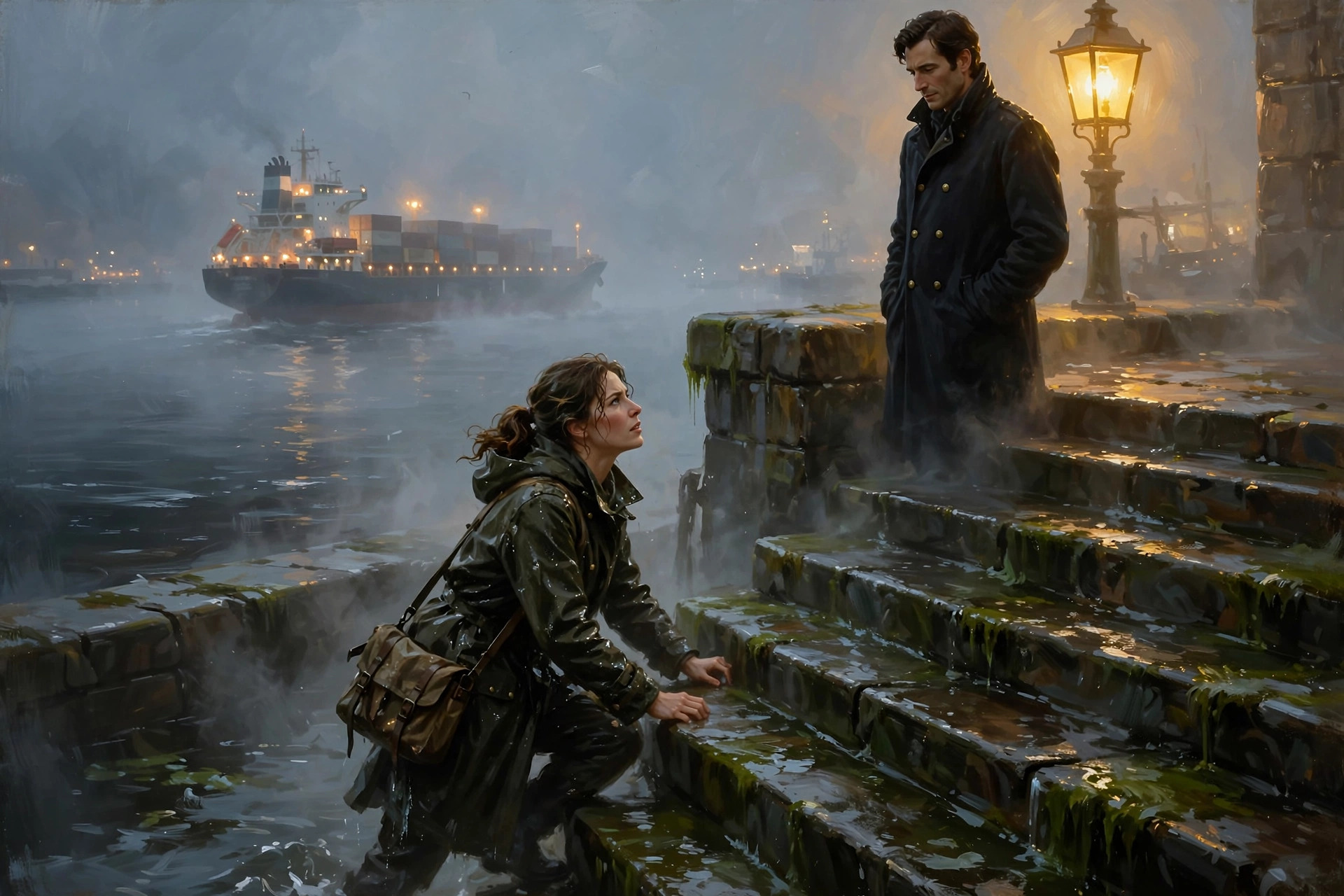
"You're tying off crooked," Dominic Achard said from the top of the steps.
Ysolde Varga didn't look up. She threw a second half hitch over the bollard ring, hauled it snug, and let the launch knock once against the stone like a dog that wanted in.
"I'm tying off wet. It's different."
"It's four in the morning."
"Then you're up early." She swung her pilot bag over one shoulder and started climbing. The steps on Tern Quay were green to the third tread and treacherous after that, and she took them the way she'd taken them since she was small enough to need both hands. "Or late. I don't know your habits, Harbormaster."
He stood in the yellow cone of the quay lamp with his coat buttoned to the throat and his hands in his pockets. Tall, which she'd known. Patient, which she hadn't. In three years she'd mostly seen him through the glass of the harbormaster's tower, a dark shape bent over a desk, or across a meeting room saying no in a voice that never rose.
He wasn't saying anything now. He was looking past her, out to where the lights of the bulk carrier she'd just walked through the Grellan Narrows were sliding toward the outer anchorage, small and smug and very much afloat.
"That's the Corvessa," he said.
"Is it."
"Draws nearly eleven meters. She was scheduled for a daylight transit at nine."
"Her master wanted the tide." Ysolde reached the top step. Her boot found the wet patch she always forgot about, and she pitched sideways, and his hand closed on her elbow before she'd decided whether to fall.
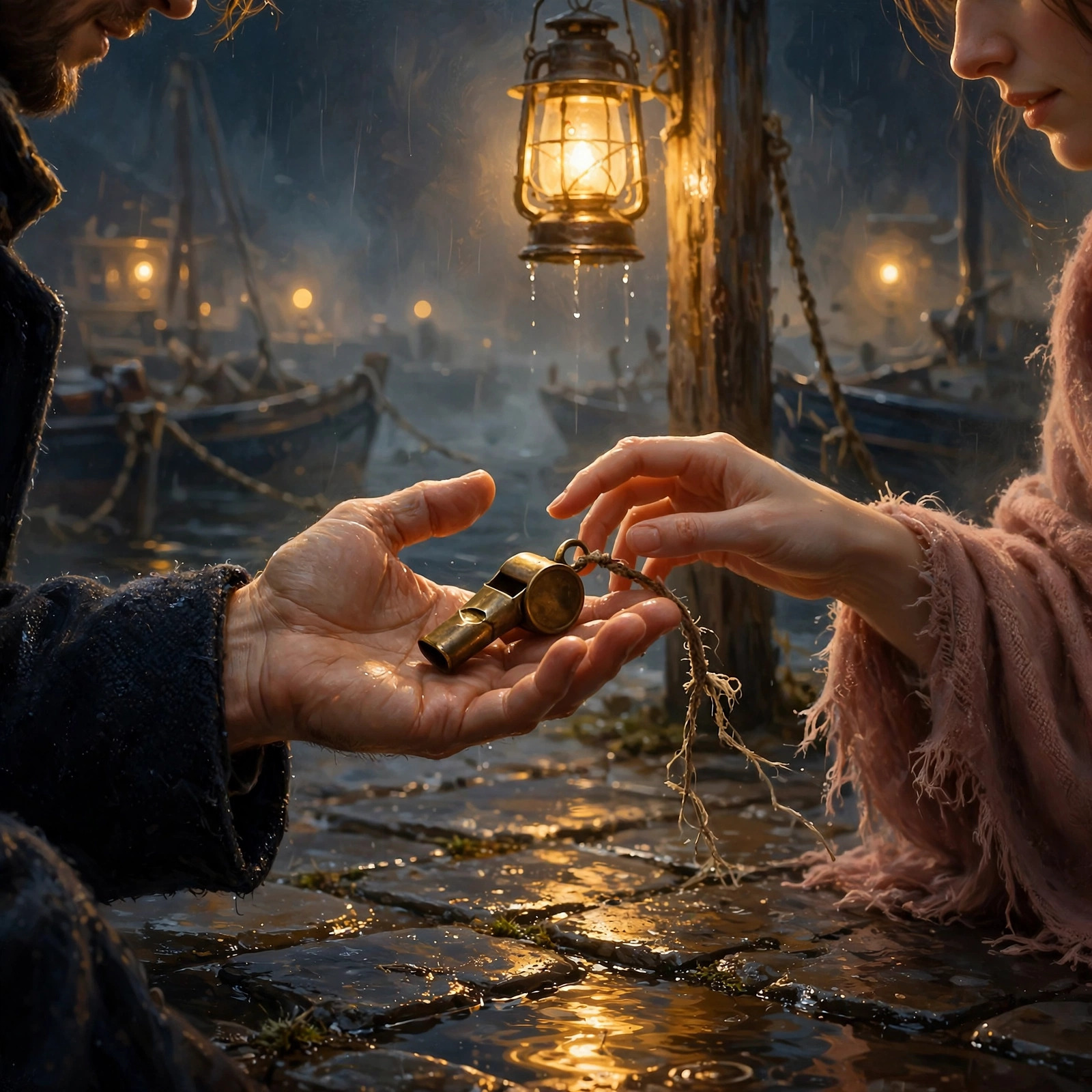
Something snapped against her collarbone. The brass whistle her father had bought his first season went skittering off its cord and rang on the stones, a bright stupid sound, and rolled toward the edge.
Dominic put his foot on it.
For a moment neither of them moved. His grip on her arm was firm and impersonal, the way you'd hold a railing. Then he let go, bent, and picked up the whistle. He turned it once in the lamplight. The brass was worn smooth where forty-odd years of thumbs had rubbed it, and now there was a fresh bright dent along the barrel where it had struck.
He held it out on his flat palm.
Ysolde took it fast, the way you'd take something off a stove. She closed her fist around it and didn't put it in her pocket.
"Thank you," she said, because her father had raised her right, and hated it.
"The Narrows are closed after dark."
"I'm aware."
"By my order. Since the grounding."
"I said I'm aware." She could feel the cord's frayed end tickling her wrist. "Everyone on this coast is aware. The shipping line is very aware. Ask the board how aware they are, come autumn."
His jaw shifted. She'd found the bruise, then. Everybody in Halveny knew the number, because the pilots' association had printed it on a flyer and pinned it to every noticeboard from the fish market to the chapel: $2,400,000 a year, the contract that walked if the port couldn't take night traffic. Half the pilots on the roster would be scraping hulls for a living by spring.
"Nobody's going to ask the board anything if a ship opens herself up on the Skerry bar," Dominic said. "That's what happens at night in there. The shoals move. The charts are wrong by midsummer every year. I've read the survey reports."
"Reports."
"Yes."
"Written by men in a launch with a lead line, in daylight, twice a year." She tilted her head at him. "You've read about the water. I've been in it."
"Then you know exactly how dangerous it is." He took his right hand out of his pocket. "License."
She laughed. It came out thinner than she'd meant. "You're not serious."
"Card, please, Pilot Varga."
The bag strap bit her shoulder. She shifted it closer to her body without thinking, and saw his eyes follow the movement down to the oilcloth flap and back up to her face. He didn't ask. She liked that less than if he had.
"I've got a ship on the noon tide," she said.
"Then you'd better get some sleep."
She dug in her jacket, found the laminated card in its sleeve with the association's gull stamped in the corner, and slapped it into his palm harder than she needed to. He didn't flinch. He glanced at it, at her photograph, which was terrible, and then slid it into the inside pocket of his coat and did the button up over it.
That small sound, the button, was worse than anything he'd said.
"Here's what happens," he said. "I can file a suspension in the morning. Ninety days. Your association will fight it and lose, because you just took an eleven-meter draft through a closed channel on a falling moon and there are three tug crews who watched you do it."
"They'll say they didn't."
"Some of them will. Not all." He let that sit. "Or."
She waited. The tide sucked at the bottom step. Up the quay, behind a dark window on Tern Quay, her father was pretending to sleep and would be pretending to have slept when she came in.
"Or," Dominic said, "you come to the tower tomorrow and you show me how."
"How what?"
"How you're doing it. I've stood up there and watched your father's launch go out on black nights all summer and come back with nothing on the radio. Then yours. I've watched ships that had no business moving come out the far end clean." His voice stayed level, but something had come into it, a held thing, as if he'd spent a long time not saying this out loud. "I don't believe in luck. Not on water. So either you're very good or you've got something nobody else has."
Her fist tightened on the whistle until the new dent pressed into her palm.
"And then what? I explain my trade and you hand it to the Port Authority in a binder?"
"And then you take me through." He nodded toward the black gap between the headlands where the Narrows ran. "At night. On a real transit. If I come out the other side believing you, I'll take it to the board myself."
"And if you don't believe me?"
"Then you'll have the ninety days to think about it."
She studied him. Up close, under the lamp, he looked tired in a way that wasn't about the hour. There was a line between his brows that had settled in for good. She'd heard he'd come from a bigger port down the coast and left it fast, and nobody in Halveny knew why, and he wasn't the kind of man you asked.
"You'd get in a pilot launch with me," she said. "In the dark. In a channel you closed."
"I'd rather not."
"That's honest."
"I'd rather know." He looked at her bag again, then away, deliberately, the way a man takes his eyes off a door he's decided not to open yet. "Ten o'clock. Bring whatever it is you bring."
She could say no. She could walk up the quay and let him file and let the association's lawyer earn his fee. She could keep her mouth shut and her bag shut and her father's long winters of work exactly where they'd always been, against her own ribs.
But the contract would go. The pilots would go. And Dominic Achard would stand in his glass tower for another year watching the Narrows like a man watching a fire, and nobody would ever tell him what her father knew about that water.
She wanted, very badly and for no good reason, to be the one who told him.
"Ten," she said. "I'll bring coffee. Yours tastes like the inside of a boot."
"You've never had mine."
"I've smelled it from the dock."
Something moved at the corner of his mouth and went still again. He stepped back to let her pass.
Ysolde walked up Tern Quay with the bag tight against her side and the broken whistle hot in her hand, and didn't look back, and knew without looking that he stood there under the lamp with her name buttoned inside his coat.
The Chart Table
"You're giving it to him," Hugh said, before she'd even got her boots on.
"I'm showing it to him. There's a difference."
Her father stood at the stove in his undershirt, a spatula in one hand, the eggs going brown at the edges because he'd stopped watching them. The kitchen of the cottage was small enough that he could block the door without moving, and he was blocking it now, though he'd never admit that was what he was doing.
"There's no difference with a man like that. He looks, he copies, he files it. Next season some kid from the coast is running the Narrows off our marks and calling it Port Authority survey."
"Next season there won't be a Narrows to run. Not at night. Not for anyone." Ysolde pulled the oilcloth tube from her pilot bag and set it on the table between the salt and the butter dish, where it had sat a thousand mornings of her childhood. "He's got my license in his coat, Dad."
"Then let him keep it a while. You'll live."
"And you? You'll live on what, exactly, when the association folds?"
He turned the eggs out onto a plate and pushed it at her. She didn't eat them. He sat down heavily and put one big scarred hand flat on the tube, the way he used to put it on her head when she was small and wouldn't stop asking where her mother had gone.
"Your mother took the good china," he said. "You remember that? Took the china and the radio and the car. Left me this." He tapped the tube. "Left you this. It's the only thing in this house that never walked out the door."
Ysolde looked at his hand. The knuckles had swollen over the winter. He couldn't grip a ladder rail anymore, which was why the night runs had been hers alone since spring.
"It's not walking anywhere," she said. "I'm carrying it there, and I'm carrying it back."
He held on a second longer, then lifted his hand.
"Don't unroll the north end," he said. "Not for him. Not the Kettle."
"I wasn't going to."
She was, a little. She took the tube anyway, and two coffees from the bakery on the corner, and climbed the harbormaster's tower stairs with her father's warning knocking around her skull like a loose block.
Dominic was already at the chart table. Of course he was. The tower's glass ran on three sides, and the morning came through it flat and white, showing every surface he'd cleared. There was nothing on the table at all. Not a pencil. He'd made room.
"You're early," he said.
"You're earlier." She put a coffee down in front of him. "Bakery. Before you ask, no, I didn't poison it."
"I wasn't going to ask." He picked it up, smelled it, and drank, which she suspected was as close as he came to trust. He was in shirtsleeves today, the coat hung on a hook by the door. She glanced at it before she could stop herself. He saw her glance.
"It's still in there," he said.
"I wasn't going to ask."
That got the corner of his mouth again. It didn't stay.
She uncapped the tube and slid the chart out. The linen backing had gone soft as an old shirt, and it smelled of oilcloth and pipe smoke and the cottage. She laid the south edge down and weighted it with her coffee cup, and then she unrolled it slowly, a hand's width at a time, while he leaned in on his knuckles across from her.
The printed chart underneath was an old Admiralty sheet, faded blue. Over it lay her father's ink, black and brown and in places nearly purple where he'd run short and mixed whatever he had. Soundings in his square hand. Arrows for set and drift at different states of tide. Little crosses where the shoals had walked in a bad winter, and newer crosses beside them where they'd walked back. And in pencil, finer, slanting, her own notes from nine years on the water.
Dominic didn't say anything for a long time. He traced nothing. He kept his hands on the table edge, as if touching it would be a liberty.
"When was this started?" he asked finally.
"The year I was born. He says it was to keep himself awake on the night shifts. My mother said it was to stay away from home." She shrugged. "Both, probably."
He bent closer to the pencil. "These are yours."
"Some."
"This one." He pointed without touching, at a line she'd drawn along the eastern bank, with a note beside it. Hold the light on the chapel roof till the bell buoy opens. Not before. "That's a transit. Two marks lined up. You can't see either of them on a moonless night."
"You can see the chapel roof. They leave the porch lamp on. Have done since the war." She tapped the margin. "When it's foggy you count. It's written there. Seconds at eight knots."
"Seconds." He looked up at her, and she saw that line between his brows go deeper. "You're running a channel on seconds and a church lamp."
"I'm running a channel on forty years of somebody writing down exactly where he was every time he got it right. And every time he got it wrong." She moved her finger down to a smudge near the mouth. "That's where he got it wrong. He never inked over it. He wanted to see it."
Dominic studied the smudge for so long she thought he'd forgotten her.
"That grounding," he said quietly. "The one in March. It wasn't a Varga boat."
"No. It was a ship that came through with no pilot at all, because somebody saved on the fee." She heard the edge in her own voice and didn't soften it. "You closed the Narrows on us for their mistake."
"I closed it because I didn't know the difference." He straightened. "I still don't. Not from this. A chart can say anything."
The roll still sat fat in her left hand, most of the north end wound tight inside it. He looked at it. She felt him look at it.
"There's more," he said.
"There's always more."
"The Kettle's up there. The bend under Grey Head. That's where it gets bad, isn't it?"
She didn't answer. She thought of her father's hand flat on the tube, of the car going up the quay road with the radio in the back seat. Of how quiet the kitchen had got after.
Dominic didn't reach. She'd half expected him to, and she'd half wanted him to, so she'd have a reason. He just stood back from the table and put his hands in his pockets.
"I'm not going to learn it off paper," he said. "I'd be lying to the board if I said I could. Take me through. Show me the chapel lamp. Count your seconds where I can hear them. If it holds at the Kettle, I'll stand up in front of Margit Lowry and say so."
"And if it doesn't hold?"
"Then we'll both be very wet, and I'll have learned something."
She laughed despite herself. It surprised them both. He looked away out the glass toward the headlands, and she noticed his jaw working, as if something else wanted saying and he'd shut a door on it.
"You've done this before," she said. "Gone out with a pilot to check them."
"Once." Flat. Final. He didn't turn around.
She didn't push. She lifted her coffee cup off the south edge, and the chart curled toward her hand on its own, the way it always had, eager to be closed. She rolled it shut, tight, and slid it home into the oilcloth and capped it.
The dented whistle swung against her breastbone on its new cord, a bootlace she'd knotted at midnight. She pressed it flat with two fingers.
"New moon's Thursday," she said. "Slack water just after eleven. Be on the pilot launch at half ten, and wear something you don't mind ruining."
He turned back from the glass. "Thursday."
"Thursday," Ysolde said, and tucked her father's winters under her arm.
Outer Roads
"Port ten," Ysolde said. "Hold it. Hold it."
Dominic held it. The launch leaned into the turn with a low grumble from the engine, and the fog closed behind them like a curtain somebody had drawn without asking. She stood at his shoulder in the wheelhouse doorway, one hand on the frame, the other flat against the glass as if she could feel the water through it.
"Midships."
He brought the wheel back. He didn't ask why. That had surprised her an hour ago, at the pontoon, when he'd stepped aboard in an old wool coat and boots that had clearly seen salt before, and said only, "Your boat. Your calls."
Somewhere off the starboard bow, a bell buoy clanked, slow and irregular, rocked by a swell neither of them could see.
"That's the Outer Shepherd," she said. "You hear how it's late on the swing? Tide's still making. Count with me."
She counted out loud, the way her father had taught her on the kitchen floor with a wooden spoon for a wheel. One, Halveny. Two, Halveny. At eleven the bell came again.
"Eleven," Dominic said.
"Eleven's good. Nine means we're set north. Seven means stop the engine and pray." She tapped the glass. "Starboard five. Slow ahead."
The chart was in its oilcloth tube, wedged in the rack above the compass where she could touch it without looking. She didn't take it out. She hadn't needed to for years, not this part. Tonight she wanted him to see that, too.
They came up on the chapel lamp at twenty to midnight. It wasn't much: a single amber smear high on the hill, there and then gone as the fog thinned and thickened. She put her hand over his on the wheel without thinking about it.
"Put it on your left eyebrow," she said. "Not the bow. Your eyebrow. Keep it there."
He turned his head a fraction. "Like that?"
"Like that."
She took her hand back. His knuckles had been cold.
The Kettle announced itself the way it always did, with a change in the sound of the water. The hiss along the hull went hollow. The launch shivered. Dominic's shoulders came up, and she watched him make them go down again by force.
"Now we're in it," she said quietly. "Grey Head's on your right. You won't see it. Don't look for it."
"What am I listening for?"
"Nothing. That's the trick. When it goes quiet on the right, the shoal's under us and we're too close. Port, easy. Easy." She leaned out the door into the wet dark. "There. Hear that?"
A second bell, deeper, off to the left.
"The Kettle buoy. It's been dragged twice since 2019. The Authority's survey still has it where it was. That's how the coaster went aground." She came back in. "They followed the buoy instead of the water."
He didn't answer. His eyes stayed on the lamp. She called him through the bend in short words, port, steady, starboard a touch, slow, and he answered each one with his hands before she'd finished saying it. Once the hull touched something soft and let it go, and he made a sound low in his throat, and she said, "Mud. Fine. Keep on," and he kept on.
Then the hollow sound went away, and the swell came up long and easy under them, and the fog fell back far enough to show black water and nothing else.
"Outer roads," she said. "Stop engine."
He pulled the throttle back. The engine died to a tick, then silence. The launch drifted, turning slowly, and the bells went on behind them in the dark, keeping their own time.
Dominic took his hands off the wheel. They were shaking, a little. He looked at them as if they belonged to someone else.
"Sorry," he said.
"Everyone shakes the first time through the Kettle at night. My father threw up over the side."
"Did he." Almost a laugh. He leaned back against the chart table and pressed his palms flat on it. "I wasn't scared of the shoal."
She waited. The cabin light was off; there was only the faint green glow of the compass, enough to see the side of his face.
"The last port I worked," he said. "Before here. There was a pilot. Good one, everybody said. He wanted to take a tanker out on a night I didn't like. Wind against tide, visibility going. I liked him. I trusted him. I signed it off." He was quiet a moment. "He went over the side boarding from the ladder. They found him two days later. The inquiry said I'd had every reason to refuse and I hadn't."
The launch rolled gently. Ysolde found she had her hand around the whistle at her throat, the dent pressing into her thumb.
"That's the once," she said. "When you went out with a pilot."
"I went out with the boat that looked for him." He finally turned his head and looked at her. "So now I close things. I don't sign. I don't trust a man because he's good, or a woman because her father was. I check. I check everything."
"You let me call you through the Kettle blind."
"Yes." He seemed to hear it as he said it. "I did."
She should have said something useful. Something about the board, about the autumn review, about all those ships that would go somewhere else if Halveny couldn't bring them in after dark. Instead she stepped across the little wheelhouse, which took one stride, and put her cold hand against his cold face.
"You held the lamp on your eyebrow the whole way," she said. "Nobody does that the first time."
"Nobody?"
"Not even me."
He laughed then, properly, a short surprised breath, and she kissed him while it was still in his mouth.
It wasn't careful. He tasted of salt and the bad coffee from her thermos, and his hand came up to the back of her neck and stayed there, warm now, holding her as if the boat might pitch her away. She felt the chart table edge against her hip. She felt the bells, somehow, through the deck. When she drew back, she didn't go far.
"That," he said, unsteadily, "wasn't on any survey."
"No. It wasn't."
They stood like that while the launch turned a slow half-circle in the roads. Out in the fog the Outer Shepherd rang, late on the swing, eleven seconds.
She lifted the bootlace over her head. The whistle swung, dull brass in the green light. She looped the cord once around his wrist, over the cuff of his coat, and let it sit there, the whistle resting in his open palm. He went very still. He looked down at it the way a man looks at a bird that has landed on him.
Then she slid the cord off again, slow, and put it back around her own neck.
"Start engine," Ysolde said. "Tide's turning."
The Safe Door
"You took it off my launch," Ysolde said, before the tower door had finished swinging shut behind her.
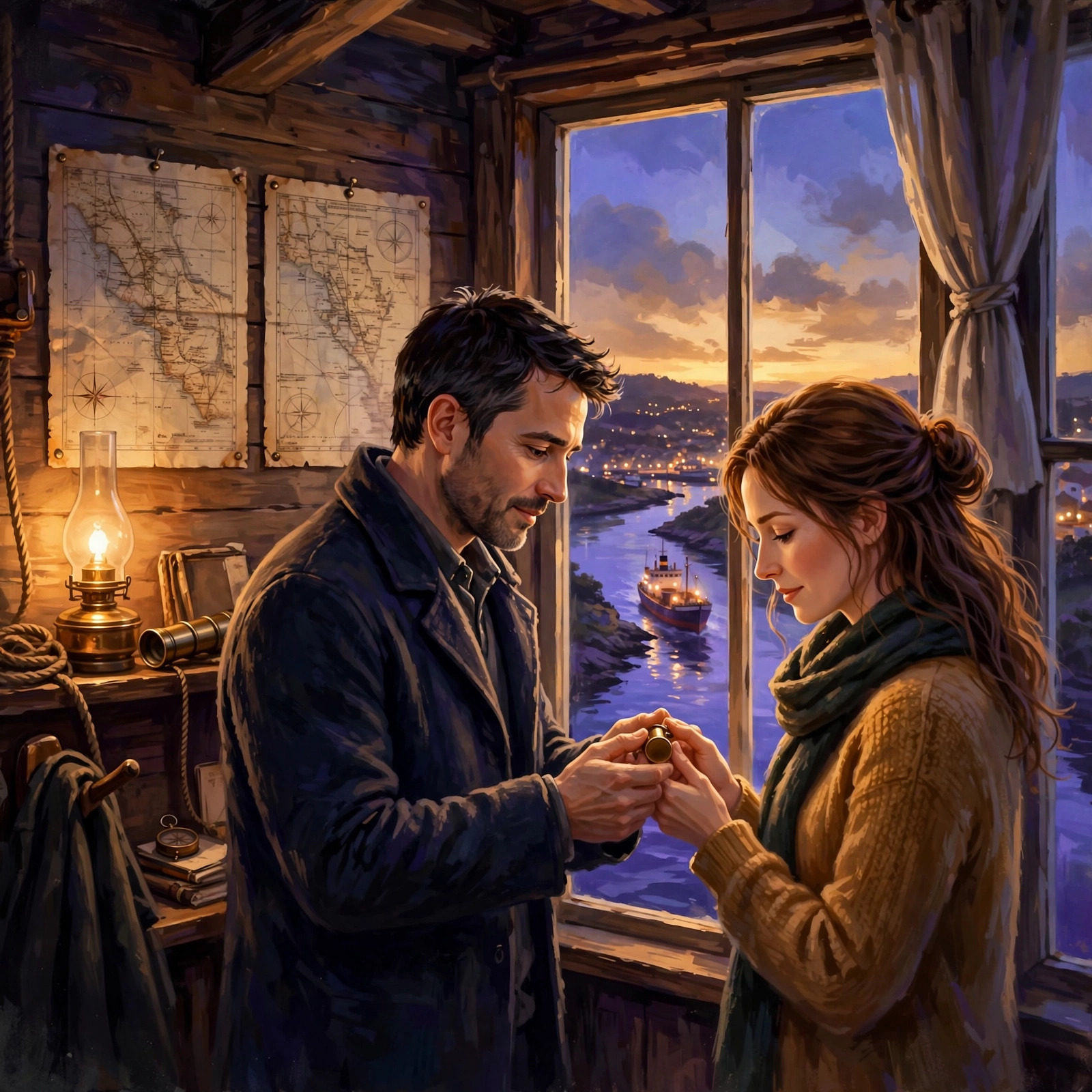
Dominic didn't look up from the desk. The oilcloth tube lay across his blotter, still capped, still beaded faintly with harbor damp. Beside it sat a printed form with the Port Authority crest at the top and three lines already filled in, in his small, upright hand.
"I collected it," he said. "From a vessel moored at a public berth. I'm entitled to inspect anything aboard a licensed pilot boat."
"You're entitled to ask."
"I asked you on Tuesday. You showed me half."
She crossed the room in four strides. The morning came in flat and grey through the tall windows, and the whole harbor lay below them. The cranes stood idle. A coaster rode at anchor in the outer roads, waiting for the daylight that Halveny could still give it. Last night she'd stood on a drifting boat out there with her hand on his face.
"Give it back, Dominic."
He looked at her then. He hadn't slept. She could tell by the line between his brows, sharper than yesterday, and the way he'd done his tie too tight, as if a neat knot could hold the rest of him together.
"Sit down. Please."
"I'll stand."
He nodded as if he'd expected that, and turned the form around so she could read it. She didn't need to. She'd seen the heading on other people's desks. Notice of Suspension, Pilot License. The box for duration was filled in already. Ninety days.
Something cold went down through her, the same cold as the water off Grey Head.
"You're suspending me." She heard her voice come out quite level and hated it for that. "This morning. After last night."
"Because of last night." He laid his palm flat on the tube. "Ysolde, listen to me. The board meets about this inside a week. Margit Lowry will ask me one question. Can ships pass the Narrows safely after dark? I can't answer yes because a pilot I like called a good line through the Kettle. I need the chart. Surveyed, dated, in the record. And I need it on record that I found night runs happening against my closure and I acted."
"You need to look like you're in control."
"I need to be in control." The words came out harder than he seemed to mean them, and he pulled back. "The last time I wasn't, a man went into the water."
"So you'll put me on the beach to prove you're careful."
"Ninety days. Then you're back, and the passage is open, and the chart's in the survey where it can't be lost or hoarded or..." He stopped.
"Go on. Hoarded."
He didn't. He stood and walked to the safe set into the wall behind his desk, an old iron box painted harbor green, with a brass dial worn bright at the edges. He worked the combination with his back to her. She watched his shoulders and remembered the weight of his hand on the back of her neck, warm, steady, holding on as if the deck might throw her.
"My father began that chart the year I was born," she said. "He drew the Kettle shoal with a pencil he'd sharpened on his knife. I added the dragged buoy myself, last spring. Every mark on it is something one of us found out by nearly dying. You don't get to lock it in a box because you're frightened."
The safe door swung open with a low iron complaint. Inside were ledgers, a cash tin, a flare pistol in its case.
"I'm not doing it because I'm frightened."
"Then why didn't you knock on my door this morning and ask me?"
He turned with the tube in his hands. For a moment she thought he might answer honestly. His mouth moved. Then his jaw set, the way it had the first night on Tern Quay, the night he'd caught her coming in.
"Because you'd have said no," he said.
She would have. She knew it the moment he said it, and that was the worst of it. Last night she'd looped the cord around his wrist and then taken it back, because that was what she did. She held things. Her father held things. Her mother had packed one suitcase and given away nothing, and still she'd gone.
"Maybe," Ysolde said. "You didn't find out."
He slid the tube onto the middle shelf, between the ledgers, and didn't close the door yet. He stood with one hand on the edge of it.
"I'll file the notice at noon. I'll give the board everything. Your name doesn't have to be the headline. I'll say a pilot cooperated."
"A pilot cooperated." She laughed, and it hurt her throat. "And my father?"
"Hugh's retired. There's nothing to suspend."
"There's his name. That chart's got his name on the margin in ink."
He looked at the shelf as if he hadn't thought of that, and she saw him decide not to think of it now.
"Two million, four hundred thousand dollars a year," he said quietly. "That's what walks out of this harbor if I can't prove safe passage. Every pilot in the association feels it. You feel it. I'm trying to keep the port alive and nobody dead. I can't do both by trusting people."
"You trusted me Thursday."
"I know." He said it to the safe. "I know I did."
She put her hand up to her throat. The bootlace was rough under her fingers, the whistle warm from her skin, the dent the size of a fingernail where it had struck the deck. Her father had bought it his first season, from the chandler at the end of the quay, and blown it through fog for forty winters, and handed it to her the day she passed her license, without a word, as if handing it over cost him nothing.
It had cost him. She'd always known that. She'd never once asked him why he did it anyway.
She lifted the cord over her head.
Dominic went still. She saw him see it, the whistle swinging, and saw something open in his face, hope maybe, or fear, and she didn't care to sort out which.
She didn't put it around his wrist this time. She laid it on his desk, on top of the suspension notice, square on the line where her signature would go. The brass looked small there, dull against the white paper.
"You'll want a whistle," she said. "For when you go out on your own."
"Ysolde."
"You've got my license in your coat. You've got my father's chart in your box. Have the rest."
"That's not what I--"
She was already at the door. Her hand found the cold brass knob and turned it. She didn't look back, because she knew exactly what she'd see, a tall tired man by an open safe, and she knew that if she looked she'd stay and argue, and if she stayed she'd beg, and she had never in her life begged anyone to keep from leaving.
The stairwell smelled of paint and old rope. She went down fast, her boots loud on the iron treads, one flight, then the turn, then the next.
Halfway down she stopped with her hand on the rail. Above her, faint through the stone, came the heavy iron swing of the safe door, and then the click of the bolt dropping home. One sound, small and final, and after it nothing at all. No footsteps. No voice calling her name down the well.
She stood there a moment longer, listening to the silence of a man up there alone with what he'd locked away. Then she went on down and out into the grey.
Board Table
Margit Lowry tapped the folder with one finger, as if testing whether it would bite.
"Harbormaster, your report recommends we keep the Narrows closed after dark, suspend Ms. Varga's license for ninety days, and adopt this chart as the basis for a new survey." She looked up over her reading glasses. "Do I have that right?"
Ysolde sat at the far end of the long table with her hands flat on the wood so nobody could see them shake. Hugh sat beside her in his good jacket, the one that still smelled faintly of mothballs and diesel. He hadn't spoken since they'd climbed the tower stairs. He hadn't needed to. His knee kept knocking hers under the table, and she let it.
The oilcloth tube lay in the middle of the board table. Someone had unrolled the southern end and weighted it with a coffee mug and a stapler. The pencil marks looked small under the fluorescent light. Her father's handwriting. Hers, sloping the other way.
Dominic stood at the head of the room. He hadn't sat once. He looked like he hadn't slept since he'd sent her down those stairs, and she hated that she noticed.
"No," he said.
Margit's glasses came off. "No?"
"The report's wrong. I'm withdrawing the suspension." He set a single sheet in front of her. "That's the withdrawal. Signed this morning."
A board member near the window made a sound like a kettle starting. Hugh's knee went still.
"On what grounds?" Margit asked.
"On the grounds that I left something out." Dominic didn't look at Ysolde. He looked at the chart. "Last Thursday I went through the Narrows at night on Ms. Varga's launch. I didn't observe. I took the wheel through the Kettle under Grey Head, on her calls, in the dark, under my own closure. The buoy there has dragged. Your official survey puts it a good way north of where it actually sits. I saw it with my own eyes because I broke my own order to get there."
The room was very quiet. Out past the glass, a gull hung on the wind over the berths and didn't move.
"You understand what you're telling us," Margit said.
"I understand I signed off on a suspension for something I'd done myself. If her license goes, mine should go with it." He finally turned his head. His eyes found Ysolde's and held for one second, and there wasn't any certainty left in them at all. "I was trying to make sure nothing surprised me. That's not the same as keeping anyone safe."
Ysolde's throat closed. She looked at the chart instead.
Margit folded her glasses. "Mr. Achard, the last time this port lost a harbormaster midseason, it took us most of a year to replace him. You're aware I can recommend your dismissal from this table."
"Yes."
"And you still want this on the record."
"It's already on the record. I just said it."
Hugh made a low noise beside her. It might have been a laugh. It might have been something else.
Margit turned a page in the folder and didn't read it. "Then here's my problem. The contract on the table is worth two million four hundred thousand dollars a year to this port, and it walks if I can't promise safe night passage by the end of this review. Our harbormaster's evidence is a private chart belonging to a family that's been running the Narrows illegally, and the harbormaster himself is now one of the people who ran it." She looked down the table. "Ms. Varga. Whose chart is it?"
Ysolde felt her father's hand land on her wrist. Not gripping. Just there.
She'd rehearsed this in the cottage kitchen for four nights. She'd say it was theirs, that the board could borrow what it needed and give it back. She'd say her father had begun it the year she was born and nobody else had the right to it. Every version ended with the tube in her own hands, walking out.
Dominic hadn't kept anything back. He'd put his own name on the table next to hers.
"It's ours," she said. Her voice came out rough. "My father's, and mine."
Margit waited.
Ysolde stood. The chair scraped. She walked the length of the table, and every board member's eyes went with her, and she didn't look at Dominic. She lifted the coffee mug off the corner of the paper and set it aside. Then the stapler. The chart sprang back toward its roll, the way it always did, as if it wanted to close up and keep its secrets.
She held it open with both palms. Then she unrolled the rest. The north end, the one she'd never shown him in the tower. The Kettle. Grey Head. Her father's cramped notes from a winter she barely remembered, and her own careful pencil from the last three autumns.
"There's the whole of it," she said. "Survey it. Copy it. Put it in the public record so every pilot in Halveny can read it, not just the Vargas."
"Ysolde," Hugh said quietly.
She turned. Her father was looking at her the way he'd looked at the water the morning her mother's ferry left, like he was watching something go out with the tide. Then his mouth moved, and it was almost a smile.
"About time somebody else did the pencil work," he said.
Something in her chest gave way. She took her hands off the paper. It stayed flat.
Margit studied the chart for a long moment. Then she put her glasses back on.
"Here's the motion. Night passage through the Grellan Narrows is restored, effective tonight, under a joint survey carried out by the pilots' association and the harbormaster's office together, using this chart as its base. Ms. Varga's license stands. Mr. Achard keeps his post." She glanced at him. "On probation, through the end of the next season, with any further breach of his own orders grounds for dismissal. Questions?"
Nobody had any.
"All in favor."
Hands went up around the table. Ysolde didn't count them. She watched Margit's pen move across the minutes and heard her say it carried, and then the room was full of chairs moving and someone already on the phone to the shipping line.
Dominic hadn't moved from the head of the table. She could feel him looking at her. She could feel him take one step, then stop, as if he'd finally learned not to reach for things that weren't his to hold.
A surveyor from the association was already bending over the chart, pulling a camera from his bag. Her father stood, slow on his bad hip, and laid his hand once on the linen edge as he passed it.
Ysolde picked up her coat. She walked past the board table, past Dominic, close enough to see the tremor still in his hand, and she didn't say a word. She went down the tower stairs with her hand on the cold rail, and the door at the bottom swung shut behind her in the wind.
Tower Window
"You left your coat on the hook yesterday," Dominic said, "and then came back for it, and then left without it anyway."
Ysolde stopped on the top stair. He was standing at the long window with his back to the room, and the coat was folded over the arm of his chair as if he'd been guarding it.
"I came for the coat."
"I know." He didn't turn. "It's been sitting there all day. People kept asking me whose it was."
"What did you tell them?"
"That it belonged to the only pilot in Halveny who'd ever made me drive a launch through the Kettle in the dark." He turned then. "Most of them stopped asking after that."
The board table had been cleared. No coffee rings, no minutes, no surveyor's camera bag. On the wall beside the window, the official chart of the Grellan Narrows hung where it always had, its Kettle buoy still printed in the wrong place, a neat red question mark now pencilled beside it in his hand.
She crossed to the chair and picked up the coat. It was warm on one side from the last of the sun through the glass.
"The association finished copying this afternoon," he said. "Every sheet. They've got the north end photographed at three different exposures because the surveyor didn't trust the first two. He kept saying your father's handwriting was a crime."
"It is."
"He also said nobody alive could read the Grey Head notes but a Varga, so he wants you at the office on Monday to read them aloud while he types." Dominic rubbed the back of his neck. "I told him you'd probably charge him."
"I probably will."
That got the corner of his mouth. Only the corner. He went to the safe under the desk, crouched, and worked the dial with the care of a man who'd been doing it badly all week. The door swung open. He took out the oilcloth tube first and set it on the table between them, and then he reached back in and closed his hand around something small.
"This was in the launch's locker," he said, straightening. "From that night. You left it when you went over the side onto the quay ladder. I locked it up with the chart because I didn't..." He stopped. "I didn't know what else to do with something of yours I had no right to."
He held out his hand, palm up. Her father's brass whistle lay across it, the solder seam on the mouthpiece worn bright from a lifetime of teeth and thumbs.
She looked at it a long time.
All her life she'd kept her hands closed. Things went out the door and didn't come back. Her mother's ferry. Her mother's blue scarf, the one she'd let a schoolfriend borrow and never seen again. She'd built a whole careful self around the rule, and here was a man standing in the last light with the proof that the rule was wrong sitting in his open palm.
She took the whistle. His fingers didn't close on it, didn't hold on for even a second longer than they had to. She noticed that. She suspected he'd been practising.
"And the chart," he said. "It's yours. The original. The survey has the copies, and the copies are what the law needs. Margit signed off on it this morning."
"Margit signed off on giving it back?"
"Margit said, and I'm quoting, that she wasn't about to put a family heirloom in a filing cabinet next to the parking permits." He pushed the tube a few centimeters toward her across the table, then took his hand away and put it in his pocket. "So. It's back where it belongs."
Ysolde uncapped the tube. The smell of it came up, linseed and old pencil and the inside of her father's sea chest. She slid the linen out and unrolled it on the table, the whole of the Narrows from the outer roads to Grey Head, and smoothed it flat with both palms the way she'd done since she was old enough to reach.
Then she looked at the wall.
"Have you got pins?"
He blinked. "Pins."
"Drawing pins. Whatever you use to hold up that thing." She nodded at the official chart.
He opened the desk drawer and came back with a little tin and held it out without a word. She took four. She carried the night chart to the wall and lifted it into place beside the printed one, edge to edge, so that the Kettle on her father's paper sat level with the Kettle on the government's. Two versions of the same water. One right and one wrong, and now anybody climbing these stairs could see both.
She pressed the first pin in at the top corner. Her thumb shook a little. She did the second.
"You don't have to leave it here," he said behind her. Quiet. "You could take it home. Nobody would blame you."
"I know." She pressed the third pin in. "If I take it home, it's mine. If I leave it here, it's ours. The pilots', and the office's, and whoever's standing at this window at two in the morning wondering if the Kettle buoy's dragged again." The fourth pin went in. She stepped back. "I'd rather it was here when somebody needs it than safe in a cottage on Tern Quay where nobody can."
He didn't answer. When she turned around, he was looking at the chart, not at her, and his jaw was working.
"I took it from you," he said finally. "I had it in my hands and I chose the board over you, because a file can't drown on me. That's what I told myself. And you still..." He gestured at the wall. He couldn't seem to finish.
"You also stood up in front of Margit and told her you'd steered the Kettle yourself. On my calls. With your post on the table."
"That was the least I owed you."
"It was a great deal more than the least, Dominic."
The sun had gone behind Grey Head. The water below the tower turned from copper to slate, and the room went dim around them, and neither of them reached for the light switch.
She put the whistle in her coat pocket and kept her hand on it.
"I love you," she said. Plain as a channel mark. "I'm not good at handing things over. You might have noticed."
He let out a breath that was almost a laugh and almost something else. "I noticed."
"So I'm handing that over. You can do what you like with it."
He crossed the room in three steps, slower than he wanted to, she could tell, like he was still asking permission with every one of them. He stopped in front of her.
"I love you too," he said. "I've been trying not to hold on to anything for so long I forgot I was allowed to. I'm going to get it wrong."
"Probably."
"I'd like to get it wrong with you."
She stepped into him. His arms came around her carefully, and then not carefully at all, and she pressed her face into the rough wool of his jumper and felt his heart going hard and fast under her cheek. He smelled like salt and the tower's old radiator. She held on. For once in her life, holding on didn't feel like hoarding.
After a while he turned them, gently, toward the glass, his chin resting on the top of her head and his arms still around her.
Down in the dark, the first harbor light came on at the end of the breakwater. Then the leading lights on the shore. Then, one by one, the buoys along the Grellan Narrows blinked awake, green and red, marking the channel out past the Kettle toward the open roads.
A cargo ship was already waiting out there, lit up like a town, ready to come in.
"Night passage," he murmured.
"Someone's pilot is going to be very tired tomorrow."
"Someone's harbormaster too."
She smiled against his sleeve and watched the lights come on over the water, her father's chart pinned on the wall behind them, the whistle warm in her pocket, and his arms right where she'd left room for them.
Get notified when new stories drop

Serena Blake
Serena writes romantic suspense and dark romance for readers who want pulse and payoff. Her stories chase trust as hard as they chase danger.
Leave a comment
Comments