


The Weeping Rivets
"I asked the Company for an inspector," Archibald Rennick said, "and they've sent me a schoolmistress."
Euphemia Lindsay set her satchel on the boiler-house bench and began unbuckling it. "I taught Sunday school once. For a fortnight. The minister asked me not to come back."
"Why?"
"I explained the steam engine to the infants when I was meant to be explaining Jonah."
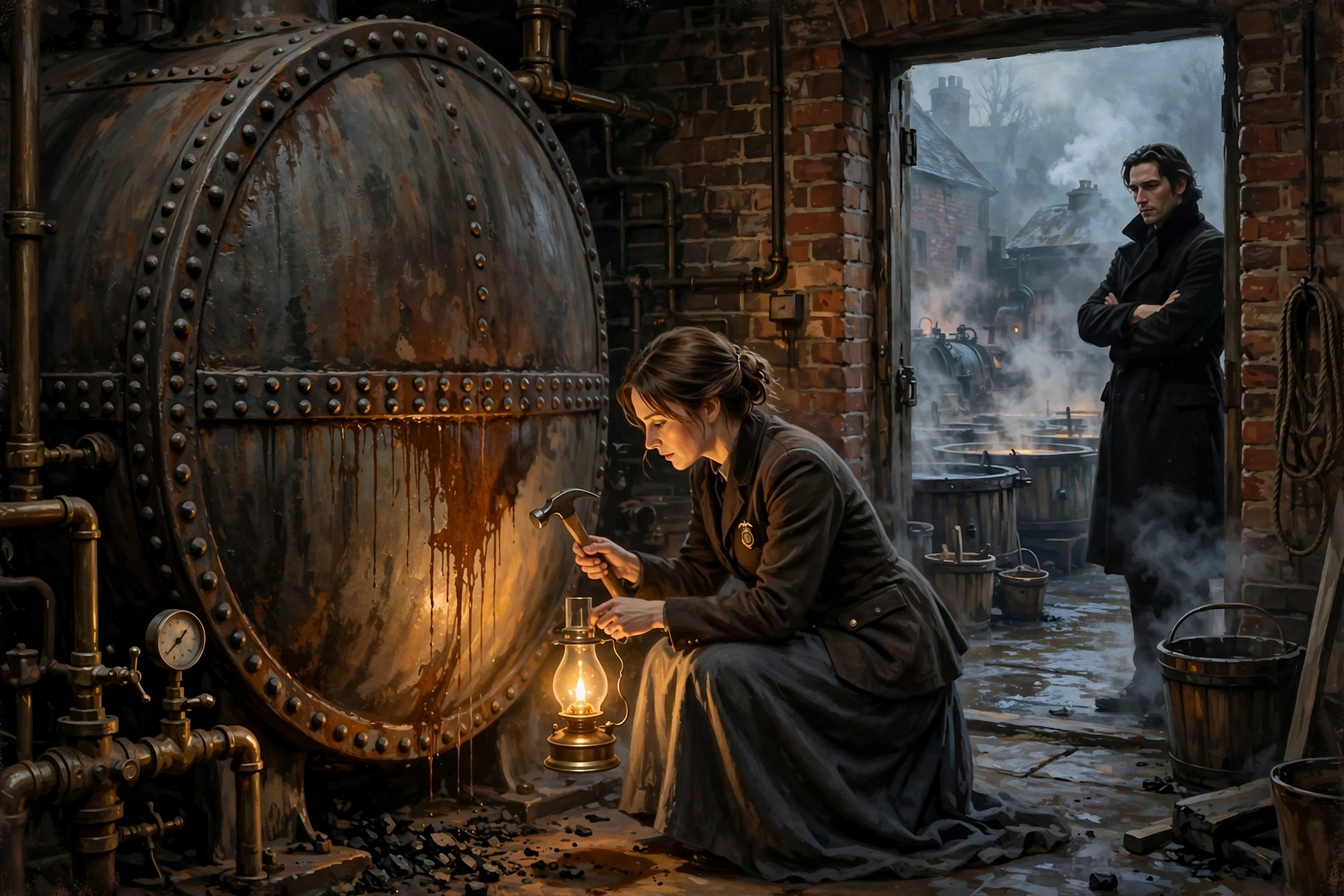
He didn't laugh. He stood in the doorway with his arms folded, tall and dark-coated, the kind of man who looked as though he'd been carved for a doorway and resented any other spot. Behind him the dye works hummed and dripped. Vats steamed in the yard. A cart loaded with bolts of khaki cloth creaked toward the Paisley road.
"Mr Moir knows I've a contract with the War Office," he said. "He knows I report for France in three weeks. And he sends a lass with a hammer."
"He sends his inspector with a hammer." She drew it out, a small chipping hammer worn smooth at the grip, and a wire brush, and a lamp. "The men he'd have sent are in France already, Mr Rennick. You'll be joining them. Until then you've got me."
"For the duration."
"For the duration," she agreed, and the word sat between them like a bill neither wanted to pay.
She'd heard it from every owner on the Clyde for two years. Duration. As though she were a coat lent against the cold, to be handed back with thanks when spring came. She'd stopped flinching at it. Mostly.
The boiler crouched in its brick setting, cold for the inspection, a long Lancashire shell that had seen more winters than either of them. She walked its length with the lamp held low, listening to her own boots on the plates.
"It was my father's pride," he said, behind her now. He'd come in after all. "He bought it secondhand from a mill in Johnstone and ran it thirty years without a day lost."
"Thirty years is a long time for a shell to be proud."
"Is that a professional opinion?"
"It's a sentence. The opinion comes after."
She found the staining low on the left flank, where the shell sat nearest the flue. A rust-brown tear ran down from a ring of rivets, dried and redried until it looked like old tea on a cup. A plate. Wrought iron, riveted on by hand, the heads uneven in a way no works machine would leave them.
She crouched. Her skirt pooled in the soot and she let it.
"What's this?"
He was quiet a moment too long. "A repair."
"I can see it's a repair. Whose?"
"My father's. Before my time running the place." He shifted. "It's held."
"It's weeping."
"Everything in a dye works weeps, Miss Lindsay. The walls weep. The windows weep. My bookkeeper weeps when the indigo prices come in."
That nearly made her smile, which annoyed her. She took up the wire brush and went at the rivet heads. Rust came away in flakes the colour of dried blood, and under it, around two of the heads, the iron had thinned and gone soft as biscuit. She set the brush down. She tapped once with the hammer, then again, a hand's width along. The first note rang. The second came back dull.
She knew that dull note. She'd heard it in her sleep for most of a decade, though she'd never heard it awake until she took this post. She'd been at her sums in the kitchen when the works whistle at the Govan yard went on and on and didn't stop, and her mother had put down the kettle very carefully, as if it might break.
A soft inspector had passed that boiler. Everyone said so afterward. A kind man, they said, who hadn't wanted to put forty hands out of work before Christmas. Her brother had been one of the forty.
"Miss Lindsay?"
She realised she'd stopped moving. She tapped again, to give her hand something honest to do.
"How long has this plate been on?"
"Before the old Queen died. I was a boy." He crouched beside her, which she hadn't expected. Up close he smelled of wet wool and something sharp and chemical, and there was a faint green stain along his thumbnail that no soap had shifted. "What do you hear?"
"I hear iron that's tired."
"Tired isn't on your form, I'd guess."
"No." She turned and looked at him straight. "Thinning is. Wastage is. I'll want it ground back and gauged, and a hydraulic test before I'll put a figure to anything."
"How long?"
"A week, if your men are quick."
He rubbed the back of his neck. "I've sixty hands in that yard who don't eat if this doesn't fire. I've a sister who'll be running the place by herself the day I sail. I don't have a week to spare, Miss Lindsay."
"Then you'll have a week you didn't spare. That's how time works."
"Do they teach you to talk like that at the Company?"
"No. I came that way. It's why the minister threw me out."
This time his mouth moved. Not a smile, exactly. The start of one, caught and put back. He stood, and offered his hand to help her up, and she looked at it a second too long before she took it. His grip was rough and warm and gone again almost at once.
She brushed the soot from her skirt and found it had no intention of leaving.
"You think I'm being difficult because I'm a woman," she said.
"I think you're being difficult." He considered. "The woman part I'm still deciding on."
"Decide quickly. I'll be back on Thursday."
She followed him out through the yard to his office, a narrow room above the dye store with ledgers stacked to the sill and one window looking down on the vats. A photograph on the wall showed an older man with Archie's jaw, standing proudly before the very boiler she'd just tapped. Someone had kept the glass very clean.
She drew the certificate from her satchel. Good card, the Company's crest at the head in neat letterpress, the lines below waiting: working pressure, date of examination, and two places to sign. One for the inspector. One for the owner. Neither valid alone.
She laid it on his blotter, face up and empty.
"What's that for?"
"So you'll know what it looks like," she said. "Both of us have to sign it before that boiler lights. Have a good look, Mr Rennick. Get used to the idea that one of those lines is mine."
She buckled her satchel and went down the stairs, and didn't look back to see whether he picked it up.
At the bottom she heard the scrape of a chair, and the small dry sound of card being lifted from a desk.
Dye Vats
"You're early," Archibald Rennick said, without turning round. "It's not Thursday."
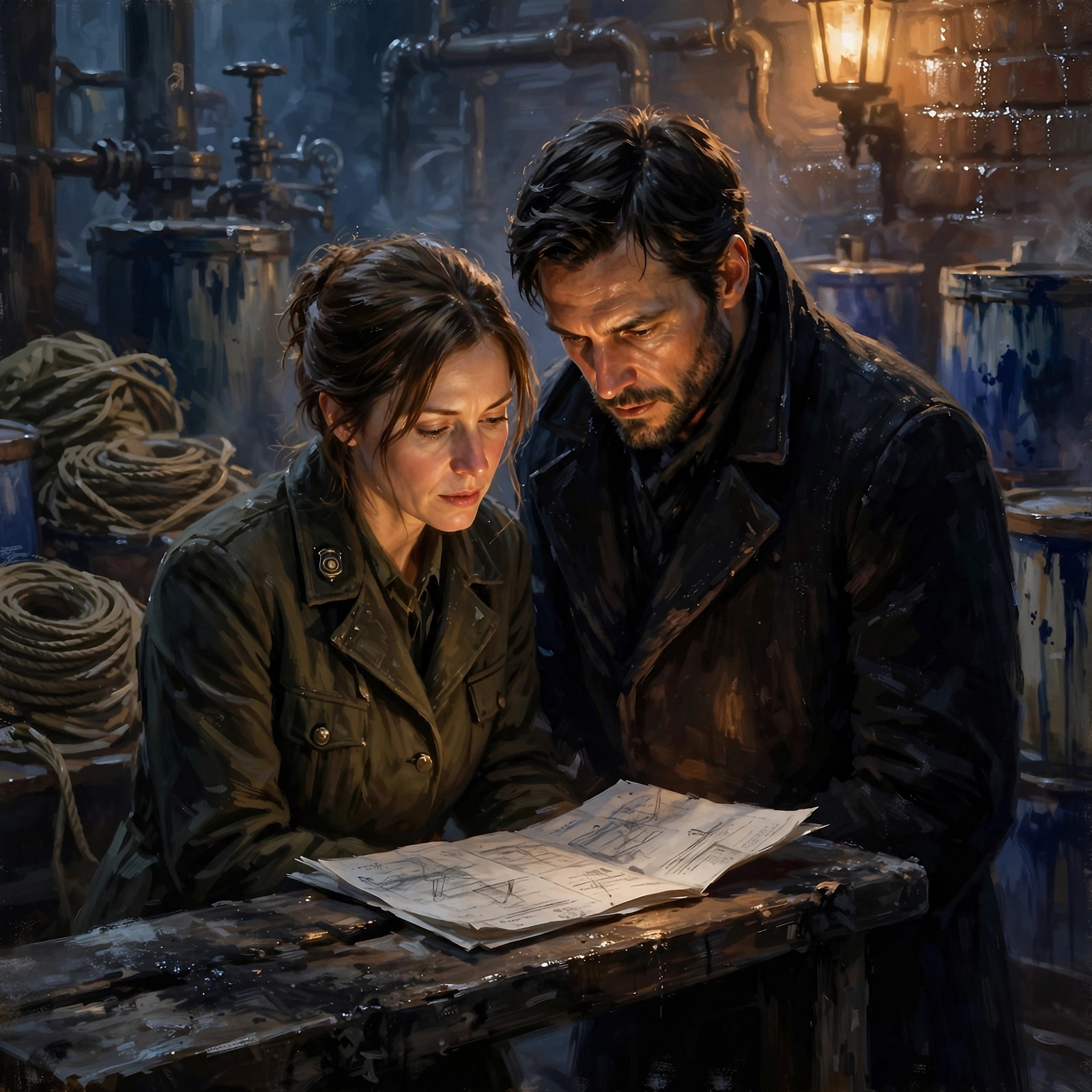
"It's Wednesday afternoon. I was passing." Euphemia stopped at the edge of the duckboards, where the yard's cobbles gave way to slatted wood slick with something brownish green. "Your men have the shell half ground. I looked on my way in."
"You looked on your way in." He was in shirtsleeves with a rubber apron tied over them, a long wooden paddle in both hands, leaning over the nearest vat like a man stirring porridge for a regiment. "Paisley's on nobody's way to anywhere, Miss Lindsay."
"Glasgow's a short train. I wanted to see the grinding before it went too far."
"Checking up on me."
"Checking up on iron. You happen to be standing near it."
He did turn then. There was a streak of dye along his cheekbone, the exact colour of every greatcoat she'd seen on Buchanan Street that winter. He held the paddle out to her, handle first.
"Since you're here. You've seen what the boiler does. Come and see what it's for."
She hadn't meant to take it. She took it. The wood was warm from his hands and heavier than it looked, and when she pushed it down into the vat the liquor resisted, thick and hot, steam curling up past her face. She lifted, and a length of wool came up over the blade, sodden and dark, the colour of mud and hedges.
"Khaki," he said. "Forty bolts a day when the boiler's running. Every one of them already sold to the War Office before it's dry. The vats want heat all day or the colour goes patchy, and a patchy batch comes back to us with a very polite letter."
"How polite?"
"Polite enough to cost us the contract." He took the paddle back and laid the cloth down into the liquor again, gently, the way her mother used to put a baby into a bath. "There's six vats in this shed and four in the next. They've been stone cold since Monday. You can hear it."
She could. The shed was too quiet. A dye works should hiss and knock and drip, and this one only dripped. At the far end a pair of women in head-scarves were folding dry cloth on a long table and not hurrying, because there was nothing to hurry for.
"I know what it's for, Mr Rennick."
"I don't think you do. Not yet."
"My brother worked a boiler at a laundry in Govan." She hadn't planned to say it either. It came out flat, the way she'd practised it for years in case anyone ever asked. "I know exactly what it's for. It's for everyone standing near it."
He went still with the paddle across the vat. She watched him decide whether to ask, and decide not to, and she was grateful for that and annoyed at being grateful.
"Archibald." A young woman was coming down the duckboards from the office stair, a ledger hugged to her chest and a pencil through her hair, quick on her feet in a way that said she'd walked these boards all her life. "The carter wants to know if he's to come Friday or not at all, and I've told him I'll ask the person who knows, so I'm asking her."
She stopped in front of Euphemia and put out a hand, ink on the side of the middle finger.
"Jessie Rennick. I keep the books. You'll be the inspector he hasn't stopped talking about."
"Jessie."
"He says you hit his boiler with a hammer and then insulted him."
"I tapped it," Euphemia said. "And I only insulted him once."
Jessie grinned, and it was her brother's mouth exactly, the version that hadn't learned to put itself back. "Twice, he says. He's counting. So, Friday?"
"Not Friday. I'll have the hydraulic test done Saturday if the grinding's finished. After that I'll know what I can set."
"Set," Jessie said. "Not pass."
"Set."
Jessie looked at her brother, a quick sideways look that went over his head like a ball between two people who'd played catch since they were small. "I'll tell the carter Monday, then, and pray." She tucked the ledger tighter. "I'd rather it was settled while he's still here to argue with you. Once he's on that boat it's my signature, and I'm far less pleasant."
"Jess."
"Well, it's true. Less than three weeks, Miss Lindsay, and he's away to France with the Engineers, and I'll be the one you're tapping at." She said it lightly. Her knuckles had gone pale on the ledger's spine. "So be kind to him. He hasn't the practice for losing."
"Jessie, the carter."
"Going." She went, back up the boards, and at the foot of the stair she glanced round once at the two of them standing beside the steaming vat, and something in her face settled, as if she'd added a column and liked the total.
Euphemia watched the door close behind her. "France."
"Royal Engineers. They want men who understand pressure and pipework." He hung the paddle on its hooks above the vat. "Somebody thought it was funny."
"Is it?"
"Not this week." He wiped his hands on the apron, which only spread the colour. "She'll manage. She's managed the books since our father went. She knows every hand by name and what their weans are called. She'll be better at it than me."
"Then why do you look like that?"
"Like what?"
"Like a man who's hidden the good spoons and can't remember where."
For a second she thought she'd gone too far. His eyes went past her, out through the open shed door to the boiler house, where the grinders were screaming against the shell, and stayed there a little too long.
"Because I'd like to leave her something that runs," he said. "That's all."
It wasn't all. She knew the shape of a man leaving things out; she'd sat across the table from enough owners with their hands folded over the very page she needed. But the steam was in her hair and the cloth was settling in the vat and he looked tired in a way that had nothing to do with grinding, and she let it lie. For now.
"You'll want those rivet heads gauged properly," she said instead. "I'll bring the Company's depth gauge Saturday, but it's shared between four of us and it reads short in the cold. If I drill test holes round the plate I want a reading I trust."
"Wait there."
He went up the office stair two at a time and came back down slower, carrying a flat wooden case no longer than her forearm, its corners worn round and pale with handling. He opened it on the lid of the dry vat. Inside, on faded green baize, lay a brass depth gauge with a fine steel needle and a vernier scale, polished until the numbers were soft at the edges, and a little notebook tucked in the lid with pencilled columns in an old, upright hand.
"My father's. He gauged every plate in that boiler himself, every year, and wrote it down." His thumb rested on the notebook a moment and then lifted away, as if it had touched something hot. "It reads true. He'd not have kept it otherwise."
"I can't take your father's gauge."
"You're not taking it. You're borrowing it." He closed the case and held it out to her across the vat, both hands, the way he'd held out the paddle. "And you'll bring it back, because you're the sort who would. And I'll know the numbers are honest, because they'll be his."
She looked at the case. She looked at him, the khaki streak on his cheek, the grinders howling in the yard behind.
Then she put her hands under his and took the weight of it.
Footbridge
"Another ten," Euphemia said, and Archie leaned on the pump handle again.
The boiler house had gone quiet at dusk, the hands sent home, the grinders silent, the shell filled cold to the crown with water from the Cart. Now there was only the creak of the hand pump, the tick of the gauge needle climbing, and the lantern hissing on its hook above the manhole.
She crouched by the patch plate with his father's notebook open on her knee. The ground rivet heads shone dull and new against the old iron, and the readings she'd taken that afternoon sat pencilled beside the old man's upright figures. The pattern had a gap in it. Every plate in the boiler was there, year after year, except this one. She'd noticed it on Thursday and said nothing, and she said nothing now.
"What does it read?" Archie was breathing hard. His shirtsleeves were rolled and his forearms were wet to the elbow.
"Hold it there." She brought the lantern close to the seam. "I'm looking for sweat. A bead, a hiss, anything."
"And if there's nothing?"
"Then you pump again, and I look again."
"You'd make a fine slave driver."
"I'd make a fine anything. They only let me be this one." She ran her thumb along the lower edge of the plate. Dry. Then not dry. "Give me five more. Slowly."
He gave her five. The needle trembled up. She bent until her nose was nearly on the iron, and there it was, a thread of water standing out from beside the second rivet, thin as a hair, then not thin at all.
"Ease off--"
The rivet head let go with a crack like a snapped stick, and the water came out sideways, white and hard, straight into her lap.
She went over backwards onto the brick. The lantern swung wildly. Somewhere above her Archie was swearing and hauling on the relief cock, and the jet hissed and staggered and died to a dribble, and she lay in a spreading pool of Cart water with his father's notebook held high over her head in one fist.
"Euphemia." He was on his knees beside her. "Are you hurt? Did it catch your face?"
"It caught everything below the waist." She sat up. Her skirts clung to her shins like wet paper. "The book's dry."
"Damn the book."
"Don't you dare. It's the only honest record in this building." She handed it to him and watched him close it carefully, which told her more than his swearing had. Then she looked at the plate, at the pale hole where the rivet head had been, and the cold settled in her properly.
That was cold water. At working pressure it would have been steam.
Archie had seen it too. He sat back on his heels and didn't say anything for a while, and the dribble from the hole slowed to drops.
"Well," he said at last. "That's a reading."
"That's a reading."
He helped her up. Neither of them mentioned his hand staying on her elbow on the way out.
The yard was dark and the mill chimneys of Paisley stood black against a green sky. He walked her toward the White Cart Water footbridge because it was the short way to the tram, and because, she suspected, he didn't want to go back to the office and sit with the notebook. Her boots squelched at every step. Halfway across the bridge she stopped and wrung out a fistful of hem over the rail, and the water pattered down into the river.
"My brother would've laughed himself sick at this," she said.
Archie leaned on the rail beside her. "The laundry boiler. In Govan."
She hadn't expected him to remember. "Aye. He used to come home soaked to the oxters and Mother would make him strip in the close." She twisted the hem again, harder. "It was a rivet too. That's what they said after. A plate that should've been off years before, and a man from a company like mine who'd passed it four times because the owner gave him tea and called him sir."
"You think he took money?"
"I think he was kind. I think he didn't want to be the man who shut the laundry." She let go of the cloth. "Kind killed my brother, and nine women folding sheets."
He was quiet. The river went on under them, brown and quick.
"So you're not kind," he said.
"I'm careful. Moir thinks a woman in this work will go soft the first time an owner looks sorry. Half the yard thinks it too. I'd rather be called a harridan than sentimental." She glanced at him. "You'll be glad to hear tonight's been very unsentimental."
"I'm devastated."
"You've got water in your eyebrows."
"You've got water everywhere."
She looked down at herself, at the black skirt plastered flat, the drip off her cuffs, the hem in a sodden rope round her ankles, and something in her chest gave way, and she laughed. Not politely. It came up out of her loud and helpless, the laugh her brother used to get out of her by putting frogs in her boots, and she had to hold the rail.
Archie didn't laugh. He was looking at her as if she'd done something he would have to write down.
Then he kissed her.
It wasn't tidy. His hand was cold and wet against her jaw and his mouth was warm, and she caught at his sleeve, meaning to push him off, and didn't. A tram bell rang somewhere up the road. She stopped hearing the river.
When he drew back he looked as startled as she felt.
"That was," she began.
"Very unsentimental. Aye." His voice wasn't steady. "I'm away in three weeks, Euphemia. I shouldn't have."
"No," she said. "You shouldn't." She didn't step away.
He let out a breath and unwound the grey wool scarf from his neck and put it round hers, crossing the ends over her wet collar with great attention, as if it were a seam he was caulking.
"You'll catch your death."
"I'll bring it back Monday."
"Keep it till the plate's fixed." The lightness went out of his face. "We'll talk about the plate."
"We will," she said, and she meant it as a warning, and he heard it as one.
On the tram she sat in the corner seat with her skirts dripping onto the slats and her report already forming in her head, the sharp words lining up. Her hands, without asking, stayed buried in the wool at her throat. At her stop she took it off, folded it, and put it in her satchel beside the blank certificate. She did not take it out again that night, and she did not give it back.
Condemned
"You've not declared it," Euphemia said. "Not once. Not in eighteen years of Company books."
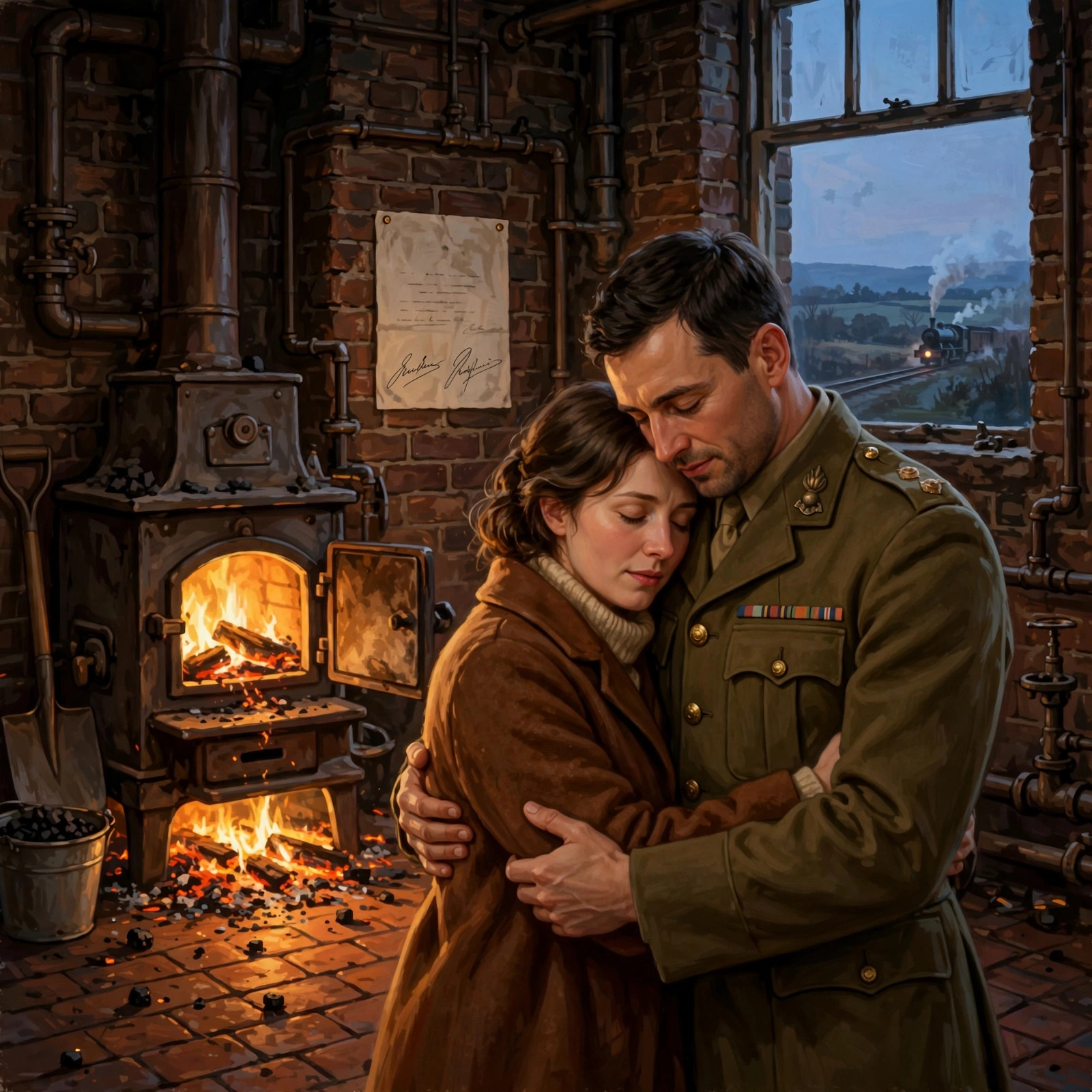
Jessie Rennick looked up from the ledger with her pen still lifted, a bead of ink gathering on the nib. "Declared what?"
The works office was narrow and warm, the window over the yard fogged at the corners with steam. Euphemia had come straight from Glasgow on the early train with the Company's register copy under her arm, and she set it open on the desk beside the blank certificate, the one she had carried back and forth in her satchel for a week like a debt.
"The repair plate on your boiler shell. Riveted, wrought iron, by the look of it about the turn of the century. Any repair to a pressure vessel insured by Clyde Steam has to be declared and examined. There's nothing here." She tapped the column. "Your father insured this boiler every year and never wrote a word about it."
Jessie set the pen down. She had her brother's dark brows and none of his habit of hiding behind them. "There's a plate?"
Euphemia stopped.
"I do the books," Jessie said slowly. "I've done them since I left school, near enough. Insurance, coal, wages, the army contracts. Archibald does the boiler. He's always done the boiler." She stood and went to the window and wiped a circle in the fog with her sleeve. "He said the test on Saturday went badly. He said it was a rivet."
"It was a rivet. Beside the plate. The iron round it's gone soft." Euphemia heard her own voice tighten and made herself slow it. "His father's notebook has gauging for every course of that shell. Every one but the plate."
Down in the yard a cart was backing into the loading bay, and the carter was shouting at the horse. Beyond it the boiler house door stood open, a red glow inside where the stoker had banked the fires overnight and was raising them now for the morning's dyeing. The khaki vats would be wanted by nine.
"Where is he?" Euphemia asked.
"Glasgow. The depot, about the uniform cloth. He'll be back on the half-ten." Jessie turned from the window. "Miss Lindsay. What happens?"
Euphemia looked at the certificate. Clyde Steam's letterpress crest, the printed lines for working pressure, for date, for inspector, for owner. The scarf lay folded square in her satchel. She thought of Moir across his desk the day she'd been taken on, saying the trouble with women in this work was they'd sign anything for a man who looked tired. She thought of a laundry in Govan, and a door blown off its hinges, and her mother's face.
She uncapped her pen.
"They've got the fires up," she said. "That boiler isn't to be fired until it's repaired and tested. Not at any pressure."
"He'll be back at half ten--"
"And they'll have had steam on it for an hour and a half by then." She wrote CONDEMNED across the face of the card in square capitals and signed beneath. The ink went into the stock unevenly, catching on the grain. She left the owner's line bare. Then she picked the card up and went down the stairs.
The yard was full. It always was at the start of a shift, women in clogs and shawls coming through the gate, men rolling sleeves, the girls from the drying lofts laughing in a knot by the pump. Some of them knew her by now. One of the older dyers raised a hand.
Euphemia went into the boiler house. The stoker was a broad, slow man with his cap on backwards, and he straightened from the firebox door when he saw the card in her hand.
"Draw your fires," she said.
He looked past her, toward the yard. "Mr Rennick's not--"
"I'm the Company's inspector and the boiler's condemned. Draw them now, please, and open the dampers."
He did it. She'd half thought he wouldn't. He took up the long rake and hauled the burning coal forward onto the plates in heaps of orange, and the heat rolled out and scorched her face, and she stood in it and didn't step back. Behind her the yard went quiet in a spreading way, the way a church does.
She came out into it and pinned the certificate to the boiler house door with the drawing pin from the old notice there.
"There'll be no steam today," she said, loud enough for the back of the yard. "Nor till it's made safe. I'm sorry for it."
A woman near the gate said, "And our wages?" and someone else said, "He's away to France, who's to sort it?" and the sound came up all at once, hard and frightened. Euphemia didn't answer it. She had nothing that would answer it.
Jessie was at the foot of the office stairs with her arms folded tight.
"You could have waited for him," she said.
"I could have waited for him to talk me out of it."
Jessie looked at her for a long moment, and then turned and went in to the wage book, as if someone ought to be doing something useful.
He came at twenty to eleven. Euphemia heard him before she saw him, his step on the cobbles, then nothing, which meant he'd seen the door. When he came up into the office his face had no colour in it at all.
He had the certificate in his hand. He'd taken it down himself.
"Sixty folk," Archibald Rennick said, "stood in my yard while you drew my fires. And I heard it from the carter at the station."
"You'd have argued."
"Aye, I'd have argued. It's my boiler." He set the card down on the desk between them, very carefully, the way he'd crossed the scarf over her collar. "You read the notebook. You saw. You said nothing on Saturday, nothing on the bridge, and then you went to Glasgow and dug it out of the register and you came back and did this before I could open my mouth."
"Your father put a plate on that shell and never declared it."
"I know."
Jessie's head came up from the wage book.
"I've known since he died," he said, to the desk. "I found it the first time I went in with a lamp. I thought, he must have had a reason. I thought, I'll see to it next year when the contracts are steady. And then there was the war, and the army contracts, and Jessie's to have this place on her own." He looked at his sister then, and away again. "I wasn't going to leave her a fine and a scandal and a closed works."
"So you'd leave her a burst shell instead," Euphemia said.
It landed. She watched it land and wished it back and didn't take it.
"You'll want my signature," he said quietly, "on whatever comes next. A repair order. A reduced pressure. Some paper for Moir."
"Yes."
"No." He didn't raise his voice. He didn't touch the card, didn't tear it, only pushed it an inch back toward her with two fingers. "I'll not put my name to anything you've written today. Not till I can look at it without seeing my yard."
"Archibald," Jessie said.
"I'm going down to tell them myself," he said, "since nobody else thought to." And he went, and the stair creaked under him, and in a minute Euphemia heard his voice out in the yard, lower than hers had been, and the noise of the crowd coming down to meet it.
She stood in the office with Jessie not looking at her.
Then she opened her satchel and took out the grey scarf, still folded square, and laid it on the desk beside the condemned certificate, and went out by the side gate so she wouldn't have to cross the yard.
New Plate
"You'll not be in the shell when they drive the rivets," Duncan Moir said. "You'll be in the yard with your clipboard like a sensible woman."
Euphemia pulled the boilermaker's leather apron over her skirt and knotted it twice. "If I'm in the yard, I'm guessing. I've done enough guessing for one boiler."
Moir stood by the open manhole with his bowler in his hand, as if the boiler were a grave and he'd come for the burial. Above them the dye works was quiet in a way she had learned to hate that week: no hiss, no thump of the vats, only the boilermakers' hammers and somewhere in the sheds a woman singing to keep herself busy.
"Miss Lindsay." He lowered his voice. "The board meets in a fortnight about the permanent places. I'd put your name forward. I'd still like to. But if you sign off a repair you supervised with your own hands, on an undeclared plate the Company never knew of, and it goes wrong, it's not the works that hangs. It's you. And me for hiring you."
"Then it'd better not go wrong."
"That's no answer."
"It's the only one I've got." She took the lamp from its hook. "The plate came out yesterday. I measured the shell behind it myself. There's good iron under there, and the new plate's thicker than the old. I want to see every rivet go in hot."
He looked at her a long moment. Then he put his bowler back on, which with Moir was a kind of decision. "Then I'll tell the board you weren't ready for a permanent post. You'll keep the duration. That much I can hold for you."
It went in under her ribs, cleaner than she'd expected. She'd wanted that post since the first morning a works foreman had looked past her to ask where the real inspector was.
"Thank you," she said, and meant it, and climbed in.
Inside, the shell smelled of iron filings and old scale. The square hole where the father's plate had been was lit from outside, a pale window in the curved dark. The old plate itself lay on a sack out in the yard, its rivet holes ragged where the chisels had cut them. She'd turned it over last night and found initials scratched on the inner face, small and careful, and a year: 1899. She hadn't said so to anyone.
The new plate was swung into place from outside. The holdup man braced his dolly inside beside her. Then the first rivet came through glowing, and the hammers began.
She counted nothing. She watched. She put her lamp to every head as it cooled, ran her thumb round the edge of each, and twice made them cut one out and drive it again. The boilermaker swore the second time, then apologised, then swore again under his breath, and she let him.
By the afternoon her hair was full of grit and her wrists ached from holding the lamp. When she crawled out the manhole the light made her blink, and the first thing she saw was Archibald Rennick standing at the foot of the brick setting.
He'd been in Glasgow again. She could tell by the good coat and the train soot on his cuffs. He hadn't been in the yard since the fires were drawn, not while she was there.
Moir saw him too. "Mr Rennick."
"Mr Moir. I went to your office this morning. Your clerk said you'd be here." Archibald didn't look at her. He looked at the old plate on its sack. "I've a thing to tell you, and I'd rather tell it where I can see what it cost."
"Go on, then."
"That plate's my father's work. He put it on before the old century was out and never declared it. I found it when he died. I knew, and I kept firing at a hundred pounds on top of it, every day since." His jaw worked. "Miss Lindsay didn't find it by luck. She found it because she does her job. I'll pay what the Company fines. I'll sign whatever you need."
Moir was silent long enough that the singing woman in the sheds trailed off.
"You'll pay a fine," he said at last. "A large one. And you'll be grateful it isn't a magistrate."
"Aye."
"And who's to run this place while you're digging trenches for the Engineers?"
"My sister." Archibald said it plainly, as if he'd practised the plainness on the train. "She's kept the books four years. She knows the contracts better than I do. I should have told her about the plate the day I found it." He finally glanced at Euphemia, quick, then away. "She knows now. She'll keep the pressure where it's set."
"Where it's set," Moir said, "is up to Miss Lindsay."
Euphemia wiped her hands on the apron. Her voice came out rougher than she liked. "Sixty pounds. Not a pound more for the life of that shell."
"Sixty." Archibald nodded slowly. "It'll slow the vats."
"It will."
"The army'll grumble."
"Let them."
Something moved at the corner of his mouth. Not a smile. Something nearer to it than she'd seen in a week.
They filled her cold for the hydraulic test, the yard hands working the pump while Moir stood at the gauge with his watch out. Euphemia went round the new plate with the lamp, then round it again, crouched on the setting with her cheek near enough the iron to feel the chill. Archibald stood a little behind her. He didn't speak. Once, when she shifted her footing on the wet brick, his hand came out and stopped an inch from her elbow, and stayed there till she was steady, and went back to his pocket.
The needle climbed. She watched the seams, not the gauge. No weep. No bead of water at any head. Moir called the test pressure and held it, and the yard held with him.
"Dry," she said at last, and heard her own voice crack on it.
"Dry," Moir agreed, and snapped his watch shut.
They let it down, and fired her by evening, slow, the way the old men liked. Euphemia stayed by the gauge glass while the steam came up. Archibald had gone up to the office, and came back down with a fresh certificate, the ink still wet where his name sat beside the space for hers.
He held it out. Not across a desk this time. Hand to hand.
She took it, and the pen he offered after it, and wrote her name and the figure in her clearest hand, and stood with him while the needle rose and settled, steady, on sixty, and stayed.
Boiler House Dawn
"You'll get soot on the uniform," Euphemia said.
Archibald looked down at himself as though he'd forgotten what he was wearing. The khaki was new enough to crease wrong at the elbows. He had the Sam Browne on already, and the cap under his arm, and he'd come into the boiler house sideways through the half-door the way the stokers did, ducking his head.
"It's the same colour as the cloth we dye," he said. "If it gets dirty, nobody in France will be able to tell."
"Your sister will be able to tell."
"Jessie'll be able to tell from Paisley." He set the cap on the bench by the gauge glass, beside her satchel. "She's at the station already. Said she'd keep my seat and my temper both."
The boiler sat cold in its brick setting, banked down overnight so the yard men could clear the flues before the new week. The grey light from the high windows lay along the shell and found the new plate, its rivet heads still bright where the hammers had dressed them. Outside, somewhere past the drying sheds, a cart was being loaded. Otherwise there was only the drip of the feed tank and the two of them.
She hadn't meant to come. She'd told herself so on the first tram and again on the walk along the river. The certificate was signed; the pressure was set; an inspector had no business at a works the morning its owner left for the war.
She'd come anyway, with the frame under her arm wrapped in brown paper.
"What's that?"
"Glass and a backboard. The card'll curl in the damp otherwise, and then some fool will say he couldn't read the figure." She unwrapped it on the bench. "I'd rather nobody had an excuse."
He watched her slide the certificate out of her satchel. Their two names sat side by side at the foot of it, his heavier, hers small and very straight. Sixty, in her hand, in the box for working pressure.
"You took it home," he said.
"I took it to have it framed. I'd have hung it on Friday if the man had been quicker." She fitted the card under the glass and pressed the back down, her thumbs careful at the corners. "Don't look at me like that."
"Like what?"
"Like I've done something soft."
He didn't answer that. Instead he reached into his tunic and brought out a notebook, small and black and fat with use, its spine mended with tape. She knew it before he opened it. She'd stood in his office the second day and turned its pages, his father's tidy columns, every repair since the nineties, and the long silence where the patch should have been.
"I've been meaning to do this all week," he said. "I kept not doing it."
He turned to the last written page and laid the book open on the bench. Below his father's final entry, in pencil gone faint, he'd written in ink: the year, the plate, wrought iron, hand-riveted, never declared. Then the date of the test that failed. Then the date of the new plate, and the words cut out and replaced under the eye of Miss E. Lindsay, Inspector.
Euphemia read it twice. Her throat had gone tight in a way she didn't care for.
"He'd have hated that," Archibald said. "Him and his clean books. But Jessie should have the truth in his hand and mine, not have to dig for it." He held out the pen. "It wants your name. You were there. I wasn't, not properly. I was in Glasgow making excuses."
"You were in Glasgow confessing."
"Eventually."
She took the pen. She signed under his line, inspector's style, surname and initial and the date, and then he took the pen back and signed beneath her, and for a moment they both stood looking at it, the ink drying in the cold.
"There," he said quietly. "Now it's true on paper too."
She picked up the frame. There was a nail already in the whitewashed wall by the gauge glass, left from the old notice board, and she reached for it, and she reached for it and found she was a hand's breadth short.
"Give it here."
"I can reach."
"You can't. You're on your toes."
"I'm on the setting brick."
"You're on your toes on the setting brick, and if you fall into the ash pit I'll miss my train fishing you out." He took the frame from her, gently, and hooked the wire over the nail, and straightened it with one finger until it sat level. Then he didn't move away.
She was close enough to smell the new wool of his tunic and the coal on the air. She looked at the certificate rather than at him.
"Moir asked me on Saturday whether I regretted it," she said. "The post. He said a permanent man would've been easier for him to put up for, after the war. He said I'd let my feelings get into the iron."
"Did you?"
"I don't know." It came out sharper than she meant. She made herself go slower. "My brother's boiler was passed by a man who liked the owner. That's all I've ever thought about, walking into a place like this. Don't like anybody. Don't let anybody like you." She pressed her lips together. "And then I went and stood in your boiler with a lamp for a day and a half, and it wasn't for the Assurance."
He was very still beside her.
"It was a good plate, though," she said. "I'd have passed it for anyone."
"I know you would." His voice had gone rough. "That's why I signed."
He bent, then, to the firebox door, and swung it open on its hinge, and took the box of matches from the shelf where the stokers kept them. The kindling was laid already, paper and shavings and good dry coal over it. He struck a match and it flared and died in the draught. He swore under his breath.
"Shield it," she said, and crouched beside him, and cupped her hands round the second one.
It caught. The paper curled and went gold at the edges. Neither of them stood up.
"I've something of yours," he said, not looking at her. He reached into his tunic again and brought out the grey scarf, folded small. "You left it on my desk. I thought about taking it with me. Then I thought you'd want it back to throw at me properly when I come home."
"Is that what you think?"
"I think I was a fool on that floor in front of sixty hands and you were right and I couldn't stand it." He turned the scarf over in his fingers. "And I think I love you, Effie. I'd like to have said it on the footbridge and I didn't. I'm saying it now, in a boiler house, with soot on my uniform, because I've a train in an hour and I'm done keeping things off the books."
The fire ticked and settled. She took the scarf from him and didn't put it away. She wound it once round his neck instead, over the stiff new collar, and held both ends.
"I love you," she said. Plainly, because he had. "Come back and argue with me about pressure."
"I'll come back."
"Promise it. I don't sign for anything I haven't seen."
"I promise." He put his forehead against hers. "And you'll look in on Jessie. And not let her raise it."
"Not a pound."
He laughed, short and unsteady, and then his arms came round her and she held on to the ends of the scarf and to him, crouched there on the cold brick, until her knees ached and she didn't care.
When they rose, the coal had caught properly, red under the shavings, and the first warmth was coming off the firebox door. Above it, level on its nail, the certificate hung on the wall with both their names showing through the glass as the fire caught.
Get notified when new stories drop

Marcus Hale
Marcus writes slow-burn and marriage-of-convenience stories where logistics become intimacy and competence is a love language.
Leave a comment
Comments