


The Hedge Corner
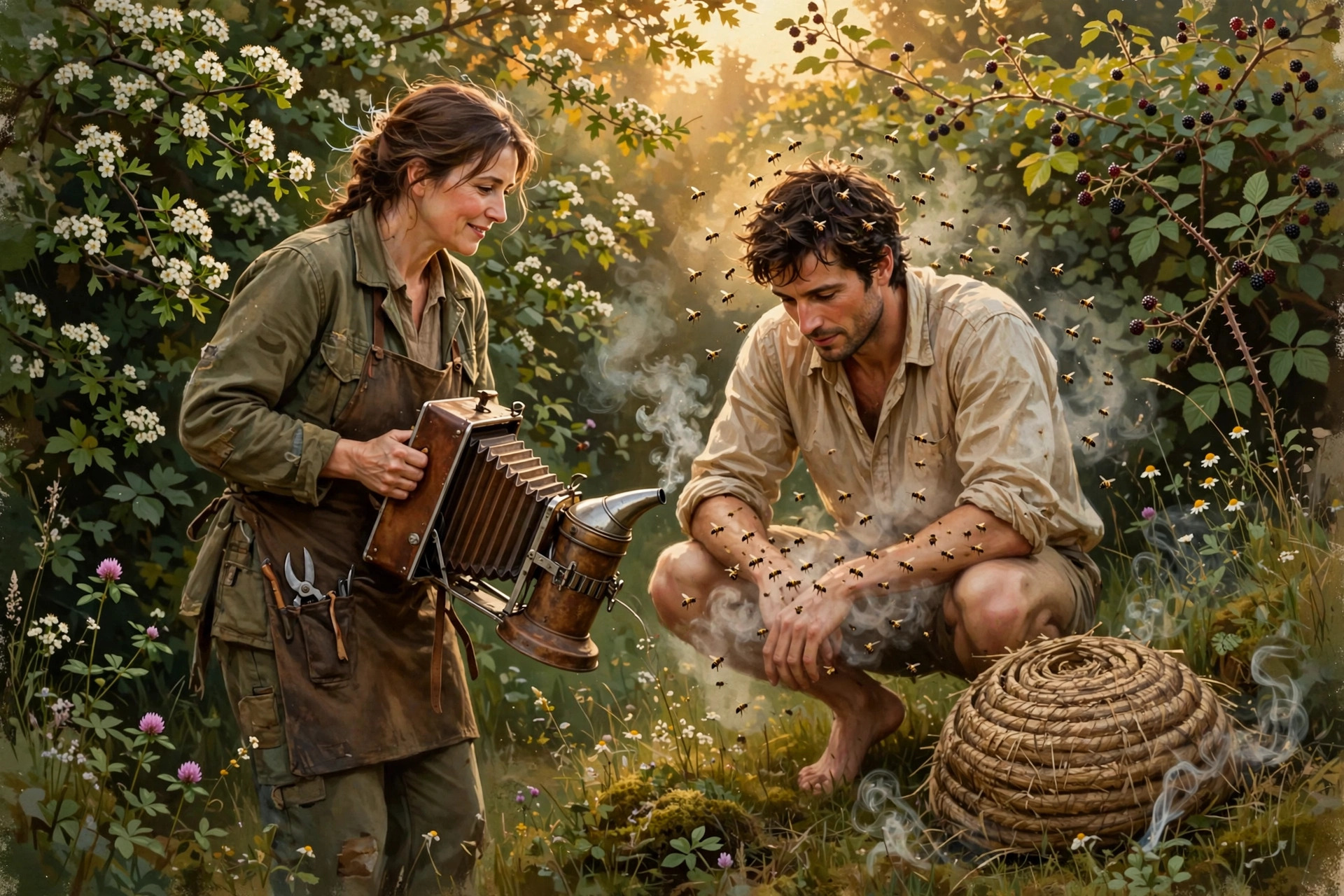
"You're standing in my bees," Rosamund said, and the man at the old hive didn't even turn around.
He was crouched in the hedge corner where the hawthorn met the bramble, one palm flat on the straw dome her grandmother had coiled and stitched long before Rosamund was born. The colony was out in force, a brown cloud thick enough to blur him. They were landing on his wrists, his collar, his hair. Not one of them was stinging.
"They're not yours," he said. "Not yet."
She had the smoker in her hand, already puffing, the leather bellows creaking the way it had since her mother riveted the thing together. She lifted it toward him, meaning to clear the air between them, and a dozen bees left his sleeve and came straight at her face.
She flinched. The smoker hit the ground, rolled, and spilled a smear of glowing burlap into the dry grass.
"Oh, for--" She stamped at it with her boot. Smoke curled up around her ankles.
The man finally stood. He was tall, rumpled, wearing a shirt the color of old wax and no shoes at all. He stepped on the last ember with one bare heel as if it were nothing, then picked up the smoker and turned it over in his hands. The nozzle had bent where it struck a stone. When he squeezed the bellows, it only wheezed.
"Sorry," he said. "They don't like it near the old ones. Makes them think of fire."
"It is fire. That's the point." She held out her hand. "Give it here."
He gave it here. His fingers were warm and smelled faintly of propolis, resinous and sweet. A bee walked off his knuckle onto hers, considered her, then flew home.
Rosamund looked at the bent tin and felt the afternoon tilt. She'd have to straighten it tonight, or buy a new one, and new ones weren't in the budget. Nothing was in the budget. The orchard cooperative's man was coming at the end of the month to confirm the contract, and the contract wanted every hive she had, all forty of them, trucked down to the Ashcombe Valley orchards in time for bloom.
"Who are you?" she asked.
"Elias."
She waited. He didn't offer anything else. He was looking at the straw hive the way people looked at photographs of the dead.
"Elias," she repeated. "Is that all I get?"
"It's the part that's easiest to say."
"Well, Elias, this is private land, and that hive is older than both of us put together, so if you've come to steal it, you've picked the worst-tempered colony in the county."
That got a smile out of him. It was a lopsided, startled thing, as if he hadn't used it in a while. "They're not bad-tempered. They're grieving."
"Grieving what?"
He didn't answer. A breeze moved through the hawthorn and the colony's hum dropped half a note, deep and settling, like a cello finding its tune. Rosamund had kept these bees for most of a decade and she'd never heard them sound like that. She found herself standing very still.
"They do that for you?" she asked quietly.
"They do it for themselves. I just listen."
She ought to call someone. She ought to walk back to the house, dial the sheriff's office, and let a deputy deal with a barefoot stranger talking poetry in her hedge. Instead she crouched beside the hive, because the bees were calm and she'd never once seen them calm, and that was its own kind of emergency.
"My grandmother made this," she said. "Straw and bramble. Oak board underneath. She said it was the only hive that ever came to her on its own."
"It did."
"You say that like you were there."
He crouched again, close enough that his shoulder almost brushed hers. "I've been near it a long time."
"I'd have noticed you."
"Would you?" He tipped his head toward the field, the forty white boxes in their rows, the barn with its sagging door, the truck with one bad tire. "You notice the work. You don't look up much."
Rosamund opened her mouth to argue and found she couldn't. She'd stopped looking up the year her father drove away with half the equipment and none of the debt. She'd been a girl then, and she'd learned what a failing apiary sounded like: silence in the boxes, silence at the supper table, then an engine in the lane at dawn. She'd rebuilt every hive since with her own hands, and she didn't ask anyone for help, because asking was how you found out who'd leave.
"You don't know me," she said.
"No." He said it gently. "But they're starting to."
A single bee landed on the back of her hand and stayed there, walking in a slow circle. Elias watched it with an expression she couldn't read, something hungry and frightened at once.
The sun was sliding behind the ridge. The air had gone cool and gold. Rosamund stood, brushing straw off her knees, and he stood with her.
"Where are you staying?"
He glanced at the hive. "Here."
"Here is a hedge."
"I'm not going far from them." Something in his voice tightened, then smoothed over before she could catch hold of it. "I can't. Not tonight."
"Can't, or won't?"
"Does it matter?"
It did, but she couldn't have said why. She looked at his bare feet, at the bees still drifting around his shoulders like they'd chosen him for a reason she hadn't been told. She looked at the bent smoker in her own hand.
"There's a barn," she said. "Loft's dry. There's a cot from when I used to sleep out during swarm season. No heat, and the door sticks."
"I don't need heat."
"Everybody needs heat. There's a wool blanket in the trunk. Don't touch the extractor, don't touch the truck, and if you're gone in the morning with any of my frames, I will find you."
"I'll be here in the morning."
He said it like a promise, and that was the part that unsettled her. People made promises in the evening. Mornings were when they kept them or didn't.
"We'll see," she said.
She walked him to the barn and wrestled the door open. He stepped inside and turned in a slow circle, looking at the rafters, at the stacked supers, at the hook where her mother's old veil still hung. Then he held out his hand.
"The smoker. I'll fix it."
"You bent it."
"So I'll fix it."
She hesitated, then handed it over. It was a small thing. It shouldn't have felt like trust.
From the hedge corner, faint across the dusk, the old colony was still humming, low and even. Elias tilted his head toward the sound the way a man listens for someone calling his name.
Rosamund pulled the door most of the way shut and left it open a crack, so he could hear them.
Brookfold Market Stall
"You can come round the table," Rosamund said, for the second time. "Nobody bites over here. Not even my mother."
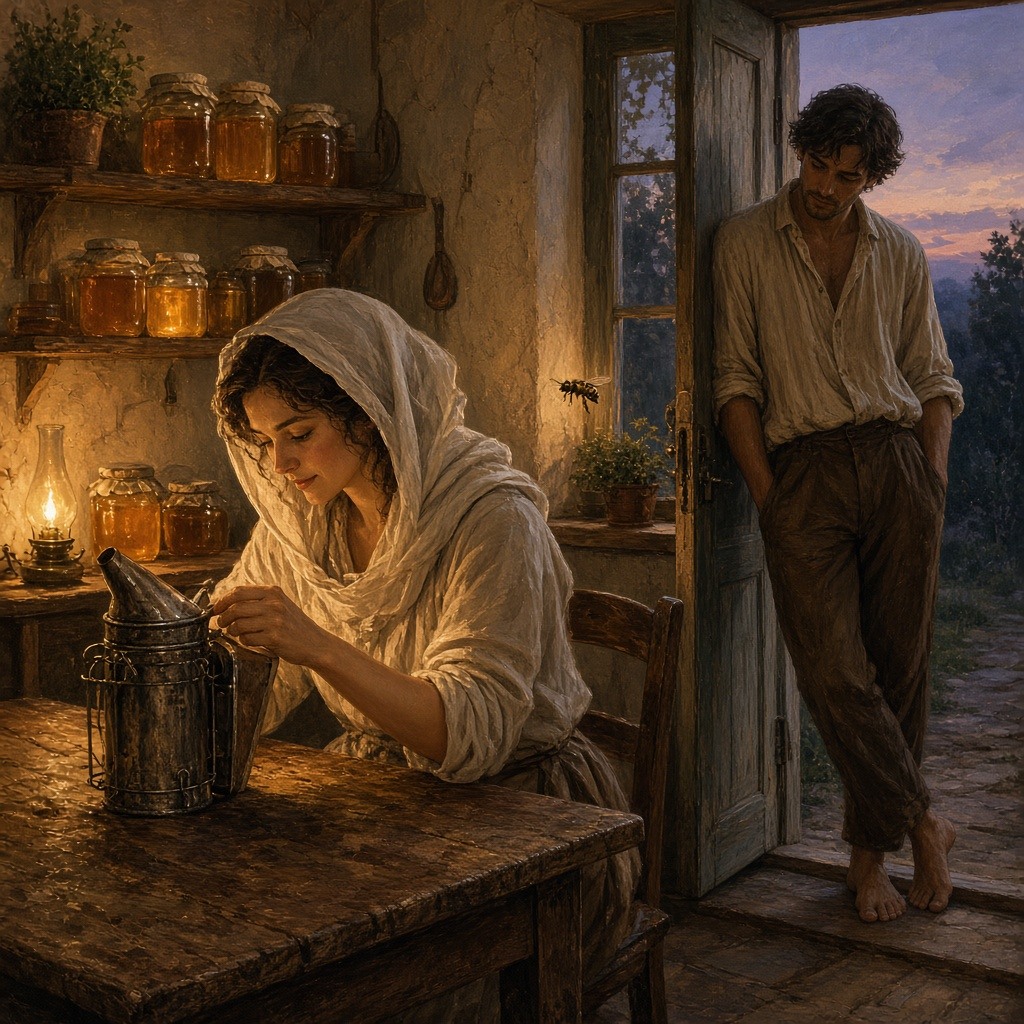
"I'm fine where I am."
Elias stood at the far end of the stall, where the trestle met the hedge that ran along the market green. One hand rested flat on the canvas awning pole as if it might blow away. Beyond the hedge, the lane climbed toward Hollin Apiary, and if the wind came right you could just hear the hives from here, a low thread under the market noise.
He'd been standing in exactly that spot since they'd unloaded the crates.
"You're blocking the comb honey," she said.
He shifted half a step. Not one inch further toward the middle of the green.
Marta, arranging jars in their tidy amber rows, didn't look up. "Leave him be, Rosie. He's minding the corner."
"The corner doesn't need minding."
"Every corner needs minding." Her mother set a jar of heather honey at the front, label squared. "Ask your grandmother."
Rosamund opened her mouth and shut it again. Three days the man had slept in her loft, and every morning she'd come out expecting an empty cot and found him already at the hedge, sitting cross-legged in the dew beside the old straw hive with his head tipped toward it. He ate what she left on the barn step. He hadn't touched the truck. He hadn't touched the extractor.
He'd touched the smoker, though.
He'd handed it back to her this morning without a word. The tin nozzle was straight again, a faint seam where he'd worked it true, and the leather bellows had been oiled until it breathed easy. Her mother had made that smoker before Rosamund could walk. It hadn't puffed that clean in years.
She'd said thank you. He'd looked surprised, and then pleased, and then he'd gone back to the hedge.
"Morning, Achterlees."
Desmond Kerr came across the green in his cooperative fleece, a clipboard tucked under one arm the way other men carried newspapers. He nodded to Marta, picked up a jar, held it to the light, and put it down again in the wrong row. Marta moved it back.
"Desmond," Rosamund said. "Didn't expect you till next week."
"Board met early." He tapped the clipboard. "Ashcombe Valley's blooming ahead of schedule. Warm spring. They want the hives in the orchards by the end of next week, and they want the full count."
"I know the count."
"Forty." He said it anyway. "Forty strong colonies. Not thirty-nine and a promise. Last year Pruett's outfit came up short and the board's still sore about it. I went to bat for you, Rosamund. Eighteen thousand's the best rate in the county."
She knew the number. She'd written it on the inside of the feed shed door in grease pencil, under the mortgage figure, so she'd see both every morning. Eighteen thousand dollars was the difference between Hollin staying Hollin and Hollin becoming somebody's paddock with a pretty view.
"I've got thirty-nine boxed and ready," she said. "The fortieth's the old colony."
Desmond frowned. "That straw thing your gran kept?"
"It's not a thing. It's the strongest hive I've got."
"Then it's the fortieth." He shrugged, not unfriendly. "Board doesn't care what it's made of, long as it's bees and they're working."
At the end of the table, Elias's hand had tightened on the awning pole. She saw his knuckles go pale. He didn't say anything. He was looking up the lane toward the apiary, the way he'd looked at the barn rafters that first night, as if listening for something only he could hear.
"It's never been moved," Rosamund said. "Not once. My grandmother set it down in that corner and it's stayed there."
"So it'll be a first." Desmond made a mark on his clipboard. "I'll send the flatbed Tuesday week. Or you bring them yourself, whichever. But it's forty, or it's nothing, and I can't hold the contract past that."
He turned to go, then paused and squinted at Elias. "New hand?"
"Something like that," Rosamund said.
"Good. You'll need the help loading." Desmond offered his hand across the end of the trestle.
Elias looked at it. For a second Rosamund thought he'd step forward. Instead he leaned, one foot still planted by the hedge, stretching his arm the whole way out to reach. The handshake was awkward and brief. Desmond gave him an odd look and wandered off toward the cider stand.
"That was rude," Rosamund said.
"I shook his hand."
"From a mile off. What's wrong with this end of the table?"
"Nothing's wrong with it." His eyes came back to her, gray and steady. "I like it here. I can hear them."
"Hear who?"
He didn't answer. A bee drifted down out of nowhere and landed on his collar, and he didn't brush it off.
Rosamund turned away and started restacking the wax blocks that didn't need restacking. Her hands wanted something to do. Forty, or nothing. She'd known that since the winter. She'd planned it alone at the kitchen table at two in the morning, the way she planned everything, because there'd been nobody else at the table since she was a girl and her father had walked out the year the hives went foul. You learned to count on the things you could lift yourself.
"You'll move it, then," Elias said quietly. He'd come no closer, but his voice carried.
"I don't have a choice."
"You always have a choice."
"Says the man who hasn't paid a bill in his life." It came out sharper than she'd meant. She made herself look at him. "Sorry. That wasn't..."
"It was true." Something moved behind his face, there and gone. "I've never paid for anything. Not the way you mean."
She wanted to ask what that meant. She wanted to ask why he flinched whenever anyone said the word move, why he'd slept three nights with the loft door propped open toward the hedge, why the bees followed him into the market like a loose shawl. Instead she held out the smoker, which she'd hooked on her belt out of habit.
"You did a good job on this."
He reached for it, then stopped and let his hand fall. "Keep it near you. You'll want it."
"For what?"
He tipped his head toward the lane again. The hum had changed. She heard it too now, under the fiddle music from the far stalls: higher, restless, the sound a colony made when it was thinking about leaving.
"Today?" she said. "It's too early in the year."
"It's a warm spring." Almost a smile. "Your man with the clipboard said so."
Her pulse picked up, half alarm, half something she refused to name. She caught herself watching his mouth and looked hard at the honey instead.
Marta finished squaring the last row. Then she took a small jar from the crate under the table, one Rosamund didn't recognize. Old glass, slightly green, the wax seal hand-pressed. The label was in her grandmother's slanted writing, faded nearly to nothing: Hedge corner.
Her mother walked down the length of the stall, right to the end where Elias stood, and pressed it into his palm, folding his fingers over it with both her hands.
"You'll be wanting this back," Marta said. "She kept it for you. Said you'd come round again."
Elias went very still. He looked down at the jar, then at Marta, and his throat worked.
"Thank you," he said, barely loud enough to hear.
Marta patted his wrist and went back to her chair, as if she'd handed over nothing more than change.
Rosamund stared at her mother. Her mother calmly unwrapped a sandwich.
The Linden Tree
"Hold the box higher," Elias said. "No, under it. Where the weight is."
Rosamund was already halfway up the ladder, cardboard nuc box braced on one hip, and she did not appreciate instructions from a man standing comfortably in the grass. "I've boxed more swarms than you've had breakfasts."
"I don't eat breakfast."
"That explains a lot."
The swarm hung from the third branch of the old linden at the edge of the market lane, a dark, shifting beard the size of a winter loaf. It had poured out of the air ten minutes after Marta handed over that jar, while half of Brookfold market stood around pointing phones at it. Rosamund had chased the onlookers back behind the bread stall with a voice she usually saved for goats. Now there was only the linden, the ladder, the restless roar overhead, and Elias.
He hadn't brought a veil. She'd noticed that and decided not to say anything.
She puffed the smoker twice at the base of the cluster. The bellows breathed easy now, no wheeze, the nozzle straight where he'd hammered it true. Cool smoke drifted up through the leaves.
"Gentle," he murmured. "She's nervous."
"The queen?"
"All of them." He tipped his face up. "Mostly her."
Rosamund looked down at him. The sun came through the young linden leaves in coins and lay across his cheekbones, his throat, his bare forearms, and the bees that had broken away from the cluster were landing on him. Not stinging. Walking. One crossed his knuckles slow as a pilgrim.
"You're doing it again," she said.
"Doing what?"
"Being a flower."
That almost-smile. "Shake the branch. One hard knock. Don't apologize to it."
"I wasn't going to apologize to a branch."
"You apologize to everything. Doors. Jars. The truck."
Her face went hot under the veil. She did talk to the truck. Everyone talked to that truck. She set her jaw, set the box, gripped the limb above the cluster with her gloved hand and struck it once, hard.
The swarm dropped like poured grain. Most of it landed in the box with a soft, heavy thump that she felt in her wrists. The rest exploded upward in a furious, glittering cloud, and the noise climbed into something she could feel in her teeth.
"Did she go in?" Rosamund called. "I can't see her."
"Wait."
"If she's not in there, they'll go right back up and I'll--"
"Rosamund. Wait."
So she waited, arms aching, the box humming against her ribs. Below, Elias closed his eyes. He lifted one open hand, palm up, the way you'd offer a horse an apple.
The cloud thinned. It didn't scatter. It narrowed, spiraled, and came down past her in a long golden rope, and she watched bee after bee land on the lip of the box and turn tail-up, wings fanning.
"They're calling," she said, barely aloud. "That's the scent signal. She's in."
"She's in."
She knew what fanning looked like. She'd seen it a hundred times. She had never seen a cloud of bees choose its path down a man's outstretched arm like water finding a riverbed.
She climbed down carefully, box level, and set it on the grass in the linden's shade. Her knees didn't want to hold. She told herself it was the ladder.
"Leave the flap open till dusk," he said. "Let the stragglers find her."
"I know."
"I know you know."
She pulled her veil back. The air smelled of crushed leaves and wax and smoke, and the hum was still everywhere, softer now, settling, a sound with the edges sanded off. A few bees drifted around Elias's head. One sat on his collar like a brooch.
"How do you do that?" she asked.
He opened his eyes. For a moment he looked at her as if she'd asked something enormous. "They're frightened when they leave home. It's the most frightening thing they ever do. Everything they've built, gone. They only need someone to tell them it'll be all right."
"And you tell them."
"I try."
"Do you believe it? When you tell them?"
He was quiet long enough that she heard the fiddle start again at the far stalls. "Not always," he said.
She thought of the flatbed on Tuesday week. Forty hives strapped down and rattling toward the Ashcombe Valley orchards, the old straw skep among them because Desmond's paper said every one, no exceptions. She thought of the way Elias went still whenever anyone said move. She thought of the green jar in his pocket, her grandmother's writing, you'd come round again.
She didn't ask. She was very good at not asking.
"You've got one on you," she said instead, and reached up.
The bee on his collar walked onto her glove without fuss. She lowered it to the box lip and watched it march inside. When she straightened, he was closer than he'd been. Or she was. Neither of them had stepped back.
His hand came up, slow, the same slowness he'd used on the swarm. He touched the veil's brim where it lay crumpled at her shoulder and smoothed it flat.
"You were good up there," he said.
"I hit a branch."
"You hit it without apologizing."
She laughed, sudden and helpless, and the sound startled a few bees off the box. They circled once and came back. He watched them return, and something in his face loosened, and she understood that he'd been afraid too. The whole time. Standing in the grass with no veil, telling them it would be all right.
Her father had told her things would be all right. Then he'd packed the car.
This man had never once told her that. He'd only fixed the smoker and slept with the loft door open toward the hedge and stood under a tree full of panic with his hand out.
She pulled off her glove. Then the other. She dropped both in the grass.
"Rosamund," he said, careful, like a warning or a question.
She didn't decide it. Or she did, the way she decided everything, alone and all at once. She caught his shirt in her bare fist and pulled him down the last little distance and kissed him.
He went still. One heartbeat. Two. Then his hand found the back of her neck, warm and unhurried, and he kissed her back as if he had been waiting a long time and had stopped expecting anything to come of it.
Around them the linden hummed. The box hummed. Somewhere in his chest something hummed too, low, against her palm, and she couldn't tell where the bees ended and he began.
She didn't let go.
Straps and Truck
"You didn't wake me," Elias said from the barn door.
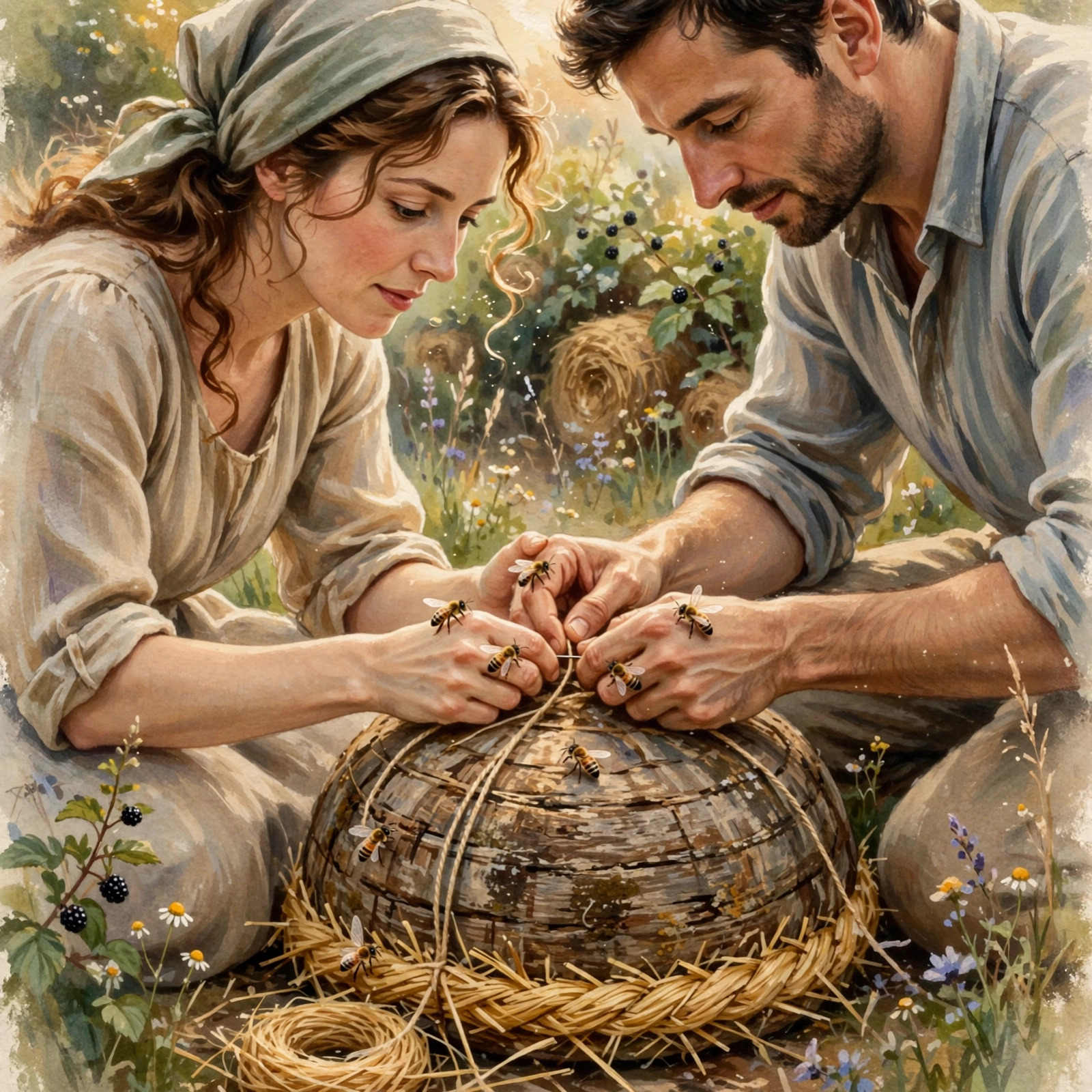
Rosamund didn't turn around. She cinched the ratchet strap another click across the last row of boxes and felt the truck bed settle under the weight. "You were asleep. People who are asleep don't need waking."
"It's not five yet."
"Desmond's flatbed comes Tuesday for the rest. These are mine to run down myself." She yanked the strap tight. "Thirty-nine boxes and one basket. Every one, no exceptions. He wrote it twice."
She heard him come across the yard, barefoot in the wet grass. She heard him stop. She knew exactly what he was looking at, because she'd spent most of an hour in the dark getting it there.
The old skep sat at the front of the bed against the cab, its coiled straw gone the color of weak tea, the bramble stitching dark with age. Her grandmother had built it in 1971 on the kitchen table, or so Marta always said, and the oak board underneath had been replaced once and never again. Rosamund had padded it with feed sacks and run two straps over it in an X, crossing at the crown where the straw was thickest. She'd blocked the entrance with a folded screen. She'd done it gently. She wanted that noted.
"Rosamund," he said. "Take it down."
"No."
"Please."
She finally looked at him. He was in the same shirt he'd worn under the linden, and his hair was flattened on one side from the loft. He looked like a man who'd run. He also looked, she thought, like a man who'd been planning to leave for a while and had just been caught at it.
"You were always going to go," she said. "Weren't you. You turned up at my hedge out of nowhere, and you'll go back to nowhere the minute it suits you. I'm not losing this place over a basket of straw and somebody's maybe."
"That isn't--"
"Then tell me what it is." She waited. The smoker was clipped to her belt, cold, the nozzle he'd straightened sitting true. "Go on. You've had nine days of me not asking."
He opened his mouth. Closed it. His gaze went to the skep, and his hand came up to the back of his own neck the way it had gone to hers, as if checking something was still there.
That was the answer, then. Silence. She'd grown up on it. She swung herself down off the bumper and went for the driver's door.
"It isn't that I'll leave," he said behind her. "It's that I can't."
She stopped with her hand on the handle.
"I can't go past where I hear them." His voice had gone strange, thinner at the edges, as though some of it were coming from farther off. "If the colony leaves the land, I don't follow it as a man. I go back to being what I was. Bees. Just bees. And I won't remember any of it. The hedge. The loft. You."
She turned around.
He was standing where he'd been, but the light was wrong around him. The yard lamp was behind the barn and he shouldn't have been lit at all, and yet the outline of his shoulders glittered faintly, like dust in a sunbeam. As she watched, a single bee lifted off his sleeve. Not landed there. Lifted off, as if it had been part of the cloth a moment before.
"Stop that," she said.
"I'm not doing it. They're in the truck. They're scared and they're shut in, and they're pulling." He pressed the heel of his hand to his breastbone. "It's started already, just from the straps."
Her chest went tight and furious. "How long have you known this?"
"Since before you were born."
"And you let me plan it. You stood in my kitchen while I read Desmond's paper out loud. You watched me count every box." Her voice cracked and she let it. "I said every one, no exceptions, three days running, and you just ate your eggs."
"I know."
"Why?"
He looked at the skep. "The last woman who kept them was your grandmother's aunt. I never told her either. I thought if she knew, she'd stay for the wrong reasons. She sold off the bottom field and moved the colony to the orchard edge one spring. She didn't know what she was carrying." He swallowed. "I came back with no name. The bees kept the hive. I came back slowly, over years. She was gone by then."
"So you did it again. To me."
"Yes."
He didn't defend it. She almost wished he would, so she'd have something to push against. Another bee came loose from his collar, and another, drifting toward the cab like sparks drawn up a chimney. He flinched each time, small.
She looked at the truck. Thirty-nine boxes and a basket. Eighteen thousand dollars in the cooperative's ledger, the only number that had kept the bank from coming up the lane last winter. If those hives weren't in Ashcombe Valley orchards by the end of next week, there was no Hollin Apiary to argue about. There was a sign at the gate and her mother crying at the stall and Rosamund, again, standing in an empty yard listening to an engine get smaller.
"You don't get to do this," she said. "You don't get to hand me the whole of it at five in the morning and look at me like that. Like I'm the one choosing."
"You are the one choosing. You always were." It wasn't an accusation. It sounded like grief.
"Then why didn't you let me choose with the truth?"
He had no answer for that. She watched him not have one.
She thought of her father, the car packed in the dark, the note on the kettle. She thought of standing under the linden with her bare fist in this man's shirt. She'd let herself have that for five days. Five days, and here it was, the same old shape: someone keeping the real reason in his pocket until it was too late to do anything but lose.
"I've got the orchard by seven," she said. "I've got Desmond waiting with a clipboard."
"Rosamund."
"If you can't come, then don't come." She hauled the door open. The hinge shrieked. "That's what you'd have done anyway. Eventually."
"That's not true and you know it."
"I don't know anything about you. That's the point."
She climbed in and slammed the door hard enough that the skep's straps creaked behind her head. Through the back window she could see the screened entrance, the straw crown pressed against the glass. Somewhere inside it a low, frantic buzz was building, she could feel it through the seat.
The engine caught on the second try.
In the side mirror he was still standing in the yard, one arm half lifted, not reaching, just held there. The faint glitter along his shoulders had thickened. A loose knot of bees turned above his head and did not settle.
She put it in gear.
The truck rolled down the lane, boxes knocking gently in their straps, and she didn't look in the mirror again until the hedge was behind her. By then she couldn't tell, through the grey and her own blurring eyes, whether there was a man at the gate or only a smudge of moving air.
She gripped the wheel and drove.
Back Down the Lane
She made it as far as the stone bridge before the sound behind her head changed.
It had been frantic, a high fizz against the glass. Now it thinned. It went ragged and uneven, like a crowd losing the thread of a song, and then it dropped so low she had to turn off the radio static to hear it at all.
Rosamund pulled onto the verge. Gravel spat under the tires. She twisted in the seat and pressed her palm flat to the back window, right where the straw crown leaned.
Nothing pushed back.
"Don't," she said to the glass. "Don't you dare."
The bees weren't dying. She knew dying bees, the crawl and the stagger, and this wasn't it. This was a colony forgetting why it had been loud. This was the quiet of a house after someone has walked out of it.
She thought of him in the yard with his arm half raised. She thought of the note on the kettle, and of how she'd hated her father for leaving it, and how she'd never once asked what he'd have said if anyone had stopped him at the door.
She'd packed the truck in the dark. She'd strapped down the thing that mattered most and told no one.
"Oh, God," she said. "I'm him."
The lane was too narrow to turn in. She did it anyway, three points that became seven, the back wheel dropping into the ditch and climbing out with a groan that rattled every box in the bed. Something cracked behind her, a dry wooden snap. She didn't stop to look.
Her phone was on the dash. She called Desmond with one hand and steered with the other.
He answered on the first ring, which meant he was already standing at the orchard gate. "You're late, which isn't like you."
"I'm not coming."
A pause. Wind across his end of the line. "Say that again so I'm sure I heard it."
"Thirty-nine hives, I could bring you thirty-nine by noon. But not the old one. It can't leave the land. I can't explain it to you, Desmond."
"The contract's forty. You signed forty." He didn't sound angry. He sounded tired, the way people do when they're about to be fair and hate it. "I can't pay eighteen thousand for thirty-nine and tell the board it's fine."
"I know. I'm not asking you to."
"Then what are you asking?"
She swallowed. The hedge was coming up on the left, ragged and green, and beyond it the gate. "You've wanted my grandmother's parcel for years. The strip along the creek."
"Rosamund."
"It's flat, it drains, you could put a hundred trees on it. I'll sell it to you. Enough to cover what I owe the bank for the season. You keep your contract money, find someone else's forty. I keep the yard."
The line went quiet long enough that she checked the screen.
"That's your gran's ground," he said finally. "She used to walk it with a cane. I remember her."
"So do I."
"You're sure."
"No," she said. "But I'm doing it."
He breathed out. "I'll bring the papers tonight. I'll pay you what it's worth, not what I'd like. And I'm writing down that you said no to me before I could say no to you."
"Write it in pen."
She hung up as the truck jolted through the gate.
The yard was empty.
Not empty of things. The barn, the extractor shed, the line of hive stands with their gaps like missing teeth. Her mother's car was there, parked crooked by the house. But the place by the gate where he'd stood held only a loose shimmer of bees, turning slow and aimless over the gravel, low enough to brush.
Marta came out of the house at a half run, apron still on, the tin smoker swinging from her hand. She stopped when she saw the cloud.
"I came for the stall jars," she said. "I came and he was going."
"You knew." Rosamund was already out of the cab, already at the straps. "You've known all along what he is."
"Since the day he walked out of that hedge asking after your gran." Her mother's mouth trembled. "I thought it wasn't mine to tell. I thought, she'll trust him or she won't, and I'll not push her. I've pushed you enough in your life."
"You never pushed me."
"Then I didn't push enough." Marta set the smoker down on the truck's tailgate. "Love, what do you need?"
"Help me lift."
The straps came free. Together they eased the skep out, heavy and warm, the coiled straw prickling Rosamund's forearms. It wasn't until they'd carried it, step by careful step, to the hedge corner that she saw what the snap had been.
The oak base had split clean across one side. A dark crack ran from the edge almost to the entrance, and a thread of bees was spilling out of it, wandering onto the board, unhurried, lost.
"Hold it level," Rosamund said.
She ran for the shed. Wood glue, the bar clamps, a strip of seasoned oak she'd been saving for a frame she never built. Her hands knew this work even when the rest of her was shaking. She came back, knelt in the grass, and Marta tipped the skep a hand's width so she could reach.
"Smoke," Rosamund said, and her mother lit it without a word and puffed gently at the crack, the sweet cool vapor drifting low.
The bees retreated. Rosamund worked glue deep into the split, pressed the halves together, laid the oak strip across the underside and clamped it tight. Her knees were wet. Her eyes were worse.
"Gran stitched this with bramble," she said. "Did you know? She told me once. Said bramble holds because it doesn't want to let go."
"She said that about your grandfather too," Marta said, and Rosamund laughed, a wet ugly sound, and wiped her face with her wrist.
They set the skep down on its stand. The clamps stuck out like small iron fists. Rosamund sat back on her heels, the smoker ticking as it cooled on the grass beside her, and looked at the gravel where the loose cloud still drifted.
"I'm here," she said, not loudly. "I brought it home. I'm not taking it anywhere. I should've asked you. I should've asked you every single thing."
For a long moment there was nothing but wind in the hedge.
Then the skep began to stir.
It started deep, under the straw, a low sound she felt in the stand before she heard it. It climbed. It steadied. It became the same rich, settled drone she'd fallen asleep to as a child with her ear against her grandmother's sleeve, and the bees on the board turned as one and walked back inside.
Over the gravel, the drifting cloud slowed. It thickened. It drew in on itself, gold and brown, folding like a hand closing, until there was a shoulder in it, and the line of a jaw, and a man on his knees by the gate with his palms pressed flat to the ground, breathing hard.
Marta put a hand over her mouth.
Elias lifted his head and looked straight at Rosamund, the way you'd look at someone across a long distance you hadn't been sure you'd cross.
"You came back," he said.
She couldn't stand yet. She didn't try.
"Down the lane," she said. "Turns out it goes both ways."
New Straw
"You're doing it too tight," Elias said.
Rosamund didn't look up from the coil. "I've been doing this since I could hold a needle."
"And you've been doing it too tight since then." He crouched beside her in the grass at the hedge corner, close enough that his knee touched hers, and laid two fingers on the rope of fresh straw she was binding. "Feel that. She'll breathe through the old rows and choke on this one."
She stopped. She pressed the new coil with her thumb, then the faded gold row beneath it, worn soft from fifty-odd summers of weather. He was right. The new straw sat hard as a broom handle.
"Fine," she said, and loosened the stitch.
It was the third morning since the truck had come back down the lane, and the clamps were gone. The oak strip held. The skep stood on its stand with a pale scar along the base, and a little higher up, where the straw had thinned over the years, Rosamund was adding a new ring. Gran's bramble binding still showed between the old rows, dark and knotted. Rosamund had cut fresh lengths from the hedge that morning, stripped the thorns with her knife, and soaked them in a bucket until they bent without snapping.
The bees had watched her do it. She'd felt them watching.
Elias reached past her for the bucket and drew out a strand of bramble, running it through his fist to shed the water. Then he held it out.
She took it. That was new too, the taking. For three days she'd been catching herself halfway through a decision and stopping, turning, saying his name. Should we move the water trough? Do you want the north row requeened this year or next? Is it all right if I sell the extra comb at Brookfold market, or does she need it? He answered every time, and every time he looked faintly surprised to be asked, the way a man looks at a gift he hasn't unwrapped.
"Hold the coil," she said.
He held it. His hands were brown and steady and very human. She'd checked them the first night, turning them over in the kitchen lamplight while Marta pretended to wash a pan that was already clean. No gold at the edges. No drift. Just knuckles and a scar across one thumb he said a hive tool had given him in a year he couldn't name.
She pushed the awl through, fed the bramble after it, drew it snug. Not too tight.
"Better," he said.
"Don't sound so pleased."
"I'm extremely pleased." He wasn't smiling, quite, but his mouth had given up trying not to. "Twelve years and nobody's ever let me correct their stitching."
"Nobody's ever let you do anything."
That landed harder than she'd meant. His hands stilled on the straw. A few bees came out of the entrance and walked the new ring, inspecting it, then went back in.
"No," he said. "That's true."
Rosamund set the awl down on her knee. The smoker sat in the grass between them, Marta's old tin one with the leather bellows cracked at the fold. Her mother had walked down after breakfast, put it in Elias's hands without explanation, and walked back up to the house. He hadn't lit it. He'd just kept it near him all morning, the way you'd keep a dog near.
"She gave you that," Rosamund said.
"She did."
"She never let me use it till I was nineteen. She said I squeezed it like I was angry at it."
"Were you?"
"Usually." She picked up a handful of loose straw and began twisting it into the next length, feeding it into the coil. "Dad left the spring the hives failed. I was small. Mum kept the stall going and Gran kept the bees going, and I decided I'd keep everything else going, and I think I just never stopped deciding." She pulled the bramble through. "I didn't ask you about the truck because I was sure what you'd say. I was sure you'd go. People go. So I thought I'd do it first, and then it wouldn't be you leaving. It'd just be the job."
He was quiet. The hedge moved in the wind behind him, and the skep's deep drone shifted under her palm.
"I'd have told you," he said finally. "If you'd asked. I'd like to think I'd have told you." He turned the smoker a quarter turn in the grass. "I didn't tell her. Your gran's aunt. She kept this colony before your gran did. She was going to move the hive to her sister's farm over the hill, and I said nothing, because I was afraid that if she knew, she'd keep the hive out of pity and not because she wanted to. So I kept quiet. And she kept it anyway, as it happened, because her sister died that winter. But she never knew. She thought I was a hired man who wandered off one day."
"Elias."
"So you and I made the same mistake from opposite ends." He looked at her then. "That's the honest version."
Rosamund wiped her palms on her jeans. Desmond would be sending the papers for the creek parcel by the end of the week. She'd walked down there yesterday evening, alone, and stood on the bank where Gran used to rinse the extractor, and said goodbye to it out loud like a fool. She hadn't cried. She'd come back up the hill and found Elias sitting on the porch step with Marta, the two of them shelling peas, and she'd sat down between them and taken a handful, and that had been enough.
"You said you'd stay," she said. "Human. If I let you share the work."
"I did."
"That's what this is." She tipped her chin at the coil, the bramble, his hands. "I'm letting you. I'm not very good at it yet."
"You loosened the stitch."
"Once."
"It's a start."
She tied off the end of the ring, tucked the bramble under, and sat back. The new straw circled the skep in a bright band, startlingly yellow against the old weathered rows. In a season it would darken. In a few years nobody would be able to tell which ring was hers.
Elias set his hand flat on the new coil. The bees came out again, more of them now, and walked over his fingers without stinging, as they always did, as if he were a branch they'd known forever. Then, one by one, they crossed from his knuckles onto her wrist.
She didn't move. She'd felt this once before, at the linden, the colony settling on her like a decision made somewhere outside her. This was different. Slower. Less like being chosen and more like being agreed with.
"They're doing it again," she whispered.
"They never stopped. You just stopped noticing." He was looking at her, not the bees. "I noticed."
The last of them lifted off her wrist and went home. Rosamund stood, knees stiff and damp, and held out a hand. He took it and came up out of the grass, and for a second they were just standing there at the hedge corner with straw dust on their sleeves and the smoker at their feet.
"I love you," she said. It came out plain. She'd expected it to be hard, and it wasn't. It was the easiest thing she'd said in years. "I'm not deciding that alone. I'm telling you so you can say something back."
His breath went out of him in a short, astonished laugh. "I love you," he said. "I loved you at the hedge, when you told me to get off your land. I've been trying to work out how to say it without it sounding like the bees talking."
"Does it matter?"
"No," he said. "Not anymore."
She stepped into him. His arms came around her, warm and solid and staying, and she put her face against his shoulder and felt the drone of the hive through the stand behind them, through the ground, through him. The hedge rustled. Up at the house a door banged and Marta's voice called something about lunch that neither of them answered.
Rosamund held on. So did he.
Get notified when new stories drop
Cade Ellison
Cade specializes in romantasy and paranormal romance: magic systems with rules, courts with knives, and longing that rearranges destinies.
Leave a comment
Comments