


The Broken Hinge
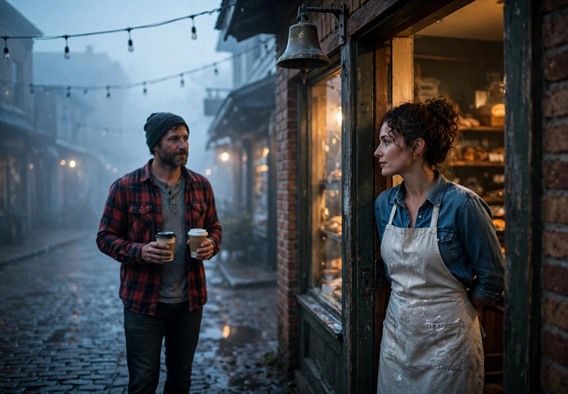
"You're blocking my light," Rosie said, without looking up from the hoof stand.
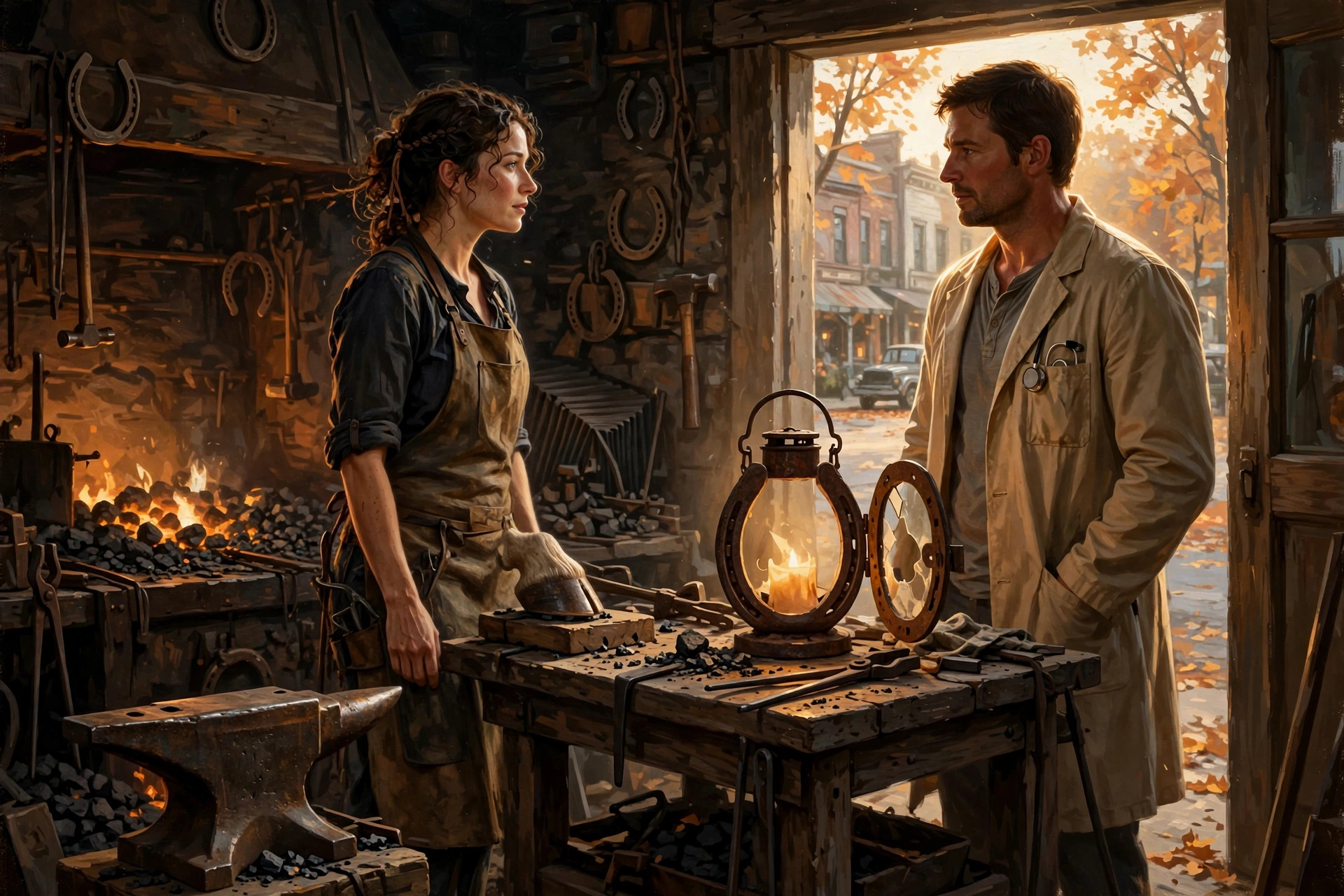
The shadow in the forge doorway didn't move. It shifted its weight, boots scraping the threshold her grandfather had worn smooth, and set something heavy on the workbench beside her rasp.
"Fern asked me to bring this by." Wade Tillinghast's voice had dropped half a register since she'd last heard it, but the pause before he spoke hadn't changed at all. "She said you'd know what it was."
Rosie straightened. Her lower back complained. Eleven years of bending under horses would do that, and so would three days of hauling a coal forge back to life by herself.
He looked the same and not. Broader through the shoulders, a little gray at the temple, a canvas vet coat with a stethoscope coiled in one pocket and baling twine in the other. He was looking at the anvil, not at her.
She looked at the bench instead.
It was the lantern. Of course it was. Wrought iron bent into the curve of a horseshoe, glass panes set in a riveted frame, a loop on top for the pole. Her grandfather had forge-welded it the year before her father was born, and every first frost since, it had swung at the head of the Lantern Walk across the Bellhollow footbridge.
Now it was orange with rust. One door hung off a single rivet, the hinge pin sheared clean.
"Oh," she said. It came out smaller than she meant.
"It's been in Fern's shed." Wade rubbed his thumb along the bench edge, not touching the lantern. "Somebody stacked fence posts on it."
"Somebody."
"Not me."
"I didn't say you."
"You were thinking it."
She was, actually, which was unfair and also very satisfying. She picked up the lantern. It was heavier than she remembered. Last time she'd held it she'd been in cutoffs, sunburned, and he'd been laughing at her for trying to carry it one-handed across the yard.
She set it down again.
"You could've just left it on the step," she said.
"Fern said to hand it to you." He finally met her eyes. His were the same flat creek-stone gray. "Apparently she doesn't trust me to deliver a message."
"Smart woman."
That landed. She watched it land, the small tightening at his jaw, and felt sorry about half a second too late. She opened her mouth. He was already turning toward the door.
"Wade--"
"Here she is," he said, and stepped aside.
Great-Aunt Fern came up the walk like a parade float, all purple fleece and clipboard, a thermos tucked under one arm. She'd run the post office counter for most of Rosie's childhood and still moved like she had a line forming behind her.
"You found it," Fern said, beaming at the bench. "Good. Wade, you didn't drop it."
"I didn't drop it."
"He's very careful," Fern told Rosie, as though recommending a dentist. "Painfully careful. Rosie, honey, can you fix it?"
Rosie looked at the sheared pin. The rust was surface, mostly. She could wire-brush it, heat the frame, punch a new pin from round stock, peen it over. A couple of evenings. The glass was fine.
That wasn't the problem.
"Fern, I've got shoes to set. I've got exactly two clients and one of them is a pony who bites." She waved at the forge, the coal bin half full, the cracked window she hadn't gotten to. "I'm not exactly in a position to take charity jobs."
"It's not charity. It's tradition."
"Tradition doesn't pay the loan."
She hadn't meant to say it in front of him. The words were out, ringing off the brick like a dropped hammer.
Fern unscrewed the thermos lid with great calm. "No," she agreed. "It doesn't. And that payment came due last week, didn't it?"
Rosie stared at her.
"Small town." Fern poured coffee into the lid and held it out. "The bank manager's wife does my hair."
Wade made a noise near the door that might have been a cough. Rosie didn't look at him. She took the coffee because her hands needed something to do.
"They gave me until after the Walk," she said quietly. "Forty-eight hundred, or they take the equipment. Which is the forge."
"Then you'd better land Dale Purcell."
"I'm trying."
"Twelve horses on a regular schedule," Fern said. "That's what he's shopping for. His last farrier retired to Florida and his knees went with him." She tilted her head at the man in the doorway. "Wade's out at Purcell Stables every week."
"Fern," Wade said.
"I'm only stating where you are on Thursdays."
"I don't recommend farriers. It's not my place."
"Since when?"
"Since always." He said it to the floor. "I keep my work separate."
Rosie heard the shape of it, the careful walls of it, and something in her chest went tight and hot. She'd left that summer without a word. She'd packed her truck the night Grandpa signed the sale papers and driven to Pennsylvania before sunrise, because if she'd stayed to say goodbye she'd have had to watch somebody decide not to wait for her. She knew exactly why a man might start keeping things separate.
Knowing didn't make her like it.
"Nobody's asking you to vouch for me," she said.
"Good."
"Good."
Fern sipped directly from the thermos, watching them both over the rim like a woman at a tennis match. "Well, this is lovely," she said. "Now. The lantern."
Rosie set the coffee down and picked the thing up again. The iron was cold. Her grandfather's punch marks showed under the rust, little crescents where he'd stamped the rivets, a tiny lopsided star he'd always claimed was a mistake. She ran her thumb over it.
When she was small, he'd let her hold the lantern pole on the bridge for exactly three steps. Then he'd take it back and laugh and say, someday.
"First frost's coming early," Fern said, gentler now. "They're saying a week, maybe. People will be watching who carries it. People who own horses."
"That's manipulative."
"That's organizing, dear. There's a difference, but I've never been sure what it is."
Wade, at the door, almost smiled. Rosie caught it before he shut it down, a flicker at the corner of his mouth, the same one he used to get right before he kissed her behind the feed store. Her stomach dipped like she'd missed a stair.
She looked away fast.
"The hinge pin's gone," she said, mostly to the lantern. "Frame's sound. I'd have to strip it and reset the door."
"Is that a yes?"
"It's a 'this is going to eat my evenings.'"
"You don't have evenings," Fern said. "You have a forge and a cot in the back room. I've seen it."
Wade's head came up. "You're sleeping here?"
"That is none of your business."
"There's no heat in that back room."
"There's a forge, Wade. It's literally fire."
He held her gaze a beat too long, then nodded once, the way he'd nod at a horse owner who'd decided against his advice. He pulled his truck keys from his coat. "I've got a colic call out past the ridge."
"Go," Fern said. "Thank you for carrying."
He paused on the threshold. For a second Rosie thought he'd say something else. His hand flexed against the doorframe.
Then he was gone, and the light came back across the hoof stand, and she was annoyed at how much colder the room felt.
Fern came around the bench and put her papery hand over Rosie's on the lantern.
"Your grandfather made this the year I got engaged," she said. "It's been across that bridge every single frost. I'd hate for this to be the first year it doesn't."
Rosie looked down at their hands. At the snapped pin. At the little star.
"Leave it," she said. "I'll fix it."
Fern squeezed once, hard, and let go.
Rosie carried the lantern to the back shelf and set it there, broken door facing out, where she'd see it every time she reached for the tongs.
Purcell's Barn Aisle
"You're holding that rasp like it owes you money," Wade said.
Rosie didn't look up. The bay gelding's near fore was clamped between her knees, his weight leaning into her hip the way big horses did when they'd decided you were furniture. "And you're standing in my light again."
"It's a barn aisle. There's light everywhere."
"Not where you're standing."
He moved a half step left. The fluorescent tube overhead buzzed. Somewhere down the row a mare banged a stall door with one hoof, steady and bored, and a barn cat watched them from a hay bale like it had money on the outcome.
Dale Purcell leaned against the wash rack with his arms folded over a canvas coat. He hadn't said much since she'd pulled in at seven. He'd shaken her hand, said her grandfather's name once, and pointed at the gelding. "Start with Brigadier. He's the one nobody likes doing."
Now she understood why. Brigadier had flat soles and a habit of snatching his foot back right when the clinch was half set. She'd already lost one nail to the shavings.
She finished the rasp work, eased the hoof down, and stepped back to sight along the leg. A hair long on the outside. She picked the foot up again.
"He's touchy on that heel," Wade said quietly. "Old bruise. Spring before last."
"I can feel it."
"I'm just saying."
"You're always just saying."
But she shifted her grip anyway, took the pressure off the heel, and Brigadier sighed and let his weight settle. She felt Wade notice. She didn't give him the satisfaction of looking.
The portable forge hissed on the tailgate of her truck at the end of the aisle. She carried the shoe out with tongs, set it into the coals, and watched the steel go from gray to cherry. Behind her, boots scuffed. Wade had followed, hands in his pockets.
"Purcell's been through three farriers in four years," he said.
"Is that a warning?"
"It's information."
"Same thing, with you." She pulled the shoe, laid it on the anvil horn, and opened the branch with three hard strikes. The ring bounced off the cold morning. "Why are you even here? It's Thursday. You do Thursdays. I'm not on your list."
"Purcell asked me to look over whatever you do."
She stopped with the hammer raised. "He what?"
"He likes a second opinion."
"On a trial shoe."
"On anything with four legs and a vet bill." He shrugged. "Don't take it personally."
"I take everything personally, Wade. You used to know that."
It came out sharper than she meant. He went very still, the way he did around a nervous horse, and for a second the forge was the only thing talking. Then he reached past her, took the second set of tongs off the tailgate without asking, and held them out.
"You'll want to fit it hot," he said. "He'll stand for it if somebody's at his head."
She looked at the tongs. At his hand. There was a white scar across his knuckles she didn't remember, and she hated that she wanted to ask about it.
"Fine," she said. "His head. Not my light."
He almost smiled again. He didn't let it land.
Back in the aisle, Wade took Brigadier's halter and murmured something low, nonsense words, the same tuneless hum he used to do under his breath while he drove. The gelding's ears swiveled toward him and stayed there. Rosie lifted the foot, set the hot shoe against the trimmed wall, and the smoke curled up white and sharp, the old burnt-horn smell she'd loved since she was small enough to sit on an overturned bucket and watch.
Brigadier flinched. Wade shifted his weight with him, one hand flat on the horse's neck, and the flinch turned into nothing.
She checked the burn pattern. Even. Good.
They did it twice more to get the heel right. Neither of them talked. She'd pull the shoe and he'd already be turning the horse's head just enough. She'd reach for nails and they'd be in the box on the hoof stand, where she hadn't left them. When Brigadier tried his snatch on the last clinch, Wade said "Easy" a half second before it happened, and Rosie had already braced for it, and the foot stayed put.
She set the final nail, clinched it, and smoothed the wall with the rasp. When she straightened, her lower back cracked, and Wade's hand drifted toward her elbow like he meant to steady her. It stopped a few inches short and went back to the halter.
She pretended not to see that either.
Purcell pushed off the wash rack and came down the aisle. He crouched, which on a man his size took some doing, and ran a thumb over the clinches. He picked the foot up himself and turned it to the light. Then he set it down and had a stable hand walk Brigadier out to the gravel and back.
The gelding moved sound. Even. Not a hitch.
"Huh," Purcell said.
Rosie waited. Her heart was going hard enough that she could feel it in her bruised thumb.
"I've got twelve head that need regular work," he said finally. "Shoes, trims, the whole rotation. I pay on time and I pay per horse, and I don't like surprises." He nodded at Wade without looking at him. "And Doc here signs off. Anything he says rests, rests. Anything he says changes, changes. You good with that?"
The words sat in her mouth, sour. A man she'd walked out on, holding the pen over her whole life.
"When would I start?"
"After the Walk. I'll have you back for a couple more in the meantime. See how you do with the mares." He rubbed his jaw. "Your granddad shod for my father. Never once had to tell him twice. That's a high bar."
"I'm aware."
"Good." He walked off toward the office, already pulling his phone out.
Rosie stood in the aisle with the rasp hanging from her fingers. Twelve horses. Steady money. Enough, maybe, to keep the bank off the forge. And every one of them would pass through Wade's careful hands first.
"You didn't have to do that," she said.
"Do what?"
"Help."
"I held a horse." He was coiling the lead rope, slow, too neat. "I hold horses all day."
"You hummed at him."
A pause. "He likes it."
She started packing her box, nail by nail, mostly so her hands had something to do. She could feel him behind her not leaving. When she finally turned, he was holding a dented green thermos, the steel scuffed down to silver at the edges.
"It's not a big deal," he said. "You were out here at seven. With no heat in that back room."
"Wade."
"Cream, no sugar. Unless that changed too."
It hadn't. She took the thermos, and it was warm all the way through, and their fingers didn't touch, and she felt it anyway.
Cooling Anvil
"You're going to burn your eyebrows off," Wade said from the doorway.
Rosie didn't look up. The pin stock glowed in the tongs, a thin bar of orange no thicker than a pencil, and she had maybe ten seconds before it lost its heat. "Then stand somewhere useful or go home."
He stood somewhere useful. She heard his boots cross the packed dirt floor, felt him stop at her left shoulder, just outside the swing of the hammer. He'd always known where that was. Some things didn't need relearning.
She set the bar on the anvil's edge and drew it out in short, quick strikes, turning it a quarter each time. The ring filled the forge. Her grandfather's anvil had a voice like a church bell with a cold, and she'd missed it more than she'd let herself admit.
"Fern told me you were at this all night," Wade said when she paused.
"Fern tells everybody everything."
"She told me the bank's waiting on you, too."
Rosie's hammer stopped midair. Then she brought it down, harder than the iron needed. "Fern should stick to lanterns."
"She's worried."
"She can worry from her own kitchen." Rosie lifted the bar, squinted at it, and put it back in the fire. The coals flared. "I've got it handled."
"Sure."
She turned then. He'd come straight from a call, by the look of him. Mud to the knee, a smear of something she chose not to identify on his sleeve, his hair flattened on one side where a barn cat had probably napped on him. He was holding the green thermos. Her thermos now, apparently, since she'd forgotten it on the truck seat and he'd filled it again.
"Cream, no sugar," he said, and set it on the workbench beside the lantern.
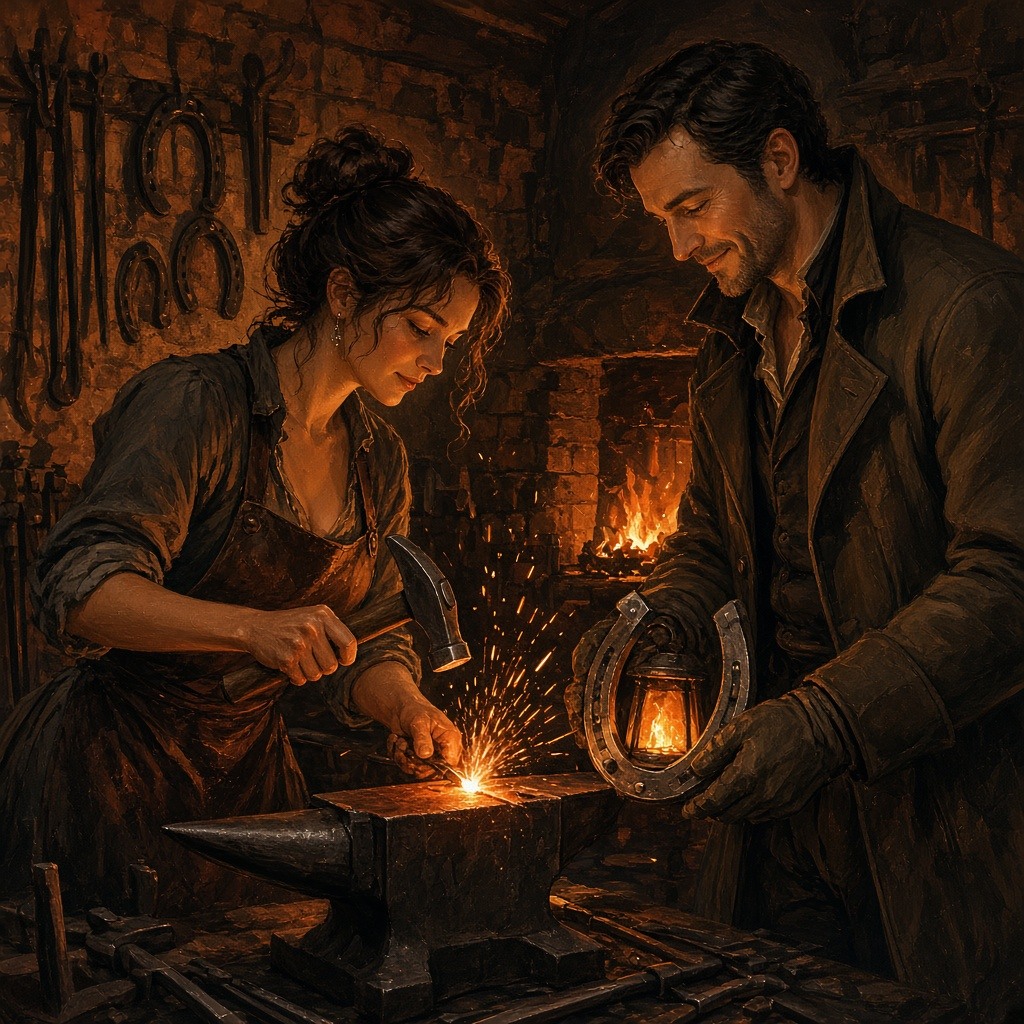
The lantern lay on its side on a folded feed sack, where she'd been fussing with it since supper. Wrought iron, the cage shaped like an upturned horseshoe, glass panes clouded with decades of soot she'd scrubbed off one careful square at a time. The door hung crooked where the old pin had sheared. Her grandfather had built it the year he'd taken over the forge, forge-welded the frame, riveted every joint by hand. She'd found his initials stamped under the base, small and plain, as if he hadn't wanted to brag.
"You couldn't just buy a hinge pin," Wade said.
"Not one that fits. He made everything to his own measure." She pulled the stock from the fire again. "Hold the door square for me."
He did, without asking how. His fingers bracketed the little iron door, steady and patient, and she worked the hot pin down to size, checked it against the knuckles, drew it a hair thinner. Close quarters. She could smell the cold on his jacket, hay and liniment and October.
"You used to sit right there," he said quietly, nodding at the stool by the slack tub. "Summers. Watching him."
"I used to sweep right there. He paid me in root beer."
"I remember. You'd come out to the river after with your hands black to the wrist."
She kept her eyes on the iron. "Wade."
"I'm just saying I remember."
The pin cooled to a dull gray. She quenched it in the slack tub, a short hiss and a puff of steam, and fed it through the knuckles of the hinge. Tight. Good. She set the peen of the small hammer against the end and began to mushroom the head over, tap by tap.
"He sold it to a guy from Albany," she said. Her voice came out flatter than she meant. "Didn't tell me until the papers were signed. I came home from a shoeing clinic and there was a padlock on the door and he was sitting in Fern's kitchen like nothing happened."
Wade didn't move his hands.
"I thought I was going to take it over. That was the whole plan. My whole plan." Tap. Tap. "So I put everything in the truck that night. I figured if nothing here was mine anymore, I'd better go before anyone told me so."
"I was here," he said.
"I know."
"I waited at the river until it got dark. Then I came by here, and the padlock was on the door." He let out a breath. "I figured you'd call."
"I almost did. About a hundred times." She set the hammer down. "Every time, I thought you'd be smart to hang up."
"I wouldn't have."
The words sat between them on the anvil, still warm. She didn't know what to do with them, so she did what she always did. She went back to work.
She upended the lantern, peened the bottom end of the pin, and dressed both heads with a file until they sat flush. Her shoulders ached. Her bruised thumb throbbed. She swung the door open and closed, open and closed. It moved like it had in 1979, she'd have bet the forge on it, no catch, no grind.
"Hang it up," Wade said.
"It's not done. I haven't oiled the…"
"Rosie. Hang it up."
There was a hook in the rafter above the anvil, black and ancient, where her grandfather used to hang it every autumn so the whole street could see the forge lantern was ready. She'd seen it empty when she'd unlocked the door this spring and had stood under it for a long minute before she could make herself sweep.
She climbed onto the stool. Wade passed the lantern up to her, and she caught the bail and settled it onto the hook. Then she got down and lit a match and reached up through the little door and touched the wick.
The flame caught. Light came through the scrubbed glass in clean gold panes and laid itself across the anvil, across the cooling hammer, across his face.
She hadn't realized how close he was standing until she turned around.
"It holds," she said, stupidly.
"It holds." He was looking at her, not at the lantern. He'd been careful for days, she realized. Careful in Purcell's aisle, careful with the lead rope, careful setting the thermos down so their fingers didn't brush. He wasn't being careful now. "You did that by yourself."
"You held the door."
"Barely."
"Wade, I'm still the woman who left."
"I know who you are." He reached up and, slow enough that she could have stepped back, brushed a streak of soot from her cheekbone with his thumb. "I always did."
She didn't step back.
He kissed her by the anvil, where the iron still ticked as it cooled, one hand at her jaw and the other flat against her back like he was keeping her from blowing away. He tasted like his own bad coffee. She fisted a hand in his muddy jacket and kissed him back, and for once she didn't think about the bank or the clock or the twelve horses in Purcell's barn or who would leave whom. She just stood there and let herself be held.
When they broke apart, she rested her forehead against his collarbone and laughed, a little shaky.
"Fern's going to know," she said.
"Fern knew before I did." His voice rumbled under her ear. Then, quieter, almost to himself: "I've got the Purcell mares Thursday. I want to look at the bay before you do. Just to be sure."
Something in the way he said it snagged, a small unsure note she couldn't name. She lifted her head to ask, but he'd already let go and stepped back, rubbing the back of his neck, the careful look sliding halfway home.
"Goodnight, Rosie."
"Goodnight."
The door shut behind him and let in a gust of cold that ran the length of the forge. Above the anvil, the lantern rocked once on its hook, and its little door, her grandfather's door, with her pin in it, didn't rattle at all. The light settled. The lantern swung true.
Mare in Stall Six
"She's not lame," Rosie said. "She's sore. There's a difference, and it's in her feet."

Wade didn't look up from the bay mare's near fore. He had the hoof cradled between his knees, testers clamped at the toe, and he was watching the mare's ear instead of Rosie's face. The mare flicked it back and shifted her weight, and he eased the testers off.
"She's pointing that foot when she stands," he said.
"Because her shoes are a month past due and her toes are long. Fix the angle and she'll quit pointing."
Stall six smelled of pine shavings and liniment. Rosie had her apron on, her nail box at her boot, a fresh set of shoes cooling on the tailgate outside after she'd shaped them that morning by eye and by the tracing she'd taken Tuesday. Down the aisle, Dale Purcell leaned on the half door of the tack room with his arms folded, the posture of a man who paid for things and wanted to see them done.
Wade set the foot down. He ran his hand up the mare's cannon bone, slow, and stopped above the fetlock. His jaw worked.
"Dale," he called. "Got a minute?"
Rosie straightened. "Wade."
He was already walking past her. Not fast, not rude. Just past, the way a man walks past a fence post.
Purcell pushed off the door. "Problem?"
"I don't want her shod today. I want her on stall rest, cold hosing twice a day, and I'll come back Monday and block her if she's no better."
"Rest." Purcell glanced at Rosie, then back. "She's supposed to be one of the trial horses."
"She can be a trial horse when she's sound."
"She's sound enough to shoe," Rosie said. She heard her own voice go thin and hated it. "Mr. Purcell, I've trimmed horses that looked worse than this and had them moving clean by the end of the week."
Purcell rubbed the back of his neck. He had the look of somebody who'd been caught between two dogs before and didn't care for it. "You signed on knowing Wade signs off on the work."
"I know."
"Then he's signing off. Or not signing, I guess." He nodded to Wade. "Rest her. Let me know Monday."
And that was all. He went back into the tack room and the door swung to behind him, and the mare sighed through her nose and dropped her head into the hay net as if nothing had happened at all.
Rosie unbuckled her apron. Her fingers fumbled the strap twice.
"Rosie," Wade said, low. "Hear me out."
"You could've asked me." She rolled the apron around her rasp and nippers and shoved the bundle into the nail box. "Before. Out here. You could've said, I'm worried about the leg, what do you think. You didn't even look at me."
"It's her leg I'm worried about. Not your shoes."
"Monday's after the Lantern Walk." She lifted the box. It was heavier than it should've been. "You know what happens after the Lantern Walk."
Something crossed his face then, quick, and went under. He opened his mouth. Closed it. "I can't sign off on something I'm not sure of."
"You were sure enough Thursday night."
She hadn't meant to say it. It landed between them in the aisle and lay there. He went very still, and the stillness was worse than any answer, because she knew it. She'd seen it on him for a week. The distance clicking back into place like a latch.
"That's not fair," he said quietly.
"No," she agreed, and walked out to her truck.
She drove back into Bellhollow with the heater roaring and the shoes she'd made sliding against each other in the bed every time she took a curve. By the time she parked in front of Achterlund Forge, she had already decided, though she wouldn't have said so out loud. Her body had decided. Her hands were doing it before her head caught up.
The cot folded with a crack of aluminum. Her duffel was still mostly packed; she'd never really unpacked it, she realized, which said something she didn't want to hear. She hauled out the portable anvil and the propane forge she'd brought from her last job two states over, the stand, the hoof jack, the boxes of shoes. The shop's own anvil, her grandfather's, she couldn't lift and wouldn't have taken anyway. It stayed bolted to its stump in the middle of the floor like it had always meant to.
She was dragging the propane tank across the threshold when Fern came up the sidewalk in her red wool coat with a roll of ribbon in one hand.
Fern looked at the truck. At the cot. At Rosie.
"Well," she said. "That's quick, even for you."
"Don't."
"I haven't done anything yet." Fern set the ribbon on the tailgate. "I came to tie the bow on the lantern. Ribbon goes on the morning of. Always has."
"Then tie it." Rosie heaved the tank up and wedged it against the wheel well. "It's fixed. It'll hold. Somebody else can carry it."
"You're four thousand eight hundred dollars behind and you think running makes that smaller?"
Rosie stopped. She hadn't told Fern the number. She'd never said it to anyone but the woman at the bank.
"Postmistress," Fern said, and shrugged. "Thirty years of people's envelopes. I know what a late notice looks like through the window of an envelope, sweetheart."
"Then you know it's done. Purcell won't sign me without Wade, and Wade won't sign. That's it. I'm not going to sit here waiting for the bank to padlock it." Her voice cracked on the word. She turned back to the shop so Fern wouldn't see. "I already did that once."
Fern was quiet for long enough that Rosie thought she'd gone. When she spoke, her voice had lost all its tease.
"Last time you didn't let anybody stand next to you while it happened."
A truck pulled up behind Rosie's. She knew the engine before she turned. Wade got out and didn't come closer than the curb. He'd changed out of his coveralls; his hair was damp like he'd stood under a hose. He took in the folded cot, the propane, the duffel, and his face did the thing again, going still and shut.
"You're leaving," he said. Not a question.
"You made the call. I'm making mine."
"Rosie, there's something about that mare I need to--"
"Monday," she said. "Tell me Monday. I won't be here."
He flinched, a real one, quick as a horse shying from a feed sack. Fern looked between them and, for once in her life, said nothing.
Wade's gaze went past Rosie into the forge, up to the rafter hook over the anvil, where the lantern hung with its glass scrubbed bright and her new pin set in the little door.
"The Walk's tomorrow night," he said.
"I know when it is."
"It leads. It's always led." He looked at Fern. "Can I?"
Fern nodded once.
He walked into the forge without asking Rosie, which was the second time that day, and she should have been angrier about it than she was. He reached up and lifted the lantern off the hook with both hands, the way you'd lift a sleeping cat, and the door didn't rattle. It swung a little and settled.
He carried it past her to his own truck and set it on the passenger seat. Then he pulled the belt across it and buckled it in.
Rosie made a sound that wasn't quite a laugh.
"It's going across that bridge tomorrow," he said, not looking at her. "Whether you're carrying it or not."
He got in and drove off, slow, the lantern riding shotgun.
Fern picked up her ribbon. "I'll just hang onto this, then," she said, and went back down the sidewalk without another word.
Rosie stood alone in the cold with her whole life stacked in the bed of her truck. Her grandfather's anvil sat in the doorway's frame behind her, too heavy to move, waiting. She looked at it a long moment.
Then she reached up and slammed the tailgate shut.
Purcell's Office
Rosie had the contract folder under her arm and her truck keys in her fist when she pushed open the office door at Purcell Stables, and the first thing she saw was Wade standing in front of Dale Purcell's desk with his hat in his hands.
She stopped on the mat. Fern, who had insisted on riding along "to say goodbye properly," bumped into her back.
"Oh," Fern said. "Well, isn't this convenient."
Purcell looked up from behind a desk buried in feed invoices and coffee rings. He had the weathered, unhurried face of a man who'd outlasted three droughts and a barn fire. "Ms. Achterlund. Come to return my paperwork, I'm guessing."
"I'm here to tell you I'm out." She set the folder on the corner of the desk. "You'll want somebody who's staying."
Wade didn't turn around. His shoulders went tight under his canvas jacket.
"Sit down a minute," Purcell said. "Doc was just getting to something."
"I don't need to sit."
"Then stand. But close the door, you're letting the heat out."
Fern closed it. Then she lowered herself into the only other chair with the satisfaction of a woman who'd bought a front-row ticket.
Wade turned the hat around once by the brim. "The bay mare. Juniper."
"She's lame," Purcell said. "You told me that yesterday. You told me she rests till Monday and nobody touches her feet."
"I told you that because I needed it to be true." Wade's voice came out low and even, the voice he used on horses that wanted to kick. "Six weeks ago I looked at her for a stone bruise. Left front. I told your barn crew it was an abscess and had them soak and pack it, and I trimmed the heel down myself to open it up."
Rosie's keys bit into her palm.
"It wasn't an abscess," Wade said. "I took too much heel. I threw her whole angle off, and she's been landing wrong ever since. That's what Rosie would've found the second she picked that foot up. That's why she's sore. Not anything anybody else did."
The office went quiet enough that Rosie could hear a horse blowing in the aisle outside.
Purcell set down his pen. "You're telling me you lamed my mare."
"I'm telling you I misread her and made it worse. Yes."
"And then you told me to keep the new farrier off her."
Wade's jaw worked. "I told myself it was so she'd heal. Some of it was." He finally glanced back at Rosie, and his face wasn't shut this time. It was raw. "Some of it was I didn't want you to be the one to see it."
Rosie couldn't make her mouth do anything.
"Nine years," Purcell said. "Nine years you've had my account, and I've never once questioned a bill." He leaned back, and the chair creaked like an old gate. "I'd have liked to hear this six weeks ago, Wade."
"I know."
"I'm going to have to think about who looks after my horses."
"I know that too." Wade put his hat back on. "Whatever you decide. But she's the best I've ever seen with a foot, and she was right about that mare, and I'm not going to let you hand that contract to somebody else because of a mess I made."
He didn't wait to be dismissed. He crossed the small office in three strides, and Rosie stepped aside without meaning to. His sleeve brushed hers. He smelled like cold air and liniment. He didn't look at her as he went out, and the door rattled in its frame behind him.
Fern let out a long, delighted breath. "Well. Somebody's been raised right."
"Fern," Rosie said.
"I'm only remarking."
Purcell rubbed his eyes with a thumb and forefinger. "Did you know?"
"No." Rosie's voice came out rough. "I knew the angle was wrong from across the aisle. I didn't know who'd trimmed her."
"He could've let you take the blame for it. Let you shoe her, let her go sore, let me think the new girl ruined a good mare." Purcell shook his head slowly. "Man just set fire to a lot of goodwill so you wouldn't have to wear that."
Rosie looked down at the folder she'd laid on the desk. It had sat on her dashboard all morning while she argued with herself in the cab, engine running, cot and duffel and propane tank stacked in the truck bed like proof.
Fern was watching her with a softness Rosie didn't trust.
"The loan's due Monday," Fern said quietly. "Forty-eight hundred. I know you've been hiding the notice in the coffee can."
"How do you--"
"I ran the post office for longer than you've been alive, sweetheart. I know what a bank envelope looks like."
Purcell's eyebrows climbed. "That right?"
Rosie's face went hot. Every instinct she had said to pick up the folder, walk out, drive until Vermont was a smudge in the mirror, and fix it somewhere nobody could watch. She'd done it before. It had worked, more or less, for most of her life.
She thought of Wade setting the lantern on his passenger seat and buckling it in.
"That's right," she said. "If I don't get steady work by Monday, the bank takes the forge."
"Huh." Purcell pulled the folder toward him and flipped it open. "Then I'd say you came to the right office."
"You still want me? After yesterday?"
"Yesterday you packed a truck. Today you walked in here and told me the truth to my face, same as he did." He uncapped the pen. "I'm not hiring a truck. I'm hiring a farrier. Twelve head, starting next week, and I'll want you on Juniper first thing to fix what he did."
"She'll need a wedge pad for a few cycles," Rosie heard herself say. "Bring her heel back slow. It's not a quick job."
"Then don't go anywhere."
Fern made a small noise into her scarf that might have been a sob or a laugh.
Rosie's fingers had gone loose on her keys. She looked at them, the forge key with its square head, the truck key worn smooth. Through the office window she could see her pickup in the gravel lot, tailgate up, a corner of the folded cot sticking over the rail.
"Give me a second," she said.
She went out into the cold. The sky over the paddocks had gone pewter, and the puddles along the fence line had a skin of white on them that hadn't been there at dawn. First frost. The Walk would go tonight.
She dropped the tailgate. She hauled the duffel out and set it on the gravel, then the propane, then the cot, and carried them one at a time to the bench under the barn eave where she could load them back into the forge later. Her arms shook a little on the cot. She told herself it was the weight.
When she came back in, her cheeks stung and her nose was running, and Fern handed her a tissue without comment.
Purcell had turned the last page of the contract toward her side of the desk. His own signature sat on the second line, broad and slanting.
"Your turn," he said, and held out the pen.
Rosie took it. She wrote her name.
Purcell pulled the paper back, looked at both signatures, and nodded once, the way a man nods when a gate latches.
"Signed," he said.
Bellhollow Footbridge
"You're holding it too high," Wade said. "Your arm's going to give out."
"My arm's been swinging a hammer since before you could tie a suture." Rosie shifted the lantern to her other hand anyway. The iron bail had gone warm from her glove. "And the Walk's over. Nobody's following me now."
"I'm following you."
She glanced back. He'd stopped a few boards behind her on the footbridge, hands in his coat pockets, collar up, frost silvering the rail beside him. Below them the river ran black and loud with snowmelt from the hills. The last of the walkers had drifted off the far end twenty minutes ago, their small candle jars bobbing up Main Street like a loose string of beads. Fern had gone with them, ribbon looped around her wrist, calling out that the cider at the church hall wouldn't drink itself.
Which left the two of them and the forge lantern, and a bridge that creaked every time either one moved.
"You did fine," Wade said. "Leading it."
"I nearly walked into the mayor at the turn."
"He'll live. He's been walked into before." He came up beside her, close enough that his sleeve brushed hers. "You didn't look at the ground once. Everybody else does on that first stretch. The planks are slick."
"I was looking at the lantern."
"I know. So was I."
She set it on the flat cap of the center post, where the rail met the old stone pier. The glass panes threw horseshoe-shaped bars of light across the boards, across his boots, across the water. The little door she'd fixed sat snug in its frame. She put a fingertip to the new hinge pin out of habit, and it didn't so much as tick.
"Holds," Wade said.
"It better. I forged that pin three times before I liked it."
"Three?"
"The first one was ugly. The second one was fine. Fine isn't the same thing."
He laughed under his breath, and the sound went straight through her coat. She leaned her forearms on the rail and looked down at the town. From up here Bellhollow was mostly roofs and chimney smoke and the yellow squares of kitchen windows. The church hall was lit end to end. She could pick out the forge on Main, dark, the bay doors shut, the new sign she'd hung two weeks ago catching a streetlight.
It was still hers. Monday the bank would get its money out of the Purcell deposit, and the anvil would stay where it had stood her whole life. She kept waiting to feel that settle in her chest. It hadn't yet. It felt like a horse that might still kick.
"Purcell call you?" she asked.
"About an hour before the Walk." Wade studied the water. "He's keeping me on. For now. He wants a second opinion on anything lameness-related for the next year, and he wants it from somebody out of Rutland."
"That's going to sting."
"It already does." He shrugged one shoulder. "I earned it. I trimmed that heel and told myself it was textbook, and then I stood in his barn and blamed the next person who'd touch her. That was you."
"You didn't blame me. You just didn't ask me."
"Same road, slower truck."
She turned her head. He was watching her now, not the river. The lantern light caught the gray coming in at his temples, the scar along his jaw where a colt had clipped him years back. She'd never asked about that scar. She'd been gone when he got it.
"I almost drove off," she said. "Yesterday. I had the keys in the ignition. I sat there with the heater running and thought, this is what I do. I go before anybody can tell me to."
"I know."
"You don't, though. You weren't there."
"I was at the end of the block." He said it quietly. "In the truck. With the lantern on the seat. I figured if you pulled out, I'd at least see which way you went this time."
The river filled the quiet. Rosie's throat had gone tight, and she pressed her gloved knuckles hard into the rail until the feeling passed, which it didn't.
"Twelve years ago you waited at the river," she said. "And I didn't come."
"Eleven, come August."
"You kept count."
"I'm a vet. I keep count of everything." He took one hand out of his pocket and set it on the rail beside hers, not touching. "I quit waiting a long time ago, Rosie. I want you to know that. I built a whole tidy life where nobody got close enough to make me stand at a river again. Then you showed up yelling at me about a horse."
"You were wrong about that horse."
"I was wrong about a lot of things."
She looked at his hand on the frost-white wood. Then she pulled off her glove with her teeth, which was undignified, and put her bare hand over his. His skin was cold. She didn't care.
"I'm not packing the truck again," she said. "I want that on the record. If I get scared, I'm going to come find you and be scared at you. You'll have to put up with it."
His fingers turned under hers and laced through. "I can put up with a lot."
"I've noticed."
"Rosie." He waited until she looked at him properly. His voice didn't do anything fancy. It never had. "I love you. I think I loved you when you were twenty-one and terrible at saying goodbye, and I know I love you now. I'm done keeping a stall's width between us."
For a second she couldn't find any breath at all. Then she laughed, wet and ragged, and the sound bounced off the stone pier.
"I love you too," she said. "I love you, Wade. I came back for the forge. I'd have stayed for you."
He pulled her in. She went the whole way, her face against his collar, his arms locked around her back, the bulk of both their coats crushed between them. He smelled like woodsmoke and liniment and the cold. She felt him shake once, a long shudder, and then go still, his chin resting on top of her hat as though he'd been aiming for that spot for over a decade.
They stood like that until the bridge stopped creaking under them.
"Fern's going to ask," he murmured into the wool.
"Fern's going to know. She'll take one look at my face."
"Want to give her a minute more?"
"I want to give her an hour."
Rosie turned in his arms without letting go, so her back was to his chest and his hands folded over her middle. Beside them the forge lantern burned on the post, steady, its horseshoe bars of gold spilling down over the rail and onto the dark water. Below, Bellhollow glowed, window by window, the church hall bright, Main Street quiet, and her forge waiting at the end of it with its doors shut and its fire banked for morning.
Get notified when new stories drop

Lila Monroe
Lila writes contemporary and small-town romance with banter-forward leads and soft landings. She believes the best love stories sound like two specific people, not a trope checklist.
Leave a comment
Comments