


The Cut Padlock
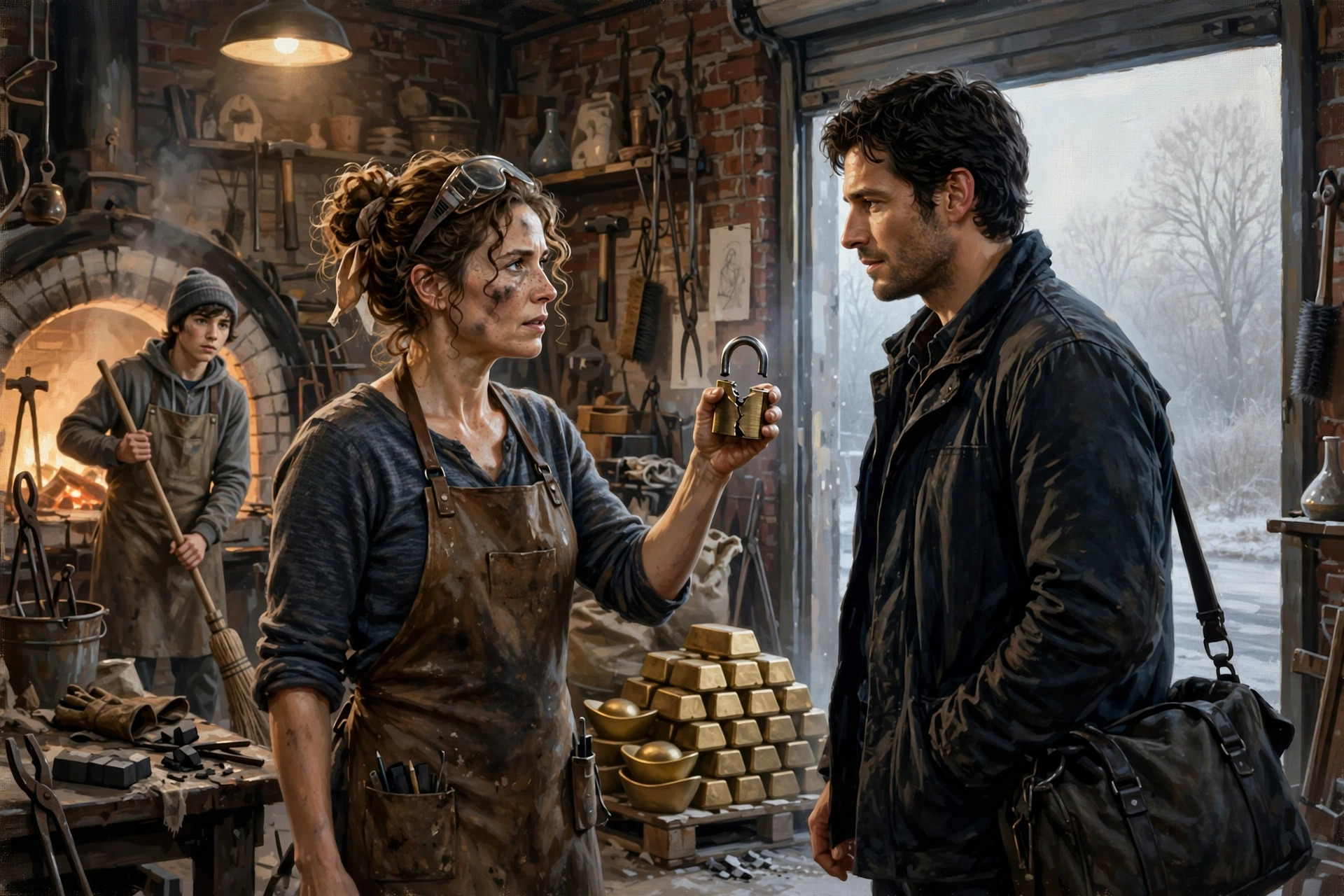
"It's not a crime scene, it's my loading door." Juno Faraday held the padlock up between them like evidence she'd already ruled on. The shackle had been sheared clean through, the cut bright and silver against the old brass. "Somebody with bolt cutters and a grudge. I know who. I don't need a consultant to tell me."
The man from the arts commission didn't reach for it. He stood just inside the roll-up door with a duffel on one shoulder and a plastic case at his feet. He was looking at her rafters, her floor drains, the gap under the side door where November came in.
"You touched it," Matteo Serrano said.
"It's my lock."
"It was your lock. Now it's the only thing he handled that we know of." He held out a zip bag. "Please."
She dropped it in harder than she needed to. He sealed it, wrote on it with a marker from his jacket pocket, and set it on her workbench, squared to the edge.
Across the shop, Bea Okonjo was pretending to sweep. She had swept the same patch of concrete near the kiln for most of ten minutes, and her broom had not once touched the floor.
"He didn't take anything," Juno said. "I checked the ingots at six. They're all there."
"Then he was counting them." Matteo finally looked at her, and it was worse than him looking at the rafters. He had a quiet, careful face, the kind that gave nothing away until it decided to. "Or showing you he could. Either way, he comes back."
"You've known about Lorne for an hour."
"I've known men like him for longer."
She didn't have an answer for that, so she walked past him to the ingot stack. The commission bronze sat on two pallets against the north wall, dull gold bars banded in steel, sixty thousand dollars of metal that belonged to the city until it became a firefighter on a granite plinth. If it vanished, the contract went with it. If the contract went, the bank would come for the building, and the building was the only thing her father had left her that Lorne hadn't already gotten to.
"I'll buy a better lock," she said.
"You'll buy a better lock, and he'll buy better cutters." Matteo crouched by the plastic case and flipped the latches. Inside were panels of welded steel mesh, folded flat, and a bag of heavy bolts. "I'm putting a cage around the stock. Anchored to the slab. Camera on the door, camera on the cage. I'll sleep in your office until the pour."
"You'll what?"
"The commission's paying for coverage, not for me to drive by twice a night."
"There's no bed in my office."
He nodded at the duffel. A folded cot frame stuck out of one end. "There is now."
Bea's broom made its first real contact with the floor, a long scrape that sounded a lot like a laugh being swallowed.
Juno pressed her thumb into the bridge of her nose. Ten days until the pour. Ten days to finish the gating, run a practice heat, and get a half-ton figure out of the ground in one piece. She did not have room in those days for a man who bagged padlocks.
"You drill holes in my slab," she said, "you patch them when this is done."
"Done."
"And you don't touch anything near the kiln."
"I wasn't planning to."
"And you don't call me ma'am."
Something moved at the corner of his mouth, there and gone. "Wasn't planning that either."
He worked the way she cast, she noticed, against her will. No wasted motion. He measured the footprint of the pallets twice, chalked a line on the concrete, and ran the hammer drill in short clean bursts so the dust fell in neat cones instead of clouds. When he lifted the first mesh panel into place, she caught the far edge without thinking and held it plumb while he set the bolts.
"Thanks," he said.
"Don't. I just don't want it falling on my bronze."
"Juno." Bea's voice had changed. "Come look at this."
Bea had abandoned the broom by the kiln area, where the memorial mold stood on its sand bed. It was the torso, the hardest piece, the firefighter's shoulders bent under the weight of a hose line. They'd built the ceramic shell together over weeks, dipping and stuccoing layer after layer, firing it until it rang like a bell when you flicked it. Juno knew every inch of it.
So she saw it before Bea pointed. A chip, thumbnail-sized, knocked out of the lip of the pour cup. Beside the mold, on the floor where they had no business being, lay her father's crucible tongs.
Her stomach went cold.
She picked them up. The long shank was fine, the steel still true, but the ash grip had split along the grain right where the rivet went through, a crack you could fit a fingernail into. Ray Faraday had forged these tongs and riveted that handle the year she started apprenticing under him. He'd shaped the grip to her hand, not his, and told her she'd grow into the rest.
"They were on the rack," Bea said quietly. "I hung them up myself Friday."
Behind her, the drill had stopped. Juno didn't turn around.
"He knocked them off," Matteo said. He'd come up close enough that she could hear him, not so close she had to move. "Either looking for something or making noise on purpose."
"He knew they were Dad's." Her voice came out flatter than she meant. "He used to joke I'd be buried with them."
She felt him go still, the way you go still around a hot crucible, choosing where to put his hands. He didn't put them anywhere.
"The mold first," she said, mostly to Bea. "Can we save the cup?"
Bea was already crouched beside it, running a fingertip around the chip. "It's just the lip. The shell's sound underneath. I can build it back with slurry and stucco, couple coats, fire it with the next batch." She glanced up. "It'll be ugly."
"Ugly's fine. Ugly holds."
Bea went for the slurry bucket. Juno stood with the tongs across her palms and tried to remember how her father had set that rivet, whether she could drill it out without wrecking the steel.
"Clamp it tonight," Matteo said. "Glue the split, clamp it, let it cure. Then rewrap it. You'll lose a little of the shape."
She looked at him. "You know wood?"
"My grandfather made chairs." He shrugged one shoulder. "I know enough to know you shouldn't try to drill that rivet when you're angry."
She hated that he was right. She hated more that he'd read the plan off her face. She hung the tongs on the rack, carefully, crack facing out, and went to find her clamps.
By the time the light went orange in the high windows, the cage was finished. It ran wall to wall around the pallets, bolted every foot, with a gate on a heavy hinge and a lock that looked like it belonged on a bank. A small black camera watched it from the ceiling. Another watched the loading door. Bea had the first coat drying on the pour cup and the tongs sat clamped and glued on the bench, the split closed to a dark line.
Matteo tested the gate twice, then held out a single key. "That's yours."
"And yours?"
"I'll keep mine on me." He hesitated, and it was the first time all day she'd seen him do it. "I'll need one to the side door. And the office. If something happens at three in the morning, I can't wait for you to drive over."
"I live upstairs."
"Then I can't wait for you to find your shoes."
Bea made a strangled noise and became very interested in her stucco.
Juno looked at him for a long moment. He'd stopped being careful about his face, just a little, and what was under it looked tired, and stubborn, and not unlike her own reflection in the kiln door. She didn't like men who wanted to manage her. She'd liked one once, trusted him with the accounts and the funeral arrangements and her father's tools, and she had the empty bank statements to show for it.
But the cage was good. The cage was very good.
She dug into her jeans and worked a key off her ring, the old brass one for the side door, worn smooth from her father's pocket before hers. She held it out between two fingers, not quite letting go when he took hold of it.
"You lose that," she said, "you're sleeping in the parking lot."
"Understood."
She let go.
Cot in Office
"You're doing it wrong," Matteo said from the office doorway.
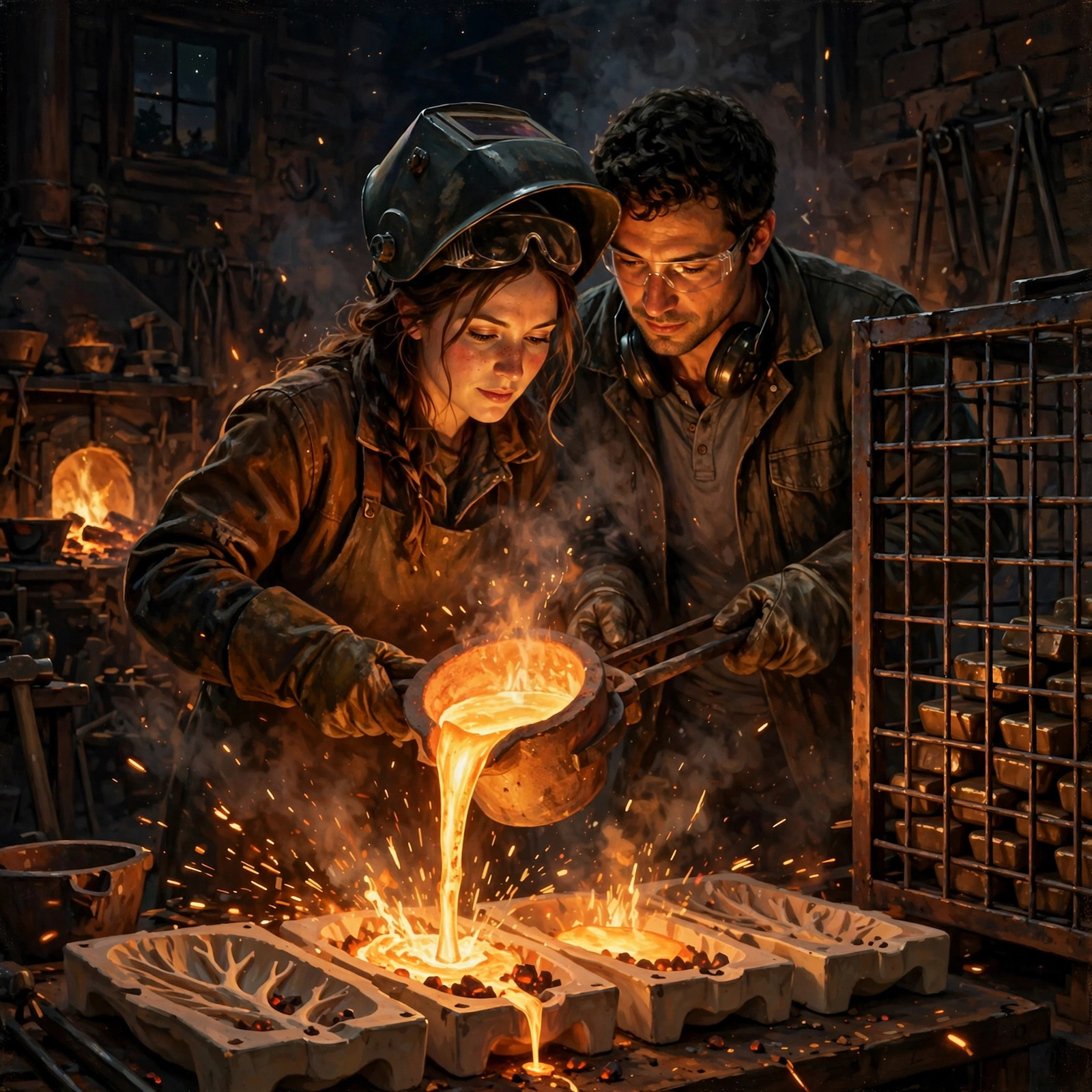
Juno didn't look up. She had the blower housing off the burnout kiln and her arm in it to the elbow, and the motor was making a sound like a coffee grinder full of gravel. "It's been doing this since March. I know what I'm doing."
"Since March, and you know what you're doing."
"Go back to bed."
"It's eleven-thirty." He came across the shop floor in his socks, which seemed unfair somehow, a man that size moving that quietly. He crouched beside her and shone a small flashlight into the housing. "Your fan's rubbing. Bearing's gone. Hear the pitch drop when it heats?"
She did hear it. She'd heard it for months and told herself it was character.
"I don't have a bearing."
"Hardware place on the highway opens at seven." He clicked the light off. "I'll go."
"You're supposed to be guarding the bronze."
"The bronze has a cage and two cameras. You have a blower that's going to quit in the middle of a burnout." He stood, and his knees cracked, and he looked faintly embarrassed about it. "I'll be back before your apprentice gets her coffee."
She wiped her hands on a rag and didn't thank him. He didn't seem to expect it. He went back to the cot, and she heard the springs complain, and then nothing. She stood in the shop for a while under the one work light, looking at the dark line on the tongs where the glue had cured overnight, and then she went upstairs and didn't sleep.
He was back at seven-forty with a paper bag and two coffees. He'd guessed hers wrong, too sweet, and she drank all of it.
The blower took him most of the morning. Juno pretended to work on the patina bench and watched him instead. He laid every part on a clean shop towel in the order it came out. Bolts in a row. Washers beside the bolts. He photographed each step with his phone before he moved to the next one.
"You always this careful?"
"Yes."
"Even with a fan."
"Especially with a fan. Nobody ever got hurt doing it slower." He pressed the new bearing home with the heel of a socket and a mallet, three short taps. "People get hurt when somebody's sure they remember how it went back together."
She thought that sounded like something he'd learned the expensive way. She didn't ask. When he bolted the housing on and flipped the switch, the blower came up smooth and clean, a low even breath, and something in her chest let go that she hadn't known was clenched.
"Huh," she said.
"Huh," he agreed, and almost smiled.
The second night she found him at the wax table.
He wasn't touching anything. He was standing over the tray of runner and sprue wax with his hands in his pockets, the way people stand in museums when the guard is watching. Beside the tray sat a hand from a sculptor's commission, a woman's wax hand curled around nothing, still rough with seam lines from the rubber mold.
"You can touch it," Juno said from the stairs. "Just not the hand."
"What happens to it?"
"Chasing. You clean up the seams and the bubbles before it goes in shell. Every flaw in the wax comes out in the bronze." She came down and pulled the stool out with her foot. "Sit."
"I wasn't asking for--"
"Sit, Serrano."
He sat. She plugged in the little alcohol lamp and lit it and handed him a dental tool, a thin steel hook with a flattened end. She found a reject casting wax, a test leaf Bea had pulled badly a month ago, and set it in front of him.
"Warm the tip. Not hot. If the wax smokes you've gone too far. Then you just..." She reached around him without thinking, her hand over his on the tool, and guided the warm steel along the seam. The wax softened and flowed and the line was gone. "Like that. You don't push it. You let it move."
He was very still. She could feel the heat of the lamp on her wrist and the heat of him under her palm, and she took her hand back a little too fast.
"Your turn."
He gouged it. Of course he gouged it. He pressed like the leaf owed him money, and a curl of wax came up on the tool, and he stared at it with such open dismay that she laughed out loud, a real laugh, the first in weeks.
"You're holding it like a pry bar."
"That's what I'm used to holding."
"Hold it like a pencil. Loose." She watched his fingers ease. "Loose, I said. You're strangling it."
"If I hold it loose I can't control where it goes."
"That's the point. The wax knows where it wants to go. You just keep it company."
He tried again. Slower. The seam softened under the tip, ragged at first, then smoother, and on the fourth pass it simply disappeared. He sat back and looked at the leaf as if it had done the work itself.
"Huh," he said.
"Huh," she agreed.
They sat there longer than a test leaf deserved. He asked how she'd learned and she told him, a little: summers sweeping this floor, the first time she'd been allowed near the furnace, the burn scar on her forearm from a sprue she'd grabbed too early. He told her about his grandfather's chairs, how the old man had never measured twice because he'd never had to. He didn't tell her why he'd stopped being a cop. She noticed him not telling her, the way you notice a step that isn't there in the dark.
Near one in the morning she yawned so hard her jaw popped.
"Go to bed," he said.
"You go to bed."
"I am in bed. Technically." He nodded at the office door, the cot visible through it with its army blanket squared like a hospital corner. "That's the closest I've had to a bedroom since I got here."
"It's a terrible cot."
"It's a very terrible cot."
She should have gone up then. Instead she walked him to the office door, which was ridiculous, it was twelve steps, and on the way he stopped at the rack.
The tongs hung there now, the clamps finally off, crack facing out like she'd left them. The long steel shank caught the work light. The ash grip was dark with decades of hands, worn into a shallow curve where a palm had pressed it, and the glued split ran down it like a vein.
He didn't touch it. He looked at the worn place, and then at her hands, and then back.
"That's not your grip," he said quietly. "Somebody bigger wore that in."
Juno's throat went tight. "No."
"Your father's?"
She nodded once.
Matteo stood there in his socks in the half dark, careful the way he'd been careful with the bearing, and asked, "What was he like?"
Practice Pour
"You're standing too close," Juno said.
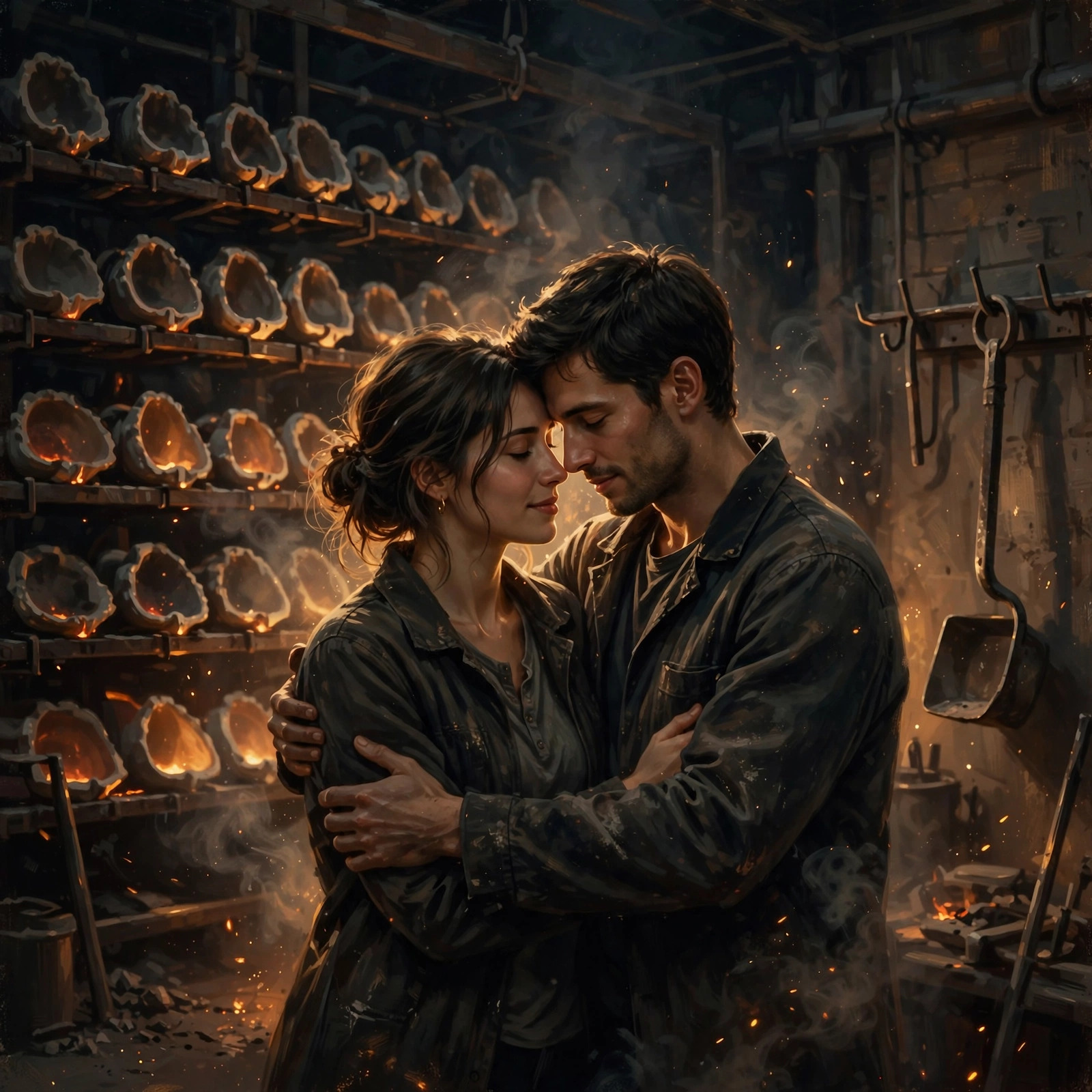
Matteo took one step back from the furnace lid, then another when she kept looking at him. He wore the leather apron she'd dug out of the locker, the spare one, too short in the body for him. Leggings strapped over his boots. Face shield pushed up on his forehead like a welder in a recruiting poster.
"Here?"
"Here." She put two fingers on his chest and moved him a half pace to the left, so he stood behind the tail of the shank and out of the line she'd walk. "If I trip, you don't catch me. You let go and step away."
"That's a terrible plan."
"It's the only plan. Bronze doesn't care who's brave."
Across the floor Bea snorted into her respirator. She had the practice flask set in the sand pit, a squat steel can packed with investment, nothing in it but a test sprue and a lump of scrap they'd melt down again next week. Beyond her, behind the kiln, the memorial mold sat on its stand, the firefighter's torso wrapped in shell, the pour cup gleaming with Bea's fresh patch. Nobody was touching that today. Today was for learning how three bodies moved around one fire.
The tongs hung ready on the hook by the furnace. Juno had checked the glued split twice that morning, run her thumb down it, tapped it with a screwdriver handle, listened. It held. Her father's palm print was still worn into the ash, and the crack ran right through it now.
"Lid," she said.
Bea swung it. Heat came up out of the furnace like a door opening onto summer in the desert, and the light inside was the color of an orange held up to the sun. Matteo flinched, then didn't. She watched him decide not to.
"Shield down."
He dropped it.
She lifted the shank off its hook. Empty, the tongs were heavy. In a minute they'd be heavier. She lowered the jaws into the furnace, found the crucible's waist by feel and memory, and closed them. The ring locked. She leaned back and the crucible came up out of the coals glowing, a skin of slag on top, the bronze underneath moving like something breathing.
"Tail," she said.
Matteo's gloved hands closed on the far end of the shank. She felt the weight shift through the steel, the whole load suddenly half as mean. He didn't pull. He didn't push. He just held, and the tongs settled level between them.
"Walk with me. Small steps."
They walked. Bea skimmed the slag with a long spoon, quick, and flicked it into the bucket. Ten feet to the sand pit felt like a city block. Juno's forearms burned. She could hear Matteo breathing behind the shield, slow, counting maybe.
"Stop. Tip on my word. Not before."
"Copy."
"Don't copy me. Just do it." She lined the lip over the flask. "Now. Slow."
He lifted the tail a few inches. The bronze poured.
It always surprised her, even after all these years. How liquid it was. How it looked like light pouring out of a cup. The stream hit the sprue and sank, and the flask drank it, and the sand around the can hissed. Juno kept her eyes on the cup, on the level, on the thin tremble of the shank.
"Little more."
He gave her a little more. Exactly a little more.
"Hold."
The cup filled. The stream thinned and broke. She tilted back and he followed her without being told, bringing the tail down, and they walked the empty crucible to its stand and set it in the sand, and only then did she let go.
Bea pulled her respirator down. "Okay," she said. "Okay, cop."
"Security consultant."
"Sure." Bea grinned at Juno. "He didn't drop it."
"He didn't drop it," Juno agreed, and her voice came out strange.
Bea looked between them, then very deliberately peeled off her gloves. "I'm going for coffee. Good coffee. The place across the bridge. It takes a while." She was gone before anyone could argue, the side door banging behind her.
Juno hung the tongs on the hook. Her hands were shaking a little, the way they did after a pour, the body catching up to what it had carried. She pushed up her shield. Matteo pushed up his.
The furnace lid was still open a crack. Heat rose off the coals in a slow column and the air between them wobbled, so that his face looked like it was underwater.
"You did fine," she said.
"You talked me through it."
"That's the job."
"No." He pulled off one glove, finger by finger. "The job is me standing in your office with a clipboard. That was something else."
She should have said something dry. She had a dozen ready. Instead she looked at his bare hand, and he looked at hers, still gloved, and he reached out and tugged the leather at her wrist until the glove slid free and dropped on the floor.
"You're very bossy around fire," he said.
"You're very obedient around fire."
"Only around yours."
She kissed him first. She'd think about that later, that she'd been the one to step in, into the shimmer, into the smell of hot sand and his sweat. His mouth was warm and careful for about one second and then not careful at all. His hand came up to the back of her neck, under her braid, and held her there like he'd been waiting to be told he could.
When they broke apart the coals had dimmed. Her shield had slid down crooked. He fixed it, which made her laugh.
"That wasn't protocol," she said.
"I'll write myself up."
"Do that."
He didn't let go of her. She didn't make him.
That afternoon she drove to the bank alone.
She told him it was for crucibles, which was half true; she did need crucibles. She told Bea nothing. She sat in the parking lot for a while with the engine running, looking at her phone, at a message she hadn't answered and hadn't deleted, and then she went inside and stood at the counter and asked for the amount in cash. The teller asked if she was sure. Juno said yes the way she'd said it to every question since her father's funeral. Yes, I'm sure. Yes, I've got it. No, I don't need anyone.
The envelope was thicker than she'd expected. She put it in the inside pocket of her canvas jacket and zipped it shut.
Back at the foundry, Matteo was on the roof checking a camera mount. She could hear his boots overhead. She went straight to the office, where the cot sat squared and neat, and past it to her desk, and was opening the bottom drawer when the door creaked.
"Brought you a latte," Bea said. "It's cold now. Your fault for vanishing." She held out the cup. Then her eyes dropped.
Juno looked down. The jacket had fallen open when she bent, and the envelope stuck halfway out of the pocket, the bank's blue logo plain on the flap, a fan of hundreds showing at the edge.
Bea didn't say anything. She set the cup on the desk very gently, the way you'd set something down near a sleeping animal, and she looked at Juno, and kept looking.
Tanner Road
"You came alone," Lorne said. "That's new."
"It isn't. You just never noticed."
He laughed and wiped his hands on a rag that made them dirtier. Behind him the scrapyard climbed in rusted terraces: car doors, radiator cores, a stripped boat hull tipped on its side. A magnet crane hung still over the far pile. Juno kept her hands in her jacket pockets so he wouldn't see them.
She'd parked on the shoulder of Tanner Road instead of pulling through the gate. Habit. Her father used to do the same, back when the three of them traded bronze scrap and favors and Lorne still brought doughnuts on Fridays. She'd been twenty-two and grieving the year after that, and Lorne had put an arm around her at the funeral and said, I've got the books, kid, don't you worry about the books.
She hadn't worried. That had been the problem.
"So." He tucked the rag in his back pocket. "You read my message."
"I read all of them."
"And?"
She took out the envelope. The blue logo looked cheap out here, small against all that iron. "This is what I can do. It's not what you say I owe. It's what I can do without selling the furnace."
He didn't reach for it. He looked at it the way he used to look at a load of brass someone swore was clean, weighing it before he touched it. "You know what's sitting in your shop right now."
"I know what's sitting in my shop."
"Then you know this is light."
"It's what I've got, Lorne. Take it, sign the release, and stay off my property. That's the deal."
"Your property." He smiled. "Funny. I helped your dad pour the slab that building sits on."
"And then you emptied his accounts."
"Our accounts."
Gravel cracked behind her. She knew the sound of those boots. She'd been listening to them overhead for most of a week.
Lorne's eyes went past her shoulder and something closed in his face, quick and practiced. "Well. You didn't come alone after all."
She didn't turn. "Go back to the truck, Matteo."
"No."
He came up level with her, not touching, close enough that she could feel him there. His jacket was zipped to the throat. His phone was already in his hand, screen lit.
"Mr. Achebe-Vasquez. I'm with the arts commission's security contract. You're aware there's a report on file about the break-in."
"I'm aware there's a report." Lorne spread his hands. "Nothing in it with my name."
"Not yet."
"Are you threatening me on my own lot?"
"I'm telling you what's on file." Matteo's voice was flat, even, the voice he used reading camera logs. "And I'm telling you she's leaving now."
"She is standing right here," Juno said.
Lorne looked between them and found what he needed. He always did. "Oh, kid," he said softly. "You got yourself a new one to hold the books."
She put the envelope back in her pocket. Her hand was shaking, and she hated that Matteo saw it.
"Offer's closed," she said.
"It was never open." Lorne pulled the rag back out and turned toward the crane. Over his shoulder he said, "Cages come apart, Juno. Ask your dad what we could do with a cutting torch."
She walked to her truck without answering. Matteo followed her the whole way, and she let him, because the alternative was running.
He didn't speak on the drive. He drove behind her, his headlights steady in her mirror, all the way back to Faraday Art Foundry, and when she pulled into the yard he was parked beside her before her engine stopped ticking.
Inside, the shop was dim and warm. Bea had gone home. The kiln clicked as it cooled, and the mold sat in its rack by the burnout area, the patched pour cup pale against the gray shell. The firefighter's torso, waiting.
"How did you know?" She shrugged out of the jacket and threw it on the bench.
"You told me it was for crucibles." He set his phone face down beside her jacket. "Crucible suppliers don't take cash, and you don't drive to Tanner Road to buy them. I checked your truck's last stop on the gate camera. You turned the wrong way."
"You tracked me."
"I did my job."
"Your job is the bronze."
"My job is the site. You're the site." He scrubbed a hand over his jaw. "Juno, you walked into a yard full of cutting equipment, alone, with a stack of hundreds, to meet the man who broke your lock. Do you understand what he could've done?"
"He's not going to hurt me."
"He already has. You said so in the truck the first night."
She had. She'd said it by the furnace too, after, with his hand still warm on her neck. She turned away and picked up the shank from its hook because her hands needed something. The long steel, her father's rivets, the ash grip with its glued seam. She ran her thumb down the clamp mark.
"It's handled," she said.
"It's not." He picked his phone back up. "I'm calling the commission."
She went still. "To say what?"
"That there's an active threat to the metal, and the owner's in direct contact with him. That I'm recommending they hold the pour until the police have something."
"You can't."
"It's in the contract. Any credible threat, I report. I don't get to pick and choose."
"If they hold it, I miss the unveiling. If I miss the unveiling, they pull the contract and I lose the shop. You know that. You read every page of that thing."
"I know." His thumb was already moving. "I'd rather you lose the contract than lose--"
"Don't."
He looked at her once, and then he put the phone to his ear. She heard it ring. She heard a voice answer, and Matteo say his name and his company, polite, procedural, and the words recommend a hold came out of him as calm as if he were reading a weather report.
She didn't decide to throw it. Her arm just went. The shank sailed past the kiln rack, nowhere near the mold, nowhere near him, and struck the concrete with a sound like a dropped bell. It skidded and stopped against the base of the furnace.
Matteo lowered the phone. On the other end someone was saying, Mr. Serrano? Hello?
Juno walked over and picked up the grip end. The glued seam had let go. Worse, a new crack ran crosswise through the ash, right where her father's palm had worn it smooth. The wood shifted in her hand. She set the shank back on the floor, gently, the way you'd set down something that was already gone.
"I'll call you back," Matteo said into the phone, and ended it.
"You're done," she said. Her voice came out very quiet. "Get your cot. Get your cameras. Send the commission whatever you have to send. You're fired."
"You can't fire me. The city pays me."
"Then tell the city I won't have you in my building."
He stood there a long moment. She watched him want to argue, watched him find the clause, the line, the procedure, and watched him put it down.
"The cage stays," he said. "The cameras stay. They're commission property. I'll have the feed sent to the station."
"Fine."
"Lock the side door tonight. The brass one sticks if you don't lift it."
"I know how my own door works."
"I know you do." Something in his face gave, just briefly. "I'm sorry about the grip."
She didn't answer. She didn't trust what would come out.
He went into the office. She heard the cot fold, the creak of the frame, the zip of his duffel. When he came out he didn't look at the furnace or at her. He stopped at the bench where her jacket lay, the envelope still a hard square in the pocket.
He reached into his own pocket and took out her father's key.
He left the key on the bench.
She heard the side door lift and settle shut behind him, exactly the way he'd told her to do it.
Rewrapped Grip
"You're not supposed to be here," Juno said, before he'd even gotten the side door all the way open.
Matteo lifted the door the last inch, the way it needed, and stepped in out of the gray morning. He had the pouring shank across both forearms like a man carrying a sleeping dog. "I know. I knocked. Twice."
"I heard you."
"I figured."
Bea looked up from the investment bench, a coffee halfway to her mouth, and very deliberately set it down. "I'll be in the wax room," she announced to nobody. She didn't move.
Juno stood by the kiln rack with her arms folded. She hadn't slept much since he'd left. The cot was gone from the office, but she kept seeing the rectangle on the floor where its feet had pressed the dust. "That's mine," she said, nodding at the shank.
"It is." He crossed the shop and laid it on the bench where he used to sit with his laptop and his camera feeds. "I took it Thursday night. Before I left. You'd put it down by the door like you were going to throw it out."
"I was going to fix it."
"You were going to throw it out," he said, quieter. "Look at it first. Then yell."
She meant to stay where she was. Her feet didn't agree.
The steel was the same, black and scaled, her father's rivets standing in their neat line. But the ash grip had been stripped of the old split glue and pinned through, two small brass dowels sunk flush where the crack had run. Over the repair he'd wrapped the handle in waxed linen cord, tight, overlapping turns, finished with a whipped knot she recognized from rigging. Under the cord, at the palm, the original wood still showed through in one narrow window, worn pale and smooth.
"I left that bit bare," he said. "Where his hand was. I didn't want to cover it."
Juno put her own palm there. It fit the way it always had.
"Where'd you learn to do this?"
"Guy who restores tool handles out past the river. I paid him to teach me instead of paying him to do it." He shrugged. "Took two nights. The pins were the hard part."
Her throat had gone tight, and she was furious about it. "This doesn't change anything. The commission still has the pour on hold because of you."
"I called them back yesterday."
"And said what?"
He pulled a folded page out of his jacket and set it beside the shank. She didn't pick it up, so he said it. "I resigned the contract. Effective last night. They're sending someone else for the cage, someone who'll answer to them and not argue." He met her eyes. "I told them the hold was my call and I'd been wrong to make it without you. They'll want to hear from you to lift it."
Bea made a small sound by the bench.
"You quit," Juno said. "You get paid for this. They were going to refer you for the transit job. You told me."
"I told you that so you'd think I was busy." The corner of his mouth went up and then fell. "I'm not here for them. You need four hands on that crucible and Bea can't be both of them. So I'm asking if I can stay on as crew. No fee. No protocol. You say where I stand, I stand there."
"Why?"
He took a while. When he spoke it came slow, as if each word had to be lifted over something. "I had a client, when I was still on the force and doing side work. A judge. I watched her so close she couldn't open her own mail. She fired me and she was right. I swore I'd never be that again, and then I turned around and did it to you, by phone, behind your back." He looked at the grip, not her. "That's why I left the force. I've never said that to anyone."
Juno found she was holding the shank against her chest.
A soft electronic chirp came from his jacket. Then another.
Matteo's whole body changed. He had his phone out before the third chirp. "Motion on the cage. East camera." He turned the screen so she could see without being asked, and that, more than anything, landed in her.
On the grainy feed a man in a dark canvas coat crouched at the back of the bronze cage, out behind the loading bay. A small tank stood beside him. A thin blue flame bloomed at the end of a hose.
"That's Lorne," Bea said. "That's his coat. He's had that coat since I was hired."
"He's cutting the hasp." Matteo was already moving, then stopped himself so hard he nearly rocked. He looked at Juno. "Your building. Your call."
She heard the hiss through the back wall now, faint and patient. Sixty thousand dollars of commission ingot sat in that cage, every pound of the firefighter's torso still waiting to be melted. Behind it, nine years of her name on the door.
Her whole life she'd have walked out there alone.
"Bea, call the police. Tell them a torch is involved." Her voice didn't shake, which surprised her. "Matteo, come with me. You talk. I don't trust what I'll say to him."
"Copy."
They went out through the loading bay. The cold air hit her face, and with it the sharp smell of cut steel. Lorne looked up. The flame wavered in his hand. He was grayer than she remembered, thinner around the jaw, and for one second he looked only tired.
"Junie," he said. "I just want what's mine."
"Shut that off," Matteo said, level. "Put it on the ground. Step back toward the fence. There's a camera on you and the feed's at the station already."
Lorne looked past him, at Juno, as if she'd overrule it. She didn't. She stood beside Matteo, close enough that her sleeve touched his.
"You heard him," she said.
Lorne's thumb found the valve. The blue flame shrank to nothing. The hasp glowed dull orange, half eaten through, and held.
Sirens came up Tanner Road sooner than she'd expected. Two officers took the torch, the tank, and then Lorne's wrists, and he didn't fight them. He only said, to the gravel, "Your dad would've paid me." Juno found she had nothing to give that, not even anger. She watched the cruiser door shut on him and felt her shoulders come down from somewhere near her ears.
One of the officers took Matteo's statement. Bea took the other one's questions about the cash, chin up, and Juno let her.
When the lot was quiet again, she stood at the cage looking at the scarred hasp. Matteo stood a careful step away, hands in his pockets, waiting to be told where to stand.
"I can't do the pour with two people," she said. "I've been pretending I could. I need both of you. I need help." The words felt strange and enormous in her mouth, and then they were just out. "Please."
Bea let out a breath and bumped Juno's shoulder with hers. "Took you long enough, boss."
Matteo didn't say anything. He just nodded once, like a man signing his name.
Back inside, Juno picked up the office phone and dialed the commission herself. A woman answered. Juno gave her name, the foundry, and the case number one of the officers had written on her hand.
"The threat's in custody," she said. "My crew's in place. I'm asking you to lift the hold."
There was a pause, some keys, a muffled question to someone else. Juno held the rewrapped shank across her knees while she waited, her thumb on the bare window of wood.
"All right, Ms. Faraday," the woman said. "Hold's lifted. You're cleared to pour on schedule."
Juno hung up and looked at the two of them. "We're back on."
Bronze Still Warm
"Not yet," Juno said, and caught Matteo's wrist before his hammer touched the shell. "Give it another ten minutes. If you crack it while it's this hot, you'll take a chip out of his shoulder and I'll have to chase it for a week."
"You said it was cool enough."
"I said the crucible was cool enough." She let go of him. Her glove left a gray print of shell dust on his sleeve. "He's still thinking about it."
Matteo lowered the hammer and looked at the mold the way he'd looked at the fence line his first night here, as if it might do something sudden. Heat came off it in a soft, steady wave. The ceramic had gone the color of old bone, scorched black at the pour cup, and a thin seam of light still showed where the sprue met the shell.
Bea had gone home half an hour ago, after the bronze was in and nobody had died. She'd pulled off her face shield, kissed the top of Juno's hood through the leather, and said, "I'm taking a shower and then I'm sleeping for a year. Don't break him open without me." Then she'd looked at Matteo and added, "Or do. Just take pictures."
So now it was the two of them on the pour floor, and the place had gone quiet in the way it only did after. The blowers were off. The big doors stood open to the yard, and the evening came in cool across the concrete and met the heat rising off the sand pit. Somewhere out past the cage, a gull complained about something.
Juno sat down on an overturned bucket because her knees had decided it for her. Her arms were shaking. They always did after a big pour, a deep tremble that started in the forearms and worked its way up, and for most of a decade she'd hidden it by staying busy until it passed.
Tonight she just sat there and let it happen.
Matteo set the hammer on the bench, beside the long shank. The ash grip was dark with sweat now where her hands had been, the waxed linen cord a little scorched at one end. He touched it with one finger, lightly.
"It held," he said.
"It held." She flexed her hands inside the gloves. "I kept waiting for it to give. Right at the lift, when the crucible came out full. I thought, this is where Dad's rivet lets go, and I drop sixty thousand dollars of bronze on my own feet."
"You didn't say anything."
"You were on the other end. I didn't have to."
He looked at her then. He was still in the borrowed leathers, the jacket too short in the arms, and his hair stood up in a sweaty crest where the hood had been. He'd taken the rear of the shank on the second pour without being told, because Bea's grip had started to slip, and he'd walked backward on her count with his whole body bent toward the weight. He hadn't once looked at the cameras. She'd noticed that. She'd noticed it more than she wanted to admit.
"You counted out loud," he said. "The whole way across."
"Habit."
"I liked it." He pulled off his gloves and dropped them on the bench. "You've never told me where to stand before. Not once. I kept waiting for it."
"I told you to get out."
"That's where not to stand." Something eased at the corner of his mouth. "Different instruction."
She laughed, and it came out shakier than she meant. He crossed the floor and crouched in front of her bucket, and without asking he took her right hand and peeled the glove off it, finger by finger, the way she'd seen him unbuckle the cage lock: slow, careful, like there was a right order to it. Her bare hand was red and damp and trembling. He held it between both of his and didn't try to stop the tremor. He just held it.
"Does that happen every time?"
"Every time."
"You never let anyone see it."
"There was never anyone to see it." She looked at their hands instead of his face. "Bea knows. Bea pretends she doesn't."
"I'm not going to pretend."
"I know," she said. "That's the problem with you."
He went still at that, the old stillness, and she felt him start to pull back into it. She tightened her fingers around his before he could.
"That came out wrong. I mean it's the thing I'm going to have to get used to."
The light at the sprue had faded. Juno stood, and her legs held, and she took up the small hammer herself and passed him the chisel. "Okay. Now."
They worked around the figure together. She set the chisel at the seams and he tapped where she pointed, and the shell came away in curved gray pieces that clattered on the concrete. Underneath, the bronze was raw and dark and gold where the chisel scraped it. A broad shoulder emerged first. Then the collar of a turnout coat, every fold Bea had pressed into the wax. Then a jaw, lifted slightly, eyes on something above all of them.
Matteo stopped tapping. "He looks like he's listening for something."
"The sculptor wanted that. Like he's waiting for the call." Juno brushed shell grit out of the bronze ear with her thumb. It was still warm, warm as a body. "Some families are coming to the unveiling. The guys from that station. They'll put their hands on him."
"And he'll be here because you didn't quit."
"He'll be here because three people carried him," she said. "I couldn't have lifted that crucible alone. I'd have tried. I'd have killed myself trying, probably, just to prove it."
Matteo set the chisel down. The last big piece of shell lay at their feet, curved like a broken bowl, a ghost of the torso printed on its inside.
"I gave up the fee," he said. "And the referral. I know you think about that."
"Every hour."
"Don't." He wiped his palms on his leathers, which only made them dirtier. "For six years I've been paid to stand outside doors. I'm good at it. I made one judge feel like she lived in a cell and I told myself it was the job. Then I came here and you wouldn't let me guard you, and I stood outside your door anyway, and I nearly did it again." He stopped. "Tonight I got to carry something with you instead. Nobody's ever let me do that."
Juno looked at him across the shoulder of the bronze. The yard lights had come on outside, and the open doors framed the cage, its hasp still scarred black.
"I love you," Matteo said. Plainly, the way he said everything that mattered, no protocol in it at all. "That's the whole report."
Her eyes stung. She blamed the shell dust and knew better.
"I love you too," she said. "I didn't want to. I wanted to do it alone, like everything else. I can't seem to."
"Good," he said, rough.
She stepped around the figure, over the broken shell, and he met her halfway. His arms came around her and hers went around him, leather creaking, both of them smelling of smoke and sweat and hot metal. She pressed her face into his collar. Her arms were still trembling, and she let him feel it. He held on harder, steady through the shaking, his cheek against her hair.
Beside them the firefighter stood in the dusk, bronze still warm, listening.
Get notified when new stories drop

Serena Blake
Serena writes romantic suspense and dark romance for readers who want pulse and payoff. Her stories chase trust as hard as they chase danger.
Leave a comment
Comments