




The Cracked Pipe
"Who soldered this?"
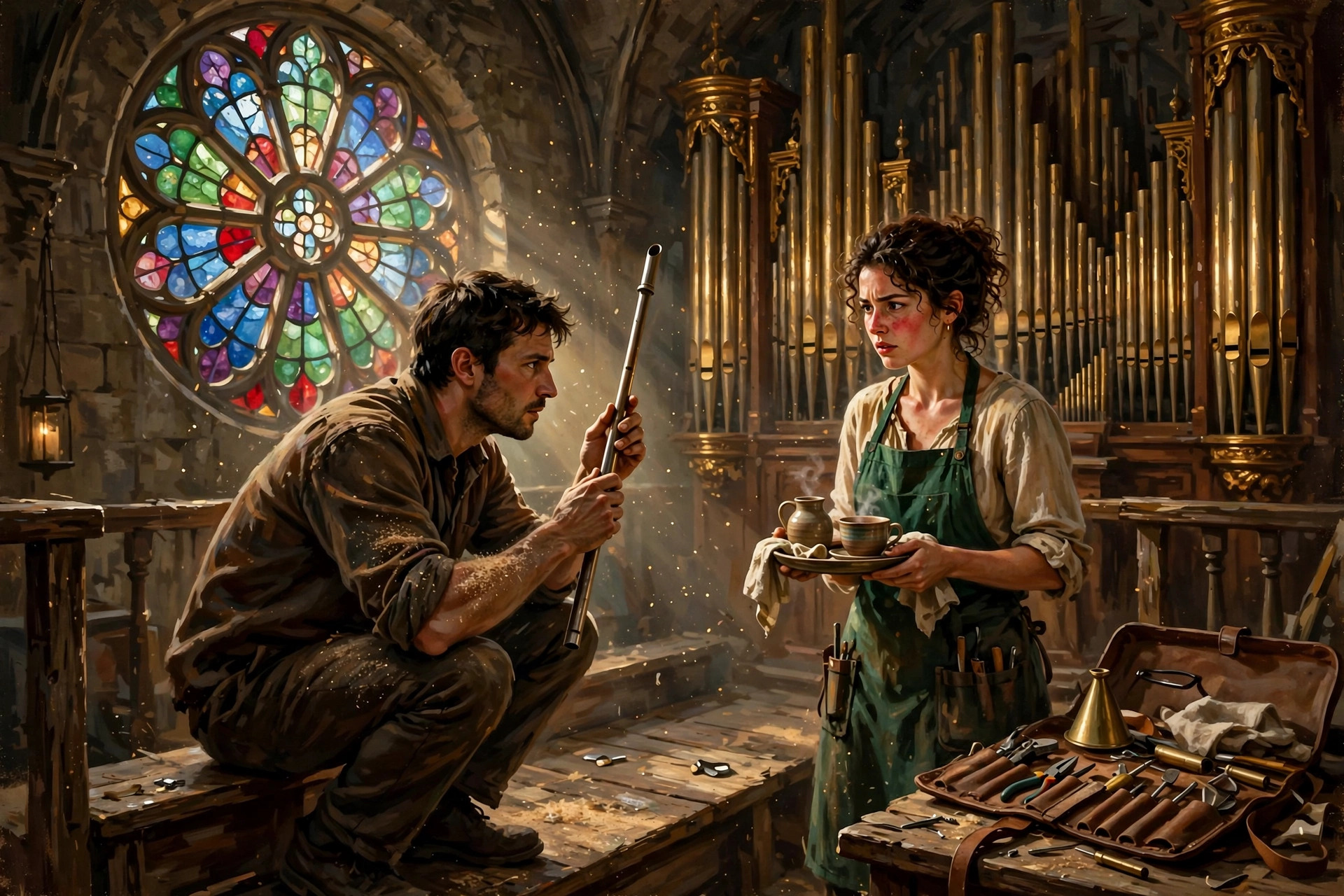
Clementine Ashgrove had climbed the loft ladder with a tray of tea for the new man, and the new man had not said hello. He was crouched on the walkboard behind the great organ with a pipe across his knees, holding it to the light from the rose window as if it had insulted his mother.
"Good afternoon to you too, Mr. Teague." She set the tray on a crate. "I did."
"Then you'll know it's wrong."
Behind her, Lottie stopped halfway up the ladder. Clementine heard the faint squeak of her apprentice's trainers going very still.
"It's not wrong. It's holding."
"It's holding like a plaster on a broken leg." He turned the pipe so she could see. A pale seam of solder ran along the resonator of the vox humana, the chapel organ's oldest stop, the one her grandfather used to call the old lady's voice. "You've built up the joint so thick the tin can't move. Every time the chapel warms up, she pulls against it. That's why she's cracked again, right beside your patch."
Clementine looked. There it was, a hairline split, bright as a pencil line, just past her own work.
Her face went hot. She hated that it went hot.
"That repair was done in a hurry," she said. "The heating failed the winter before last and the trust needed her playing for a funeral by Saturday."
"So you did it fast."
"I did it in time."
"Those aren't the same thing." He set the pipe gently on his knee, which was somehow worse than if he'd tossed it. "I'm being paid to make this organ sing properly, Lady Clementine. Not to make it get through Saturdays."
"Just Clementine."
"Fine. Clementine." He said it like he was testing a note he didn't trust.
He wasn't what she'd pictured when her father's letter from the trust said they'd hired a voicer from London. She'd imagined someone elderly and fussy, with half-moon spectacles. Jonah Teague was tall enough that he had to fold himself under the swell box, and he had sawdust on his sleeve and a tool roll spread open beside him like a surgeon's kit. Worn leather, every pocket full. Near the end sat a small brass cone, rubbed almost gold at the tip where a thumb had pressed it for years.
"Ashgrove Organ Works has looked after this instrument since before either of us was born," she said.
"I know. I read the logbook." He tipped his head toward the battered ledger on the bench. "Lot of patching in there. Lot of 'temporary' in your hand."
Lottie made a small noise. Clementine didn't turn around.
"Temporary," Clementine said, "because a full restoration costs money the trust hasn't had. You might have noticed the roof."
"I noticed the roof." He glanced up at the water stain spreading across the plaster like a map of somewhere damp. For a second something crossed his face that wasn't contempt. Then it was gone. "Big houses always have a roof."
"What's that supposed to mean?"
"Means there's always a reason the craftsman's work gets done cheap." He picked up the brass cone, turned it once in his fingers, and put it back in its pocket with more care than he'd shown her all afternoon. "I've heard most of them."
She stared at him. "You've been here three hours."
"Long enough to read a seam."
"Long enough to decide you know me."
He held her gaze then, properly, and she was annoyed to discover his eyes were grey and tired and very steady. "I don't know you. I know this joint. And this joint says somebody cared more about getting it done than getting it right."
That landed somewhere under her ribs, in a place she kept locked. Getting it done. That was the whole of her life, wasn't it? The invoices paid on time, the boiler mended, the apprentice's wages found somewhere, her father's chin kept up at trust meetings. She had stayed and stayed and stayed, and kept things holding.
"Lottie," she said, without looking away from him. "Would you give us a minute?"
"Gladly." The ladder creaked as Lottie fled, then creaked again as she came back up two rungs. "Your tea's getting cold, Mr. Teague. She made it herself. She never makes anyone tea."
"Lottie."
"Going."
The loft settled into quiet. Dust turned in the coloured light. Below them, the chapel door groaned in the wind.
"Say what you came up here to say," he said.
"I came up here to bring you tea."
"And now?"
"Now I'd like you to remember that you're a guest in my family's chapel, working beside my family's workshop, and that the people who've kept this organ breathing through three wars and a leaking roof did not do it by being precious about their solder."
"Precious." A muscle moved in his jaw. "That's what your sort calls doing it properly. Precious. Fussy. Too slow. Right up until it fails, and then whose fault is it?"
"My sort?"
He didn't take it back. He just looked down at the pipe.
She could have gone down the ladder. She could have rung her father and asked the trust to find someone with manners. She thought about it for a whole breath, the easy, sensible thing, and then she thought about the old lady's voice on Christmas Eve, thin and human and trembling over the congregation, and she didn't move.
"Fine," she said. "If my repair's so bad, tell me what you'd do."
He seemed surprised she'd asked. "Cut out the old patch. All of it. Dress the edges back to clean metal. Then a new seam, thin, so she can still flex. It's slow, fiddly work. Most shops won't bother."
"My shop will."
"Will it."
"Give it here."
For a moment he didn't. He sat with the pipe across his palms, weighing it, or weighing her. Then he stood, ducking under the swell box, and held it out.
It was heavier than it looked. It always was. The tin-lead was cool and dull and smelled faintly of old wood, and the crack ran under her thumb like a dare.
Their fingers overlapped for a second on the resonator. His were rough, warm, nicked across the knuckles. Neither of them let go quite fast enough, and she felt the instant stretch, absurd and irritating, before she pulled the pipe to her chest.
"I'll want to see it before it goes back in," he said.
"You'll see it."
"And if it's thick again--"
"It won't be."
He nodded once, picked up the cooling tea, and took a long swallow as if to prove a point. "Milk, no sugar. Lucky guess."
"Lottie told me."
"Lottie seems to tell everyone everything."
"She does." Clementine turned to the ladder, the pipe tucked under her arm like something stolen back. At the top rung she stopped. "Mr. Teague."
"Jonah."
"Jonah. When I bring this back to you, it'll be the best seam you've ever seen. And you'll say so."
His mouth twitched. It wasn't quite a smile. It looked like a man who'd forgotten how and was considering trying again. "I'll say whatever's true."
"Then I'll make sure it's true."
She went down the ladder with her heart going hard and her jaw set, through the cold nave and out into the wind, the old lady's cracked voice clutched against her, already planning the cut, the clean edge, the thin bright line that would prove him wrong.
Rupert's Visit
"You're holding the iron like it owes you money," Jonah said from behind her.

Clementine didn't look up. The vox humana pipe lay clamped in the cradle on her bench, the old patch gone at last, the edges dressed back to clean grey metal that caught the lamplight. She'd spent most of three evenings on it. "Is that a professional opinion?"
"It's an observation. You grip hard when you're nervous."
"I'm not nervous. I'm concentrating."
"Same knuckles." He leaned over her shoulder, close enough that she could smell sawdust and cold air on his jacket, and studied the seam line without touching it. "That's good prep. Honestly good."
She set the iron in its stand before her hand could betray her. "You said you'd only say what's true."
"I did." He straightened. "Don't let it go to your head. You haven't soldered it yet."
The workshop door banged open on the wind, and Lottie's voice carried in from the yard, bright with news. "Car on the drive. The silver one."
Clementine's stomach dropped a quiet inch. She wiped her hands on the rag at her belt, then wiped them again.
Jonah watched her do it. "Silver one?"
"Rupert." She untied her apron and hung it on its peg. "He's come to see my father."
"And you're going."
"I'm expected."
He said nothing to that, which was somehow worse than if he had.
The study at Ashgrove Hall had always been too warm. Her father kept the fire high for his joints and the curtains half drawn for his eyes, so that the room glowed like the inside of a lantern. Edmund Ashgrove sat behind the great desk with his reading glasses pushed into his white hair. Rupert Vane stood by the window in a navy coat that had never seen sawdust, a slim leather folder under one arm.
"Clementine." Rupert kissed her cheek, courteous and brief. "You've solder on your wrist."
"I've solder everywhere. Occupational hazard."
"I'd have it no other way." He said it lightly, and she believed him, which was the trouble with Rupert. He was never unkind. He simply knew exactly what this was.
He opened the folder and laid a sheet on the desk beside the cream page already waiting there. Her father had kept that one weighted under the brass inkstand since the solicitor's courier brought it, the wax seal dull red in the firelight. The consent page. Two lines at the bottom, both empty.
"The schedule of terms," Rupert said, tapping the new sheet. "The solicitors finally agree on the wording. Nothing changes for you, Clem. The Works stays open. The estate's clear. Your father keeps the Hall."
"It's very generous," her father said, and his voice had the careful brightness he used in church. "Very generous indeed."
Clementine looked at the empty line with her name typed beneath it. Two hundred and forty thousand pounds. She'd done the sum so many times it had worn a groove in her. Her mother had looked at a smaller number once, packed two cases, and gone. Clementine had been old enough to carry one of them to the car.
"No rush," Rupert said. "Read it properly. I'd rather you were sure."
"I'm sure," she said, too quickly. "I'll read it tonight."
Her father let out a breath and reached for the decanter. Rupert's eyes rested on her a moment longer than politeness required. Then he smiled and asked about the organ.
She found Jonah in the yard when she came back, sitting on an upturned crate with his tool roll open across his knees. He was rubbing the old brass tuning cone with a soft cloth, slow circles, the way some men handled rosaries. He put it away when he saw her.
"How was the financier?"
"Pleasant."
"Pleasant." He rolled the canvas shut and tied it. "You walked in there with your shoulders up round your ears and came out with them flat. Like somebody'd handed you a heavy box and you'd decided it was yours."
"You don't know anything about it."
"No. I know people like your father, though. Big houses. Lovely manners. Bills that land on somebody else's table." He stood. "Good luck to you."
"That's rich, from a man paid by my father's trust."
"Paid on time, so far." His jaw tightened on something he didn't say. "So far."
She meant to walk away. Instead she heard herself say, "The swell box action's dead on the north side. You said you needed it working before you could voice anything up there."
"I did."
"Then we're doing it tonight. I'm not losing another day to the wind getting in that cable."
He looked at her for a long moment. "Fine. Bring a torch."
The chapel at night was a different animal. The nave swallowed their footsteps and the loft creaked with every gust that worried the lead roof. They worked by two torches and a work lamp clipped to the case, Jonah on his back under the swell pedal linkage, Clementine kneeling beside the old junction board where the cotton-covered wires ran like veins into the dark.
"Someone's replaced half of this with bell wire," he said. "Bell wire."
"My grandfather. The war took the proper stuff."
"Your grandfather had nerve."
"It's held for decades."
"It's held because God's patient." He held out a hand without looking. She put the wire strippers into it. He didn't have to ask which tool, and she didn't have to wonder, and the ease of that unsettled her more than the argument had.
They worked. She called out contacts, he traced them, and somewhere past ten the linkage gave a stiff clunk and the swell shutters on the north side groaned open for the first time in a year. A breath of cold, dusty air rolled out over them both.
Jonah laughed. It was short and startled, as if it had escaped him. "There she is."
Clementine sat back on her heels, grinning before she could stop. "You said 'she.'"
"Don't tell anyone."
"Lottie will know by morning anyway."
He propped himself on one elbow, the lamp throwing his face half into shadow. "Are you going to sign it?"
The question landed in the quiet like a dropped spanner. She busied herself coiling the spare wire. "That's not your concern."
"No," he agreed. "It isn't."
A gust hit the west window. Somewhere below, wood scraped against stone, and then the long ladder leaning by the stair door slid sideways and crashed across the loft entrance, its top rungs wedged against the rail.
Clementine was already moving, the reflex of a woman who'd righted every fallen thing in this building since she was a girl. She got one hand on the cold rail.
"Leave it." Jonah was up first. He stepped past her, took the ladder's weight with a grunt, and walked it upright against the wall, settling its feet with a scuff of his boot. Then he tested it twice, steady, and turned.
"I could have managed," she said.
"I know you could." He brushed the grit off his palms, not quite meeting her eyes. "You don't have to manage everything, Clementine."
It was the first time he'd used her name. She stood very still in the cold air off the open shutters and found she had no answer at all.
Brass Cone
"Thinner," Jonah said. "You're still feeding it like you're afraid it'll run away."
"It's solder. It doesn't run away. It runs through, and then I spend an hour picking it out of the boot."
"So don't flood it."
Clementine lifted the iron off the seam and glared at him over the top of her magnifier. He was leaning against the end of the bench with his sleeves pushed past the elbow and a mug of tea gone cold in one hand, and he'd been watching her work for most of an hour without touching a thing. She'd have preferred he grabbed the iron. Watching was worse.
"You could go back to the Hall," she said. "There's a fire in the library. Dad's asleep in front of it by now, you'd have it to yourself."
"I'm fine here."
The workshop was quiet in the way it only got after Lottie went home, the long room dark except for the pool of light over the bench, the racks of pipes along the walls catching it in dull silver stripes. Rain ticked on the skylight. The old voicing chest sat at her elbow, its little bellows already charged, waiting.
She drew the iron along the last of the seam, slow, and this time the solder went in bright and narrow and stopped where she told it to. She set the iron in its stand and let out a breath.
Jonah put the mug down. He came round beside her and bent close, turning the pipe under the lamp with two fingers at the boot. She could smell cold rain on his jumper and the faint metallic tang of flux.
"That," he said, "is a seam."
"Don't sound so surprised."
"I'm not surprised. I'm relieved. There's a difference." He ran his thumbnail beside the join without touching it. Then he frowned and tilted the resonator toward the light. "The mouth's gone out of round. Here. Probably when you pulled the old patch."
She looked. He was right; the top of the little resonator had a faint flat to it, a slight egg shape where it should have been a circle. She reached for the rack of cones on the wall, the workshop's set, old steel ones her grandfather had bought secondhand.
"Not those." He was already unrolling the canvas tool roll on the bench, and his hand went straight to the worn brass cone in its own pocket at the end. He hesitated, just for a second. Then he held it out to her, base first.
She didn't take it. "That's yours."
"It's the right size. Yours are too steep, you'll flare it." He kept his arm out. "Go on."
She took it. It was warmer than she expected, as if it had been sitting in his pocket rather than the roll, and heavier. The brass was dark gold and smoothed glassy near the tip where a thumb had rested over and over. Along the base ran a thin soldered seam, neat as stitching.
"Someone made this," she said.
"My dad." He said it to the pipe, not to her. "Spun it on his lathe before I was born. He said bought ones were for people who didn't care what the metal felt."
She set the cone into the mouth of the resonator and pressed, slow, turning a quarter at a time. The brass slid against the tin with a whisper. She felt the flat give, felt the circle come back true under her fingers, and she found she was being more careful than she'd ever been with anything of her own.
"He had a workshop," Jonah said behind her. "Like this. Smaller. Four of us, if you count me, and you shouldn't, I was mostly sweeping." A pause. "He took on a rebuild for an earl. Big house, big instrument, three manuals. Eighteen months of work. He borrowed against everything to buy the materials, because a man with a title and a chapel doesn't stiff you. Everyone said so."
Clementine stopped turning. She didn't look round.
"The earl died before the last invoice. The son said the estate couldn't honour his father's private arrangements. The solicitors were very polite about it. Polite for two years." He let out a short breath that wasn't a laugh. "The bank wasn't polite at all. Dad sold the lathe last. Then he sold everything else, then he sat in the kitchen. He kept that." He nodded at the cone in her hand. "Only thing."
She thought of the study desk at the Hall. The cream paper lying there under its wax seal, the figure in the schedule she'd read so many times it had stopped being a number and become weather. She thought of every tradesman's bill she'd paid this year by moving money out of somewhere else.
"So when you walked into the loft," she said, "and saw an earl's daughter."
"I saw someone who'd let a pipe crack for want of an afternoon." He was quiet. "And I was wrong. Mostly."
"Mostly."
"You do still flood a seam."
She laughed despite herself, and it came out unsteady. She drew the cone free. The resonator mouth was round again, clean. She held the brass out to him, and he shook his head.
"Hang on to it till it's in. In case."
She set the pipe into its hole on the voicing chest. Her hands weren't quite right; it took her two tries to seat the boot. Jonah reached past her and checked the tongue with a fine wire, a tiny adjustment, the barest nudge of the tuning spring, and then he stepped back and left the key to her.
"Your stop," he said. "Your family's. You do it."
She pressed.
For a heartbeat there was only the hiss of wind. Then the reed caught, and the pipe spoke.
It wasn't a beautiful sound, exactly. The vox humana never had been. It was thin and nasal and strangely human, a voice humming behind a closed door, and it wavered a little in the cold air before it settled. But it was whole. No buzz, no rattle at the seam. The note she'd been hearing in her sleep since she was small, from the back pew of the chapel with her mother's coat around her shoulders.
She let go of the key and the note died. The room seemed louder without it.
"Well," Jonah said softly. "Hello."
She pressed the key again because she couldn't help it, and held it this time, and when she turned her head he was looking not at the pipe but at her. Whatever was on her face, he didn't make a joke about it.
She released the key. "It's been broken since before you were here. I kept meaning to do it properly. There was always something else."
"There always is." He reached out and, very carefully, as if she were the cracked thing, tucked a loose strand of hair back behind her ear. His knuckles were rough with old burns. "You don't have to apologise to me for being tired."
Nobody had ever said that to her. She didn't know what to do with it, so she did the only thing that seemed to fit. She stepped in, and kissed him.
He went still for half a breath, and then his hand slid to the back of her neck and he kissed her back, slow and certain, the way he did everything that mattered. The bench edge pressed into her hip. Rain hammered the skylight. Somewhere behind her the bellows sighed as the wind bled out.
It was the sigh that did it. A small dry sound, like paper settling on a desk.
She pulled back, the cone still in her hand.
Wax Seal
"You don't have to do it this morning," her father said.

Clementine didn't look up from the desk. The consent page lay where it had lain for weeks, cream laid paper gone faintly soft at one corner where she'd kept touching it, the solicitor's red wax pressed into a neat coin above the line that waited for her.
"You said that last month."
"I meant it last month." Edmund lowered himself into the wing chair by the cold grate. He'd dressed for the trust meeting in his good tweed, and he looked smaller inside it than he used to. "Rupert isn't pressing. He told me so himself."
"Rupert never presses. That's rather the point of him."
Her father made a sound that wasn't quite a laugh. Outside, a van door slammed down by the stable block, and she knew without looking whose van it was. She'd heard it arrive at seven. She'd been awake since five, sitting on the edge of her bed with a brass tuning cone in her lap, turning it over until the metal was the same temperature as her palm.
It was in her cardigan pocket now. She could feel the weight of it against her hip.
"Clemmie." Edmund leaned forward. "Is there something I ought to know?"
She thought of rain on the skylight. A rough knuckle at her ear. You don't have to apologise to me for being tired.
She thought of the other morning, the one she'd been nine years old for, standing in this same study while her father read a note on the blotter and folded it very small. Her mother's handwriting. The bank's letters stacked underneath.
"No," she said, and uncapped the pen.
Her signature came out cleaner than she'd expected. Clementine Ashgrove, every letter joined, no shake in it at all. She sat back and looked at it the way she'd look at a seam she'd just run, checking for gaps. There weren't any.
Her father didn't speak for a moment. Then he got up, came round the desk, and put his hand on the top of her head the way he had when she was small and had done something brave at the dentist.
"Thank you," he said quietly. "I know what it is."
He didn't. That was the kindest thing about him.
"Someone should tell Jonah," Edmund added, already turning toward his papers. "Trust'll want the chapel finished before any announcement. He'll need to know the timetable."
"I'll tell him," she said.
The workshop smelled of flux and cold iron. Jonah was at the voicing chest with his back to the door, the vox humana pipe lifted out of its hole and turned in his hands toward the window light. He was humming under his breath. She had never heard him do that.
"It held overnight," he said, without turning. "Not so much as a whisper at the seam. I was going to take it up to the chapel after lunch, if you've a free hour. Thought you might..." He looked round and stopped.
She didn't know what her face was doing. Whatever it was, it made him set the pipe down very carefully on the bench.
"Clementine."
"I've signed the settlement." It came out flat, like a measurement. "This morning. Papa was there. I thought you ought to hear it from me before the trust meeting."
He didn't move. Somewhere above them a pigeon shifted in the rafters.
"Right," he said eventually. "And last night?"
"Last night was..." She pushed her hands into her cardigan pockets, and one of them closed on brass. "It was always settled, Jonah. Long before you came. It isn't something I decided yesterday, and it isn't something I can undecide because of a pipe and a bit of rain."
"A bit of rain," he repeated.
"You knew about Rupert."
"I knew there was a man who brings you papers and you look at them like they're weather." He wiped his hands slowly on the rag at his belt. "I didn't know you'd already put your name to it in your head."
"I put my name to it six years ago, when I took this place on." She heard her voice climbing and pulled it down. "There's the workshop. There's Lottie's job. There's two hundred and forty thousand pounds we haven't got and a roof that leaks over the chapel loft. Somebody stays. Somebody pays it. That's how it works here."
"Is it." He wasn't asking.
"Don't."
"Don't what? Don't notice?" He laughed, short and without any pleasure in it. "I've watched families like yours my whole life, Clementine. You're very good at deciding what the people who work for you can afford to lose."
That landed somewhere under her ribs. "That's not fair."
"No," he agreed. "It's not. I'm sorry." And then, quieter, the worst part: "But I'm not wrong, either."
She had no answer, so she gave him none.
He turned away and began, very methodically, to roll up his tools. She watched him do it the way she'd watch a stop being drawn down. The reed knives first, into their felt pockets. The fine wires. The little mirror on its bent handle. His fingers were steady. That was the worst of it, how practised it looked.
"The chapel," she said. "You're not finished."
"The voicing's mapped. Every stop's marked. Your workshop can finish the regulation from my notes; you'll do it better than half the men I've trained." He tied off the roll and tucked it under his arm. "I'll write to your father about the fee. He can pay it or not."
"Jonah, he'll pay it."
"Then that'll be a first." He took his phone out, looked at it for a second, and then put it to his ear right there in front of her, as if he needed a witness. "Hello. Yes, it's Teague. The Leipzig post, is it still open? ... Good. Then yes. I'll take it. I can be in London tonight and fly out when they've sorted the paperwork. ... Thank you. Yes. Thank you."
He hung up. The workshop seemed to have doubled in size.
"Leipzig," she said.
"Standing offer. Head voicer. I'd been sitting on it." He shrugged one shoulder. "I was starting to think there might be a reason not to."
"You're leaving today."
"Better today than in a month when I've started minding." He looked at the vox humana pipe on the bench, and something moved in his jaw. "Put it back yourself. You know how. Seat the boot gently, it's soft metal."
"I know it's soft metal."
"I know you do." His voice gentled in spite of everything. "Look after it."
He walked past her. He smelled of rain and rosin and the cold outside, and he didn't touch her, and she didn't reach out. The door swung on its hinges behind him and let in a slice of grey light.
Only then did she take her hand out of her pocket and find she was still holding his cone.
"Jonah!"
She got as far as the yard. His van was already turning, gravel cracking under the tyres, the wipers going once across a windscreen with nothing on it. She lifted the cone, but he was looking at the drive, not the mirror. Or he was looking at the mirror and had decided not to see.
The van went down past the lime avenue and the gatehouse and out onto the lane toward Little Hensley and the London road, and the sound of it thinned and thinned until there was only the rooks.
She stood there until her hands were cold.
Then she went back inside, crossed to the bench, and set the brass cone down beside the vox humana pipe, upright, the way he always left it, as though he'd only stepped out for a minute and would want it to hand when he came back.
She didn't let herself touch it again.
Torn Page
"You've been carrying that thing about for three days," Rupert said, "and I'm beginning to think it's a weapon."
Clementine looked down. The brass cone was in her left hand again. She'd fetched it from the bench that morning without deciding to, the way she might pick up a coat on her way out of a room.
"It's a tuning cone."
"I know what it is. I've had a year of organ vocabulary at dinner." He was standing by the study window with his back to the lime avenue, his good grey overcoat still on. That meant he'd guessed this wouldn't take long. "Your father said you asked for me. Specifically. Before lunch. You've never once asked for me before lunch."
Her father sat in the wing chair by the cold grate with a newspaper folded on his knee. He hadn't turned a page since she'd come in.
The consent page lay on the desk where it had lain since Thursday. Cream laid paper, heavy and ribbed against the light, the solicitor's wax seal pressed dark red into the corner. Her own signature ran across the lower half in black ink. The line beside it, the one waiting for Rupert, was still bare.
She set the cone down on the blotter. Then she picked up the page.
"Rupert, I'm withdrawing my consent."
He didn't move. Her father's newspaper slid off his knee and landed on the rug with a soft slap, and nobody bent to get it.
"I signed it," she went on, because if she stopped now she'd never get going again, "because I've spent my whole life making sure nobody in this house ever had to wonder whether I'd stay. I thought if I signed, that was proof. But you'd be the one paying for it, and you'd know every morning at breakfast exactly what you'd bought. That isn't fair to you. It isn't fair to me either."
"Clem." Her father, quietly.
"I'm not finished, Papa."
She took the top edge of the page in both hands. The laid paper resisted, the way good paper does, and then it gave with a long dry sound right down through her signature, through the bare line, and stopped at the wax seal, which held both halves together like a stubborn hinge. She worked it apart with her thumbs. The seal cracked in two.
Rupert watched the pieces settle on the desk. Then, to her astonishment, he smiled.
"Well," he said. "Thank God for that."
"I beg your pardon?"
"Don't look so injured. I'd have signed. I'd have been perfectly decent about it, and you'd have been perfectly decent back, and we'd have had thirty years of being perfectly decent at each other across a very long table." He came away from the window and picked up the two halves, squared them neatly, the financier in him unable to leave anything untidy. "I've known it was an arrangement since the first dinner. I just hoped one of us would turn out to mind more than the other. Neither of us did."
"I'm sorry."
"Don't be. I'm thirty-eight and I've never once been the reason someone looked the way you've looked since Thursday." He tilted his head toward the cone on the blotter. "It's him, I take it. The voicer."
She didn't answer. She didn't need to; her face went hot and gave her away.
"He left," she said finally.
"Men do. Some of them come back." He tucked the torn page into his inside pocket. "I'll return this to the solicitors myself. Saves you the letter."
Her father had got to his feet. He looked older than he had at breakfast, and taller, as if he'd remembered something about his own spine.
"The debt, Clementine."
"I know about the debt."
"Two hundred and forty thousand pounds doesn't go away because you've had a change of heart."
"No. So I'm selling the Works."
The study was very quiet. Out on the avenue a rook complained about something.
"Not the craft," she said. "The building. I rang the agent in Little Hensley yesterday. The old coach house, the yard, the frontage on the lane. There's a developer who's wanted it for flats since before Mama left. The valuation won't cover everything, but it covers a good part of it. I keep the tools. The benches, the metal stock, the patterns. Everything you can lift."
"Your grandfather built that workshop."
"Grandfather built organs. The workshop was where he kept the kettle."
For a terrible second she thought he'd sit back down and pick up the paper and let her carry it alone, the way she'd carried the bank letters since she was old enough to read them. She'd been nine when she'd found her mother's note on this same blotter, on top of the envelopes nobody wanted to open. She'd decided then, in her school shoes, that she would never be the one who left.
Her father crossed the room and put his hand flat on the desk beside hers.
"Then the Hall pulls its weight too," he said. "That woman from the wedding company has written to me four times. Weddings in the long gallery, concerts in the chapel once the organ's finished, the lot. I've been refusing on principle." He grimaced. "I'm not certain any longer what the principle was. Pride, mostly. I'll ring her this afternoon."
"Papa."
"I let you sign that page with me sitting right there." His voice roughened. "I told myself it was your choice. It was easier than saying I'd rather lose the roof than watch you do what your mother did in reverse. Selling yourself to keep everyone, instead of leaving to save herself. I should've said so on Thursday. I'm saying it now."
Rupert cleared his throat. "If it helps, the debt sits with a lender I know. A sensible repayment schedule on whatever's left, with a sale agreed and an events income behind it... I could make two telephone calls. As a friend of the family, not as anything else."
Clementine looked at him, really looked, for perhaps the first time in a year. "You're a much nicer man than I deserved to marry."
"Yes," he agreed cheerfully. "Remember that when you're choosing godparents."
He kissed her cheek, shook her father's hand, and let himself out. She heard his car start on the gravel, and it was a smooth, expensive sound, nothing like a van, and it didn't make her chest ache at all.
She picked the cone up off the blotter and closed her fingers round it.
By four o'clock the light in Ashgrove Organ Works had gone the colour of weak tea, and the place echoed.
Lottie had been there since noon, sleeves shoved to the elbow, a pencil behind each ear because she kept forgetting she'd already got one. The pipe racks along the north wall stood bare. The long bench had been cleared down to its scarred oak top, except for the vox humana pipe, wrapped now in clean felt and laid in its own narrow box like something asleep.
"Scrapers in with the burnishers or on their own?" Lottie held up a fistful.
"On their own. Wrap the edges."
"You'll want the soldering irons in the tin trunk, I suppose."
"I'd want the soldering irons in a velvet-lined coffin if I could afford one."
Lottie snorted and wound newspaper round the scrapers. "Is it true, then? Flats?"
"It's true."
"Where'll we work?"
Clementine noticed the we and had to look hard at the box of reed tongues in front of her for a moment. "I don't know yet. Somewhere with a roof and a decent floor. A barn, if it comes to it."
"I've worked in worse than a barn." Lottie taped the bundle shut and wrote SCRAPERS, SHARP, DON'T BE STUPID on it in large capitals. "You're keeping me on?"
"If you'll stay."
"Course I'll stay. Who else is going to label things properly?"
They worked through the drawers one by one: the tin knives, the mandrels in graded sizes, the old pattern sheets for the flue pipes, soft and furred at the corners from three generations of thumbs. Lottie carried the heavy crates to the door. Clementine did the delicate ones herself.
When the last drawer was empty, Lottie nodded at the cone in Clementine's apron pocket, its bright brass mouth showing.
"That going in a box too?"
Clementine took it out and turned it over. It was warm from being carried.
"No," she said. "That one isn't ours to pack."
Lottie didn't ask. She just pulled another flattened carton off the stack, snapped it square, and held it open while Clementine lowered the felt-wrapped pipe inside.
Organ Loft
"You've put the tremulant on too fast," Jonah said from the top of the loft stairs. "It'll sound like a choir of goats."
Clementine didn't turn round. Her hands stayed where they were, flat on the cool ivory of the choir manual, because if she moved them she wasn't sure what they'd do.
"It's not on at all," she said. "I haven't drawn a single stop."
"Then you're sitting at a silent organ in an empty chapel for the fun of it."
"Yes."
She heard him come up the last step. The loft boards had a loose one near the rail, and he found it, the way he'd found it the first morning, and swore under his breath, exactly as he had then. Something in her chest gave a small, foolish lurch.
Then she did turn. He was in the same canvas jacket, rain on the shoulders, a holdall in one hand and his hair standing up as if he'd driven with the window down. He looked tired. He looked like he hadn't slept in a proper bed since London.
"You're meant to be in Leipzig," she said.
"I'm meant to be a lot of things." He set the holdall down by the bench. "I rang them on Wednesday night. Told them no."
She stared at him. Wednesday — that was before she'd torn the page. "Who told you?"
"Nobody told me anything. That's the point." He pushed a hand through his wet hair and made it worse. "I was sitting in a rented room in Bermondsey with a contract open on the laptop, and I kept thinking about your seam on that pipe. How thin you got it. And I realised I'd done what I always do. Packed before anyone could ask me to stay. Left before I could be left." He let out a short breath. "So I turned them down. I didn't know you'd done anything. I didn't know until your apprentice rang me yesterday and shouted at me for a full five minutes."
"Lottie shouted at you?"
"She called me a coward with a nice ear. Then she told me about the flats." His voice dropped. "Clementine. The building."
"It's only bricks."
"It's three generations of bricks."
"It's bricks," she said again, more firmly, because she had decided that in the study and she meant to keep deciding it every morning until it felt true. "The tools are what matter. The hands are what matter. And Lottie." She lifted her chin. "I've spent my whole life paying for things with bits of myself. I'd rather pay with a roof."
He didn't answer. He came and stood at the end of the bench and looked at the stop knobs, the rows of them on either side, worn pale where fingers had pulled them for longer than either of their families had been alive.
"You put it back," he said quietly.
"This morning. Lottie held the lamp. I didn't drop it."
"You tried it?"
"No." She looked down at her hands. "I wanted the voicer to hear it first. It seemed wrong otherwise."
His mouth moved, not quite a smile. "Even though the voicer ran off to Bermondsey."
"Even then."
She reached into her apron pocket and took out the brass cone. She'd carried it everywhere for days; it had been on the study blotter, in the packing crates, on the bedside table next to a glass of water she never drank. She held it out on her open palm.
"You lent me this until it was reinstalled," she said. "It's reinstalled."
Jonah looked at the cone for a long moment. Then he closed her fingers back over it with his own.
"Keep it," he said. "My dad kept it because it was the one thing nobody could take off him. I think he'd like it to sit in a shop where people actually pay their bills."
"I don't have a shop anymore."
"You will." He sat down on the bench beside her, close enough that his wet sleeve pressed against her arm. "There's a barn in Little Hensley. Behind the pub with the crooked sign. The farmer wants it rented and doesn't care what for, so long as nobody keeps pigs in it. The floor's concrete. It's got power and a decent door." He paused. "I went and looked at it on the way here. Before I lost my nerve."
Clementine couldn't speak for a second. She turned the cone over in her fist and felt its seam, smooth under her thumb.
"You want to rent me a barn," she managed.
"I want to rent us a barn. You do the pipework. I voice. Lottie labels things in capitals and insults me." His knee bumped hers. "I've been freelance for most of my working life because staying anywhere meant trusting the people who held the purse. I'd like to try staying where I hold half of it."
"Half of nothing, at the moment."
"Half of nothing with you is the best offer I've had all year. And I've just turned down Leipzig, so that's saying something."
She laughed, and it came out wet and cracked, and she pressed the back of her wrist to her eyes and didn't care that he saw.
"Play it," she said. "Please. Before I make a fool of myself."
Jonah put his hand on the old stop knob. Vox Humana, the faded label read, the lettering hand-painted, gilt worn almost away. He drew it slowly, and she heard the soft wooden knock of the slider moving inside the soundboard, a sound she'd known since she was small enough to sit under this bench and watch her grandfather's shoes.
He didn't touch the tremulant. He set one finger on middle C and held it.
The note came out of the case above them and filled the cold chapel. It was reedy and low and faintly breathy, the strange nasal warmth of a voice half-swallowed. No rattle. No buzz at the seam. Just the old stop singing, clear, as if it had only been waiting for someone to ask.
Clementine's eyes stung all over again.
Jonah added the G above, then the E, a plain chord, nothing clever. The sound settled into the stone and the dark pews below and the rain-streaked windows. He listened with his head tilted, the way he always listened, as if the pipes might tell him a secret if he kept still enough.
"Your seam," he said, without taking his hand off the keys. "Listen to it. You can't hear it at all."
"Your truing."
"Our pipe, then."
He lifted his hand. The chord died away slowly, the chapel holding the last of it in its rafters like a drawn-in breath before letting it go. In the quiet afterwards she could hear the rain on the roof, and the slow tick of the blower winding down, and Jonah breathing beside her.
He turned on the bench to face her. His hands, rough and scarred at the fingertips from reed tongues and solder, came up and held her face very carefully, as though she were the most delicate thing he'd ever been asked to regulate.
"I love you," he said. Plainly. No joke on the end of it to soften it. "I loved you on the ladder, and in the shop with solder on your cheek, and I loved you in that study when you told me it was settled and I didn't believe you and went anyway. I'm done going anyway."
Clementine set the cone down on the music desk, where it caught the light from the window and shone.
"I love you too," she said. "I didn't sign that page because I didn't love you. I signed it because I was frightened of what loving you might cost. Turns out it costs a building." She swallowed. "I'd pay it again."
"You won't have to."
"I know."
He reached past her and pressed middle C once more, and while the old stop hummed its low, human note into the empty chapel, he pulled her in against him. She wrapped her arms round his damp jacket and held on, her cheek against his collar, his chin resting on her hair, the two of them folded together at the console as the note went on and on above them, steady and sure and finally whole.
Get notified when new stories drop

Noah Carrington
Noah covers sports romance and forced-proximity heat: rivalries, road trips, and the quiet moment after the crowd goes home.
Leave a comment
Comments