


A Broken Rib
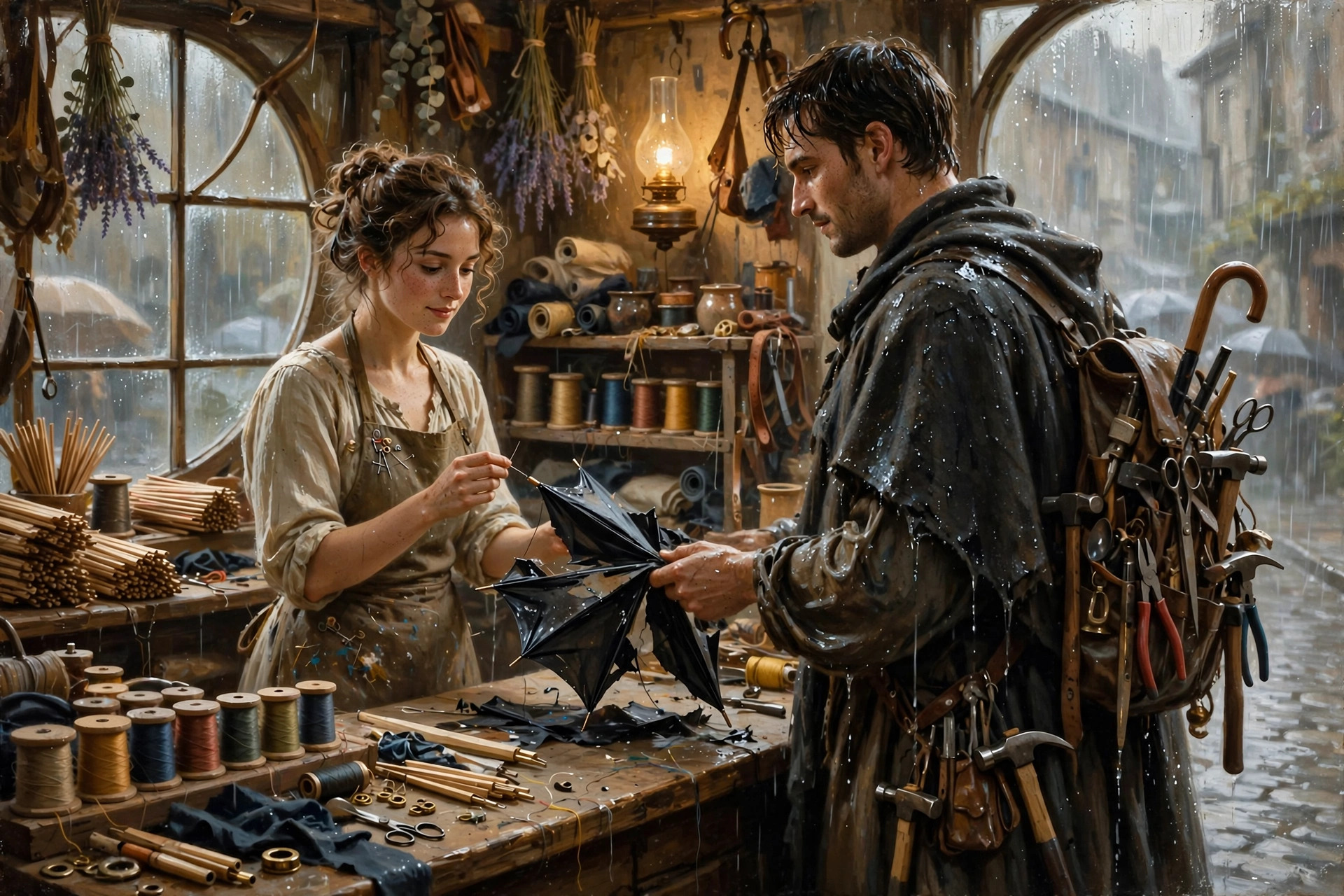
"It isn't for sale," Juniper said, before the stranger had finished setting the umbrella on her counter. "Whatever you think it is. And I don't buy secondhand."
"Good, because I'm not selling." He was tall, damp at the shoulders, a tinker's pack slung across his back with pots that clanked when he moved. He opened the umbrella halfway. One rib jutted out of the black silk like a snapped wing. "I'd like it mended."
"Then you want a tinker."
"I am a tinker."
"Then mend it yourself."
He looked at the rib, then at her, with the patience of a man who had been turned out of better shops than hers. "I fix kettles. Hinges. The odd clock, if it isn't too proud. This needs someone who knows canopies, and the woman at the inn said Bellows Lane has only one."
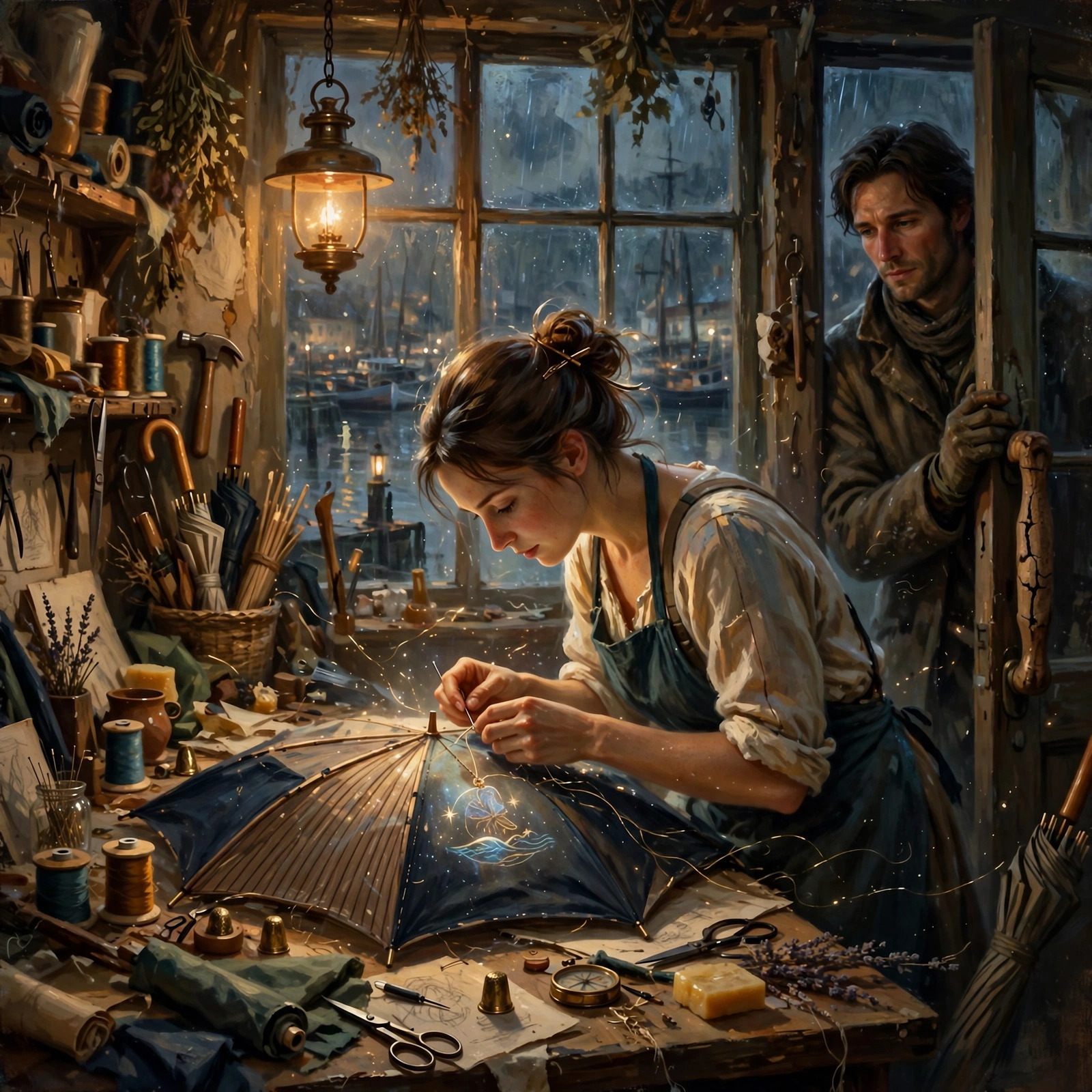
The woman at the inn talked too much. Juniper wiped her needle on her apron and didn't put it down. Behind her the bench ran the length of the back wall, crowded with spools, whalebone and steel ribs sorted by length, and a pearwood blank she'd meant to start carving all week. Rain ticked against the bow window. Gullmere had been grey since the ice went out of the harbor, and everyone in town seemed to have discovered at once that their umbrellas leaked.
"I've got eleven orders ahead of you," she said. "All of them from people I know."
"I can wait."
"You'll be gone by the time I get to it. Tinkers always are."
"I've taken a room for the season." He said it lightly, but his gloved thumb ran along the umbrella's handle, back and forth, as if steadying it. The handle was cheap turned beech, cracked at the crook. "Longer, maybe. If the town will have me."
"The town has opinions about strangers."
"So I'm learning."
She came around the counter, mostly to stop him dripping on her floorboards, and took the umbrella from him without asking. Close up, he smelled of rain and lamp oil. His coat was good wool gone shiny at the cuffs, the kind someone buys once and keeps a decade. She ignored that. She ignored the way he stepped back to give her room, as if he'd been taught to.
The silk was plain. No charm stitched in it anywhere, not so much as a hem-knot. An honest, ordinary, badly kept umbrella.
"Who folded this wet and left it?"
"Me."
"For how long?"
"A while." He winced. "It was my mother's. Or so I was told. It came with me to... it came with me when I was small. I've carried it ever since. Never thought much about keeping it well until the rib went."
Juniper turned the frame in her hands. The runner was rusted, the stretchers loose, the ferrule worn almost flat from being leaned on like a walking stick. Someone had used this umbrella hard and loved it badly, which was the most common way of loving anything.
"It needs a new rib, a new runner, and that handle's going to split clean through by summer."
"Then you'll do it?"
"I didn't say that." She held it out to him. "I said what it needs."
He didn't take it. "What would it cost?"
"More than it's worth."
"Not to me."
That was the trouble with it. He said it plainly, no wheedling, and her hand stayed out between them a beat too long. She knew the look of a man who owned very little and had decided which pieces of it mattered. Her father had worn that look over his workbench, the night before the guild men came up Bellows Lane with their warrant and their polished boots.
She pulled the umbrella back against her apron. "I don't do charity work, and I don't take favors, and I don't owe anyone anything when the job's done. You pay in coin, up front, and you don't come round asking how it's going."
"That seems fair."
"And if you complain about the wait, I'll hand it back in pieces."
"Also fair." The corner of his mouth went up. He had a face that didn't smile often and seemed surprised when it did. "Anselm Roake."
"I didn't ask."
"You'll need it for the ticket."
She did, annoyingly. She wrote it on a scrap of card and tied it to the ferrule with red thread, and he watched her hands while she did it. People always watched her hands. Most of them were wondering whether the rumors were true.
"You're Juniper Saltash," he said.
"The woman at the inn again?"
"And the baker. And a fisherman who told me your umbrellas never let a drop through, even sideways, even in a squall off the harbor." He tipped his head toward the window, where her finished stock hung from hooks in the bow: oxblood, bottle green, a yellow the color of gorse. "He said it like it was a miracle."
"It's good waxed silk and tight seams."
"Is that all?"
"That's all." She set his umbrella on the bench beside the pearwood blank and gave the blank a long look. It was a good piece, close-grained, a hand's span longer than she needed. Beech was no wood for a handle that would be carried every day for a lifetime. "Come back Saturday. Not before."
"Saturday." He shifted the pack on his shoulder. The pots clanked again. For a man who mended kettles, he didn't seem to have dented any of his own. "Thank you."
"Don't. I haven't done anything yet."
He went to the door, and she bent over the bench, making a show of being busy, which meant she didn't see him stop. She only heard the silence where the bell should have rung.
When she looked up he was standing by the window, close to the oxblood umbrella, not touching it. Rain ran down the glass behind him and threw moving shadows across the silk. He was studying the underside of the canopy, where the panels met the crown.
Where, if a person knew precisely what to look for, a single knot of silver thread sat folded into the seam, small as a grain of barley, turned in on itself the way her father had taught her.
Anselm Roake didn't say anything. He looked at that seam for a long, quiet moment, and then he looked at her, and something careful and unreadable passed behind his eyes before he put his hat on and opened the door.
The bell rang. The rain came in. Juniper's needle had gone still in her fingers.
The Pearwood Blank
"You said Saturday," Juniper said, without looking up from the rib she was filing.
"I did." Anselm Roake shut the door behind him with care, as if the bell might hold it against him. "I'm not here for the umbrella. I'm here because your shutter's hanging by one hinge and I have a screwdriver."
She looked then. The shutter on the bow window had been swinging loose since the wind turned, banging all night like someone knocking to be let in. She'd meant to see to it. She had meant to see to a great many things.
"I don't need help."
"Then I'll fix it badly, and you can redo it." He was already setting down his pack. The pots clanked. "That'll be satisfying for you."
From the stair at the back of the shop came a dry laugh. Mother Ilse Brannagh stood on the bottom step in her gray shawl, her fingers stained a faint permanent indigo that no soap in Gullmere had ever shifted. She owned the building, and the Drying Loft above it, and most of the opinions on Bellows Lane.
"Let the man work, Juniper. That shutter woke me twice."
"It's my shutter."
"It's my hinge," said Mother Ilse, and went back up.
So he fixed it. Juniper filed the new rib and listened to him outside the glass: the scrape of an old screw coming free, a muttered word when one dropped into the gutter, the tap of a hammer. He worked like a man who'd been taught by someone strict. No wasted movement. Every screw lined up before it went in.
When he came back in, rain on his shoulders, the shutter sat flush and silent.
"Well," she said. "It's not bad."
"High praise."
"Don't get used to it."
He didn't leave. He stood near the bench, hat in hand, and looked at the frame of his mother's umbrella spread open on the cloth, the cracked beech handle set to one side, the pearwood blank beside it.
"Is that for me?"
"It's for the umbrella." She picked up the blank and turned it in her hands. It was pale and close-grained, the color of milky tea. "Beech splits. This won't. Not if I cut it right."
"Can I watch?"
Nobody asked that. They stared, or they pretended not to, but they didn't ask. She found she didn't have a ready answer.
"Sit there," she said finally, pointing at the stool by the window. "And hold this."
She handed him the frame. He held it the way she showed him, the shaft braced against his knee and the runner pushed up so the ribs stood stiff, while she bound the new rib to the stretcher with waxed linen. His hands were steady. Big knuckles, a white scar across the left thumb. A tinker's hands should have been burned and blackened from solder. His weren't.
"You don't mend many kettles," she said.
"Why do you say that?"
"Your hands are too clean."
He was quiet a moment. "I'm newer at it than I let on."
"What were you before?"
"Someone who did what he was told." He shifted his grip as she pulled the binding tight. "It was less interesting than it sounds."
It didn't sound interesting at all. It sounded lonely, and that was none of her business, so she tied off the thread and bit it and didn't ask anything else.
The afternoon went gray and then dark. She lit the lamp. He stayed. At some point Mother Ilse came down with two mugs of tea and a look that Juniper refused to meet, set them on the bench, and went back up without a word, which was worse than anything she might have said.
He came back the next morning before she'd unbolted the door.
"Still not Saturday," she told him through the glass.
"I brought bread." He held up a loaf, steaming in the cold. "From the baker who talks too much."
She let him in.
That was the day she carved the handle. She clamped the blank in the vise and roughed it out with the drawknife first, long curls of pearwood peeling off and gathering at her feet, pale as wood shavings in a church. He swept them up without being asked. She let that go too.
Then the gouges, small ones, and the work went slow and close. She cut the ribbing her father had always used, a spiral of shallow grooves that would fit a palm in wet weather and never slip. Her father had carved one for every umbrella he ever sold. People in Gullmere still brought them in for re-covering, decades old, and she knew his grooves the way she knew his handwriting.
"Who taught you?" Anselm asked.
The gouge paused. "My father."
"Is he still--"
"No."
She didn't say dead, because he wasn't. She didn't say where he was, because that was a stone room in a guild town with a slot in the door, and she hadn't said it aloud in years. She went on cutting. Anselm didn't push. He just sat on the stool and passed her the next gouge before she reached for it, and she pretended not to notice that he'd learned which one she'd want.
"Mine raised me in a house with a lot of other children," he said after a while, to the window. "Bells for everything. Bells to wake, bells to eat. Rules on every wall. Some people hated it." He turned his hat in his hands. "I didn't. You always knew where you stood."
"And your mother's umbrella?"
"The only thing that came with me." He smiled a little, at nothing. "I've carried it everywhere since. It's the closest thing I have to a fixed address."
Juniper set the gouge down. Something in her chest had gone tight and unhelpful, and she didn't like it.
"Hand me the rasp."
He did. Their fingers brushed. Neither of them made anything of it, and both of them, she suspected, noticed.
By the time the light went copper she was sanding. Coarse paper, then fine, then her own palm, rubbing linseed into the grain until the ribbing shone like honey. It was a good handle. Better than good. She held it up to the lamp and turned it, and the spiral caught the light.
"That's beautiful," Anselm said quietly.
"It's too long."
"Is it?"
"A hand's span too long. I knew that when I chose it." She looked at the pearwood, then at him. "My father did this sometimes. For people going away. He'd carve the handle long and split the spare along the grain, so it would fit back together only one way. One half went on the umbrella. The other went with someone who'd stay behind."
"Why?"
"So there'd be a reason to come back." She shrugged, as if it were a small thing. "Old Gullmere nonsense."
She set the handle in the vise again, laid her finest blade along the grain at the ribbed end, and tapped once with the mallet. The pearwood opened with a soft, clean crack, the way good wood does when it's been asked properly. Two halves. The grooves ran from one to the other without a break.
She fitted them together once to be sure. They closed like a held hand.
Then she pulled them apart, and before she could think better of it, she held one half out to him across the bench.
"You're going away eventually," she said. "Tinkers do."
Anselm looked at the piece of pearwood for a long moment. Then he took it, and his thumb found the grooves, and he closed his fist around it as if someone might ask for it back.
The Drying Loft
"You're strangling it," Juniper said.
"I'm holding it."
"You're holding it the way a man holds a rope over a cliff." She reached across and loosened his fingers on the needle, one by one, until the steel lay light against his knuckle. "There. It isn't going anywhere."
Anselm looked down at his own hand as if it belonged to someone else. Around them the Drying Loft hung full of open canopies, a dozen of them strung from the rafters on hooks, oxblood and slate and a green like wet moss, all turning very slowly in the draught from the louvres. The light came through them in stains. It put a patch of rose on his cheekbone and a patch of grey on his collar, and he hadn't noticed either.
She had not meant to bring him up here. Nobody came up here. Mother Ilse climbed the ladder twice a year to complain about the roof, and that was all.
But he'd come back. Three days after she'd split the pearwood, he'd come back through the shop door with a bag of rivets he swore he'd found going cheap, and stood at her bench asking what the silver thread was for, and she had heard herself say, Come and see.
Now his mother's canopy was stretched across the frame between them, its broken rib replaced with good steel, its old black silk patched so finely she was quietly proud of it. Only the hem was left. And the knot.
"Again," she said. "Under the seam. Not through it."
He slid the needle under. The silver thread followed, thin as a hair.
"Now turn it back on itself. Small. Smaller than you think."
"How small is small?"
"Smaller than that."
He laughed, low, and the needle wobbled. She put her hand over his to still it. His skin was warm and dry, rough at the heel of the thumb where tinkers' tools rubbed. She felt the pulse in his wrist jump once under her fingers, and she pretended very hard that she hadn't.
"Here." She guided the point around. "The knot has to close on the rain side. If you close it on the inside, it'll turn the rain inward and you'll be wetter than if you'd carried nothing at all."
"Has that happened?"
"Once. I was fourteen. My father stood out in the yard for an hour in a private downpour and wouldn't let me fix it, because he said I'd remember better." Her mouth tugged sideways. "I remember."
He was quiet, working. The knot drew closed under both their hands. She felt the faint give in it, the little hum through the thread like a struck glass, and knew it had taken.
"Did you feel that?" she asked.
"Something." He frowned at the seam. "Is that all it does? Keeps the rain off?"
"Off this." She tapped the silk. "Only what falls on the canopy. Not an inch past the rim."
"Why not further?"
The loft creaked. Somewhere below, the shop bell gave its tired little rattle in the wind, and then went still.
"Because further isn't yours," Juniper said. "You can stitch a broad charm. Turn the rain off a whole doorstep, a whole street. People have. But the thread takes its price out of the stitcher. You lose the feel in your hands for a season." She flexed her own fingers without meaning to. "No hot, no cold. Can't tell silk from sacking. For a woman who sews for her bread, that's a long, hungry season."
"And the guild forbids it."
She glanced up. He was looking at the knot, not at her.
"The guild forbids a great many things," she said. "Mostly people like me."
He didn't answer that. He only turned the needle in his fingers, and she watched his jaw work, as though he'd tasted something he couldn't spit out.
"Your hands are better than you let on," she said, to change the air.
"I've had practice being careful."
"That's not the same as being good."
"No." He looked up then. "It isn't."
The canopies turned overhead. Rose light, grey light, green. She was still holding his hand on the frame. She became aware of it all at once, the way you become aware of a step that isn't there, and she should have let go. She'd let go of everyone. She was very good at it.
She didn't let go.
"Juniper," he said, as if he was asking her permission for her own name.
"Don't make a speech."
"I wasn't going to."
"You looked like you were."
"I was going to say your thread's tangled."
She looked down. It was. A loop of silver had snarled itself around both their fingers, his and hers, and drawn tight. She laughed, startled, and he laughed too, and somewhere in trying to pick it loose they ended up a great deal closer than the frame allowed.
He kissed her carefully. Of course he did. As though she were a seam he was afraid to pull.
Juniper took hold of his collar and kissed him back, not carefully at all.
The frame tipped. His mother's canopy slid sideways and one of the hanging slate ones swung down and bumped the back of his head, and he made a noise against her mouth that was mostly laughter. She didn't stop. His hand came up to her jaw, thumb along her cheek, and the silver thread still bound their fingers together, and for a little while she forgot to be anyone who needed to be on guard.
When she drew back, his eyes were closed.
"That," he said, "was not on the list."
"What list?"
He opened his eyes. Something moved behind them and was put away again, quick as a coin into a pocket. "Things I meant to do in Gullmere."
"Then you made a bad list." She snapped the snarled thread with her teeth and freed them both. Her heart was going like a loom. "Go down and put the kettle on. I'll finish the hem."
"You're sending me away."
"I'm sending you to the kettle. It's one floor."
He went. She heard his boots on the ladder, then the hatch thump shut, then his weight crossing the shop floor below. She righted the frame. She straightened his mother's canopy and smoothed the silk with a palm that would not quite hold still, and she sat a long moment under the turning colors, touching her own mouth like a fool.
The kettle didn't sing.
She noticed that slowly. No clank of the tin on the stove. No water from the jug. Below her there was only quiet, the deliberate kind, and then a faint scrape she knew down to her bones. The loose board by the hearth, the one her father had once kept pennies under.
Juniper set the needle down and crossed to the hatch on her stockinged feet. She didn't open it. There was a knothole in the boards near the ladder, and she knelt and put her eye to it before she could decide she was ashamed.
Anselm was crouched by the hearth with his back half to her. The board was up. In his hand was a flat packet bound in oilcloth, and as he turned it to slide it into the gap she saw the wax on its face, thick and dark, pressed with some stamp she couldn't make out in the poor light. Only a round shape. Only a glint.
He held it a moment longer than he needed to. Then he pushed it down into the dark, laid the board back, and pressed it flat with the heel of his hand until it sat just as it always had.
He stood and reached for the kettle.
Above him, Juniper stayed on her knees on the loft floor, the taste of him still on her lips, and did not move at all.
Water on Bellows Lane
"Sandbags won't hold it," Anselm said, shouldering through her door with a sack under each arm and rain sluicing off his hat brim. "The culvert at the top of the lane's gone. It's coming down like a millrace."

Juniper didn't look up from the bench. She was knotting off a canopy in quick, angry loops, the way she'd worked for three days now, ever since the loft. Ever since the knothole.
"Then put them by Mother Ilse's step. Hers is lowest."
"I already did." He dropped the sacks against her own threshold anyway and began stacking them, his coat dark with water to the shoulders. "Yours next. Then the cooper's."
She had not asked him to. She had not asked him for anything since he'd climbed down that ladder and put the kettle on as if nothing lay under her hearth board. She'd let him drink his tea. She'd let him go. She had told herself it might be letters from his mother's people, a will, a debt. She had not lifted the board. She had wanted, badly, to be the kind of woman who didn't.
Outside, someone shouted. A crate went tumbling past the bow window, end over end in brown water that had been ankle-deep an hour ago and now climbed the cobbles toward the sills.
Mother Ilse came in on the next gust, skirts hitched to her knees, a basket of dye pots clutched to her chest. Her white hair was plastered flat. "The cellar's under," she announced. "Forty years of madder and woad, floating like ducks. Juniper, girl, I need the high shelf."
"Take it." Juniper was already clearing it with one sweep of her arm.
Anselm took the basket from the old woman without being asked and set the pots up out of reach of the water. He turned to help Mother Ilse out of her sodden shawl, and as he lifted his arm the seam of his inside pocket, worn thin from the rain and his own fidgeting, gave with a soft rip.
Two things fell. The carved half of the handle struck the boards and spun. The other thing landed flat and heavy and lay there, gleaming in the lamplight.
Brass. Round. A raincloud and three falling lines pressed into its face.
Juniper knew that stamp. She had seen it once, pressed into wax on the paper they'd nailed to this very door, the winter her father was taken out of it in irons.
Nobody moved. The water muttered at the sandbags.
"Well," Mother Ilse said at last, very quietly. "That's no tinker's tool."
Anselm bent and picked up the seal. He didn't hide it. That was somehow worse. He held it in his open palm like a man showing what he'd been carrying.
"Juniper. I meant to tell you."
"When?" Her voice came out flat and far away. "Before the report, or after?"
"It isn't written yet."
"But it's due."
A muscle went in his jaw. "At the spring rains."
"And the packet under my hearth. That's your notes. My knots. My window." She laughed, and it hurt her throat. "You fixed my shutter so you could see better inside."
"I fixed your shutter because it was banging." He took a step toward her. "Listen to me. There's a way through this. The licence is forty crowns. I could--"
"You could what? Pay my way into your guild?"
"Make it lawful. Make it safe."
"Safe." She said the word as if it were something he'd tracked in on his boots. "They called it safe when they took him. Rules kept us safe. Rules emptied his bench."
A scream from the lane cut across them. Through the bow window Juniper saw the water had topped the cooper's step. A child's cradle bobbed out of a doorway, empty, thank God, and a woman waded after it to her waist. Further down, Mother Ilse's front door swung open on its hinges and brown water poured over the threshold.
The sandbags wouldn't hold. Nothing he'd brought would hold.
Juniper reached under the bench and dragged out the great canopy, the one she'd been building all winter for the market awning, oiled silk wide enough to cover a cart. Her father's spiral was already stitched along its ribs in silver. A narrow charm, a lawful one. It would turn only what fell on the silk.
She threaded her finest needle.
Anselm saw it before Mother Ilse did. "No."
"Hold the frame or get out of my shop."
"Juniper, a broad stitch will take your touch. You told me so. A whole season."
"I know what I told you. You wrote it down, I expect."
That landed. She watched it land and felt no better.
"Let me go for the guild," he said. "There are licensed menders in the city. Weather-wardens. I can have them here by--"
"By the time the lane's a river." She bit the thread. "I don't need your guild. I don't need you."
Mother Ilse caught her wrist, gently. Her fingers were stained blue to the second knuckle. "Your father said much the same, girl. On the roof of the Pellow house. You were nine and you held the ladder."
"Then I know how it's done."
She shook the old woman off and began.
The broad knot was not like the narrow one. It didn't loop back on itself. It reached out. Each pass of the needle pulled at something under her skin, a cold thread drawn from her fingertips up into her wrist, and the silver stitches lit one by one along the seam. She worked with her left hand on the silk and her right on the needle. Outside, the rain hissed and then, impossibly, began to bend. It slid off the roofs at a slant. It ran away down the gutters as if someone had tilted the whole lane.
Anselm had not left. He was holding the frame. His knuckles were white on the ribs and he was saying her name, low, over and over, like a man counting stitches for her.
She tied the last knot.
The water at the cooper's step paused. Then it began, slowly, to draw back down the cobbles, leaving silt and a single floating shoe.
Juniper set the needle down. Or meant to. It was already on the floor. She looked at her left hand where it lay on the silk and could not feel the silk. She pressed it. She pinched the web of her thumb, hard enough to leave a mark, and there was nothing. Only the sight of skin going white, then pink.
"Juniper." Anselm reached for that hand.
She pulled it back before he could touch it, which was absurd, because she wouldn't have felt him.
Her half of the handle lay where it had rolled off the bench in the scramble, near the hearth. She bent for it with her good hand. The spiral her father had taught her ran under her thumb, and she felt every groove, every one, and hated that she could.
"Here," she said. "Take your reason to come back."
She threw it. It struck his chest and dropped to the wet boards between his boots, and lay there beside the brass seal he'd let fall, and neither of them reached for either.
Mother Ilse said nothing at all. Outside, the rain kept turning away from Bellows Lane.
The Guild Hearing
"State your trade," the clerk said, without looking up from his ledger.
"Canopies. Ribs, silk, handles." Juniper kept her left hand in her coat pocket, where nobody could see it lying there like a glove someone else had dropped. "Rain-turning, when it's asked for."
"Unlicensed rain-turning."
"I've been asked for it for most of a decade. Nobody asked for a licence."
The guild hall in Gullmere smelled of lamp oil and wet wool, and the benches were full. She hadn't expected that. The cooper was there, and the baker's widow, and half of Bellows Lane in their Sunday coats, silt still dried in the cuffs of some of them. They didn't look at her. They looked at the long table at the front, where three guild officials sat in grey under the brass rain-and-anchor of the guild seal, and beside them, standing, Anselm.
He'd shaved. His coat had been mended at the pocket, badly, with brown thread that didn't match. She noticed that before she could stop herself, and it made her angrier than anything else in the room.
The senior official, a heavy woman with spectacles pushed into her grey hair, tapped a folded sheaf of papers. "Assessor Roake has had the lane under observation since the start of the month. His report is due to us at the spring rains, but given the events of the flood, we've called it early." She turned. "Assessor."
Anselm took the report from her. He didn't open it.
Juniper knew what was in it. She'd lain awake two nights knowing. The silver knot in the seam of the oxblood canopy in her window. The bench, the needles, the charm book her father had left. A broad charm stitched in full sight of a guild man, and a hand to prove it. She'd told him everything in the Drying Loft, with the silk hung around them like sails, and he'd written it down afterward. Of course he had. That was what they did.
"Read it into the record," the official said.
"No."
The clerk's pen stopped.
Anselm turned the papers over once in his hands, the way he turned a bent rib to find where it would give. "I wrote it the way I was taught. Every stitch she made, every coin she took, every rule she broke. It's accurate." He looked down at it. "It leaves out that the cooper's children slept dry. It leaves out that she did it with a needle in one hand and her own feeling draining out of the other, and that nobody in this hall would've lifted a finger to turn that water. The guild included."
"The guild turns water for licensed parishes," the official said. "Bellows Lane didn't pay."
"Bellows Lane couldn't pay." He said it plainly. "And she couldn't pay the forty crowns to stitch legally for them. So the rule kept them wet. I've believed my whole life that rules are what keep people safe. I grew up in one of your houses. I know what a bell's for." His jaw worked. "I watched the rule fail them, and I watched her not fail them. I won't put my name to the wrong one."
He walked to the iron stove at the side of the hall. Nobody stopped him. Juniper thought later that it was because nobody believed it until it was done.
He opened the stove door, and the heat breathed out orange over his face, and he fed the report in a page at a time. The edges curled black. Somebody on the benches made a small sound, the baker's widow, Juniper thought, and then the room went so quiet she could hear the paper catch.
"Roake." The official had risen. "Do you understand what you've done? That report is guild property. Your post. Your pension. Your room at the house."
"I understand it." He shut the stove. Then he reached into his coat, the good pocket, and took out the brass seal she'd last seen lying in floodwater at his feet. He set it on the long table, squarely, the way you'd set down a key you were returning. "I resign. You can strike me from the rolls tonight."
"You've nowhere to go."
"I know that too."
Juniper found she was standing. She didn't remember doing it. Her good hand was clenched on the bench rail and her other hung in her pocket, heavy and senseless, and she couldn't tell whether she wanted to shout at him or at herself.
The officials conferred in low voices. Without a report, the senior one announced at last, there was no finding. The matter of the lane was closed. She said it the way people say a thing they intend to reopen, and nobody on the benches cared. They were already getting up. The cooper clapped Juniper on the shoulder on his way past, hard, and didn't say anything, and that was nearly worse.
When she looked again, Anselm was gone.
She walked home alone through the drizzle. It was the thin kind, the sort that came before the real spring rains and promised them. It didn't turn from her. She had no canopy with her and she couldn't have held one properly anyway.
Bellows Lane still had the black canopy wedged in the iron signboard bracket over her door, its silver seam gone dull now the flood had passed. The lane was swept. Somebody had scrubbed her step. She stood looking at it with the key in her right hand and couldn't get the door open, because the lock stuck and it wanted two hands, and she'd been doing everything with one for two days and pretending it was fine.
"Let me."
He was behind her. Of course he was. His coat was soaked through and he had a canvas bag over his shoulder, small enough that it couldn't hold much.
"Is that everything?"
"They let me fetch it before they changed the lock." A short laugh, not really a laugh. "Seven years. It's mostly shirts."
She should have told him to go. The words were right there, the ones she'd used on every neighbour who'd brought soup since the flood, every hand that had tried to carry her basket. I'm managing. I don't need it. Her father had said them too, all the way to the guild cells.
She held out the key.
He took it, lifted the latch with his other hand, and turned. The door swung in on the smell of linseed and silk and cold ashes. She hadn't lit the stove since the hearing summons came.
"Why?" She didn't go in. "You'd a bed. A pension. You'd a name in that hall."
"I had a name they gave me." He stepped past her into the shop and stood dripping on the boards where he'd stood the night of the flood. "I'd like one I chose."
"I threw it at you."
"You did. Hit me square." He touched his chest, where the mended pocket sagged. "I picked it up after you'd gone up to bed. Yours, I mean. And mine." He reached into the bag and brought out a bundle of handkerchief, and she knew the shape of what was inside before he unwrapped it. "I've kept yours. I'll give it back when you ask. But I thought you should have this one. So you know I'm not leaving with it."
He crossed to her workbench, where the broad needle still lay where Mother Ilse had picked it up off the floor and set it straight. He moved it aside with care. Then he laid his half of the carved handle down on the scarred wood, spiral side up, the grooves of her father's ribbing catching the grey window light.
First Spring Rain
"Hold it lower," Juniper said. "No, lower. You're strangling the needle."
Anselm loosened his grip. The silk on the frame between them was grey-green, stretched taut over its ribs, and he was bent over it in the Drying Loft with his sleeves pushed to the elbow and his tongue caught in the corner of his mouth like a schoolboy at sums.
"Better?"
"Worse, but in a new way. That's progress."
He laughed under his breath and kept going. Above them the roof tiles had begun to tick. Not the flood's roar, nothing like it. Just a soft, scattered patter that came and went, the first proper rain of spring feeling its way across Gullmere.
Juniper sat on the low stool beside him with her right hand in her lap. She'd stopped hiding it somewhere around dawn. It lay there pale and quiet, as if it belonged to someone napping in the next room. She could see it. She could make it close if she watched it closely enough. But when Anselm's knee bumped against her wrist, she only knew because she saw it happen.
"Over, under, back through the loop," she said. "Then you pull, and you think of the rain sliding off. Only off this canopy. Nowhere else."
"Only this canopy." He said it carefully, the way he'd once recited guild rules, but softer now. "I'm not stitching anything broader than a hat brim. You've my word."
"Your word's all you've got left, so keep it dry."
He glanced up at that. She expected hurt. What she got was the corner of his mouth lifting.
"Fair."
The knot went through. He pulled it snug, and the silk gave the faint shiver it always did when a charm took, a ripple like a cat's back under a palm. Juniper felt it in her left hand where it rested on the frame. Not in her right. Never in her right, not until the leaves turned, and maybe not then either.
She looked at the stitch for a long moment.
"Is it wrong?" he asked.
"No." Her voice came out rough. "It's clean. It's better than my first one."
"Liar."
"My father told me mine looked like a spider had fallen in ink." She hadn't meant to say that. She kept going anyway. "He's in the debtors' house at the edge of the city. Has been since I was small. The guild fined him for the roof charm, and he couldn't pay, and they took his needles and then they took him."
Anselm set the needle down on the frame. He didn't reach for her. He'd learned that too.
"I could visit him," he said. "If you wanted. I know how those places work. I know which door to knock on and which clerk takes bribes in biscuits."
"You've no money for biscuits."
"I've got hands." He turned them over, palms up, ink in the creases, a fresh scratch from a rib wire. "Mother Ilse says I can sleep in the storeroom if I fix her gutter and stop tracking mud on her stairs. That's room and board, near enough. And you've got forty crowns to find by midsummer and only one hand to find it with."
Juniper stared at the wall. The rack of drying canopies swayed slightly in the draught from the louvres, blue and plum and mustard, every one of them paid for by someone on Bellows Lane who'd trusted her with a coin and a forecast.
She'd spent her whole life making sure nobody had to carry her. She'd paid for that with a season of feeling. She'd thrown a piece of carved wood at a man's chest in the street because he'd dared to be kind and lie at the same time.
"I don't know how to do this," she said.
"Do what?"
"Let you."
The rain thickened on the roof. It stopped ticking and started to drum, gently, steadily, the sound of a town getting a long drink after a hard winter.
Anselm shifted on his stool so that he faced her. "I don't know how to stay somewhere nobody's assigned me," he said. "There was always a bell. Somebody's list. My name on a door that somebody else painted." He swallowed. "I burned the list. I don't have a door. I'm not going to be very good at this either."
"You were terrible at the knot an hour ago."
"I was."
"You're less terrible now."
"That's the plan."
She laughed, and it cracked halfway through into something wetter. She put her good hand over her eyes. When she took it away he was still there, patient, waiting with his ink-stained palms on his knees.
"I love you," Juniper said. Plainly, because there wasn't any other way she knew to say anything. "I love you and it terrifies me and I'm not going to stop."
He let out a breath that seemed to come from the soles of his boots.
"I love you," Anselm said. "I've loved you since you told me my canopy was a disgrace and charged me double to fix it."
"It was a disgrace."
"I know. I love you anyway. I'm staying, Juniper. If you'll have me at the bench."
She stood. Her right hand bumped the frame and she didn't feel it, and she didn't care. She stepped into him, and he rose to meet her, and his arms came around her back and held. She pressed her face into his shoulder. Wool, rain, and a little river still.
With her left hand she could feel everything. The heat of him. The fast knock of his heart. With her right she could feel nothing at all, so she pressed it flat against his spine anyway and let him feel it for both of them.
They stood like that while the downpour settled in for the afternoon.
When she finally stepped back, she went to the shelf by the stair and lifted down the two halves of the ribbed handle. Hers, pale and bright. His, gone darker, the tide line drawn faintly across the spiral like a high-water mark on a cellar wall.
"I can't glue it," she said, holding them out. "Not with this hand."
He took the halves from her. He turned them until the grain met grain, the carved ribs lining up, the split she'd made along the wood closing as if it had only been waiting. She talked him through the pin and the glue, and he worked slowly, and she steadied the pieces with her left palm until the seam all but vanished.
Then he fitted the handle to the grey-green canopy with his new clean knot still drying in its silk.
Juniper pushed open the loft's rain door onto the little iron balcony above Bellows Lane. Below them, the street shone. People were hurrying under hats and shawls and her own bright canopies, the baker's boy splashing on purpose.
Anselm opened the canopy over both of them. Rain struck the silk and slid away, only from them, only there, exactly as it should.
She closed her good hand around the joined handle. He closed his around hers, and around the hand that couldn't feel him, and held both.
Get notified when new stories drop

Marcus Hale
Marcus writes slow-burn and marriage-of-convenience stories where logistics become intimacy and competence is a love language.
Leave a comment
Comments