


Toll Window
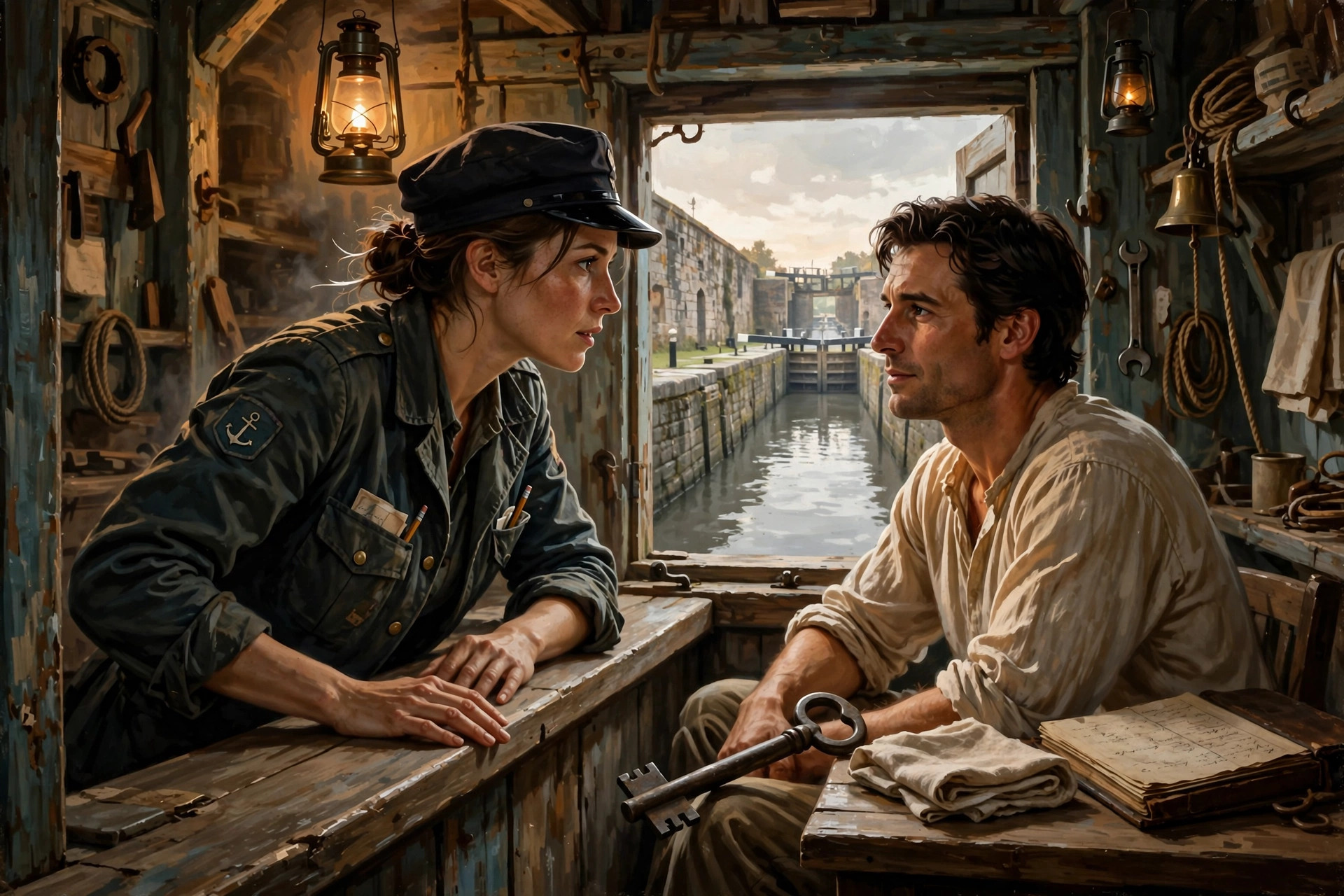
"You can't take a woman's boat because she was late on a bill," Ivy said.
Lazlo Dravik didn't look up from the ledger. He was on the far side of the toll window in the lock house, sleeves rolled to the elbow, a rag in one hand and the gate key across his knees. The iron gleamed where he'd worked oil into the teeth.
"Late." He turned a page with one clean finger. "Your mother hasn't paid passage since the spring thaw."
"She's had a bad season. Everybody on the canal has."
"Everybody else paid."
Ivy put both palms flat on the sill between them. The wood was worn smooth by decades of coins and elbows and captains leaning in to argue exactly like this. She'd stood on the other side of it a thousand times with a clipboard. She'd never stood here begging.
"The engine went in April," she said. "Then the hull patch. She's caught up on fuel and insurance. She'll catch up on you."
"On me." He finally lifted his eyes. They were gray as the lock water and about as warm. "I'm a company, Ivy. You print my letterhead."
"You're a man sitting in a booth with a rag."
Something moved at the corner of his mouth and was gone. He set the rag down, folded it into a neat square, and laid it beside the key. Everything Lazlo touched ended up squared.
"The Gull owes eighteen thousand dollars," he said. "I've carried it longer than I carry anyone."
"Carried it." She laughed, short. "You charge interest."
"Contract says I may. I haven't."
That stopped her. She hadn't known that. She dispatched his barges, timed his gates, kept the long gray schedule board in the corner current to the quarter hour, and somehow she'd missed that he'd let the meter sit still on her mother's account.
"Then why now?"
He reached under the counter and came up with an envelope, already sealed with the company stamp. He'd written it before she'd walked in. Of course he had.
"Because the bank asked me in July why one hull on my canal floats for free," he said. "Because if I let one slide, the next six captains tell me their engines went in April too."
"Hers actually did."
"I believe you." He said it plainly, which was worse. "Belief doesn't go in the ledger."
Through the window behind him she could see the lock itself, the long stone chamber brimming, the downstream gates shut tight. Otto would be along soon to crank the paddles for the afternoon run, and he'd need that key. Lazlo had probably oiled it so the old man wouldn't strain his shoulder. He'd never admit that either.
"Give her the winter," Ivy said.
"No."
"Until the grain contracts pay out, then."
"No."
"Lazlo." She heard her own voice go thin and hated it. "It's my mother's whole life. She's run that barge since before I could walk. You know what she'd be without it? She'd be a woman sitting on Ashby Wharf watching other people's boats."
He was quiet long enough that she thought she'd reached something. He picked up the gate key and turned it in his hands, feeling the weight. It was his grandfather's, forged back when the canal still carried coal. He'd told her that once, her first month, in the only unguarded sentence she'd ever heard from him.
"Fourteen days," he said.
"What?"
"You have fourteen days. Cleared in full, or the Gull stays tied at my wharf and I sell her to cover it." He set the key down and slid the envelope across the sill until the corner touched her fingers. "That's more than the contract gives."
"That's not a kindness."
"It's the only kind I've got."
She didn't pick it up. She looked at him instead, at the careful collar and the shadow along his jaw he'd missed shaving, at the way he kept one hand resting on the key like someone might take that too. People said his partners had walked off with half the company when he was young and left him the debts. People said a lot of things on a canal. Ivy had learned not to trade in other people's ruin. She had enough of her own father's to keep track of.
"You could just ask me to work it off," she said.
His eyebrows rose. "You'd be dispatching for free until you were sixty."
"I'm good at my job."
"You're the best I've had." He said it to the ledger, not to her. "Which is why I'm not putting you in debt to me. I don't want someone on this side of the window who stays because she owes."
The words sat between them strangely. Ivy found she'd leaned in, close enough to smell the oil on his hands and the cold stone of the lock house walls. He'd leaned too. Neither of them seemed sure who had started it.
A horn sounded downstream, two short, one long. Her mother's signal.
Ivy straightened so fast the stool behind her scraped. "She's early."
"She's always early when she's nervous." Lazlo glanced at the schedule board, then at Ivy. "Does she know you came up here?"
"No."
"Does she know about the notice?"
"She knows she's behind." Ivy kept her eyes on the envelope. "She doesn't know how far."
"She signed every passage slip herself."
"She signs them without reading. My father used to do the reading." Ivy pressed her thumb along the stamped seal. "He was very good at telling her the numbers were fine."
Lazlo said nothing. He took the gate key off the counter and hung it on its hook by the door, iron clanking against iron, ready for Otto. When he turned back, his face had closed up again, all business.
"Fourteen days," he repeated, softer. "Come to me before the last one if you need to. Not after."
"I won't need to."
"Everybody says that."
"I'm not everybody." She heard how it sounded, how much she meant it, and he heard it too. His gaze held on her a beat too long, then dropped to the schedule board, to the neat column of her handwriting listing tomorrow's runs and fees, every one of them his.
Outside, the Gull's blunt green bow nosed around the bend, her mother a small figure at the wheel in the red knit cap she wore year-round. Benedetta waved up at the lock house window, grinning, like any day on the water was a good day.
Ivy waved back with her left hand. With her right, below the sill where nobody on the canal could see, she folded the notice once, twice, and pushed it deep into her jacket pocket.
Ashby Wharf
"You're going to tell me she's seaworthy," Lazlo said, "and I'm going to have to look anyway."
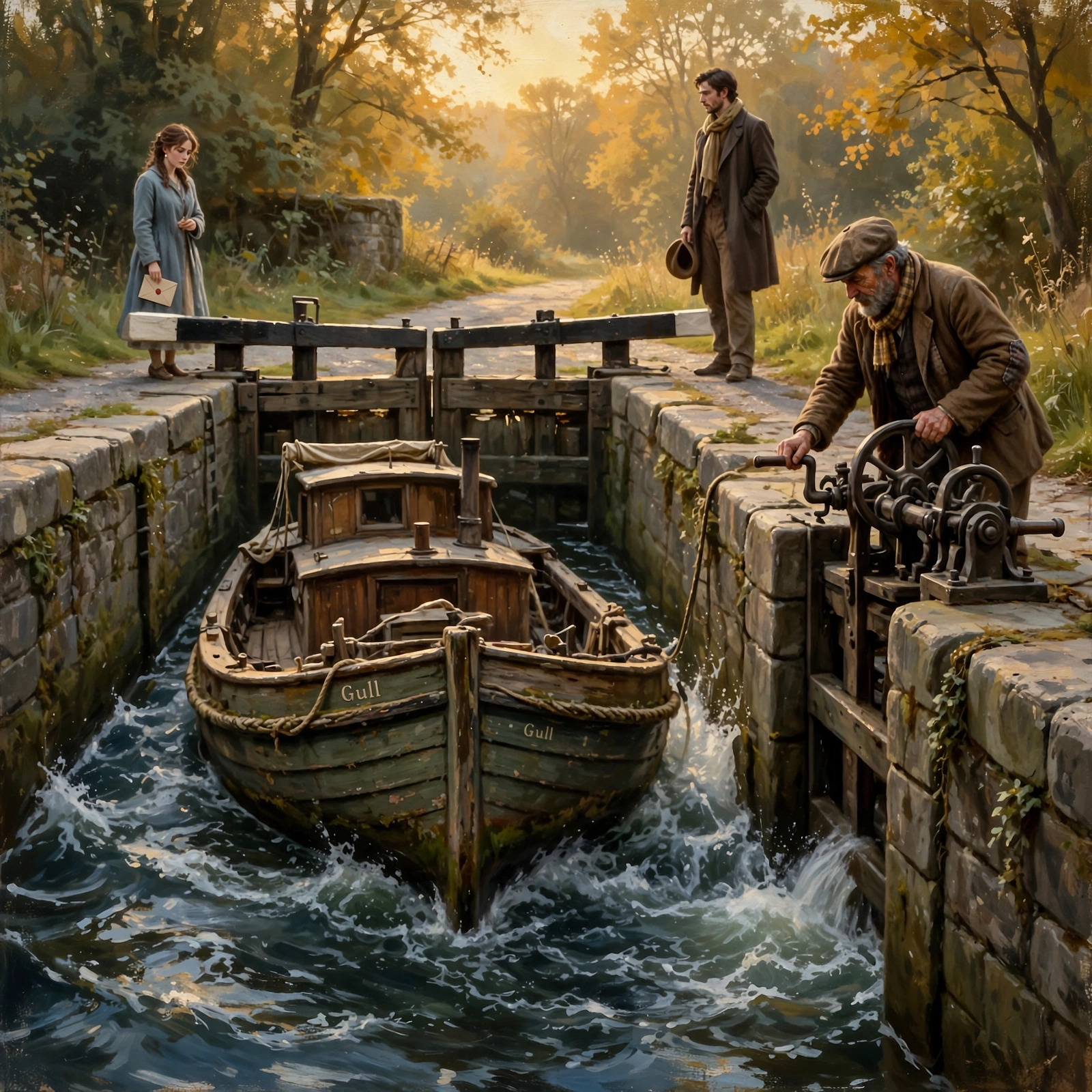
Ivy planted herself at the foot of the gangplank as if that would stop him. "She's been seaworthy since before you could tie a bowline."
"That's the part that worries me." He stepped around her with a clipboard under one arm. His boots rang on the Gull's deck, and the old barge settled a fraction under his weight, a small complaint from the hull.
Ashby Wharf was quiet in the way it only got midweek. A couple of narrowboats were moored at the far end, and a gull was working over a dropped sandwich near the bollards. Her mother's laundry flapped on a line strung from the wheelhouse to the mast stub: two flannel shirts, a dish towel, the red cap pegged by its pompom.
Benedetta came up out of the cabin wiping her hands on her trousers. "Mr. Dravik. Ivy said you might come poking."
"Lazlo's fine."
"Lazlo, then. You want coffee? It's terrible."
"I'd love some."
Her mother laughed, delighted, and vanished below. Ivy climbed aboard and stood close enough to read his clipboard. He tilted it so she could. She wasn't sure whether that was courtesy or a dare.
"It's an insurance walk," he said, low. "If I take a vessel against a debt, I have to know what I'm taking."
"You're not taking her."
"Then this is a very boring visit." He ran his palm along the gunwale, pressed a thumb into the wood near the stern, and frowned. "Soft here."
"It's been soft for years. It holds."
"Things hold until they don't." He moved forward to the bow and crouched over the rope fender lashed there, a fat coil of old hemp gone grey, split down one side so the core showed through like a broken loaf. "When did this crack?"
"Last month. She clipped the wall coming into your lock."
"She clipped Otto's wall," he corrected. "Otto would say so, loudly." He unhooked it without asking and turned it over in his hands. "If she rubs like this coming in again, she'll gouge the hull."
"I'll replace it."
"With what?"
Ivy didn't answer. He didn't push. He set the clipboard on the hatch cover, shrugged out of his jacket, and rolled his sleeves to the elbow. From his jacket pocket he took a coil of tarred marline and a folding knife, as if he'd brought them on purpose.
"You came ready," she said.
"I own a lock. Everyone's fender is cracked."
Benedetta returned with three mugs balanced in two hands and stopped short. "Oh, you don't have to do that."
"It's quicker than writing it down." He began binding the split tight, wrapping the marline in close turns, pulling each one hard enough that the cords stood out along his forearms. Ivy watched his hands longer than she meant to. They were careful hands. They were not, she reminded herself, kind ones. They belonged to a man who'd put a date on her mother's whole life.
Her mother sat on the cabin roof and sipped. "My husband used to do the fenders. He did them badly. Big messy knots." She smiled at the water. "Ivy does everything now. She's the clever one."
"I've noticed," Lazlo said, without looking up.
Ivy took her mug and burned her tongue on it. Terrible was generous.
"So what's the verdict?" Benedetta asked him. "Am I a hazard to navigation?"
His hands paused on the marline. Ivy felt the pause like a hand on her own back. He could say it right now. He could tell her mother the number, the date, the word seize, and it would be out of Ivy's hands forever.
He met Ivy's eyes. She gave him nothing. Not a plea, not a nod. Just the flat look she used on captains who argued their fees through the window.
"You're a hazard to coffee," he said finally. "The boat's mostly sound."
Benedetta hooted. "Mostly! I'll take mostly."
He finished the binding with a hitch and tucked the end under, neat as print. Then he carried the fender back to the bow, hung it on its lashing, and gave it a push. It swung and thumped the hull, solid, no give in the split. He stood looking at it a moment with his hands on his hips, as though it had told him something he hadn't wanted to hear.
"That'll do you a season," he said.
"What do I owe you?" her mother asked.
It was a joke. Benedetta always asked it as a joke. Lazlo didn't laugh.
"Nothing," he said. "Not for that."
He picked up his clipboard and his jacket. On the gangplank he turned, and for a second Ivy thought he'd say it after all. Instead he spoke only to her, quietly, as she followed him down to the wharf boards.
"She thinks I came for a social call."
"She thinks everyone does."
"You can't keep the numbers in your pocket forever."
"I don't need forever." She held his gaze. "I need eleven days."
Something moved behind his face, there and gone. He glanced at the schedule pinned in his clipboard, her handwriting again, the runs she'd booked through Sorrel Lock for the week, and his mouth tightened. "Come up to the lock house Saturday night. Late. There's a backlog I want cleared before the weekend boats."
"Is that an order?"
"It's a shift." He paused. "I'll pay you for it. Obviously."
"Obviously," she said, and was annoyed to find she was almost smiling.
He walked off up the wharf, jacket over his shoulder, a dark smear of tar on one forearm he hadn't noticed. She watched until he turned the corner by the chandlery. She didn't let herself think about why.
When she climbed back aboard, her mother was turning the fender in her hands, admiring the wrapping.
"He does good work," Benedetta said. "Better than your father." She looked up, and her face went soft and uncertain in a way Ivy hated, the face from the year everything came apart. "Ivy. He didn't come about money, did he? We're all right with the tolls?"
The notice was still folded in Ivy's jacket. She could feel its corner through the lining, sharp against her ribs.
"We're fine, Mamma," she said. "He was just checking the fenders. I've got the tolls handled."
Her mother beamed and went below to wash the mugs, humming. Ivy stood alone at the bow with her hand flat on the mended split, pressing until the marline bit her palm.
The Iron Key
"You're late," Lazlo said, not looking up from the ledger spread across the lock house table.
"I'm early. You said late. This is late." Ivy shrugged off her jacket and hung it on the peg by the door, beside the iron key on its hook. "You just got here earlier."
"I live here."
"You live upstairs. That's not the same as being in the office at ten at night with your sleeves rolled."
He glanced at his forearms as if they'd betrayed him. The tar from the wharf was gone, scrubbed pink. He pushed a stack of passage slips toward her without a word, and she sat down across from him and started sorting them by date.
The backlog was real. She'd half suspected it wasn't. Slips from the grain boats, the gravel barges, a pleasure cruiser that had paid in cash and left a thumbprint of sunscreen on the paper. She worked through them steadily, matching each to the schedule she'd written in her own hand, and she did not let her pen slow when she reached the week's runs for the Gull.
Lazlo didn't look at those. She checked. He was reading a contract with the fixed attention of a man defusing something.
Outside, a horn sounded, two short and one long.
The door banged open on the wind and Otto came in shaking water off his cap. He'd kept the gates at Sorrel Lock since before Ivy had ever seen the canal, and he moved through the lock house like it was a coat he'd worn soft.
"Gravel barge coming down," he said. "Last one. Then I'm going home to my bed, and if the canal floods, it floods."
"It won't flood," Lazlo said.
"Not with you watching it, it won't." Otto reached for the key on its hook and stopped. He flexed his right hand, slow, and Ivy saw the knuckles, swollen and shiny in the lamplight. He tried to close his fist and didn't quite manage.
Lazlo was on his feet. "Go home."
"I've got one barge."
"And I've got two hands. Go home, Otto."
The old man looked from Lazlo to Ivy and back, and something knowing crossed his weathered face. "He'll want somebody on the far gate," he told her. "He won't say so. He'll do it all himself and put his back out and be a bear about it till Wednesday."
"I'm right here," Lazlo said.
"I know where you are, boy. I've known where you are your whole life." Otto settled his cap. At the door he paused. "Grease is in the tin under the bench. She's sweet tonight. You oiled her."
Then he was gone into the dark, his torch bobbing down the towpath toward the lane.
Lazlo lifted the key from its hook. It was longer than Ivy's forearm, a crank of black iron with a square socket at one end and a handle worn bright where generations of palms had turned it. He weighed it in one hand.
"My grandfather forged this," he said. "In 1951. The year he bought the lock off a man who'd lost it at cards."
"Is that true?"
"The cards part, I'm not sure. He liked a story." He held the door. "Come on. You can hold the torch."
The rain had thinned to a fine cold drift. The lock lay below them, a long black slot of water between stone walls slick with weed, the upper gates shut and roaring faintly where the canal pressed against them. Downstream, the gravel barge's running lights swung in the dark, waiting.
Lazlo fitted the key to the paddle gear on the lower gate and began to wind. The ratchet clacked. Far below, the sluices opened, and the water in the chamber began to drain with a sound like a long exhale. Ivy kept the torch on his hands. They were sure on the iron, no wasted movement, the turn of a man who'd done this since before he could see over the balance beam.
When the levels matched, he leaned his back into the beam and walked the gate open. The barge slid in, the skipper raising a hand from the wheelhouse. Lazlo walked the gate shut again and crossed the narrow footboard to the upper gates.
Then he stopped, and held the key out to her.
Ivy stared at it.
"You've watched it a thousand times," he said. "From the window. With your schedules."
"Watching isn't doing."
"No." He didn't lower it. "That's why I'm asking."
She set the torch on the coping stone, its beam skating across the water, and took the key. It was heavier than she'd expected and warm from his grip. He moved behind her and showed her where it seated, his hand over hers just for a moment, then gone.
"Steady," he said. "Don't fight it. Let the ratchet carry you."
She turned. The first pull caught in her shoulders and she gritted her teeth. The second came easier. On the third the gear gave all at once and the paddles lifted, and the canal came pouring into the chamber through the sluices in a white rush that threw spray up over the gate and across both of them.
Ivy laughed out loud. She couldn't help it. Cold water ran down her collar and she kept winding, and the barge rose in the chamber beside them, slow and enormous, lifted by nothing but water she'd let in.
"There," Lazlo said, close at her ear. "That's it."
When the chamber was full, she let go of the key and found her hands were shaking, not from the cold. Together they put their backs to the beam. The gate swung. The barge's engine thrummed, and it slid out onto the dark upper canal, its wake slapping the stone, its lights shrinking until they were two sparks and then none.
The spray still hung in the air, fine as mist, beading on Lazlo's lashes. He was looking at her the way he'd looked at the fender, as if she'd told him something he hadn't wanted to hear.
"Nobody but Otto has turned that key in eleven years," he said.
"Why me?"
"Because you'd never ask." He swallowed. "You never ask for anything, Ivy. You just carry it."
She thought of the schedule on his table, her handwriting, the Gull's runs inked in neat rows. Her chest went tight. She almost said it. She opened her mouth to say it.
Instead she stepped forward and took a fistful of his wet shirt, and he bent to her, and he kissed her there on the lock gate with the water still roaring under their feet and the iron key cold against her hip where she'd hooked it through her belt.
He tasted of rain. His hand came up to her jaw, careful, as if she were the one who might give way.
She didn't. Not yet.
Scheduled Waiver
"Sit down, Ivy."

She didn't. Lazlo was behind his desk in the lock house with the dispatch ledger open in front of him. Beside it lay a stack of passage slips, squared at the corners the way he squared everything. The window behind him showed the upper canal, flat and brown under a low sky. A grain barge waited at the lower gate with its engine idling.
"I've got the eleven o'clock coming through," she said. "Otto can't work the paddles with that hand. Someone has to--"
"Otto's managing. Sit down."
She sat. The chair was the hard one, the one he kept for haulers who came to argue their rates. She'd sat in it her first week, six years ago, when he hired her. He'd slid a contract across the desk and watched her read every line. He had seemed surprised that she read it.
He turned the ledger around so it faced her and set one finger on a row near the bottom of the page.
Gull. Ashby Wharf to upper basin. Passage: waived, maintenance credit.
Her own handwriting, small and neat. Above it was the same entry, and above that another. They went back almost three weeks, to before he'd ever named a deadline.
"There's no maintenance credit," Lazlo said. "There's never been one. I don't offer them."
"I know."
"Then tell me what I'm looking at."
She could hear the grain barge's engine through the glass, a low steady knock. She folded her hands in her lap so he wouldn't see them.
"You're looking at my mother still having a boat on Friday."
He was quiet. He turned a page, then another, running his finger down the margins. He wasn't hunting. He'd already found every one. He was counting them in front of her.
"Nine runs," he said. "I went back through the slips last night because the till was short and the slips weren't. Benedetta signed every one of them. Does she know what she signed?"
"She doesn't read them. She never has."
"I know she doesn't." His voice stayed level, and that was worse than if he'd shouted. "You know she doesn't. That's why you used her slips."
Heat climbed her throat. "Don't make it sound like that."
"How should I make it sound?"
"Like I was trying to keep her from going under." She leaned forward. "The Gull's the only thing she has left that's hers. My father left her with a stack of bills and a story about how he'd handled it, and he hadn't handled anything. She found out from a man at the door. I'm not letting her find out that way again. Not from you, and not from a notice nailed to her wheelhouse."
"So you lied in my book instead."
"I shifted the numbers. It wasn't stealing. I was going to make it right. I've been putting money aside. I'd have paid every waived run back before--"
"Before I noticed?"
She didn't answer. He nodded slowly, as though she had.
Lazlo stood. He went to the window and stayed there with his back to her, both hands flat on the sill. Out on the gate, Otto was leaning his whole weight into the beam, his right arm tucked against his ribs. It hurt to watch him.
"Saturday night," Lazlo said to the glass. "On the gate. I asked you why you never ask for anything."
"I remember."
"You had this on my table right then. Your handwriting. I'd have been standing next to it." He turned. His face was very still. "Was that part of it?"
It took her a moment to understand him, and then it hit her like cold water. "No. God, Lazlo. No."
"You'd understand if I had to ask."
"I almost told you. I opened my mouth to tell you."
"And then you didn't."
"Because I knew you'd do exactly this." She was on her feet now, though she didn't remember standing. "You'd read it off the page like a clause. You'd never look at the person who wrote it. You didn't charge her a cent of interest, you fixed her fender with your own hands and wouldn't take a dime, and you still won't move the date. Not one day. You'll let her lose the boat and feel generous about it."
That landed. She watched it go in. A muscle moved in his jaw.
"I've been generous," he said quietly. "And when I was generous before, the men I trusted emptied the accounts and left me the lock and the lawyers. I put everything in writing now because writing is the only thing that doesn't change its mind." He came around the desk. "You were the one person in this building I didn't check. I didn't read your entries. I signed them."
She had no answer for that. It sat in the room between them, heavy as iron.
"You should have come to me," he said.
"And said what? Please?" Her laugh came out thin. "I've watched people say please to you, Lazlo. You give them a copy of their contract."
"You don't know what I'd have given you."
"Neither do you. That's the problem."
The grain barge sounded its horn, one short impatient blast. Neither of them looked toward it.
He held out his hand, palm up.
For a second she thought he meant something else. Then she understood, and her fingers went to the lanyard at her neck, the blue cord and the plastic badge with the toll company's mark. It had her picture on it from the year she'd cut her hair too short. It opened the lock house door and the dispatch drawer and the gate cabinet where the key hung.
"You're firing me."
"You falsified the dispatch record on nine passages. I'd fire anyone for that." His hand didn't waver, but his voice did, just slightly, on the last word. "I'm not doing it to anyone. I'm doing it to you."
"And the Gull?"
"The debt stands. The date stands." He swallowed. "Plus the nine runs."
So the hole was deeper now, and she had dug it herself. She thought of her mother in the Gull's galley that morning, humming over the kettle, sure the money troubles were years behind her.
She lifted the lanyard over her head. It caught in her hair and she had to work it free, and that small clumsiness nearly undid her. She refused to cry in front of him in the arguing chair.
She didn't put it in his hand. She stepped past him and laid it on the desk, square on the open ledger, over her own small, careful lie.
"You were right about one thing," she said at the door. "I don't ask."
She went out. The horn blew again behind her, and through the window she saw Otto struggling at the beam alone. She didn't stop. She heard the lock house door close behind her and didn't let herself look back to see whether he was still standing by the desk.
Otto's Share
"Sit down, Mama. Please."
Benedetta didn't sit. She stood in the Gull's galley with a dish towel over one shoulder and a mug in her hand, studying her daughter the way she read a sky before a long run. "You've said please twice since you came aboard. You never say please."
"I'm saying it now."
The kettle ticked as it cooled. Through the porthole Ivy could see Ashby Wharf, the gulls fighting over a bread crust, a grain barge easing out toward Sorrel Lock without her name on its slip. Three days now since she'd last scheduled anything. Her hands didn't know what to do with themselves, so she flattened the folded paper on the table between them.
Benedetta set the mug down. She didn't pick up the paper. "That's the company's letterhead."
"It's a notice. For the Gull." Ivy made herself keep going before the old habit closed her throat. "There's a debt. Back tolls, from when Papa ran the books. I found it years ago and I thought I could pay it down quietly. I couldn't. Lazlo gave us until tomorrow."
Her mother's face didn't move. That was worse than shouting.
"And there's more." Ivy pressed her thumb against the table's edge, against a nick her father had carved with a fish knife when she was small. "I changed the dispatch record. Nine times. I marked our passages waived so the tolls wouldn't add up. He caught it. He fired me. The nine runs went on top."
"You lied in the ledger."
"Yes."
"For this boat."
"For you."
Benedetta finally sat, slowly, the bench creaking under her. She picked up the notice and read it all the way through, lips moving at the figure. Then she folded it back along its creases with great care, as if neatness could still help.
"Your father did that," she said. "Fixed things in the dark so I'd keep smiling. I kept smiling right up until the bank came." She looked up. "I thought I raised you different."
"You did. I just learned it from him anyway."
Something in her mother's jaw gave. Benedetta reached across the table and took Ivy's wrist, hard, the grip of a woman who had hauled lines in sleet. "You should have told me the first day."
"I know."
"Not because I could pay it. Because I'm your mother and it's my boat." Her thumb pressed the soft inside of Ivy's wrist. "We'd have been scared together. That's cheaper than this."
Ivy laughed, wet and ugly, and wiped her face with the heel of her hand.
Boots sounded on the gangplank. Two sets, one quick and one dragging. Benedetta's head turned. Ivy knew the quick ones before the hatch opened, and her whole body went still.
Lazlo ducked into the galley in his good coat, the one he wore to the bank, and he had the iron gate key in one hand. It was as long as his forearm, black and oiled, and in the Gull's narrow galley it looked like a weapon. Otto came down behind him, right hand wrapped in a crepe bandage, his face pink from the walk.
"Mrs. Marchetti." Lazlo nodded to Benedetta, then looked at Ivy. He looked tired. He looked like he hadn't slept since Wednesday. "I'm sorry to come aboard without asking."
"You've never once asked," Benedetta said. "Sit or stand, Mr. Dravik, but don't loom."
He stayed standing. He set a manila folder on the table beside the notice and opened it with two fingers. "Otto."
Otto shifted his weight. "I told him it's daft."
"You told me you'd take it."
"I said both." Otto looked at Ivy, eyebrows up, as if she might explain the man to him. "He wants to sell me a quarter of the lock. For a dollar and my signature. Says the one who turns the gate ought to have a say in who goes through it."
Ivy stared at the paper. It was a proper contract, stamped, three pages. Lazlo's signature already sat on the last line, firm and dark. Beneath it was an empty line with Otto's name typed under it.
"You don't share anything," she said.
"No." He pulled a pen from his coat and held it out to Otto. "I've had the whole lock to myself since my partners cleaned out the accounts. Every slip, every gate, every vote. And I sat in that office reading your nine entries and the only thing I could think was that nobody in the building could have stopped me firing you. Not even me." He swallowed. "That's not control. That's just being alone with a stamp."
Otto took the pen in his left hand. His signature came out shaky, a child's loops, and he squinted at it. "That'll hold up?"
"It'll hold up. I had it witnessed this morning."
"Then I'm a partner." Otto set the pen down. "First vote. Leave the girl's boat alone."
"That's why I brought you." Lazlo picked up the notice. He didn't look at the figure on it; Ivy suspected he didn't need to. He tore it once down the middle, then across, and laid the pieces on the table in front of Benedetta. "The debt's forgiven. The nine runs too. I've closed the account."
Benedetta didn't touch the scraps. "Why?"
"Because I'd rather lose the money than be the man who takes the Gull." His eyes went to Ivy. "And because I signed her entries for six years without reading them. I'll start reading. But I'm not going to make her pay for trusting the wrong thing about me."
"I lied to you."
"You did." He didn't soften it. "I'm still angry about that."
"Good." Her voice shook. "You should be."
Benedetta pushed herself up from the bench, tucked the dish towel into her waistband, and looked between the two of them with an expression Ivy couldn't read and didn't like. "Otto," she said. "Come on deck and tell me about this hand. I've got liniment that'll take the stiffness out."
"I'm fine."
"You're a partner now. Partners do what they're told." She steered him toward the hatch by his good elbow, and her glance back at Ivy said don't you dare hide from this one too.
The hatch thudded. Water lapped the hull. Lazlo turned the key over in his hands as if checking it for cracks.
"Otto can't wind the paddle gear with that hand for a few weeks," he said. "And he has a vote now, and his vote says the lock needs a dispatcher who knows it better than I do. I can't overrule him." A crooked tilt to his mouth, not quite a smile. "Turns out that's the point."
"You're rehiring me."
"I'm asking. There's a difference." He held the key out, heavy end first, the way you'd hand someone a blade. "My grandfather forged this. Nobody's carried it off the lock but family and Otto. I'm not giving it to you because I owe you. I'm giving it to you because I want you to come back on your own, and this is the only thing I have that isn't a contract."
She looked at the iron. Then at his hand, steady, and his face, which wasn't.
"If I take it," she said, "you don't get to read me like a ledger."
"Then tell me things before I have to."
"That's going to be very hard for me."
"I know. It'll be hard for me to wait."
She reached out. The key was colder than she expected and heavier than she remembered from the night on the gate, and when his fingers slid away from it the full weight dropped into her palms. She closed both hands around the shaft, the oil slick against her skin, and held on.
Lock House
"You're early," Lazlo said, without turning from the window.
"You're here at all." Ivy shut the lock house door with her hip. The key was in both hands, wrapped in an old flannel shirt of her mother's because it had left rust-brown smears on everything she owned overnight. "It's Sunday. The Lazlo I used to work for didn't come in on Sundays."
"The Lazlo you used to work for didn't have a partner who calls at six to ask if the upstream paddles are greased." He turned then. He looked like he'd slept in his shirt, or not slept. "They are, by the way. I checked twice. He wanted me to check a third time."
"Did you?"
"Of course I did. He has a vote."
She laughed, and it surprised her, how easily it came out of her in this room. The last time she'd stood here, her lanyard had been lying across the open ledger and his voice had been flat and careful. The desk was cleared now. The ledger sat closed at one corner, squared to the edge, and beside it lay a fresh pad of passage slips and two pens, one red and one black.
She unwrapped the key on the desk. The flannel fell open around the iron.
"Today was the day," she said.
"I know what today was."
"I kept waking up thinking about it. Four in the morning, sitting up in my bunk, counting money I don't have to count anymore." She smoothed the flannel flat. "Mom heard me. She came in and sat on the end of the bunk and didn't say anything for a long time, and then she said I'd been doing sums in my sleep since I was a kid. Since before Dad left." Her throat tightened. "I didn't know that."
Lazlo came around the desk, slowly, the way he'd crossed the lock gate that Saturday night, as if the ground might move. He didn't touch her. He leaned against the edge of the desk beside her so that their shoulders nearly lined up.
"What else did she say?"
"That she'd have sold the Gull before she let me cook books for her." Ivy pressed her thumb into the key's worn grip. "She was angry. She's still angry. She made me pancakes anyway. That's how I know it's bad."
"That's how you know it's going to be fine."
"Is that how it works in your family?"
"My family didn't make pancakes." He said it plainly, no bid for pity in it. "My grandfather forged that key and then didn't speak to my father for most of a decade over a gate repair. My father signed with two partners who emptied the account and left him the paperwork. I watched him read contracts at this desk until he couldn't see the words." He nodded toward the ledger. "I thought if I wrote everything down, nobody could take anything. Then you did. And I found out I'd built a place where the only person who cared enough to break the rules had to do it in the dark."
"That isn't on you."
"Some of it is."
"Some of it," she agreed. "Not most."
Outside, a horn sounded twice upstream, long and short. A barge wanting down. Ivy straightened before she thought about it, her body six years deep in the habit, already reaching for the slip pad.
Lazlo watched her hand.
"You haven't said yes," he said quietly. "You took the key yesterday. You didn't say yes."
She looked at the pad. At the two pens.
"I'm going to tell you something before you have to find it," she said. "That's the deal, right?"
"That's the deal."
"I almost didn't come. I sat on the wharf at Ashby with this thing in my lap for an hour, and I thought, if I go back, he'll always be checking. Every slip. Every till. I'll never be anything to him but the woman who lied." She made herself keep her eyes on his face. "And I thought I could stand that, if it meant not having to say the rest out loud."
"The rest."
"That I'm not coming back for the job."
The horn sounded again, impatient. Neither of them moved.
Ivy picked up the key. It was the weight she knew now, the weight that had dropped into her palms aboard the Gull, and she carried it across the little room to the iron hook by the door where it had hung since before either of them was born. The hook was worn smooth in a crescent. She lifted the key and set the eye of it over the hook, and it settled with a low clank, swinging once against the plaster before going still.
"There," she said. "It's back where it belongs. That's not me giving it back. That's me staying where it is."
When she turned, he was closer than she'd left him.
"Say it properly," he said. His voice wasn't steady at all. "I've had eleven years of people saying things that mean something else. Say it so I can't read it wrong."
Her heart was going hard enough that she felt it in her wrists.
"I love you, Lazlo. I don't like you very much some days. I love you."
He let out a breath that was almost a laugh and almost not. Then he reached past her, unhooked the key, and put it in her hands.
"Come on," he said. "They're waiting."
The morning was bright and cold on the lock side, the canal flat and green above the upper gates. A rust-red barge idled beyond them, the pilot leaning out of his wheelhouse with his arms folded. Lazlo raised a hand to him. Ivy fitted the key to the paddle gear, set her feet the way Otto had shown her, and leaned.
The gear resisted, then gave. She felt Lazlo's palm settle over the back of her hands, not taking the turn from her, only adding his weight beside hers.
Water began to speak under the gate, a rush and then a roar, white churn boiling up through the sluices into the chamber below. The level crept up the wet black stone. Mist lifted off it in the sun.
"Ivy." He had to raise his voice over the water. She looked up. He didn't look away from her, and he didn't hedge it with anything. "I love you. I've loved you since you argued with me about the Thursday schedule and won."
"I didn't win. You changed it a week later and pretended it was your idea."
"That's what winning looks like with me."
"I'm going to need you to get better at that."
"I know." He let go of the key and caught her instead, his arms coming around her back, hers sliding up around his neck, the iron left braced in the gear between them and the lock filling at their feet. She pressed her face into his shoulder. He smelled of grease and cold air and the cheap lock house coffee, and he held on like a man who had decided, finally, not to count anything.
Upstream the pilot leaned on his horn.
Neither of them let go until the water stood level with the gates.
Get notified when new stories drop

Serena Blake
Serena writes romantic suspense and dark romance for readers who want pulse and payoff. Her stories chase trust as hard as they chase danger.
Leave a comment
Comments