

Booth Invoices
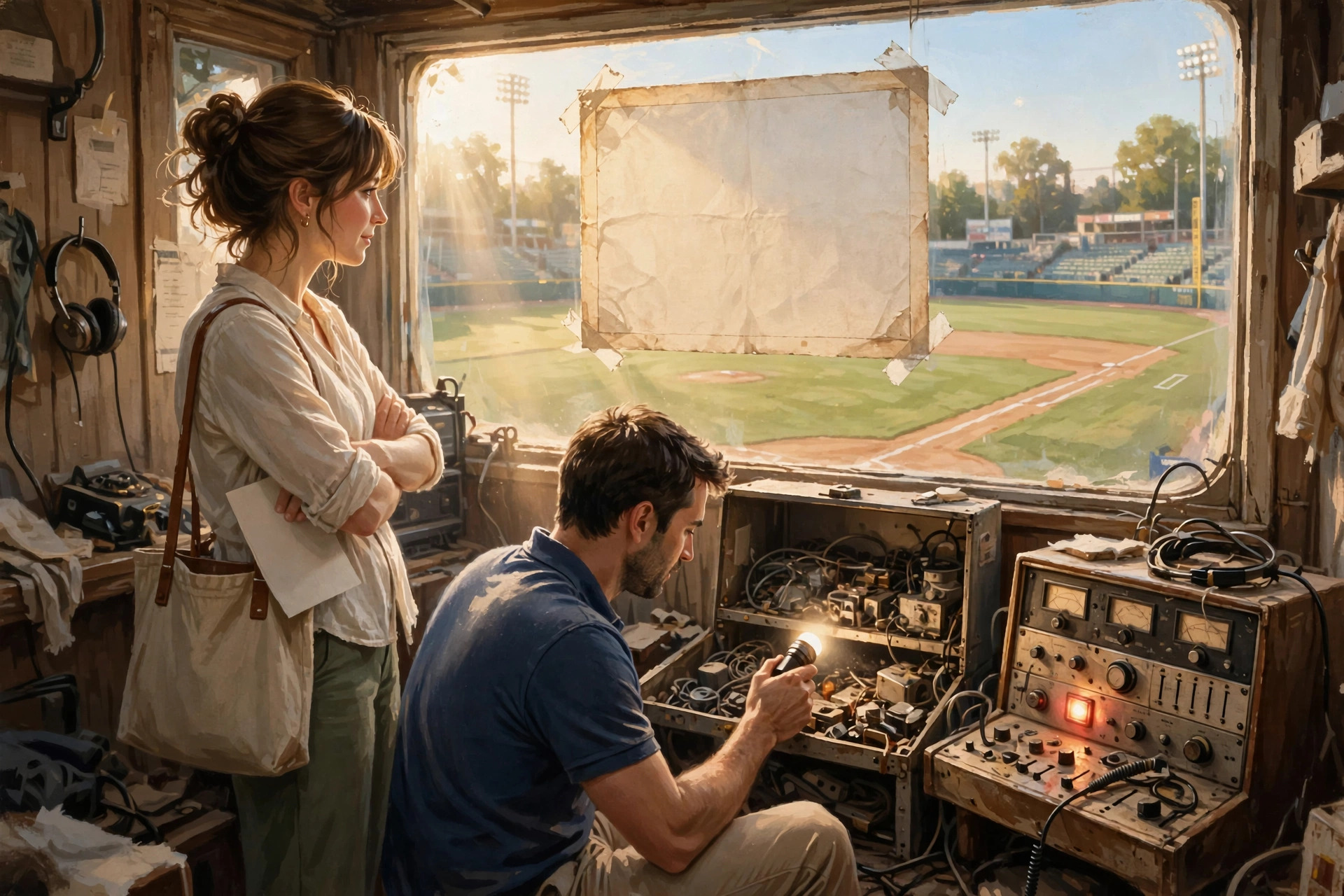
"You want a new console," Nadia said, and slapped the invoice onto the desk between his elbows. "Read me the line where Gloria agreed to that."
Theo Lindqvist didn't look up. He was half under the broadcast desk, one shoulder wedged against the rack, a flashlight clamped in his teeth. He took it out to answer her.
"Hi. Good afternoon. Nice to meet you properly."
"We've met."
"You've signed my parking pass. That's not meeting." He slid out on the carpet and sat up, dust on his navy polo, hair flattened on one side. He had the kind of face that looked like it was already apologizing for something. "And it's not a new console. It's a quote for one. There's a difference."
"Not on my ledger, there isn't. A quote turns into a purchase order turns into me explaining to the owner why the radio guy spent the concession budget on blinking lights."
The press booth at Pettibone Field was the size of a generous closet, with a window that ran the width of it and a view straight down the first-base line. Somebody had taped a laminated lineup card to the glass and the sun had bleached it to the color of weak tea. Nadia knew the booth too well. She knew where the carpet buckled, which outlet sparked, and which ceiling tile leaked when the wind came off the river.
She knew the console best of all. Steel faceplate, plastic knobs gone shiny from thumbs, and the red cough button in the lower corner, worn pale at the center like a stone in a creek bed.
Theo followed her eyes. "It drops audio. Twice last week. Once in the middle of a double play, which, I'll be honest, was not my finest radio."
"So fix it."
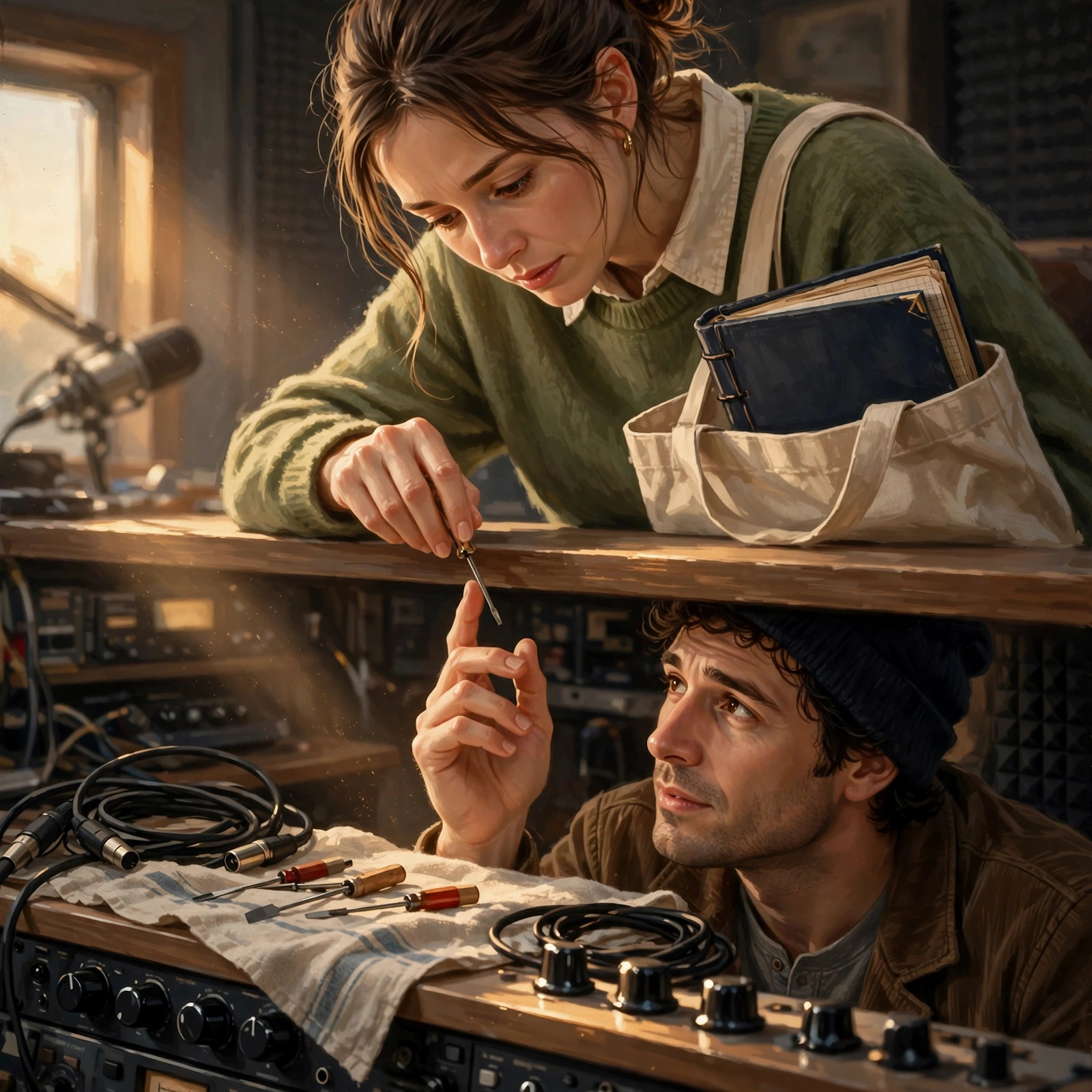
"I'm trying to fix it." He gestured at the open rack, the coiled cables, a little screwdriver set laid out on a dish towel like surgical tools. "That's what this is. But the unit's old. Parts are hard to find. The quote's a backup plan."
"It's not old. It's broken in."
He looked at her a moment longer than she liked. Then he went back under the desk.
Nadia stayed where she was, arms folded, tote bag strap cutting into her shoulder. Inside it, under her laptop and a sleeve of receipts, the scorebook pressed its stiff cloth corner against her ribs. She'd brought it up the stairs without thinking. She always did.
"Can you hand me the small Phillips?" Theo's voice came muffled. "Second from the left."
"I'm not your assistant."
"Understood. Can you hand it to me anyway?"
She handed it to him. Their fingers didn't touch, and she noticed that they didn't, which annoyed her.
"Whoever wired this was meticulous," he said. "Every cable's labeled. In pencil. Little arrows. It's like reading somebody's diary."
Nadia looked out the window at the infield, where the grounds crew was dragging the base paths in slow ovals. "It was installed right," she said. "Leave it that way."
A pause under the desk. Then a click, and a second click, and the console's meters flickered from dead black to a soft amber sweep. Theo slid out again and sat back on his heels.
"Okay. Full reset." He leaned over, pressed a sequence on the faceplate, and watched the delay readout climb and settle. "Seven seconds, locked. Let's see if she holds."
"She."
"Everything that's temperamental and older than me is a she. My grandmother. My first car." He tapped the red button with two fingers, quick, like he was checking a stove. The meters dipped and came back. He did it again. And again.
"It works," Nadia said.
"I'm making sure."
"You've made sure four times."
He lifted his hand off the button and put it flat on his knee, as if he'd caught it doing something without permission. For a second the apology in his face went real.
"Habit," he said. "I like knowing the exit works."
"It's a baseball broadcast. Who are you planning to escape from?"
"Me, mostly." He said it lightly and then stood up fast, brushing at his knees, done with it. "Look, I'll tear up the quote. The reset should hold through the homestand. If it doesn't, I'll come find you, and you can yell at me in person again. I'm told it builds character."
"Who told you that?"
"You. Just now. With your whole face."
She did not smile. It took effort, which annoyed her more than the fingers.
He picked up the invoice and folded it into quarters, then eighths, then held it out to her like a peace offering. She took it. Paper, warm from the sun on the desk.
"Can I ask you something?" he said.
"You can ask."
"The fans. The ones online. There's a stream, the guy on the comment boards keeps calling me 'the human weather report.' Does Gloria read that stuff?"
Nadia shifted her tote to the other shoulder. The scorebook slid with it. "Gloria reads everything. She owns a ballclub. Reading complaints is the whole job."
"Great. Cool." He sat in the broadcast chair and spun it a quarter turn toward the field. "Because I've got a contract renewal coming at the end of the season, and I'd love to not be replaced by a guy in his mom's basement."
"Maybe be less of a weather report."
He laughed, surprised, a real one. "You listen?"
"I keep the books. I listen to everything that costs money."
"That's a no, then."
"That's a yes, and it's a no on the console." She turned for the door. The handle stuck, the way it had stuck for years, and she lifted and pulled before he could tell her the trick. She felt him notice that, too.
"Ms. Brennan."
She stopped in the doorway.
"The pencil labels," he said. "The arrows. If you know who did that, tell them thanks. It made it easy."
Nadia held the folded invoice so tightly the creases bit her palm. "He'd have hated the quote," she said, and went down the stairs.
That night the Herons lost by one in ten innings. Nadia didn't stay in the front office to reconcile the gate. She walked the third-base concourse after the last vendor had rolled down his shutter, past the dark pretzel stand and the mural of a heron mid-strike, to a gray door with no sign on it. Inside, a folding chair. A cheap laptop. A secondhand microphone on a clamp, and a pair of headphones with the foam half gone.
She took the scorebook out of her tote and opened it flat on her knees, Eamon's careful ruled columns, her own pencil marks filling them in where his had stopped. Tonight's game sat there in tiny diamonds. She ran her thumb down the tenth inning.
Then she pulled the headphones on, dropped her voice into the low, dry register nobody upstairs had ever heard her use, and leaned toward the microphone.
"Folks, let's go to the replay. Bottom of the tenth, winning run on second, and our friend in the booth tells you, and I quote, 'that one's hit fairly well.'" She let the pause sit. "Fairly well. Lord. The man has the passion of a parking meter. Somebody check on him. I think he's pressing the button again."
In the chat window, the comments came pouring in faster than she could read them.
She didn't laugh. She picked up her pencil and finished the box score.
Gloria's Office
"Sit down, both of you. You're making my carpet nervous."
Gloria Pettibone said it without looking up from her desk. Nadia took the chair by the window. Theo took the other one, the one with the split vinyl. He sat on the edge of it, knees wide, like he might have to stand up fast.
The office smelled of burnt coffee and the lemon polish Gloria put on everything she owned. Signed bats hung on the paneling behind her. One of them was Eamon's, from the year the Herons won the league. Nadia didn't look at it. She looked at the pen in Gloria's hand.
"I'll be quick," Gloria said. "The radio deal is up at the end of the season. WKRF wants to renew. Mr. Lindqvist here would presumably like to keep his chair."
"I would," Theo said.
"And I've got a stack of letters from season ticket holders asking me to hand the whole broadcast to that internet program. The Back Booth." Gloria set the pen down. "Some of them are very well written. One came with a drawing."
Theo's jaw moved. "A drawing of what?"
"You. As a parking meter."
Nadia studied the window latch.
"So here's what I'm doing," Gloria said. "I'll decide after the last home game. Not before. I'm going to listen to both of them that night, start to finish, and then I'm going to make up my mind."
"One game," Theo said.
"One game. You've had a season. That's plenty of time to get interesting." She turned to Nadia. "And you. I need a full count of everything in that booth before I sign any contract with anybody. What's ours, what's the station's, what's worn out. If the club's handing the booth to a stranger, I want to know what I'm handing over."
"I can do that by Friday," Nadia said.
"You'll do it with him. He knows what the equipment does. You know what it cost." Gloria picked her pen back up, which meant the meeting was over. "Try not to kill each other. The paperwork's awful."
They went down the hall without talking. At the stairwell Theo held the door, and Nadia went through it, and he said to the back of her head, "A parking meter."
"It's a little funny."
"It's a lot funny. That's the problem."
She kept climbing.
The press booth was hot by midmorning, sun coming flat through the glass. Nadia set her clipboard on the desk and her tote on the floor by her feet, the scorebook inside it pressing a square shape into the canvas. Theo pulled open the cabinet under the counter and started handing things out.
"Two mixers. One's dead, one's fine."
"Which one's dead?"
"The pretty one." He held it up. "Somebody bought this because it had lights."
"That was the station. Not us." She wrote it down. "Next."
Cables. A crate of them, coiled and tied with bread ties. Two spare microphones. A field-level phone nobody had used in years. The console with its red button sat in the middle of all of it, and Nadia noticed that every time Theo reached past it, his thumb brushed the button. Not pressing. Just checking that it was still there.
By noon they'd filled four pages. By one, he'd taken off his jacket and she'd stopped pretending she wasn't hungry. He produced half a sleeve of crackers from his bag and set it between them without comment. She took two.
"Headsets," he said, and pulled a cardboard box from the back of the cabinet.
There were three. Two were the station's, black plastic, a WKRF sticker peeling off each one. The third was older. Gray, heavy, the ear pads replaced at some point with leather that had been stitched on by hand, in tidy black thread.
Nadia's pencil stopped.
Theo turned it over. "This one's not on any list."
"It's the club's."
"Somebody fixed it." He ran his finger along the stitching. "Somebody who could sew."
"He couldn't sew. He learned for that." It came out before she could stop it, and she wrote headset, gray, club property on the clipboard in letters a little too hard. "It's been in that box since before you. You can use it if the station's are bad."
"They're not bad. They're just fine." He was still holding it. "This was his."
"Everything in here was his, practically." She meant it to sound flat, like a fact on a ledger. It didn't. She put the pencil down.
Theo didn't say he was sorry, and she was grateful. He set the headset on the desk between them, carefully, the way you'd put down a bird.
That night she stayed late with the gate receipts and left at midnight with the box score half done. The gray door off the third-base concourse stayed shut. She told herself it was because she was tired.
The next afternoon, the second day of the count, he was already in the booth when she came up. He'd laid everything out on the floor in rows like a yard sale. The gray headset sat at the end of the last row, by itself.
"I listened to tapes last night," he said.
"What tapes?"
"The station keeps them. Ten years of Herons games on a hard drive somebody labeled misc." He sat back on his heels. "I listened to about six innings of him."
Nadia stood very still in the doorway with her tote on her shoulder. The handle had stuck again behind her. She hadn't fought it.
"He used to say a ball was 'gone to Mrs. Pettibone's garden,'" Theo said. "What does that mean?"
"Gloria had tomatoes behind the right field fence. For years. He thought anything that cleared it should count double." She heard her own voice go soft and pulled it back. "She took the garden out after."
"And the strikeouts. He'd say the batter was 'sent home to think about it.'"
"Only on called third strikes. Swinging, it was something else."
"What?"
She shook her head and set the tote down, and the scorebook slid against her ankle through the canvas. Theo picked up the gray headset, turned it over once, and held it out to her across the rows of cables.
"Here. It should be on somebody who knows what it's for."
She took it. The leather was warm from the sun on the glass. She hadn't touched it in three seasons, and her hands knew exactly where the stitched seam ran.
"I've been calling games all year like I'm reading the traffic," he said. "I know it. You heard it. Everybody heard it." He wasn't smiling now. His thumb was moving on his knee, the same small press, over and over, on nothing. "I've got one game left before she decides."
"I know."
"So teach me," he said. "The old calls. His. Teach me how he did it."
Seven Seconds
"You're writing it before it happens," Theo said.
Nadia didn't look up. "I'm writing it after. You're saying it after that."
The booth glass was propped open a few inches for the breeze, and the sound of the park came through in pieces: the vendor down the line, a kid banging a souvenir bat on a railing, the snap of a catcher's mitt. It was a weeknight, two days after he'd asked her to teach him, and she had come up with the scorebook in her tote and told him it was so he could see how Eamon tracked things. That was true. It was also the first time the book had been open anywhere but the gray room off the third-base concourse.
She'd chosen the folding chair against the back wall, behind his shoulder. He'd moved it closer twice. She'd moved it back once.
"Six-four-three," she murmured, and penciled it in, the little diamond, the arrow, the tidy slash. "That's how he'd mark a double play. Short to second to first."
"I know what a six-four-three is." He leaned toward the mic, cleared his throat, and called it. Grounder to short, flipped to second, on to first, two down. It was clean and correct and about as warm as a parking ticket.
She bit the inside of her cheek.
"Say it," he said, off mic.
"I didn't say anything."
"Your pencil said it."
Between innings he hit the cough button for no reason at all, the worn red square giving under his thumb, the little light blinking. He did it again. Then he reached over and set his palm on the scorebook, not on the page, just the cloth edge of the cover, as if asking permission.
"Can I look?"
Every part of her wanted to close it. She turned it toward him instead.
He was quiet a long time. Eamon's pages were in the front, his slanted pencil, his margins full of small jokes for nobody. A drawing of a tomato beside a home run. A frowning face beside a called third strike. Then, a third of the way in, the hand changed. Rounder letters. No jokes. Every pitch marked, ball, strike, foul, foul, foul, with a dot system Eamon had never used.
"You do every pitch," Theo said.
"Habit."
"His didn't."
"He had a microphone. He didn't need to." She held out her hand for the book.
He didn't give it back. He was frowning at the top of the open page, at tonight, and his thumb found its spot on the edge of the desk and started its small press. "Hang on."
Below them the visiting pitcher was set. Theo half-turned in his chair and pulled one earbud from the cable looped around his neck, the one he'd been wearing on and off all night. He'd mentioned it at the start, offhand, sour: he listened to the Back Booth during games now. Know your enemy. Half the bleachers had it on their phones anyway; you could hear it leaking out of pockets.
"Listen," he said, and handed her the earbud.
She didn't want it. She took it anyway, because refusing would be a sentence she'd have to explain.
Through the earbud came the Back Booth's hiss of crowd noise, a recorded loop tonight, since the voice that ran it was sitting in a press booth wearing nothing but a scorebook on its lap. A canned intro played, then a clip from some earlier game, the voice wry and low and pitched in a way she'd practiced in a dark room for two summers.
"Not that," Theo said. "Last night. I recorded both." He thumbed his phone, and the earbud switched to a split file, his broadcast in one channel, the stream in the other.
Her voice came first. And that one is gone, folks, gone to the garden.
She counted without meaning to. One, two, three, four, five, six, seven.
Then Theo's voice, crisp and late: Fly ball, deep right, and that one's out of here.
"Every time," he said. "I timed it all night. Every pitch, every hit. She's ahead of me by exactly my delay."
"She?"
"He. It. The Booth." He waved a hand. "My signal goes through that box." He tapped the console, the red cough button sitting under his fingers like a sore. "Seven seconds, in case somebody in the bleachers says something I can't put on the air. Everybody listening at home hears me seven seconds late. Which is fine, because nobody at home can see the field."
"So?"
"So whoever's doing that stream isn't listening to me and riffing. I figured that's what it was. Some guy in a basement with my feed and a bag of chips." He shook his head slowly. "But you can't beat a broadcast you're listening to. You can only beat it if you're watching the game."
The pitch came in below them. Strike, on the outside corner. Her pencil made its dot without her.
"The TV feed's delayed too," he said. "Worse than mine. So that person's here. Inside the park. Tonight, probably."
Nadia set the earbud on the desk. Her fingers were steadier than she felt. "Or somebody with a seat and a phone."
"With a soundboard? With crowd loops?" He laughed, short. "No. Somebody's got a room."
"Half this park is rooms. You should see what I sign for in janitorial." She reached for the book again, and this time he let her have it. She closed it and kept her hand flat on the cover. "Are you going to tell Gloria?"
"Tell her what? That her fans' favorite thing is coming from inside the house?" He rubbed his face. "She'd probably love it."
"She would."
"You don't sound surprised."
"I've worked for her a long time." Which was true, and sounded like an answer, and wasn't.
The inning went on. He called it. She scored it, and when the third out came on a called strike she wrote the small frowning face in the margin before she could stop herself. Eamon's face. Her pencil had never done it before.
Theo saw. He didn't say anything about it. He went to a break and pressed the cough button once, then took his hand off it and laid it on the desk, palm down, and left it there.
"Can I tell you something," he said. "Not on air. Not for the Booth, not for Gloria."
"You don't have to."
"I know. That's why I can." He looked out at the field, not at her. "Before here I did games in a bigger market. Triple-A. Good gig. I was going to be somebody, everybody kept saying. One night the home team blew a lead in the ninth and I was mad, and I thought we were in commercial."
She waited.
"We weren't. I said something about the manager. About his family, actually. It was mean and it wasn't even funny. It went out live, before anybody could hit anything." His thumb moved against the desk, pressing nothing. "They let me go that week. Clip's still out there if you look. I don't look."
"Theo."
"So, yeah. I lean on the exit." He finally glanced at her, a little embarrassed, a little defiant. "Every call, I'm thinking about what I shouldn't say instead of what I should. And then some voice in a closet beats me to it by seven seconds and sounds like it's having the time of its life."
Nadia held the closed scorebook against her chest. Somewhere under her feet, past the concourse and the gray door, there was a microphone she'd left running on a loop, telling the whole town how dull he was.
"Thank you for telling me," she said.
"Don't make it a thing."
"I won't."
The break ended. He leaned back to the mic, and she opened the book and found her place.
Rain on Tarp
"You're going to drop it," Nadia said.
"I'm not going to drop it." Theo had the scorebook balanced on one palm and was reaching for the window latch with the other, because the rain had started coming in sideways across the desk. "I'm saving it. There's a difference."
"Give it here."
He handed it over and got the window shut just as the sky opened all the way. Below them the grounds crew came running out of the dugout tunnel, and the big tarp began to unroll across the infield. It went slow at first, then fast, a long blue tongue swallowing the dirt around second base while the crew hauled at the edges and shouted at each other over the noise.
The booth lights flickered once and died. Only the console stayed on, glowing on its rack, its red cough button lit like a coal.
"Backup circuit," Theo said. "Your husband wired the board to its own line. I found the label."
"He didn't trust the stadium."
"Smart man." He sat back in his chair and pulled his headphones down around his neck. "We're in a delay. Studio's playing the countdown show. I've got nothing to do for maybe an hour but listen to rain."
Nadia should have gone downstairs. The gray door off the third-base concourse would be dark too, and the little laptop in there ran on battery, and the Booth's listeners would be waiting for her to fill the delay with something mean and funny. She stayed in her chair. She opened the scorebook on the desk between them and turned it so the console light fell across the page.
"Show me the faces," he said.
"They're just doodles."
"Nadia."
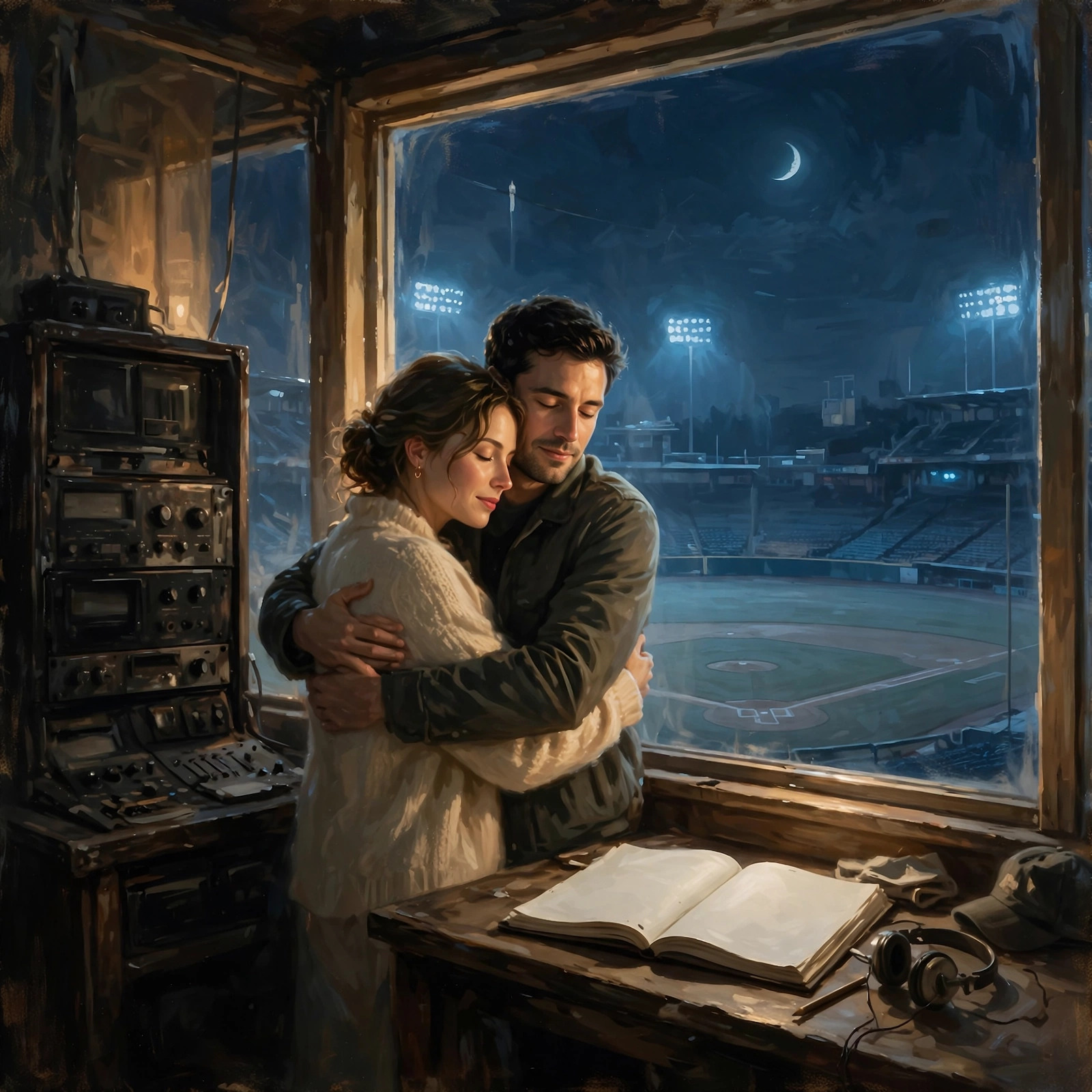
So she showed him. Eamon's frowning face for a called third strike. A little sun for a home run. A stick figure tripping over a bat, which meant an error he'd thought was funny. Theo leaned in close to see, and his shoulder came against hers and stayed there. She could feel the rain through the wall and his breathing beside her, and neither of them moved away.
"He liked it," Theo said quietly. "You can hear it on the tapes. He liked every pitch."
"He did."
"I don't think I've liked a pitch in three years."
She looked at him then. He was close enough that the red light from the console picked out the stubble along his jaw. He didn't look embarrassed this time. He looked tired, and honest, and like he was waiting to find out if she'd laugh.
She didn't laugh. She put her hand flat on the page, over Eamon's tripping stick figure, and Theo put his hand over hers, and when she leaned in he met her halfway.
It was a careful kiss at first, the way you'd test ice. Then it wasn't careful. His hand slid up to the side of her neck and she caught a fistful of his shirt and the chair creaked under them, and outside the tarp snapped in the wind like a sail. When they finally broke apart she was breathing hard and so was he, and the scorebook had slid sideways under her elbow.
"Okay," Theo said, a little dazed. "Okay."
"Don't make it a thing."
"Too late." He grinned, really grinned, the first time she'd seen it. "I'm going to get us coffee before the concession stands figure out the power's out. Don't go anywhere."
He left. Nadia sat in the red dark with her mouth still warm and her phone buzzing in her pocket. She knew what it was before she looked. The Booth's message board, lighting up. Where are you? Rain delay content please. Roast the radio guy. And under that, a forwarded note from the front office inbox, which she managed: Gloria's assistant, confirming that the owner would be tallying fan votes on the two broadcasts through the weekend, ahead of the final home game.
The Booth was ahead. But not by much, and Theo had been better lately. She'd heard it. Warmer. Looser. People were noticing.
If he won, the Booth went dark and the voice in the booth stayed his. Eamon's chair. Eamon's console. And she'd go back to being the woman who kept the books.
She went downstairs.
The storage room off the third-base concourse smelled of damp cardboard. She pulled the door nearly shut, sat on the overturned bucket, and opened the laptop. Battery at half. Mic live. She didn't let herself think about the coffee.
"Evening, Carrow Falls," she said, low and quick, in the voice that wasn't quite hers. "Rain delay at Pettibone Field, which means our friends at the radio station are playing reruns. So let's talk about why the radio guy is so careful. You ever wonder? Turns out there's a reason."
She told it. The bigger market. The blown lead in the ninth. The remark about a manager's family that went out live. She told it the way the Booth told everything, fast and sharp, and she heard herself land the laugh lines and hated how well they landed.
The door swung open behind her.
Theo stood there with two paper cups. He'd come down the concourse looking for her, she understood, because she hadn't been in the booth. Because he'd wanted to find her. He stood in the doorway and listened to the end of his own story in her mouth.
She hit the mute key. Too late, of course. Everything she'd said was already out. There was no delay on the Booth. That had always been the point.
"Theo."
He set the coffee down on a shelf, very carefully, as if it might go off. "Seven seconds," he said. "You beat me by seven seconds every night because you were sitting right under my feet."
"I can explain."
"You told me not for the Booth." His voice didn't rise. That was worse. "No. I told you. And you said you wouldn't."
"It was close," she said. "The vote. You were winning, and if you win, it's just... gone. All of it. His whole game."
"His game." He looked at the laptop, at the bucket, at the scorebook she'd carried down without noticing, tucked under her arm. "He liked every pitch, Nadia. You just used his book to keep score while you took me apart."
She had nothing to say to that. Her throat had closed around everything.
He reached into the inside pocket of his jacket and drew out the gray headset, Eamon's, the one with the hand-stitched band. She'd left it in the booth earlier and he must have picked it up to bring to her. He held it out.
She took it. His fingers didn't touch hers.
Then he turned and walked out into the concourse, past the shuttered stands, toward the stairs and the dark booth and the red button waiting for him, and he didn't look back.
Final Home Game
Gloria Pettibone didn't look up when Nadia knocked. She had two radios on her desk in the Herons front office, a transistor tuned to WKRF and a tablet propped against a stapler with the Back Booth's page open, and she was eating sunflower seeds out of a coffee mug.
"First pitch in forty minutes," Gloria said. "If this is about the concession invoices, they can wait."
"It's not invoices."
Nadia set Eamon's scorebook on the edge of the desk. Then she set the laptop beside it and turned the screen so Gloria could see the stream dashboard, the little red dot, the chat already scrolling with fans asking where the Booth had been for two nights.
Gloria stopped chewing.
"It's me," Nadia said. "The Back Booth. It's been me since the start of last season. I run it from the storage room off the third-base concourse, under the press box. That's why it always gets the pitch first. His feed sits on a delay. Mine doesn't."
For a while the only sound was the transistor, a pregame jingle for a tire shop.
"You," Gloria said finally. "My bookkeeper."
"Yes."
"Using my building, my wifi, and my ballclub's name."
"Yes." Nadia folded her hands so they'd stop doing things. "And the thing everybody laughed at on Wednesday, about his old job. He told me that in private. I put it on the air because the vote was close. That was mine. Nobody made me."
Gloria leaned back. The chair complained. "Why are you telling me this an hour before I decide?"
"Because you shouldn't decide on something that isn't real. There's no Back Booth. There's a widow in a closet doing her husband's voice badly." Her own voice wobbled on the last word and she let it. "Keep Theo. Give him the booth. Whatever you do with me after, that's fair."
Gloria picked a seed shell off her lip and studied her for a long moment, the way she studied a balance sheet she suspected of lying.
"Go do whatever you came to do," she said. "Then come back here."
The Storage Room
The room smelled of bleach and old popcorn oil. Nadia sat on the overturned bucket, put on the gray headset, and unmuted.
The chat exploded. SHE'S BACK. Booth lives.
"Hey, Carrow Falls." She didn't lower her voice. She didn't speed it up. She just talked, in the plain alto that ordered paper towels and argued with vendors. "This is the last one. I'm Nadia Brennan. I keep the books upstairs. Some of you knew my husband. He called this team for a long time, and when he was gone I couldn't stand the quiet, so I filled it. Mostly by being mean to the guy who replaced him."
The chat slowed. Then stopped.
"What I said about Theo on Wednesday, he told me in confidence. I broke it. He's a good broadcaster and he loves this game more than I've let anybody see. Turn on WKRF tonight. Give him the seven seconds. He's worth the wait."
She clicked end stream. The red dot went gray. She closed the laptop, pulled the power cord from the wall, and coiled it around her hand until there was nothing left hanging.
Then she took off the headset and picked up the scorebook.
Theo was at the desk with his back to the door, sleeves rolled, finger resting on the worn red cough button the way it always did. He was resetting the delay unit, watching the little readout tick.
He heard her and didn't turn. "If you're here to say sorry, the anthem's in six minutes."
"I'm here to bring you this."
She held out the scorebook. He looked at it over his shoulder, then at her face, then back at the book.
"That's his."
"It's the season. Every pitch since April." She set it beside his mic. "You keep score on index cards. It drives me crazy. Use this. Or don't. It's yours."
"Nadia." He swiveled now, all the way around. "Gloria called up here ten minutes ago."
Her stomach dropped. "And?"
"She said the internet show was off the air for good and I'd better be worth the trouble." He opened the book carefully, to the latest page, Eamon's pencil drawing of a heron in the corner. "Did you do that? Shut it down?"
"I did a lot of things this afternoon."
The organ started below them. He watched her a second longer, something moving in his jaw, and then he put on his headset and turned to the field.
She left before he could see her face.
Gloria had the transistor turned up loud. Nadia sat across the desk with a ledger she wasn't reading.
Theo sounded different. Not louder. Looser. When the Herons' shortstop booted a grounder he said, "Oh, that one's going on his blooper reel at the wedding," and the line went out clean, no cough, no dead air. When a fan in the bleachers caught a foul ball in a nacho tray, he laughed so hard he had to stop talking, and he didn't hit the button then either. He just laughed, and let the town hear it.
In the eighth, the Herons tied it on a bloop double. "Write that down, folks," Theo said, and Nadia could hear paper turning. "I'm writing it down. In pencil. Somebody taught me."
Gloria glanced at her. Nadia looked at the ledger very hard.
They lost by one in the tenth. The crowd stayed to clap anyway.
Gloria clicked the radio off. "I'm renewing WKRF. Three years. Him in the booth."
Nadia let out a breath she hadn't known she was carrying.
"And you," Gloria went on, "are on probation. One season. You clear every broadcast idea, every side project, every podcast your niece talks you into, through me. You lie to me once more and you're keeping books for the car wash."
"Understood."
"Your husband used to sneak out of budget meetings to buy hot dogs." Gloria stood, gathering the seed mug. "Go on. I'm locking up."
The park emptied slowly, then all at once. The grounds crew dragged the infield under the last lights, and the third-base concourse went dark stand by stand, shutters rattling down.
Nadia passed the storage room without stopping. The bucket was turned right side up. The laptop was under her arm.
At the foot of the press box stairs she could see a single lamp still burning in the booth window above, and a shape in it, bent over something on the desk.
She put her hand on the rail. It was cold and a little damp from the dew.
She started to climb.
He didn't look up when she reached the doorway. He was bent over the scorebook, pencil moving in small careful strokes, and the lamp threw his shadow long across the empty desk.
"You're filling in the tenth," Nadia said.
"I'm trying to. I don't know how you mark a runner who gets thrown out because he stopped to look at the ball." He tapped the page. "Your husband has a little drawing for everything except that."
"He'd have drawn a duck."
"A duck."
"For a guy who stops in the road." She stayed on the threshold. The dew from the rail was still cold on her palm, and she wiped it on her jeans. "Gloria renewed you. Three years."
"I heard. She came up here and told me to stop laughing on air, and then she said she was kidding, and then she didn't smile, so I genuinely don't know." He set the pencil down. "She told me about you, too. The probation."
"Car wash ledgers, if I slip."
"You'd be good at it. Very precise with suds."
It was almost the old rhythm, the one from the first week when she'd marched up here with his equipment receipts and he'd argued with her about the price of foam windscreens. Almost. He still hadn't asked her to come in.
She came in anyway.
The booth smelled of cold coffee and the warm dust of electronics cooling down. The delay unit sat in its rack under the desk, dark for the first time all season. Its little red cough button had gone pale at the center where a thumb had pressed it for most of a decade, first Eamon's, then Theo's. She'd watched Eamon wire it in. He'd sworn at it for an hour and then named it.
"You switched it off," she said.
"Game's over. Nothing left to dump." Theo reached down and rested two fingers on the button without pushing it. "I didn't touch it tonight. Not once. I kept waiting to need it."
"I heard."
"The nacho tray."
"The nacho tray," she agreed, and something in her chest gave a little, because he'd sounded so happy and she had been sitting in Gloria's office pretending to read a column of numbers.
She pulled the second chair out and sat. Not close. The scorebook lay open between them, his pencil marks crowding Eamon's old margins. Nadia put her hands flat on the desk so they would stay still.
"I'm sorry," she said. "I said it this afternoon to Gloria and to the whole town, and I've been practicing saying it to you since the sixth inning, and it still isn't big enough. You told me the worst thing that ever happened to you in the dark with the rain coming down, and I took it downstairs and sold it for votes."
He didn't help her. He just listened, which was worse.
"I told myself it was for the booth. For keeping his game going the way he did it." She looked at the dead red button. "That's not true. It was easier to be a voice in a closet than to be the widow who kissed the new guy. Nobody can see a voice. I didn't want anyone to see me."
"I saw you," Theo said quietly. "That was sort of the problem."
"I know."
"You know what I did, when I walked out of that storage room?" He turned the pencil over in his fingers. "I went to my car and I sat there and I thought, well, there it is. Same as last time. You say one honest thing near a microphone and it ends you. I almost called the station and told them not to bother with the renewal. I had the phone in my hand."
"Why didn't you?"
"Because I'd already been hiding up here for a year. Hitting that thing every time I had a real thought." He nudged the button again, gently. "You did something cruel. I did something cowardly for a lot longer. I don't think I get to stand on a very tall box."
"It was cruel."
"It was." He met her eyes. "And then you walked into Gloria's office and took it all off. On air. Your job, the stream, the thing you built out of him. I listened to that in the parking lot, too."
Her throat closed. She looked down at the page so she wouldn't have to watch him watch her.
He'd finished the tenth. At the bottom, beside the out, sat a lopsided little duck.
She laughed, a wet, ugly sound, and covered her mouth.
"Is that right?" he asked. "I was guessing."
"It's terrible. He'd love it."
"Then it stays."
Out the window the grounds crew had finished with the tarp. One bank of field lights clicked off, then another, and the green below went from bright to gray-blue. Theo reached across and turned the scorebook's page. Clean paper, ruled in Eamon's pencil all the way down, never used.
"Next season," he said. "I'd like you to keep it with me. Up here. Not every game. Whenever you want. You know the drawings. I'll only invent ducks."
"Gloria said I have to clear every side project."
"Tell her it's not a side project." He slid the pencil toward her. "Tell her it's me."
She didn't pick up the pencil. She stood, came around the desk, and stopped in front of his chair, close enough that his knee touched her leg. He looked up at her, very still, the way he'd looked at the field before his first pitch of every game, before he learned not to flinch.
"I love you," Nadia said. Plainly. Out loud, in a room built for voices, with nothing switched on to catch it. "I've been scared of it for weeks. I'm still scared. I love you."
Theo let out a breath that shook a little at the end.
"I love you, too," he said. "No delay."
He stood and she stepped into him, and his arms came around her back, and she pressed her face into his shoulder and held on hard. He smelled like the booth and like rain-damp cotton. His hand spread between her shoulder blades. Neither of them said anything clever.
Below, the last bank of lights hummed and began to fade. The window went soft and dark. On the desk beside them, the lamp still burned over the open book, and the clean page waited, every line ready for whatever they'd call next.
Get notified when new stories drop
Noah Carrington
Noah covers sports romance and forced-proximity heat: rivalries, road trips, and the quiet moment after the crowd goes home.
Leave a comment
Comments