

The Cracked Glass
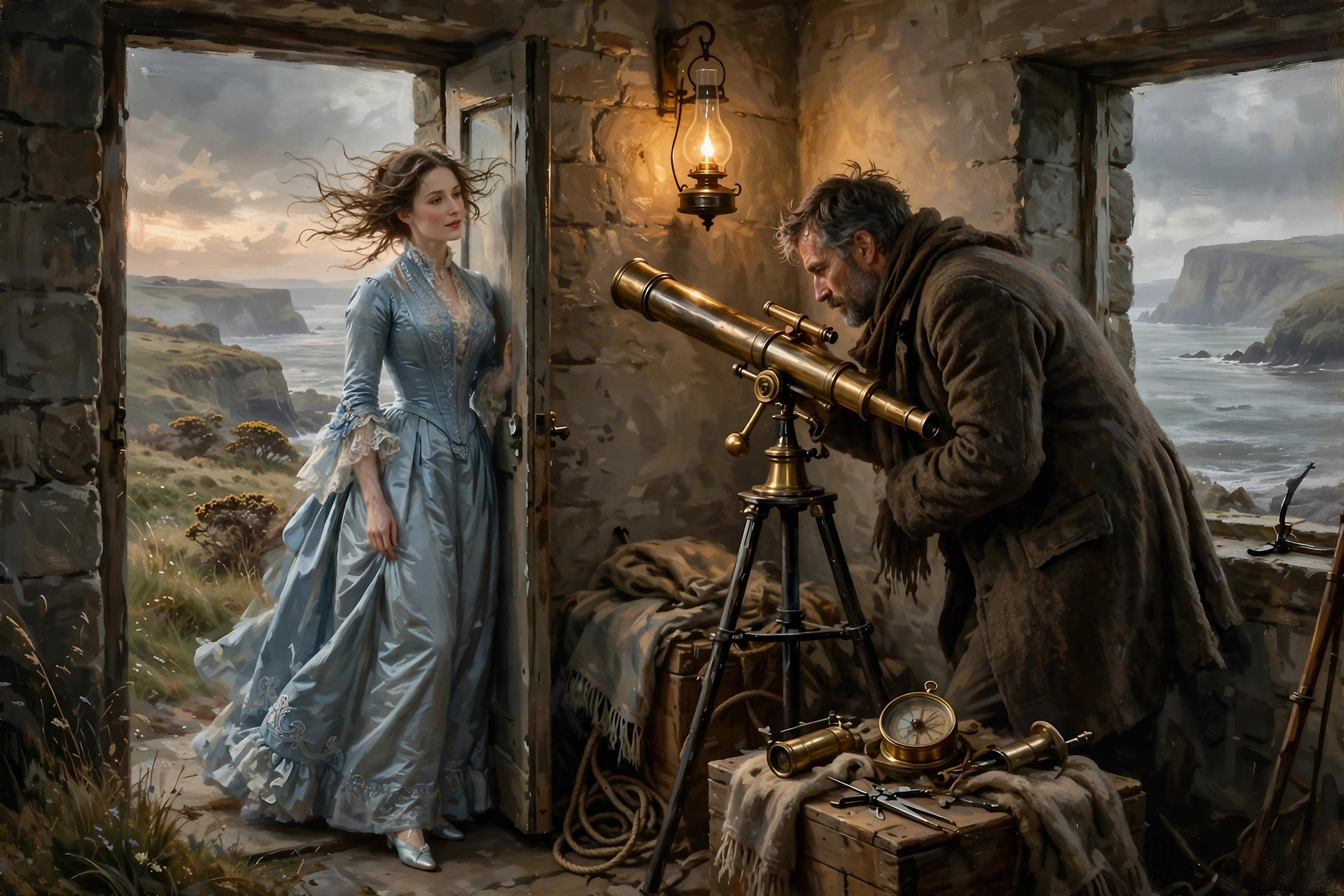
"You have a message for me," Leonora said, before the door had finished banging against the wall. "From the Earl of Stanmore. I'd like it now, please."
The man at the window did not turn around. He was bent to a long brass telescope set on an iron cradle, one hand lifted as if to quiet a dog.
"Shut the door, if you would. The draught gets in the ledger."
She did not shut the door. She had walked up from Llaneilian in shoes made for Grosvenor Square, and the wind off the headland had pulled half her hair from its pins. A woman who had come that far on principle did not start by obeying.
"I was told," she said, "that a rider came to the lodge at noon to say the station had received word from Liverpool. Word for the Dacre household. I am the Dacre household."
"You're Lady Leonora." He straightened at last. He was tall enough that the low beam of the signal room made him duck his head, and he had the weathered, unhurried look of a man who spent his days staring at distances. "And no, you're not the household. Mrs. Bowen keeps the household. I sent the rider to her."
"Mrs. Bowen sent me to you."
Something moved at the corner of his mouth. It was not quite a smile. "Did she."
"She said, and I quote, 'Go and shout at Owain, it'll do you both good.'" Leonora finally pushed the door to with her heel. "So. Mr. Prys, I presume."
"Prys will do." He wrote something in the ledger, a neat line in a cramped little column, and blotted it. "What came was a notice, not a message. The Earl has paid the Dock Trustees for private use of the line. His terms follow. They haven't come through yet."
"Then where are they?"
"Somewhere between here and Liverpool." He nodded at the window. "In the queue."
She stared at him. "The queue."
"Messages go in the order they're handed in. Shipping first, as a rule, because that's what the Trustees built the line for. A merchant in Liverpool wants to know his barque's been sighted off Holyhead, he pays for it, and it goes. Your father's terms go when they reach the front."
"My father is an earl."
"He is." He said it the way one might agree that the sky was grey. "And the semaphore arms on the next hill don't know it."
Leonora pulled off her gloves, one finger at a time, because it gave her hands something to do. The room was small and smelled of lamp oil and wet wool. A chalkboard on the wall held rows of numbers she could not read. Beyond the window the sea lay flat and pewter-coloured, and on the far headland a mast stood up against the sky with two black arms stuck out at angles, like a scarecrow giving directions.
"Surely," she said, "there's some provision. A gentleman pays for a thing, and the thing is done promptly. That's rather the point of paying."
"He paid for use. Not for jumping the line."
"And if I asked you to move it forward?"
"I'd say no."
"If I insisted?"
"I'd say no more slowly." He capped his ink. "My lady, there's a woman in Liverpool waiting to hear whether her husband's ship rounded the Skerries. She handed her question in before your father handed his. I'm not putting a lord's letter ahead of her."
That landed somewhere under her ribs, and she disliked it. She disliked him for it, briefly and with great energy.
"You don't know what's in his letter."
"Not yet."
"You will, though." She realised it as she said it. "You read them. Every one."
"I have to. I write it down, then I send it on. That's the job." He looked at her properly now, steady grey eyes under heavy brows. "If it helps, I've forgotten most of them by supper."
It did not help. The thought of this stranger copying out her father's verdict in his small, tidy hand, letter by letter, made her face go hot. She knew what the terms would say. Everyone in London knew what they would say. Marry Sir Lionel Askew, or don't come home.
She had broken it off with Askew in front of three hundred people. She remembered the crack of her mother's fan against the supper table, the silence after, all those faces turning. And she remembered that she had not stayed to hear what anyone said. She had picked up her skirts and gone, down the stairs and into the carriage, before a single soul could answer her.
The fan was in her reticule now. She had not been able to leave it behind.
"How long?" she asked.
"In clear weather, a message runs from here to Liverpool in about five minutes. Coming the other way, the same."
"Five minutes." She laughed, short and disbelieving. "Then it could be here by tea."
"It could."
"You don't sound as though you think so."
He didn't answer. He had turned back to the window, and something in the set of his shoulders had changed. Leonora followed his gaze. The far headland was still there, but softer, as though someone had breathed on the glass.
"Is that..."
"Coming in off the water." He bent to the telescope again. "Give me a moment."
She could not have said afterwards why she moved. Impatience, perhaps, or the old habit of stepping toward whatever she couldn't control so she could pretend she was in charge of it. She crossed to the window to see for herself, reticule swinging from her wrist, and turned too sharply in the narrow space between the desk and the cradle.
The reticule caught the end of the telescope.
It was not a hard blow. It barely seemed a blow at all. But the brass tube jumped in its cradle, the eyepiece struck the iron rim with a small, bright sound, and Owain jerked his head back as though he'd been stung.
For a moment neither of them spoke.
Then he lifted the eyepiece toward the grey light, and she saw it. A fine white line ran clean across the glass, edge to edge.
"Oh," Leonora said. "Oh, no. I'm so sorry. I didn't..."
"No." He turned the glass slowly in his fingers. His voice was quite calm, which was somehow worse than shouting. "You didn't."
She fumbled with the reticule's drawstring, she hardly knew why, as if there might be something inside to put it right. Her fingers found the fan first. When she pulled it free, one of the ivory sticks hung loose, snapped clean through at the rivet. It must have taken the knock before the brass did.
She stood there holding the broken fan, staring at the broken glass, and felt, absurdly, that she might cry.
Owain glanced at the fan. Then at her face. Something in his own face eased a fraction.
"That's a Canton piece," he said quietly.
"It was my mother's."
He nodded once, as though that settled something, and set the eyepiece gently on the desk. "There's a man in Liverpool sells replacements for this glass. Dollond's own. I'll write for one."
"By the line?"
"By the line. When it's my turn." He put his eye to the cracked lens anyway, squinting past the flaw, and held it there a long time. When he straightened, the far headland had gone. Simply gone, as though it had never been. The window showed only a white wall pressed close against the panes.
"Well," Leonora said, unsteadily. "What happens now?"
He drew the shutter halfway, turned up the lamp, and sat down at the ledger as though settling in for a long wait. He looked very tired, suddenly, and very still.
"Now nothing comes in," he said, "until I can see the next station again."
A Fortnight
"Hold still," Owain said, "or I'll have this card through my thumb."
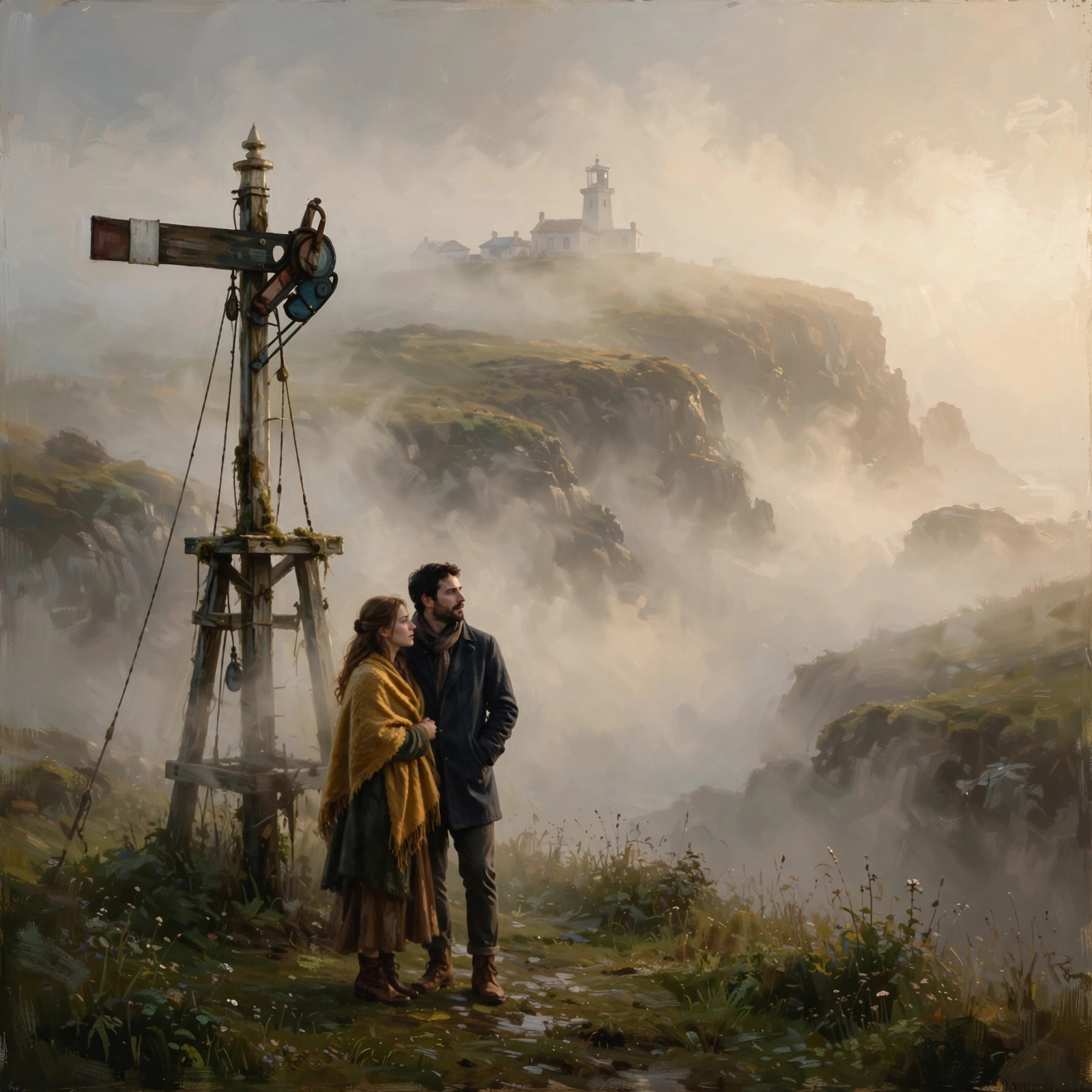
Leonora had not moved, or she had not meant to. She was standing at his shoulder in the narrow space by the window, careful this time to keep her reticule pinned against her skirts, watching him work a strip of pasteboard into the brass collar of the eyepiece. The fog had thinned at dawn. By noon the far headland had come back, grey and doubtful, and then the next station's arms had appeared above it like a man waking and stretching.
"I'm perfectly still. You're the one fidgeting."
"I'm not fidgeting. I'm shimming." He folded the card once more, narrow as a ribbon, and pressed it in with the flat of a penknife. "The crack runs edge to edge. If the two halves shift, the image doubles. If I pack them tight, they can't."
"And then you can see?"
"Then I can see well enough to be wrong only now and again."
She looked at him sharply, but he wasn't smiling. Or he was, very slightly, somewhere at the corner of his mouth where a smile could pass for a squint. She had spent most of two days at the lodge deciding he was a sullen, provincial creature with no conversation. It was disconcerting to find he had some after all.
He fitted the eyepiece back into the tube. It went in with a small, reluctant click. He put his eye to it and held there, one hand resting on the brass, as if the telescope were a horse that might shy.
"Well?"
"Hush."
No one had told Lady Leonora Dacre to hush since the nursery. She opened her mouth to say so, and then the arms on the far station dropped and rose, and Owain's free hand reached blind for the pencil and began to write.
She watched the pencil instead of the window. Letters, then numbers, then letters again, set down in a neat column without his ever looking at the page. The arms moved. The pencil moved. Somewhere behind her the stove ticked. When the far station stood still at last, he straightened and rubbed his eye with the heel of his hand.
"Yours," he said.
"You know already?"
"I read everything that passes. I have to. I can't relay what I haven't read." He turned the ledger toward her, then seemed to think better of it and turned it back. "Shall I read it out? The code's in the book, but it'd take you an hour."
She sat down on the stool by the desk because her knees suggested it. "Read it."
He read it in a flat, careful voice, the voice of a man reading a tide table.
"From Stanmore, by private arrangement with the Trustees. To Lady Leonora Dacre, care of Point Lynas. You will remain at Llaneilian until you consent to the match with Sir Lionel Askew. Consent by the line within one fortnight of this date restores your allowance and your place. Silence or refusal, and you will have a hundred a year and no house of mine. Askew is willing to overlook the ballroom. I am not certain I am." He paused. "That's the end of it."
"He didn't sign it."
"He signed it Stanmore."
"That's not signing. That's stamping." She laughed, and the sound came out wrong, thin and high. "A hundred a year. He knows precisely what that buys. A room in Bath over a milliner's, and the milliner's wife calling me dear."
Owain said nothing. He tore a fresh sheet from the back of the ledger, copied the message out in plain English in a hand far neater than hers, and folded it once. He held it out.
She didn't take it. She was looking at her own hands, which had gone, without asking her, to the reticule and drawn out the fan. The broken stick swung loose from the rivet. She closed the fan carefully so the loose stick lay flat against the others, as though that made it whole.
"I struck a table with this," she said. "In front of three hundred people. I said I wouldn't marry a man who counted me among his cargo, and I said it loudly, and then I ran. I didn't even wait to see their faces." She turned the fan over. "I've been rather proud of the first part. I'm less proud of the running."
"Was he counting you among his cargo?"
"He'd valued me. I heard him with my father. So much for the name, so much for the connexion, so much off for my temper." She glanced up. "You think that's foolish."
"I think I'd have struck the table harder." He set the folded sheet on the desk beside her, since she wouldn't take it. "A fortnight's a long time on this line, my lady. Things come and go."
The door banged open below them, and a voice called up the ladder in Welsh, then in English, as if to be fair to everybody.
"If either of you's dead up there, say so, and I'll take the broth home."
Gwen Bowen came up the ladder sideways, a covered can in one hand and a basket in the other, her shawl dark with damp. Owain rose to take the can from her before she'd reached the top. She surrendered it and looked from his face to Leonora's and back, and Leonora had the uncomfortable feeling of being read faster than any semaphore.
"It's come, then," Gwen said.
"It's come."
"Well. You'll eat first, both of you. Nobody ever decided anything worth having on an empty stomach." She set out two bowls from the basket, and a heel of bread, and poured. The broth was leek and mutton and very hot. "You look like a wet sermon, my lady. Drink that."
Leonora drank it. It was the first thing she had tasted properly in days.
Gwen settled on the bench under the window with her knitting as though she meant to stay till Christmas. She nodded at the telescope. "You've patched it."
"Card."
"Card." Gwen sniffed. "Six years at that glass and he still won't trust a lens he didn't see ground. He'll sit squinting through card till the new one comes, and he'll not leave this room to fetch it himself, not if the Trustees sent a carriage."
"Gwen."
"I'm only saying."
"You're always only saying." But he said it gently. He had gone back to the telescope and stood with his hand on it again, his eye not at the glass but on the sea beyond, the dark line toward the Skerries where the water broke white. He looked at it the way Leonora had seen men look at a grave. Gwen's needles slowed, and she looked at him, and then very deliberately at her wool.
Leonora put down her bowl.
She thought of the room in Bath. She thought of Askew's voice, so much off for temper. She thought of a fortnight spent at the lodge, waiting for a man to walk up the hill with her own life folded in his pocket, read off to her in a voice like a tide table. Every word her father sent would pass through this tower first. Every word she sent back would too.
She did not want to stand by the window watching the arms move and understand nothing.
"Mr. Prys."
He turned.
"If I'm to wait a fortnight for my fate to come over that hill," she said, "I'd rather be able to read it myself. Will you teach me the code?"
Shutter Levers
"Left eye," Owain said. "Not that one. The other left."
"There is only one other left, Mr. Prys."
"Then use it."
Leonora bent to the telescope and closed her right eye, which made her squint like a fishwife, and she was glad nobody from London could see her. The brass was cold under her fingers. The new eyepiece had come up from Holyhead that morning in a box packed with straw, and he had fitted it while she watched. He'd done it slowly, unscrewing the cracked lens and laying it on a square of flannel as though it had died in his service.
The folded card that had shimmed it all week lay beside the flannel. He hadn't thrown it away. She noticed that.
"Do you see the arms?"
"I see a great deal of sky."
His hand came over hers on the tube and moved it a fraction west. The hill across the bay leapt toward her, gorse and stone and the next station's mast standing black against the grey, its arms raised at odd angles like a man hailing a cab.
"Oh," she said.
"There. Now read it."
She had spent four afternoons with his chalked board of positions, and four evenings at the lodge copying them out by candlelight while Gwen pretended not to look. Upper arm high, lower arm level. She knew it. She knew it the way she had once known the order of precedence at a dinner of forty, and her lips moved without her permission.
"Six. No, it's moved. Two. Two again." She frowned. "That's a ship's number, isn't it?"
"It is." He had a pencil and the slate ready. "Go on."
The arms swung and held, swung and held. She called them out and he wrote, and somewhere past the fourth group she stopped thinking about her hair, or her squint, or the absurdity of an earl's daughter shouting numbers at a wall. Then the arms dropped to rest, and she straightened.
He turned the slate so she could see. In his square hand, beside her numbers, he had written the meaning from the code book: a brig, inward bound from Dublin, passing the Point.
"That's all?"
"That's all. A brig is coming home." He was almost smiling. "Now we send it on."
He went to the levers by the shutters, two long iron handles worn bright at the grip, and worked them while she read the slate aloud a second time. The arms above the roof groaned and knocked into place. She felt it through the floorboards, the whole tower answering him. When he finished he looked east through the smaller glass, waited, and nodded once.
"Taken," he said. "It'll be on a desk in Liverpool before the kettle boils."
"Five minutes," she said. He'd told her that the first week, and she had not believed it.
"In clear weather."
She looked at the slate in her hands. Her first. A brig from Dublin, and some merchant in Liverpool would put down his pen and send a boy running to the quay, and none of them would ever know that Lady Leonora Dacre had read it off a hill. It was the most useful thing she had done in her life. She was a little ashamed of how much that pleased her.
"You've a good eye," he said.
"I have a borrowed eye. It came in straw."
"Sit down a moment. I've something of yours."
He fetched it from the drawer of his table: her mother's fan, folded, wrapped in a clean handkerchief. She had given it to him on the second day without much hope, because the snapped stick had parted right at the rivet and the jeweller in Bond Street would have charged the earth. She'd half forgotten. Now he opened it on the table between them, and the painted silk spread out, the little Canton gardens and their bridges, the lady with the parasol who had never once in Leonora's life looked anywhere but over her shoulder.
The broken stick had been drawn together. A pin of brass, no thicker than a needle, ran through the ivory where the old rivet had been, its heads tapped flat and filed smooth.
"I drew it from wire," he said, as if apologising. "Brass won't match the old one. But it'll hold."
She closed the fan, then opened it again. It moved as it always had. Better, perhaps. She had carried it at her come-out and every season after, and at the end she had brought it down on a supper table in front of three hundred people hard enough to rattle the glasses, and said she would not marry Sir Lionel Askew, and walked out before a single soul could reply. She'd heard the stick crack, she thought now. She just hadn't looked.
"You needn't have," she said.
"I had the evenings."
"You have every evening. You never leave."
It came out sharper than she meant. He didn't flinch. He picked up the cracked eyepiece from its flannel and turned it in the light, and the fracture caught silver across the glass.
"My brother kept a fishing boat out of Cemaes," he said. "Rhys. He went out after herring one autumn, the year before I took this post. There was a gale coming. Holyhead saw it, and sent the warning down the line." He set the lens down. "Fog came in on this point. The warning sat here most of a day, waiting for the arms across the bay to show. By the time it cleared, the boat had gone onto the Skerries."
Leonora didn't speak. Outside, a gull worked the wind and slid away.
"It wasn't the keeper's fault. He did right. Nobody can send what can't be seen." He said it like something learned by heart. "But I thought, if there's a man at every glass who never looks away, never takes a holiday, never goes down the hill for a pint, then at least it won't be because of him. So I don't."
"For six years."
"Gwen's been counting," he said, and she laughed, wet and surprised, and he looked up at her laughing as though he'd been handed something.
She ought to go. The light was going yellow over the water, and Gwen would have supper on, and there was nothing more at the station for her to do. She stood and put the fan in her reticule and buttoned her glove. She went as far as the shutters.
Then she stopped, with her hand on the cold iron of the near lever, because she realised she had spent her whole life going as far as the door, and she was tired of the sound of her own footsteps.
"Show me how these work," she said.
He came and stood behind her. He set her hand on the grip and his over it, and moved the lever a little way, so she could feel the weight of the arm on the roof and the catch where it held. She was very aware of his breathing. She turned her head.
He kissed her there, by the shutter levers, carefully, as if she were a signal he didn't want to misread. Her hand slipped off the iron and found his coat instead. When he drew back she didn't let go of it.
"Leonora," he said. Only that. Nobody had said her name without a title in front of it since her mother died.
Below them the brig from Dublin was rounding the Point, small and dark, a lantern just lit at her stern. Leonora watched it go by and did not reach for her shawl. The window turned blue, then black, and he lit the lamp, and she stayed.
Order of Receipt
"You've been quiet since you came up the hill," Owain said, without turning from the glass. "Gwen send you with something?"

"Bara brith. It's in the cloth on the table." Leonora took off her gloves and laid them beside it, one over the other, fingers matched. "She says you'll eat it standing up, and that it's a disgrace."
"She's right on both counts."
He made a mark in the log and straightened. The morning was clear as a bell, the arms across the bay black and sharp against the sky, and the room smelled of lamp oil and the tar on his coat. Two days ago she had stood by those levers with her hand in his coat and not wanted to be anywhere else. Now she couldn't look at them.
She had not slept well. She had lain in the lodge's damp best bed and counted the days left of her father's fortnight on the ceiling cracks, and somewhere around midnight she had begun to do sums she had never done in her life. A hundred a year. Rent. Coal. Whether a woman could live on bread brith and pride.
"Owain." It came out too formal. She tried again. "What happens now?"
He set the pencil down very precisely, parallel to the edge of the log, the way he did everything. "Now?"
"With us. If there is an us." She heard how it sounded, and pressed on. "I'm not asking for a speech. I'm asking what you think."
For a long moment he looked at the window, not at her. The sea moved under the glass, ordinary and grey-blue.
"I think I'd be lying if I said I had anything to give you but this," he said. "This room. That glass. The Trustees pay me enough for one, and the cottage behind is two rooms and a leak. I don't go to Holyhead. I don't go to Liverpool. I don't go to church at Llaneilian, Gwen will tell you, more's the pity." His mouth moved, not quite a smile. "I can't leave the post. You know why. So that's what there is, Leonora. This station. That's all I can offer."
He said it the way he read a signal, plainly, nothing added. She thought later that if he had said it badly, with apology or hope, she might have argued with him. But he said it as a fact, the way her father said things, and something in her went cold and orderly and very far away.
"I see," she said.
"I'm not saying it to send you off."
"No. You're saying it because it's true." She was already reaching into her reticule. Her hand knew where the paper was; she had folded it at the lodge at dawn, sealed it with the candle stub and the edge of a spoon, because she had not brought her father's crest to Anglesey and would not have used it if she had. "I'd like to hand in a message. For the Earl of Stanmore. By the private arrangement."
He looked at the folded square in her fingers. Then at her face.
"It's sealed," he said.
"Yes."
"I'll have to open it to send it. You know that. Every letter goes through my hands."
"Then open it after I've gone."
He didn't take it at once. She held it out between them until her arm began to feel foolish, and still he didn't move, and she thought with a kind of terror that he might ask. That he might simply say, What is it, and she would have to tell him, out loud, in this small bright room.
He didn't ask. He took the paper the way he took every message, by the corner, and turned to the rack on the wall where they waited in order of receipt. There was nothing ahead of it. He slid it into the first slot and wrote in the log: the hour, her name, the Earl's, and the words sealed, private line.
"It'll go within the quarter hour," he said, to the log. "Five minutes to Liverpool, in this. Your father will have it before he's finished his breakfast."
"Good." Her voice did not shake. She was proud of that and hated herself for being proud of it. "Thank you, Mr. Prys."
His head came up at that. She saw it land. She picked up her gloves and pulled them on wrong, the left one twisted, and didn't stop to fix it, because if she stopped she would stay, and if she stayed she would have to watch him read it.
The fan was on the table, under Gwen's cloth. She had taken it out without thinking, the way her mother used to, to have something in her hand while she talked. The brass pin he'd drawn from wire glinted where the broken stick joined. She looked at it and could not make herself pick it up.
She left it there and went out.
The door was heavy and she let it close softly behind her. That was something, at least. Last time she'd left a room for good, it had been a ballroom, and the fan had struck a table so hard the candles jumped, and she'd been through the doors before anyone could say her name. This time there was no one to say it but him, and she was gone before he could.
The path down from the Point went between gorse and old stone wall. She walked fast. Halfway, where the wall broke and the lodge chimneys showed over the rise, she found she had stopped. She told herself it was the glove. She took it off and put it right, finger by finger, and then, because her face was already turned that way, she looked back.
The weather had changed while she wasn't watching. The sky over the bay had gone pale and soft-edged, and a whiteness was coming in off the water, low and quick, folding the far headland away as she looked at it. The arms across the bay blurred, then thinned, then were not there.
The station's window was lit by the morning still, a square of yellow in the grey. She could see him through it. He was at the rack. He had the paper in his hands, and she watched him break her poor spoon-pressed seal with his thumb, carefully, the way he'd lifted the cracked eyepiece out of its housing that first day, as if the thing might cut him.
He unfolded it. He read it.
She knew what it said; she had written it four times before she could make it short enough. I accept Sir Lionel Askew. I will come home. L. Nine words, and her initial, and nothing in them anyone could argue with.
He stood very still at the window with it. Then he turned to the glass, bent to it, and stayed bent, longer than any signal took. When he straightened he went to the levers, put his hand on the near one, the one she had held, and did not pull it.
The fog reached the Point. It came over the wall at her shoulder cold as well water, beaded on her sleeve, and took the station's edges first, then the yellow of the window, so that the last she saw of him was a shape with one hand on the iron, waiting for something across the bay to show itself.
Nobody can send what can't be seen. He had said it as though it were a prayer.
She thought of the paper going back into its slot, first in line, sealed again by nothing but weather. She thought of the fan on the table under the cloth. She ought to go down to the lodge, to Gwen and the fire and the long business of packing. Her feet would not do it yet.
Above the roof, the semaphore arms hang still in the white.
Second Message
The door stuck on the damp, and Leonora had to put her shoulder to it. When it gave, Owain was already on his feet by the table, as though he had been standing there for two days.
"You walked." He said it the way another man might have said you're bleeding.
"There wasn't a horse that would go. Your aunt's pony looked at the gate and went back to bed." She pushed her hood off. Her hair was wet through, and her hem was black with mud to the knee. "I followed the wall. Then the gorse. Then I followed the sound of the sea and hoped it stayed on the left."
"It's a cliff, Leonora."
"I'm aware it's a cliff. I nearly met it."
He crossed the room and stopped short of her, his hands lifting and then going nowhere. Behind him the window was a sheet of white. Her slip lay on the table where she had left it, opened now, flattened under the log. Her mother's fan lay closed beside the lamp.
He had read it. Of course he had read it. She had known he would when she gave it to him. She had sealed it anyway, as if wax could keep him from what was inside.
"It hasn't gone," she said.
"Nothing's gone. Not since you left."
She took her gloves off, finger by finger, because her hands needed something to do. "Then I'd like to hand something in."
For a moment he only looked at her. Then he went round the table, sat, and drew a fresh slip from the drawer. He set the pen beside it, square, the way he set everything. He did not offer her a word of help, and she understood that he couldn't. He was the keeper. She was a subscriber. That was the only way this could be done.
She wrote standing up. Her hand was too cold to lean forward. The letters came out upright and slow.
Father. I withdraw my consent. I will not marry Sir Lionel Askew, now or later. I renounce the allowance and ask nothing more of you. L.
She folded it and didn't seal it. She held it out across the table.
He took it, opened it, and read it twice. She watched his mouth go tight.
"You know the rule," he said quietly.
"You taught me the rule."
"It goes after the first. I can't take that one back off the table. I can't hold it, or burn it, or lose it in the log. When the fog lifts, your father reads that you'll marry Askew. A few minutes later he reads that you won't."
"Five minutes, in clear weather."
"About that."
"So he'll know." She heard her voice thin and made it steady. "He'll know I said yes the moment I was frightened, and that I took it back once I'd had two days in a cold house to think. He'll tell everyone at his club I can't keep my own mind. That I'm the girl who threw a fan at a table and ran." She lifted her chin. "Let him. It's true. I'd rather he had the truth in the right order than a lie that was tidy."
Owain put the second slip on top of the first, edge to edge. Then he opened the log and wrote. She watched him write the time and her name, under her name of two days before, and copy the words into the code. His pen didn't shake. Hers would have.
"You'll have a hundred a year," he said, not looking up.
"I can count."
"It isn't much."
"It's more than the man at the end of the line has, I expect. He seems to manage." She tried to smile and nearly managed it. "I'm not asking you for anything. I want to be clear. I didn't come for an offer. I came because I couldn't stand to have that one be the last thing I ever said."
He set the pen down. "Sit by the stove. You're shaking."
"I'm not."
"You are. Sit."
She sat, because her knees decided it for her. He put a blanket round her shoulders, the rough grey one from the hook, and his hands stayed a moment on the wool. Then he went back to the window and bent to the glass.
They waited. The stove ticked. Somewhere below, the sea worked at the rocks. She thought of the long nights he had sat here like this, the night of the gale, the message he couldn't send, his brother out past the Skerries. She did not say any of it. She only watched his back, the way he held himself still at the brass tube, patient as the rule.
The door opened behind her and she jumped.
Gwen Bowen came in sideways with a basket on her arm and fog in her shawl. She looked at Leonora's skirts, and at her face, and at her nephew, and set the basket down hard.
"Half the morning I've been looking for you," she said to Leonora. "Bed empty, door open, and a lady of the house gone out on that path in this. I thought you'd be in the sea."
"I'm sorry, Mrs. Bowen."
"You will be, when you see those boots." Gwen unpacked bread and a can of broth and pushed the broth onto the stove. "And you," she said to Owain. "Let her come up here alone."
"I didn't know she was coming."
"You never know anything that isn't on the far hill."
He didn't answer that. He had gone still at the glass in a new way.
"Owain," Leonora said.
"Wait."
The white in the window was thinning. Not lifting, not yet, but going grey, then pale, then showing the dark shape of the gorse below, and the slope, and the line of the bay. Owain stayed bent. His hand went out blind for the lever.
"There," he said. "Arms up. They're calling."
He answered, the levers groaning overhead, the arms on the roof creaking into their angles. Then he took the first slip from the table and began to send.
Leonora stood up, the blanket sliding off. She watched the rods move, one shape and the next, and she knew enough now to read her own words leaving. I accept. Her stomach turned. Gwen came and stood by her and said nothing, which was the kindest thing anyone had done for her in a month.
He finished. He checked the far station's answer through the glass. Then he picked up the second slip, and his shoulders came down a little, and he sent that too. She read it go, letter by letter, into the clearing air. I renounce.
He made the last signal and let go of the lever. The arms settled.
"It's gone," he said. "Both of them."
Leonora found that she was crying and didn't care. It was done. Her father would read them in the order she'd made them, and that was the shape of her now, and she could live inside it.
She picked up her mother's fan, then set it down again by the lamp. "Keep it here," she said. "It's safer with you."
She reached for her cloak. Owain was already taking his coat off the peg.
Gwen looked at the coat. "Where are you going?"
"I'm walking her down."
"You haven't walked anyone anywhere in six years."
"Then it's time." He stood with the coat in his hands as if it belonged to someone else. "The fog could come back. The line's open. If Holyhead calls, it has to be answered."
"I know how the levers go," Gwen said. "I've watched you sulk over them since you were a boy." She pulled the stool to the window and sat herself down at the glass. "Go on. I'll keep the watch. And bring her straight to the kitchen, mind, not the parlour. There's no fire in the parlour."
Owain stood in the doorway a long moment, looking back at the room, at the log, at his aunt's grey head bent to the Dollond. Leonora didn't hurry him.
Then he stepped out, and pulled the door to behind them.
The fog lay in rags along the slope, and the sea under it was the colour of pewter. The path was slick. He offered his arm and she took it, and they went down together, slowly, the station above them with its arms raised to the clearing sky, and neither of them looking back.
Clear Weather
"You've got the arms backward," Owain said. "That's a K, not an R."
"It's an R. The upper arm is raised." Leonora kept her eye to the Dollond and did not look at him. "You're standing on the wrong side of me, that's all. Everything looks backward from there."
"I've stood on this side for six years."
"Then you've been reading backward for six years, and the whole of Liverpool has been too polite to say so."
He laughed. It came out of him low and short, as though he'd been storing it somewhere and had lost track of the key. She liked the sound more than she'd ever admit. She liked it more than the long glass, and she loved the long glass.
The morning had come up clean. For two days the sky had stayed scrubbed and blue over the headland, and the sea below had gone from pewter back to its proper green. Through the brass tube the far station sat small and sharp on its hill, its arms crooking and straightening as some ship's name passed along toward the Mersey.
She lifted her head. "It was a K."
"I know."
"You might have let me be right a little longer."
"You'd have caught it yourself." He wrote the letter into the log in his square hand, then set the pen down and did not pick it up again. The station went quiet around them, the stove ticking, the shutter levers resting in their brackets.
Gwen had gone down to the lodge at first light. She'd said there was bread to set and a Lady Leonora who had not eaten properly since Michaelmas, and she'd looked at her nephew in a way that made him find something urgent to do with the lamp wick. The door had banged behind her. Then it had been only the two of them, and the glass, and the clear air.
Leonora turned on the stool. Her cloak hung on the peg beside his coat. She had walked up alone in her oldest boots, the ones she'd have been ashamed to wear on any London pavement, and the hem of her skirt was dark with dew. Nobody would be sending her new boots now. Nobody would be sending anything at all.
"There'll be a letter," she said. "From my father. Not by the line. He won't pay for the line any longer, not for a daughter who costs him nothing." She tried to smile at that and nearly managed it. "He'll write it himself so he can underline things."
"What will it say?"
"That I've always been ungovernable. That my mother spoiled me. That he read the first message and allowed himself a glass of port, and then he read the second." She looked down at her hands. "He'll know I almost went. That's what will please him most, I think. That I wavered."
Owain came and crouched by the stool so that his face was level with hers. He didn't touch her. He had a way of waiting that she'd mistaken, on the first day, for coldness.
"You did waver," he said.
"Thank you. That's very comforting."
"And then you walked up a cliff path in a fog you couldn't see your own feet in, and you put the other slip into my hand." His mouth tightened at the corner. "I read the first one, Leonora. I logged it. I had to sit there all night with it under the lamp, knowing I couldn't touch a word. I thought that was the last thing I'd ever know about you."
"I'm sorry."
"I'm not asking for sorry." He stood, and went to the table, and lifted something from the drawer beneath the log.
It was her mother's fan.
He'd wrapped it in a square of clean linen, the way she'd seen him wrap the spare lens. He folded the cloth back carefully. The painted silk was whole, the little Canton ladies still crossing their little bridge under a willow, and the stick she'd broken against a ballroom table in front of three hundred people lay straight among the others. The brass pin he'd drawn from wire caught the window light.
"I said I'd keep it," she said. "I meant you should keep it."
"I know what you meant." He held it out to her. "You left it here because you thought you'd be leaving again. That it'd be safe with something that doesn't move." He shook his head once. "I've been the thing that doesn't move. I don't think I want to be, now. Take it back. Carry it. Open it at somebody, if they deserve it."
She took it. The ivory was warm from the drawer, or from his hands. She opened it a little way, and the pinned stick held, firm as the others.
"I used to think," she said slowly, "that if I could only stand high enough, nothing could reach me. Rank, I mean. A title is a very tall wall. And whenever anything came close, I ran behind it." She closed the fan. "I ran out of that ballroom before Sir Lionel could even open his mouth. I ran out of here, too. I keep running toward walls."
"There's no wall here," Owain said. "Stone and a stove and a leaky shutter."
"I've noticed the shutter."
"I told you once that I could only offer you this station."
"You did."
"It's still true. I haven't come into a fortune since Thursday." He rubbed the back of his neck. "But I walked you down that hill, and the sea didn't come up and swallow anybody while I did it. Gwen kept the watch. The world kept on. I'd forgotten it could."
Leonora stood. The stool scraped on the boards. Out past his shoulder, through the small panes, the far arms were moving again, catching the sun.
"I don't want a wall," she said. "I want this. The leaky shutter and the log and you getting my letters wrong on purpose." Her voice wanted to shake and she let it. "I love you, Owain. I'm not running anywhere. I'm saying it standing still."
He looked at her for a long moment, the way he looked through the Dollond, as though she were a long way off and he meant to read every line of her correctly.
"I love you," he said. "I've loved you since you came through that door shouting and broke my eyepiece."
"That was an accident."
"It was a very loud accident."
She laughed, and then he kissed her, and it was nothing like the first time by the levers, when they'd both been frightened of what they were doing. This was slow and sure. His hand came up to her jaw. The fan was still in her fingers, pressed between them, and she didn't let go of it.
When they drew apart he didn't step back. He turned her gently toward the window and stood behind her with his arms around her waist, his chin near her hair, and she leaned back into him until she could feel his heartbeat through her shoulder blades.
Across the water the far station's arms lifted and fell, sharp and plain in the clear air, passing some message along toward Liverpool that had nothing to do with either of them.
"What's it saying?" he asked.
She watched it, and didn't reach for the glass. "I've no idea," she said, and held his arms tighter around her. "Let it go by."
Get notified when new stories drop

Marcus Hale
Marcus writes slow-burn and marriage-of-convenience stories where logistics become intimacy and competence is a love language.
Leave a comment
Comments