


The Clinic Radio
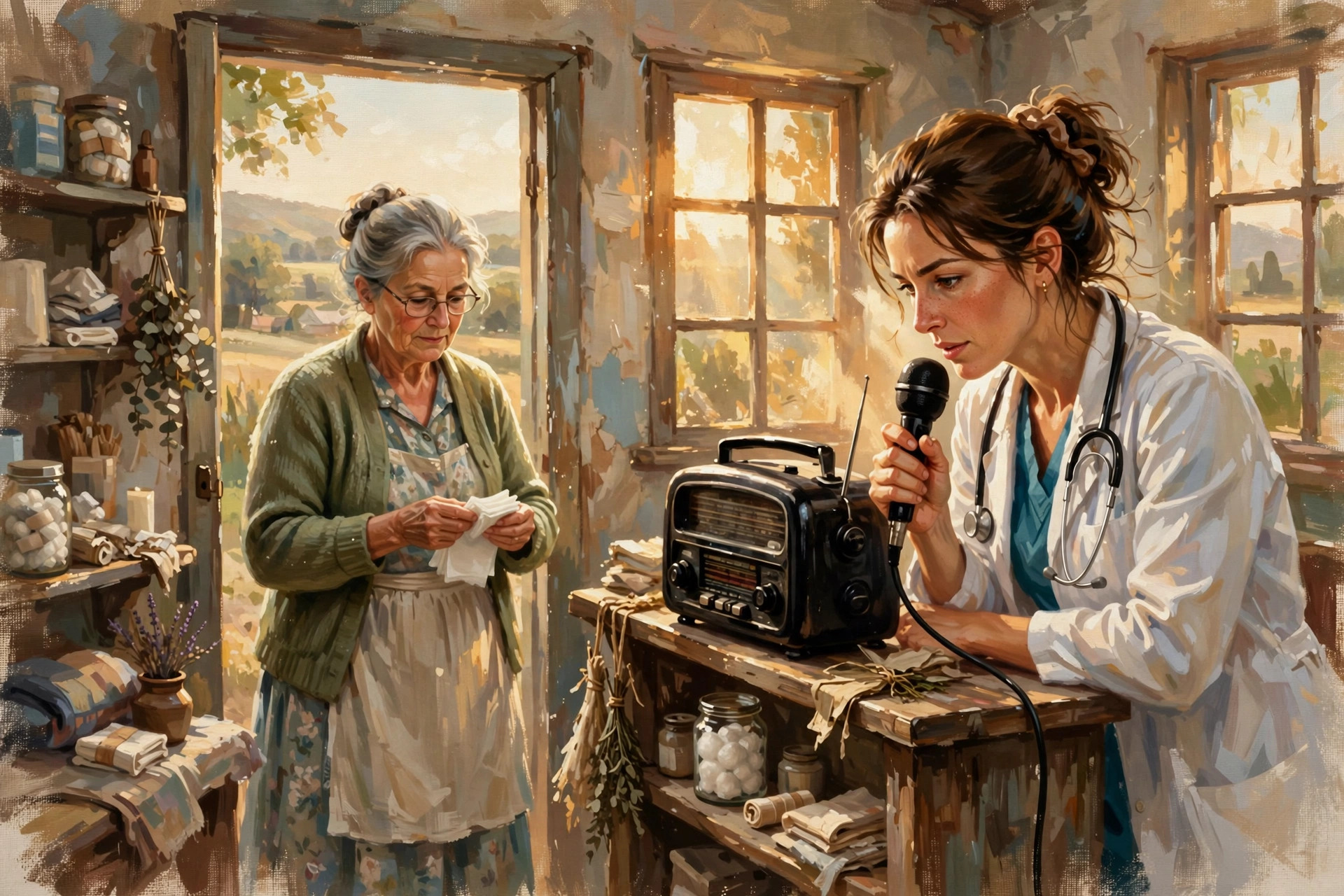
"Tolliver Gap Clinic to county dispatch. I have a man in his sixties, chest pain, sweating, pressure down. I need an ambulance now." Simone Ferrante let go of the key and stared at the black radio on the shelf like it owed her money.
Nothing came back. Only a soft hiss, and then a click somewhere far up the line.
"It does that," her mother said from the doorway. June Ferrante had come in to drop off a casserole for the staff fridge and stayed to fold gauze, because nobody in Tolliver Gap ever just dropped anything off. "It goes up the ridge first. Then it thinks about it."
"Thinks about it."
"Abel says it's the old machine. It holds the call, then sends it on."
Simone checked the clock above the exam room door. The second hand crawled. Behind her, the farmer on the table breathed in short pulls, his big hands flat on the paper sheet, and his wife held his boot like it might keep him anchored. Simone had already given him aspirin. She'd already started the line. She'd done everything a clinic with one doctor and one radio could do, and now there was only waiting.
She hated waiting more than she hated anything.
The speaker crackled at last. "County copies, Tolliver Gap. Unit rolling."
Forty seconds. She'd counted every one of them.
The ambulance took the man down the valley a long while later, lights washing red across Front Street. Simone stood on the clinic steps with her stethoscope still around her neck and her jaw so tight it ached. He'd make it. Probably. That wasn't the point.
"Where's the shop?" she asked.
June didn't pretend not to know which one. "Two blocks down. Simone, honey, he's not going anywhere. You could have lunch first."
"I'm not hungry."
"You were never hungry when you were mad. Your father was the same way." June untied her apron. "I'll walk with you."
"You don't have to."
"I know I don't."
Kincaid Hardware & Radio still had the same green awning, faded now to the color of old mint. The bell over the door gave the same tinny double ring. Simone had told herself for most of a decade that she'd stopped remembering that sound. Her body disagreed.
The shop smelled of oil and cut keys. Bins of nails ran along one wall, radios and scanners crowded the other, and at the back counter a man bent over an open chassis with a soldering iron, his reading glasses pushed into dark hair that needed cutting.
He looked up. The iron stopped.
"Simone."
"Abel." She kept walking until the counter was between them, which seemed wise. "Your repeater nearly killed a man this morning."
He set the iron in its stand, carefully, the way he'd always set things down. Broader through the shoulders than she remembered. A thin white scar across one knuckle that was new. "The Hollister call? I heard it come through."
"Then you heard it come through forty seconds late."
"I know how late it is."
"Do you? Because a heart doesn't care how fond you are of your capitals wiring."
June, by the paint chips, made a small sound that might have been a cough.
Abel took his glasses off and folded them. "It's not about fond. It's the only thing on that ridge that reaches both sides of the valley. The county's been promising a new tower since before you left." He paused on the word, so briefly she almost missed it. "I keep it running. That's what I can do."
"Running isn't the same as working."
"No," he said quietly. "It isn't."
That took some of the wind out of her, and she resented it. She'd come in ready for him to be defensive, ready to win. Instead he looked tired, and honest, and a little like the boy who used to fix her bike chain on the curb out front without being asked.
"So fix it," she said.
"The lag's in the store-and-forward. It holds every call on tape before it passes it on. Lew built it that way in 1979 so nothing got lost when the line was busy. It's slowing down. Belts, heads, something in the bank. I haven't found it yet."
"Then I'll find it."
His mouth moved, not quite a smile. "You're going to climb into a steel cabinet on Tolliver Ridge and troubleshoot tape heads."
"I've put my hands inside worse."
"I believe that."
He reached under the counter and came up with a handheld radio, scuffed yellow, its rubber antenna bent at the tip. He turned a knob, listened to the squelch, and slid it across to her.
"What's this?"
"Spare. It's programmed to talk straight to dispatch on simplex if you're close enough to the county road. It won't reach from the clinic, but if you're out on a house call by the highway, it skips the ridge. No wait." He tapped the side. "Battery's new. Charger's in the box."
She picked it up. It was heavier than it looked, warm from sitting near his work lamp. She didn't want to be grateful. She was anyway.
"Thank you," she said, and it came out stiffer than she meant.
He nodded, and that was when she saw the ring.
Not on him. On the counter beside the chassis, on a folded square of velvet, a small gold band with a single pale stone, a jeweler's tag still looped through it. A woman's ring. Too small to be anything else.
Abel followed her eyes. He didn't hide it. He didn't move to pick it up either.
"Nora's," he said. "Stone came loose. I told her I'd reset the prongs."
"Nora Bayliss?"
"We're getting married." He said it plainly, like reading out a part number. "Three weeks from Saturday."
"Oh." Simone set the handheld down and picked it back up again. "Congratulations. She was always nice. She used to give me free cough drops."
"She still does that."
"Good. That's good."
June had found something deeply interesting about a can of wood stain.
The silence stretched long enough to feel like the radio's. Simone made herself breathe through it. Nine years was a long time. He had every right. She'd left. He hadn't come. That was the whole story, and she'd made her peace with it on a bus somewhere past the state line.
"The tower's on Walt's land, isn't it?" she said.
"Bayliss Ranch. The shed sits on the high pasture."
"Take me up there."
"Simone--"
"I'm not asking you to like it. I'm asking you to show me. I've got a clinic full of people who drive an hour for a blood pressure check, and every one of them is trusting that box when it matters. I need to see it with my own eyes."
He looked at her for a long moment. Then at the ring. Then back.
"Wednesday," he said. "Early. Wear boots. The road washes out past the cattle guard."
"I'll be ready."
"You always were," he said, and went back to his soldering before she could decide what he meant by it.
Tin Shed
"You said boots," Simone said, "not waders."
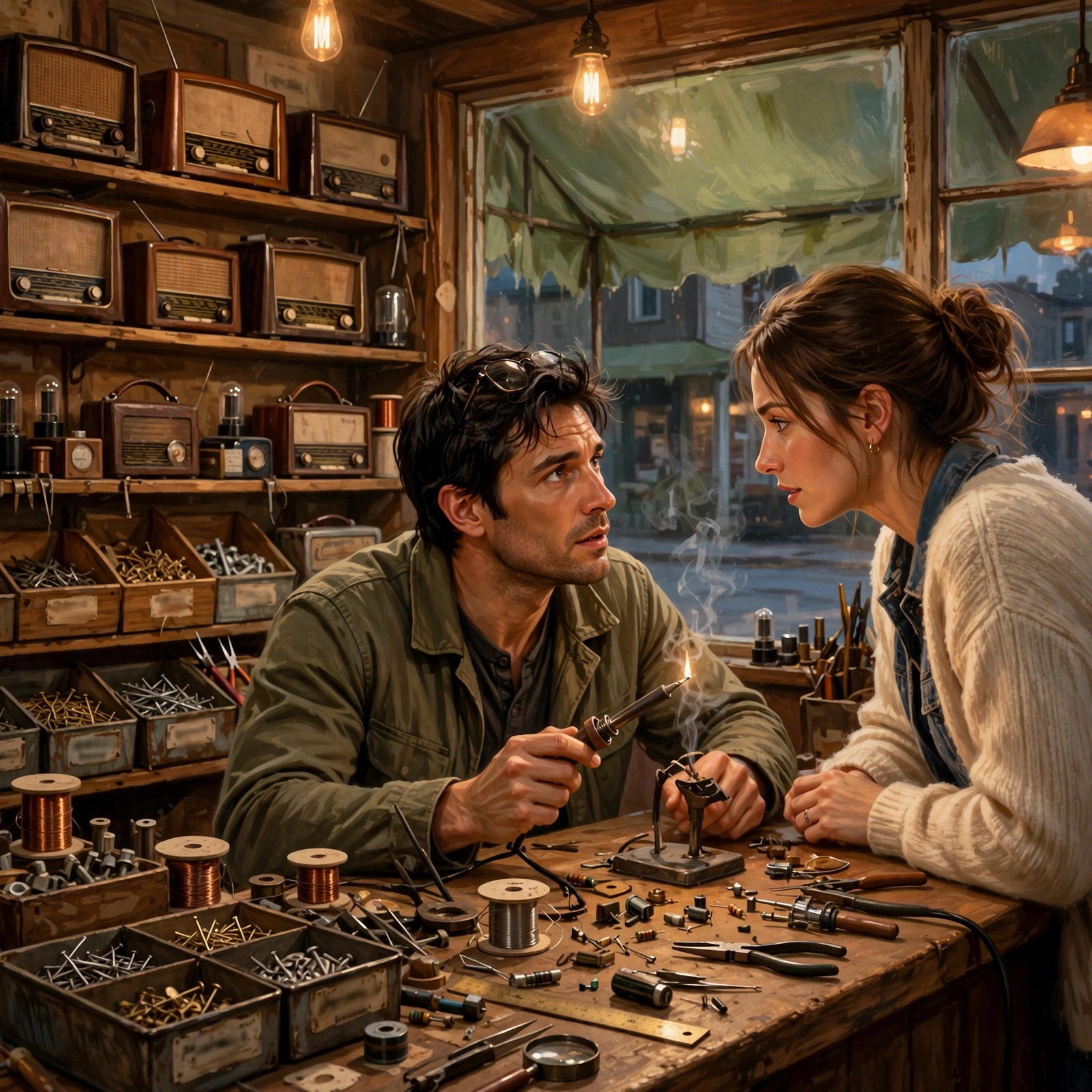
Abel didn't look back. He was already past the cattle guard, picking a line through the washout where the ruts had turned to brown soup. "I said the road washes out. That's the road washing out."
"You could've said it's a creek now."
"Then you'd have worn waders, and they'd have filled up at the second crossing, and I'd be carrying you." He held out a hand at the edge of a slick rock without turning around. "Step there."
She ignored the hand and stepped there anyway. Her heel slid. He caught her elbow before she went down, let go the second she was upright, and kept walking as though nothing had happened.
The high pasture opened above them, all frost-burned grass and a sky so wide it made her ears ring. Walt's cattle lifted their heads and lost interest. At the crest stood the tower, a lattice of galvanized steel with an antenna whip on top, and at its foot, a tin shed no bigger than a garden closet, its roof patched in three colors of sheet metal.
"That's it?" She couldn't keep it out of her voice. "That's the whole emergency system for the valley?"
"That's my capitals whole emergency system." Abel worked a key off the ring at his belt. "The county's never paid for a better one."
The padlock was stiff with cold. He breathed on it, swore under his breath, and it gave. The door groaned on its hinges.
Inside, it smelled like hot dust and old oil. A single bulb hung from a cord. Against the back wall stood a steel cabinet, chest-high, painted the dull green of old army surplus, with a row of brass terminals along the top edge gone dark with age. A hand-lettered card was taped to the side. L. KINCAID 1979. DON'T KICK IT.
Simone touched the card. "Did people kick it?"
"He did. When it stuck." Abel knelt and unlatched the front panel. "Store and forward. A call comes in, it records to tape, checks the line downstream, plays it back out to the county. Made sense when the ridge ate half the signal. Now it's the reason you wait."
"Forty seconds."
"Forty seconds." He swung the panel open. "I timed it the week I took it over. Never got it any shorter."
She crouched beside him. The guts of the machine were a thicket of colored wire, every joint hand-soldered, the tape transport mounted on the left with two reels turning slowly in their idle loop. It was beautiful in the way old surgical tools were beautiful, made by somebody who expected them to be used hard.
"Show me where it hangs."
He pointed with a screwdriver. "Here, the relay checks for a clear line. Here, the tape cues. The capstan's worn, so it hunts for the start of the message. That's most of your lag."
"Can you replace the capstan?"
"Nobody makes it."
"Can you make one?"
He gave her a sideways look. "You haven't changed."
"I'm a doctor. I don't accept 'nobody makes it.'"
He snorted, but he was reaching deeper into the cabinet, past the transport, to a narrow shelf near the floor. "There's an overflow bank. If the downstream line drops mid-call, the message gets shunted here so it doesn't get erased. In theory the machine plays it out when the line comes back." He drew out a reel, aluminum spool dulled with grime, tape wound tight. "In practice, sometimes it forgets."
"How long has that been in there?"
He turned it over. A strip of masking tape on the hub, his own handwriting, faded. Outage, spring 2015. Check.
Something in his face went still.
"Spring," he said. "That was the ice storm. Line was down four days. I pulled the bank, meant to go through it." He rubbed his thumb along the edge of the spool. "My mother's house sold that week. I forgot."
Simone's knees had started to ache from crouching. She didn't move. Spring of 2015. The bus station in the county seat, the bench by the vending machine, the duffel at her feet with everything she owned in it. The clock over the ticket window. Watching the door until the driver called final boarding.
"Play it," she said.
"It's probably nothing. Somebody's cow got out."
"Abel. Play it."
He looked at her then, really looked, and whatever he saw made him stop arguing. He swapped the reels with careful hands, threading the tape through the guides and past the head the way other men tied their shoes, without thinking. He wound the slack. He flipped a toggle. The speaker grille hissed.
A man's voice first, asking for a tow truck on the county road. A beep. A woman reporting a downed line by the school. A beep.
Then a voice that made Simone put her hand flat on the cold floor.
"Abel, it's me. It's Simone. I know you're at the shop, I know you'll hear this before anybody else does, because you always hear everything first." A laugh, thin and breathless. Twenty-five and terrified. "I got the letter. I got in. The bus leaves at six tomorrow from the county seat, and I'm not asking you to say anything back. I'm just... come with me. Meet the bus. If you're there, you're there. If you're not, I'll understand. I love you. Okay. That's it. Six o'clock."
A beep. Somebody asking about a lost dog.
Abel reached out and stopped the reel. The shed was so quiet she could hear the cattle tearing grass outside.
She waited for him to say something. He didn't. He sat back on his heels with his hands on his thighs and stared at the tape as if it might rewind itself and say something else.
"I sat there until they called final boarding," she said. Her voice came out level, the way it did when she gave bad news. "I thought you'd decided."
"I thought you left without telling me." His jaw worked. "You were just gone. Your mom said you'd gone to school. I figured..." He stopped. "I figured that was what people did."
She knew what he meant. Everybody in Tolliver Gap knew about his mother.
"I called," she said. "I called once, on that. I didn't call again because I was too proud, and then it was a year, and then it was too late to be anything but stupid."
"It wasn't stupid."
"Nine years, Abel."
He stood abruptly, and she thought he might walk out into the pasture, but he only turned to the cabinet. He pressed his palm against the steel side, over his capitals card, and held it there.
"This thing kept it," he said quietly. "Every word. And I'm the one who didn't listen."
She wanted to touch his back. She kept her hands where they were. There was a ring in his shop on a square of velvet, and a wedding three weeks from Saturday, and she had not climbed a washed-out road to make his life harder.
"It's not just us," she said instead, getting to her feet. "If it held my message, it's holding others. People calling for help who never got through."
"Not since I fixed the overflow. That was the last bad bank."
"You're sure?"
He was quiet. "No."
"Then I need to know what this machine does when it fails. Not in theory. On a bench, where you can test it."
He looked at the cabinet a long moment. Then he took a socket wrench from the toolbox by the door, knelt, and set it on the first of the floor bolts. Rust flaked under the turn.
"Truck's at the cattle guard," he said, not looking up. "You get the door."
The bolt came free in his hand, and he started on the next.
Workbench Light
"You're holding it wrong," Abel said, without looking up from the cabinet.
Simone lifted the magnifier lamp an inch higher. "I'm holding it exactly where you told me."
"Then I told you wrong." He reached over and tilted the arm toward the brass terminals, his knuckles brushing her wrist. "There. Now I can see what Granddad was thinking."
The repeater sat open on the workbench at the back of Kincaid Hardware & Radio, its steel door swung wide on a hinge that complained every time anyone breathed near it. Behind them the shop was dark except for the exit sign and a bin of galvanized nails catching the light. Out front, Front Street had gone quiet an hour ago.
She had come straight from the clinic. Her stethoscope was still in her coat pocket, and she kept forgetting and hearing it knock against the bench.
The bell over the front door jangled.
Abel straightened so fast he nearly hit his head on the lamp. Nora Bayliss came down the center aisle with a paper sack in one arm and a cardboard tray of coffee in the other, picking her way past the stacked paint cans like she'd done it a hundred times. She probably had.
"Don't get up," she said, though nobody had sat down. "You left your light on, and I know what that means. You haven't eaten." She set the sack on the corner of the bench, well clear of the open cabinet. "Turkey on rye. I got two, because I figured the doctor hadn't either."
Simone opened her mouth to say she was fine and found she wasn't. "Thank you. Really."
"And these." Nora fished a small white bag from her coat. "Flux, the no-clean kind you like, and the thin solder. The supply house dropped them at the drugstore by mistake again." She smiled at Abel. "They think we're married already."
"Close enough for the supply house," Abel said.
He said it easily. Simone watched his hands. They had gone still on the edge of the cabinet.
Nora leaned in to look at the wiring, curious, careful not to touch. "Is this the thing that's been eating Dad's calls about the heifers?"
"Eating everybody's calls," Simone said. "Mine included."
"Well, if anyone can talk it out of that, it's him." Nora squeezed Abel's arm, one quick press, the way a sister might, and turned for the door. "Don't stay up past two. And don't forget the ring's for Saturday fitting, not Saturday wedding. You've got time."
The bell rang again behind her. Her car started, idled, pulled away.
Simone unwrapped a sandwich she suddenly didn't want. "She's lovely."
"She is." Abel picked up the bag of solder and turned it over twice. "She's the best person I know."
Simone didn't ask anything else. She ate half the sandwich standing up, because that was how she ate everything, and he ate none of his.
The reel sat on the shelf above the bench in a freezer bag, labeled in his square capitals. Neither of them looked at it for long. They'd played it twice since the ridge. Once was enough to know every word, and twice was enough to know they couldn't play it a third time and stay polite.
"Show me the lag," she said.
He keyed a handheld, said, "Test," and set it down. They both watched the old relay. It sat there, thinking, a sealed coil wrapped in cloth tape. She counted without meaning to. At forty seconds a lamp on the panel blinked amber and the speaker across the bench crackled his voice back to them, small and late.
"Forty seconds," Simone said. "My father had about four minutes once the ambulance was called. It took nine to come." She'd never said that part out loud in this town. "Forty seconds is a tenth of a life, some nights."
Abel looked at her, then at the coil. "It's this joint." He tapped a terminal with the tip of a probe. "Cold solder. It's been cracking and healing with every freeze since before I was born. The relay hunts for contact before it'll pass anything through. Granddad's original joint. I never wanted to touch it."
"Why not?"
He shrugged one shoulder. "It was his."
"It's failing."
"I know." He picked up the iron from its stand. The tip glowed a dull bright silver. "I need a third hand. Hold the lead with the hemostat. Don't let it drift."
She took the clamp from the tray. Her fingers knew it better than his tools; she'd held a thousand vessels steady in a thousand worse lights. She set the jaws on the copper lead and locked them.
"Huh," Abel said.
"What?"
"Nothing. You're steadier than I am."
"I've had practice not shaking."
He bent close. Their shoulders touched and neither moved. He wicked the old solder away with a braid of copper, and the smell of rosin rose between them, sharp and pine-sweet. She watched him lay a bead of new solder down, bright and clean, flowing into the joint like it had always meant to be there.
"Let go slow," he murmured.
She opened the clamp. The lead stayed.
He keyed the handheld. "Test."
This time she didn't count. The amber lamp blinked almost before he'd lifted his thumb, and his voice came back across the bench, nearly on top of itself.
Simone laughed. It came out of her before she could stop it, a short, startled sound. "Abel."
"Don't get excited. That's one joint. There's a whole cabinet of them, and the tape bank's still--"
"Abel, it worked."
He turned his head. He was so close she could see the scar through his left eyebrow, the one from the fence wire the summer they were seventeen. His face did something she remembered and had spent years telling herself she'd invented.
"Yeah," he said. "It did."
The open cabinet sat between them, its door pressed against her hip. She could have stepped back. She didn't. He didn't either. He leaned in across the brass and the new bright joint, and she met him halfway, and he kissed her once, slow and certain, the way he'd done everything worth doing when they were young.
It lasted long enough to be real.
When it ended, neither of them spoke. The shop hummed around them, the lamp, the cooling relay, the furnace kicking on somewhere in the dark.
His eyes went past her shoulder to the velvet square on the shelf by the register, where the ring sat with its loose stone, waiting.
Abel set the iron down in its stand and stepped back.
I Gave My Word
"You came in the back," Simone said.

Abel stood in the clinic's supply room doorway with his cap in both hands, the way men stood at funerals. Two days had passed since the shop. Two days of him not calling, and her not calling either, because she'd decided long ago she would never again be the one sitting by a phone.
"Didn't want to walk through your waiting room."
"There's nobody in it. It's lunch."
"Still." He turned the cap a quarter turn. "Can we talk in here?"
She set down the box of gauze she'd been shelving. The room was narrow, steel racks on both sides, and when she faced him there was barely a yard of linoleum between them. She remembered his shoulder against hers over the hot iron. She folded her arms.
"Go ahead."
"I gave Nora my word." He said it to the floor first, then made himself lift his eyes. "In March. I asked her, and she said yes, and I gave her my word. What happened Saturday shouldn't have."
"Shouldn't have, or can't again?"
"Both." His jaw worked. "Can't again, Simone. I'm sorry."
She had told herself in the dark of her mother's spare room that he would say exactly this. Knowing it was coming didn't help. It landed somewhere under her sternum, a clean, specific ache, like pressing on a bruise she'd forgotten she had.
"You love her?"
"I care about her. She's good. She's been good to me for a long time." He paused. "We understand each other."
"That's not what I asked."
"It's the answer I've got." He put the cap back on, then took it off again. "My mother packed a bag one night and was gone by breakfast. Didn't leave a note. I was nine. I swore I'd never be somebody who just..." He stopped. "I keep what I promise. That's the whole of me, if you want to know. That's all I've got that's worth anything."
"That's not all you've got."
"It's the part I trust."
She could hear the clock over the exam room door through the thin wall. She thought of the reel on his shelf, her own young voice trapped on it for nine years, asking him to come. She thought of how long she'd believed he'd simply chosen not to.
"Okay," she said.
"Okay?"
"You've decided. I heard you." She picked the gauze back up because her hands needed somewhere to go. "What about the repeater?"
Relief crossed his face, and she hated that it hurt her more than the rest. Work was safe ground. He would always run there.
"I'll keep at it. The relay joint's holding. I want to pull the tape bank apart this week, see if the transport motor's what's dragging. I'll have it back on the ridge before--" He caught himself.
"Before the wedding."
"Before the cold sets in."
The bell on the front door jangled. Boots crossed the waiting room, heavy and unhurried. Simone stepped past Abel into the hall, close enough to smell rosin still on his jacket, and found Walt Bayliss at the reception window, hat pushed back, a sheaf of feed-store receipts in one fist.
"Doc. Need you to look at this hand." He held up his left. A gash across the meat of the palm had been wrapped in what looked like a shop rag and electrical tape. "Barbed wire. It's nothing."
"It's not nothing. Come on back."
Walt saw Abel then. Something settled in the rancher's face, not hostile, only watchful, a man who'd been sizing up weather his whole life.
"Abel."
"Walt."
"Saw your truck out back. Figured it was radio business."
"It is."
Simone led Walt into exam two and sat him on the paper. She unwound the tape. The cut was deep but clean, and she reached for the irrigation syringe. Abel lingered in the doorway as though leaving would look worse than staying.
"That tower still off my ridge?" Walt asked him.
"Bench-testing the box. Back up soon."
"Good." Walt watched Simone flush the wound and didn't flinch. "Lease comes up for renewal first of the year. Same as always. Dollar and a handshake." He looked at Abel steadily. "Nora's mother signed the first one with your granddad. I'd like to keep doing things the way we've done them. Family way."
It wasn't a threat, quite. It was a man telling another man where the fence line ran.
"Understood," Abel said.
"Knew you would." Walt turned his palm toward the light for Simone. "Stitches?"
"Five or six. Hold still."
Abel was gone before she'd drawn up the lidocaine. She heard the back door shut, then his truck turning over, and she kept her needle exactly where it needed to be.
When Walt had left with a tetanus shot and instructions he wouldn't follow, Simone went to her office and opened the bottom drawer. The application had been sitting there since her second day, the one the health district had mailed her when she'd asked about options. A commercial satellite terminal for the clinic roof. A direct line to county dispatch, no ridge, no tape, no lag, no man who had to drive up a gravel road in a storm to coax it awake.
She had told herself she'd only file it if the repair failed.
The repair hadn't failed. One joint was fixed. The rest was a hope with a soldering iron.
Her father had lain on the kitchen floor, and her mother had stayed on the phone while the minutes stacked up, and the ambulance had come over the pass too late. Simone had been in the next room doing homework. She remembered the way her mother kept saying they're coming, they're coming, like saying it could make it so.
She was done with that kind of waiting. She had been done with it since she was a girl.
She uncapped a pen. The form wanted a justification, and she wrote it plainly: current emergency relay subject to a forty-second delay, dependent on volunteer maintenance and private land access, single point of failure. Every word true. None of it fair.
At the line for a second signature, a local partner or sponsoring agency, she paused. She thought of asking her mother. She thought of asking the district. She left it blank and signed her own name, sharp and complete, and dated it.
The county drop box stood at the corner of Front Street by the feed store, painted municipal green, its slot dented by years of tax payments and jury summonses. The wind had turned cold off the ridge. Across the street the hardware shop window was lit, and through it she could make out the long workbench, and a figure bent over it under the lamp, not looking up.
She held the envelope against the slot a moment.
Then she let it fall, and heard it hit bottom.
Porch Light Night
"Hand me the wrench," Abel called down from the clinic roof. "No, the other one. The one you're holding like you'd rather throw it."
Simone climbed two rungs and passed it up without a word. The frost had come in overnight, silvering the gravel lot and the hoods of the trucks already parked along the fence, and her breath hung white between them. Above her, Lew Kincaid's steel box sat on a fresh-poured pad, brass terminals catching the last of the light.
She hadn't seen Abel in more than a week. Not since the drop box. Then this morning his truck had backed up to the clinic with the repeater strapped in the bed under a moving blanket, and he'd asked for her ladder and nothing else.
"You didn't tell me you were bringing it here."
"Didn't know until Tuesday." He set a bolt, tightened it, tested it with his palm. "Lease isn't mine anymore. Walt's within his rights."
She gripped the ladder rail. "Abel."
"Antenna mast's shorter from down here, but there's no ridge in the way and no tape bank in the middle. Straight to county." He finally looked at her, and his face was tired and oddly light. "Your window, your call."
Below them a car door shut. Nora Bayliss crossed the lot in a green wool coat, a thermos in each hand, and stopped at the foot of the ladder.
"I brought cider," she said. "Simone, could you hold one? He never drinks anything when he's working, and then he complains about his throat."
Simone took the thermos. It was warm through her gloves. Nora's left hand was bare.
Nora caught her looking and didn't hide it. "We talked Sunday," she said quietly. "Really talked, for once. We'd built something sensible. I like sensible. But I watched him at that workbench, the night I brought supper, and he looked like somebody had turned a lamp on inside him. I've never once done that." She smiled, a small rueful thing. "I'd rather have a friend who's happy than a husband who's careful."
"Nora, I didn't--"
"I know you didn't. Neither did he. That's rather the point." She tipped her head toward the road. "I told Daddy myself. He took it about as well as a heifer takes a fence. He'll come around. He's here, isn't he?"
Walt Bayliss was there, leaning on his truck with his arms crossed, watching the roof like it had personally insulted his cattle. The stitched hand was bare and healing clean. Simone noted it before she could stop herself.
Up top, Abel climbed down, wiped his palms on his jeans, and pulled a folded paper from his jacket. The county man in the orange vest who'd come up from the district office stepped forward from the growing knot of people by the clinic steps.
"That's the transfer," Abel told him. "Equipment, mast, the frequency license my grandfather held. All of it goes to the county. Clinic keeps it."
The county man read it under a flashlight, then read it again. "You understand you're giving up any claim to this."
"I understand."
Simone's throat closed. Eleven years of driving that gravel road in the dark. Every storm. Every winter. The box his grandfather had soldered by hand. He'd never let anyone else touch it, and now he was handing it to a stranger on a clipboard.
"Why," she said, too low for the others.
"Because it shouldn't depend on me." He wasn't looking at her now. "Because you were right about that part. One man on a ridge is a bad plan for a town."
The county man cleared his throat. "Dr. Ferrante, there's also your satellite application on file. If this checks out tonight, the district won't fund both."
She'd known that. She'd known it since she saw the truck this morning, and she'd spent the whole afternoon telling herself the satellite line was still the safer thing. No volunteers. No one to wait on.
Her mother came up beside her, wrapped in the old plaid scarf, and slid an arm through hers. June Ferrante said nothing. She only squeezed, the way she used to at the kitchen table, years after, when neither of them could talk about the floor.
Simone looked at the roof. Then at Abel, who'd given away the only thing in this valley that was his.
"I want to withdraw it," she said. "The satellite filing. Pull it."
The county man blinked. "You're sure?"
"No." She drew a breath of cold air. "But I'm asking him to keep it running. With me. If he'll teach me." She turned. "Will you? I can't do the tape side. I can't do half of it."
Abel went very still. Someone near the steps coughed. Nora, beside the ladder, studied her thermos with great interest.
"Yeah," he said. His voice cracked on it. "Yeah, I'll teach you."
The county man made a note, sighed the sigh of someone filing two forms instead of one, and nodded at the clinic door. "Then let's test it. Roll call's in five."
Inside, the clinic radio sat on the front desk where Simone had cursed it on her first morning. Abel keyed the handset and passed it to her mother, because June had read the Porch Light names for the school for most of two decades and everyone said nobody did it better.
"You'll want the stopwatch," Abel told the county man.
Outside, people had lined the road, faces turned toward the valley.
June pressed the key. "Tolliver Gap, first frost. Here are our people."
The county dispatcher's voice came back so fast it overlapped her last word. Simone's hands went to her mouth. The county man stared at his watch and then held it up so Abel could see. Nothing. No gap at all.
June began the names. Families, the ranches, the old ones who'd passed, read in her clear school-office voice, and down in the valley the first porch light blinked off and on. Then the next house. Then the next, a ripple of gold traveling down the dark like a lit fuse, all the way to the bend where Front Street met the creek.
When her mother read the name Ferrante, the clinic's own porch light flickered. Simone hadn't touched the switch. Abel had his hand on it, and he didn't look at her.
Walt Bayliss had come to the doorway. He watched the radio a long moment, then grunted. "Well. It works." He glanced at Abel. "Lease is still gone."
"I know, sir."
"Good." Walt pulled his hat down. "You'll come help me with the calving radios in March anyhow. Nobody else knows the damn things." He went out to his truck. Nora followed him, turning once in the doorway to wink at Simone before the door swung shut.
The last name went out. The last light down the valley blinked. Someone started clapping, then everyone was, then it softened into goodnights and car doors and the crunch of boots on frosted gravel.
The crowd drifted home.
Clinic Roof
Simone came up the ladder with one hand on the rungs and the other pressed flat over her coat pocket, and Abel, crouched by the steel box with a flashlight in his teeth, didn't hear her until her boots hit the roof.
He took the light out of his mouth. "Thought you'd gone home with your mother."
"She's driving herself. She said, and I'm quoting, 'Go on up, I'm not blind.'"
"Ah." He looked down at the brass terminals as if they'd said something interesting. "She's not wrong about much."
"She's wrong about my hair. Every single time."
That got the corner of his mouth. He clicked the flashlight off. Without it, the roof was frost and starlight and the green standby lamp on the housing, and the low hum that came up through the tar paper into her heels. It sounded nothing like it had on the ridge. Up there it had stuttered and caught. Down here it purred, steady and patient, an old dog finally let in by the stove.
"You don't have to babysit it," she said. "The county man said the test was clean."
"He said it was clean for one call." Abel ran his thumb along a seam where he'd sealed the conduit that afternoon. "Frost does things to joints. Grandpa used to sit with it the first cold night every year. Said it was the night it told you what was going to break by spring."
"And what's it telling you?"
He listened. She watched him do it, head tipped, eyes half shut, the same way she'd seen him listen at the shop bench while she held the iron and he talked her through a joint she could've soldered blind. He had a way of going quiet that wasn't empty. It was full of attention.
"It's telling me it's warm," he said finally. "First time in years."
Simone sat down on the low parapet. Below them the valley dropped away in a long dark fold, and down the length of it the porch lights were still on. Nobody had flicked them back off after the roll call. A few houses had gone dark, but most hadn't, gold dots strung along the road all the way to the bend at the creek, as if the whole town had decided to leave the door open a while.
"Do they always leave them burning?"
"Some years." He came and stood a careful arm's length off, hands in his jacket. "Mostly it's the old folks. Tonight it looks like everybody."
"Because it worked."
"Because your mother read it." He paused. "And because it worked."
She found she couldn't look at him for a second, so she looked at the lights. "You gave it away, Abel."
"I gave it where it's needed."
"You gave away your capitals machine. You lost Walt's lease. You stood on that porch and handed a man in a county windbreaker a deed with your name on it, and you didn't even make a face."
"I made a face."
"You did not."
"Inside. I made a real ugly one inside." He rocked on his heels. "Simone. It wasn't doing anybody any good up on that ridge with forty seconds of dead air between a sick kid and an ambulance. You were right about that. You were right the first morning."
"I was rude the first morning."
"Right and rude. It happens."
She laughed, and it came out wobblier than she meant. Then she took her hand off her pocket and drew out the reel.
It wasn't much to look at. A dented aluminum spool the size of a saucer, the brown tape wound tight, a strip of masking tape on the hub, Abel's square capitals still reading Outage, spring 2015. Check.. She'd gone by the shop that afternoon while he was up on the ladder and taken it from the shelf over the workbench, where it had sat since they carried it down from the ridge. She'd meant to ask first. She hadn't asked. Old habits.
Abel went still the way he had on the porch.
"I took it," she said. "This afternoon. I'm sorry, I should've said."
"It's yours."
"No." She held it out across the space between them. "That's the thing. It was never mine. I recorded it and then I got on a bus and didn't wait to hear if anybody answered. I just decided nobody had. I decided that about everything for a long time." Her throat tightened. "My dad waited. In the kitchen, on the floor, with my mom holding his head. He waited and it didn't come in time, and after that I didn't wait on anything. Not people. Not machines. Not you."
"Simone."
"Let me finish, I've been practicing on the ladder." She swallowed. "I'm asking you to take it. Not to play it. Just to have it. Because it was for you, and you never got it, and I'd like one thing in your hands tonight that somebody gave you because they wanted you. Not because you'd fix it."
For a long moment he didn't move. Then he took his hands out of his pockets and closed both of them around the spool, and his fingers covered hers on the cold metal, and he didn't let go.
"You know what I used to do," he said, low. "After you left. I'd go up to the shed and run the playback. Every week, most of a year. Just in case. I told myself it was maintenance." He shook his head. "It was sitting right there. The whole time. Stuck in the bank behind a dead relay I was too proud to call anybody about."
"You didn't know."
"I didn't ask. That's different." His jaw worked. "My mother went out the door one morning and never said a word, and I figured that was what people did. So when you went, I didn't call your school. I didn't drive down. I didn't ask your mother where you were, and she'd have told me. I just kept the lights on and the repeater running and waited for somebody to need me for something." He looked down at the reel. "Turns out I'm a fool who waits, and you're a fool who won't."
"Between us that's one functioning adult."
"Barely." But he was smiling now, the real one, crooked and a little helpless.
The low drone went on behind them. A truck rolled slow down Front Street, its lights sweeping the frosted fields, and somewhere a screen door banged and a dog complained about it.
Simone stood up off the parapet so their hands, still stacked on the spool, were the only thing between them.
"I don't want to be careful anymore," she said. "I've been careful for a long time. So I'm going to say it plain, and you can do what you want with it." Her breath fogged in the cold. "I love you, Abel. I loved you at the bus station when you weren't there, and I love you now when you are."
He made a sound that wasn't a word. Then he set the reel on top of the warm steel housing, very gently, the way he set down anything that mattered, and he turned back and put his hands on either side of her face.
"I love you," he said. "I never quit. I tried. I'm real bad at quitting things."
"I noticed."
"Ask me to stay," he said, and his voice cracked again. "Just once. I'd like to hear it."
"Stay," Simone said. "Please. With me. Not for the machine."
"Okay," he said, like it was the easiest promise he'd ever made, and pulled her in.
She went. She put her face in the cold collar of his jacket and her arms around his back and held on, and he held on harder, one hand spread between her shoulder blades, his chin on the top of her head. Neither of them said anything for a while. They didn't need to. The repeater hummed against her hip through the steel, warm as a hand.
When she finally turned her cheek against his chest, she could see the whole valley past his shoulder, all the way to the creek, and almost none of the porch lights had gone out.
They were still burning below.
Get notified when new stories drop

Ivy Chen
Ivy writes historical and second-chance romance with period texture and modern emotional clarity. Courtship stakes, letters, and choices that cost.
Leave a comment
Comments