


The Snagged Meadow

Faye caught Oren’s wrist before he could turn the crank again. “Stop the roller. You’re pulling the tear wider.”
“I’m trying to persuade them off the fold.” He leaned toward the miniature meadow inside the walnut cabinet. “There’s perfectly good grazing to your left.”
The painted sheep nearest his finger sat down.
“Your livestock can submit a complaint after I’ve secured the linen.”
“They don’t usually behave like this.”
Another woolly shape lowered itself beside the first.
Faye released him and reached for the wooden grip projecting from the lamp housing. “This closes the shutter?”
“Yes, but…”
She turned it. Darkness crossed the tabletop landscape, swallowing the little white backs. The mechanism gave a complaining squeal beneath Oren’s hand.
“No more pressure,” she told him.
He let go of the crank.
The silence that followed had the particular texture of a man discovering that paying a specialist meant occasionally letting her touch his possessions.
“Thank you,” Faye added.
Oren looked from her to the blank opening. “They were almost across.”
“And almost taking your hillside with them.”
She set her tool case on the clear end of the workbench. Behind her, he drew a dusty cover from a stool, then caught himself before shaking it out.
“Outside?”
“Fold the dirty side inward. Away from the painting.”
His mouth tightened, but he obeyed. That improved him considerably.
Faye had prepared for unstable pigments, brittle fabric, and an owner whose estimate of “a little sticking” would bear no resemblance to the damage. She hadn’t prepared for insubordinate farm animals. Even in Dapplewick, where she’d learned not to question every improbable shop window, those seemed worth mentioning before a commission began.
Oren folded another protective cloth over his arm. Beneath it stood a low inspection light.
“May I?” She indicated its adjustable neck.
“Please. The joint slips if you bend it too far.”
She angled the beam across the torn edge. Warm machinery released a scent of oil and hot dust, with something resinous beneath it. Along the lower guide, a loose tongue of painted fabric had doubled back and caught against a projecting fastener.
“Has anyone tried to pull this free?”
“Not with tools.”
Faye looked up.
“I asked the brook to change direction.”
“Did it help?”
“It made the bank muddy.”
She pressed her lips together.
“You can laugh,” he told her. “I’ve already had a disappointing conversation with a tree.”
The laugh escaped before she could tidy it away. Oren’s expression loosened at the sound, and she became inconveniently aware of the pale sawdust caught in his dark hair.
She returned to her case.
“I’ll need access behind the lower guide.”
He drew a key from his waistcoat pocket, unlocked the narrow service panel, and lifted it free. As he turned to set it down, his elbow approached her arranged tools.
“Not there.”
He stopped.
“Against the wall, please. Upright.”
“I was going to put a cloth beneath it.”
“That would be lovely. Against the wall.”
He gave her a look that suggested the building had enjoyed better manners before she arrived, but carried the piece where she’d indicated.
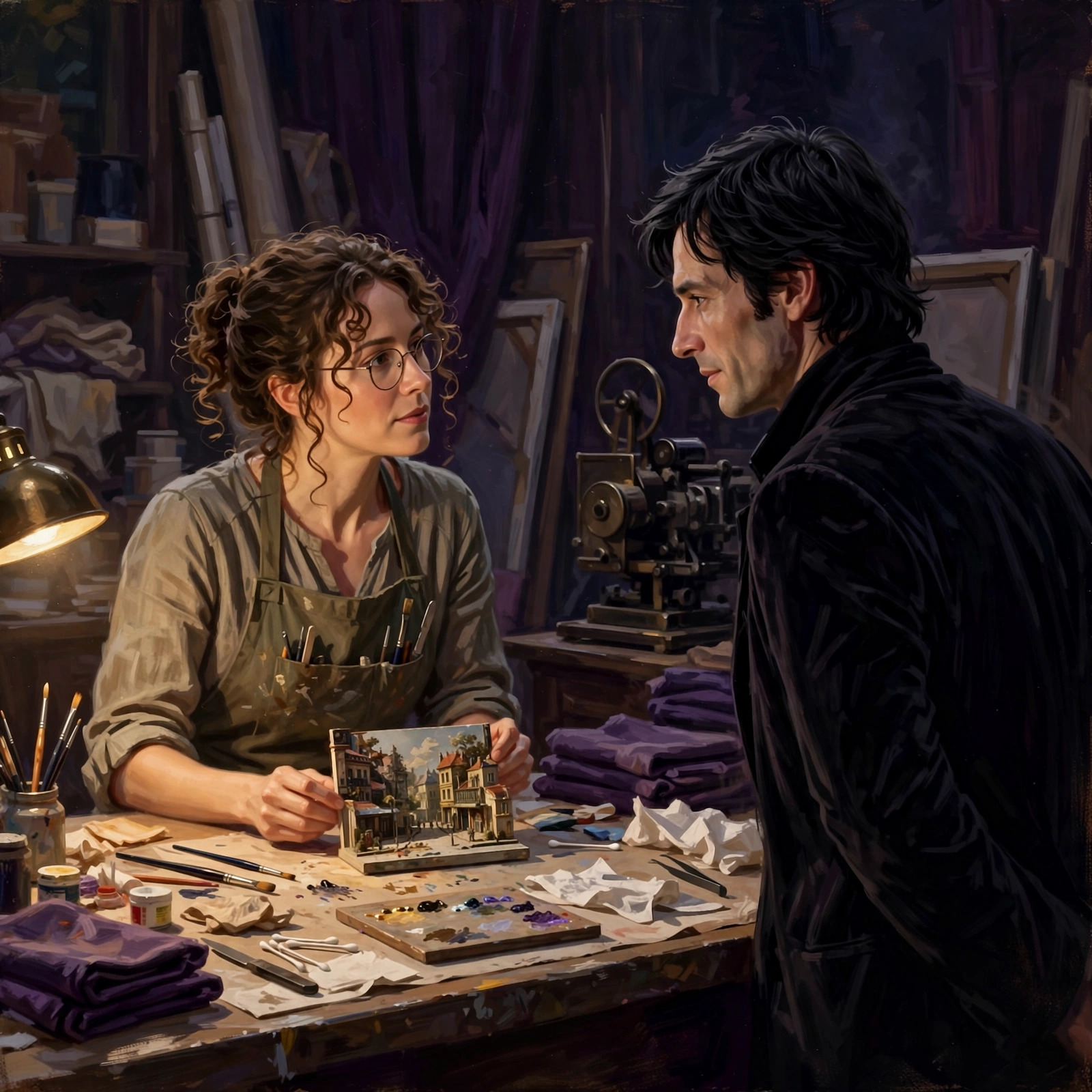
Through a protective grille beneath the housing, she noticed a postcard-sized rectangle of smoked glass in a tin frame. A dense impression marked its surface. She shifted sideways, trying to distinguish the shape from her own reflection.
Oren followed her glance. “That stays where it is.”
“Then I’ll work around it. Does it affect the damaged section?”
“Not while the lamp’s shuttered.”
She laid a clean board under the loose material. Its reverse rasped lightly against her fingertips, rougher where old sizing had worn away. She eased a thin spatula beneath the trapped fold, then stopped when the tension changed.
“I need you here.”
He came close enough that his sleeve brushed hers.
“Hold this support. Flat. Don’t lift when I move.”
“I could ease the spindle backward.”
“Not yet.”
He studied her face, then looked down and settled his fingers along the board’s clean edge.
She’d expected another argument. Its absence unsettled her more than the first had.
Faye slipped the tool farther beneath the snag. A frayed thread clung to the fastener. Rather than tug, she took fine tweezers from her case and lifted it clear.
“Now back a little. Slowly.”
Oren moved exactly as instructed.
The caught edge relaxed. She guided it out, supporting the paint layer so it didn’t buckle. Nothing flaked away. Nothing tore.
Beside her, his shoulders dropped.
“There you are,” he murmured.
Whether he meant the meadow or her, she couldn’t tell. She preferred the former. It was easier to invoice.
She secured the loose section between smooth temporary supports, using padded clips beyond the painted area. Then she examined the offending metal.
“This needs attending to before anything travels past it again. I’ll document the tear before I begin the repair.”
“Could we test it now that it’s free?”
“No.”
His jaw shifted.
She began putting the tweezers away. “If you need someone who’ll approve running damaged scenery, I can charge for the assessment and leave.”
The offer came out briskly, polished by use. Her case remained open beneath her hand.
Oren set down the support she no longer needed.
“I asked because the ticket receipts pay for this place. And for your work. I’m allowed to hope the answer’s yes.”
“You are.”
“You’re allowed to say it isn’t.” He glanced at her half-packed instruments. “Must that involve going?”
She left the case open.
Her former spouse had treated an available hour as something already belonging to him. These days, Faye could reach for departure before anyone had actually barred an exit. Here, Oren had stepped back. The passage to the doorway was clear.
“No,” she answered. “It needn’t.”
He rubbed a dusty thumb against his trousers. “Then I’ll try asking less optimistically.”
She took out her notebook instead.
“The agreed conservation fee covers examination and treatment. It doesn’t cover persuading your flock.”
“Naturally. They’d demand references.”
“And I need uninterrupted access while I’m working. If a repair needs time to settle, it gets that time.”
“Understood. Your payment doesn’t depend on filling the seats.”
Faye wrote down the fastener’s position. He waited without leaning over to inspect her notes.
“May I check on them?” he asked.
She considered the supported edge. “Light only. Nothing moves through the guide.”
Oren opened the shutter a fraction.
Brightness returned to the visible strip. The stubborn creatures remained planted in the grass, though the nearest now faced away from them both.
“Excellent,” Faye told it. “A professional grudge.”
Oren’s laugh was quiet and surprised. He closed the brass fitting again, then placed the cabinet access key beside her notebook.
“Keep that while you’re working.”
He moved to the far end of the bench and began folding the remaining covers, leaving her access clear.
Faye slipped the small piece of metal into her apron pocket. “You can stay. I could use someone who follows instructions.”
“An uncommon qualification here.”
She drew the inspection light closer and made room beside her for his stool.
The Glass Recess
Faye lifted the last padded clip from the repaired linen edge and caught Oren moving his stool closer with his foot.
“That’s far enough.”
He stopped with the seat angled beneath him. “For me or the furniture?”
“Whichever was about to lean on my drying materials.”
He retreated until his knees cleared the worktable. “I’ve moved entire mountains with less supervision.”
“Painted ones.”
“They’re sensitive about that.”
She hid her smile by checking the narrow supporting patch. Its bond had settled properly, and the mended section lay flat. Beneath it, the fastener Oren had reset no longer projected into the linen’s path. She passed a scrap of fine cotton over the metal. Nothing caught.
“Now you may be cautiously impressive.”
He stood, but didn’t reach for the crank. “With the lamp?”
“Briefly. Stop when I ask.”
“Gladly. There’s something you ought to know before we test any further.”
Faye set her inspection mirror down. She disliked important information arriving after permission, even information delivered by a man who had spent the afternoon fetching exactly what she requested.
Oren noticed where her fingers had stopped.
“Nothing will happen merely because we light it.” He indicated the clear wall opposite the cabinet. “Keep outside the projected landscape. I’ll do the same.”
“Explain first.”
He took his place beside the housing rather than between her and the door.
“The scenery can become somewhere I enter. Not an illusion I stand behind. Somewhere with weather, ground beneath my feet, all of it.”
“And your customers?”
“Watch. They can walk through the light, but it stays light for them. It admits only two people: its shadow-born custodian and the counterpart whose shadow answers his.”
She glanced at the pale rectangle awaiting illumination. “Answers how?”
“They reach toward each other without either person moving. There’s no mistaking it, according to the instructions I inherited.”
“You haven’t seen that yourself?”
“No.”
Something in his quiet answer made her put down the cotton rather than continue folding it.
“If those shadows overlap in the enchanted projection for one uninterrupted minute, it establishes a permanent emotional connection.”
Her stomach tightened. “Define emotional.”
“Feelings pass between them. Not thoughts. No commands, no power to make someone stay or touch you. It doesn’t create love. It doesn’t give permission for anything.”
“But no private unhappiness afterward.”
“Not entirely private.” His gaze remained on her face. “That part isn’t small.”
Faye picked up her pencil, then laid it down again. “And interruption?”
Oren touched the wooden grip beside the lamp.
“This closes an opaque shutter. Either person can reach it. The light goes, the landscape goes, and anyone inside returns here. Any unfinished joining stops. Switch off the lamp and you get the same result.”
“Show me.”
He opened the shutter. A painted hillside spread over the opposite plaster, enlarged until its little gate stood almost tall enough to use. Grass stirred although the rollers remained still.
Faye stayed beside the bench. Oren turned the grip, and the hillside vanished.
“Your turn.”
She opened it herself, watching the metal move within its slot. Then she closed it sharply. Darkness replaced the gate without a lingering glimmer.
“It doesn’t lock?”
“No.”
The removable shaft shifted slightly beneath her palm. She seated it fully before letting go.
“Keep the approach clear. No stools, covers, or artistically displaced mountains.”
“I’ll warn the mountains.”
She returned to the lower guide and checked its clearance with her mirror. Oren waited until she had withdrawn the instrument before crouching under the cabinet.
Behind the protective grille, under the lamp housing, he released a small catch. From the recess he drew a tin-framed piece of smoked glass, hardly larger than a postcard. A dark impression lay within it, deeper than soot.
“This is the other part you should know.”
Faye rested her tools on their cloth. “May I look?”
He placed it on a clean pad, keeping hold until she had cleared the pencil away.
“My impressed shadow. The source of what I can do here. Burning that impression is the only way to abolish the pairing, or sever the connection if it’s already formed.”
“Burning glass?”
“The darkness on it burns. The frame and glass remain.”
She studied the uneven blackness. “What happens to you?”
“I live. I keep my health, my memories, the ordinary shadow at my heels. But I can never enter painted scenery again, or bring it to life. There’s no making another.”
His thumb rested against the tin rim. She could see where he had folded its corners by hand.
“And if the counterpart simply refuses?”
“Then nothing needs burning. The theater keeps its enchantment. We’d be free to know each other ordinarily, or not at all.”
Faye nodded toward the recess. “Put that away before I drop something expensive on it.”
“Your mirror?”
“My professional composure.”
His smile arrived slowly. He returned the framed impression and secured the grille while she removed the temporary supports.
“Someone I lived with would have liked it,” she said. “Never having to ask whether I was upset.”
Oren stayed crouched, giving her the worktable to herself.
“Would you?”
“I was married to him. Apparently that meant every available part of me already belonged to him. My evenings. My attention. An explanation whenever I went quiet.”
The last support resisted. She eased it sideways rather than pulling against the repair.
“Eventually I stopped explaining. Now I’m very good at finding the door.”
“I noticed.”
She looked up.
He rose, brushing dust from his trousers. “I’m not asking you to forget where it is.”
That deserved more than the brisk acknowledgment she almost gave him.
“Thank you.” She handed him the freed support. “Flat on the shelf, please.”
He placed it carefully beside its mate.
“Someone stayed with me for a while,” he said. “She loved everything I could do with this place. Less so the evenings when I needed to mend a belt and eat something from a saucepan.”
“Eating from the saucepan saves washing up.”
“I thought it showed promise as a shared philosophy.”
Faye laughed, softly enough that he continued.
“After she left, I kept improving the show. If I could make it extraordinary enough, perhaps somebody would remain after the seats emptied.” He adjusted the shelf’s loose cover. “Maintaining all this became easier than asking anyone to stay.”
“A permanent connection would save you asking.”
He looked toward the closed shutter. “I’ve let myself think that.”
She waited.
“It wouldn’t be an answer, though.”
Faye drew the inspection light closer. “No. It wouldn’t.”
He took his place at the crank without touching it.
She checked the cleared passage beside the lamp, then the repaired edge. “A short run. No projection this time.”
Oren began turning. The linen travelled cleanly through the guide, carrying its tiny fence and distant trees without a tremor. Faye watched the mend pass safely beneath her light.
While the landscape continued its smooth advance, she pulled a second chair from against the wall and left it beside her worktable for Oren.
Ordinary Lamplight
Faye slid the brass shaft across her worktable before Oren could set his parcel on it.
“Food at that end. Mechanism at this end.”
He redirected the bundle. “I’d hoped lunch might improve my standing.”
“Not if you grease the shutter handle.”
“A very particular route to your good opinion.”
“There are others. That one’s just closed.”
His smile distracted her enough that she checked the cleared passage through the rollers again, although she had already checked it. The projecting fastener now sat flush. Her treatment of the torn linen needed further inspection, but nothing threatened to catch as the landscape advanced.
Oren held up a cloth darkened with old lubricant. “The socket’s clean. Shall we refit this before testing?”
Faye examined the opaque shutter, secured open for their inspection. “Leave it on the table until we’ve checked the alignment. We’ll use the electrical switch for this pass.”
She touched the switch herself, then moved aside so both could reach it.
“A glimpse,” she added. “No stepping into anything.”
“Agreed.”
He turned the crank while she watched the repair travel. A painted footbridge emerged between willow trees, its tiny railings newly legible where she had removed the dulled surface grime.
“There.” She lifted her inspection mirror. “Stop there.”
Oren stopped. Faye switched off her work light and nodded.
The projection spread across the opposite wall.
It should have shown the same bridge enlarged. Instead, water shifted under the painted timbers, carrying flecks of pale sky. Faye leaned nearer to inspect a wavering mark on the bank. Oren leaned with her.
Their silhouettes crossed the lower edge.
Both dark profiles turned toward each other, though neither person moved. Between them, narrow ribbons of darkness reached across the projected water and joined.
Through the cabinet’s protective grille, the smoked glass turned black.
Faye looked at Oren just as he looked at her.
“It’s us,” she whispered.
His fingers struck the switch.
The bridge vanished. So did the joined silhouettes. Faye’s raised mirror reflected only a faint rectangle from the doorway.
Oren restored her work light, then stepped back from the controls.
“Well short of a minute.” His voice sounded rough. “Nothing’s established.”
Faye lowered the mirror onto its cloth. She missed the cloth’s centre and corrected it with unnecessary precision.
“We both saw that.”
“Yes.”
“You didn’t know.”
“Not until you did.”
She believed him. His surprise had been too naked, his face briefly stripped of the careful hospitality she knew. Now he was looking at her as though any movement might send her down the stairs.
Her bag stood beside the doorway. She could reach it without passing him.
Instead, she picked up the wooden grip.
“Let’s put this back.”
Oren brought the retaining screw. He offered it on his open palm rather than fitting it himself, and she accepted it with the screwdriver.
The shaft slid home. Faye tightened the screw, then worked the shutter through its full travel. Its metal edges met with a clean click.
“Your turn.”
He opened and closed it from his working position.
She repeated the test from hers. The grip sat comfortably within reach of either of them.
Only then did she put down the tool.
“The picture has identified something,” she told him. “It hasn’t decided anything for me.”
“No.”
“I’m saying that because you look rather pleased underneath looking terrified.”
Oren glanced at the darkened apparatus. “That’s embarrassingly accurate.”
She almost smiled. Almost was enough to loosen his shoulders.
“We can leave it untested,” he continued. “Finish the conservation work without projecting it again. I’ll pay you for that work exactly as agreed. You don’t owe the theater an experiment.”
Faye smoothed a corner of the cloth. A brisk acknowledgment would let her retreat into her tools. She could spend the rest of the afternoon discussing linen tension and leave with nothing further exposed.
“If I never accept it,” she asked instead, “you can still do everything you did before?”
“Yes. Refusing the connection doesn’t injure me or silence the scenery.”
“And if I did accept, I could shut my door, but not keep my feelings behind it.”
“You’d still have private thoughts. But an emotion could reach me when you’d rather be alone with it.”
She rubbed a trace of brass dust from her thumb.
“That’s not a small distinction.”
“I know.” He paused. “I know it in words. You’ve had to defend it.”
That answer brought her gaze back to his.
“Would you rather I accepted?”
Oren took longer over this.
“Part of me would. Something permanent sounds reassuring until I remember it wouldn’t make you choose my company.”
“Or enjoy your lunch.”
“The lunch has a better chance. There’s cheese.”
Her laugh escaped before she could tidy it away.
He glanced toward the parcel but stayed where he was. “I could show you the orchard another time. There’s rain that never reaches the ground.”
Faye tilted her head.
Oren pressed his lips together. “I’m doing it again.”
“Offering a better show?”
“Yes.”
“The cheese was doing quite well.”
“Then I’ll stop at cheese.”
She crossed to the ordinary table lamp and adjusted its shade. Warm light reached his cheek, showing a faint smudge near his ear. No landscape opened behind him. Nothing in the cabinet stirred.
“I was looking at your mouth before any of that happened,” she admitted.
His attention returned to her so quickly that she felt heat climb her neck.
“While I was explaining the socket?”
“Don’t let it encourage you. It wasn’t the explanation.”
“I’ll retire that lecture.”
Faye moved closer, leaving enough room between them for either to step away.
“May I kiss you, Oren? Here, with all that switched off?”
“Yes.” His smile softened. “I’d like that very much.”
She set her fingertips against his sleeve. The wool was worn smooth at the elbow. Such an ordinary discovery, and somehow harder to take calmly than moving water on a wall.
He waited while she leaned toward him.
Their first kiss was brief and slightly off-centre because she was still smiling. She drew back far enough to see his face.
“May I?” he asked.
“Yes.”
His palm settled lightly against her cheek. This time she met him without the nervous smile, her fingers curling into his sleeve as his lips moved gently against hers.
She could feel the warmth of him, the small adjustment he made when she stepped nearer. When she eased back, his hand fell away without trying to keep her there.
Faye left her fingers on his arm.
“That wasn’t the scenery.”
“No,” Oren murmured. “It wasn’t.”
They stood together until her stomach made an undignified contribution.
He looked gravely toward the parcel. “Excellent timing.”
“Before lunch. If we try a rehearsal, it’s brief. We agree before starting, and either of us can end it.”
“With the interruption control available to both.”
“Yes. A rehearsal. Nothing beyond that.”
“Agreed.”
She checked that the enchanted lamp remained switched off while he unwrapped bread and cheese on the clean end of the table.
Then Faye pulled her chair against his and sat down to share what he had brought, leaving the projection deliberately dark.
The Empty Socket
Faye turned the wooden grip, watched the shutter close, and opened it again with the projection still dark.
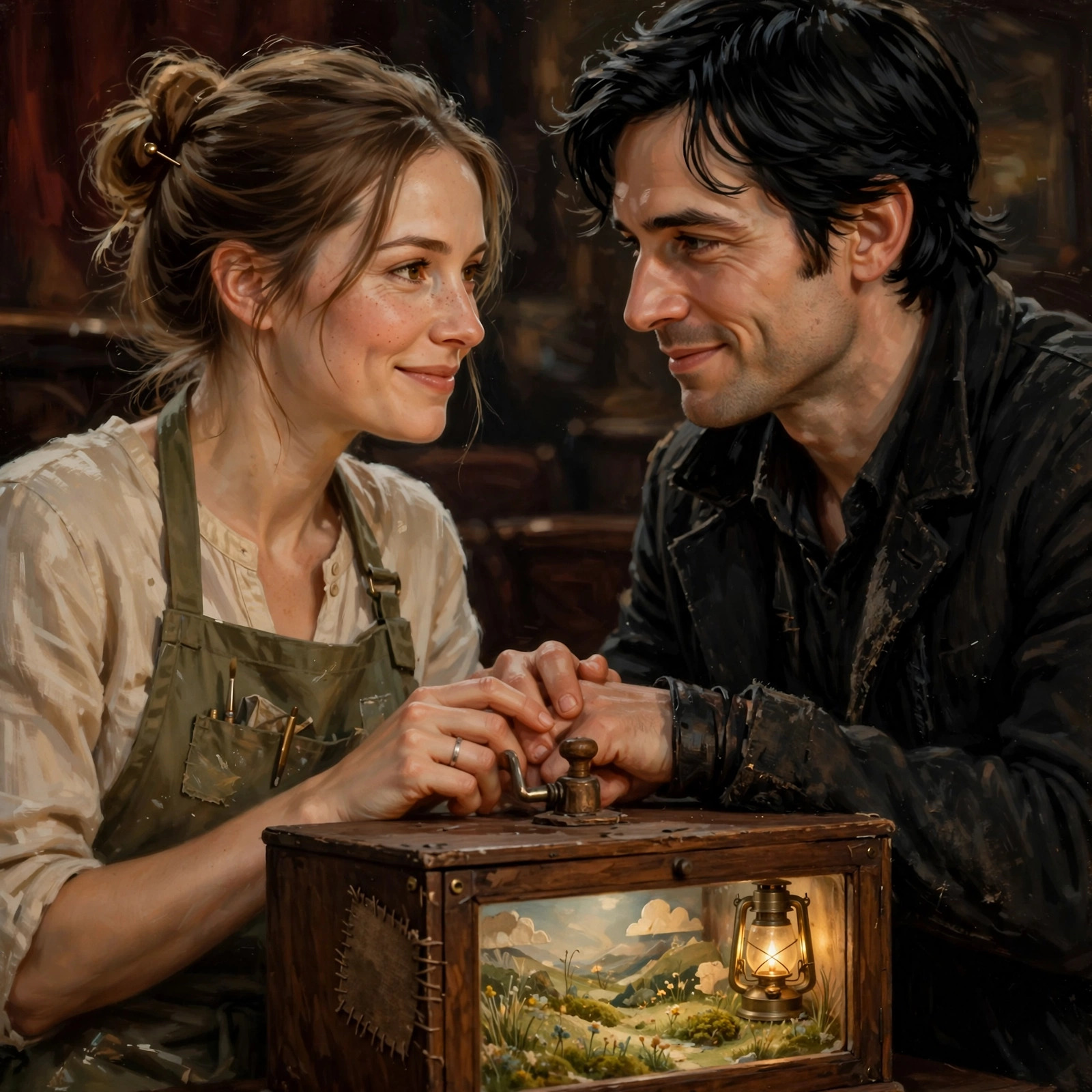
“Testing only,” she told Oren. “Briefly. I’m not agreeing to the connection.”
He stood beside the switch, his sleeves rolled clear of the machinery. “Neither am I. We stop well before a minute.”
“And sooner if either of us says so.”
“Yes.”
She left the control where they could both reach it. Her tools lay on their cloth across the worktable, each cleaned before she had come over. She had almost put them away. Leaving them out had seemed a small admission that she expected to stay afterward.
Oren glanced at her fingers resting on the wooden grip.
“We don’t have to try.”
“I know. I’m choosing to try this much.”
He waited for her nod before pressing the switch.
Light spread across the plaster. The painted orchard acquired distance, its narrow path opening between trees whose leaves shifted without any movement of the linen. A branch extended past the cabinet’s edge. Faye could see the pale undersides of the foliage and, beyond them, rain suspended over distant grass.
She stayed on the projection-room floor.
Beside her, Oren lowered his arm. His shadow stretched toward hers, not quite touching. She watched the gap narrow as the illumination settled.
“I’m still not sure I could live with it,” she murmured. “Even if this feels lovely.”
His sleeve brushed her wrist. There was a small metallic scrape.
She looked down at once.
The socket was empty. Oren’s hand was coming out of his pocket without the removable grip.
“You took it. Switch it off.”
He pressed the switch immediately.
The orchard vanished. Their shadows separated into the ordinary shapes cast by the work light. Nothing of him remained inside her: no borrowed grief, no pleasure she had not felt herself. Only her own pulse struck hard at her throat.
For a moment, neither moved.
Then Oren drew the brass shaft and its ebonized grip from his pocket. He placed it on her worktable, within easy reach.
Faye looked at the object rather than his face. He had made it to fit her palm as comfortably as his. She had tested it herself. She had believed that was enough.
“I switched it off.” His voice sounded scraped thin.
“When I caught you.”
“Yes.”
She stepped away from him. Her hip met the table edge, and she moved sideways until there was clear floor between her and the doorway.
Oren’s fingers curled against his empty palm.
“I was afraid.”
“Don’t start there.” She had to swallow before she could continue. “You took away the thing I was supposed to be able to use.”
“I know.”
“Then start there.”
He looked at the bare socket.
“I removed the shutter handle so you couldn’t interrupt the rehearsal as quickly. I thought if I had longer, you might feel differently.”
The room seemed abruptly shabby around him: a frayed cuff, dusty conduit, the rubbed patch on the floor where he stood to operate the projector. She had been beginning to cherish those things. Now she could scarcely look at them.
“Longer than I agreed to give you.”
“Yes.”
“After I told you I wasn’t sure.”
His chin lowered. “Yes.”
Faye rubbed her thumb across a dried fleck of adhesive on her forefinger. It would not come away.
“Did the machinery make you do it?”
“No. That was me.”
She nodded once, sharply. At least she would not have to argue with an enchanted apparatus about whose fingers had been in whose pocket.
He shifted toward her, then stopped when she straightened.
“I wasn’t going to let it reach the full interval.”
“I couldn’t know that. You’d already changed what we agreed.”
“You’re right.”
She disliked how little relief there was in hearing it.
The glass in its recess had gone smoky again. Through the open access panel she could see the dull tin edging, no longer lit by the impossible depth within it. The permanent connection had not formed. The painted surface remained sound. Nothing had torn except the assumptions she had brought into the room.
Her bag stood beside the doorway. She could put her tools inside, walk out, and refuse to return. Let him find someone else to examine the linen under working tension. Let the invoice sit unfinished. Distance first; arrangements afterward, if ever.
Her fingers had already closed around the bag’s strap before she stopped.
She had left a marriage in which every unanswered summons required an explanation. Since then, she had learned to be gone before an explanation could become permission. The habit had carried her safely through many doorways.
But her work was still here.
Faye set the bag on a chair.
“I’m disconnecting the roller drive.”
Oren stepped away from the cabinet. “All right.”
“So it can’t be run before the handover. The restoration needs its final checks, and I won’t leave it available for another demonstration in the meantime.”
“Do you need me to hold anything?”
“No. Please stay there.”
He stayed.
She unplugged the projection equipment and laid the cord clear. Then she took up her screwdriver. The familiar weight gave her something manageable to attend to.
With the access panel secured open, she eased the drive coupling apart and fixed it clear of the roller shaft. The gearing could no longer carry movement into the painted linen. She checked that the disengaged parts could not slip together, then replaced the cover.
Oren watched without offering instructions.
“I can explain what happened in my head,” he began.
She laid the screwdriver down.
He looked away. “That isn’t something you owe me time for.”
“No.”
Faye folded the protective cloth around her inspection mirror. She slid it into its padded sleeve, followed by the brushes she used for lifting dust from fragile paint. Her hands were not as precise as usual. She slowed down rather than let him see her drop something.
“I’ll come back the day after tomorrow, before you open. For the final inspection and professional handover.”
“I’ll have the paperwork ready.”
“And I’ll bring the invoice. Nothing gets operated before then.”
“Understood.”
She packed the remaining implements, leaving the cabinet key in the zipped compartment she had used throughout the commission. There was still a job to finish. Keeping the appointment did not require her to stand here any longer tonight.
Oren’s gaze followed the closing zip.
“May I write to you?”
She pulled the strap over her shoulder. “About the work.”
His mouth tightened. “About the work.”
He moved aside before she reached the doorway. She could have passed him without turning sideways; she noticed the space anyway.
On her empty worktable, the brass shaft lay at an angle to the grain, its wooden grip pointing toward the place where she had stood.
Faye left it there and carried her tools into the corridor.
Clear Glass
Faye slid the cabinet key into the lock and opened the access panel. Oren moved his chair back, clearing the narrow space beside her without being asked.
“The invoice is on the table,” she told him. “I’ll finish the inspection before you sign.”
“Take whatever time you need.”
She set her bag where it couldn’t touch the lamp cord. The brass shaft and its wooden grip still lay on the worktable. Farther along, the smoked-glass plate rested in the fireproof maintenance tray.
She kept her eyes on the gearing.
With the drive coupling secured clear, she eased the roller through by hand. The repaired linen edge passed cleanly through its guide. Nothing lifted, dragged, or caught. She checked the painted surface with her inspection mirror, then closed its padded sleeve.
“The conservation work is complete. I’ve left the powered drive disconnected. You can turn the scenery manually without disturbing the repair.”
Oren examined the section she indicated. “I accept the work.”
He signed the handover sheet and gave it back. Then he took up the invoice, checked the payment details, and used his phone.
Faye waited for the transfer to appear in her account. The full amount arrived, without deduction or an accompanying message.
“Received. Thank you.”
She marked the invoice paid and put his copy beside him. That portion of her life could be folded neatly into a document wallet. She wished the rest would learn manners.
Oren picked up the removable handle.
“May I refit this now?”
“Yes.”
He seated the brass shaft in the shutter socket and tightened its retaining screw. Then he stepped away so she could test it. The opaque blade traveled fully across the aperture and withdrew again without resistance.
Faye left it closed.
“It works.”
“Yes.” He rested his palms against his thighs. “And that doesn’t make what I did smaller.”
She stayed beside the housing.
“I took away a choice we’d agreed you would have,” he continued. “I removed the handle so you couldn’t stop the rehearsal as quickly. You trusted me to leave it accessible. I’m sorry.”
There was no explanation attached. Faye had prepared herself for one so thoroughly that its absence left her with her fingers still braced against the casing.
“A repaired mechanism can’t restore trust.”
“I know.”
“You switched the lamp off when I noticed. That doesn’t turn it into an accident.”
“It wasn’t an accident.”
He looked at her then, without reaching across the space between them.
“I’ve decided to burn the impression.”
Her gaze went to the dark glass in its tin frame.
“You don’t have to do that for me to be able to refuse the connection.”
“No. You already can.”
“And refusing it doesn’t destroy anything.”
“I understand.” He drew his chair farther from the table. “But I kept treating the possibility as something I could persuade you into. I’m removing it. This isn’t an offer, Faye. You don’t have to return afterward.”
Her mouth had gone dry. “You can’t put it back.”
“No.”
He nodded toward the corridor. “You can leave now. The work’s accepted and paid for. You don’t owe me your company while I do it.”
She put the key on his copy of the invoice. Her bag was packed; the passage behind her was clear. She could carry away her tools and leave this decision entirely in his hands.
“I’ll stay,” she told him. “That’s all I’m agreeing to.”
“All right.”
Oren moved the papers away from the maintenance tray. He checked the clear space around it, switched on the extractor, and put a metal cover within reach. Faye moved her bag to the chair by the doorway.
“May I light the cabinet? With the shutter closed.”
She checked the blade’s position herself. “Yes.”
He plugged in the equipment and switched on the lamp. Through the open access panel, she could see rain sliding over a painted hillside. The linen itself remained stationary.
Oren lifted the framed plate from the tray and released the tin retaining tabs. He laid the frame aside, then returned the smoked glass to the fireproof surface with tongs.
His sleeve brushed the edge of the table. He rolled it higher before lighting the maintenance burner.
Faye’s fingers tightened around her bag strap.
He passed the narrow flame across the impression. For a moment, nothing changed. Then a dark thread rose from the surface, curled toward the extractor, and vanished.
The rain stopped.
Not gradually. A silver streak remained suspended above a painted roof. Along the distant ridge, the mist ceased slipping between the trees.
Oren extinguished the burner. His free hand lifted toward the cabinet, fingers turning in the small, familiar motion Faye had watched him use to coax weather across the hills.
Nothing answered.
He tried again before his hand fell.
Faye looked down at the tray. The impression was gone. Through the clear glass she could see an old scratch in the metal underneath.
Oren stood with his head lowered. His ordinary shadow crossed the floor beside his shoes.
She nearly stepped toward him. Instead, she loosened her grip on the strap and stayed where she was.
“Leave it to cool,” she murmured.
He nodded and set down the tongs.
The extractor hummed between them. After a while, he switched off the lamp.
“What will you sell tickets for?” she asked.
Oren looked toward the linen. “Something smaller than I’ve been promising.”
He opened a folder from the shelf. Inside lay a canceled program sheet and a page crowded with pencil marks.
“The enchanted performances are canceled. I’ve started the refunds. I’ll use the rollers, fixed lighting, and a spoken presentation instead. Not until I can manage the machinery and speak without losing my place.”
“That’s a different skill.”
“Several, apparently.” His mouth moved without quite becoming a smile. “I tried reading aloud while turning this. The mountains arrived halfway through an explanation of the river.”
Faye looked at his penciled notes. “Mark your cues on a separate running sheet. Nothing on the linen.”
“Nothing on the linen,” he agreed.
“And rehearse the transitions before you advertise. Don’t fill the room and hope your hands catch up.”
He drew a line through the tentative opening date.
“I’ll need practice. The tickets will have to be cheaper, and I can’t manage the same number of performances alone. I’ve worked through the expenses. It’ll be lean.”
“I can advise on safe handling. I can’t teach you how to run that program.”
“You shouldn’t have to. I’ll learn.”
She studied the figures beneath his notes. He had included maintenance, refunds, and his own living expenses. There was very little left.
“Don’t underprice it out of embarrassment.”
He rubbed his thumb over a pencil smudge. “I’ll check the figures again.”
Faye lifted her bag onto her shoulder.
“If I eventually have something fit to show,” he asked, “may I send an invitation?”
Her first answer pressed against her teeth, ready to close the exchange before he could ask anything else.
She looked at the cleared passage.
“After some time apart. I’ll consider it. I’m not promising to come.”
“Understood.”
He put the folder aside and faced the cabinet. His fingers hovered briefly over the painted hills, then lowered to the crank.
Oren turned the ordinary roller by hand, and the motionless landscape began to travel with the work of his wrist.
The Shared Crank
Oren turned the crank too quickly, and a painted hillside slid past before he had finished introducing its sheep.
“They’re in a hurry,” Faye observed.
“They’ve heard the presentation before.”
She laughed, surprising herself enough to loosen her hold on the parcel she had brought. Oren smiled but kept working. He eased the scenery onward until the little bridge stood centered in the opening, then paused without letting the linen jerk.
That was better. She could see where he had practiced: the quieter changes of pace, the running sheet propped within sight, the way he waited for the picture instead of racing his voice ahead.
“Beyond the bridge,” he began, “the road turns toward the village, where the inhabitants have wisely declined to be painted outdoors.”
“Sensible people.”
“Very difficult to sell tickets to.”
He brought the passage to a careful stop. The projection room settled around them, warm from the lamp. Its shutter handle remained fitted beside Faye’s elbow, with nothing obstructing her reach.
“That’s as far as I can do without consulting my notes.”
“The bridge arrived where you promised it.”
“A considerable improvement over its recent travels.”
She laid her parcel on the worktable and unfolded the cloth. Inside rested a broad wooden grip, smoothly rounded, with a brass sleeve through its center.
“The fitting we discussed. I checked the measurements you sent.”
Oren left the mechanism still and came closer. “May I?”
She passed it to him. He tested its weight against his palm, then held it where the narrow old knob projected from the crank arm.
“That would spare my wrist.”
“Mine, too. It turns freely on the spindle, so neither of us has to twist with it.”
“You’re sure you’d enjoy helping fit it? You’re not here on a maintenance visit.”
“I brought a spanner to a private performance. I think that answers you.”
“I was trying not to make assumptions about your evening accessories.”
She took the tool from her bag. It felt good to have an answer that was simply funny.
While Oren fetched a washer from the shelf, Faye cleared a place for the removed fitting. The tin-framed glass lay in the maintenance tray, clean and cold. She lifted it by its edges.
“Where shall this live?”
He indicated the storage drawer under her worktable. “There’s a wrapping cloth inside.”
She folded it around the inert plate and put it away. He made no speech about it. When the drawer closed, he was comparing washers, choosing the one that would leave the new sleeve enough freedom to revolve.
Faye held the arm still while he loosened the old fastener. The narrow knob came free and landed in the cloth with a small wooden knock.
“I nearly sent this instead of coming,” she told him.
He stopped with the washer resting on his thumb. “You could have.”
“Yes.” She kept her attention on the exposed spindle. “I had the wrapping ready. Then I realized I was preparing to answer an invitation with hardware.”
“Useful hardware.”
“Oren.”
“Sorry. I’m listening.”
She looked up. His expression had lost its easy amusement, but he had not moved nearer or reached for her.
“I’d like to keep seeing you. I also need to keep my own home. An evening alone can’t become something I have to defend.”
“All right.”
“And if I’m working, I may not answer. That isn’t a test of how hard you’ll try to reach me.”
“Would you prefer that I wait for you to call back?”
“Unless something genuinely needs an answer.” She rubbed a mark from the spanner with her thumb. “My former husband treated being able to reach me as a right. Eventually, every unanswered call needed an explanation.”
Oren set the washer down. “You won’t owe me an account of your afternoon.”
She had expected to need more sentences. Their absence left an unfamiliar space, and she made herself stay in it.
“There’s something I need to do differently, too. When I’m upset, I leave before anyone can turn it into a negotiation. Sometimes leaving is necessary. But sometimes I’m gone before I’ve even told someone what’s wrong.”
“You were right to leave here.”
“I know.” She met his eyes. “Coming back doesn’t change that.”
“No.”
“I can forgive you without pretending I didn’t see you remove that handle.”
His gaze dropped briefly to the lamp housing. “I don’t expect you to forget it.”
“If we disagree, I’ll try to tell you whether I need quiet or whether I’m leaving the conversation altogether. I won’t promise never to walk away.”
“I’m not asking for that promise.”
She slid the brass sleeve onto the spindle. Oren offered the washer, waiting until she had seated the wood before placing it against the end.
“I’ll have to learn not to offer you a better show whenever I’m frightened,” he murmured.
Faye glanced at him.
“Someone stayed once for the scenery. I kept improving it instead of noticing how little we had to say when the lamp was off.” His mouth tightened. “I brought that habit here. You didn’t ask me to.”
“Sometimes I’ll come for supper and have very little to say.”
“We could eat supper.”
“Without a mountain appearing over the potatoes.”
“My potatoes are quite dramatic on their own.”
She smiled, then tested the fastening. Too tight. She backed it off slightly, secured it, and let the new grip spin under her palm.
“Try that.”
He turned the mechanism slowly. The painted road advanced without a shudder. When he stepped aside, she took his place; the broad curve sat comfortably in her smaller grasp.
“Better,” she murmured.
“Much.”
She stopped the rollers. “If you need conservation work later, we agree the work separately. I decide how it can safely be done.”
“And I manage the performances.”
“Yes. I can enjoy them without becoming responsible for them.”
He nodded. “Would you have supper with me here sometime? No tools required.”
“I’d like that. And sometimes at my place, when I invite you.”
“I’d like that, too.”
Faye put the spanner away. There was nothing left to adjust, nothing requiring her professional attention. She stood beside the ordinary panorama and reached for Oren’s hand because she could leave, and because she had chosen not to.
“I love you.”
He looked at their joined palms, then at her face. “I love you.”
She drew him closer. His free hand settled lightly at her waist, and she kissed him, unhurried enough to feel him smile against her mouth. When they parted, he stayed near without tightening his hold.
Faye reached back to the new grip. Oren rested his hand alongside hers, and together they began to turn it. Their hands rested together on the smooth wood while a painted orchard passed slowly across the little stage.
Get notified when new stories drop

Cade Ellison
Cade specializes in romantasy and paranormal romance: magic systems with rules, courts with knives, and longing that rearranges destinies.
Leave a comment
Comments