



Press Cloth and Brass
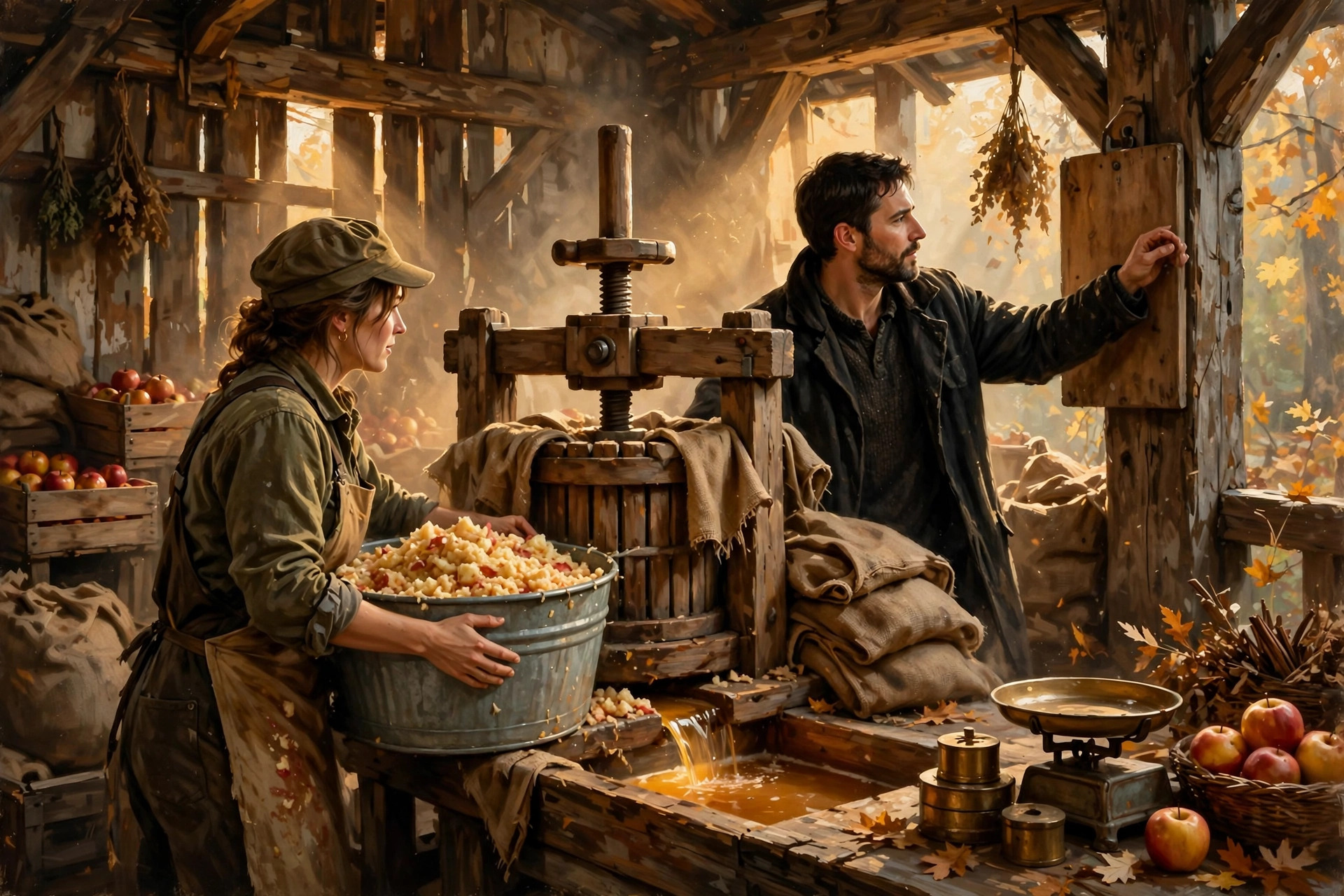
"Take your thumb off that brass hook before I drop forty pounds of apple pulp onto your boots," Laurel Vance warned, bracing the galvanized tub against her hip inside Clover Creek Cider Mill.
Julian Mercer-Kerr did not step back from the timber post. His broad shoulders filled a dark canvas coat that looked far too clean for October press week, and his fingertips stayed resting on the hinged white-oak sign-off board bolted at eye level. "Good morning to you too, Ms. Vance. The Oakhill County Irrigation Trust sent notice that I'd be inspecting the riparian charter records today."
"A notice in the mailbox isn't permission to unhook Co-op property while my grinder's running." Laurel heaved the tub forward, dumping crushed Russet mash onto the open burlap square stretched across her slatted press rack. Tart juice hissed onto the floor drain, thickening the air with the sharp scent of bruised fruit, wet cedar, and birch woodsmoke drifting from the corner stove.
As she swung the empty metal rim back toward the chute, her elbow clipped the edge of the iron platform scale beside the post. A tarnished metal cylinder sitting next to the brass counterweights rolled off the tray and struck the concrete curb with a dull ring.
Julian dropped down on one knee before Laurel could curse. He scooped up the tube, brushing stray mash off its seam.
"Who leaves delicate survey gear on an active fruit scale?" Laurel demanded, tucking a damp strand of hair behind her ear with the clean back of her wrist. "That tray vibrates every time the belt kicks in."
Julian stood, turning the cylinder in long, capable fingers. He twisted the top open, exposing a lining of smooth red cedar fitted with neat cork stops, then ran his thumb over a fresh crescent dent on the brass cap. A muscle ticked near his jaw, though his voice stayed level and measured. "It's a sampling case for my field hydrometer and sediment tubes. I lathed the housing myself three years ago so it could survive gravel bars. Evidently I didn't factor in orchardists swinging steel tubs."
"Leave it on my desk next time and it won't test your lathe work." Laurel folded the four corners of the burlap cloth into a tight packet, smoothing the rough weave until sweet amber liquid wept through the mesh. "Why are you trying to take down the board anyway? You have eyes. Count the clips where it hangs."
Julian set the dented case carefully behind the scale pillar, well clear of her elbows, and unlatched the hinged oak frame where it hung. Four buff cardstock slips hung in a neat row along the top row of fourteen numbered brass clips, each bearing a neighbor's inked signature. "Simon Pringle wants a verified inventory before Friday's preliminary tally. Four farms signed over the weekend. Ten slots remain empty, including number fourteen at the bottom."
"Number fourteen is mine," Laurel said, lowering a fresh slatted rack onto the wrapped pulp cheese. "And it's staying blank."
"Martha Gable told our office the membership was ready to clear its books." Julian pulled a narrow leather notebook from his breast pocket, uncapping a fountain pen with deliberate care. Dark hair curled slightly over his collar, damp from the creek fog outside, and gray eyes studied her across the stacked racks without flinching. "Once all fourteen creek-side farms clip revocable consent cards into this frame, the Trust releases forty-eight thousand dollars to retire your Co-op's equipment loan and lays a sealed concrete bypass pipe along the upper ditch."
"A sealed pipe that locks Clover Creek underground from June through September," Laurel shot back. She reached for the second tub under the grinder chute, muscles burning across her shoulders. "Do you know what happens to shallow-rooted heirloom trees when you cut off natural bank seepage during a dry summer? The taproots bake in hardpan clay while your concrete main shoots every drop straight past us to the valley subdivisions."
"Open dirt channels lose nearly a third of their volume to evaporation and silt," Julian replied, tapping his pen against the notebook margin. "A metered turnout valve guarantees an exact, legally defensible allocation. Nobody gets shorted because an upstream neighbor forgot to pull a flashboard, and nobody drags a friend into county court when a drought hits."
Something tight and personal flashed behind his controlled posture, vanishing before Laurel could name it. She wiped sticky hands on her canvas apron. "We don't sue each other on this road, Mr. Mercer-Kerr. When my parents walked out on a blighted crop and a double mortgage years ago, these neighbors didn't call lawyers. The Co-op paid off the salvage loan on this mill so we wouldn't lose our roof."
"Wait a second before you sprain something proving a point, girl." Boone Vance stepped through the side doorway from the boiler shed, leaning lightly on a smoothed hickory cane as he eased his stiff spine down onto an overturned apple crate near the woodstove. Though his hair had gone silver at the temples, his hands were still massive and scarred from decades of grafting scion wood. He nodded toward the post. "Careful with those mitered corners, son. I planed and joined that white oak right here on the workbench back in 2017."
Julian looked from the dovetailed frame in his hands to the older man by the hearth, genuine respect warming his tone. "You quarter-sawed the stock so the mill steam wouldn't warp the doors. That's fine joinery, Mr. Vance."
"Boone," her uncle corrected easily, stretching his bad leg toward the stove grate. "Anyone wearing muddy lugs in my press room doesn't need formalities. Though Laurel here treats anyone carrying a county clipboard like an auctioneer coming for the copper kettles."
"Boone," Laurel warned, heat rising up her throat beside the scent of warming cedar smoke.
"She thinks if she doesn't press every bushel along this valley for pennies and guard the ditch with a pitchfork, she's stiffing the folks who carried us after I wrecked my back," Boone continued mildly, whittling a curl off a pine kindling stick with his pocketknife. "Never mind that half those growers have knees worse than mine and wouldn't hate retiring that bank note."
"Retiring the note shouldn't mean killing the orchard that pays for our keep," Laurel said, quieter now, though her fingers curled hard into her apron seam. Seven autumns of hauling wet pomace and patching stone diversion sills sat heavy in her bones. If she let an outsider buy out the creek draw with one tidy check, she would be no better than the people who had packed two suitcases in a bad blight year and left Boone under crushing debt.
Julian closed the oak doors gently so the glass pane over the four signed slips didn't rattle, leaving the board hanging securely on its post. When he turned back to Laurel, the stiff bureaucrat had receded an inch, replaced by a man accustomed to reading stubborn terrain. "My father staked thirty years of ranching on neighborly goodwill and an unlined ditch, Ms. Vance. The first three-year dry spell turned handshakes into injunctions that took every acre he owned. Good people turn desperate when water drops below the intake sill. Paper and concrete keep neighbors from ruining each other."
The quiet certainty in his voice caught her off guard. Up close, faint sun lines fanned from the corners of his eyes, and a smudge of her Russet pulp streaked his coat cuff where he had rescued his brass cylinder. He wasn't a soft-handed desk clerk sent by Simon Pringle to bully smallholders; he truly believed his buried pipe was a lifeboat.
That made him twice as dangerous to her trees.
Laurel crossed the wet concrete to the scarred rolltop desk wedged beside the tally chalkboard. Snatching up the heavy cream consent card stamped with slot number fourteen—the one Martha Gable had left beside the ledger yesterday morning—she slid open the center oak drawer, dropped the unsigned card inside, and turned the small brass key until the bolt clicked shut.
She slipped the key onto the twine loop hanging inside her apron bib, right over her collarbone, and faced him across the fragrant steam rising off the press bed.
"Our charter requires all fourteen cards clipped to Boone's board before your Friday session," Laurel said. "You won't get mine behind a desk, and you won't talk ten more growers into signing away our seepage until you've seen what your dry trench actually feeds."
Julian capped his pen and slid it neatly beside his leather book. "I'm a salaried hydrology assessor, Ms. Vance. Field verification is literally my job."
"Good." Laurel picked up her wooden mash paddle and pointed its stained tip toward his far-too-clean boots. "Because before you ask one more neighbor on Clover Creek to clip their name inside that frame, you're walking every muddy acre between here and the upper weir with me."
A faint, unexpected crease dented one corner of Julian's mouth as he glanced down at his dented brass case behind the scale, then back up to meet her stare. "Tell me what time you walk the ditch, Laurel. I'll bring thicker boots."
Silt at the Headgate
Two mornings after his first visit to Clover Creek Cider Mill, Julian Mercer-Kerr stepped over the barbed-wire boundary separating Gable Berry Farm from Upper Orchard Weir, his new lug-soled waders already caked past the ankle in gray creek mud.
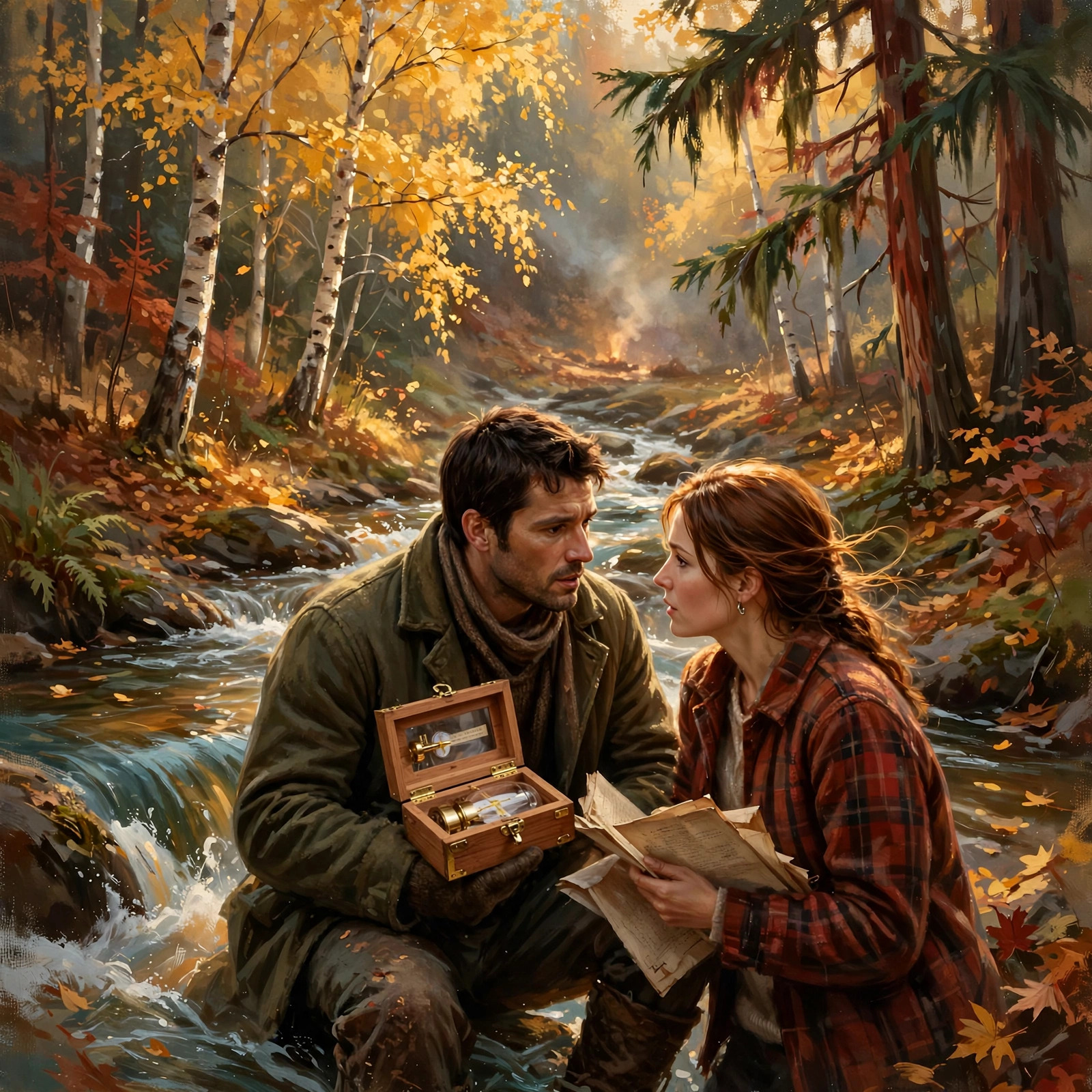
Laurel balanced Boone's hinged white-oak sign-off board against her hip. Dried flecks of early morning apple pomace speckled the oiled grain where she had set it beside the hopper before hauling it up the ridge. Inside the frame, six new cream cards had joined the earlier ones since Monday, gathered from the downstream growers who wanted out before another dry August.
"You told me to bring thicker boots," Julian remarked, pausing beside a frost-reddened tangle of Martha Gable's caneberries to unclip his canvas satchel. "You neglected to mention the briars."
"The ditch path belongs to the blackberries by mid-week if nobody trims it." Laurel shifted the heavy oak frame under her arm, hyperaware of the small brass desk key resting warm against her collarbone beneath her flannel shirt. "Watch your footing by the culvert. The bank undercuts."
Before Julian could answer, the wire gate near the berry shed clanged shut. Martha Gable marched down the mowed headland, a wool cardigan belted tight over her coveralls and a signed cream card held between two gloved fingers. She didn't spare Julian a greeting at first, fixing her sharp dark eyes directly on the pomace-splattered oak frame tucked under Laurel's elbow.
"I figured I'd catch you two up here," Martha said, halting where the berry rows met the alder scrub. "Open the clasp, Laurel. You've got ten signatures in there from the lower road, and mine makes eleven."
Laurel's stomach tightened. Slowly, she unhooked the side latch and swung the hinged oak cover wide on the top cedar rail of the fence. Ten brass clips already bit down on crisp signatures. Only four slots stood empty now.
Martha reached past Laurel's sleeve, pressed down the eleventh brass clip, and slid her card squarely into place. When she let go, the spring snapped shut like a small trap.
"My knees have got maybe one good harvest left in them, honey," Martha said, her voice gentling even as her hand stayed planted on the white-oak rim Boone had planed smooth years ago. "Forty-eight thousand dollars clears the co-op's sprayer note and lets the older places retire clean. When Boone hurt his back and the bank came sniffing around your press house, nobody on this creek hesitated to sign onto that salvage loan for you."
Heat crept up Laurel's neck. Every crate of late apples she pressed past midnight was meant to honor that rescue, yet hearing it tallied out loud beside a Trust man made her chest ache. "I haven't forgotten who kept our roof on, Martha. Not for one day."
"I know you haven't. You've worked yourself thin pressing everybody's windfalls at cost to pay us back in sweat." Martha glanced sideways at Julian, taking in his mud-streaked waders and the tarnished brass cylinder slung from his shoulder strap. "Tell her straight, Mr. Mercer-Kerr. Simon Pringle told the board Tuesday night that if all fourteen cards aren't clipped inside this box before next week's session, the County Trust moves that conservation grant over to the east valley."
"Director Pringle stated the filing window accurately, Mrs. Gable," Julian replied, his tone respectful but clipped. "Under your riparian charter, unanimous assent is required before the Trust can lay a single joint of concrete pipe."
Martha patted Laurel's forearm once, firm and calloused. "Don't break yourself trying to save a ditch the rest of us can't afford to dredge anymore, Laurel. Think about Boone, too." Turning back up the row, she left the wire gate swinging gently on its chain.
Silence settled over the alders, broken only by the choked gurgle of water hitting timber twenty yards upstream. Laurel snapped the oak frame shut with a sharp click and propped it against an elderberry trunk, turning away before Julian could read her face.
"She isn't trying to corner you," Julian said quietly behind her.
"She doesn't have to try. That's how owing decent people works." Laurel strode up the slick clay path to Upper Orchard Weir. "Come look at your intake."
Where the main channel split toward her millrace, a split-log headgate straddled the gravel bar. Autumn runoff from the upper hills had driven a gnarled alder root straight under the wooden sluice blade, jamming it crooked. Frothy brown water backed up behind the obstruction, starving the narrow ditch that curved down through Laurel's gnarled Winesap and Golden Russet rows.
Julian didn't reach for the oak board or bring up Simon Pringle's deadline. Instead, he knelt on the wet cobbles, unfastened his dented brass case, and drew out a slender glass tube seated in red cedar sleeves he had fitted with cork stops. Wading calf-deep into the eddies below the weir, he submerged the tarnished brass sampling barrel into the quiet pool behind the gravel bar, watching sediment swirl against the etched gauge lines.
Laurel folded her arms against the crisp mountain air, watching the muscles in his shoulders shift beneath his canvas coat as he angled the sampler downstream, right where clear cold threads welled up out of the seemingly dry shingle beside her highest tree roots.
He drew a second sample from the seep, held the glass cylinder toward the pale October sun, and frowned. For a full minute he said nothing, comparing the murky channel draw against the crystal-clear water rising six yards inside her orchard margin.
"You don't irrigate those upper rows from the surface ditch at all," Julian murmured, more to himself than to her.
"The ditch only feeds the millwheel settling pond," Laurel told him, stepping down onto the flat capstone above him. "My trees sit on an ancient glacial gravel lens. Water pushes sideways under the cobbles from the live creekbed all summer long. Put this stream inside Simon Pringle's sealed concrete bypass pipe, and that entire subsurface table goes bone dry by July. Forty-eight thousand dollars splits fourteen ways to a couple months of groceries, Julian, and then two hundred heirloom trees die standing up."
Julian corked the cedar-lined brass tube and slid it carefully back into its dented cap. When he looked up at her from the water, the guarded assessor from Monday was gone. He understood soil profiles, and he knew exactly what the clear column in his hand proved.
"Pringle's preliminary survey marked this reach as impermeable clay pan," Julian said slowly, his jaw tightening. "Nobody dug test pits along your root zone."
"Why dig pits when a concrete culvert looks so neat on paper?" Laurel crouched beside the jammed wooden headgate and gripped the iron lifting ring with both hands, bracing her boots against the slick timber. The heavy plank didn't budge; the wedged driftwood root held the oak tongue fast in its iron groove. "Leave it. I'll fetch Boone's crowbar after lunch."
"Step back a foot," Julian said.
Setting his leather field book beside the pomace-stained assent board, he waded straight against the cold thigh-high current pressing on the gate. He stripped off his heavy wool gloves, shoved them into his coat pocket, and hooked bare fingers around the waterlogged alder snag pinned beneath the sluice sill.
"Julian, that water's forty degrees and full of shale," Laurel warned, dropping to one knee on the capstone to take the weight off the upper iron pin while he pulled.
"Lift on three." His shoulder brushed against her knee as he braced one boot against the submerged sill timber. "One, two, three."
Laurel hauled upward on the iron ring while Julian threw his back into the twisted root. Rotting bark sheared loose first; then, with a wet, grinding crack, the driftwood tore free of the gate slot. The sudden release slammed Julian's right hand sideways against the rusted iron guide bolt before he pitched half a step backward, splashing cold spray across both their sleeves.
Water surged cleanly beneath the freed wooden blade, rushing dark and lively down Laurel's millrace ditch. Quickly, Julian caught the heavy gate Plank before it dropped too low, aligned the middle hole, and slid the thick iron pin home so the flow ran steady and clear.
"Your knuckles," Laurel breathed, letting go of the ring as he climbed out onto the gravel.
Three raw red scrapes wept across the back of his right hand where the rusted bolt had caught him. Julian barely glanced at them. Kneeling at the edge of the newly brisk tailwater, he dunked his bruised knuckles directly into the icy current, wincing once as the silt washed away and left clean skin reddened by the chill.
Laurel pulled a clean cotton bandana from her pocket and held it out. When he stood up, dripping, their fingers brushed as she pressed the folded cloth gently over his wet, freezing skin. His hand was wider than hers, rough at the base of the thumb like someone who still knew his way around workshop tools rather than just county spreadsheets. Neither of them stepped back right away. Down the slope, the cleared ditch sang softly over smooth stones, carrying cedar tang and crushed-leaf dampness up between them.
Clearing his throat, Julian wrapped the bandana once around his scraped knuckles, retrieved his leather field book with his left hand, and uncapped his pen.
Laurel braced herself for the usual bureaucratic dodge. Instead, standing right beside her, Julian turned to the official County Trust verification page and wrote in firm, unmistakable block letters across the soil column: *Active alluvial gravel lens feeding mature orchard rootstock; unlined seepage essential to perennial survival.*
She stared down at the black ink drying in the crisp air. "Simon Pringle isn't going to thank you for putting that in an official county log."
Julian closed the cover without blotting the page, meeting her eyes steadily across the narrow capstone while her bandana darkened faintly around his hand. "Simon Pringle pays me to measure where the water actually goes, Laurel, not where he wishes it went." Bending down, he picked up both his dented brass case and Boone's heavy oak assent board so she wouldn't have to carry it back down the hill, leaving Laurel standing by the clear-running headgate with her pulse beating far too fast beneath the brass key at her throat.
Rain on the Weir
Brown storm water boiled against the slotted iron guides at Upper Orchard Weir, spitting foam over Laurel's boots while she wrestled a wet cedar plank toward the spillway notch. "Don't just stand in the mud with your clipboard, Mercer-Kerr! Grab the tail end before the top board shears!" Julian dropped his heavy canvas field bag beneath the low shelter of an alder root and lunged down the slick gravel bank. Rain plastered his dark hair to his temples and darkened the shoulders of his wool coat before he even reached the water.
"Lift on my count," he shouted over the roar of the swollen creek, taking the rough timber in both hands without flinching, though the three healing scabs across his right knuckles split pale at the edges from the strain. "Watch your footing on the moss!"
Three days of restless autumn gusts had broken into a relentless afternoon cloudburst, turning Clover Creek from a clear ribbon into a churning chute of pine needles and torn leaves. If the upper flashboards blew out under the surge, tons of gravel silt would pack Laurel's millrace ditch solid before nightfall, starving the lower rootstock and choking the settling basin. Together they swung the thick plank across the foaming channel. Cold spray lashed Laurel's face, tasting of mud and crushed fern. Julian braced one boot against the concrete wingwall, taking the brunt of the current's shove against his shin as they Guided the squared ends into the iron slots.
The cedar beam jammed halfway down, shuddering violently as brown water hammered its belly.
"Hold the left guide!" Laurel climbed onto the wet capstone, grabbed the iron maul from the grass, and drove two hard blows onto the top edge of the timber. Wood rang dull and heavy under steel. With a groan, the flashboard dropped flush against the lower beam. Instantly the wild surge split cleanly, spilling harmlessly over the raised crest while the millrace intake calmed to a steady, controlled draw.
Chest heaving, Laurel lowered the maul and wiped rain from her eyes with a soaked flannel cuff. Julian climbed out beside her, water streaming from his coat hem, and knelt by the alder root to check the buckle of his canvas bag.
"Still dry?" she asked, nodding toward the square outline beneath the waxed flap.
"Bone dry." He patted the side of the bag where Boone's hinged white-oak board rested inside an oiled wrap, eleven signed grower cards tucked safely behind its brass clips. "Though I can't say the same for my boots. Or your hair."
A wet braid hung loose down her collar, dripping ice water straight down her spine. Now that the frantic push was over, the October wind bit straight through her soaked shirt, setting a sudden, fierce shiver into her shoulders. Julian noticed before she could hide it. Slinging the canvas strap across his chest, he picked up the maul in one hand so she wouldn't have to haul it.
"Come on," he said, pitching his voice below the drum of rain on the orchard leaves. "The creek's holding. Let's get down to the stove before both of us freeze solid."
They hurried down the orchard lane under low, weeping boughs of Winesap and Northern Spy. Inside Clover Creek Cider Mill, the air wrapped around them in a wave of dry cedar smoke and baked apple skin. Boone had banked the cast-iron woodstove with seasoned oak chunks before heading into town for physical therapy, leaving a squat enamel pot of spiced late-pressings simmering at the back corner of the iron plate.
Laurel dropped the latch against the wind, shrugging out of her drenched jacket and hanging it on a peg near the mash tubs. Julian set his canvas bag carefully on a dry pine bench well back from the puddles pooling around their boots, keeping the oak board sealed inside, then unbuckled his wet coat. From its deep inner pocket he drew out his tarnished brass hydrometer case. Rainwater had seeped past its dented cap.
Kneeling on the hearth bricks, he opened the cedar-lined tube, lifted out the delicate glass float, and set the open brass halves beside the stove leg to dry. Firelight caught the faint lathe marks circling the metal.
"You made that yourself, didn't you?" Laurel pulled two thick wool towels from a crate and tossed one across to him. "County issue comes in grey plastic."
Julian caught the towel, rubbing it briefly over his damp hair before draping it around his neck. "Turned it on my dad's shop lathe three winters back. Red cedar scrap from an old gatepost keeps the glass from rattling on bad roads." He glanced at the fresh dent on the brass rim and gave a faint, crooked smile. "Even survives violent encounters with cider scales."
"You crowded my weigh-in table." Still, the heat rising off the stove loosened the tight knot behind her ribs. Reaching into the cupboard, she took down two stoneware mugs, ladled dark, steaming cider from the enamel pot, and carried them over. When she handed him his mug, his fingers closed warm around the ceramic just below hers. Neither of them wore gloves now; the pale scrapes across his knuckles sat half an inch from her thumb.
Julian took a slow sip, eyes closing briefly as cinnamon and sharp heirloom tartness hit the back of his throat. "Lord, that's good. Half the stuff Simon Pringle buys for county meetings tastes like boiled sugar water."
Laurel leaned her hip against the lowest stack of empty cedar press racks, cradling her mug in both palms while steam curled up between them. Rain ticked steadily against the high clerestory windows. "Why work for him, then? You clearly hate concrete ditches almost as much as I do."
Julian looked down into the dark swirl of his mug. For a long moment only the pop of splitting oak inside the firebox filled the room. "Because concrete doesn't change its mind when a dry August hits," he said quietly. "Where I grew up, four valley ranches shared a single mountain ditch on an old handshake pact. Worked fine until a three-year drought shrank the snowpack. One neighbor cut the upper berm at midnight, my father sued on a verbal promise he couldn't prove in court, and the legal fees ate eighty acres before the judge even bangled the gavel." His jaw tightened once, then eased as he met her gaze. "Good intentions rot fast without clean ink and hard margins, Laurel. A signed release keeps neighbors from tearing each other's throats out when the creek drops."
The sharp certainty she usually kept cocked for county men faltered. She stared at the wet hem of her jeans, feeling the familiar ache of old ledger books pressing behind her breastbone.
"Clean ink didn't save Boone," she murmured. "The blight year wiped out half our young trees, and my parents looked at the bank notice, packed two suitcases, and drove south before the frost even set. Left Boone alone here to haul wet pomace sacks on a bad disc until something gave out in his lower spine." Her fingers tightened around the hot stoneware. "Martha and the co-op stepped in and cleared the salvage loan so we wouldn't lose the roof over our heads. If forty-eight thousand dollars gets those older farms out from under their equipment notes, who am I to hold the fourteenth card hostage? Yet if I sign Simon's pipe in, this orchard dies standing up, and everything Boone broke himself to keep turns into dead brush."
"You aren't your parents, Laurel." Julian set his mug down on the corner of the sorting bench and stepped closer, stopping right in front of her beside the tall cedar racks. Rainwater had dried in his dark hair, leaving it soft and slightly unruly at his brow, and the scent of wet wool, woodsmoke, and clean skin drifted off him. "Staying chained to every debt in this valley doesn't prove you won't run. Everyone within five miles already knows you stayed."
She looked up, startled by how clearly he saw the exact trap she lived inside. Gently, he took her mug from her hands and placed it beside his own on the bench. His left palm came up, warm from the stove and rough with tool calluses, cradling the side of her jaw where damp curls clung to her skin.
"Tell me to step back," Julian whispered, his thumb brushing once across her cheekbone, slow enough that she could have turned her head away with half a breath.
Laurel didn't move back. Instead she lifted her hand and curled her fingers into the damp wool lapel of his shirt, drawing him down that last narrow span.
His mouth met hers softly at first, warm with spiced apple and rain-chilled air, testing the quiet between them. A breath broke from her throat, and she tilted her chin up, pressing closer against his chest until her shoulder blades brushed the smooth cedar slats of the press rack behind her. Julian groaned low under his breath, his other arm coming securely around her waist to steady her against him as the kiss deepened, slow and unhurried and devastatingly thorough. All week they had braced against each other like flood timbers; letting go felt like warm water spilling over stone, leaving every nerve awake and unguarded beneath his hands.
When they finally parted, neither of them let go. Julian kept one hand curved around her waist and rested his forehead gently against hers, eyes closed as his uneven breath warmed her damp lips. Below them on the hearth, the open brass hydrometer tube gleamed dry in the orange stove light, while five paces away inside his canvas bag lay eleven signed cards waiting on three more, a hard county deadline neither of them had erased by crossing the floor.
The Fourteenth Card
Simon Pringle tapped a silver pen twice against the open wing of Boone's white-oak board, right beside thirteen signed grower cards. "Thirteen out of fourteen, Mercer-Kerr. Two neighbors brought theirs in yesterday afternoon, and here we sit before tomorrow's board docket while you play ditch carpenter." His polished city loafers stood wide apart on the swept floorboards of Clover Creek Cider Mill, careful of the damp apple mash near the press pan.
Laurel wiped her sticky palms down her canvas apron and unlocked the mill desk drawer. She pulled out her blank fourteenth card, holding the heavy cream paper by its corner, and walked toward the upturned tasting barrel where the hinged oak frame lay spread open.
"Miss Vance asked for a full subsurface seepage log before signing," Julian said from the shadow of the sorting bench. His canvas field bag rested against his boot, and the scrapes across his right knuckles had darkened to thin red lines since the rainstorm two nights ago. He hadn't looked directly at Laurel once since Simon's gray county sedan crunched up the orchard drive ten minutes earlier, though when she brushed past the cedar racks, his shoulder shifted half an inch toward her, as if remembering the warmth of the stove.
"Your seepage notes don't pay co-op notes," Simon answered briskly, glancing at his wristwatch. "Forty-eight thousand dollars clears every equipment lien on this creek and lets these folks retire their debt. What it requires is an airtight filing at Oakhill County Trust Hall, not back-porch charity about leaving seasonal trickle in an unlined ditch." He drew a folded buff-colored sheet from his leather portfolio and held it out toward Julian. "Attach the standard permanent non-revocable diversion rider before she clips in. Once the rigid pipe goes down, nobody sues the Trust five summers from now claiming we promised them wet gravel."
Laurel stopped three feet from the barrel. Cold morning air drifted through the open loading doors, carrying the sharp tang of crushed peels and damp cedar. "Our charter says every card on my uncle's board is revocable if creek draw drops below root level. That's why Boone built fourteen separate clips into the oak."
"And our legal counsel says revocable pledges turn into courtroom bloodbaths the first dry August," Simon replied smoothly. "Ask Julian. That's why we hired an assessor who understands hard titles instead of handshake folklore. I'll wait by the car so you two can finish the paperwork. Five minutes, Julian."
Simon pivoted and strode out into the gravel yard, his footsteps crisp until they faded beside the idling sedan.
Silence settled over the press room, thick and sudden. Only the faint drip of sweet must into the copper catch-pan marked the quiet. Julian looked down at the buff sheet in his hand, his jaw tightening until a muscle ticked below his ear. Without Simon filling the doorway, the space between the tasting barrel and the tall cedar racks felt painfully small, crowded with everything they hadn't named since the storm.
"Don't listen to his tone," Julian said quietly, stepping up to the tasting barrel. "Simon treats every watershed like a balance sheet."
"Then give him back that sheet." Laurel set her blank fourteenth card down on the barrel head beside the oak frame. "Show me the seasonal gate sketch you logged in your field book. If I sign under the co-op's revocable rules, Martha and the others get their debt relief, and I still have legal standing to make the Trust crack the upper gate when my trees stress in July."
Julian didn't reach for his field book. His gaze stayed fixed on the thirteen cream cards already lined up under Boone's hand-fitted brass clips. "If you keep a revocable hook on a forty-eight-thousand-dollar payout, Simon's lawyers will tie this co-op up in county court the first week you demand summer water. Neighbor turns on neighbor when injunctions freeze bank accounts, Laurel. Half these growers will blame you for stalling their checks, and the other half will sue the Trust until nobody has a dime left for legal fees."
She stared at him, recognizing the flat, guarded cadence that had crept into his voice. "That isn't Clover Creek. You're talking about your father's valley."
"Water law doesn't care how decent people are in October when wells go dry in August." Julian's fingers flexed against the buff paper. Moving quickly, with the practiced precision he used on gauges and calipers, he lifted the fourteenth brass clip on Boone's white-oak board, slid Simon's folded rider underneath the metal tongue, and slipped Laurel's blank card directly on top of it so their edges aligned. He held his uncapped pen out to her. "Sign it clean. Let the co-op clear the salvage loan they carried for Boone. Take yourself out from under their debt once and for all."
Laurel looked down at the oak wing, then up into his dark eyes. Something cold and heavy dropped straight through her chest. "Slipping a permanent waiver under my card while Simon waits in the driveway? You didn't even ask me before putting it on Boone's board."
"I'm trying to protect you from a handshake trap that will eat you alive!" Julian's voice cracked rough across the quiet mill, his careful composure fracturing. He set the pen down hard on the barrel stave and reached half a hand toward her sleeve, stopping himself an inch short of the coarse canvas. "Do you think I slept last night? If we leave an unrecorded seasonal promise hanging between you and the Trust, one bad drought turns your whole co-op into plaintiffs. My father lost four generations of pasture because he trusted good neighbors and penciled margins. I won't be the man who hands you a leaky pact and watches this valley tear you to pieces."
"So instead you'll help Simon lock our creek inside a buried pipe forever, where nobody can fight at all because my orchard will already be dead timber." Her throat burned, fierce and dry. Two nights ago, with his forehead resting against hers in the orange light of the woodstove, she had almost believed someone from outside this valley could stand beside her without trying to strip the place for parts. Worse, she had let him see how tired she was of carrying the mill's obligation alone, and he had used that exact exhaustion to justify sealing off her water.
"You can haul tank water for the young trees with what you save on the co-op press duty," Julian pressed, though the color had drained from beneath his windburn. "Laurel, please. A clean contract is the only thing that survives bad years. Once your debt to those thirteen farms is paid off, nobody owns your labor anymore."
"Nobody owns it now," she said, her voice dropping low and uneven. "They carried Boone when he couldn't stand upright, and my parents were already three states gone. Paying back people who saved your home isn't a prison sentence, Julian, and drying up my roots behind a lawyer's clause isn't rescue. It's liquidation with nicer manners."
Before he could answer, Laurel reached down to the fourteenth brass clip. She pinched the corner of her blank cream card and tugged it free, leaving Simon's buff permanent rider exposed and crooked beneath the brass spring. With her other hand, she yanked the buff rider loose too and shoved it flat against Julian's chest, forcing him to catch the paper against his wool coat.
"Laurel --"
"No." She folded her blank fourteenth card once, sharply, and slid it deep into her apron pocket. Then she gripped both planed edges of Boone's white-oak board and swung the heavy hinged wings together. They met with a loud wooden crack on top of the tasting barrel, latching over the thirteen signed cards inside while the fourteenth slot sat empty.
Julian stood motionless, Simon's crumpled rider crushed in his scarred right fist. Outside on the drive, Simon gave a short, impatient tap on the sedan's horn.
Laurel turned away from the barrel and crossed three quick paces to the hearth shelf beside the cold woodstove. Julian's cedar-lined brass hydrometer case still lay on the bricks where it had dried after the cloudburst, its dented cap catching the pale morning light. She picked up the cool brass cylinder. For half a heartbeat the faint scent of red cedar and river water rose from the seam, sharp enough to make her ribs ache with the memory of his hands framing her jaw beside the racks.
She walked back and held the brass tube out between them, right beside the closed oak board. "Take your gauge. And take my uncle's board down to Oakhill County Trust Hall if Simon wants to count to thirteen in front of his directors. Tell him the fourteenth farm isn't for sale, and neither is Clover Creek."
Julian looked down at the dented brass cap, then up at her closed face. Pain flickered raw across his mouth, stripped of every neat measurement he hid behind. Slowly, he took the hydrometer case from her fingers, careful not to brush her skin, and slid it into his canvas field bag. When he lifted the latched white-oak board off the tasting barrel and tucked it under his arm, the weight of it pulled his shoulder down.
"I wasn't trying to buy you out," he said softly, barely loud enough to carry past the silent press.
"You brought Simon's paper into my mill and put it under my clip," Laurel answered, folding her arms tight across her apron so he wouldn't see her hands shake. "Go make your filing, Mr. Mercer-Kerr."
Julian held her gaze for one long, miserable second, then turned and walked out through the wide mill doors into the pale October glare. Laurel didn't move from beside the quiet cedar racks. Through the open doorway she watched him stow his canvas bag and Boone's oak board behind the seat of his muddy pickup while Simon's sedan rolled ahead down the lane. A moment later Julian's engine caught, tires biting loose orchard gravel as he pulled out onto the creek road, leaving the press room empty around her save for the slow, solitary drip into the copper pan.
The Split-Weir Covenant
Boone caught Laurel's elbow at the brass-railed doors of the hearing room inside Oakhill County Trust Hall, his broad palm rough against her wool sleeve.
"Keep that card in your coat," he murmured, shifting his weight off his stiff hip as two older apple growers squeezed past them toward the folding chairs. "You don't owe this room your rootstock, Laurie."
"They carried the mill loan when nobody else in the county would sign for us," Laurel whispered back. Her grip tightened on the blank cream cardstock tucked inside her pocket. For two sleepless nights since Wednesday morning, she had stared at her ledger and done the arithmetic of loyalty. If her refusal killed the payout today, Martha Gable and a dozen aging neighbors would carry their equipment notes through another lean winter on account of her pride.
Up front at the long walnut table, Simon Pringle tapped a silver pen against a stack of blue folders. Four Trust directors sat beside him under tall courthouse windows bright with Friday afternoon sun. At the end of the table, Boone's hinged white-oak board lay closed beside a stenographer's machine. Julian sat a chair apart from Simon, dark circles smudged under his gray eyes, his canvas field bag resting against his boot. He hadn't looked toward the aisle once, though the muscle along his jaw jumped when the heavy doors swung shut.
Martha Gable rose from the front bench, smoothing her knitted cardigan as she turned half toward Laurel. Worry creased the corners of Martha's mouth. "We're called first on the docket, Laurel. Simon says if the roll stays at thirteen when the gavel drops, the forty-eight thousand dollars goes back into the general district reserve."
"It won't go back," Laurel said quietly.
Boone frowned down at her, reading the set of her shoulders at once. "Laurel, don't--"
Before he could stop her, she stepped past the front bench and approached the walnut table, drawing the blank card from her coat. Her throat felt dry as summer dust. Every instinct she owned screamed against surrendering the summer seep that kept her trees alive, yet looking at Martha's tired hands and the weathered faces filling the oak benches behind her, she couldn't make them pay her price.
Simon leaned forward with a brisk, satisfied nod, sliding an ink pen across the blotter toward her. "Miss Vance. Just in time to complete the riparian schedule. If you'll endorse the standard diversion line, our board can ratify the culvert contract before four o'clock."
Laurel looked past the pen to Julian. His scarred right hand rested flat on a thick sheaf of freshly typed linen paper, separate from Simon's blue folders. Up close, he looked exhausted, his collar slightly rumpled, his gaze locking onto the blank card in her hand with sudden, sharp alarm.
"Put that away," Julian said.
The room went quiet enough to hear the radiator hiss along the baseboard. Simon's smile thinned. "Julian, Miss Vance is prepared to clear the final parcel."
Julian stood, his chair scraping back over the floorboards. Instead of reaching for Simon's pen, he bent, lifted his cedar-lined brass hydrometer case from his canvas bag, and twisted off the dented cap. The faint, clean scent of red cedar drifted across the polished walnut as he drew out the inner glass sampling cylinder, brimming with clear water, and set it upright inside its uncapped brass base directly in front of Simon and the directors.
"Pulled from Upper Orchard Weir at dawn today," Julian said, his voice carrying clearly to the back benches. "Zero clay turbidity, steady gravel recharge, forty-eight hours after peak storm runoff. As assessor of record for Clover Creek, I am formally withdrawing Engineering Docket Seven. A closed bypass pipe violates the Trust's own aquifer-preservation statute."
Laurel froze, the blank card still poised above the blotter.
Color climbed Simon's neck. "You don't withdraw a docket at the table, Mercer-Kerr. That culvert filing is already budgeted, and your senior engineering appointment takes effect Monday morning on the strength of closing this basin."
"Then take my name off Monday's roster," Julian answered evenly. He didn't raise his voice, yet every trace of hesitation was gone from his posture. He lifted the sheaf of linen paper he had been guarding and laid it over the open halves of Boone's white-oak board. "I drafted an alternative overnight under Section Twelve of the county charter. A binding split-weir conservation covenant. The co-op guarantees clear peak-flow passage through the existing timber check-dams for downstream storage, qualifying all fourteen creek-side farms for the full forty-eight-thousand-dollar conservation payout today. In dry months, the natural gravel bed stays unpiped, and five cubic feet of base seepage remains legally locked to the mill orchard in perpetuity."
Martha gasped softly from the front row, pressing a hand to her chest. Behind her, three growers leaned forward, murmuring across the aisle.
Simon slapped his palm onto his blue folder. "A split-weir covenant requires continuous field gauging and seasonal flashboard maintenance. The board froze the monitoring budget last quarter! Who's funding three years of hydrology audits on a back-road creek, Julian? Not my office."
"I am," Julian said. He pulled a single personnel transfer sheet from the bottom of his stack, uncapped his own field pen, and signed his name across the bottom line in dark, deliberate strokes before sliding it down the walnut table to Simon. "I'm waiving the senior appointment stipends and absorbing the field-remediation penalty against my salaried assessor grade. I'll calibrate the weir gauges myself on county time, without overtime draw. The numbers balance to the cent, Director. Ask the clerk to check my schedule."
Laurel stared at the signed transfer sheet, her pulse hammering against her ribs. She knew what that senior post meant to a man who had watched a courtroom strip his father's land down to bare dirt. Security, tenure, a clean desk far away from muddy boots and angry neighbors--and he had just signed it away in front of the entire county board to protect her trees and pay her neighbors' debt.
One of the gray-haired Trust directors picked up Julian's linen covenant, peered through her spectacles at the attached hydrograph, and glanced at the crystal-clear water gleaming beside the uncapped brass tube. "Section Twelve allows split-weir grants if aquifer recharge is proven," she noted dryly, looking at Simon. "And if the assessor absorbs the monitoring line, our capital outlay drops by half the cost of pipe installation."
Simon's jaw worked, trapped between his own budget rules and four watching directors. He said nothing as Julian picked up a heavy desk stapler, aligned the split-weir flow rider squarely across the top brass clip of Boone's oak board, and drove two steel staples cleanly through the linen bond so nobody could ever slip another clause into the stack.
Julian turned the open white-oak board toward Laurel. For the first time all afternoon, he met her eyes squarely, asking nothing of her, offering no excuse.
"Read every line before you touch a pen," he told her quietly. "No revocable handshakes, and no trapdoors. The creek stays live."
Laurel bent over the board. Her vision blurred slightly as she scanned the crisp paragraphs--every gravel-seep measurement they had walked in the rain written into hard county law, protecting both the mill and the thirteen names already clipped beside hers. Her hand was steady when she took Julian's pen from his scarred grasp, signed her name on the fourteenth card, and snapped it under the brass clip.
"Wait a second," Martha called out, stepping briskly to the rail with Boone right behind her. "Does the co-op need to initial that new rider so Simon's lawyers don't fuss on Monday?"
"Just the chairwoman and one witness per farm," the gray-haired director said, already reaching for the rubber ratification stamp. "Form a single line at the clerk's end, folks."
Relief broke over the room in a sudden, warm rush of scraping chairs and bootsteps. Martha squeezed Laurel's shoulder hard, her eyes shining as she bent to initial the stapled rider first, followed by growers crowding up with broad grins to add their marks. In ten brisk minutes the directors voted four to zero, the clerk's iron stamp thudded onto the linen rider, and the stenographer snapped her notebook shut.
Across the bustle of neighbors shaking hands over their cleared debt, Laurel turned back toward Julian's chair. His canvas bag was already slung over his shoulder. While Simon argued stiffly with a director by the window, Julian capped his cedar-lined brass hydrometer case, tucked it beneath his arm, and gave Laurel one brief, quiet nod--not presuming a single inch of forgiveness just because he had fixed the legal mess--before slipping out through the side corridor door.
As the crowd began filing cheerfully toward the front lobby, Boone lifted the ratified white-oak board from the clerk's blotter, folded its brass hinges shut, and pressed its familiar, solid weight into Laurel's arms.
"Debt's paid, kid," Boone said gently, tilting his chin toward the side exit still swinging faint on its brass hinges where Julian had just vanished. "Go on. I'll drive Martha home."
Cedar and Sweet Must
Muddy boot heels scraped the threshold stones of Clover Creek Cider Mill just as Laurel finished hosing the last amber apple pulp from the press slats. She shut the bronze spigot and looked up. Julian stood framed in the wide barn doorway against the purple Saturday dusk, his wool coat unbuttoned, Boone's hinged white-oak sign-off board tucked securely under one arm and his tarnished brass hydrometer case cradled in the other.
Neither of them spoke right away. With the autumn press finally done and the co-op trucks long gone down the valley road, the high-raftered room smelled of damp red cedar, sweet fermenting must, and the birch smoke curling lazy from the stovepipe.
Laurel dried her palms on her canvas apron. "You missed the clerk's courier. Boone left that oak board at the courthouse counter after yesterday's vote so they could copy the county seal onto the back."
"I saved the courier a drive." Julian stepped inside, his rubber soles tracking dark creek silt onto the swept floorboards. The raw red scrapes across his right knuckles had scabbed over since the storm at Upper Orchard Weir, and without his stiff Trust collar he looked younger, tired in a clean way. "I was already out by the headgate checking the new notch gauge before dark."
"On a Saturday?" She tilted her head, watching him pause beside the rows of racked oak barrels. "Even Simon doesn't clock hours on the weekend."
"I don't work for Simon anymore." Julian's mouth curved, wry and quiet. "Handed in my county keys at nine this morning. Two grain co-ops over the ridge and a soil district south of town hired me on retainer to run independent watershed surveys. Starts Monday. Turns out farmers like an engineer who actually walks the ditches in the rain."
Something tight behind Laurel's ribs loosened all at once. Yesterday at Oakhill County Trust Hall, surrounded by cheering neighbors and scraping chairs, he had walked out that side corridor before she could say a word, refusing to use his sacrifice as leverage to crowd her. Now he was here in his mud-caked boots, waiting near the threshold like a man who knew the difference between winning a vote and being invited inside.
"Come in out of the draft," she said softly, gesturing toward the heavy pine workbench where two clean tasting glasses sat waiting beside an earthen jug of fresh-pressed Russet cider. "The woodstove's still throwing heat."
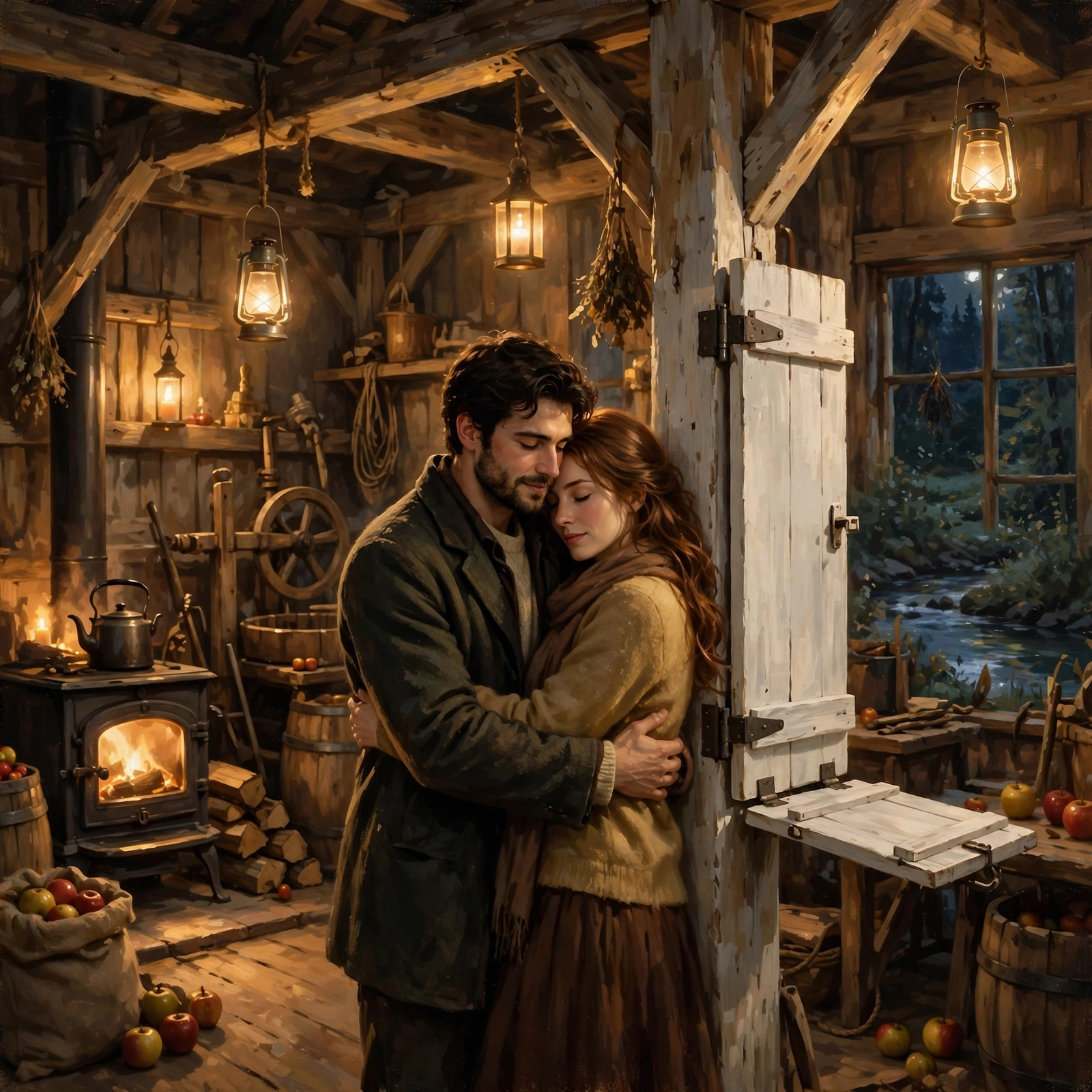
Julian walked deeper into the warm amber pool of the hanging kerosene lanterns. Instead of heading straight for the cider, he stopped at the square center post beside the idle press screw, where an empty iron peg jutted from the timber. Carefully, he unlatched the hinged white-oak board Boone had planed back in 2017, folding it open so all fourteen signed grower cards and the stamped linen seepage covenant caught the light. He lifted the brass hanging ring over the iron peg and settled the board flush against the post, right where it had hung every autumn of Laurel's adult life.
He rested his palm briefly against the pale oak grain, then turned and set his cedar-lined brass hydrometer case down on the scarred workbench beside the two empty glasses. The tarnished tube rolled half an inch and stopped against the base of the cider jug.
"Thought I might leave my sampling kit here for the winter," Julian said, his voice dropping low over the crackle of birch logs in the stove. "If the mill operator doesn't mind me checking the gravel seep twice a month."
Laurel crossed the floorboards until only the corner of the workbench separated them. Up close she caught the crisp cold-air scent of creek water and cedar shavings clinging to his wool coat. "Twice a month is hardly enough to keep your brass polished, Mercer-Kerr."
"I can come more often." All the dry humor faded from his gray eyes, leaving them steady and bare. "Laurel, Thursday morning, when I clipped Simon's permanent release onto that board behind your back... I panicked. After we kissed by the racks, knowing how much this place meant to you, all I could hear was my father sitting at our kitchen table with a worthless handshake agreement while the bank priced our wells. I thought if I locked everything into ironclad Trust paper, nobody could ever drag you into court. Instead I treated you like someone who couldn't be trusted with her own land."
"You tried to wall off the hazard," she murmured, looking down at the scarred brass tube resting beside her glasses. "I did the exact same thing from the other side."
Julian frowned slightly. "You didn't slip fine print into a contract."
"No, I just acted like asking for help was a crime." She lifted her gaze to meet his. "When my parents walked out during the blight year and Boone hurt his back saving these trees, the neighbors carried our note. Ever since, I told myself that if I didn't shoulder every ounce of the co-op's trouble alone, I was abandoning them just like my folks did. Even Martha tried to tell me I was turning gratitude into a prison, and I wouldn't listen. When I shoved your hydrometer case back into your chest on Thursday, part of me was terrified because you'd finally made me want something just for myself."
Julian went very still. Outside the wide-open mill doors, Clover Creek tumbled loud and full over the cedar flashboard they had braced together in the storm, singing through the orchard dark.
Laurel uncorked the earthen jug, poured two inches of cloudy gold must into each glass, and slid one across the pine planks until it touched his wrist. She didn't pick up hers. Instead she stepped around the end of the workbench, closing the last two feet of shadow between them, and laid both palms flat against the damp wool over his chest.
His heart knocked hard and fast under her hands. Carefully, as if giving her every chance to step back, Julian raised his scarred right hand and cupped her jaw, his thumb brushing the warm hollow below her cheekbone.
"You don't have to carry the whole valley anymore," he said huskily.
"Neither do you," she whispered. She rose up slightly on her boots, looking straight into the face of the man who had blown up his neat, safe career just to keep live water running past her roots. "I love you, Julian."
The breath rushed out of him in a quiet, unsteady sound, taking the last guarded line from his shoulders. Both of his arms came around her waist, drawing her flush against the solid warmth of him.
"I love you," Julian answered plainly, his forehead resting against hers before his mouth found hers. "God, Laurel, I love you."
She slid her arms around his neck and kissed him back, slow and deep and unhurried, tasting cold night air and woodsmoke on his lips. There was no storm battering the roof tonight, no deadline waiting on Monday morning, and no ledger left unpaid on the post behind them. When they finally eased apart just enough to breathe, Julian didn't let her go; he tucked her close under his chin, wrapping the edges of his open wool coat around her aproned shoulders.
On the workbench, the untouched cider glasses gleamed amber beside his dented brass case. Laurel rested her cheek over the steady beat of his chest, Julian tightened his arms around her in the warm lantern glow of the mill, and outside the open doorway Clover Creek ran full and clear through the dark orchard.
Get notified when new stories drop
Noah Carrington
Noah covers sports romance and forced-proximity heat: rivalries, road trips, and the quiet moment after the crowd goes home.
Leave a comment
Comments