


Rue Eau-de-Robec
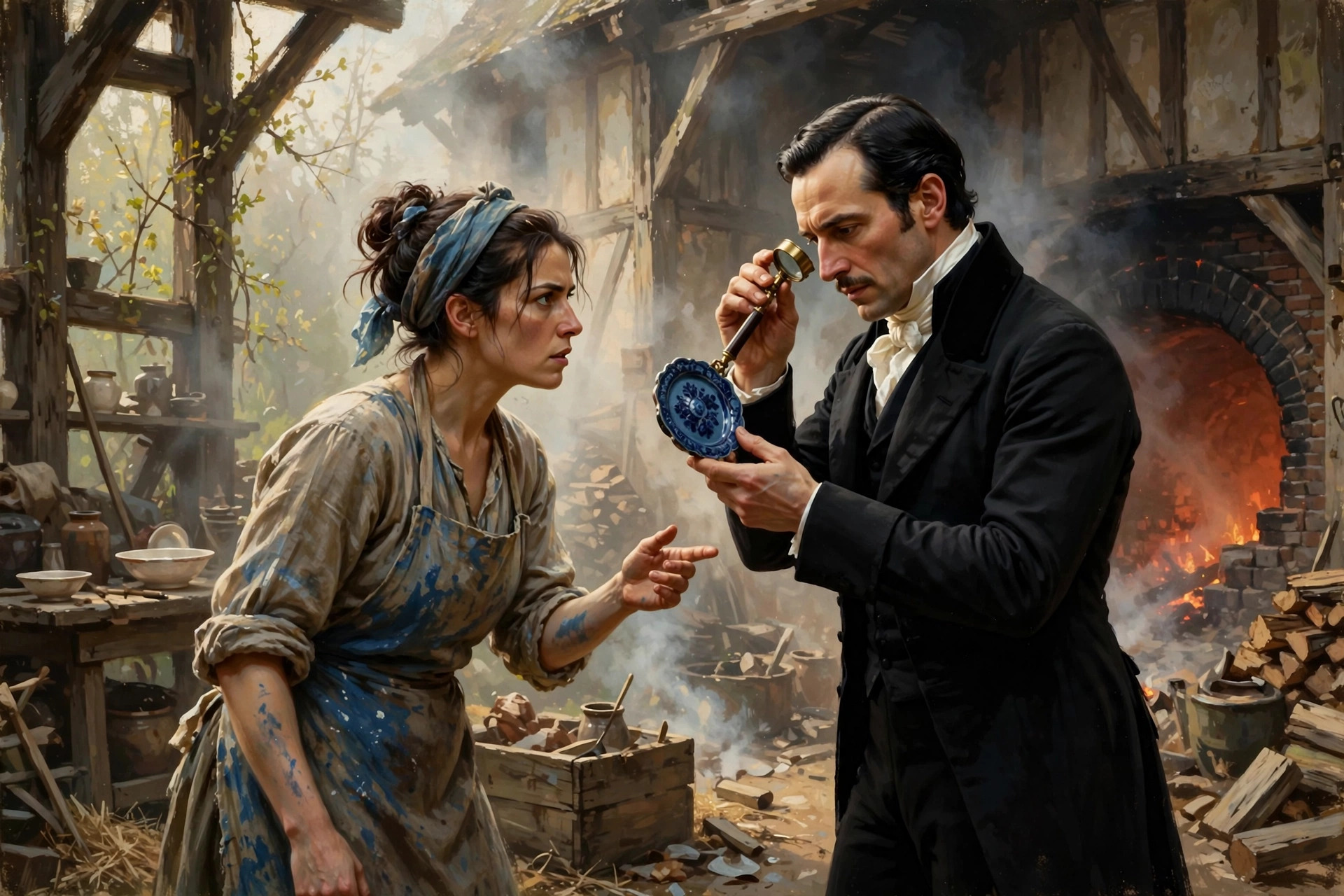
"You are squinting at birch ash, Monsieur Beaumont, not a crack in the biscuit," Fabiola Delacroix said, planting herself between the Paris assessor's black broadcloth shoulder and the open arch of the cooling chamber. Heat still rolled off the soot-darkened bricks of the Delacroix Faience Kiln Yard, carrying the sharp tang of charred hornbeam and damp river clay from the ditch beyond the timbered wall. "If you tilt the disc toward the eaves instead of burying your nose in it, the blue speaks for itself."
Maxime Beaumont did not lower the folding magnifier braced against his cheekbone. Pale spring sunlight caught the lathe-turned brass rivet and the carved pale scales between his thumb and forefinger, right beside the warm porcelain medallion she had lifted from the sagger moments earlier and set in his gloved palm. "The blue sings, Mademoiselle Delacroix. Nobody with eyes could dispute the saturation. Yet three millimeters below the rim, two gas pinholes have breached the surface."
"Pinholes." Fabiola wiped her palms down her coarse ticking apron, though the motion only smeared fresh kaolin and raw cobalt slip into a deeper indigo band across her knuckles. "Wood-fired grand-feu breathes in the draught. Every master potter in Rouen knows a high-fire glaze settles differently than coal-baked factory paste."
"Every juror under Chief Commissioner Henri Tissot carries a lens of tenfold power and a rigid rubric," Maxime replied. He lowered the glass at last, revealing gray eyes that looked maddeningly rested despite his morning train or carriage across town. Not a speck of kiln dust had dared settle on his cravat. "One ruptured bubble in the glaze coat classifies a piece as seconds. Seconds do not advance to the provincial gold medal table, however gloriously they sing."
A dry scrape of ash sounded from the threshold of the Delacroix Glaze Room. Gaston Delacroix leaned heavily on his ash-wood stick inside the timbered doorframe, a woolen shawl pinned unevenly over his left shoulder where his coat hung slack. Since the seizure had stiffened his arm and thickened his speech, the damp yard chilled him within minutes, yet he had refused to stay upstairs once the committee's salaried chemist knocked at the Rue Eau-de-Robec gate.
"Let the gentleman finish his ledger note, Fabiola," Gaston called out, his voice rasping over the gurgle of the dye-stained stream outside. "Monsieur Beaumont represents the Ministry's board. He did not climb our cobblestones to be lectured on hornbeam embers."
"I came to verify that your workshop intends to submit three sample plates before next week's regional adjudication," Maxime said, inclining his head toward the older man with crisp politeness. "Your father's name still commands respect among ceramic historians, Mademoiselle. It would be a pity to see the Delacroix mark struck on the preliminary sheet over an unwashed oxide."
Heat of a very different sort prickled beneath Fabiola's collar. Five years of hauling wet saggers, splitting cordwood at dawn, and barring the door against smooth-talking agents from Parisian manufactories who smelled an ailing proprietor and a lapsed lease had left her with scant patience for pity. Especially pity delivered in the clipped cadence of the upper-town salons where Comtesse Mathilde Beaumont's name ruled the charity Patronesses' lists.
"Our oxide is washed seven times in rainwater," Fabiola said, stepping closer. Before Maxime could fold the little instrument back into his waistcoat pocket, she plucked the ivory loupe straight from his fingers.
His bare wrist brushed her stained thumb—he had drawn off one kid glove to hold the warm porcelain—and he went still at the sheer impertinence of the theft. A vivid smudge of wet blue kaolin slip now marred the pale carved ivory scale.
Fabiola ignored the mark, though her pulse gave an unhelpful kick at the sudden nearness of cedar soap and clean wool. She snatched the warm cobalt test medallion from his other palm, held it toward the bright gap between the tiled roofs, and pressed the brass-rimmed lens to her eye.
Beneath the glass, the world narrowed to a miniature ocean. Deep, velvety ultramarine pooled over the wheel-pressed white porcelain ridges she had thrown and brushed herself. Near the outer lip, just where he had claimed, two microscopic craters broke the glassy skin like burst stars, their tiny edges slightly darkened.
Her jaw tightened. She lowered both hands.
"They are barely the width of a silk thread," she muttered.
"Under gallery lamps at the Rouen Guildhall Salon, Monsieur Tissot will spot them in five seconds," Maxime said. He looked down at his magnifier as she held it out on her flat palm. Instead of grimacing at the wet blue smear across the ivory, his mouth twitched—just a fraction—at the corner. He drew a linen handkerchief from his cuff, accepted the tool, and left the smudge untouched for the moment, tucking both lens and cloth into his pocket. "Your Saxon zaffre carries trace sulfur, or your quartz sand wasn't calcined evenly. When the kiln peaks, trapped vapor bursts through the viscous skin right as it vitrifies."
"My father and I have mixed that frit by weight since I was tall enough to reach the mortar," Fabiola countered, curling her fingers around the warm porcelain disc until its bevel bit into her palm. "If I thin the feldspar to let gas escape, the blue runs down the foot-ring like cheap tavern ware."
"Not if you adjust the carbonate balance to match the specific gravity of this year's vein," Maxime said. Something brisk and unexpectedly eager warmed his cool tone, the stiff official vanishing for three heartbeats behind the absorbed chemist. "Artisans trust memory and scoop measures, Mademoiselle. Mineral veins shift from quarry to quarry. Without an analytical balance accurate to a milligram, you are firing blind."
"Firing blind produced the chargers in the municipal museum," Gaston put in softly from the doorway, though his gaze moved with worried calculation from Fabiola's flushed cheek to the cooling brick arch. Both Delacroix knew what waited at the quarter's end if the Exposition buyers passed them over: twelve thousand francs due on the kiln lease buyout, and three rival factory syndicates already circling the broker's office to buy the yard out from under them and turn their hand-painted legacy into stamped transfer-ware.
Fabiola kept her chin level. She would rather haul river mud barehanded than hand a single line of her grandfather's glaze book to a nobleman playing at tradesman for a committee stipend. Everyone along the Robec knew the late Comte had left the Beaumont country acres buried in debt; Maxime might draw a Parisian assessor's wage now, living under his mother's roof on the hill, yet a title remained a title, and committee men collected workshop secrets the way magpies collected tin.
"Delacroix Faience does not share its glaze books, Monsieur Beaumont," she said coolly. "Not with factory buyers, and not with Exposition assessors."
Maxime's shoulders stiffened. The brief spark in his gray eyes shuttered at once behind impeccable, distant formality. "Exposition regulations strictly forbid an assessor from altering an entrant's formula or entering into commercial collaboration, Mademoiselle. I have neither desire nor permission to read your family ledger."
"Then your visit is complete. You have inspected the kiln, counted our saggers, and delivered your warning."
"My preliminary report merely certifies that your furnace achieves grand-feu temperature, which this sample amply proves," he replied, gesturing toward the disc in her hand. "However, the Paris board tasked me with ensuring Normandy's historic houses present credible technical trials, not nostalgic failures. I keep a set of calibrated analytical balances and density tubes at the Beaumont Townhouse Laboratory. Bring that medallion and ten grams of your unground cobalt ore the day after tomorrow."
Fabiola blinked at him. "To your mother's house."
"To the service wing overlooking the courtyard, which has its own street gate," Maxime said evenly, though a faint duskiness touched his cheekbones—whether at the unspoken truth that Comtesse Mathilde would sooner admit a sweep than a clay-stained woman of Rue Eau-de-Robec into her front hall, or at Fabiola's bluntness, she could not tell. "We weigh the dry ore's sulfur loss under a blowpipe. You write down your own numbers, pocket your own sample, and walk out within the hour. No recipe changes hands."
Behind her, Gaston shifted his weight on the ash stick. "Fabiola," her father murmured, a quiet plea threading the word. "We have wood stacked for one more full firing before the Guildhall carts collect."
One firing to produce three sample plates without a blemish. One chance to keep the Delacroix name painted by Delacroix hands, free of syndicate partners or charity.
Fabiola looked down at the porcelain medallion still radiating gentle kiln-warmth against her callused fingers. In the direct sun, the cobalt held the exact depth of a summer storm over the Seine—richer than anything the coal kilns at Limoges could force out of dead muffles. Yet if she tilted her wrist a hair's breadth, those two minute pinpricks winked back like tiny needles mocking her pride.
She plucked a clean square of unbleached linen from the bench beside the sagger stack and folded it briskly around the warm porcelain disc, corner over corner, until the blue vanished inside rough cloth.
"Your Parisian balances were calibrated on factory chalk, Monsieur Beaumont," she said, tucking the wrapped parcel against her apron bib with both arms crossed tight. "My zaffre comes from the same merchant chest my father sealed five winters back. There isn't a grain of sulfur in it."
Maxime picked up his tall hat from the upturned tub by the gate and ran one gloved finger lightly along its brim. "Then it will take you less than twenty minutes to humiliate my instruments and send me back to my ledgers corrected."
"Ten o'clock, the day after tomorrow," Fabiola said, meeting his level gray gaze without flinching. "At the courtyard gate. And I will bring my own scale weights to test yours first."
"I would expect nothing more trusting, Mademoiselle Delacroix," Maxime murmured. With a crisp bow toward Gaston in the doorway and a shorter, lingering nod for her, he stepped out through the timbered arch onto Rue Eau-de-Robec, carrying a streak of Delacroix blue hidden inside his pocket.
The Ivory Loupe
Fabiola set her brass ounce-weight onto the mahogany pan of Maxime Beaumont's balance before her wool shawl had settled on her shoulders. The tiny brass cylinder struck the polished tray with a bright, belligerent clink that echoed off the vaulted limestone walls of the Beaumont Townhouse Laboratory.
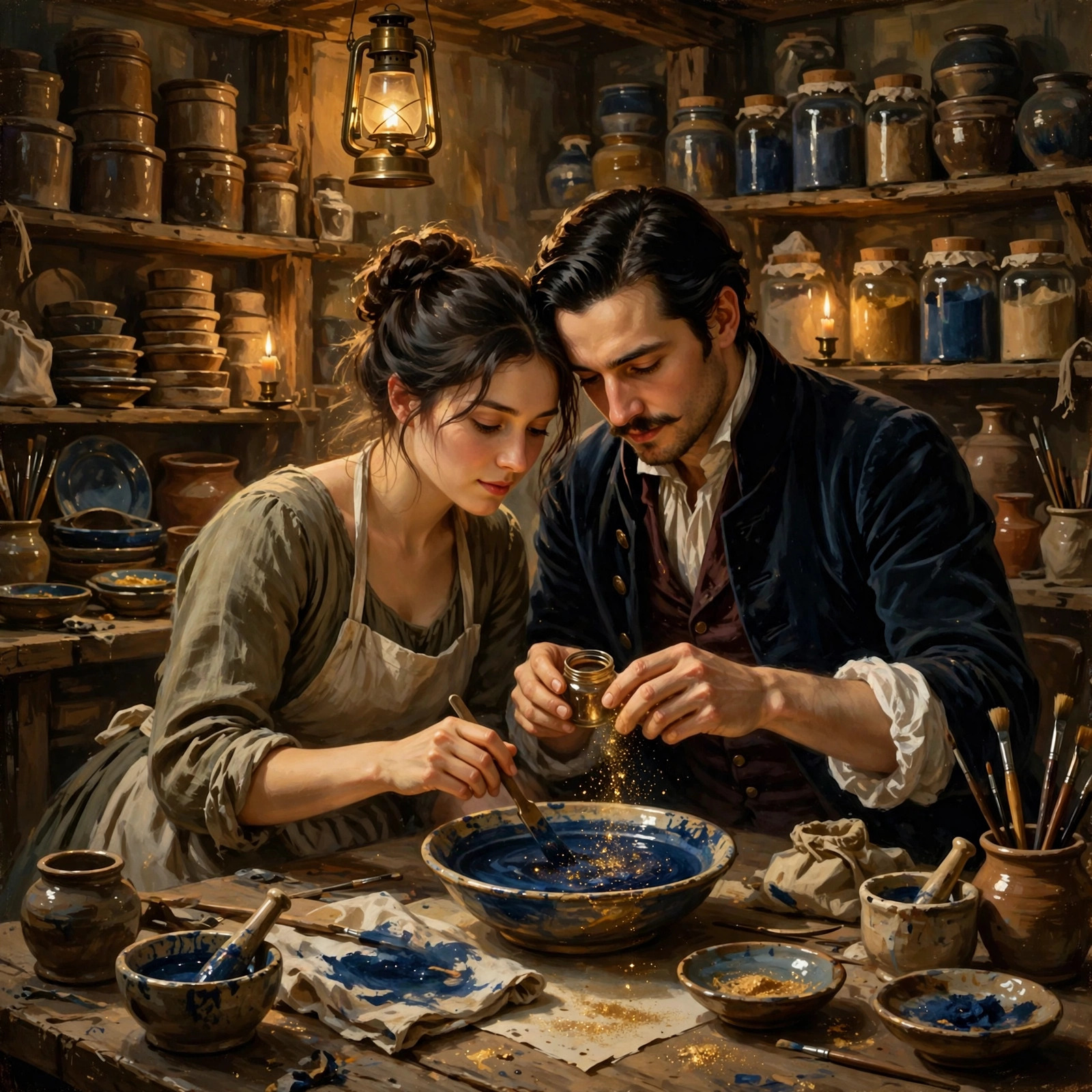
"Half a grain light on the left arm," she declared, squinting straight at the trembling ivory pointer inside its glass case while clutching her satchel to her ribs. "Wait. No. It leveled."
Maxime stood on the opposite side of the slate bench, his coat off and his white shirtsleeves rolled twice above lean wrists. Unlike two mornings ago on Rue Eau-de-Robec, he wore no kid gloves, and a crescent of pale ash marked his left thumb. A faint corner of his mouth tucked inward, not quite a smile, though his gray eyes warmed behind the reflection of the tall courtyard casements.
"Parisian brass, Mademoiselle Delacroix, checked Tuesday against standard platinum," he replied, sliding the glass sash shut to block the draft from the garden door. "Did the gatekeeper give you any trouble?"
"He pointed toward the scullery stairs until he saw your note." Fabiola unknotted her satchel strings with stiff fingers. She had scrubbed her knuckles with pumice and lemon rind before leaving the Delacroix Glaze Room, yet faint indigo crescents lingered beneath her nails like permanent bruises. In this bright converted coach-house, surrounded by stoppered glass retorts, agate mortars, and rows of labeled mineral jars, her grey serge walking dress felt suddenly coarse, smelling faintly of damp alder smoke and turpentine. "We have fifty-eight minutes, Monsieur Beaumont. You promised the hour."
"Fifty-nine, by the cathedral bells." He reached for a porcelain crucible set beside a brass spirit lamp, moving with an economical, practiced grace that owed nothing to drawing-room idleness. "Show me the piece first in cold north light, before we touch your raw zaffre."
She drew the linen-wrapped parcel from her satchel and unfolded the four corners onto the slate between them. Cool morning light poured down onto the round porcelain disc. Even cold, the grand-feu blue looked bottomless, darker at the pooled center and luminous toward the rim, yet right beside the curve sat the two microscopic craters that had stolen her sleep since his inspection.
Before Maxime could lean closer, the paneled inner door linking the coach-house to the main courtyard swung inward without a knock.
"Maxime, the vicar's carriage has already turned the corner, and the subscription ledgers for the orphanage bazaar are still--" Comtesse Mathilde Beaumont halted two paces inside the threshold, one hand lifting the skirt of her plum silk morning gown clear of the scrubbed stone floor.
Silver-haired, upright as a church spire, and scented with dry lavender water that cut right through the sharp tang of nitric acid on the shelves, Comtesse Mathilde swept her gaze from her son's rolled sleeves directly to Fabiola's bare, work-roughened hands resting beside the linen cloth. Not a flicker of surprise disturbed her powdered brow. She looked at Fabiola exactly as she might examine a baker's girl waiting beside a pantry hatch.
"Leave the crockery parcel on the Deal table by the boot-scrapers, young woman," Comtesse Mathilde said briskly, her tone crisp and utterly impersonal. "The housekeeper pays delivery slips on Thursdays between two and four. My son does not settle kitchen accounts in his study."
Heat surged straight up Fabiola's throat to the roots of her pinned hair. Her fingers twitched toward the linen corners, ready to snatch her porcelain back and walk straight out onto the cobbles. On Rue Eau-de-Robec, master potters had tipped their caps to Gaston Delacroix for three decades; here, ten streets uphill, Delacroix blue was kitchen crockery.
Maxime stepped smoothly forward, placing himself half between the bench and the doorway without hurrying. His posture straightened into the cool, formal precision Fabiola remembered from her yard, yet there was steel under his quiet voice.
"This is Mademoiselle Fabiola Delacroix of Delacroix Faience, Mother," Maxime said evenly. "Master decorator and proprietor in session. She is here at my official request to verify regional mineral densities for Monsieur Tissot's committee records."
Comtesse Mathilde's pale gaze narrowed a fraction, dropping from Fabiola's chin to the blue-stained cuticles curled against the slate, then lifting to her son's bare wrists.
"Monsieur Tissot pays clerks in Paris to weigh common dirt, Maxime," Comtesse Mathilde murmured in rapid, clipped cadence, speaking as though Fabiola had ceased to understand French. "Madame de Varennes and her daughter arrive for chocolat inside half an hour. Put on your coat and wash your hands before you shame your late father's name further with furnace grease."
"Convey my compliments to Madame de Varennes," Maxime answered without yielding an inch of floor. "My report for the Rouen Guildhall Salon takes precedence this morning. I will join you at luncheon."
For three seconds the older woman held his stare. Whatever silent argument lived inside this house was clearly years old and worn smooth down to bone. With a barely perceptible sniff, Comtesse Mathilde inclined her chin a millimeter toward empty air, ignored Fabiola altogether, and drew the heavy oak door shut behind her with a decisive click of the brass latch.
Silence settled back over the long slate bench, broken only by the tiny hiss of the spirit lamp's wick. Fabiola stared down at the cobalt disc. Her jaw ached from clenching it.
"You needn't play protector on my account," Fabiola said tightly, reaching to fold the linen over her test piece. "I know which doors in Rouen belong to tradesfolk. If Commissioner Tissot hears a lady of your mother's salon found an entrant alone at your bench, you'll have worse trouble than a missed cup of chocolate."
"Stop." Maxime didn't touch her wrist, only laid two fingers gently on the corner of the unbleached linen to keep it flat. "Look at my cuffs, Mademoiselle Delacroix."
Startled, she glanced down at the folded white linen at his forearms. Near the buttonholes sat three faint, permanent rust-brown speckles that no laundress's bleach had conquered—iron oxide burns, the exact splash marks any glaze-mixer carried after stirring wet batch tubs.
"Half my mother's circle believes I spend my mornings down here turning base lead into gold like a medieval crank because my father left us little else to boast of," Maxime said quietly, a wry, unexpected bitterness edging his composure. "The other half thinks a Beaumont drawing a government chemist's stipend from Monsieur Tissot is a scandal worse than debt. You are the first person under this roof in twelve months who actually knows the difference between cobalt arsenide and Saxon smalt. Please don't pack your cloth."
Fabiola looked up into his face. Without the tall hat and stiff black coat, the austere assessor looked younger, sharper, and startlingly human. Faint smudges of tiredness shadowed his eyes, familiar to anyone who watched temperature cones through spy-holes past midnight. Slowly, she let her fingers slip off the linen edge.
"Iron specks," she observed, nodding toward his left wristband. "You splash when you decant."
"Only when I'm hurried," he admitted, and this time the smile truly reached his mouth, brief and disarming. Reaching into his waistcoat pocket, he drew out the folding lens she had handled two days before. A tiny crescent of dried blue kaolin from her thumb still clung to the carved white scale—he had polished the brass hinge, she noticed with a sudden, odd flutter beneath her collarbone, yet left her mark untouched on the bone.
He unfolded the brass lens, turned her right hand palm-up with a brief, warm brush of his bare fingers against her calluses, and pressed the ivory loupe squarely into her hand.
"Hold that ready," Maxime said, stepping closer to her shoulder as he picked up a triangular steel file from a rack of blowpipes. "Your zaffre isn't the culprit. I tested a pinch of Rouen merchant cobalt last night—clean as rainwater. May I touch the dry foot-ring? Just a scratch on the unglazed biscuit underneath, nowhere near your blue."
Every instinct Gaston had drilled into her since girlhood screamed never to let a rival's tool score Delacroix paste. Twelve thousand francs hung on keeping their body clay and high-fire sheen inimitable before the Guildhall judges. Yet Maxime held the steel file poised in plain view, waiting on her word without presumption, close enough that she caught the clean scent of cedar soap and warm linen off his shirtsleeve.
"Two millimeters on the bottom bevel," Fabiola granted, her voice dropping rougher than she intended. "Nowhere near the maker's stamp."
Maxime turned the porcelain medallion carefully onto its face over the clean cloth and drew the steel edge once, crisp and firm, across the unglazed white rim. Fine white grit powdered the bevel instead of biting hard like flint. He set the file down, lifted a shallow glass dish containing three glassy, angular mineral shards from his shelf, and nudged it right beside the scored medallion.
"Look at your biscuit edge through the glass," he murmured, bending beside her at the bench so their shoulders nearly brushed, "then compare the grain to the middle crystal in my dish."
Fabiola leaned over the slate and brought the ivory loupe to her eye. Magnified tenfold, the scored white rim of her porcelain showed tiny, chalky pockets surrounding sharp, unmelted grains of river sand. When she shifted the lens over his glass dish, the specimen crystal gleamed smooth and translucent, fused seamlessly along its fractured planes.
"My feldspar quarry near Dieppe hit a lime vein," she whispered, lowering the glass slowly while her pulse gave a hard thump of sheer tradeswoman's recognition. "It isn't sulfur in the cobalt at all. The lime boils late in the biscuit just as the blue seals over."
"Trapping two bubbles of carbonic gas right through your mirror finish," Maxime finished softly, watching her face rather than the porcelain with quiet, unmistakable admiration. "Most factory masters in Limoges would spend six months poisoning their glaze vats with lead flux to hide that flaw instead of reading the clay body underneath. Your eye took ten seconds."
Warmth rose into Fabiola's cheeks again, altogether different from the sting Comtesse Mathilde had put there. She folded the brass lens back into its ivory sheath, feeling the lingering heat of his pocket and her own palm mingled in the smooth bone, and held it out toward his chest. "And if I wash out the lime with crushed pegmatite before the final firing, the paste shrinks faster. Three sample plates will warp on the sagger pins unless someone alters the stoking draft between dull red and white heat."
Maxime closed his fingers over the ivory loupe, wrapping lightly over the tips of hers before letting go. His gray gaze stayed steady on hers, serious and suddenly stripped of committee distance.
"I have forty pounds of washed Norwegian feldspar sitting idle in two sacks behind that cabinet, assayed pure to the thousandth part," Maxime said quietly. "And I know how fast washed pegmatite drinks pine flame between midnight and three in the morning."
Fabiola drew back half a step, shaking her head swiftly even as her heart hammered against her ribs. "Exposition rules forbid an assessor to gift raw materials or touch an entrant's ware. If Monsieur Tissot caught wind--"
"Sell me two cracked saggers for forty sous to balance my ledger, and forbid me to touch a single plate," Maxime countered, a reckless intensity breaking cleanly through his habitual restraint. "Let me come to the kiln yard after dark in three days' time, when your batches are milled. Your father cannot heave split birch into a furnace firebox for nine straight hours on a bad leg, Fabiola, and no single pair of hands in Normandy can damper two flues alone at peak heat."
Her given name fell between them onto the quiet laboratory air, unguarded and low. Outside in the courtyard, carriage wheels rattled across cobbles—Madame de Varennes arriving for polite salon gossip two doors away, in a world where women wore cream kid gloves at noon and never knew the roar of white fire behind brick.
Fabiola reached down into her open linen satchel, past her brass scale weights and her wrapped blue medallion. Folded at the bottom lay the clean, heavy unbleached canvas smock she always packed when grinding messy ores away from home, stitched at the collar with faded blue thread.
She pulled the rough canvas garment out and pressed the folded bundle squarely against Maxime's white shirtfront.
"Alder resin ruins fine lawn inside ten minutes, Monsieur Beaumont," Fabiola said, keeping her chin high though her fingers trembled faintly against the coarse cloth between their chests. "Use the river lane gate at nine o'clock three evenings from tonight, after the dyers shutter their lofts. If you drop a damper brick on your polished boots, you bandage your own toes."
Maxime caught the heavy canvas smock in both hands, holding it against his ribs as though she had handed him royal Sevres gilt instead of hempen work-cloth. "Nine o'clock by the river gate, Mademoiselle Delacroix. I'll bring my thickest boots."
Grand-Feu Blue
Split beechwood hissed inside the lower firebox of the Delacroix Glaze Room, throwing orange sparks across Maxime's rolled shirtsleeves as he shoved a thick billet onto the roaring grate. Fabiola slammed the iron latch shut with her hooked poker before the draft could chill the upper chamber. Sweat stung her brow, smelling of woodsmoke and wet clay, while the arched brick door radiated fierce heat through her heavy apron.
"Left flue down half an inch," she called over the deep hum of the chimney.
Maxime stepped to the side wall without hesitation. Wearing her spare unbleached canvas smock tied loosely round his lean waist, its hem stopping mid-thigh above soot-streaked trousers, he looked nothing like Monsieur Tissot's immaculate Parisian assessor. His dark hair curled damply at his temples, and pale cobalt dust powdered the hollows of his wrists where he had helped her sieve the dry batch before midnight. Gripping the hot iron damper plate in a folded rag, he eased the slab inward until the white roar behind the bricks dropped to a clean, singing draw.
"Cones are bending cleanly in the top arch," he reported, wiping his brow with the back of his forearm and leaving a faint streak of blue oxide near his temple. "Your Norwegian feldspar and quartz ratio drank that last surge without bubbling."
"Do not praise a firing while the mortar is still wet," Fabiola warned, though a sharp warmth rose beneath her collarbone as she watched him test the draft with a practiced palm. She dropped onto the low pine bench beside her workbench, where the scored original test piece rested on white linen beside his folded ivory and brass magnifier. Above the timbered ceiling, the floorboards creaked once as Gaston shifted in his narrow bed, then fell silent again.
Fabiola glanced upward, her jaw tightening around an old, familiar ache.
Maxime banked the stray embers with a long broom and leaned his shoulder against the warm brick pilaster opposite her, studying her upturned face in the amber lantern glow. "He stayed awake listening until two o'clock. I heard his cane tap by the stairhead when we loaded the saggers."
"Papa hates hearing another voice at his firebox," Fabiola said quietly, smoothing her soot-darkened palms down her apron knees. "The winter he collapsed beside the muffle oven, three Paris wholesalers came up Rue Eau-de-Robec before the physician had even bled him. One offered to clear our debts on the spot if Papa signed over the Delacroix glaze books and let them stamp a factory mark over ours."
"And your father refused them."
"He couldn't speak plain words that week," she said, the memory still raw as broken flint in her throat. "He knocked their inkwell off his quilt with his good arm instead. Every merchant in Normandy expects a daughter alone at the wheel to take a quiet partner, sell out cheap, or water down her slip to save fuel. If twelve thousand francs isn't laid on the notary's desk after the Rouen Guildhall Salon judging, they'll buy the kiln lease out from under us anyway. That's why no name goes on those three sample plates except Delacroix."
Maxime looked down at his scuffed boots, turning the charred broom handle slowly between his palms. The aristocratic poise he wore like armor in guild corridors had burned away somewhere past midnight, leaving the quiet, deliberate chemist who loved clean mineral equations better than drawing rooms.
"My late father signed papers much more politely than yours," Maxime said, his voice pitched low beneath the crackle of settling ash. "Two bad seasons at the turf club, four mortgaged farms, and nothing left of Beaumont but a townhouse roof my mother keeps open on borrowed credit and fierce pride. In her parlors, a son who weighs clay dust for wages is tolerated only because Monsieur Tissot promised to recommend me for the technical directorship at Sevres once the provincial jury closes."
Fabiola stilled on the bench, cold comprehension cutting through the kiln heat. "Sevres. If Tissot learned you spent six hours stoking an entrant's trial furnace--"
"Then Tissot will not learn it from these bricks," Maxime interrupted gently, meeting her eyes across the glowing floor. "My mother wants an heiress's dowry to gild our shutters. I wanted a laboratory bench where nobody cared about a coat of arms so long as the glaze held true under fire. Tonight is the finest batch I have touched in four years, Fabiola."
Neither of them moved for three heartbeats while the great brick vault ticked and cooled, dropping steadily from white incandescence toward dull cherry red. Through the high transom above the courtyard, the black sky had begun to thin to charcoal gray.
"The test ring is cool enough to draw," Fabiola whispered, rising before the tightness in her chest could undo her voice.
Together they pried loose the clay-sealed plug brick in the side spy-hole. Dry, scorching air puffed across their faces as Maxime slid the slender iron draw-hook inside, snagged the upright clay loop of the trial piece from its front sagger, and lifted it clear onto a thick firebrick slab upon the workbench. At first the round disk glowed dull orange at its edges; then, as the surface drank the cool draft, the fiery veil sank away into vitrified glass, deepening shade by shade into a fathomless, luminous Rouen cobalt that held the lantern flame like midnight river water.
Fabiola lifted the original scored medallion and set it directly beside its newly fired twin. Even before Maxime unfolded the carved ivory scales of his pocket magnifier and leaned down beside her, the truth shone plain to the naked eye. Where the old sample showed two minute dark craters, the new glaze stretched unbroken from rim to rim, rich and mirror-smooth without a single burst gas bubble or pale cloud.
"Not one pinhole," Fabiola breathed, setting the magnifier down on the timber bench because her wrist shook too badly to hold the brass rim level. "The blue didn't wash out at all. It sang right through the quartz."
"You held the reduction damper at the exact quarter-hour," Maxime murmured beside her ear, so close his warm breath stirred a loose curl against her cheek. "Look at the depth near the foot-ring. Paris hasn't seen grand-feu blue like that in fifty years."
She turned toward him with a breathless laugh catching on her lips, forgetting soot, committee rules, and twelve thousand francs in the sheer triumph blazing between them. Maxime did not step back. Raising one hand, he brushed a smudge of dry blue slip from the curve of her jaw with his thumb, his gray eyes darkening as his gaze dropped to her mouth. Fine cobalt dust still ringed both their wrists when Fabiola caught the front of her own rough canvas smock against his chest and rose onto her toes instead of retreating.
Maxime's other arm came around her waist, drawing her flush against him beside the radiating brick door, and his mouth met hers with a slow, starving certainty that knocked every guarded thought clean out of her head. He tasted of smoke and clean winter rain left in his coat collar, warm and devastatingly gentle at first until her hands slid up his shoulders into the damp curls at his nape. A low sound broke in his throat; he angled his head deeper, holding her as if all the noble salons in France could burn to cinders outside her yard gate without making him let go.
When they finally parted, leaning forehead to forehead in the amber warmth, cold blue dawn was paling through the high canal window over Rue Eau-de-Robec, and the first dyer's cart rattled over distant cobbles.
Reluctantly untying the heavy canvas smock, Maxime laid it neatly across her bench. Before pulling on his wool coat, he left his folded ivory loupe resting squarely beside the flawless twin medallions.
"Keep the glass until morning," Maxime said softly, catching her stained hand and pressing a brief, fervent kiss to her knuckles. "I am going back to my desk to draft the legal papers today, Fabiola. By tonight I'll have a clean, lawful way for us to stand before the whole guild openly--together."
The Cracked Medallion
Maxime spread a crisp folio sheet across the scarred timber bench in the Delacroix Glaze Room before the morning damp had even dried from his coat sleeves. Faint heat still rolled off the brick kiln mantle from last night's firing, warming the cold February air that leaked around the casement over Rue Eau-de-Robec. Fabiola stood at his shoulder with a mug of bitter chicory warmed on the iron brazier, her pulse giving a treacherous, hopeful leap when his shoulder brushed hers.

"Read the top clause before the ink dries in the crease," Maxime said, tapping the folded vellum with a gloved knuckle. Shadows circled his gray eyes from lack of sleep, yet his mouth curved with quiet eagerness. "I drew up the preliminary declaration at dawn."
Fabiola set her tin mug beside his folded ivory loupe and leaned over the page. Before she could read past the municipal heading, iron carriage wheels ground sharply to a halt on the narrow cobbles outside the yard gate. Heavy footsteps struck the stone threshold, followed by a brisk rap of an ebony ferrule against the open glaze-room door.
Comtesse Mathilde Beaumont stood framed against the pale canal mist, her sable-trimmed pelisse gathered tight to keep the hem clear of grey clay dust. Her cold gaze swept the sagging ceiling beams, the tubs of wet slip, and the spare canvas smock folded across the bench before fixing on her son.
"So the concierge at the Hotel d'Angleterre was not inventing tales," Comtesse Mathilde said, stepping inside only far enough to let the door swing shut behind her. "Half the guild clerks on Rue Eau-de-Robec saw a Beaumont carriage waiting near the dyers' footbridge before daybreak, Maxime."
Maxime straightened instantly, stepping slightly sideways so his broad wool coat shielded the workbench. "Mother, you have no business descending on a private workshop unannounced."
"I have every business when Monsieur Tissot arrived from Paris on the early express and summoned my brother's solicitor over breakfast," Comtesse Mathilde snapped. She flicked a kidskin glove toward the cooling brick arch. "A rival factory foreman reported that a salaried Exposition assessor spent last night stoking a trade kiln with a female entrant. Monsieur Tissot is furious. He warned that if one breath of impropriety reaches the Rouen Guildhall Salon before the regional judging, your Sevres directorship will be struck from the ministry docket before noon."
Cold dread knotted below Fabiola's ribs. She did not move from the bench, though she instinctively tucked her cobalt-stained knuckles into the folds of her dark wool skirt. Across the narrow room, the older woman's lip curled faintly at the gesture.
"You know what your late father left us," Comtesse Mathilde continued, lowering her voice to a fierce tremor meant only for Maxime, though every syllable carried off the stone walls. "Mortgaged timber and humiliating debts. That Sevres appointment is the sole respectable anchor left to our house. Will you throw away a royal manufactory post and drag the Beaumont name through tavern gossip for a potter's daughter?"
"Mind your tongue under Mademoiselle Delacroix's roof," Maxime said quietly, a muscle hardening along his jaw. "Nothing improper occurred here. We tested a mineral variance in local feldspar. And I have already drafted the legal instrument to place our work wholly above committee reproach."
Fabiola looked sharply from mother to son. "What instrument?"
Comtesse Mathilde stared at the vellum sheet on the timber bench as if it were a venomous snake. "Have you lost your wits entirely, Maxime? Jurors cannot collaborate with provincial tradespeople."
"A juror cannot judge an entry in which he holds a declared commercial patent, which is why I am asking Monsieur Tissot to recuse me from the Rouen panel while registering the modified grand-feu glaze jointly," Maxime replied. He turned back to Fabiola, lifting the folio page with urgent conviction. "Look here, Fabiola. If we file a joint chemical patent under Beaumont and Delacroix this morning, the scandal dies in its cradle. My auspices as a certified ministry chemist validate the quartz ratio, shield your workshop from disqualification, and bring enough Parisian capital to clear your twelve thousand francs without waiting on factory buyers."
The warmth left over from last night's kiss vanished from Fabiola's chest as if someone had thrown open a sluice gate to the icy canal. She looked down at the bold black script heading the page. Beaumont came first, written large in clerkly flourishing ink, with Delacroix tucked neatly beneath as the executing kiln.
Upstairs, her father's cane thumped once across the floorboards as Gaston shifted near his window stove, feeble and trusting her to hold fast to thirty-five years of his labor. Since his stroke, three separate Parisian syndicate agents had stood in this very room offering similar rescue papers, smiling gently while proposing to absorb a crippled man's recipes under wealthier names.
"Under your auspices," Fabiola repeated, her voice dangerously flat.
Comtesse Mathilde gave a brittle, incredulous laugh. "Even better. You mean to attach our family crest to common earthenware so a bankrupt kiln yard can pay its landlord? Come home at once, Maxime, before Monsieur Tissot hears of this madness and bars you from every laboratory in France."
"Wait in the carriage, Mother," Maxime said firmly, never taking his eyes off Fabiola's paling face. "Give us five minutes."
"Five minutes will not wash kiln soot out of a Beaumont coat," Comtesse Mathilde retorted. Yet something flinty in her son's stance checked her; with a frigid glance at Fabiola's rough apron, she swept out into the yard, leaving the heavy latch rattling in her wake.
Silence rushed back into the glaze room, thick with woodash and sudden estrangement. Maxime exhaled and reached toward Fabiola's sleeve. "Forgive her cruelty. She panics whenever creditors or ministry politics touch our name. Once you sign this co-registration, neither she nor Tissot's clerks can touch your three sample plates."
Fabiola stepped backward out of his reach, bumping her hip against the adjacent stone grinding bench where the two fired test disks lay side by side on folded linen: the new, mirror-smooth blue proof from dawn, and her original scored cobalt test medallion with its pair of tiny gas pinholes.
"Sign away half the Delacroix glaze book, you mean," Fabiola said, heat surging painfully into her throat. "Last night beside that door, when you promised a lawful way for us to stand openly together, I was fool enough to think you meant as man and woman. Not patron and dependent."
Maxime blinked, stunned. "I meant both, in due course! Good heavens, Fabiola, Tissot arrives to convene the preliminary clerks in three days. If an inquiry challenges my presence here last night without a formal technical registry on file, they will strike Delacroix Faience from the rolls for tampering with an assessor. Putting my chemical patent over the formula protects you!"
"Putting Beaumont at the top of the parchment swallows us!" she cried, snatching up the original scored cobalt test medallion from the linen cloth so fiercely the rough foot-ring bit into her palm. "My father spent half his life perfecting that cobalt reduction while noble houses bought German imports and sneered at Rouen clay. You walked in here with your pocket scales, adjusted one handful of ground quartz, and the very morning your mother threatens your precious Sevres chair, you offer to annex my family's craft so polite society calls it scientific sponsorship instead of disgrace!"
Color drained from Maxime's cheekbones, leaving the faint soot smudge near his temple stark against white skin. "You think I drafted this to steal credit from Gaston Delacroix?"
"I think a nobleman always protects his title first, even when he calls it charity," she said, trembling with a terror so old and fierce it sounded wholly like rage. "Parisian buyers tried to buy our stamp for scraps all winter after Papa fell ill. At least they never kissed me in the dark first to soften the bargain."
Maxime flinched as if she had struck him across the mouth with an iron kiln rod. All the open, sleepless warmth vanished behind the rigid mask of the ministry official she had hated on his very first afternoon in her yard. "I offered to forfeit my seat on the regional panel and Stake my professional standing on your clay," he said, his voice dropping low and ragged. "Because I could not bear watching your workshop go to auction."
"Delacroix Faience will win the provincial gold under the Delacroix mark alone, or we will lock the gates with our pride intact," Fabiola said tightly. "Keep your auspices for Sevres, Monsieur Beaumont. We want neither your name nor your rescue."
Turning sharply to slam the scored disk back onto the stone bench, her shaking hand misjudged the slick granite edge. The original cobalt test medallion slipped from her grasp, struck the corner of the heavy stone slab with a sharp, ringing snap, and cracked cleanly in half.
Two jagged crescents of deep grand-feu blue rocked once on the grey stone before settling apart, exposing the stark white clay body down the center like an open cut.
Neither of them breathed. Maxime stared down at the cloven disk, his throat working once before he lifted his eyes to hers. No anger remained in his gaze, only a bleak, shuttered hurt worse than any aristocratic scorn.
"I see," Maxime said quietly. Carefully, without crumpling the parchment, he folded the unsigned declaration twice and slid it back inside his breast coat. "You need not fear any claim from me, Mademoiselle. Your quartz ratio is yours alone."
Fabiola did not look at the broken halves. Swallowing hard against the sudden sting behind her eyelids, she snatched his folded brass-and-ivory loupe from the timber workbench, marched the two paces between them, and shoved the cool ivory scales deep into his outer coat pocket.
"Take your glass," she whispered fiercely, stepping back and pointing toward the yard door. "And get out of my kiln room before your mother sends the commissioner's clerks to fetch you."
Maxime's hand brushed the outside of his pocket where the magnifier rested, heavy and final against the dark wool. He inclined his head in a stiff, formal bow worthy of the coldest salon in Paris.
"Good fortune at the Guildhall, Mademoiselle Delacroix."
He turned and walked out across the flagged yard without looking back. Seconds later, the heavy street gate clicked shut, followed by the brisk clatter of iron carriage rims rolling away down Rue Eau-de-Robec until the rushing water of the canal swallowed the sound completely.
Alone in the cooling room, Fabiola braced both palms against the cold stone bench, her chest aching as if every breath scraped raw ash into her lungs. Between her braced wrists lay the two severed halves of the blue medallion. Staring at the clean white fracture dividing the glaze she had guarded so savagely, the hot armor of her anger collapsed all at once, leaving only a hollow, sickening truth: Maxime had tried to build a bridge wide enough to shelter them both, and out of sheer, terrified pride, she had smashed it in his hands.
The Guildhall Table
Rain lashed the tall leaded windows of the Rouen Guildhall Salon as Fabiola lifted the grey linen cloth from her wicker basket and set three sample plates in an even row across the green baize table. Three days of relentless wood smoke and sleepless watching hung in the wool of her best dark serge skirt, yet the wide scalloped rims caught the grey light in pools of deep, unbroken grand-feu cobalt. Not a single pinhole marred the glossy blue borders. Beside her, Gaston leaned hard on his ash cane, his weaker left shoulder angled stiffly beneath his Sunday coat while he steadied his breathing against the damp chill of the vaulted hall.
Behind the elevated oak dais sat Monsieur Henri Tissot, his silver pince-nez balanced near the tip of his nose and a thick ledger open before his cuffs. To his left, among the cushioned gilt chairs reserved for municipal patrons, Comtesse Mathilde Beaumont sat upright in plum silk and black jet, her gloved hands folded motionless over the mother-of-pearl handle of her furled umbrella. And at the far end of the assessors' bench sat Maxime. Pale and impeccably tailored in dark broadcloth, he stared straight ahead at the brass inkwell before him, never once glancing down toward the floor where Fabiola stood.
Monsieur Tissot leaned forward, lifting the center plate by its foot ring and tilting it toward the tall casement. Around the perimeter of the salon, rival factory owners from Limoges and the outskirts of Paris craned their necks, murmuring behind their hats.
"Remarkable saturation," Tissot murmured, turning the rim under his spectacles. "Deep cobalt at full wood-kiln heat, without running into the white reserve or blistering along the molding. You fired these three sample plates since Tuesday's preliminary inspection, Madame?"
"Delacroix Faience is registered under my father's name, Monsieur le Commissaire, though I manage the firing," Fabiola answered clearly, keeping her stained knuckles resting lightly beside her basket rather than hiding them in her skirts. "We drew them from our single-chamber kiln on Rue Eau-de-Robec at dawn yesterday."
From the patrons' gallery came the faint, deliberate rustle of silk. Comtesse Mathilde inclined her head a fraction toward a neighboring magistrate's wife, her expression cool and sculptural as marble.
Tissot set the dish down on the green wool with a soft tap and removed his pince-nez, tapping the silver bridge against his open ledger. "Here lies the committee's difficulty, Mademoiselle Delacroix. When our regional assessor visited your yard earlier this month, your cobalt trials suffered from acute lime pitting. Yet inside one week, an unmechanized workshop operated by an invalid master and his daughter produces three flawless specimens worthy of the national pavilion."
Beside Fabiola, Gaston shifted his weight onto his cane, color rising high in his weathered cheeks. "Monsieur Tissot, my daughter has ground her own minerals since--"
"Permit me to finish, Monsieur Delacroix," Tissot cut in smoothly, though his gaze remained fixed on Fabiola. "Certain troubling accounts have reached Paris regarding irregular technical assistance. Specifically, that a salaried chemist of this committee spent hours inside your glaze room altering your batch ratios. Exposition statutes strictly forbid private collaboration between juror and entrant. Unless you can prove this glaze was compounded and fired solely by traditional artisanal methods under your own roof, I must disqualify Delacroix Faience and award the twelve-thousand-franc provincial commission to the mechanized works at Saint-Sever."
Twelve thousand francs. The exact sum needed to buy out their expiring lease and keep Parisian syndicates from tearing down Gaston's brick kiln. Fabiola felt the blood drain from her face. Inside her reticule, wrapped in a scrap of chamois, lay the two jagged halves of the broken test medallion she had carried from the Delacroix Glaze Room that morning—brought along out of a fierce, aching refusal to leave behind the proof of what they had discovered, even after she had driven Maxime out. If she spoke of his quartz calculation now, she ruined him before his superiors; if she denied his presence, she lied under oath and lost the workshop anyway.
Before she could part her lips, chair legs scraped sharply against the polished oak of the dais.
"The statute bars a sitting juror from advising an entrant, Monsieur le Commissaire," Maxime said. His baritone carried cleanly across the hushed hall, stripped of salon drawl, calm and resonant. He rose from his seat, unbuttoning the front of his dark coat to draw a folded sheet of heavy cream vellum from his breast pocket. "It does not bar an independent citizen from discussing mineralogy with a master artisan."
In the gilt chairs, Comtesse Mathilde stiffened, her chin lifting sharply. "Maxime," she breathed, barely audible above the rain drumming against the glass, a sharp note of maternal command cracking through her poise. "Sit down at once."
Maxime did not look toward the plum silk gown. Descending the three oak steps from the dais, he walked directly to the green baize table until he stood scarcely an arm's length from Fabiola. Up close, dark shadows bruised the skin beneath his grey eyes, yet his posture held a quiet, unyielding steadiness she had never seen in him while he hid behind committee rules.
He laid the folded vellum squarely beside Monsieur Tissot's ledger. Then, reaching into his outer coat pocket, he drew out his folding brass-and-ivory loupe and set it down atop the paper with a quiet, decisive click.
"My formal resignation from the Exposition Ceramic Committee, effective prior to Monday's firing," Maxime said evenly, meeting Tissot's startled stare. "Along with my withdrawal from consideration for the technical directorship at Sèvres. You will find the date duly notarized at the municipal clerk's office."
A sharp collective intake of air rippled through the assembled manufacturers. Fabiola stared at the small ivory-scaled magnifier resting on the resignation sheet, her heart hammering wildly against her ribs. He had surrendered Sèvres. Everything he had guarded to restore the Beaumont name, everything his mother prized, laid down on green cloth without hesitation.
Tissot's bushy brows drew together in genuine consternation. "Beaumont, have you lost your senses? A state directorship is not tossed aside over a provincial faience prize! Even if you step down today, how does that prove these dishes were not doctored in a Parisian muffle furnace?"
Maxime turned slightly toward Fabiola. For a heartbeat, his grey eyes met hers, asking permission without demanding it, leaving the choice wholly in her hands.
Swallowing past the tight knot in her throat, Fabiola unclasped her reticule. She drew out the chamois cloth, unfolded it in her palm, and held out the cloven cobalt test medallion—the very disk she had dropped on her granite bench three mornings ago.
"Thank you, Mademoiselle Delacroix," Maxime said softly, taking the two jagged crescents with reverent care, making sure his knuckles did not brush her skin before the watching room. Turning back to the dais, he placed both broken halves openly before Monsieur Tissot, angling the stark white fracture toward the tall windows. "If the Commissioner will employ my glass one last time."
Frowning, Tissot picked up the ivory loupe, snapped open the brass lens, and bent low over the severed blue disk.
"Any chemist knows a factory coal-muffle leaves a razor-thin glass skin sitting wholly separate atop a pre-baked biscuit," Maxime explained, pointing near—never touching—the jagged white clay edge. "Look at the cross-section exposed by that fracture. You see blue silicate crystals penetrating deep into the porous buff body, fused alongside traces of birch wood ash along the foot. Only a live, open flame in an artisanal grand-feu wood kiln drives cobalt into raw Rouennais clay like that. All I offered was an observation regarding local feldspar purity. The glaze formula, the brushwork, and the twenty-hour firing belong entirely to Delacroix Faience."
Silence held the Guildhall Salon save for the steady rush of rain down the stone gutters outside. Tissot studied the fractured edge for a long moment, tilting both halves toward the grey daylight, then slowly folded the brass lens back into its ivory scales. He glanced from the three glowing plates to Maxime's notarized resignation, and finally toward Comtesse Mathilde, whose face had gone rigid and wintry white beneath her black lace veil.
Clearing his throat, Tissot reached for his steel pen and dipped it into the inkwell. "The mineralogical cross-section is indisputable," he announced briskly, inscribing a flourish across the bottom of his ledger page. "And as Monsieur Beaumont has vacated his post on the jury, no statutory irregularity remains. The committee awards the provincial gold medal and the twelve-thousand-franc pavilion commission to the house of Delacroix."
Beside Fabiola, Gaston let out a ragged breath, his trembling right hand gripping her elbow in fierce, wordless triumph as applause broke out among the guild clerks and local tradesmen. Immediately, two Parisian warehouse buyers pushed forward around the oak rail, calling out congratulations and asking after shipping crates.
"Maxime--" Fabiola turned toward him, leaving the plates behind on the green wool, desperate to speak over the sudden clamor of voices.
Across the aisle, Comtesse Mathilde had already risen, sweeping out through the tall double doors without waiting for her son, leaving an unmistakable chill of social exile in her wake. Maxime saw his mother's departure, inclined his head once in quiet acceptance, and looked back to Fabiola. A faint, rueful warmth touched the corner of his mouth—asking nothing in return, claiming no share of her triumph.
Leaving the ivory loupe and the broken medallion beside her winning plates, he offered her a quiet, formal bow. Before Fabiola could push past the broad shoulders of the congratulating merchants crowding around her father's cane, Maxime turned, took his hat from the porter's bench, and walked out alone into the driving Rouen rain.
Beside the Cooling Brick
The iron latch of the courtyard gate clicked, and Maxime stepped out from the shadowed archway of Rue Eau-de-Robec into the Delacroix Faience Kiln Yard, raindrops gleaming along the dark wool of his shoulders.
Fabiola stood before the brick mantle of the main furnace, a slender horn spatula poised over a dish of sizing. Above them, the timber eaves dripped steadily onto the wet cobblestones. The afternoon crowd of Guildhall buyers and congratulating neighbors had long since dispersed, and upstairs, Gaston was finally resting behind drawn curtains. Only the two of them remained in the quiet enclosure, warmed by the residual heat radiating from the thick masonry wall.
Maxime halted near the stacked cordwood, taking off his damp hat. "I didn't mean to startle you," he said quietly. "I thought you and your father would still be celebrating at the Guildhall."
"Papa grew tired once the warehouse contracts were signed," Fabiola said, setting the horn spatula down on a clean linen rag. "I sent the apprentices home an hour ago."
He glanced toward the wooden peg by the Delacroix Glaze Room door, where a heavy canvas work coat—stained at the cuffs with cobalt wash and wood soot from their night stoking the fire—still hung beside her shawl. "I came to fetch my coat," he murmured, gesturing faintly toward the peg. "And to leave the courtyard key I borrowed that night. After that, I shan't intrude upon your triumph."
"You think you're intruding?" Fabiola wiped a trace of sizing from her thumb and stepped away from the furnace ledge so he could see what rested on the warm brick between them.
Maxime hesitated, then crossed the damp flagstones. As he neared the mantle, his gaze dropped from her face to the pale ledge.
There sat the broken cobalt test medallion she had carried back from the Rouen Guildhall Salon wrapped in her handkerchief. The two halves were no longer parted. She had pressed them together with a thick seam of mastic and gold lacquer paste, binding the jagged bisque edge so a bright, gilded vein now ran straight across the deep Rouennais blue. Beside the mended disc lay his folding ivory and brass loupe.
Maxime stared down at the gold-veined seam. Neither of them spoke while a gust of evening wind stirred the smell of wet slate and beechwood ash across the yard.
"You kept it," he said softly.
"You left it on the adjudication table," Fabiola replied, her voice catching slightly before steadying. "Along with your loupe, and your career at Sèvres."
A muscle worked in his jaw. He reached out, touching the brass hinge of the magnifier without picking it up. "Sèvres was a shelter, Fabiola. Nothing more. For years, I let my family convince me that because my father ruined our country estate, my only worth lay in holding an official title and staying safely above the fray. Rules and measurements couldn't betray me. Or so I told myself."
He looked up, his grey eyes clear in the gathering dusk. "At the Guildhall today, watching Tissot prepare to dismiss your work over a rumor, I realized how cowardly that neutrality really was. Resigning wasn't a sacrifice. It was the first honest thing I've done since coming to Rouen."
Fabiola felt a hot ache rise behind her ribs. She looked down at the golden line bisecting the dark glaze, remembering the sharp crack of the clay against her stone bench three mornings ago, and the cold terror that had driven her tongue.
"I was cruel to you," she said plainly. "When your mother warned us about the rumor, and you offered to put both our names on that patent, I knew you were trying to protect me. Underneath my anger, I knew it."
"Fabiola--"
"Please let me say it," she whispered, lifting her gaze to meet his. "Ever since Papa fell ill, I've treated every person who walked through that gate like a thief coming to strip the Delacroix name off our lintel. I was so terrified of needing anyone—so terrified of what your mother's salons would call a kiln-woman who took a nobleman's help—that I struck at you first. I accused you of trying to steal what you had spent all night helping me save. I drove you out because I was afraid to trust you."
Maxime stepped closer until the hem of his damp overcoat brushed her work apron. "You had every right to guard what was yours. My mother's circle has earned very little trust from people who actually make things with their hands. And I was clumsy. I offered you legal parchment when I should have simply stood beside you."
"The gold paste won't survive another firing," she murmured, nodding toward the mended medallion on the warm brick. "If you put it back in the flame, the lacquer will burn away. It isn't seamless anymore. Anyone who looks closely will see where I broke it."
"Then we won't hide the seam," Maxime said, his voice dropping low and warm. "It held the truth today when we needed it most."
Fabiola drew in the cool, rain-washed air, her heart hammering hard against her bodice. "The pavilion commission pays twelve thousand francs upon delivery of the crates," she said. "That buys out our lease completely. Not just the kiln yard, Maxime, but the empty warehouse bay across the alley, with the north skylight and the stone chimney."
He stilled, studying the quiet resolve in her upturned face. "A north skylight is very fine for color matching."
"It would be finer still for an independent ceramic laboratory," Fabiola said, her cheeks warming even as she held his gaze without wavering. "Rouen and the surrounding workshops need a chemist who understands local clay, high-fire wood glazes, and honest craft—not someone chained to a ministry desk. Stay here. Build a laboratory with me, as full and equal partners. Let the polite drawing rooms shut their doors if they choose. I don't want my name alone on the sign if it means standing in this yard without you."
For a heartbeat, Maxime didn't move. All the guarded aristocratic restraint that had clung to him on the morning he first walked into her shop seemed to slip away into the twilight. Slowly, he reached down to the brick mantle and picked up the folded ivory loupe.
Instead of slipping it into his waistcoat pocket, he stepped right into her space. Gently, his warm hands settled at her waist, and he tucked the carved ivory magnifier securely into the folded linen of her work sash, right beside her trimming knife.
"Keep it," Maxime murmured, his palms lingering against the cotton at her hips. "We'll both be reaching for it soon enough. Though I ought to warn you, Comtesse Beaumont will likely cross the street rather than pass a storefront bearing both our names."
A shaky laugh escaped Fabiola as she lifted her stained palms to the damp lapels of his coat. "Let her cross. The light is better on our side of the canal anyway."
Maxime's smile faded into something fierce and tender. He brought one hand up to cup her cheek, his thumb brushing a faint smudge of cobalt dust near her temple with infinite care.
"I love you, Fabiola," he said quietly, clearly, without a shred of hesitation. "I loved you the night you argued feldspar ratios with soot on your brow, and I love you now. Every stubborn, brilliant part of you."
Tears stung the corners of her eyes, bright and unashamed. She leaned into the warmth of his palm, curling her hands tighter into the wool of his coat as the last weight of her solitary vigil fell away.
"I love you, Maxime," she answered just as plainly. "Stay with me."
"Always," he whispered against her hair.
He drew her tightly against his chest, wrapping both arms around her shoulders as she buried her face briefly against the rain-cooled collar of his neck before tilting her chin up to meet him. Backed against the radiating warmth of the cooling kiln brick, surrounded by the clean, earthy scent of beechwood ash and falling rain, Maxime lowered his mouth to hers—a slow, deep, unhurried kiss that sealed their promise, beginning their life side by side.
Get notified when new stories drop

Ivy Chen
Ivy writes historical and second-chance romance with period texture and modern emotional clarity. Courtship stakes, letters, and choices that cost.
Leave a comment
Comments