


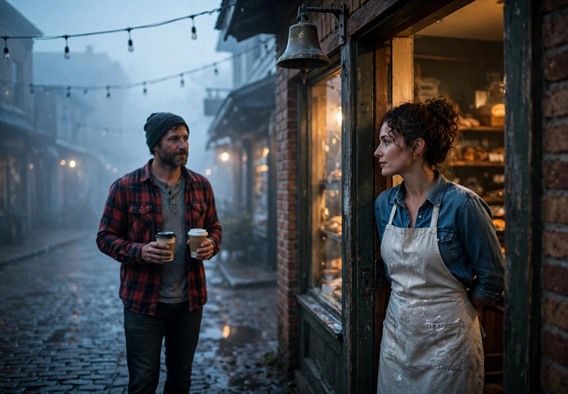
The Cracked Valve
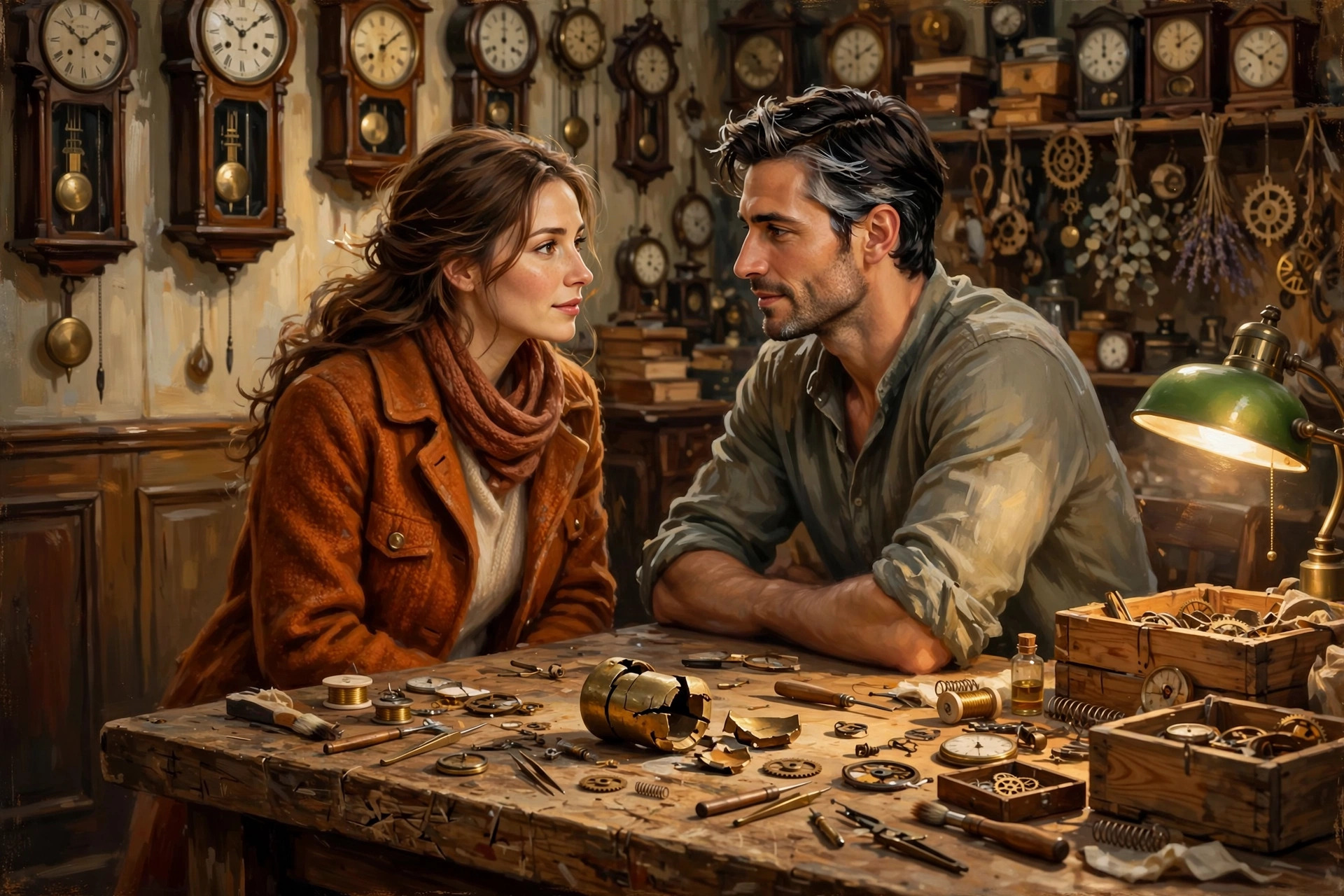
Gemma Penrose set the split brass fitting onto the scarred maple workbench harder than strictly necessary, right beside a tray of miniature steel screws.
"Don't tell me you only touch antiques now," she said before Malachi Darrow could lift his jeweler's loupe from his eye. "Because the courier route out of the valley washed out at the lower bridge, the regional supply truck won't clear the pass before Saturday's Equinox Chime, and I have suture packs backing up at Silverbrook Clinic."
Malachi slowly lowered the magnification lens from his brow. Seven years away in Geneva had sharpened the angles of his jaw and threaded a single streak of silver near his right temple, though his sleeves were still rolled twice below the elbow, the exact way he used to wear them when his father owned this room.
"Hello to you too, Gem." His voice was quieter than she remembered, pitched beneath the rhythmic, overlapping chorus of a dozen wall pendulums ticking along the newly painted wainscoted walls.
"It's Gemma," she corrected automatically, folding her arms inside her wool coat so he wouldn't see her fingers curl. "Can you sleeve it or not? If you're too busy unpacking museum pieces, I'll drive over the ridge to the hardware mill myself."
"The hardware mill doesn't stock high-pressure naval brass, and their machinist retired two winters back." Malachi picked up a pair of brass tweezers, nudging the heavy autoclave release valve a fraction of an inch toward the bench lamp. The air inside Darrow Clockworks smelled sharply of whale-oil substitute, fresh pine shavings from the shipping crates stacked near the front window, and damp September wool. "Let me look at the threads before you go picking a fight with the mountain roads."
She didn't want his reasonableness. She had prepared for arrogance, or cosmopolitan indifference, or at least the brisk politeness of a stranger who had walked out of Silverbrook in 2017 and never sent so much as a postcard after his father's estate auction closed.
"My mother told me the shutters came down off the storefront yesterday morning," Gemma said, shifting her weight onto her heels while she watched his broad, ink-clean thumb trace the hairline fracture along the valve collar. Ester Penrose had delivered that news over tea with the cautious precision of a retired nurse delivering a bad lab result. "I assumed a collector from the city bought the lease."
"I bought the lease." Something shuttered behind his dark eyes, brief and practiced. "Well. Financed it. The name over the door belongs here."
"Does it?" She kept her tone light, clinical, the voice she used when suturing loggers who swore they didn't need lidocaine. "You missed quite a few winters for a man worried about the sign out front."
Malachi didn't rise to the bait. He set the loupe back against his socket and leaned closer to the lamp, tilting the brass cylinder under the warm bulb. Watching his hands work brought an unwelcome tightness behind her ribs. Nobody in the county had hands that calm. Back when they were twenty-four and foolish enough to think grit paid property taxes, she used to sit on an overturned crate right where his lathe now stood, quizzing herself on pharmacology flashcards while he cleaned pocket watches past midnight.
When the bank foreclosed on old Mr. Darrow's debts, Malachi had packed one leather grip, taken the European apprenticeship he'd turned down twice before, and left Gemma standing on the station platform with a promise that turned to smoke before the first frost. She had learned her lesson well. You didn't lean your weight on people whose eyes were fixed on bigger horizons, and you certainly didn't ask them for favors unless an entire town's sterile instruments depended on it.
"Hairline stress split right through the seating ring," Malachi murmured, setting the loupe down beside a tin of lathe cutting paste. "Your clinic sterilizer has been running over pressure."
"The gauge sticks when the humidity drops. I tap it."
"You tap a pressurized steam vessel." His mouth twitched—not quite a smile, just the ghost of an old argument. "Still refusing to replace anything until it explodes in your hands?"
"Clinic budgets don't grow on maple trees, Malachi. Can it be brazed?"
"Silver solder alone won't hold steam psi safely. Not for medical work." He wiped his palms on his canvas apron, surveying the heavy cast-iron lathe bolted near the back partition, its belts newly greased and gleaming. "I'll have to bore out the fractured collar, turn a fresh brass sleeve on the lathe, press-fit it, and silver-solder the seam."
"How much?" Gemma reached into her coat pocket for the clinic checkbook, determined to keep every square inch of space between them strictly commercial. "Write me an invoice up front. I don't take charity hours."
"I wasn't offering charity." His gaze flicked up from the bench, steady and searching enough to make heat prickle along the base of her throat. "You never let anyone give you ten minutes' grace when we were kids, and I doubt five years running that clinic alone softened your pride."
She stilled, her hand halfway into her pocket. "You kept track of when I took over from Mom?"
Malachi looked away first, reaching for a steel Vernier caliper hanging on the pegboard. "People talk, Gemma. Even across an ocean."
Her gaze followed the movement of his arm toward the antique brass cash register at the end of the counter—and snagged on a heavy cream cardstock rectangle propped neatly beside a jar of watchmaker's pencils.
Thick black copperplate engraving caught the morning sun slanting through the front glass.
Mr. Victor Langley of Boston and Silverbrook takes pleasure in announcing the betrothal of his daughter, Miss Portia Langley, to Mr. Malachi Darrow, upon the reopening of Darrow Clockworks.
Below the announcement, smaller type noted an autumn reception to follow in Boston. Even the paper looked expensive, thick enough to turn a scalpel blade. Victor Langley's name had been all over town council minutes since last fall, ever since Langley Precision Supply started buying up commercial mortgages along Main Street.
The workshop's rhythmic ticking suddenly sounded much louder, like tiny hammers tapping against glass.
"Congratulations," Gemma said. The word came out remarkably smooth. Years of delivering difficult diagnoses had given her excellent vocal control. "I hadn't heard."
Malachi's shoulders stiffened beneath his linen shirt. He didn't glance toward the card, though he knew instantly what she was reading. "Victor sent those over with the window painter this morning. Portia is still in Boston until the end of the week."
"Langley Precision Supply." Gemma nodded once, briskly, pulling her hand free of her deep coat pocket to retrieve her clinic key ring instead of the checkbook; she needed to unlock her car and get back to her patients before she said something brittle and unforgivably small. "That explains the fresh paint on the trim. Good for you, Malachi. Really."
"Gemma--"
Metal rasped against metal.
As she yanked her heavy ring of clinic keys out of the wool lining, a jagged brass crescent dangling among the steel keys swung wide and snagged squarely on the split lip of the autoclave valve sitting between them.
The keys clattered flat against the maple bench. Neither of them moved.
Lying bright against the dark wood was half of an old tower-clock escapement wheel, its curved teeth worn velvet-smooth from years knocking against brass lock cylinders in her pocket, the jewelers-sawed inner edge cut in a deliberate, stepped zigzag.
Gemma's pulse slammed into her throat. She had meant to take it off the ring a hundred times. After seven years, it had simply stopped looking like a memory and started feeling like part of the keychain's counterweight—or so she had lied to herself every morning when she unlocked the clinic door.
Across the narrow workbench, Malachi's right hand moved before he seemed to realize it.
His fingers rose and pressed flat against the left pocket of his charcoal wool vest, where a fine brass chain looped from his center buttonhole. As his knuckle brushed the wool, something small, flat, and unmistakably semicircular shifted inside the fabric, catching the edge of the pocket seam in the exact shape of an interlocking half-gear.
He froze, his palm trapped over his own chest, betrayal and recognition colliding starkly across his face. Slowly, deliberately, he hooked two fingers into the vest pocket and drew the chain taut just enough for the notched brass teeth of the matching half to gleam for two seconds in the bench light before letting it slide back out of sight.
The pine-scented air between them went tight and airless.
"You still carry it," he said, so low the grandfather regulator behind him nearly swallowed the words.
Gemma snatched her keys backward. The sawed brass tooth scraped across the cracked autoclave valve with a sharp, ringing ping before coming free in her fist. Her palm burned where the key teeth bit into her skin.
"It makes the ring easy to find at the bottom of a medical bag," she lied, her chin coming up an inch. Her eyes flicked deliberately from his vest pocket to the cream-colored Langley announcement card by the register, then back to his face. "Don't flatter yourself."
Color rose high along Malachi's cheekbones, though he didn't offer an excuse of his own. Instead, he reached across the scarred maple to pick up the cracked clinic valve. Because her fingers were still braced beside it, his warm knuckles brushed the side of her thumb as he closed his hand around the damaged brass cylinder and lifted it clear of the wood.
Calluses rasped faintly against her skin—a lathe-worker's rough ridge along the index finger, warmer than the metal between them. Gemma pulled her hand back as if he'd touched her with a live soldering iron.
"I'll turn the replacement sleeve on the lathe tonight," Malachi said, holding the heavy brass valve securely in his fist, his voice roughened at the edges despite his careful posture. "And bring it down to Silverbrook Clinic tomorrow afternoon so I can seat it onto your sterilizer manifold myself and test the steam seal under pressure."
"You can leave it at the front desk," she said quickly, shoving her key ring deep into her coat pocket and keeping her fist closed around the cold brass crescent so it couldn't betray her twice. "I know how to tighten a wrench."
"Not on freshly soldered pressure fittings, you don't. Tomorrow afternoon, Gemma. Standard shop rate on the brass stock, if it lets you sleep at night."
She didn't trust herself to argue another thirty seconds in a room smelling of clean oil and old cedar while another woman's name sat engraved three feet from his elbow—and the other half of her twenty-four-year-old heart rested warm against his ribs.
"Tomorrow afternoon," she bit out, turning on her heel before he could circle the counter.
The brass shop bell chimed once overhead as she pulled open the heavy front door and stepped straight out into the crisp Silverbrook wind, her hand still locked tight inside her coat pocket around a piece of jagged metal that suddenly felt far too heavy to carry.
Steam and Brass
Ester Penrose dropped a wicker basket of sun-dried exam sheets onto the reception desk of Silverbrook Clinic just as the front door chime rang out behind her. Gemma looked up from a tray of unsterilized suture scissors, expecting an orchard worker with a split thumb, and found Malachi Darrow filling the narrow foyer instead.
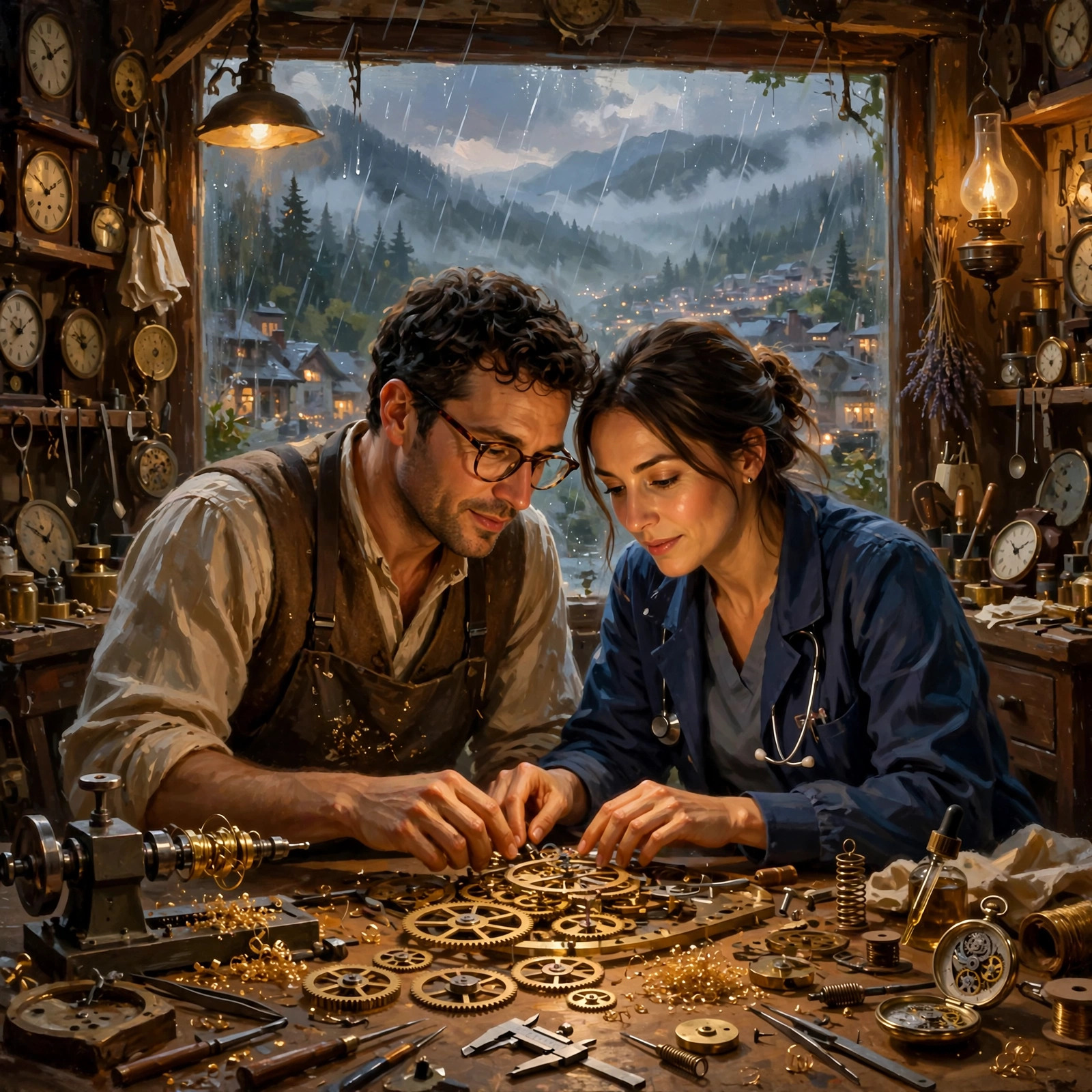
He wore a dark wool jacket over a rolled-sleeve chambray shirt, a worn leather tool roll tucked beneath one arm and a gleam of newly turned brass resting in his open palm. Cold Wednesday wind followed him inside, carrying the sharp scent of fallen maple leaves into the antiseptic quiet.
Ester turned, one hand still smoothing the top fold of bleached cotton. For two seconds her expression went utterly still, the protective arithmetic of a mother who had watched her daughter sleep on the clinic cot through three winters rather than ask anyone for a ride home. Then decades of small-town manners softened the corners of her mouth, though her dark eyes stayed watchful.
"Malachi," Ester said, wiping her palms on her cardigan before offering a brief, firm handshake. "Word down at the post office was you'd taken down the paper from the clockshop windows. You look well. Taller, though I suppose that's just the shoulders."
"Mrs. Penrose." Warmth broke cleanly across Malachi's face, genuine enough to tug something traitorous behind Gemma's ribs. He inclined his head with old-fashioned deference, careful not to brush Ester's sleeve with his oil-stained leather roll. "It's very good to see you. Thank you for the lilac cuttings you left on my father's stone last spring. The caretaker told me who brought them."
Ester's gaze flicked once toward Gemma, who stood motionless in the doorway of the sterilization room with her arms crossed over her navy scrub top, before returning to Malachi. "A neighbor remembers her neighbors. Even the ones who stay across an ocean for seven years."
A faint shadow crossed Malachi's jaw, though he didn't look away from the older woman's steady regard. "Yes, ma'am. I deserved that."
"You're here to fix my daughter's boiler before apple-picking season buries her in stitches, so I won't keep you on the mat." Ester hefted her empty willow basket onto her hip and reached for her scarf. "The committee meets on Silverbrook Green in ten minutes to string lanterns on the gazebo, and if I'm late they'll hang every wire crooked. Gemma, put those sheets in Room Two before you go home tonight."
"I know where the linen closet is, Mom," Gemma said, stepping back to let her pass, though her pulse hadn't slowed since the bell rang.
Ester paused beside Malachi at the door, giving his forearm a single, measured pat that held equal parts welcome and warning. "Mind the steam pipe at the back of that machine, Malachi. It kicks when the seal catches."
"I'll watch my fingers," he promised.
The latch clicked shut behind her, leaving the clinic abruptly smaller. Down the hall, the wall regulator Malachi's father had serviced twenty autumns ago ticked with unhurried precision. Gemma turned on her rubber-soled shoes and walked back into the cramped sterilization room without waiting to see if he followed.
He did. His boots sounded quiet and solid on the linoleum. He set his phone face-up on the laminate counter beside the sink, unbuckled the leather roll on the stainless prep table, and laid the repaired autoclave valve on a clean blue surgical towel.
Gemma looked down despite herself. Yesterday's hairline split had vanished beneath a seamless collar of freshly turned brass, silver-soldered so cleanly the joint looked poured from light. Every thread had been chased and polished until it gleamed like a watch case.
"You overbuilt it," she said, keeping her voice brisk as she reached for the crescent wrench hanging on the pegboard. "It's an eighty-gallon rural sterilizer, not a cathedral movement."
"Brass under forty pounds of wet steam doesn't care what zip code it's in." Malachi selected a narrow spanner and a spool of high-temperature thread tape from his kit. "If the collar's thin, it'll fracture again by November, and you'll be boiling forceps in a saucepan like it's 1940."
She started to reach for the manifold housing at the side of the brushed-steel chamber, meaning to thread the fitting herself so he could step back and keep his three-foot distance. Malachi moved at the exact same second. In the four-foot gap between the counter and the autoclave cart, his shoulder brushed hers, solid wool and body heat pressing briefly against thin cotton scrubs.
Neither of them apologised, mostly because apologising meant admitting how much voltage that half-inch of contact carried. Gemma stepped left toward the pressure gauge; Malachi braced one knee against the lower cart frame and wound white tape around the male threads with quick, practiced turns of his wrist.
As he fitted the brass cylinder into the manifold port and brought his spanner around to seat it, the overhead fluorescent caught the back of his right hand. Just below his index knuckle sat a fresh, shallow crescent gouge, raw red at the center and darkened at one edge with microscopic brass filings from a lathe tool.
Gemma frowned. "Hold still a second."
"I've got the threads lined up, hang on--"
"Don't torque it yet, you're going to split that knuckle open on the housing." Before he could argue, she reached over to set her hand over his wrist to halt the turn. Wait, no--if she didn't hold the collar while he repositioned, the heavy valve would cant sideways in the soft threads. She shifted her grip onto the wrench handle instead, her fingers closing right beside his to hold tension while he eased his stance.
His skin was hot under hers, rough at the palm, faintly slick with machine soap. Instead of letting go, Malachi went very still, looking down at her pale fingers tucked against his tanned knuckles on the steel handle.
"Tell me when," he murmured, his voice dropping half an octave in the tiled room.
"Go ahead. Quarter turn." She kept her thumb anchored against the cold wrench, refusing to snatch her hand back the way she had yesterday in Darrow Clockworks. Together they pulled the handle downward until the silver-soldered shoulder seated flush against the manifold ring with a dull, solid thud.
Malachi released the wrench first, flipping the intake toggle and dialing up the heating element so water hissed into the lower chamber. While the needle on the round dial began its slow climb from zero, Gemma turned without asking, tore open an alcohol prep pad and a sterile gauze square at the exam counter, and stepped right back into his space.
"Give me your hand."
"Gemma, it's a scratch from chasing the bevel at midnight. I've had worse opening oysters."
"You've got yellow metal dust ground into broken skin, and I'm the only prescriber within twenty miles if you give yourself cellulitis before Saturday." She caught his right wrist by the cuff, turning his palm down under the work lamp. "Humor the management."
A quiet laugh escaped him, barely louder than the rising kettle-hum inside the autoclave. He let his fingers go slack in hers. Gemma dabbed away the tiny glint of lathe swarf with the corner of wet gauze, her touch clinical and swift even while the heat radiating off his chest made her throat feel tight. Up close, she could see the faint silver thread of an older scar near his thumb, one she didn't know, earned somewhere in Switzerland while she had been learning to read pediatric X-rays alone at her kitchen table.
He watched the crown of her bent head rather than his hand. "You didn't leave," he said quietly.
She pressed an adhesive strip neatly across his knuckle without looking up. "Hard to miss, seeing as my name's painted on the front window."
"You used to talk about applying to the trauma fellowship in Portland once your loans cleared." His fingers flexed slightly as she smoothed the tape edges down, brushing the center of her palm. "When your mother mentioned you were running the whole practice solo, I wondered."
"Ester retired when her knees gave out on twelve-hour shifts. If I'd gone to Portland, four hundred families between here and the ridge would be driving an hour over black ice every time a kid spiked a fever." Gemma tossed the wrapper into the pedal bin and leaned back against the stainless counter, folding her arms again, though her fingers grazed the heavy lump of her keys inside her scrub pocket. "Somebody had to stay, Malachi. Not everybody gets to pack a steamer trunk whenever Silverbrook starts feeling too small."
"Is that why you think I went to Geneva?" Something raw flashed behind his composed gray eyes, cracking the neat horologist's calm he'd worn since yesterday morning. "Because this town felt small?"
"Your father lost the building, and you took the master's bench that got you out. I didn't say I blamed you." She looked past his shoulder at the trembling pressure needle, twenty pounds and climbing, steam beginning to tick softly through the internal pipes. "Ambition makes sense. Staying behind and hoping somebody remembers the return address is the stupid part."
"I never forgot the address." Malachi reached into his open jacket, unhooked the short brass chain from his vest buttonhole, and laid his half of the sawed escapement wheel onto the empty stainless instrument tray between them. The angled brass teeth gleamed dull gold under the harsh clinic bulb, worn smooth along the straight saw-cut where his thumb had worried it for years.
Gemma stared at that jagged half-circle on her sterile tray. The autoclave sighed, testing the new valve collar with a low metallic thrum, no leak, no hiss of escaping vapor.
"Don't do that," she whispered.
"You still have yours on your key ring. I saw it yesterday." He didn't touch her, just stood close enough that she could smell cedar shavings and rain-cooled wool. "Seven years, Gemma. Tell me why it's not at the bottom of the creek behind Town Hall if it meant nothing."
Pride told her to sweep his piece back into his palm and point toward the exit. Instead, some older, hungrier impulse slid her hand into her scrub pocket. She unclipped the split ring from her keys so the clinic brass wouldn't clatter, and set her half of the wheel down on the steel tray an inch from his.
Neither spoke while the steam gauge crept past thirty pounds. Slowly, with the tip of one calloused forefinger, Malachi nudged his crescent across the polished steel until the center arbor hole met hers.
With a soft, unmistakable click, the microscopic kerf of his jeweler's saw locked into its twin. Twenty-four angled brass teeth completed their circle on the tray, looking almost whole except for the hairline scar bisecting the wheel's heart.
Gemma's chest ached so sharply she forgot to guard her face. When she lifted her eyes, Malachi had braced one hand on the counter beside her hip, leaning in just far enough that his gaze dropped to her mouth. The space between them narrowed to a single warm inhale mixed with rising steam from the vent trap.
"Gemma--" he started, his hand lifting an inch from the laminate as if to cup her jaw.
Beside the sink, his phone buzzed hard against the formica, skittering half an inch with a bright double chime.
Neither of them wanted to look, yet both of them did. The lit screen sat right beside a box of nitrile gloves, clear black letters bannered across the glass: Portia Langley: Driving up with my father Friday before noon instead of Saturday. Have the paperwork ready at the shop.
The heat drained out of the small tiled room faster than winter air through a broken pane. Malachi's jaw locked; his lifted hand dropped back to his side, curling into a loose fist against his thigh.
"Gemma, listen to me about Friday--"
"Twenty-seven pounds on the regulator and holding clean," Gemma cut in, her voice startlingly even as she reached down to the stainless tray. Her fingernail caught the seam of the brass wheel and pulled the two halves apart with a tiny metallic scrape.
She dropped her jagged crescent straight into her scrub pocket without clipping it back onto her keys, leaving his half stranded alone on the bright steel.
"Send the invoice over when you get back to Darrow Clockworks," she said, turning fully toward the roaring autoclave to log the test temperature on her clipboard so she wouldn't have to watch him pick his piece up. "The valve holds pressure fine on its own."
Up the Belfry Stairs
Gemma lifted the canvas safety bag clear of the top trapdoor of Silverbrook Town Hall Belfry and bumped the heavy oak hatch back against its iron hook with her shoulder. Cold night air rushed through the open louver arches, smelling of damp granite and fallen maple leaves from Silverbrook Green far below. Across the timber platform, an oil lamp cast an amber pool over the great bronze bells and over Malachi Darrow, who stood in rolled wool sleeves tightening a leather buffer on the largest chime hammer.
"Committee sent extra braided wicks," she said, stepping onto the wide pine floorboards so she would not hover on the ladder like a coward. "And Ester insisted anyone working up in the draft past dusk needed hot cider before he dropped a wrench through the roof."
Malachi lowered his brass caliper and turned. Oil smudged the side of his wrist, and the lamplight caught the dark gold stubble along his jaw. For a second he just looked at her, as if he had listened to every creak of the spiral treads below and still half expected someone else to climb through.
"Tell Ester her knees may be retired, not her aim," he said quietly. "Set the bag by the sill where the wind misses the flame."
Gemma crossed to the stone embrasure beside the west arch. A block of pale yellow beeswax sat next to the squat brass oil lamp, softening slightly in its radiant warmth and sweetening the sharp smell of cold stone. She set the packet of cotton wicks down, then unscrewed the dented steel thermos lid. Steam curled up, rich with cinnamon, clove, and tart local apples. She poured the lid full and held it out instead of setting it down and retreating.
Malachi wiped his palms thoroughly on a clean shop rag before taking the cup. Their knuckles brushed over the warm metal; neither jerked back, though Gemma felt the small jolt travel straight up her forearm.
"How is the clinic valve holding?" he asked over the rim.
"Ran four full sterilization cycles before five o'clock. Not a whisper of steam where it doesn't belong." She leaned one hip against the rough granite sill, tucking her hands into the pockets of her quilted vest. Inside the right lining lay the sawed crescent of brass she hadn't bothered putting back on her keyring since Wednesday afternoon. Its jagged teeth pressed lightly into her palm.
Malachi drank half the cider, watching the dark canopy above Silverbrook Green where the white gazebo glimmered beneath the streetlamps. Down there on Saturday at dusk, the whole town would crowd onto the grass with pockets full of thin brass wish-tags waiting for these hammers to ring in the equinox.
"My father used to bring me up here every Thursday before the chime," Malachi said. He set the half-empty cup on the stone ledge, reached into his trousers pocket, and drew out his half of the escapement wheel. Without fanfare, he laid the curved brass piece flat on the granite right beside the warm base of the lamp. "He'd check the leather striking pads with a feeler gauge, then stand right where you're standing and listen to the river wind through the louvers like the building was alive."
Gemma looked down at the solitary half-gear glinting in the yellow light. The clean cut of his jeweler's saw from 2017 still showed every tiny file mark along its inner edge.
"You don't have to explain yesterday's text to me, Malachi," she said, though her voice came out lower than the brisk nurse's tone she had hidden behind at Silverbrook Clinic. "You came home with a business plan and a fiancée. People grow up and make sensible arrangements."
"Don't call it sensible." He turned fully toward her, bracing one boot against the timber frame of the tenor bell. "And please don't pull the hatch shut over your head the way you did yesterday afternoon before I could finish a sentence."
Heat prickled under Gemma's collar because the shot landed dead center. Slowly, she drew her hand from her vest pocket. She looked at the jagged curve resting on her palm, then leaned down and fitted her half of the retired tower wheel against his on the warm stone sill. The center arbor holes kissed; the microscopic kerf slid home with a faint, dry click. Beside the beeswax and the flickering lamp, the brass circle lay whole again.
"I'm still standing here," she said. "Talk."
Malachi stared at the joined wheel for a long beat, his chest rising once, hard, beneath his flannel shirt. "When Darrow Clockworks went under and the bank auctioned my father's lathes, it broke him faster than his heart did. Seven years in Geneva, every bench I rented, every rich collector's repeater I rebuilt, I told myself one thing: I would never walk back onto Silverbrook's main street unless nobody on earth could take that shop away from me."
"So you partnered with Victor Langley," Gemma said quietly.
"Victor bought the building note and the machinery paper from the regional bank before I came stateside," Malachi answered, his voice rough with self-disgust. "Eighty-five thousand dollars on a commercial demand mortgage. Portia and I met through his Boston supply house. She didn't want a husband any more than she wanted a house in Silverbrook. What she wanted was her father signing over regional management of Langley Precision Supply, and Victor wouldn't hand the division to an unmarried daughter."
Gemma blinked, the cold draft off the louvers sharpening against her cheeks. "She doesn't love you?"
"Portia hates the quiet here after twenty minutes, and she told me over dinner in March that romance was an expensive distraction from logistics." Malachi gave a humorless half-laugh, rubbing the back of his neck. "We shook hands like two accountants. Victor writes off the eighty-five thousand dollars when the marriage license is filed, bundles the Langley restoration contracts into my shop, and Portia gets her Boston corner office by winter. Nobody gets hurt because nobody pretends it's real."
Silence settled under the heavy timber rafters, broken only by the tiny hiss of oil drawing up the lamp wick. Gemma looked from the locked brass wheel on the granite to the man standing two feet away.
"Then why did you look like a man walking to the gallows when her name lit up your phone?" she asked.
"Because you walked into Darrow Clockworks on Tuesday morning carrying a cracked clinic valve and glaring at me like seven years hadn't dulled a single edge." Malachi took one step closer, closing half the distance between them. "Because in ten minutes at my workbench, every neat, gutless ledger entry I made in Boston turned into a lie I couldn't stomach."
Gemma's pulse stumbled hard against her ribs. Habit screamed at her to step back toward the trapdoor, to remind him about eighty-five thousand dollars and binding signatures before she let hope anywhere near her bloodstream. Instead she gripped the cold edge of the stone sill behind her hip and held her ground.
"Victor and Portia will be in town before noon tomorrow," she whispered. "With paperwork."
"Let him bring a briefcase full of it." Malachi stopped directly in front of her, close enough that the warmth coming off his wool sleeves cut right through the autumn chill, smelling of beeswax, spiced cider, and clean brass filings. "I'm meeting Portia alone the minute her car pulls in, and I'm ending the engagement before noon strikes. I'll find another way to settle Victor's note even if it strips the walls bare, because I am done trading my life for a lock on a door."
"Malachi--" Her voice cracked on his name. "If Victor calls that loan--"
"Then it's my debt to answer cleanly, not a reason to belong to someone else while I'm looking at you." Slowly, giving her every chance to turn her head away, he lifted both hands and cupped her face. His palms were warm and rough-calloused from the lathe, his thumbs resting just beneath her cheekbones as if she were the rarest mechanism he had ever been trusted to hold. "Tell me to step back, Gemma, and I'll climb down that ladder right now. Just don't tell me Tuesday meant nothing."
She couldn't have lied if the belfry roof came down. Reaching up, Gemma caught the front of his flannel shirt in both fists and pulled him the last inch down to her.
His mouth met hers with a sudden, starving heat that stole the air straight out of her lungs. Nothing about it was careful or measured. Malachi groaned low in his throat, one arm sliding down from her jaw to band tight around her waist, lifting her half off her heels against his chest while his other hand tangled into the loose hair at her nape. Gemma parted her lips on a shaky gasp, tasting warm cinnamon cider and salt, seven years of swallowed grief breaking open all at once.
She slid her hands up over his shoulders, feeling the taut muscle under the wool shudder as she angled her mouth deeper against his. Above them, the great silent bronze bells held the night wind in their curves while Malachi kissed her again and again, slow and drugging and fierce by turns, until her knees went watery against his thighs and every defensive wall she had mortared since twenty-four came unpinned.
When they finally broke apart, neither moved an inch back. Malachi rested his brow hard against hers, his chest heaving against her ribs, his thumb tracing one trembling line across her lower lip before his head dipped to press a rough, lingering kiss against her temple.
Breathing hard, Gemma let her forehead drop against the solid warmth of his collarbone, listening to the wild, uneven hammer of his heart beneath the flannel. Without letting go of his shirt with her left hand, she reached sideways toward the lamplit sill, slid her half of the warm brass gear free of its twin, and closed her palm tightly around the metal, daring for the first time in seven years to believe he might choose Silverbrook on honest terms.
The Glass Counter
The iron belfry key knocked solidly inside Gemma’s coat pocket as she pushed open the front door of Darrow Clockworks at noon on Friday, bringing in a brisk gust of autumn air from the sidewalk.

She had left Silverbrook Clinic for twenty minutes between morning walk-ins and afternoon blood draws, expecting either an empty showroom or the muffled quiet of a hard conversation finishing in the back office. Instead, crisp white legal sheets lay fanned across the long glass display case from one polished brass corner bracket to the other.
Two strangers stood on the customer side of the counter, flanked by an open calfskin briefcase.
The older man wore a charcoal cashmere overcoat unbuttoned over a tailored vest, his silver hair combed straight back from a sharp, ruddy brow. Beside him stood a tall, immaculate woman in camel wool, her dark chignon pinned without a stray hair in sight, holding a slim leather folio against her hip as she surveyed the nineteenth-century wall regulators ticking in stately unison along the wainscoted wall.
Behind the glass counter stood Malachi.
He wore a clean white shirt with the cuffs buttoned at his wrists, his dark hair neatly brushed, though the muscles along his jaw were pulled taut enough to carve shadows beneath his cheekbones. An uncapped fountain pen rested beside his right knuckle on the glass.
At the jingle of the shop bell, all three heads turned toward the doorway.
"Gemma," Malachi said, straightening so abruptly that his hip bumped the wooden cash drawer behind him.
Before she could take a step past the threshold mat, the silver-haired man tapped the back of his knuckles briskly against the top sheet of heavy bond paper in his grip. "There now, Malachi, that settles the hardest ink of the autumn," Victor said, his baritone filling the cedar-paneled room with easy proprietorship. "Having your signature on the final equipment schedule puts the whole forgiveness rider in motion right on calendar. Once the October banns are behind you two, this building sits clear of the eighty-five-thousand-dollar note and we never have to look at another lien filing."
The floorboards beneath Gemma’s boots seemed to tilt an inch toward the street.
She looked down at the counter. Thick black paragraphs marched across the crisp vellum, bordered by notched red tabs and the embossed seal of Precision Supply at the top of the schedule. Right beside Malachi’s hand, dark blue ink shone freshly dried on an initialed equipment annex.
The woman in camel wool turned toward Gemma with a cool, practiced smile that never touched her dark eyes. She stepped smoothly forward, extending a slender, ungloved hand across the narrow strip of pine floor between them, a square-cut diamond catching the noon window light above her knuckle.
"Hello," she said cleanly. "You must be one of the neighbors on the block. I’m Portia, Malachi’s fiancée. My father and I drove up from Boston early this morning to go over the autumn property papers before the festival crowd clogs the highway."
Gemma accepted the brief, dry handshake and let go at once, keeping her left palm buried deep inside her wool pocket where the heavy iron belfry key lay beside a curved half-moon of warm brass. "Gemma Penrose. I run Silverbrook Clinic next door."
"Ah, the brick cottage with the lilac hedge," Portia murmured, glancing back toward the front window with mild, appraising interest, as if measuring frontage rather than trees. "Father and I were actually looking at the town parcel map over coffee. Once the main street restoration contracts ramp up next spring, we’re hoping to look into annexing that adjoining clinic lot to expand the precision workshop bay and put in proper loading access from the rear."
"Portia," Malachi cut in sharply, his voice dropping an octave. "The clinic lot isn't on any map of mine, and nothing is getting annexed."
Victor chuckled from the counter, unbothered, folding the heavy mortgage schedule neatly in half between his palms without surrendering an inch of it. "Plenty of snow between now and spring zoning, son. No need to rush the neighbors while we're still uncorking the ink on today's business. Miss Penrose knows main street buildings change hands when growth comes to a quiet town."
"Silverbrook Clinic isn't main street retail," Gemma said evenly, though the pulse in her throat beat hard and fast against her collar. She didn't look at Victor or Portia. She looked straight across the glass display case at Malachi.
Last night in the high stone belfry of Silverbrook Town Hall, with lantern light gilding the old bronze bells overhead and cinnamon cider still warm on their tongues, he had looked down into her face and sworn he would end this arrangement the moment Portia arrived before noon. It was twelve-fifteen. The calfskin briefcase had clearly been open for half an hour. Fresh blue ink sat on an equipment schedule under his palm.
"Malachi?" Portia asked lightly, tilting her head a fraction as she registered the tight, unbroken line between the man behind the counter and the nurse standing by the door. "Did we interrupt an errand?"
Say it now, Gemma thought, the plea rising so fiercely inside her ribs it nearly crossed her lips aloud. Tell them both right here while the sun is up. Tell them the ink stops today.
Malachi opened his mouth. He braced both palms flat on the edge of the glass case, leaning forward as if to come around the oak gate at the end of the counter.
"Victor, Portia, listen to me--" he started.
Beside him, Victor shifted his stance and lifted the folded eighty-five-thousand-dollar mortgage schedule slightly, tapping its stiff corner against the mahogany casing of the tallest nineteenth-century regulator on the wall—the six-foot rosewood Vienna piece Malachi’s late father had spent winters restoring before insolvency stripped the shop bare. The long brass pendulum swung behind beveled crystal, ticking with slow, magisterial authority into the hush.
"Careful, Malachi," Victor murmured, his congenial tone cooling into iron business sense as he caught the heat in the younger man's voice. "Portia has a three o'clock call with the regional board in Boston, and my attorneys already logged the morning filing. Let's not muddle personal errands with shop solvency."
Malachi froze.
It lasted no longer than a single swing of the rosewood regulator’s pendulum—there, back, there again. Three seconds in the bright noon light of the showroom. His gaze flicked sideways from Gemma’s face to the thick mortgage schedule in Victor’s hand, then up to the gleaming rosewood crown of the regulator on the wall. The old, boyhood dread of padlocks and auctioneers flashed stark and naked across his features, locking his shoulders rigid behind the glass.
He didn't speak. For three full heartbeats, standing three feet from his fiancée with a signed equipment annex under his wrist, he calculated the ruin.
Something cold and terribly quiet clicked shut inside Gemma’s chest.
She knew that silence. She had stood inside its exact Twin seven autumns ago on a wet porch while a twenty-six-year-old boy with raw ambition and his father’s broken pride stared past her shoulder toward Geneva, weighing what she was worth against the terror of coming up empty-handed. Back then she had waited until his train pulled out to understand that when a man’s pride and safety went on the scales, Gemma Penrose was always the weight set aside on the shelf.
She was thirty-one years old now. Her mother’s bad knees had taught her how to carry an entire town’s fevers, stitches, and midnight scares on her own two shoulders without leaning on a soul. She would not stand in another man’s doorway waiting to be trimmed out of his ledger a second time.
"Gemma, wait," Malachi breathed, breaking out of his stillness a second too late, shoving the little oak counter gate open with a sharp crack against the wall. "That page on the glass is only the machine inventory from Tuesday's delivery—I haven't touched the rider. Let me take Portia into the back room like I told you I would."
Portia’s dark brows lifted sharply. "Like you told her you would?" she repeated, her smooth Boston composure thinning into sudden, watchful irritation as she looked between them. "Malachi, what on earth are you talking about?"
"Nothing that requires a back room," Gemma said.
Her voice came out clear, level, and terrifyingly steady, the exact clinical cadence she used when closing a deep laceration while a patient panicked on her exam table. She walked forward three measured paces until the toes of her leather boots touched the base of the glass display case.
Malachi stepped into the aisle to intercept her, reaching out with a lathe-calloused palm, his hazel eyes dark with alarm. "Don't do this. Don't shut the door in your head because Victor walked in twenty minutes before I could get Portia alone."
Gemma shifted half a step to her left so his outstretched hand met empty air.
"I came over on my lunch break to return town property and clear my clinic's tab," she said, looking straight past his shoulder at the crisp white contract spread across the glass. "The steam autoclave in Silverbrook Clinic ran three full surgical-pack cycles this morning without dropping a pound of pressure. Your lathe work holds."
"Damn the autoclave, Gemma, look at me--"
She reached into her coat pocket, drew out the heavy iron key to Silverbrook Town Hall Belfry, and laid it down on the glass counter with a dull metallic clack. It rested two inches from the red-tabbed edge of Victor’s paper schedule.
"The town clerk asked for the belfry key back before tomorrow's setup on Silverbrook Green," Gemma continued, never raising her voice, never hurrying a syllable while Victor watched with narrowed eyes and Portia folded both arms tight across her camel coat. "The bell hammers are balanced and oiled. Whoever rings the Equinox Chime tomorrow night won't need me up the ladder."
"Gemma, stop," Malachi said roughly, stepping closer despite their audience, reckless now that the ice had already formed in her eyes. "You know what last night was. Give me ten minutes to finish what I promised."
"Keep your ten minutes, Malachi. Keep your rosewood clocks and your clear deed, too." Reaching back into her deep wool pocket one last time, Gemma closed her palm around the jagged, saw-toothed half of the brass escapement wheel she had carried through seven New England winters.
For one brief instant the metal felt warm from her own skin, every hand-filed brass tooth familiar against her palm.
Then she drew it out into the cold noon glare and set her half of the brass medallion sharply onto the glass counter, right beside Victor’s contract and the iron belfry key. The metal struck the thick plate glass with a bright, ringing ping that cut straight across the steady ticking of twenty wall clocks.
Malachi stared down at the severed half-gear glinting between the black legal clauses and his fiancée’s leather folio. All the color drained out of his face.
"Our clinic account is settled in full," Gemma told him quietly. "Send the paper invoice next door if your bookkeeper needs a receipt for the valve sleeve. Good afternoon, Mr. Victor, Miss Portia."
"Gemma--" Malachi started after her, his boot catching the edge of the threshold runner as Victor caught his sleeve with a sharp, low warning.
Gemma didn't pause, didn't quicken her stride, and didn't look back through the wavy front glass. Pushing the heavy shop door wide into the crisp Friday wind, she stepped out onto the main street sidewalk and walked straight toward Silverbrook Clinic, leaving the little brass bell jangling overhead and her half of the notched escapement wheel glinting cold and solitary between Malachi and his fiancée.
The Equinox Chime
Gemma shifted the copper urn on the folding table at the edge of Silverbrook Green, ladling hot spiced cider into a paper cup before her mother had to lean over the trestle. Dusk was settling purple and crisp across the grass. Around the white-painted gazebo, neighbors clustered in wool sweaters, holding slender brass wish-tags on red twine that caught the amber glow of the streetlamps.
Next door inside Silverbrook Clinic, the repaired steam sterilizer sat cool and silent after a smooth Saturday morning run, its custom brass valve holding pressure without a whisper of leaked vapor. Across the asphalt, the display windows of Darrow Clockworks looked strangely dim.
"You've poured three cups for the baker's boy, sweetheart," Ester said mildly from her folding chair, a plaid blanket tucked around her bad knees. She nodded toward the curb behind their booth. "And you have company."
Gemma set the ladle down. Parked beside the granite boundary post sat a sleek charcoal sedan, its trunk popped open. Portia stood at the bumper in a tailored trench coat, hoisting a leather weekender bag into the cargo space with brisk efficiency. She shut the lid with a solid thud, dusted her palms together, and walked over to the cider table.
"Miss Penrose," Portia said, nodding politely to Ester before meeting Gemma's gaze. No diamond flashed on her bare left hand. "Do you sell that by the cup, or is it strictly for locals who enjoy freezing on a lawn?"
Gemma reached for a fresh cup, keeping her expression even. "No charge on the equinox. Cinnamon stick?"
"Please. I have a long drive down the turnpike ahead of me." Portia accepted the steaming cup, wrapping her manicured hands around the cardboard rim. She glanced across main street toward the dark storefront of Darrow Clockworks, one brow lifting with dry amusement. "You didn't leave much paint on the walls yesterday afternoon when you walked out. I almost applauded, except my father was turning the color of a plum."
Gemma's throat tightened. Beside her, Ester quietly busied herself straightening napkins.
"I only came in to return the town key," Gemma said.
"Right. And a jagged piece of clockwork that made Malachi look like someone had kicked the wind out of his ribs." Portia took a careful sip of cider and sighed, her shoulders dropping an inch inside the camel wool. "For what it's worth, your clinic lot is safe. Malachi ended our engagement over breakfast this morning. Handed back my father's redevelopment lease unsigned and refused every restoration contract tied to our family's name."
The ladle slipped an inch against the copper rim before Gemma caught it. Across the green, children chased each other around the gazebo steps, their laughter bright in the cooling air.
"Your father holds the note on his building," Gemma said quietly. "Calling it due ruins him."
"My father tried," Portia replied, utterly without malice. "He gave Malachi until noon to reconsider or wire the payoff. By nine o'clock, Malachi had an antiques broker up from Hartford with a padded box van. He signed a dealer's bill of sale on the spot and crated up every single one of those nineteenth-century regulators off his walls. Even the tall rosewood piece in the corner."
Gemma stared at her, the spiced steam rising between them. "His father's regulator?"
"Every clock in his private collection," Portia confirmed. "Wired my father the full eighty-five thousand dollars at eleven-forty, took the notarized release receipt off the hood of the broker's van, and wished us both a safe drive out of Silverbrook." She tipped her paper cup toward Gemma in a crisp salute. "Frankly, he did me a tremendous favor. My father stormed back to Boston at lunch, furious enough to wash his hands of my marriage prospects altogether. I get to sleep in my own Beacon Hill apartment tonight without pretending I care about escapement gears or country festivals."
"You don't sound brokenhearted," Ester murmured from her chair.
"Not remotely, Mrs. Penrose. Your cider is lovely, though." Portia took one more sip, tucked her keys into her pocket, and looked directly at Gemma. "His shop walls are stripped bare down to the plaster hooks, Nurse Penrose, and he's been pacing behind that dark window since the van pulled out. Try not to punish him twice for hesitating once. Men with proud fathers are notoriously slow learners."
With a faint, genuine smile, Portia turned back to her sedan, slipped behind the wheel, and pulled smoothly away from the curb, her red taillights disappearing around the bend toward the highway.
Gemma stood frozen beside the cider urn, her pulse hammering against her ribs.
"Go on, Gemma," Ester said softly, reaching out to take the ladle from her daughter's hand. "My knees aren't pouring cider, my hands are."
Before Gemma could step around the table, a low, resonant vibration trembled through the soles of her boots. High above Silverbrook Green, inside the stone arches of Silverbrook Town Hall Belfry, the oiled bronze hammers swung back and struck.
The first deep note of the Equinox Chime rolled out across the valley, rich and clear and perfectly balanced. Conversations hushed across the grass. Dozens of townsfolk tilted their faces toward the darkening sky as the second bronze peal followed the first, brass wish-tags chiming softly together in raised hands.
At the brick path bordering the shadow of the maples, near the stone gazebo steps, a tall figure stood watching her through the gathering dusk.
Gemma untied her canvas apron, laid it over the back of Ester's chair, and walked across the trampled autumn grass while the belfry bells rang overhead.
Malachi wore no coat over his rolled flannel sleeves, though the evening wind had teeth. Wood shavings clung to his cuffs from packing crates, and a faint smudge of crate ink marked his jaw. As she stopped two paces from him beside the bottom step of the gazebo, the third bronze chime washed over them both, vibrating right through the air between their chests.
He didn't reach for her arm or crowd her space. Slowly, he drew his right hand from his trouser pocket and opened his palm between them.
Resting against the calluses of his lifeline lay a crisp, folded paper stamped with a bank wire confirmation and a red notarized release seal. On top of the folded paper lay both halves of the hand-filed brass escapement wheel from 2017, their sawed teeth nestled close, catching the warm lantern light from the gazebo railings.
"I froze yesterday," Malachi said, his low voice pitching clear under the fourth roll of the bells. "When Victor tapped that paper near my dad's rosewood case, every bad memory from seven years ago locked my knees. I let three seconds pass when I shouldn't have let half a breath come between us."
Gemma looked down at the two notched crescents of brass in his open palm, then up into his dark, tired eyes. Her throat ached with the truth Portia had already handed her.
"Portia stopped for cider," Gemma said, her voice unsteady. "She told me about the Hartford broker. Malachi, your collection--your father's regulator--"
"Wood and brass, Gem," he said simply. "My father loved making clocks work for the people who lived here. Keeping museum pieces behind locked doors while signing away my own life wasn't honoring him. It was hiding." He lifted his thumb slightly, nudging the mortgage release receipt. "The building and the lathes are mine, free and clear. No riders, no silent partners, and nobody touching a blade of grass near Silverbrook Clinic."
Shame, sharp and clarifying, warmed Gemma's cheeks in the cool twilight. For seven years she had worn self-reliance like armor, so terrified of coming second that she had bolted at the very first shadow of doubt.
"You asked me for ten minutes," Gemma whispered as the fifth chime echoed off the surrounding hills. "You told me up in the belfry what you were going to do on Friday, and the moment I saw those papers on the glass, I didn't let you speak. I threw seven years back at you and ran out the door so I could say I left first."
"You had seven years of reasons not to trust a promise from me," Malachi answered quietly.
"I had Thursday night in the belfry," she countered, stepping closer until the hem of her wool skirt brushed his boots. She reached out and rested her palm lightly against the underside of his wrist, feeling the rapid, living beat of his pulse beneath the warm skin. "I was scared, Malachi. I panicked instead of standing beside you for five minutes while you fought your corner."
His breath left him on a rough exhale. Carefully, without closing his hand until she chose, he tilted his palm toward her. Gemma lifted her half of the brass medallion from the paper, feeling the familiar, hand-filed notches bite gently into her skin, though she didn't slip it back into her pocket.
Overhead, the twelfth and final bronze peal of the Equinox Chime rang out across Silverbrook, lingering in the crisp dusk air until a warm cheer erupted across Silverbrook Green. Neighbors surged cheerfully up the gazebo steps around them, laughing and stretching on tiptoe to tie hundreds of glinting brass wish-tags along the white wooden railings.
Lantern light danced across Malachi's face as a laughing couple brushed past his shoulder with mugs of cider.
"It's loud out here," Malachi murmured, his gaze holding hers through the festival crowd, raw and unguarded in a way she had never seen him look, not even at twenty-six. He nodded back across main street toward the dark brick alley beside Darrow Clockworks. "The shop walls look pretty bare right now, and there's nothing ticking inside, so it's terribly quiet. Walk across the street with me to the back garden, Gemma?"
Closing her hand tight around her half of the brass wheel, Gemma reached with her free hand and laced her cold palm directly into his warm one. "Lead the way."
Two Halves Riveted
Malachi lifted the iron latch on the alley gate behind Darrow Clockworks, letting the cedar door swing inward before stepping aside so Gemma could pass first into the small walled garden. Across the pitched slate rooftops, the first bright scrape of a fiddle rose from Silverbrook Green, braided with the warm murmur of neighbors calling over cider barrels. Inside the chest-high fieldstone walls, the autumn air hung still and cool, carrying the sharp, green scent of crushed thyme underfoot and windfall apples softening in the grass.
Gemma kept her palm tucked inside his as they crossed the flagstones. When they reached the narrow back porch, Malachi reached up with his free hand and pulled the beaded brass chain by the door. A single amber bulb flickered to life overhead, spilling golden light across his weathered outdoor worktable, a heavy cedar garden bench, and the low, gnarled boughs of an old Russet apple tree leaning over the wall.
"Wait right here," Malachi said softly, reluctantly letting her hand go.
"I'm not going anywhere." Gemma leaned her hip against the edge of the wooden worktable, folding her wool coat closer against the evening chill while keeping her fist curled around the notched half-wheel in her palm.
Through the multipaned back window of Darrow Clockworks, the amber porch light caught pale rectangles on the plaster walls inside. Empty brass hooks jutted out where tall mahogany and rosewood cases had hung two mornings ago. Not a single pendulum swung in the dark showroom. Watching him unlock the back door and step briefly inside to retrieve a small canvas roll from his main bench, Gemma felt an unexpected tightness crowd her throat.
For years she had walked down main street past those shuttered front windows, telling herself she preferred a life where she owed nobody a favor and depended on no one to stay. Even at Silverbrook Clinic, when winter flu flattened half the valley, she had worked double shifts rather than ask her mother to come out of retirement for an afternoon. Keeping the bolt slid shut from the inside had felt wise. Looking at those bare plaster rectangles in the dark shop, she saw how expensive armor really was.
Malachi stepped back onto the porch, pulling the shop door shut until the latch clicked. He unrolled the canvas cloth beside the small cast-iron anvil bolted to the corner of the outdoor worktable, exposing a row of miniature punches, files, and a slender chasing hammer with a polished hickory handle.
"You kept an anvil out in the herbs?" Gemma asked, tipping her head toward the dark clumps of rosemary and winter savory crowding the base of the porch steps.
"My father bolted it out here before I was tall enough to see over the apron," Malachi replied, a faint smile tugging at the corner of his mouth. "Summer evenings got too stifling over the soldering lamp inside, so he'd bring brass stock out under the apple tree until the mosquitoes drove him in. When I swept out the yard last weekend, the bolts were rusted solid into the oak planks, so I oiled the iron and left it."
He reached into his waistcoat pocket and drew out his half of the retired tower clock escapement wheel, setting it flat on the smooth face of the iron block. Then he looked up at her, his dark eyes steady under the warm porch bulb, and held out his open palm.
Without hesitating, Gemma uncurled her fist and laid her worn brass crescent into his hand. The metal had warmed against her skin during the short walk from Silverbrook Green.
"When I sawed this in half the night before I left," Malachi murmured, turning both pieces onto the iron face so their hand-filed teeth faced each other, "I thought I was being terribly noble. Giving you half a promise while I went off to chase guarantees."
"You were twenty-six and watching everything your family built go up on an auction block," Gemma answered quietly, stepping closer until her shoulder brushed his coat sleeve. "Neither of us knew how to ask the other to carry half the weight."
"I spent seven years swearing I'd never stand in an empty shop again." Malachi slid the two jagged center cuts together on the anvil. With a soft, metallic whisper, the dovetailed notches he had filed in 2017 meshed cleanly, turning two broken crescents back into a complete, spoked brass gear with a tiny, split pinhole dead in the center. "Turns out an empty shop isn't what scares me, Gemma. Standing in a full one while you walked away up main street nearly stopped my heart."
From a tiny corked glass vial tucked into the canvas roll, he shook out a single short length of heavy brass wire, scarcely thicker than a sewing needle, with one end already domed like a miniature nailhead. Holding the joined escapement wheel steady on the iron block, he guided the brass pin straight down through the center bore where the two halves met. Because he had cut the keyhole notch directly across that central arbor hole seven years ago, the snug brass pin locked both halves laterally the instant it slid home.
With a pair of small nippers, Malachi trimmed the protruding wire flush, leaving a hair's breadth of bright new brass gleaming above the darker patina of the wheel. He picked up the chasing hammer, balanced the domed steel face over the pin, and brought it down in one crisp, ringing tap.
The tiny note chimed clear in the quiet garden, distinct even against the distant reel of the fiddle drifting down from the town gazebo. Malachi turned the wheel over, checked the flared head of the rivet with his thumb, and gave the reverse side one gentle, finishing strike to seat it smooth.
When he lifted the escapement wheel from the anvil, it rose as a single unbroken piece. No seam shifted. No daylight showed between the halves.
Malachi set the hammer down and turned fully toward her. Taking her right hand, he turned her palm upward and placed the riveted brass gear in the center of it.
"No halves," he said, his voice low and rough around the edges. "No contingency clauses, and no back doors. It doesn't come apart again unless somebody takes a cold chisel to it, and I'm throwing mine in the creek."
Gemma looked down at the whole brass wheel resting in her open hand. The newly peened rivet gleamed bright gold at the hub, binding the two softened, pocket-worn crescents that had spent seven autumns apart. The metal felt warm from the friction of the hammer blow and the heat of his skin.
She didn't close her fist to hide it away, and she didn't step back toward the gate. Lifting her gaze to his face, she took in the faint smudge of bell oil still lingering near his temple from Thursday evening in Silverbrook Town Hall Belfry, the tired lines bracketing his mouth after a morning spent dismantling a decade's worth of armor, and the fierce, quiet hope he wasn't trying to disguise.
"Yesterday afternoon," Gemma said, keeping her voice clear even as her chest rose on a quick breath, "I walked out of your front room because I told myself if I shut the door first, I wouldn't have to hear the latch click behind you. I've been bracing for people to leave since I watched your tail lights disappear down the valley road. I'm done bracing for the door to close, Malachi."
Stillness settled over him, deeper than any silence inside the dark clockshop. He didn't interrupt, giving her all the room in the world to finish.
"I love you, Malachi," Gemma said plainly. "Not the boy who left, and not some bulletproof businessman who never makes a mistake. You, right here."
Something tight and guarded broke open across his expression. Reaching up with both hands, Malachi framed her jaw, his calloused thumbs resting warm and gentle along her cheekbones as he tipped her face toward the amber light.
"I love you, Gemma," Malachi answered just as plainly, his forehead coming down to rest briefly against hers before he pulled back half an inch to hold her eyes. "An empty wall in Silverbrook with you beats every regulator ever built. Keep me busy fixing clinic valves and town hall bells for the next fifty years, and I'll count myself the richest man in the county."
A laugh caught in Gemma's throat, warm and bright, right before she rose onto her toes under the low, crooked boughs of the Russet apple tree. Malachi slid one arm firmly around her waist, drawing her flush against the wool of his coat as his mouth met hers.
There was none of the desperate, stolen urgency that had swept over them up in the belfry before Friday broke over their heads. He kissed her slowly, thoroughly, as though they owned every hour on every clock face in town and had nowhere else to be before spring. Cider smoke and distant laughter drifted lazily over the fieldstone garden wall from Silverbrook Green, mingling with the cool scent of crushed thyme and sweet autumn apples around their boots.
Parting from his lips only far enough to draw a warm breath against his cheek, Gemma lifted her arms to wrap them securely around his shoulders. Sliding her wrist inside the collar of his coat, Gemma closed her hand tight around the riveted brass wheel against the back of Malachi's neck as they held each other in the quiet garden with their town humming just beyond the gate.
Get notified when new stories drop

Ivy Chen
Ivy writes historical and second-chance romance with period texture and modern emotional clarity. Courtship stakes, letters, and choices that cost.
Leave a comment
Comments