


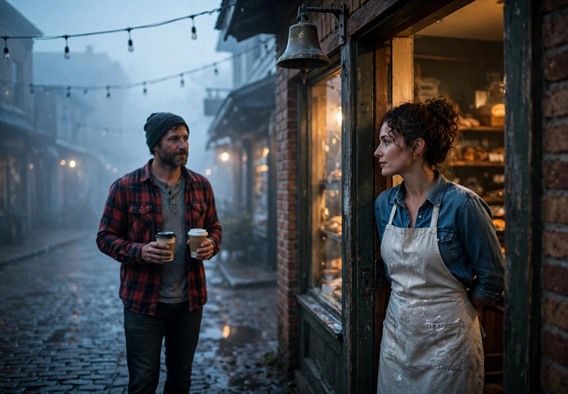
The Tar Bucket
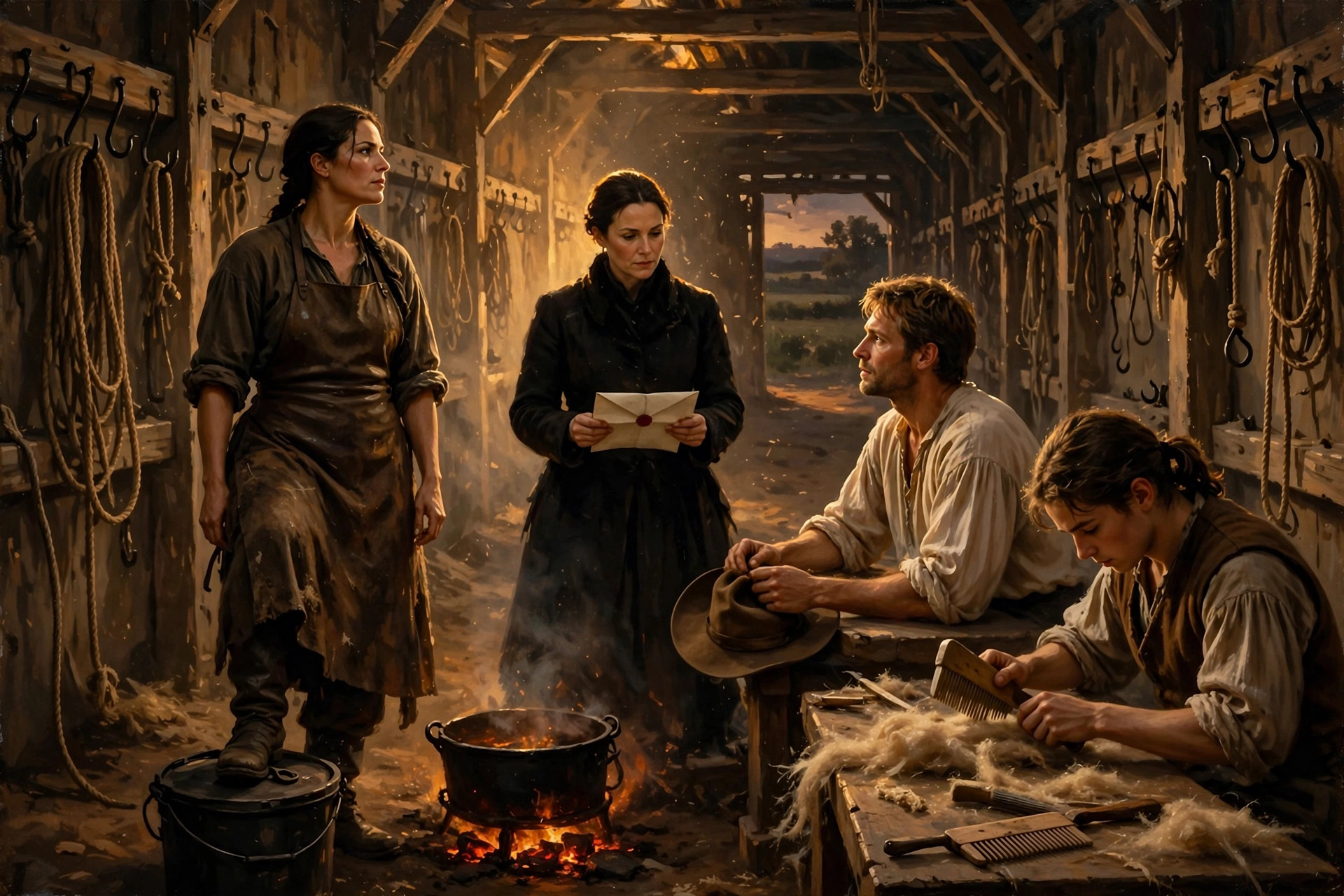
Adair kicked the lid onto the tar bucket and turned on the man standing where her second maker should stand.
"You're in my apprentice's place."
"I was told the far end." Dorian Mowbray had his hat off, which was courteous of him, and his sleeves rolled already, which was not. "All the years I've kept Mowbray Weir I've heard this shed rattle across the water. I never came up the bank."
"Sensible. Stay down there."
Honor Quist stepped between them with a paper held flat, the way she held everything, as though it might otherwise argue back. "The trust commissions one load line for the hanging cradle. Two makers lay it. Two mouths swear over it together, and it holds what they name and nothing else. Adair Fell of Quistlow Rope-Walk, and the sluice-reeve of Undersluice Mill, who holds the charter for the water."
"No."
"Adair."
"You'd put a Mowbray strand inside a rope of mine."
"I'd put the town's supper above the river." Honor tilted the page so the seal caught the glow off the coals. "The Sallow was licking the meadow's edge when I crossed it. The Hanging Granary has a floor, and no floor stays dry forever. Everything Quistlow eats between now and spring has to swing above that flood on a sworn length, and I cannot hang it from one mouth. You know the rule better than I do."
At the bench, Tobin Ock was combing the same handful of hemp he had been combing since the warden came in. He was extremely thorough about it. He had not moved a finger's width down the bale.
"Tobin. You're wasting good fibre."
"Yes, mistress." He moved a finger's width.
Honor lowered the paper. "There's another matter, and I'll say it here rather than let you hear it in the hall. Three hundred dollars on your lease, in arrears, and it falls due the hour Oswin Crake assays your work. The trust's fee is the only money in this town that will cover it. I've held it off as long as I can hold anything."
The coals under the pitch popped and settled. Adair looked down the long dim run of the shed, at the hooks, at the dust turning over and over in the light.
"My mother laid alone," she said. "You know what they say came of that."
"I know what they say." Honor's voice did not shift. "I know what they'll say if the grain goes, too."
Dorian set his hat on the bench, brim down, careful of the tar.
"Then strike my name off," he said. "It's a clean answer. Nobody need be shamed by it. I'll go back down the bank and tell my father the walk refused us, and the trust can write that in its book. If the town would sooner lose its winter than take a strand from a Mowbray, that's a thing the town's entitled to choose."
He said it reasonably. That was the worst of him. He said it like a man offering to hold a door for her.
"You'd let it drown."
"I'd let it be decided by people who aren't being asked to swallow something they hate."
"Get out of my shed."
"I will." He reached for his hat, and stopped, because she had not finished.
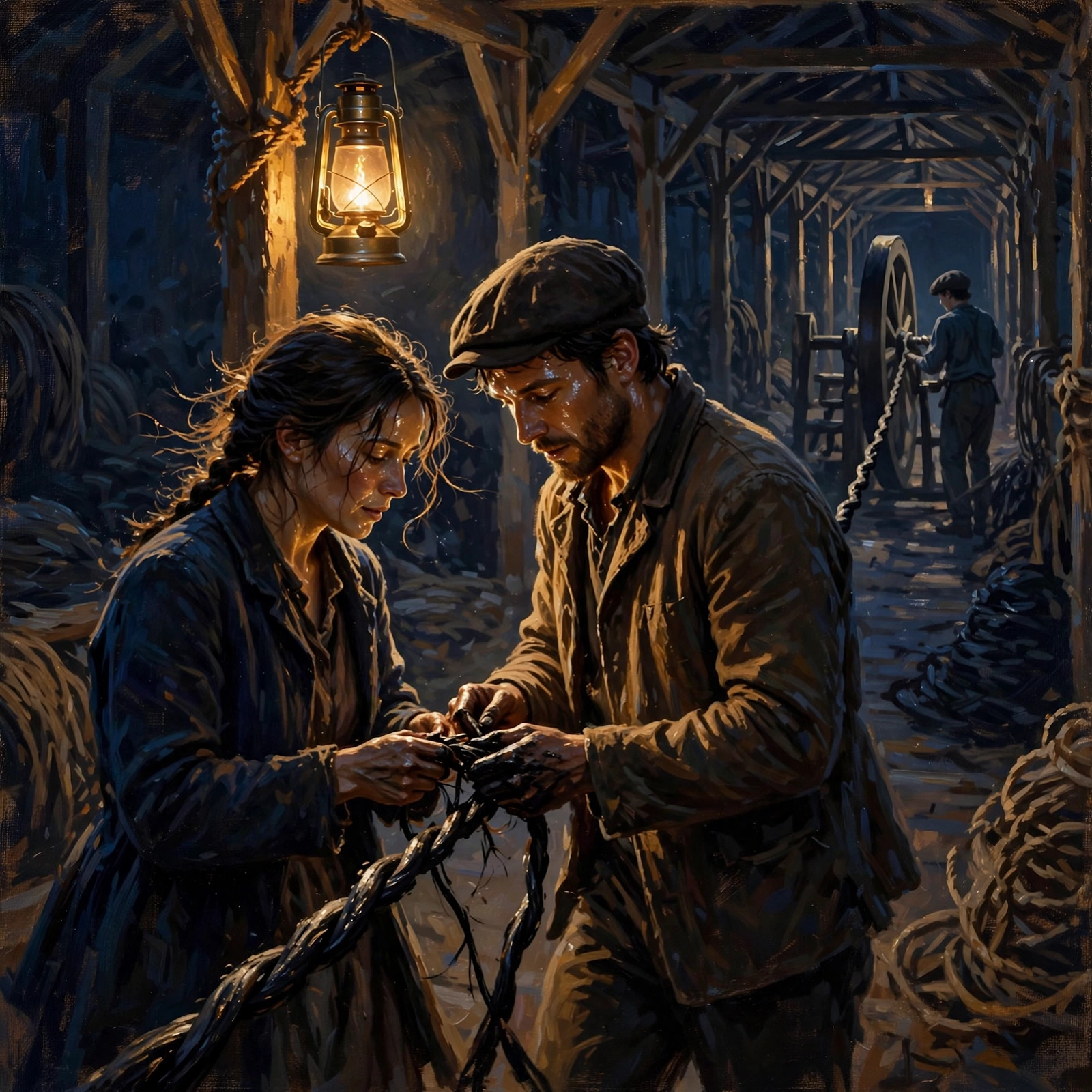
Adair drew the marlinspike off her belt. Steel the width of her thumb, as long as her forearm, the ash haft worn glossy in the shape of another woman's grip. Her mother had forged it out of a broken weir-chain link and filed every tooth by hand, and it had not been out of Adair's reach since the year they pulled her out of the Sallow. She raked the first of the hemp straight with it, slow, letting the dust rise, letting him watch how little she needed him.
"Tobin. The far crank's not yours today."
Tobin's comb stopped. "Mistress--"
"Mind the pot. Keep it just off the boil and don't let it skin."
She pointed the spike at the far end, where the iron spindle sat in its greased cradle.
"There. You turn. I walk backward the whole length of this floor and the lay comes off me as I go, and if you spin faster than I step you'll ruin a bale I paid for with money I haven't got. Have you ever turned one?"
"No."
"Then you'll learn what my apprentice learns in his first month, and you'll learn it before supper."
He went. He wiped his palms on his coat first, which told her everything about how much he understood, and he took the handle in both fists like a man taking a chain.
She walked backward. The heat came off the pot in waves and the dust got into her throat, and the rattle filled the shed the way it had filled every day of her working life, and behind her the river went on rising without asking anyone. Her fingers found the twist without her eyes. The stuff came out of her palms warm and even and hungry for the turn, and she gave it exactly what it needed and no more.
"Slower," she said, at the first quarter.
He slowed.
"You're fighting it. It isn't a gate. It doesn't care how strong you are."
At the halfway hooks his knuckles had gone white and shiny. She saw the skin lift on the heel of his right palm, a pale weal rising and splitting, and she saw him feel it and keep the rhythm anyway, and something in her chest went tight and disagreeable.
"That's blistering."
"I know what it is."
"My mother's palms looked worse than that at the end of a day. Hers held." She let the words sit in the heat. "The mill keeps its men soft. Say so and go home. I'll not tell them you tried."
Dorian's jaw worked. Sweat ran into his collar. "Tell them whatever you like," he said. "Only tell them after."
He did not quit. He did not even slow to spite her. The rattle went on, steady and stupid and faithful, and she hated how much it sounded like relief.
Near the far hooks she turned her back to him and settled something into the heart of the lay with two fingers, quick, the way she had been doing since she was a girl at this bench. It took no time at all. When she faced him again he was watching her shoulders.
"You turned away."
"I turned round. It's a walk. People walk on it."
"Yes," he said, and let it go, and that was somehow worse than a question.
At the end of the run she caught the length off the hook and looked at it against the light: even, tight, honest all the way down, and hers. Tobin brought the pot up the floor with both arms stiff and his eyes carefully on the boards.
Dorian let go of the handle. His palms were raw meat from the base of the fingers to the wrist, wet where the blisters had opened, and he held them slightly away from his sides as if they belonged to somebody he was minding for a while.
Adair looked at them for a long moment. She did not say one kind thing. She took the brush out of the pot, shook the black off it once, and put the handle into his raw right palm, and folded his hand round it with her own because it would not close by itself.
"Tar's yours now. You'll walk backward and dress it as it comes, and you'll not let it cool."
"And you?"
She was already going past him down the long floor, wiping her hands on her apron, and she took the far crank in her fists and set her boots.
"I'll turn," she said. "Start walking, reeve."
The first strand began to turn between them.
The Spinning Wheels
"Slower," Adair said. "You're walking like the boards owe you money."
"I'm a reeve. I go up to a thing and open it. Nobody's ever asked me to go backward on purpose."
"Then you've had a soft career. Heel, then toe. The hemp pays out of my apron, the twist comes off the wheel, your brush keeps the black hot in the lay. Let it cool and you'll have a rope with a cold heart, and I'll burn it."
"You burn rope here."
"I burn bad rope here. Heel. Toe."
They went down the long floor backward together, and the wheel sang at the near end where Tobin leaned into the crank, and the tar pot breathed in its brazier halfway along the run so that every pass carried them through the heat of it. Her eyes ran. Her forearms went slick. The Sallow was loud outside the boards, a sound like a crowd in another room, and under it the small dry click of hemp becoming something that would hold.
He learned her hands before he learned the step. When her thumb pressed down he shortened his stride. When her fingers spread he gave her slack without being told. By the second half of that first long morning he was watching her knuckles instead of his own boots, and the strand came off the wheel even and glossy and black, and she had nothing to shout about, which irritated her more than shouting would have.
"Don't look at me," she said. "Look at the work."
"I'm looking at the work. You keep standing in front of it."
She turned her face away so he wouldn't see the corner of her mouth go.
Later, when a splash of tar went up his sleeve and he looked at it with the patience of a man reading a bill, he said, "I was fond of this shirt."
"It's tar. It's fond of you now. You're married."
"At the mill we say measure twice, swear once, and never do either where the owner can hear."
She laughed. Out loud, one hard bark of it, in her own walk, over her mother's floorboards, with a Mowbray holding a brush. She stopped at once and made her voice flat again and told him his elbow was too high, and he lowered it, and he did not smile in a way she could catch hold of and punish.
They ate on the hemp loft floor with their backs against the bales because the benches were down the walk and neither of them felt like walking to a bench. Tobin brought bread and a wedge of hard cheese and set it on a clean cloth and went back to keep the pot hot. Dorian tore the loaf and gave her the bigger piece without ceremony, and she took it, because she was hungry, and told herself that was the whole of the transaction.
The river went on being loud. It had been at the meadow's edge for days and it had not gone down.
"Where were you," she said, "the night my mother drowned?"
He set his bread on the cloth. He wiped his fingers on his knees, one and then the other, thoroughly, as if the question had put tar on them.
"At Mowbray Weir. On the gate platform with the chains in my hands. I hauled until my shoulders quit on me. Then I went down the bank to Sallow Reach and pulled out who I could get a grip on."
"Who'd you pull out?"
"Two of the cart men. Both lived. One of them still won't speak to me, and I don't hold it against him."
It was all true. She could hear that it was true, the way she could hear a sound strand under her thumb, and she could hear something else too, the shape of the telling. He had given her the platform and the chains and the bank and the two cart men, the whole night laid out smooth and finished, and he had not given her the hour. Not once. Not the hour he took up the chains, nor the hour the water came, nor who had told him to haul.
"The gate order comes down from the mill," he said, before she asked.
"I didn't ask that."
"No."
She ate her bread. She let the quiet sit long enough to be a thing with weight, and he sat inside it without filling it, which was, she thought, a skill a man learned somewhere. Undersluice Mill, probably. She did not accuse him. She had no proof of anything except the shape of an answer, and she had spent her life on the difference between a lay that looked tight and a lay that was.
"Your brush is cooling," she said, and stood, and brushed the crumbs off her apron, and went back down to the wheel.
Her strand went on all that day and into the next, and his under her hands after it, because a sworn rope took one from each maker and no others, and she had to put the hemp into his fists and stand close enough to feel the heat coming off his shoulders while he learned to feed it. He was slow. He was not stupid. When she said "thinner," he made it thinner. When she said nothing at all for a whole pass, he glanced over and found her watching his hands with her head tipped, and he went red under the tar smears and kept his eyes front.
At the far hooks she turned her back to him, the way she had been doing since she was a girl at this bench, and drew the spike off her belt and tucked something down into the heart of the lay, quick, two fingers and a twist of steel, and put the spike away.
Tobin was coming up the floor with the pot in both arms. He saw. She watched him see. He looked at the boards, and then at the rafters, and then he said, "Loft's swept, mistress," and set the pot down where she liked it, at the angle she liked, and went back to the crank.
Behind her, Dorian said, "You're in my light."
"I'm in my rope."
"Those are different things, are they."
"In here they are."
He let it go. He always let it go, and every time he did, something in her tightened a turn further, like a strand taking twist it hadn't been offered.
On the morning they cut it free the walk smelled of tar and cold hemp and rain coming. Tobin stood at the wheel with the knife. Adair set her palm flat on the finished length and walked it hand over hand from the near hook to the far, all the way down, reading it, and it read even and tight and honest, hers and his, closed together the whole run.
"Cut," she said.
The rope came off the wheels with a long sigh. They coiled it between them on the swept boards, sunwise, wide loops, Dorian laying each turn where she pointed and then where she didn't have to point, until the coil sat finished and black and steaming faintly in the cold air.
"Hands on," she said. "Both. We say it together or we don't say it. And reeve, we name one thing. Whatever else you'd like this rope to be good for, leave it outside the door."
"One thing," he said.
She put her palms down. He put his over the coil beside hers, close enough that the sides of their hands touched, his skin tar-stained and rough and shockingly warm.
"This rope holds the granary cradle above Sallow Reach," they said together, "and nothing else."
The heat came up out of the hemp into her palms, not the tar's heat, something deeper and slower, and the coil went firm under her hands, stiffening loop against loop like a body deciding to stand. The loft creaked. Tobin stopped breathing loud.
Adair looked across at Dorian and found him already looking at her, his mouth open a little, his eyes wet from the smoke or from something else, and neither of them lifted a hand first.
The Granary Hook
"Over the beam," Adair called. "Not under. Under, and we'll be fishing the town's bread out of the Sallow with our teeth."
Dorian came out along the cross beam on his knees, which was the sensible way, and she was glad he had the sense and gladder he hadn't asked leave for it. The coil rode his shoulder. Below them the river went on making its sound, a crowd talking in another room.
"There's a groove worn here."
"My mother cut it. Two hands left of the iron. Seat the rope in that and it'll never saw itself."
He found it with his thumb, laid the bight in, and paid the tail down. She caught it one-handed, which was showing off, and knew it, and did it anyway.
On the platform Dilly Sarn had her lantern hooked to a nail and her sleeves shoved past her elbows. "Water's up a hand since supper," she called. "I'm not saying it to hurry anybody. I'm saying it because it's true and I'd rather somebody else knew it too."
"Haul," Adair said.
They hauled. The oak cradle came up off the flooded boards complaining at every peg, a cart bed's worth of timber swinging on iron hooks, and the rope went warm under Adair's palms. Not tar-warm. The other heat, the slow one, coming up out of the hemp like a hearth through a floor. Beside her Dorian's hands slid and caught, slid and caught, the new skin on his palms still pink and shiny from the crank.
"It knows what it's for," he said.
"It knows what we said. Don't get clever with it."
"Wouldn't dream of it."
The hooks took the beam's weight with a knock they both felt in their teeth. The cradle hung. Below it the Sallow slid up the ladder's lowest rung, patient as a cat, and stopped a foot short of the oak.
Dilly let out a whoop that carried down the reach. Then she was swinging sacks up off the punt, and Dorian was taking them at the rail, and Adair was stowing them in the cradle in the pattern her mother had taught her before either of them was any use at anything, tight corners, seams inward, no sack leaning on its neighbour's mercy.
"You've done this before," Dorian said, setting the last one where she pointed.
"I've done everything before. It's a small town."
He laughed, low, and wiped his palms down his thighs, and stood there looking at the loaded cradle swinging above the water like a man who couldn't find the bottom of his own relief. Adair went out along the beam to check the chafe at the shoulder.
The oak was wet. Her boot went out from under her on the slick of it, and his hand came round her waist and took her, hard, flat-palmed, and held.
She got her balance. She did not step away. Neither did he.
"I had it," she said.
"You had it after I had you."
"That's a reeve's answer."
"It's the only kind I've got." His hand stayed. She could feel every place his blisters had been. Below them the grain shifted and settled, and the rope hummed a little, and the river went on talking in the other room.
"The last thing my mother said to me," Adair said, "she said it standing in the walk's door with that spike in her fist. She said, the lay's sound, Adair, don't you let them tell you it isn't. Then she went out to the weir."
Dorian's thumb moved once against her side and stopped.
"For a season after, people spat when I went past. Not at my feet. At me. One woman crossed the whole street to do it properly, and then nodded to me, because we're polite here." Her voice came out dry and level, the way it did when she was talking about hemp. "I was walking to buy thread. That's the part I keep. I was walking to buy thread."
"Adair."
"Don't. If you're kind to me on a wet beam I'll go straight off it."
He was quiet a moment. The lantern below guttered and steadied.
"That night," he said. "The night I hauled chains."
"You never gave me an hour."
"No." He looked down at the black water instead of at her. "There's a thing about that night I could tell you, and it would--" He stopped. She felt him stop, felt the whole length of him stop, the way a wheel stops when a hand comes down on the spokes. "It's late. The grain's up."
"That's not an answer."
"No," he said again, and it was worse than the first one.
Then, quieter, rougher: "Give me something of yours to hold."
She turned in the circle of his arm. He was close enough that she could see the tar still in the creases of his knuckles, and the rain in his eyelashes, and the fright in him, which she could not read and did not like.
"Why?"
"Because I've nothing to give you back yet, and I'd rather owe you than be owed."
Adair took the spike off her belt. Steel with an ash haft, a thumb's width, forged out of a broken weir-chain link by a woman who had never once in her life asked anyone's permission for anything. It was still warm from Adair's own body. She put it into his hands and closed his fingers over it, and his fingers were shaking, and she pretended not to notice, and he let her pretend.
"That's your mother's."
"It's the only thing I own that isn't the walk."
"Adair, I can't--"
"Then don't lose it."
He looked at her. She looked at him. The cradle creaked on its hooks and the rope held its one named thing, and she leaned in, or he did, or the beam shifted under them and gave them both an excuse, and their mouths were a breath apart when lantern light came up the ladder in a long yellow swing.
"Reeve."
Bertram Mowbray came over the rail without breathing hard, in a good coat, at that hour, on that water. He had a folded paper in his glove and he did not look at the cradle, or the grain, or the rope.
"The meadow takes the river at the turn of the night. It's written and it's granted and it's mine. You'll be at the winch before light."
"That meadow's the trust's," Adair said.
"That meadow is grass." He looked at her then, and his look went over her like cold water over a stone. "I've seen what a Fell rope does when it's asked to hold. I'd not hang a dog from it. A disgraced woman's daughter, and the town pays her for hemp."
The rope thrummed above them, taut and warm and full.
"Say something," Adair said to Dorian.
He took the paper from his father. He folded it smaller. He put it in his coat pocket, and the spike went in after it, and she heard the headgate key on his belt knock once against the steel as his hand went down.
He said nothing at all.
Bertram smiled at her, briefly, the way a man does when a door has been shut for him without his touching it, and went down the ladder. Dilly had turned away to the punt and was very busy with a rope that needed no busying.
"Dorian."
"Get off the beam," he said. "It's wet."
He went down after his father, one hand on the rail, the other pressed flat against his pocket. Adair stood on the cross beam in the dark with her mother's groove under her boot and watched him not speak, all the way down, rung after rung, until the lantern reached the boards.
Above the climbing water the cradle swung, safe and full, holding exactly what they had named and nothing else.
Slack in the Dark
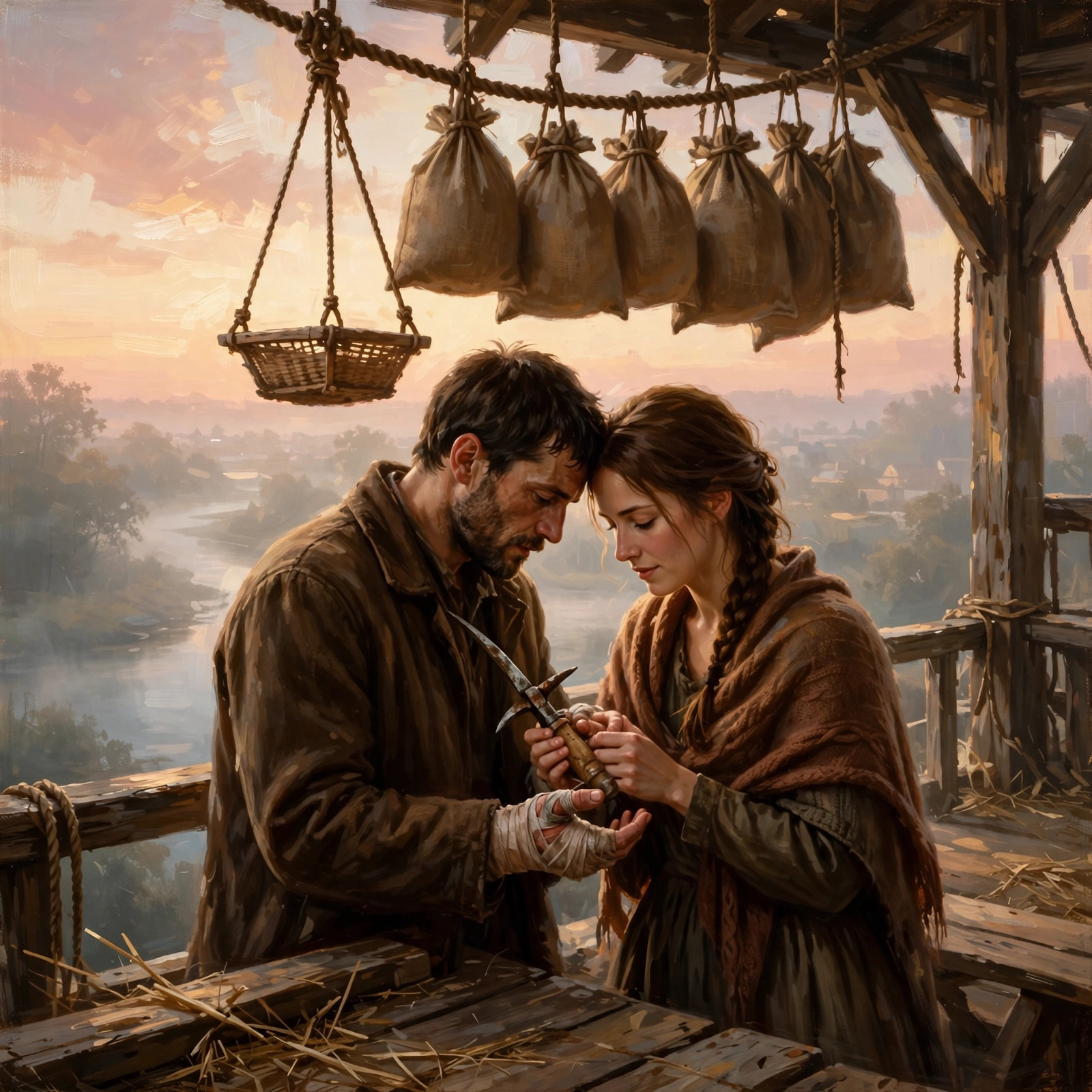
Adair caught his wrist on the winch platform with the key still hanging on its leather loop.
"Don't."
"The order's written." Dorian kept his voice low and even, the voice he used on men who worked under him. "It was written before I ever laid a strand alongside yours."
"That meadow belongs to the trust."
"It's grass. The race is the mill's living."
"Then say it to Quist in daylight with me standing beside you."
"I've said it in daylight." He drew the iron off the loop. "Nobody heard it."
Below them Dilly Sarn stood in the shallows with the headgate chain over her shoulder, boots sunk, patient as a post.
"Reeve. Whenever you like."
Adair put both hands on his. "Dorian. Look at me. My rope is holding their grain over the water you're about to send at it."
"It'll hold. It's sworn."
"It's sworn for one thing."
"Then it holds one thing." He took his fingers out from under hers, gently, and set the key in the winch slot, and it went home with a sound like a tooth into a socket. "Go up and look at your cradle."
He turned it. Dilly hauled. The chain came up clinking out of the black, link after link, and the race slackened with a long sigh, and out under the alders the meadow began to drink.
"That's the meadow, then," Dilly said, to nobody. She spat into the water and coiled the chain over her forearm.
Adair went up the bank because the cradle was hers to look at, and because she would not stand on that platform and be sent anywhere. She climbed to the boards of the Hanging Granary and stood over the beam with her boots in her mother's groove, and the oak frame swung beneath her, heavy and dry and safe.
Below, a lantern set down at the anchor post. Dorian, alone, with his coat off. He laid both palms along the tarred lay the way she had taught him on the walk, walking backward, thumbs seated, and he tipped his head as if listening for a second voice.
Then he spoke over it.
"For the granary cradle and the grain in it. And for the mill headgate at Undersluice, and the water it turns. Both. Let it hold both." A breath. "Let the naming be mine."
She was already shouting. "Take your hands off it. Dorian, take your--"
The rope went soft.
Not parted. Soft, like a thing that had stopped bothering, and it slid through his palms and sagged, and the cradle dropped a hand's width and swung, and the whole granary groaned through its pegs. He staggered. Something rang off the stones by his boot, steel on stone, once.
Adair came down the ladder without touching half the rungs. She got his wrists and pushed his palms back against the hemp.
"Feel that. Feel it, tell me what you feel."
"Nothing."
"It's warm, it was warm this morning--"
"Adair." He looked at his own hands as though they belonged to a man across the river. "It's cold. It's cold all the way to the elbow."
She held them there anyway, pressed them into the lay until the tar marked his skin, and he could not tell her one fibre from another. He bent, fumbled twice, and got her mother's spike up off the stones with the heel of his hand and his thumb, like a man learning to use a tool through a mitten.
"Now the naming's mine," he said. "The diversion, the water, all of it. My hand and my rope. Not yours."
"You spoke over my strand."
"I spoke over my own."
"There's no such thing." She let go of him. Above them the cradle creaked on its hooks, lower than it had hung since the day they raised it, and she went back up and sat on the boards with her arms round her knees and watched it until the sky went grey.
It held through the next day, which was crueler than falling. Tobin walked the bank below it with a lantern every hour and said nothing about the sag, or the way one strand had begun to open along its length like a lip. Adair would not let Dorian onto the boards. She would not let anyone lay a finger on the lay but herself, and she did not lay a finger on it either, because she knew what was tucked inside her own strand, and if it opened she would have no walk, no lease, and no mother worth speaking of.
The following dusk she was at the tar pot in the loft when the sound came up the water. A long ripping sigh, then oak striking stone.
She took the lamp and ran.
Dilly and Tobin were already in the shallows, hauling. The cradle lay tilted at the flood edge with one corner stove in and its iron hooks bent like fishhooks, and the sacks were going out into the black, splitting as they went, grain unspooling downstream in a pale ribbon that the current took without any interest at all.
The rope hung in two long gaping tongues. Adair put the lamp close, and there in the opened lay, dry and bright and whole, sat the reverse tuck her mother had taught her at eleven years old and the guild had outlawed before she was grown. Sound. Every turn of it sound, exactly where the naming had failed.
Tobin looked at it a long moment. Then he looked at her, and shut his mouth, and went back to the sacks.
"There's no rot in that," Dilly said, wringing out her skirt.
"No," Adair said.
Dorian came down the bank with his coat over his arm and got hold of a sack and it slid straight out of his fingers. Dilly took it from him without a word. He stood there with his palms open, and Adair caught his hand and put it against the lamp glass, close enough that she felt the heat on her own knuckles.
"Well?"
"I know it's there because you're holding me."
"Dorian."
"If I'd named the headgate with you, you'd have had to swear the water into that meadow. Your name on the diversion. Quist would have had your lease for it inside a week." He was speaking carefully, the way he did when he had rehearsed a thing in the dark. "This way it sits on me. It was meant to sit on me."
"You turned the water at night with my strand under your hands and you spoke over it alone."
"Yes."
"Your father wrote an order and you carried it. I stood on that beam and asked you to speak and you folded the paper smaller." Her voice came out flat and hard and she let it. "You haven't shielded me. You've decided for me. That's the whole of what he did, and you've done it in his coat."
"I thought--"
"Don't tell me what you thought. Say what you did."
He looked at the grain going out on the water. "I turned the headgates in the dark. Dilly hauled. Then I named the rope by myself, for the cradle and the mill both." He swallowed. "It's said now."
"I'll say the chains to whoever asks," Dilly put in. "I've a memory for hours."
Down in Quistlow the guild bell started, and a voice came along the water crying Oswin Crake's summons, the Assay Hall, the rope brought whole, both makers to attend.
Adair held out her hand. Dorian did not feel the spike leave his fingers; she watched him look down and see it gone. She seated the steel in the lay, opened his strand from the anchor upward, and cut it free, and the tarred weight of it came into her fist warm from the water and nothing else.
Then she walked up the bank with her mother's spike and his strand, and the bell going through the town behind her, and she did not look back at him standing in the flood with his hands open.
The Reeve's Key
Tobin's mallet rang on the peg and the cradle's stove corner came back square. Adair kept her shoulder under the oak until the last peg bit, then eased the frame down onto the trestles.
Dorian had the bent hook in both palms. He'd been turning it a good while, the way a man turns a thing that might tell him something if he waited long enough.
"It'll need the forge," Tobin said.
"First light." Adair wiped her palms down her apron. She had not spoken to the reeve since the bank and she did not speak to him now. He set the hook on the trestle where she could reach it, which was the only useful thing he'd found to do all afternoon.
Crake came up the granary steps with his ledger under his arm and looked at the burst sacks and the water still lipping the meadow.
"Tomorrow. The Assay Hall." He nodded at the gaping hemp. "The whole of it on the table, both makers standing to it. Bring the spike."
Dorian's mouth moved as if to thank him. Nothing came. Adair carried the hook to the smith herself.
They spread the tarred length along the long table in the morning, strands gaping, his cut strand beside it. Bertram sat at the head in his good coat with his gloves folded on the wood. Honor Quist had the lease book open and her thumb in the arrears page. Dilly stood at the back with her chain-scarred palms crossed.
"Who speaks?" Crake asked.
"I do." Dorian didn't wait to be called on. "The weir gates opened early the night Sabra Fell drowned. The hour agreed was the town bell. My father turned the winch before it rang. I was on the chains at Mowbray Weir and I hauled for him."
Bertram's gloves came off the table. "Hold your tongue."
"I've held it since the water took her." Dorian's voice didn't rise. "Not to the guild. Not to her. I let Quistlow say a forbidden lay drowned Sabra Fell, and I knew what hour the river came."
Adair's hands went flat on the hemp. She had known her mother's work was sound since she was a girl, and knowing had never once been the same as hearing it.
"And this week," Dorian went on, "I turned the headgates in the dark on his written order, and swore the rope alone, for the cradle and the mill both. Twice now. Once for him, once for myself, and both times I called it sparing somebody."
Bertram stood and the bench legs shrieked on the flags. "You're no son of mine. Don't come to my mill. Don't carry my name into another room." He was at the door before anyone thought to stop him, and then it was shut, and the hall was quiet enough to hear the Sallow.
Dorian unlooped the key from his belt and laid it down, a hand-span of iron on its stitched leather. The water charter came out of his coat, folded small. He set it beside the key and pushed both toward Crake.
"The gates and the water. Neither's mine to swear with now."
Crake took up the key.
"The lay inside is mine," Adair said. "The outlawed one. I tucked it into my strand with this and told nobody. Tobin saw and kept his mouth shut, because I'd have sacked him for speaking." She held the steel out, ash haft toward Crake, which was how her mother had always handed it to anyone. "Open it. Do what you like with me after."
"I was going to tell you," Tobin said from the wall. "When you were less yourself."
Crake set the point at the anchor and walked it up. The hemp opened ahead of the steel and closed behind it. He stopped where the naming had widened, worked the spike in, and lifted the inner strand into the window light.
"Not a fibre parted." He turned it over. "Sound where the naming gave. Sound the whole length." He looked at Dorian. "It never failed. You did."
"It's her lay," Adair said, and her voice came out wrong, and she let it.
"It's Sabra Fell's lay." Crake wrote it, and the clerk copied it after him, and the scratch of the two pens was the only sound in the room. "Entered. Licensed to Quistlow Rope-Walk. Any man calls it forbidden hereafter can argue with my book."
Adair put her knuckles against her mouth. Her mother had told her not to let anyone say otherwise, and she had carried that sentence around like a stone in her apron pocket, and here it was, written down by somebody else.
"The rope's not certified," Crake went on. "Two makers laid it. One unmade it. Re-lay the strand, swear the true purpose together, and I'll set my seal on your walk."
Honor Quist counted the fee onto the table, coin by coin, and the sound went through Adair like heat. She pushed the whole stack back across the wood.
"Arrears."
Quist looked at her a moment, then drew the pen through the page and turned the book so she could see the line struck out. "The walk's yours. I'll not have you laying rope in a shed you're afraid of losing."
Then the warden stood. "The mill's claim on the Sallow is void from this table. The trust holds the gates. Dilly Sarn, you'll work them. Keep the race for Undersluice and the meadow dry, and take your orders from me."
Dilly flexed her palms. "I'll need a second on the far chain at night."
"Take the apprentice."
Tobin went red to the ears.
The next morning Adair took his cut strand down from the wheel post and laid it on the bench between them.
"It goes back in."
"Adair--"
"You'll lay it again. Not because I've forgiven you. Because the rope takes two, and I'm not losing my shed over your manners."
Tobin brought the tar hot and the fresh hemp. She set Dorian's hands on the strand, right over left, and put hers over them.
"I can't feel it."
"You don't have to. Watch my thumbs. When they go down, you go down."
They walked backward the length of the shed. She counted, and he watched and moved when she moved, and the hemp turned up between their palms and went away behind them tarred and true, Tobin brushing the heat along as they came. Twice his grip drifted and twice she felt it go and took it back without stopping her count.
"You've a voice like a sergeant," he said.
"I've a voice like a woman who means to keep her lease."
At the far wheel she stopped and made him look at what they'd laid, because he couldn't feel it and she could, and that made it hers to tell him. "That's yours. That's sound."
They swore it at the anchor post, both together, for the granary cradle and nothing else. Crake pressed his seal into the wax and hung the tag himself.
The hooks came back from the forge at midday. Tobin and Dilly went up the granary ladder with them, and Dorian carried sacks by watching his arms, one at a time, and Adair let him find his own way to be useful and did not take them off him. What he'd do come winter, with no mill and no key, neither of them said. They had the cradle hung and loaded before the light went, and the tail brought down and made fast at the walk's anchor post, and the whole length stood taut above the head of the shed.
Under it she took his hands again out of habit, to show him where the tar had thinned. His palms were cold. They were tacky too, both of them, and stuck faintly when she moved.
She stopped.
"Dorian."
He turned his head, and she kissed him, and the tar held between their palms a moment before it let go.
Above the Water
"Lower," Adair said. "Your head, not your shoulder. There, against the strand."
Dorian folded down at the platform rail and set his ear where she pointed. Overhead the length ran taut from the cross beam out above the meadow to the anchor post at the head of the walk, and it sang, one note, unbroken.
"Well?"
"One note."
"That's a sound lay. When it starts going you get a second note under the first, like a fly shut in a jar." She rapped the rail twice with her knuckle. "You may hear it before I do. You've an ear trained on chains."
"Years of them."
"Then use it on something that holds."
He got up and looked over the rail instead of at her, which she had learned meant he was arranging sentences.
The Sallow had gone back into its bed. It had left a grey line along the meadow wall well above the reeds, and a shine of silt on the grass, and nothing worse. Downstream the mill wheel turned, the race ran, and the gates stood where Dilly had set them at the trust's word. Above the boards the oak frame hung full and quiet on its hooks, Tobin's new pegs pale in the stove corner.
There was a pale strip on Dorian's belt where the leather loop had hung, untanned, the shape of a key that wasn't there any more.
"I've no post," he said. "The key's on Crake's table with the charter under it. My father shut his door on me in front of the guild and he'll not open it. And these are cold." He turned his palms up. "They'll stay cold. I'm not going to tell you it wears off by spring. Better you hear it from me here than find it out in January."
"January's a long way off. I'll be rude to you well before then."
He didn't smile. She took the folded paper out of her coat and laid it on the rail, with the pencil stub on top so the wind wouldn't have it.
"What's that?"
"My lease. Honor's seal at the foot, and the arrears struck through in her own hand. She did it slowly. She enjoyed it."
"Adair."
"The far wheel's yours. Tobin can tar and mind the loft, and he's better at both than you'll ever be, so don't spoil him by being modest. You'd lay at the far end and I'd lay at the near, and I'd tell you when it drifted, and you'd take it back. Half the lease. I've left the margin blank for your name, which is the only part I can't do myself."
He looked at the paper and not at the margin. "You'd be carrying a man who can't feel hemp. Give it a year and you'd be doing two men's work and calling it a partnership."
"Don't."
"You asked me to say things plainly."
"I asked you to say them to me. That's not the same as saying them for me." Her voice came out sharper than she'd meant, and she let it. "You did this in the dark with my rope in your keeping and your mouth shut. Don't do it again in daylight on my own platform."
He was quiet long enough that she heard the race again, and a heron down Sallow Reach making its ugly noise.
"When I was on the chains that night, I knew the hour was wrong," he said. "I could have called it out. Dilly would have heard me. The whole reach would have heard me."
"I know." She waited.
"My father never shouted once in his life. He'd go quiet, and a week later some man's lease was gone, or some woman's boy was off to the coast. So I learned that a thing said out loud gets paid for by whoever's standing nearest." He laid one palm flat on the rail. "I've been swallowing them ever since and calling it sparing people. It isn't. It's only quieter."
Adair put her thumb on the pencil stub and rolled it a little, back and forth.
"I hid my mother's lay inside my strand," she said. "Not because I doubted it. I knew it was sound when I laid it, and Crake found it sound, and it was sound. I hid it because if I'd told you, you'd have helped me carry it."
"That's not a crime."
"It is in my shed. I'd sooner be doubted than helped. Doubt I can work against, all day, happily. Help puts somebody else inside my work, and then if it goes it takes them too." She stopped and made herself finish it. "She told me her lay was sound and not to let anyone say otherwise. I heard the second half of that for years and never the first."
"That's a poor way to keep a rope-walk."
"It's kept the roof on."
"And you alone under it."
She had nothing ready for that. She pushed the paper an inch toward him and held out the pencil, and he took it, and then had to look down to be sure it was still there.
She held her wrist up where he could see it. "Watch me. Same as at the wheel. When mine goes, yours goes."
She wrote nothing. She only moved the pencil in the air above the margin, slow, and he followed her, and the letters came out crooked and legible, his name in the space she'd left. The wind lifted the corner of the sheet and she put her wrist on it.
"There," he said. "A crooked name on a good lease."
"I've had worse on better paper."
He set the pencil down carefully, watching it land, and then he looked at her properly for the first time since he'd come up the ladder.
"I love you," he said. "I'm not arranging anything. I'm not deciding it for you. I'm saying it, and what you do with it is yours."
She had a longer speech ready. She'd built it on the ladder, rung by rung, and it went out of her like tar off a hot strand.
"I love you," she said. "Plain, since that's the house style. No conditions in it. I'll say it in the shed too, where the hemp can hear, and I'll say it in front of Tobin, and he'll go red, and I'll enjoy that."
"He will."
Then she came into him and he came into her, and they held on, sitting down together on the boards with their backs against the rail, neither of them in any hurry to be upright. His palms were cold through her coat at her shoulder blades, and she didn't say they weren't.
"I can't feel you," he said, into her hair.
"I know. I'm here anyway. You'll have to take my word for a good many things now."
"I'll take it."
She reached past him and took her mother's marlinspike off her belt, the steel gone dark with use, the ash haft smooth, and set it across his palm and folded his cold hand shut around it, and closed the other over that, and put both of hers on top and left them there.
"You'll not feel it," she said. "You'll know it's there because I'm telling you. That's how it'll be. I'll tell you."
"Tell me, then."
"It's yours. It was hers and now it's yours, and I'm done taking it back."
He couldn't hold it by feel. He held it by looking, and by her weight on him, and it did not move.
The spike lay in his unfeeling palm with both her hands wrapped over it, and above them the rope hummed its one note over the full cradle, and the grain hung dry and safe above the settled water.
Get notified when new stories drop
Cade Ellison
Cade specializes in romantasy and paranormal romance: magic systems with rules, courts with knives, and longing that rearranges destinies.
Leave a comment
Comments