


The Outer Row
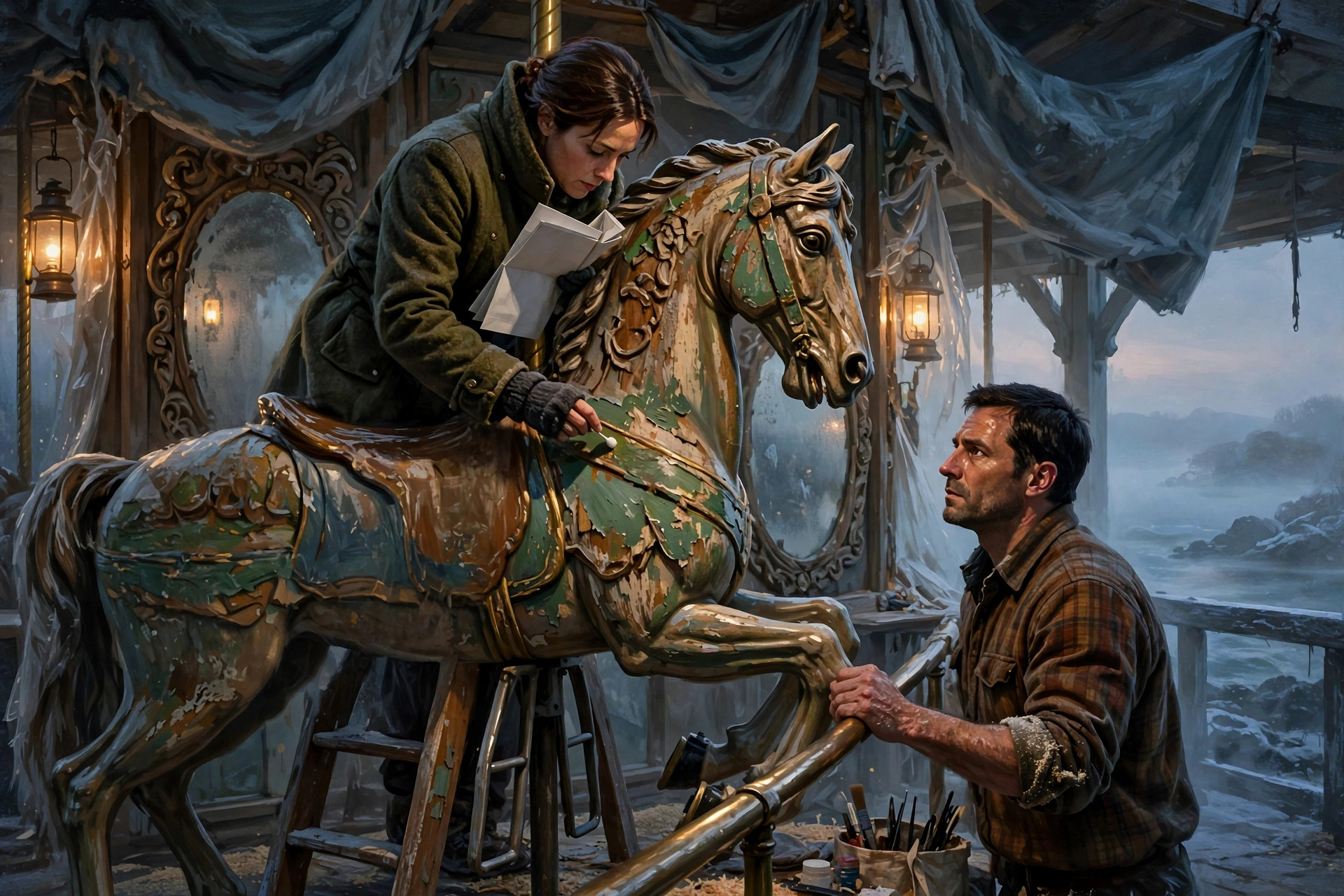
"Get off my horse."
Rosalind kept the cotton turning in a slow circle over the mare's shoulder. "I'm on a ladder. She's on a pole. Nobody's off anything."
"You're rubbing the paint off her."
"I'm rolling a swab across a surface that's already lifting. If I stop, the flakes come with me anyway, and then we both have a bad afternoon."
He stood at the bottom of the ladder with one hand on the rail, which she suspected was less about her safety than about the ladder's proximity to the animal. Flannel rolled to the elbow. Sawdust in the cuff. A thumb with an old white seam across the pad of it, the kind of scar a man gets from a tool he has used since he was young.
"Kids ride her," he said. "Every summer. They kick her ribs all day and she takes it. Now a woman comes in with a stick and a cotton ball and she's supposed to be delicate."
"She's supposed to be documented."
She reached into her coat one-handed, found the folded sheet, and held it open against the mare's neck so he could read it without climbing. Survey and condition record, Jubilee Carousel, Winnow Bay Pier Pavilion. Prepared and signed by Rosalind Pike. The Trust's letterhead above it, small and grey and unhelpful.
He read it. She watched his eyes go along the line twice, and stop where her name sat by itself.
"This ride isn't a museum."
"No. Museums have roofs."
The pavilion was cold in a way that got into the joints of her fingers. Above them the tarps breathed in and out with the wind off the water, and under the boards the lake kept up its steady slapping at the piles, a sound like something patient trying the same door over and over. The mirrors along the inner wall were fogged at their edges. The rounding boards had been draped in plastic sheeting, and the shapes underneath looked like furniture in a house nobody lived in.
Rosalind lifted the cotton away and looked at it.
Green. A green with too much yellow in it, bright as a lime rind, sitting on the white beside a smear of old wax and a hundred years of dust. The old shop had mixed its greens deep and grey. She had spent a week with photographs of them before she ever got on the train.
She folded the swab into her coat pocket and said nothing about it.
"Well, that's a lovely bit of paper," said a voice from the platform steps. "Does it come with money?"
The woman coming up the boards had a ring of keys in one fist and a coat buttoned wrong by one hole, and she wore the cold like a personal insult she intended to settle later. "Billie Ballard. I own the ride. My nephew owns the tools and the opinions."
"Rosalind Pike. The Trust sent me."
"I know what the Trust sent you. I've been writing them letters since the fire." Billie put her keys down on the mare's rump, which made August move them at once. "Here's the shape of it. They'll pay for the roof over our heads, and they'll leave the outer row standing together, but not one dollar comes across that water until somebody with letters after her name signs a record that says what's true. So you can swab whatever you like."
"Billie."
"The pier lights up again at Winterlight, August. That's the date. I'm not standing in the dark in front of the whole town telling them the roof is a maybe."
He looked at the mare instead of at his aunt. Rosalind watched him decide something and put it away for later.
"Fine," he said. "Then she comes down. You're not doing it up a ladder with the pole through her."
He went up onto the platform, and the boards took his weight without a sound, which told her he knew exactly where to step. From under the crank housing he brought out a wrench worn silver at the jaws. The hanger nut came loose in three turns and a quarter; she counted, because counting was what she did when a man was working near something she was responsible for.
"Take her head," he said.
"I've got her."
"You've got her mane. Head."
She set both hands along the jaw, and the glass eye that was left looked straight past her at the water. The other socket was empty, a dark little room with a rim of old gesso around the door.
August worked the hanger free of the crank and let the pole go. It dropped through the body and rang off the boards, one long brass note that went out under the tarps and came back thinner. Billie didn't flinch. Rosalind did, and was annoyed about it.
They brought the mare down between them, his shoulder under the barrel of her, her arms around the neck, walking backwards down the two shallow steps while he told her, in the same flat voice he used for everything, "Left foot. Now the other one. Don't look at the boards, they're not going anywhere."
Billie had already dragged the trestles out from the wall and thrown padded moving quilts over them, and she got the door with her hip. Cold air came off the water and up the ramp in one push. They carried the animal along the boards, down under the pier where the light went green and moving, and through the door with the letters painted on the glass: Ballard Carving Shop.
Inside it was warmer by ten degrees and smelled of hide glue and fresh basswood. Shavings lay curled across the floor like something spilled and not yet regretted. A glue pot sat on a hot plate at the end of the bench, and along the wall, in a rack, a row of gouges stood handle-up in order of sweep, each one worn pale where a palm had been.
They set her down. The mare stood on the trestles with her legs hanging, the nailed-on saddle blanket still tacked along her back, and for a moment she looked less like a patient than like a horse waiting for somebody to come back with the bridle.
"There's a lifting flake at the shoulder," Rosalind said. "I'd like to get under the edge of it and see how far the loss runs. Lend me a sweep, something small. I'll give it straight back."
August crossed to the bench, took the canvas roll off its hook, and laid it flat. She saw a boxwood handle gone the colour of tea, a steel ferrule seated by somebody who had cared about it.
He folded the flap over. He wound the tie around twice and pulled it, and set the roll on the shelf above the glue pot, out of reach.
"No."
"It's a tool. It's for exactly this."
"It's my grandfather's, and it's for exactly what I use it for."
Billie's keys jingled somewhere behind them, going out. The door let in a slab of lake noise and then cut it off.
August put one hand flat on the mare's neck, the way you'd settle a real one, and looked at Rosalind for the first time since the ladder.
"Look all you like," he said. "You're not touching what you don't understand."
The Hare Panel
"Level. Keep it level, the frame's carrying more than it looks."
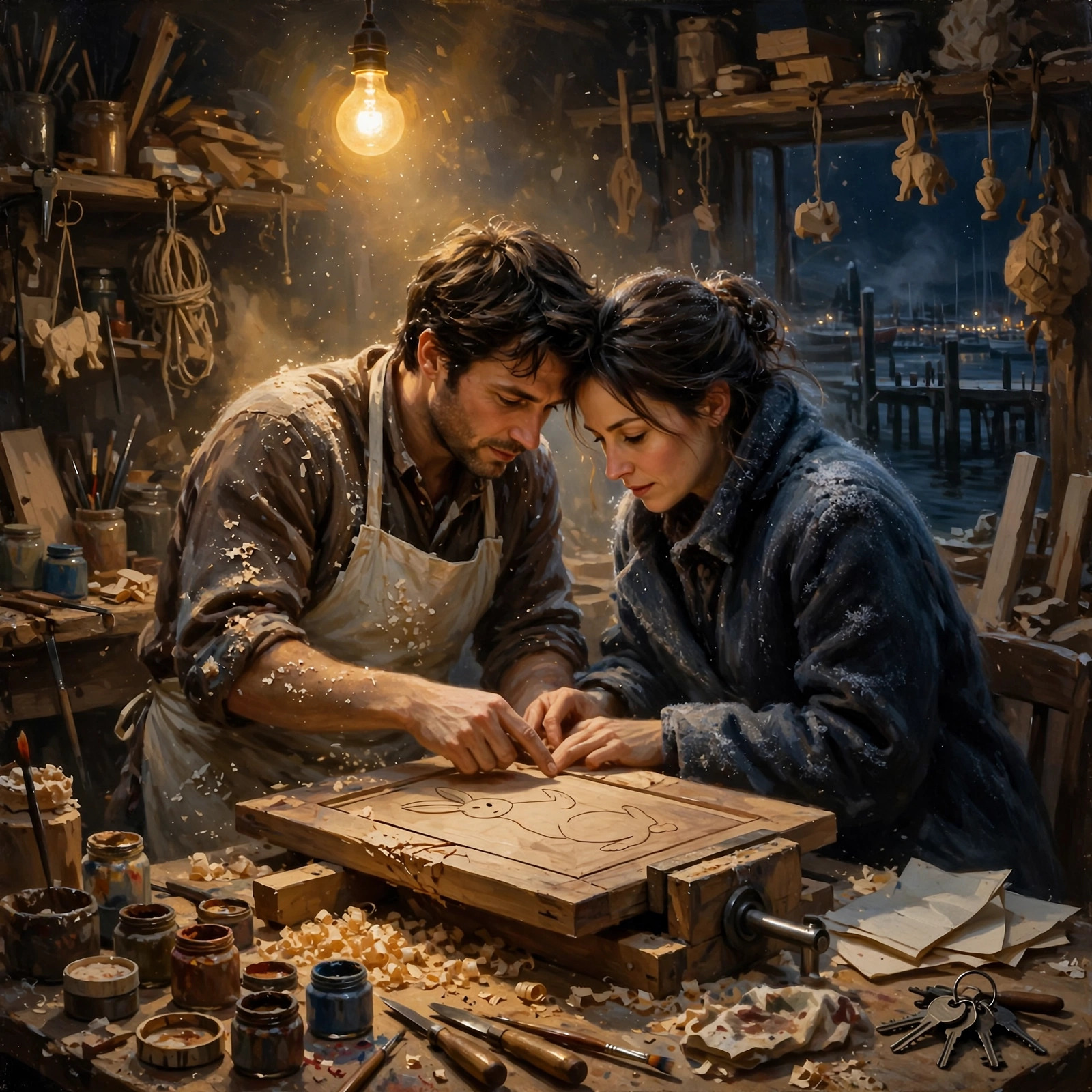
Rosalind came down the step ladder with her end held high, and August backed ahead of her, one palm flat under the gilt edge, telling her heels where the rungs were without once looking at them. Above the mirrors sat a pale rectangle where the hare had been running through wheat since before anybody's grandmother bought a ticket.
It took the two of them, and most of the ramp, and a sideways turn at the shop door to get the board flat on quilts. The lower end crumbled a little as it settled. What came off it smelled like pond, not wood.
August pushed his thumb into the dark corner and it went in like cake.
"Don't." She caught his wrist, faster than she meant to. "Sorry. It's evidence."
"It's mush."
"It's mush that tells me how wet it got and how long it stayed wet. Give me an hour before you cut anything."
"I've been giving it years." He wiped his thumb down his apron. "Since the fire."
The door banged against its stop. Wanda came in with mail wedged under her chin and a rubber-banded brick of envelopes in the crook of her arm, and dropped the lot on the clear end of the worktop.
"Roof estimate. Second roof estimate, because the first one was a joke with a decimal point in it. Electric. Insurance. And a letter from the Trust asking whether the survey is proceeding, which is a very polite way of asking whether I've paid for it."
"It's proceeding," Rosalind said.
"Then somebody put that in writing where they can see it."
Billie came in behind her with her phone already lit. She read the screen, and her mouth did something small and closed, and she went out onto the boards and pulled the door to after her. Through the glass they could see her back, and two gulls working the pilings, and one hand cupped over the phone.
When she came in again she laid the phone face down on the bills. "Weather," she said, to nobody in the room. Then she took her coat off its nail and went back up the ramp.
"She takes the ones she doesn't like out there," Wanda said, "so the wood doesn't have to hear."
There was a brown envelope in the stack with the library's stamp on it. Rosalind slid out the cover sheet she'd printed that morning, still faintly warm from the machine, and August wiped his fingers on his apron before he touched the edge of it.
"That's her."
"That's the front page."
"You put her on the front."
"She's the best thing on the ride."
He looked at the photograph longer than the moment needed. Marigold with her one glass eye, her mane smoke-dulled, standing on trestles like a bad idea somebody had already committed to. "Yeah," he said. "She is."
"What's it for, though?"
"A bid. If it lands, I get a studio. My own bench, my own door, my name on the glass."
He handed the sheet back by its corner, careful, the way you hand a wet drawing to a stranger. "Then it'd better land."
Rosalind set the lamp low and raking, mixed a thimble of solvent, and rolled a swab across a patch of wheat no bigger than a thumbnail. The brown film came up onto the cotton in a smear the colour of weak tea. August leaned in over her shoulder to see it, close enough that she felt the heat of him through her sleeve and stopped noticing the pond smell entirely.
"That isn't the paint. That's a varnish somebody brushed on later to make her shine for photographs. It's yellowed, and it's pulling at the layer under it."
"And underneath?"
"Watch." She rolled a fresh swab, same pressure, three passes. Nothing came off but grey. "Cured oil, old as the pier. It doesn't move for this. If it moved, if I saw colour on the cotton, I'd stop and we'd be having a much worse afternoon."
Down at the rotten end it was the opposite. There the colour came away in flakes like pepper, and she caught them on a sheet of glassine and folded it into a paper envelope and wrote on the outside what it was and where it had come from.
"You keep those?"
"I keep everything I'm allowed to touch."
He glanced at the canvas roll on the shelf above the glue pot, still tied. "Not everything."
"Not everything," she agreed.
"If you two are going to stand there breathing on each other," Wanda said, without looking up from her ledger, "I'm opening a window."
August untied the roll. He took out the boxwood handle gone the colour of strong tea, laid the blade against the sound wood, and waited while Rosalind chalked her line a finger's width above the rot. Then he cut. The steel went through with a sound like somebody biting an apple in another room, three passes, and the bad end came free in his fist.
He put the offcut into her hands instead of the pail.
She turned it under the lamp. Where the old carver had shaped the wheat, the cuts were short and stacked, each one laid over the last, none of them longer than a knuckle.
"He never took a long cut," she said. "Not once. Short, overlapped, all the same hand."
"That's how you keep the grain from tearing out at the ends."
"It's also how you know it's him."
She carried the envelope of flakes to the table and went on down the length of the trestles to the mare, because the flank needed a sample and the light was already set. The tacks along the saddle blanket had pulled at one corner; she lifted it, and rolled cotton along the wood beneath, and tipped the lamp so the beam ran flat across the surface.
A sweep showed. One long pass of a wide tool, curving up over the swell of the muscle and finishing without a stutter, confident as a signature. Nobody who cut wheat in short stacked strokes had made that.
She held the lamp there a moment longer than the sample needed.
Then she took out her notebook and wrote, in the small square hand she used for records, that the mare was substantially intact. Original head and tack. Surface stable.
August had come up behind her with the offcut still in his hand. He stood at the trestle and watched the pencil move, and she waited for the question, and he didn't ask one. She capped the pen and put the swab in her pocket with the other one.
"I'll carve your corner," he said. "Match the wheat, run it right into the old work so you can't find the seam with your fingernail. But every scrap of that paint stays. Every flake off the hare. Every crumb."
"You want me to keep the crumbs."
"I want you to keep the crumbs."
The rotten end went into the pail on top of the chips, and it sat there, dark and soft and finished, while above it the sawn square waited pale in the lamplight, raw basswood with the chalk line still on it. Wanda turned a page at the far end of the table.
"Every scrap," Rosalind said. "Bagged and labelled, and you can go through my pockets whenever you like."
He put out his hand, dusty to the wrist. "Deal."
Glass Eyes
"Lower," August said. "The lamp, not your chin."
She hooked the stand down a notch until the beam lay flat along the mare's cheek. In that raking glare the empty socket was a small room abandoned in a hurry. Bare wood. A rim of cracked gesso. One rusted tack where no tack belonged.
"Wax first." He put the tin in her palm and went to the glue pot, and came back working a lump on the end of a spatula, the color of weak tea. "Beeswax and rosin. I knock it back with pigment so it doesn't flash white behind the glass."
"You've done this before."
"I've done this a lot."
The cigar box had been sorted by iris, amber and brown and a pale blue in a bed of cotton. She took amber, because the eye on the far side was amber, and laid it in the warm bed with the flat of her knife, and turned it a hair until the pupil sat where a pupil sits.
"Now look at me," she told the horse.
"She is."
"She's looking at the lamp."
"That's what people say right before they start talking to her."
Rosalind sat back on her heels. The animal looked whole. Something went through her, quick and cold, and she set the knife down on the quilt and did not write anything at all.
"Corner," August said, before she could stay in that feeling. "Glue's hot."
The let-in block sat in its chalked square on the bench, wheat running out of the old relief and into the new without a stutter. She slid her fingernail across the seam and lost it, found it, lost it again.
"That's not fair," she said.
"That's the job." He brushed the bare basswood, laid the glue on both faces, and set the piece home with his thumbs. "Cauls."
She handed them over. They wound the clamps down together, one at each end, and the glue came out in a thin amber lip along the join, and she wiped it with a cloth wrung out in warm water while he watched her hands to be sure she wasn't taking paint with it. The bagged flakes had to move. She lifted the printed cover sheet off the bench, the one with the mare's photograph on it, and slid it under the bags to keep it flat.
"Careful with that," August said.
"It's paper. It's the least fragile thing in this building."
Wanda came down the aisle with the pavilion's bills under her arm and looked at the clamps the way she looked at everything, as though it might be added to an invoice.
"If you two wake the gulls with that motor, I'm putting it on the roof estimate."
"The gulls are already awake," August said.
"The gulls don't call me at home." She went back up toward the Ticket Hall, and her keys went on ahead of her, announcing her the whole way.
He untied the tool roll then. Rosalind pretended to be busy with the cloth.
The boxwood handle had been worn to a shine in two places, both of them the shape of somebody's grip. He put it into her hands and closed her fingers around it, and the ferrule was cool and the wood was not.
"You don't lend this."
"I'm not lending it. Hold it while I put the edge back."
He wet the oilstone. He laid the bevel flat and set two fingers on the steel, and her hand stayed where it was on the handle, so that every pass went through her arm as much as his. Back, and around, and back. The shop got very small. Glue and shavings and the wet mineral smell of the hone, his shoulder against the loose hair at her temple, and neither of them stepping away.
"My grandfather turned the handle," he said. "Ground the blade too. He was not a nice man and he made beautiful tools."
"That seems to happen."
He lifted the steel, drew his thumb along the back of it, and nodded once. Then he took the tool from her, wiped it, and laid it on the quilt by her elbow instead of rolling it up.
"Keep it near you tonight. I'm not going up and down that shelf."
She looked at it lying there. "There was a courthouse ceiling," she said. "Gilded plaster over a courtroom. I did every inch of the cleaning, and my supervisor signed the record, because that's whose name went on records. Then a solvent test failed on a section I never touched."
"And they came to you."
"They came to the name they had. I carried it out to the parking lot in a box, and the box wasn't even heavy." She turned the cloth over in her hands. "So now mine goes first. Alone. I don't leave a space for anybody else to sign."
August wiped the stone with a rag, slowly, all the way around its edges.
"Man came through here with a clipboard," he said. "Years back. Stood in front of a piece I'd cut and told me it was amusement-park carpentry. Then he asked me where the old one was, like I'd hidden it in a drawer."
"What did you say?"
"Nothing. Held his coat while he climbed up to look at the mirrors." He set the rag down. "After the fire, an assessor wrote replica in the margin beside everything I'd touched. Said it like fake. So I quit writing things down. Wood doesn't argue with you."
"Wood also doesn't get you paid."
"My aunt pays me."
"Your aunt pays you in a currency that only works on this pier."
He laughed, one syllable, surprised out of him, and went to the panel by the door and put his hand on the switch.
"Come up. I want to test the crank before I put a single horse back on a pole."
The short stair from the shop came out at the pavilion's edge, and Wanda had strung the work lights along the center pole, bare bulbs on orange cord, the whole ride lit like a fairground that hadn't been invited anywhere. August threw the breaker. The motor took up its load with a grunt, the belt slapped once and settled, and the platform began to turn.
It went slowly, the way big things do. The crank arms came over one after another and the empty poles rose and fell in their long rhythm, and the mirrors went around carrying the bulbs with them, over and over, a room full of small suns taking a walk.
"Years," Rosalind said.
"Since the fire."
She stepped up onto the moving boards because standing still felt absurd, and the floor came up under her, and she caught his wrist to steady herself. He turned to say something about the sweep rods and didn't say it. The chariot went past them, carved and gilded and empty. Her hand was around his wrist. His other hand came up and rested at her jaw, thumb just below her cheekbone, and she leaned in the half inch there was to lean, and the crank clanked over its top center, loud as a dropped pan, and they both stopped.
The lights died.
"Locking up!" Wanda called from the Ticket Hall, delighted with herself. "Some of us have a morning!"
The platform coasted and slowed. Rosalind let him lead her off it, down the short stair, and her fingers never came off his wrist, not on the boards, not on the step, not in the doorway of the shop where one work light still burned on its stand over the padded trestles.
The mare's new eye caught that last light and kept it, small and bright and looking straight at them, and Rosalind's hand was still around his wrist, and neither of them said anything at all.
Under the Blanket
Rosalind got the shop door with her hip and came in sideways out of the wind, the portfolio flat against her ribs and both hands under it.
"Move the rag," she said. "Not the stone. The rag. Thank you."
August swept a curl of basswood off the bench with the back of his wrist. The clamps lay stacked at the far end and the hare's new corner ran on into the wheat, carved and unpainted, pale as a peeled apple against the old gilding.
She set the portfolio in the cleared space and turned it to face him.
"Well?"
Marigold filled the cover. She'd taken the photograph herself, standing on a crate to get the new eye to catch the work light. Under it, in the type she'd fussed over at the library: Jubilee Carousel, Winnow Bay Pier Pavilion. Condition Survey and Conservation Record. Rosalind Pike, principal.
He wiped his palms down his thighs before he touched it, which she decided to find flattering.
"The printer ate the first two covers," she said. "The woman at the desk let me use the good stock out of the back. And I bound it myself, so if the tape's crooked at the tail, that's a hand-made object and it's supposed to look like one."
"It's a handsome thing." He turned it a little toward the light. "That's her eye."
"That's her eye. Bedded in wax, and it'll outlive both of us."
He read the cover down to the bottom line, where the mare was named, and under the name, the phrase she'd chosen after twenty minutes with a thesaurus and a cold cup of library coffee. Substantially intact.
He stopped moving. Not dramatically. His thumb simply stayed where it was on the card, and the shop got very quiet around the hum of the work light.
"Intact," he said.
"It's a term of art. It means the surviving fabric is legible. It doesn't mean nobody's ever touched her, every horse on that platform has been touched, that's what a hundred years of weather is."
"Intact," he said again, and set the portfolio down and went to the mare.
She followed him with her hands still cold from outside. He took the small flat pry from the apron pocket and knelt at the mare's near flank, and she saw where he was going and put her hand out.
"Those tacks are original."
"They're not." He worked the first one up. It came with a squeak and a sprinkle of rust and he dropped it on the quilt. "I bought them at the hardware store in a paper bag. Twelve of them. I remember the price because I thought it was robbery."
"August."
He lifted the blanket.
It came away stiff, the nailed edge holding its shape like a lid, and underneath, the paint stopped being old. There was a line across the base of the neck, fine as a hair, running under the mane where the mane would hide it forever, and above the line the wood was scorched black in a band the width of his hand. Char, sealed and stable, the fire's own signature. Below the line, clean basswood.
And low on the flank, where the blanket had covered it, two letters cut with a knife and left bare. A. B.
Rosalind looked at them for a long moment. The cold came up off the floor into her boots.
"The head came out," August said. "The head and the tack and one ear. I carried them off the boards wrapped in my coat. The body was ash by morning, and the pole had gone through it, and there wasn't a piece of it bigger than my hand."
"So you carved her."
"The summer after. Glued up out of basswood, four blocks. Married the head on a scarph up under the mane, and the blanket covers the rest." He set the pry on the quilt, gently, the way he set everything down. "The green's mine. I mixed it off the flank of the horse next to her, because that one still had her original skirt."
The swab in her sample bag. The green outside the old shop's palette, that she had pocketed and said nothing about.
"You let the town believe she came through the fire whole."
"I let the town believe what it wanted to believe. Nobody asked me either." He stood. "A man with a clipboard walked this floor after the fire and wrote the word fake next to my name. Amusement-park carpentry, he called it, and he wasn't the first. So I stopped writing my name. It's easier. People love an old horse."
"I saw it," Rosalind said.
He turned his head.
"The sweep on the flank. The long one. The old shop cut those in short strokes and broke the curve, and that one runs the whole length in one go, and I stood there with my light on it and I knew." Her voice came out steadier than she felt, which was its own kind of awful. "I wrote intact anyway."
"Why?"
"Because a new body makes her a reproduction with an old head, and the Trust doesn't put a roof over a reproduction. Because the fellowship takes one name, one, and I have spent eleven years putting my name second on other people's work, and this was going to be sixty thousand dollars and a door with my name on the glass." She heard herself and kept going, because stopping would have been worse. "Because if I'd asked you, you'd have told me, and then I'd have had to write it down."
"You watched me stand there while you wrote it."
"You watched me write it," she said. "You stood at that bench and you let me."
"You never asked me one question about this horse you couldn't answer yourself." He was not shouting. That was the part she'd remember. "You're the second person to put a name over my work."
"At least I put my name on anything."
It landed. She watched it land, in his jaw, in the way his hand went flat on the mare's neck as if the wood needed holding.
"Yes," he said. "You do."
He picked up the portfolio. For a second she thought he was going to open it, look at her pages, say something about the eye again. He set it face-down on the bench instead, linen spine up, and the crooked tape at the tail was the only part of her showing.
Then he gathered the gouge off the quilt and laid it in the tool roll and rolled the whole thing shut, tied the string twice, and pushed it to the far end of the bench, past the clamps, past the bare wheat, out of anybody's reach.
"August. The panel meets in the Ticket Hall. I need you to…"
He took his coat off the hook by the door. The cold came in around him, real winter off the water, and the work light swung a little on its stand.
"Aunt Billie's been taking her calls out on the lot," he said. "You might ask her what those are, since you're good at asking."
The door shut. The latch took.
Rosalind stood alone under the light. The blanket hung off the mare's flank where he'd left it, stiff and half-peeled, and the two letters sat bare in the wood below the burn line, cut deep enough to last. On the bench the portfolio lay face-down. Beside it the new corner of the hare panel waited, carved and pale and unpainted, and there was nobody left in the room to tell her what to do with it.
The Ticket Hall
"The mare is the reason we're all sitting in a ticket office in November," Frayne said, and laid his palm on the cover photograph, over Marigold's amber eye, as though he had found her himself. "Rosalind's record is exemplary. Original shop work, substantially intact. That's a centerpiece a fellowship can be built around."
Wanda had stacked the folding chairs against the ticket window and left the brass slide open out of habit, so the wind came off the water and shifted the papers on the table. A bucket sat under the seam in the plaster where the last rain had come through. August was at the back with his cap in both hands, turning it a quarter at a time. He hadn't looked at her since the parking lot.
"The rest of that platform," Frayne went on, "is amusement-park carpentry. Cheerful stuff. No history in it. We conserve the old work and let the fairground carving go its own way."
The brim bent under August's thumb and stayed bent.
Rosalind looked at him and he did not move at all, not his shoulders, not his boots, and she understood that the words were not new to him. Someone had said them before, and he had kept them somewhere he could still reach.
Billie's handbag sat on her lap like a small dog, her fingers inside it on something folded. "The roof," she said. "Discuss the roof, or we'll still be here when the pier lights up."
Rosalind stood. Her chair caught the floor seam and shrieked, and she let it.
"August Ballard carved Marigold's body," she said. "The summer after the fire. Her head and tack came out of the burning. Everything below the mane is his, married at the neck, and the join is under the saddle blanket, and his initials are cut in the flank beneath it. I saw the sweep on that flank when I sampled her. I wrote intact anyway."
Frayne's palm came off the photograph.
She passed the prints along the table: the scarph at the neck, the char line, two letters in bare basswood, the mane lifted on a wooden wedge. She had taken them the night he walked out, phone braced against a clamp, work light propped on a stool. Billie put her glasses on. Wanda stopped sorting bills.
"Then it's a joint record," Frayne said, "and the fellowship names a single principal. A joint filing can't be considered. You know that better than anyone at this table."
"I know it."
"So leave the attribution standing. The horse is intact in every sense a panel cares about."
"She's intact," Rosalind said. "She isn't old."
Her fingers were unsteady on the scalpel and she let them be. She cut the linen tape along the spine, one long stroke, and the pages came loose. She thought of a glass door with her name on it and made herself stop right there. The corrected survey went across to Wanda, rewritten by hand, initialed at the foot of every sheet.
"I'm withdrawing the submission," she said. "That's the honest record. Fund the roof off that one."
Frayne capped his pen. "I've championed you since Chicago. I can't champion a correction that hands a fellowship to a mechanic."
"He's a carver."
"Rosalind, think--"
"I have." She put the loose pages square against the table edge. "That's the difference."
"My backing is withdrawn." He took his coat off the chair back. "The stipend goes to the next name on the list. Consider what you've done to your own file."
The wind took the door out of his hand and shut it for him.
The two county members stayed. They read the corrected survey through while Wanda held the sheets flat against the gusts, and they voted the pavilion onto the local restoration contract, August as lead carver, Rosalind as conservator, seasonal and modest, signed before anyone left the room.
"It's a fraction of what you turned down," Wanda said, and wrote it in her ledger, because she kept the bills and had to know.
"Lead carver," August said, under his breath, twice, the way he checked a measurement.
Billie drew the folded letter out of her handbag and held it up so he could see the letterhead. "Private collector. Standing offer for the outer row, every horse, crated and shipped. If the roof money failed I meant to take it and hold the lease on what was left."
August came out of the back row. "How long have you had that?"
"Long enough to stop sleeping when the phone rang." Billie tore the sheet in half, then the halves, and put the pieces back in her handbag, because she didn't litter. "I never told you. I'm telling you now."
"You'd have sold Marigold."
"I'd have sold the row and been warm and horrible for the rest of my life." She snapped the clasp shut. "Now nobody has to find out how I'd have managed it."
He looked at his aunt a long moment. Then he put his cap on, pulled the brim straight, and nodded at her once, and she nodded back like a woman closing a till.
Wanda locked the ticket window and counted the keys onto her ring. Outside, the water went about its winter business under the boards. Rosalind carried the withdrawn pages against her chest and walked with him to the Ballard Carving Shop, and neither of them said anything about the money.
Inside, he untied the string on the tool roll, twice around, the knot he had made the night he left, and lifted out the gouge with the worn boxwood handle. He set the hare board square on the quilts and held it steady with his forearm.
Then he cut his name into the front edge of the new corner, where the wheat ran onto the let-in block. Small letters, no bigger than a thumbnail, deep enough to hold a shadow. The chips fell on the quilt and he blew them off with one short breath.
"Every rider on the outside row is going to read that," Rosalind said.
"That's the idea."
"They'll pick at it with their fingernails."
"Let them wear it down. I'll cut it again."
She watched the last stroke come clean out of the basswood. "Teach me to cut letters."
He looked at her over the hare. "You'll do it wrong."
"I'll do it wrong for a while, then."
He put a scrap in her fist, turned her thumb behind the steel, set her shoulder over the tool. "Don't push with your wrist. Lean. Let it find the line, then go along with it."
Her first attempt skated and tore a fiber loose. Her second held. He grunted, which she was learning to hear as praise, and moved the lamp a hand's width so the shadow fell where she needed it.
Then she went to the trestles and lifted the blanket and cut her initials in the flank beside his, small and crooked and deep, where the saddle would go back and the nails would go in and no eye would ever land again.
"Nobody's ever going to see those," he said.
"I know who put them there."
He tacked the blanket down, three tacks to a side, tapping with the small hammer, and while he worked she wrote a card in her survey hand and wired it to the brass pole leaning by the door. Marigold. Head and tack, original shop. Body carved by August Ballard, the summer after the fire. Conservation, Rosalind Pike.
He read it twice. He didn't thank her, and she found she didn't need it.
Then he came around the bench and put the gouge in her palm and folded her fingers over the boxwood, and she leaned in over the bare wheat and kissed him with sawdust on her hands. The tool lay between them, still warm from his grip, and neither of them let go.
The Chariot
"Up on three," August said. "Don't let go on two."
"I've never let go on two."
"You let go on two with the eye."
"That was beeswax. Beeswax doesn't count."
Rosalind got her forearm under the gilded edge and lifted, and the hare came up off the quilts with his wheat running along the bottom of him. They walked the board between them across the pavilion floor, past the mirrored center, past Marigold on her brass pole with her new amber eye taking the work lights like she'd been showing it off all her life.
"Ladder's on your side," he said.
"The ladder's on my side because you put it there."
"It's a good side."
They laid the panel face down across the carved seat of the chariot, and Rosalind took the pencil from behind her ear.
"What's that for."
"The back."
She wrote his name first, small and square, the way she lettered survey cards. Then hers underneath. Then, because her hand kept going, New corner, let-in basswood. Wheat continued by hand.
August held out his palm. She gave him the pencil. He bent over the board a long moment, and she watched his shoulders move, and when he straightened he'd added four words under both their names.
Repaired. Not replaced.
She read it twice. The pavilion was cold enough that her breath showed in the work lights, and she stood there looking at the back of a rounding board like it had said something to her out loud.
"Nobody's going to read that," he said.
"Whoever takes it down after us will."
"That's a long wait for a reader."
"I've waited longer."
She had toned the let-in corner that afternoon, mixing the glaze on the card cover of her withdrawn submission, Marigold's photograph going slowly brown under raw umber. The seam had vanished under a fingernail before the week turned. Now the wheat ran through the new wood without a stumble, and the only place the repair announced itself was the front edge, where he'd cut his name.
He went up the ladder with the driver in his teeth. She held the bottom corner steady and fed him screws one at a time, and told him left a hair, and then a hair back, and he grunted at her in the language she'd learned to hear as agreement.
The driver whined. The old gesso took the screws with a sound like teeth closing. He came down, wiped his palms on his thighs, and threw the switch on the new canopy circuit.
Light came up over the mirrors, over the gilt frame edge, over the hare mid-stride with his ears flat and the wheat bending away from his feet. Down on the front corner, thumbnail-sized, the letters held their shadow for a second and then filled with gold.
Rosalind tipped her head back and looked at his name where every rider on the outside row would be able to read it.
"Well," she said. "There you are."
"Don't."
"I didn't say anything."
"You were going to."
She laughed, and he came around the chariot and took the gouge out of her coat's other pocket, where she'd been carrying it since the shop like a stone she kept checking for. He pulled a shop rag from his back pocket and laid the boxwood handle in it and rolled the steel up, careful, the way he handled anything with an edge, and folded the ends over and pushed the whole bundle back into her coat.
"That's your grandfather's."
"It is."
"August."
"I'm not lending it." He pressed the pocket flat with his hand, once. "I'm putting it where I know where it is."
She looked down at the bulge in the wool. Her throat did something inconvenient.
"I wrote to Chicago this morning," she said.
His hand stayed on her pocket. "Yeah?"
"I told them no. The studio, the whole arrangement. I sent it before I could talk myself into being sensible."
"That was a lot of money."
"It was." She made herself say the rest evenly. "I signed for the room above the Ticket Hall. Your sister's got the lease in her drawer under the pavilion bills. There's a radiator that knocks all night and a window that looks straight down at the queue, so I'll know exactly how many people want to ride before I've had coffee."
"February up there is cold."
"I know what February is."
"You've had one."
"I want the cold," she said. "I want the shop under the pier and the compressor going at six in the morning and the noise of that thing you do with the mallet when you're thinking. I want you. I've had a room of my own in my head for years and it was quiet in there and I didn't like it."
August didn't answer right away. He took his hand off her pocket and put it on the chariot's carved rail, and his thumb went along the scrollwork, and she understood he was reading it with his fingers because he couldn't look at her yet.
"Compressor starts at five," he said.
"Then five."
"You'll complain."
"Constantly. You'll enjoy it."
He crossed to the control box and set the brake off and pushed the lever, and the motor took hold with a low shudder that came up through the floorboards into her boots. The platform began to move. Somewhere behind the mirrors the organ coughed, found itself, and came in one note flat, the way it had been coming in flat since before the fire.
"Get in," he said.
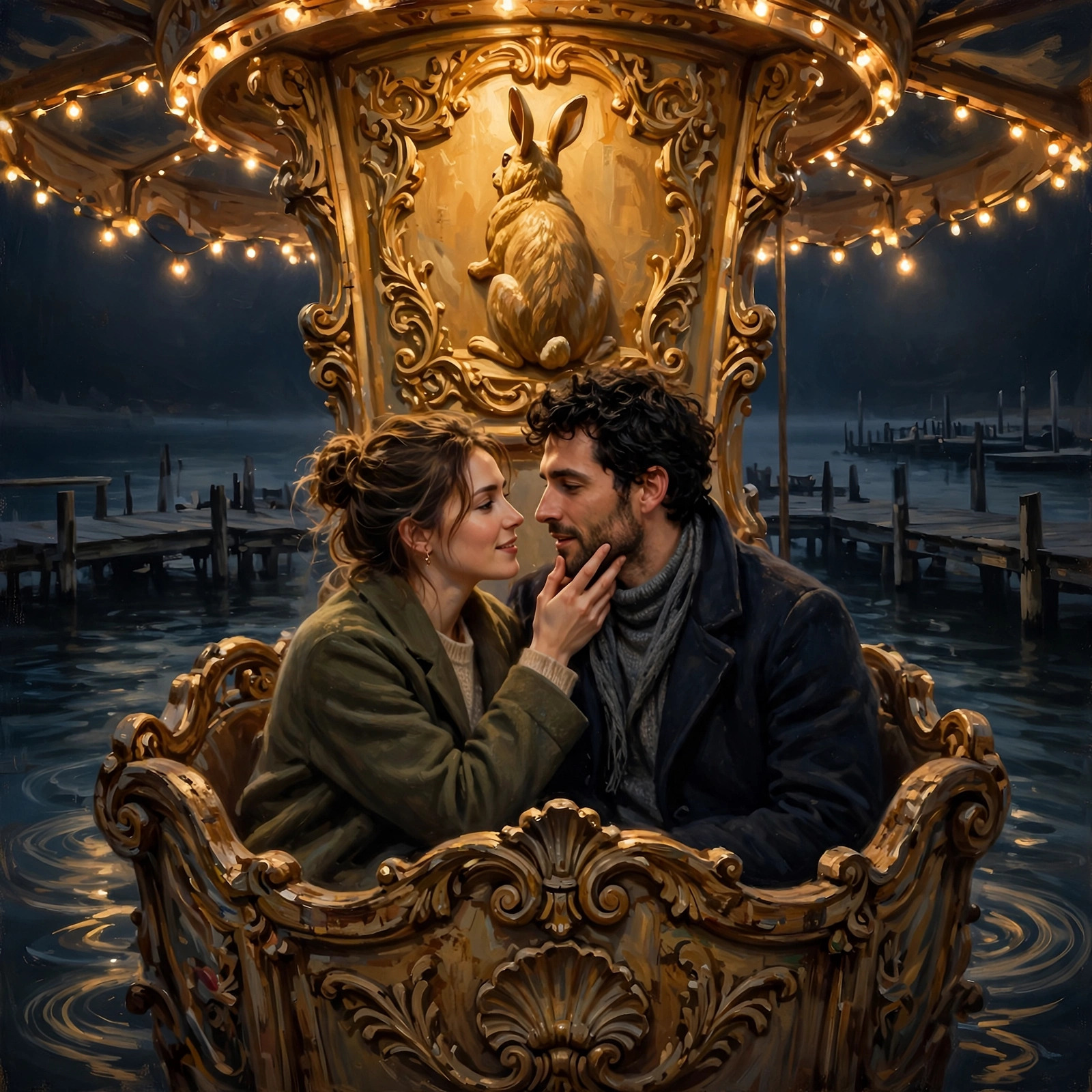
She got in. He folded himself onto the carved seat beside her with his knees jammed against the lion's head, and the chariot swung out and around, and the pavilion began to slide past in pieces: mirrors, ticket arch, dark doors, the new roof beams still smelling of cut pine.
Marigold came up beside them on her crank, rising, dropping, her mane lifting on nothing, the saddle nailed flat and neat over the flank where two sets of initials sat side by side in the dark. Rosalind watched the mare go by and felt the whole ridiculous, glorious fact of it settle in her chest: the head that had come out of the fire, the body he'd carved the summer after, the card by the door with both their names on it, and nobody left to argue.
"I love you," August said.
Just that. No joke laid over it, no tool put in her hand instead. He was looking straight ahead at the hare going round above the mirrors, and his jaw was set like a man waiting on a verdict.
"I love you," Rosalind said.
He let out a breath through his nose.
"Say it again. The organ's flat."
"I love you." She said it right into his ear, loud enough to carry over the whole wheezing band. "There. Now the entire pier knows."
"Good."
He turned and got his arm around her, and she went into him, sideways and graceless, her cheek against the cold shoulder of his work jacket, his hand spread wide on her back over the pocket with the wrapped gouge in it. She kissed his jaw where the sawdust always stayed. He held on.
Outside, past the propped doors, the pier strings came up all at once, the whole rail strung out over the black water in light. His sister had set the timer that afternoon and forgotten to tell anyone. Tomorrow the doors would open and the queue would come down the boards, and every rider on the outside row would look up and read his name.
They went around under the new-lit hare, folded together in the chariot with the organ playing flat, and Marigold rose and fell beside them, the saddle nailed down over both their marks.
Get notified when new stories drop

Marcus Hale
Marcus writes slow-burn and marriage-of-convenience stories where logistics become intimacy and competence is a love language.
Leave a comment
Comments