


Red Tag
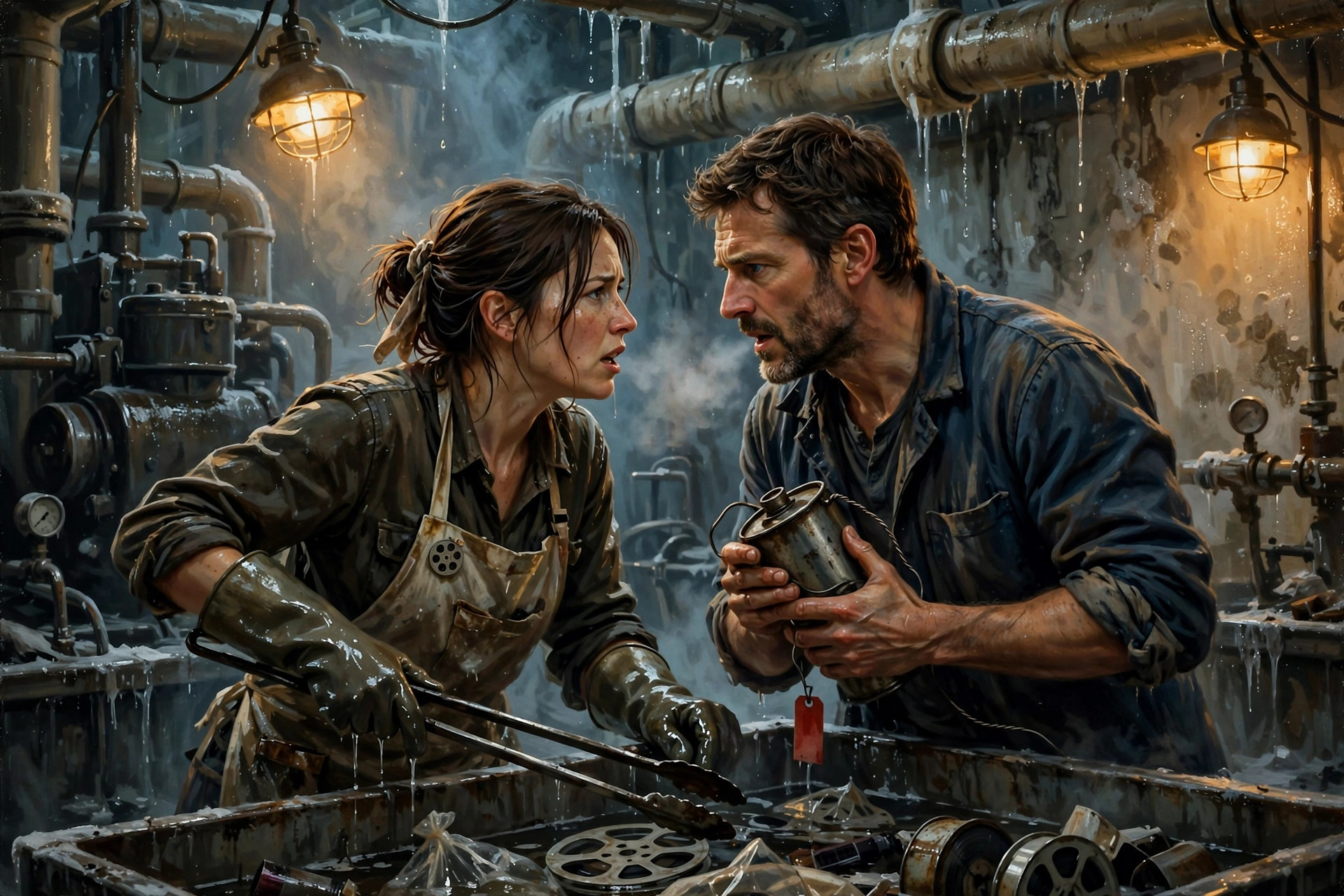
Willa got the tongs across the bin before he could tip the reel in. Steel rang on steel, and the noise went up the brine gallery and came back off the wet chalk.
Vaughn Halloran held the can against his chest with both hands, the way a man holds a plate he'd rather not smell.
"Move them."
"No."
"There's a red tag wired to the handle."
"There's a red tag on the ladies' lavatory."
"That one's earned."
She leaned her weight on the long handle and made herself breathe through her mouth. Under her boots the compressor kept up its thump, the one that went all day and all night holding the cold in the old cells, and the ammonia bit at the back of her throat. Her gloves were soaked through. Chalk sweat crept down the wall behind him and dripped off the pipe lagging onto the concrete, patient as a clock.
She'd been at the rewinds when he came down the gallery, clicking through a coastal comedy with a man falling off a pier, and she'd left it half-wound on the bench. She could still hear the click of it in her head, which was the sound of a good afternoon, and this was not one.
"Wendle," Willa told him. "The village, before the reservoir. It's the only reel of it left anywhere in the world. My great-grandmother's house goes past in the first few seconds, washing still on the line."
"Feel the seam." He turned it toward her, and she put two fingers to the solder and took them off again. Warm, like a coin somebody had been holding in a fist. "That's not the plant doing it. That's the film cooking itself. Nitrate doesn't wait for a spark off me. It brings its own."
"It's cold in there."
"It's cold in there in March. Come August it's amber soup and a space I can't send men into."
The vinegar came out of the seam then, sweetish, underneath the ammonia. She had smelled it a hundred times in this building and it still turned her stomach over, because it was the smell of something eating itself politely, from the inside, while you filled in its paperwork.
"Your invoice goes to Merrow Mutual," she said. "My wages come from the trust. Bernadette's bid is in for two hundred and sixty-five thousand dollars to move this collection somewhere with a roof that doesn't leak, and nobody signs a penny of it until the store's certified. So drown a room if you have to. Don't drown that."
"Then I'll pass what's safe and condemn what isn't." No heat in it at all, which was worse. "That's the whole job. They're not paying me to be sentimental about your grandmother."
"Great-grandmother."
"I'll be accurate in the report."
He shifted his grip so the cold side faced away from her hands. It was a stupid thing to notice. She noticed it anyway, and then she was annoyed with herself for the noticing, which took up most of a second she could have used for arguing.
Rollo Deene came along the gallery with his boots slapping and a clipboard under his arm. "I can hear a funeral from the dock. Are we having a funeral? I've got a lorry sitting under the hopper and a nephew in the cab losing his religion."
"Load going out," Willa said.
"Load going out." He was already pulling from the rack by the wall, stacking against his shirt. "Bernadette signed the destroyed list off in the spring. Silver men take the lot, I get paid by the mile, and nobody's cheating anybody."
Vaughn set his jaw. "Those aren't tagged."
"They're on the list."
"They're not tagged."
"You'll want a form for the form, this one." Rollo tapped the clipboard with two fingers and grinned at Willa like they were sharing a joke about the weather. "He'll want your signature on the tag, love, and then a signature on the signature. Twelve years I've been treasurer and I've never once been thanked in triplicate."
"Who keeps the haulage dockets?"
"My nephew keeps the dockets. I keep the jokes. It's a partnership." Rollo went off along the cold corridor with the tin dull against his shirt, and a door banged at the far end, and the lorry coughed into life somewhere above them.
Vaughn took a small notebook out of his jacket and wrote in it. He wrote for longer than the answer needed.
Willa turned to tell him about the quarry road, the rain coming in off the hills, the gate that stuck if you looked at it wrong. Behind her the tongs came off the bin, and the reel went in with a hollow boom she felt in her back teeth.
"Now it's on the destruction schedule," he said. "Properly."
"You could have waited until I finished a sentence."
"I've waited for worse things."
He walked to the end of the gallery, where the steel door stood open on the nitrate store, and took a pair of sealing pliers off his belt. Wire went through the hasp. A numbered lead bead slid up the wire, and he crimped it flat with one squeeze, and the sound was small and final, like a tooth coming out.
"Cell C is shut," he said. "Nobody goes back inside."
"I've got work in there."
"Then you've got work out here." He wiped the pliers on his thigh. "If a space is unsafe I seal it. If it goes up I flood it and let the rest of the building live. I don't open a door for anything that's in it. Not stock, not a person, not me."
"That's a cheerful way to make a living."
"It is."
He looked at the crimp a moment longer than the job needed. Then he clipped the pliers away and went up the gallery, and his torch beam went round the corner ahead of him, and the outer door thumped, and the rain came against the high windows in handfuls.
Willa stood there with her hands on the tongs until her fingers stopped aching. Then she reached into the bin and lifted the reel out, gripping the rim the way the plant's fitters had lifted ice out of these same tanks back when the building had a purpose you could drink, and the red tag swung and knocked against the steel.
Warm. Vinegar. She held it away from her coat and carried it down the cold corridor, past the loading dock, to the low cork door at the end that nobody had opened on purpose in years except her.
The ice-can room should have been the coldest place in the plant. It wasn't. She had decided a long time ago that it was the pipe run in the wall, and she had never gone looking for proof, because proof would have meant a work order and a work order would have meant a man with a torch coming to look.
Cans stood along the shelf in the dark, rows of dull tin, no chalk numbers, nothing anywhere a ledger could find. She made a gap and set Wendle in it and pushed it back with her palm until it sat flush with the others.
Two along, one was warm enough to feel through her glove. She cracked the lid and the smell came up sharper than anything written on its card, sharp enough to make her eyes water in the dark. She put the lid back down. Tomorrow. She'd look at it tomorrow, in daylight, with the bench lamp and the good nose she was supposed to have.
She fetched the biscuit tin out of the bench drawer and sat on the upturned crate with it on her knees. Every card inside was in her own hand, wax pencil on card stock, years of them, the store's whole honest opinion of itself. She found the one for the stencilled number and read what she had written that morning: the true rating, the one that would have sent it to the smelter with the rest.
She rubbed it out with the heel of her thumb until the grey went soft and blurred and there was nothing left to read. Her hand knew the shape of the next word without being asked. Somewhere else, in another building, she had written a word like that once, and she did not let the thought finish itself.
STABLE, she wrote. The pencil squeaked. She blew the crumbs of wax off the card and shut the tin, and the lid went on with a click that sounded very like a rewind.
Down the gallery the wire held on the steel door, the lead bead flat and numbered and nobody's business but his. Here, on a shelf that appeared in no inventory in the building, Wendle sat with the washing still on the line and the house still standing, and Willa held the fresh card in her fingers and read it once more. Stable.
Brine Gallery
“Up, not out. If it goes, let it go straight down.” Vaughn had his shoulder under the wet lagging and both palms flat on the steel, and his voice had gone level and quiet, which Willa was learning meant hurry.

The hanger had rotted through at the thread. All that was left of it swung from the ceiling rib on a rust-coloured thread of its own, and the run of pipe sat a hand's width low, weeping at the joint into the gulley.
“There's the whole main standing above you,” he said. “I need the section valve, and the section valve's behind that door.”
Cell C. She knew what was on it, because she'd stood and read it yesterday while her ears rang. He was already crossing the wet floor with a pair of pliers out of his belt pouch, and he did not hesitate at the wire. He set the jaws on it, squeezed, and the little lead bead came off in his fingers. He put it in his breast pocket. Then he went in and turned a wheel, and the weeping stopped, and the gallery got very quiet apart from the rain on the roof lights.
“You cut your own seal,” Willa said.
“It's my seal.” He came out wiping his hands down his thighs. “It goes back on when the work's done. Now. Something to hold that pipe that isn't you.”
She knew exactly what, and she went and got it before he could think of a reason to come with her. The long tongs leaned by the shelf where the plant's fitters had left them, longer than her arm, riveted, older than anyone's grandmother. She lifted them off the hook and did not look along the shelf, and came back with them over her shoulder like a pike.
Vaughn looked at them for a second. “Nineteen-oh-eight?”
“Thereabouts. They lifted cans of ice out of brine for forty years. They'll hold your pipe.”
They did, just. She got the jaws across the steel and up against the stub of the old bracket, and the handles wanted three hands, and she was two short. He came in behind her, took her right wrist in his left, and set it where it needed to be, and held it there while she squeezed. His palm was warm through the wet sleeve. She was aware of that in a way that was frankly inconvenient, given the circumstances.
“Wire the handles,” he said, close to her ear. “Kit, left pocket. Don't let go.”
She let go. The joint opened before he had the wire on and the main gave them both a lapful, brine-cold, straight down the collar and into the boots, and Willa made a noise she had never made in a working building before.
Vaughn started laughing. That was the trouble. He laughed with his mouth shut and his shoulders going, water running off his chin, and it set her off, and they were still going, helpless, gasping, when Rollo came round the corner with his clipboard held above his head like a man crossing a ford.
“That's the gallery,” Rollo said, wounded. “That's the gallery, that is. Bernadette's got the assessors coming for the bid and I've got a ceiling crying.”
Willa put her hand over her mouth. It made it worse. Vaughn turned away and pretended to look for the wire, which he was holding.
“It's fixed,” she managed. “It's fixed, Rollo. Nothing's lost.”
“Nothing had better be.” He went off to look at something else, and she wiped her face on a wet forearm, which achieved nothing at all.
They wired the handles, and he cut a length of new hanger stock and threaded it and hung the run true, and the tongs came off with a scrape and a small sulk of rust. He worked slowly. He tested everything twice. When it was done he took a fresh bead out of the pouch, threaded the wire through the hasp on cell C, and crimped it, and wrote the number in a little book, and put the old bead back in his pocket instead of the bin.
Willa noticed that. She noticed the whole thing, the cutting and the closing, more than she wanted to.
The tongs went back on their hook a little wider than they had come off it. She'd have to lean on them next time. Forty years of ice, and one afternoon of sprinkler pipe.
“Tea,” Vaughn said, and produced a flask with a dent in it, and the cup that was the lid, and poured for her first. His overalls were dark to the knee. Hers squelched when she shifted her weight.
“I've got a spare jumper in the office,” she said. “It's orange.”
“I've got no dignity left. Orange is fine.”
She took the flask cup back and drank and handed it over, and their fingers knocked, and neither of them made anything of it, which took a small amount of effort.
At the bench she pulled the drawer for the cement and the scrap strip, and the biscuit tin was sitting there where she'd left it, and she shut the drawer with her knee and got the strip out with two fingers, and Vaughn stood at the bench with his sleeves rolled and waited to be shown.
“Frame line here. Overlap two frames, scrape, cement, hold. That's a splice. It's the only honest thing in this building.”
“Show me.”
She did it fast, the way her hands had done it for years, and then she gave him the strip and the brush and stood back. He was careful. He was appallingly careful. He scraped with the blade laid flat and counted the frames under his breath and set the overlap like he was laying a brick, and it was slow and it was perfect, and she found she was watching his hands rather than the splice.
“You'd be no use on a deadline,” she said.
“I'd be no use on a fire.” He held it up to the lamp. “But it'd hold.”
Cody came in with the dockets in a plastic wallet, hair flat to his head, apologising before he was through the door. Willa signed where he pointed, twice, and the pen skipped on the damp paper.
“Is the ice-can room on your inventory?” he asked. “Only I've never had a load out of there, and Uncle Rollo says leave it off, and I didn't know if that was because there's nowt in it or because it's not mine to put down.”
“Racking,” Willa said. “Hooks. Nothing that goes on a lorry.”
“Right.” He smiled, relieved, and tucked the wallet away. “That's what he said.”
She was still turning that over when Rollo went past the end of the gallery with a torch, and into the ice-can room, and stayed long enough for her to count the beams he swept, and came out with nothing in his hands.
“Trust wants me to know what's where,” he said, comfortably, seeing her face. “Before the assessors.”
“Of course,” Willa said, and let her shoulders down, and hated how fast they went.
The slip came a while after that. It didn't sound like drama. It sounded like somebody tipping gravel off a tailgate for a long time, and then the roof lights went grey with the rain coming sideways, and Cody was out in the yard shouting before anyone had put a coat on.
Half the quarry road had let go above the gate, and Rollo's lorry had gone into the mud sideways and come to rest across the entrance with the trailer folded up against the wall, wheels deep, load shifted, cab door open and the wipers still going.
“Nobody's driving out of that,” Vaughn said.
“Nobody's driving out till the Ashkirk lot bring a digger,” Rollo said. “I'll not go down there on foot in this. There's beds up the office. There's a kettle.” He was almost cheerful about it. He looked at the folded trailer and then at the plant behind him, and something went across his face and off it again. “Might as well be comfortable.”
Cody took a blanket and went to sleep in the cab, where he could watch the load, he said, and where his uncle could see him from the window.
Vaughn did not go up to the office. He went along the brine gallery and out through the loading bay and round the whole ground floor with his torch, and Willa followed because she was not going to bed while a man she'd known two days walked her building alone. He tried every exit. He put his hand on each extinguisher and turned it to read the tag, and lifted the hose reel cover, and stood a moment at the nitrate store door with the new bead on the wire.
“Beds are up there,” she said. “Rollo's putting the kettle on.”
“Beds can wait.” He was looking at the corridor, counting under his breath. Not the rooms. Not the people in them. The doors.
At the office window the rain came off the roof in a sheet, and the lorry lay black across the gate with its lamps still burning into the fallen earth, and the three of them were inside with it. Vaughn took the pen out of his breast pocket, and on the back of his left hand, under the wet, he began to write the night's way out.
The Projection Booth
“One pass,” Willa told him, and set the can down between them. “Slow gate. I stop it the second it complains.”
Vaughn looked at the lid instead of at her. “I tagged that.”
“You tagged a room. I write the condition cards.”
“Paper won't make it burn slower.”
“No. It tells me what it can bear.” She had the lid off before he could answer. “Look at the edges. Look, before you decide about me.”
He looked. That was the trouble with him. He always looked first.
The night's way out was still written on the back of his hand, gone blue and blurred where the wet had got at it. He'd washed twice since and it hadn't shifted. She had decided not to tell him he'd got it on his jaw as well.
Rain went across the roof in handfuls, the way it had gone all afternoon, and down in the loading bay Rollo was shifting something heavy and swearing at it in a friendly sort of way.
Vaughn set the extinguisher by his boot and laid the fire blanket over the rail where he could reach it.
“It makes its own air. You can't smother it. That's a courtesy.”
“Water still cools it. That's not courtesy, that's physics.”
“You've hardly unpacked and you're correcting me about my own fire.”
“I'll correct you tomorrow too.” He stood with his palm an inch off the douser. “One pass. If I say stop, it stops.”
“It stops.”
“And nobody goes back inside for anything. Not for a can. Not for a coat.”
“Nobody's coat is in here.”
Hers was, over the rail, with the biscuit tin dragging the pocket down. She had brought it up from the drawer at the far end of the brine corridor and had not let herself ask why.
“It's condemned after this,” she told him. “You know that. I know that. Let me have the street one more time.”
She threaded the reel the way her hands had learned it, feed sprocket, gate, loop sized against her thumb, tail round the take-up. The old machine took it with a clatter that made him flinch and made her love this room.
Wendle came up on the wall.
Wet cobbles. A dog asleep in the middle of the street with nobody in a hurry to shift it. A man wheeling a bicycle past the chapel, lifting his cap at whoever held the camera. A woman shaking a rug out of an upstairs window and getting most of it on the man with the bicycle.
“That's the street they put under the reservoir,” Willa said. “There's nothing up there now but a car park and a sign.”
Vaughn had come a step closer. His shoulder was against the housing and he didn't seem to feel the heat of it. “Who's the man with the bike?”
“No idea. Half of them are nobody now, that's why--”
The picture jumped, went white, and the feed side stopped dead while the take-up went on pulling nothing at all.
She had the lamp doused before the flapping finished. Vaughn was already at the housing.
“It's a splice. It's only a splice. Old cement goes brittle, it's what it does.”
“Show me.”
So she showed him. The two ends laid up in the splicer, the emulsion scraped back with the little blade, the join laid flat and true. He brought the work light over and held it where she needed it and kept it there without being asked.
The acetone bit at the back of her throat. She brushed the cement on thin, dropped the pressure block, and left her thumb on top of it as if the film needed to know she was there.
“How long?”
“Long enough to be boring.”
He laughed, once, quietly, and shifted the light so it fell on her fingers instead of his own.
“There was a depot fire,” Vaughn said, to the wall. “Years back. I was on the crew.”
Willa kept her thumb where it was.
“My brother went in for the stock. Peter. He thought he had time.” He turned the light a fraction. “I shut the fire door on him. He was still inside. Twenty-four.”
The rain filled up the space where nobody spoke.
“The rest of them came home. I've counted them more times than I've slept.”
“Vaughn.”
“That's why I seal things. That's why I'll flood a room and let it drown.” He set the light down on the bench so he could look at her properly. “A reel isn't worth a person.”
“A person isn't worth forgetting.”
He didn't answer that. She hadn't expected him to.
She thought about the shelf room, and how warm it had been when she went in for the can, warmer than the cold end of a building had any right to be, and the sweet-sour edge in the air that she had put down to old stock doing what old stock does. Rollo had been down that end more than once since the road went. Blankets, he said. There were blankets up the office.
“There was a batch at the state depot,” she said. “Failing stock. It went, all of it, things that existed nowhere else. My chief lost his post over it.”
“Was he any good?”
“He was the best of them. He taught me to hold a frame up to the light and read it like a pulse.” Her hand had gone to her coat, to the tin in the pocket, the true ratings and the other ones, both in her own handwriting. She touched it and left it there. “He carried it. All of it.”
“Willa.” He waited. “Whatever it is you're not saying.”
“It's a long story, and the cement's set.”
She lifted the block, breathed on the join, flexed it once against her thumbnail. It held.
“Held.” He turned the light along it so they could both see.
“Held.” She threaded the last of it and struck the lamp again, and Wendle came back, further up the street this time, past the chapel, to the low houses at the top where the wall ran out into fields.
A woman stood at a gate with her sleeves pushed up and her hair coming down, and she looked straight into the lens and laughed at whoever was behind it, and put her hand flat on the post as if she'd been caught out.
“That's her,” Willa said. “That's my great-grandmother. That's her gate. The house with the pump is hers.”
“She's laughing.”
“She always is. In every frame anybody ever took of her, she's laughing at somebody.” Willa's voice went somewhere she hadn't sent it. “There's no stone left up there. No gate. Just water, and this.”
The reel ran out. The tail came off the feed and flapped round the take-up, thack, thack, thack, and the wall went white, and neither of them moved to kill the lamp.
Willa turned and kissed him.
He had the work light still in one hand and he put it down blind, anywhere, and kissed her back with the other flat on the bench behind her, taking her weight, keeping her there. His mouth was warm and startled and then not startled at all.
She got a fist in the front of his shirt. He made a sound against her mouth that she meant to ask about later. The tail went on flapping. Below them Rollo's boots went along the corridor toward the cold end, and she heard them and didn't care.
He stopped. His head came up.
“What?”
“Listen.”
She listened, and there was nothing to listen to. No hum under the floor. No shudder in the pipes. The compressor had gone quiet, and the quiet had a shape to it, the way a stopped clock has.
“It's the storm. It trips out.”
“It doesn't trip out.” He was already at the stair with the torch out of his pocket. “Stay up here.”
She did not stay up here.
She got to the top of the steps behind him, and the heat came up them to meet her, sweet and sour and thick, the smell off the ice-can room, where nothing in the world was supposed to be warm.
Ice-Can Room
Willa went down the last steps sideways, past him, and his hand closed on her arm at the bottom.
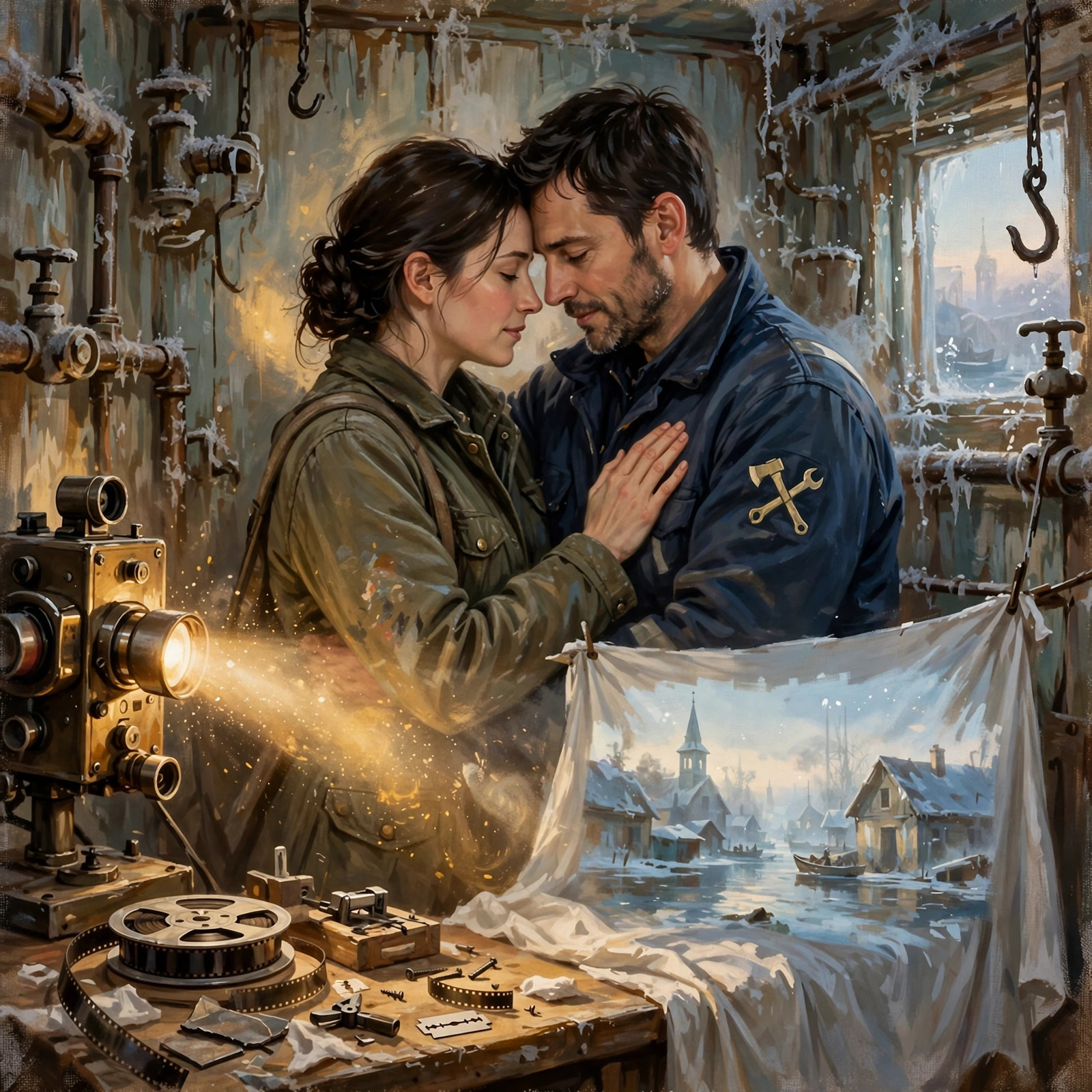
"Look from here."
White light lay under the ice-can room door in a flat sheet. Not lamplight, not orange. It moved, and the paint along the frame lifted and curled while she stood watching it.
"That's my condemned shelf," she said. "That's the whole shelf."
"Nitrate." He put the flat of his hand against her collarbone and walked her back two steps. "It makes its own air. You can't smother it and you can't starve it and it does not wait for anybody."
He was already running the length of the corridor to the mouth where the steel fire door hung in its housing. He knocked the chock out with his heel. The door came down its track and shut with a sound like a dropped safe, and the white sheet vanished, and the corridor went dark except for his torch.
Then he had the pliers off his belt. Wire through the hasp, a lead bead threaded on, one hard squeeze. The stamped number faced out at her.
"The main cells are the other side of that," he said. "Everything the trust still owns. Every reel you've got left."
"Vaughn."
"I'm flooding the room. Not the corridor. That room, and the shelf, and anything standing on the floor in it." He was looking at the door, not at her. "The water saves the rest. That's the whole arithmetic."
"The Wendle can's on that shelf."
"Then it's gone."
"I put it back."
"When?"
"While you were coiling the lamp lead. I always put it back. A tagged tin on a bench is a thing Bernadette asks questions about."
He turned toward the riser at the far end, and his boots went away from her along the wet concrete, and she had the snips out of her coat pocket, the little curved ones she used for trimming a splice. Two bites and the wire parted. The bead rang on the floor and rolled.
He was back before it stopped rolling.
"You cut my seal."
"Yes."
"Then I'm coming in with you." He hauled the door up enough to take them both. "Nobody's inside on their own. Not you. Not anybody. Not ever again."
The heat took the front of her face off. Along the shelf the tins were going one after another, each lighting into a hard white flare that threw its own lid across the floor, and the light came out of the film itself, out of the stuff she had spent seven years keeping cool and dark and calm. It didn't need the room. It was feeding on itself and it was quick, quicker than a thought, and the noise was a soft roaring, almost pleasant, like a big tap left running.
"Seventeen," she said. "Second shelf, left end."
He put the torch in his teeth. She got the long tongs off the hook, the ones bent wider since the hanger job, and the jaws went round the tin and it came away and the shelf behind it fell in. Something took the hair along her forearm. Vaughn had her by the shoulder and shoved her sideways toward the hatch, the narrow square the plant fitters had cut a lifetime ago to pass cans out to the dock, and it was still there, and it was still cold air on the other side.
She fed the tin through. He took it from the far side with his bare hands and swore and set it on the dock boards. The lid had gone out of true, warped up at the rim like a badly closed pie, and inside, when she got the snips under the edge and levered, the outer half of the reel was simply not there. Black lace, then nothing, then the tight inner coils still whole, still smelling of the projection booth, still Wendle.
"Half," she said. "Half of it's--"
"Willa. Out."
She had turned back for the next tin along, the one with the harbour footage, and he got a fist in the back of her coat and took her through the door with her feet barely touching. The steel came down. He was at the riser before she had her hands under her, and he pulled, and the pipes overhead went off like something being born.
Water hammer, then a roar that didn't stop. The bottom of the door wept, then streamed. Steam came out under it and rolled along the corridor and up the stair, and the two of them sat on the wet floor with their backs to the main cells and listened to a room drown.
"It'll hold," he said, after a while. His voice was wrecked. "That door'll hold."
Out on the dock the rain had thinned to nothing. Rollo was at the gate with the lorry, gunning it, the wheels spinning in the slip and throwing wet clay up under the arch, the whole load slewing sideways every time he tried it. He got out and looked at the road and got back in and tried again.
"Rollo," she called. "It won't take it."
"It'll take it." He leaned out, red-faced, cheerful, his tie still knotted from the evening before. "Nothing in that room worth saving anyhow, was there? All condemned. You'd have had it out in the skip come spring."
She didn't answer him. She was looking at the warped lid.
First light came up grey behind the quarry, and the Ashkirk engine came with it, Ada Prine on the step with her helmet already on, the slip cleared and the road scraped wide by a machine Willa hadn't heard arrive. Hoses came over the wall. Ada looked at the streaming door, then at Vaughn, then at the seal wire lying cut on the corridor floor, and wrote something on her cuff.
Her crew brought out what the shelf had become and laid it on the dock in a long black row. The heat and the water had split the seams. Lids came off with a touch.
Willa crouched and put her hand on one and stopped.
Leader. Scrap leader, spooled tight, wound on a cheap plastic core. In the next tin, blank stock, unexposed, the kind of thing that came off a camera test. In the next, more of it. Tin after tin after tin, the whole condemned shelf, the whole quiet shelf she had kept off every list she had ever typed.
And on the lids, under the wax pencil numbers she had written herself, the ghosts of the numbers she had rubbed out. Her own hand. Her own strokes, showing through the way old writing does when you've gone over it twice.
Somebody had been coming into her room for a long time. Somebody who knew that nothing in it appeared anywhere, that no inventory would ever ask after it, that the woman who kept it would rather be asked anything else at all. She had built a door with no lock on it and she had never once wondered who was walking through.
"I'll have that lot off the dock by dinner," Rollo said behind her, patting the lorry's flank. "Save everybody the bother."
The loss investigator came up the cleared road midmorning in a small clean car, and he took their statements one at a time in the inspection room with the door open because the smell hadn't gone out of the building. Ivo Brandt wrote in a neat hand and thanked people. He said he wasn't there to assign anything. He said he was there to write down what people saw.
"The room that burned," he said. "Was it on your inventory?"
Willa's cards were in her coat pocket in their biscuit tin, the corner singed, both versions in her own handwriting, the true ratings and the ones she had put over them. The bid was still live. Her post was still in the bid. Somewhere behind her sternum was a room in a state depot and a batch she had called stable, and a man who had cleared out his desk while she stood in the corridor saying nothing.
"Yes," she said. "It's all on the inventory. Condemned stock, listed for destruction."
"And where did it start, to your eye?"
"Under the new run." She kept her hands flat on the table. "The pipework your engineer put in. There's been heat off that end since he hung it."
Ivo's pen went on moving. Vaughn was in the doorway with his coat over his arm and his face perfectly quiet, and he waited until the pen stopped.
"Willa," he said. "Do you believe that?"
She looked at the table. She looked at the singed corner of the tin sticking out of her pocket. She let the silence go on so long that Ivo cleared his throat and turned a page.
Vaughn nodded once, at nobody. He went out along the corridor and stooped and picked the cut bead and its wire off the floor, and she heard him do it, the small scrape of lead on concrete. In the doorway he put the sealing pliers into his coat, and the wire went into his fist, and he closed his hand round it.
His truck went out through the gate and over the scraped road without stopping. Willa stood on the dock with the warped tin in both hands and the water still running out of the building past her boots.
Green Cards
Willa set the biscuit tin on Ivo Brandt's table and pushed it across with both hands.
"I need to change my statement."
Brandt laid his pen along the edge of his pad and squared it. "Then we'll start a fresh page."
She got the lid off. The green cards stood in it in a tight pack, and she tilted the tin so he could see them properly, the wax pencil shining where she had written and rubbed out and written again. Under the tidy ratings the old ones came up faint, the way a footprint comes up under a new fall of dust. Weeping. Soft. Unstable. Over them, in the same hand, the word she had put there instead.
"Read the underneath," she said. "Not the top."
He took a card to the window and turned it flat and back. "These are both yours."
"Yes."
"Say it out loud, please. As you'd say it to anybody."
She kept her fingers on the tin's rim. "I rated failing cans stable. For years, not once. I hid them in the ice-can room and wrote the cards over so nobody would go looking. That room isn't on the inventory because I kept it off it. Nobody knew about it but me. The fire started in there."
Brandt wrote. He did not look up while he wrote, which she was grateful for, and then he did look up, which she was not.
"The cans," he said. "Can you give me the numbers as they truly were?"
She turned a card over and took the wax pencil out of the lid and wrote the cache down the back of it. Every can she had carried into that room. The numbers she had rubbed off the lids and the numbers she had put on instead. The pencil skated and she pressed until it bit. He watched her do it and did not offer to help, and the list ran past the fold of the card and down the margin.
"And the pipework," he said. "The heat off the new run."
"There wasn't any. I put it there so the origin would sit somewhere that wasn't mine."
Brandt set the card beside his pad and photographed it, front and back, with a small clean phone. "Mr Halloran's certification concerns the store and the system. It doesn't concern a room that was never declared to him. I'll write the origin as you've given it."
"His licence."
"Was never mine to take." He capped the pen. "You understand what this does to your position here."
"Yes."
Out on the dock Rollo had the lorry backed up to the heap of split cans, and Cody was pitching scrap leader into the bed with a shovel, apologetically, as if it were somebody's washing he was putting in the mud.
"Cody. Your book."
The boy straightened. "The dockets?"
"The dockets."
He wiped his hands down his thighs and got the book out of his jacket and gave it to her, and that was the whole of it, the thing she had not been able to make herself do for a week: somebody handing her a thing she had asked for.
"That's my paperwork," Rollo said.
"It's his. He keeps it."
"Salvage, that is. Condemned stock, treasurer's authority, you can ask Bernadette--"
"I'll ask her." Willa opened the book on the tailgate. Folded into the back were the weigh tickets, grey carbons, stamped Vantage Metals, silver recovery, a weight and a date and a signature that was mostly a flourish.
She read a number off the back of her card. "Nine."
Cody leaned in. "Nine, aye. That'd be the first trip. And the second."
"Thirty-one."
"That's there." He put his finger on it, and then he took his finger off. "He said it was scrap. He said the tin was worth more than what was in it."
"It was scrap by the time you carted it."
The boy looked at the lorry and then at the shovel in his own hand and put the shovel down very carefully, as though it might go off.
Rollo climbed up and shut the door hard enough to make the mirror nod, and went out over the scraped road with his load sheeted and his indicator flashing left where the road only went right.
Ada Prine came along the dock with her helmet under her arm and took the book off the tailgate and read it standing, one boot up on the step.
"I'll ring Harlowtown," she said. "They can be at the smelter gate before he's off the quarry road, if he stops for a smoke, and he always stops for a smoke."
They matched the rest of it at Brandt's table with the door open and the smell still coming through it, Ada reading weights, Willa reading numbers, the boy sitting on the step outside saying "aye" and "that's there" until he stopped saying anything at all. Ada gave him her flask. He held it and didn't drink.
Ada came back in the morning with rain on her shoulders and her phone still in her hand.
"Gate," she said. "Load, dockets, tickets, all of it on the weighbridge with him. He told them it was salvage twice and then he stopped telling them anything." She put the phone away. "They took him with his own paperwork in his hand. He wouldn't put it down. Somebody had to take it off him."
Bernadette Loewe arrived with the bid file under her coat, which was somehow the worst thing that happened all morning.
"I signed those destruction lists," she said.
"You signed what I gave you."
"I could have walked down and looked." Bernadette set the file on the table and kept her hand flat on it. "I'm withdrawing the bid. I'll ring them before ten, so it comes from us." She looked at the tin, and the cards, and the singed corner. "And I'm accepting your resignation, Willa. I'd rather you offered it than I asked."
"I'm offering it."
Willa put her keys on the table. The plant key, the cell key on its brass fob worn smooth, the little one for the flat upstairs with the tape round it that she had never taken off.
"The flat goes with the post," Bernadette said.
"It does."
Alec Trewin came up the road in a hired van with crate boards and a nail gun and a boy from the university who stayed in the cab. He walked the cells with a torch and made small noises, some of them pleased, and came out and set the warped Wendle can on the boards.
"Half a reel," he said.
"The head's burned off. I don't know what's left on the tail. I haven't dared look."
"It goes in the crate either way." He turned the lid with his thumb. "You'll not be here when we open it."
"No."
She told him then, standing on the wet dock with her hands empty. "The batch at the depot wasn't stable. I rated it. You cleared out your desk for ratings I wrote, and I stood there and let you."
Alec was quiet long enough that she heard the water going out past her boots.
"I know," he said. "I've known a while. I waited to hear whether you'd ever say it without being pushed." He crouched and started laying boards. "I can take the collection, Willa. I can't take you. There's no post at my end and I wouldn't give you one if there was."
"That's fair."
"It is." He held out his hand for the can, and she gave it to him, and it went into the crate on a bed of shredded board. "It's also a rotten way to spend a morning."
She lifted the ice tongs off the hook by the hatch, bent wider than they had been, and hung them over the crate's edge where the university boy would see them and ask.
Vaughn's truck came through the gate while Alec was fitting the last lid. He got out with his coat over his arm and his sealing pliers in his fist, and he went straight to Brandt's table and put the cut lead bead and its wire down on the wood.
"That's off my section valve," he said. "I cut it to shut the section. I crimped a new bead after. Photograph it and I'll take it back."
Brandt photographed it. Vaughn pocketed it. He stood a moment with his hand still in the pocket.
"He's read you the whole tin," Brandt said, to nobody in particular. "Both hands. Her post went with it, and the bid."
Vaughn looked at the keys on the table, and at the crate boards, and at her.
"I've got the deluge to finish," he said. Flat, the way he said everything about pipe. "Two days of it. Maybe three."
"I've nowhere to be."
Neither of them said anything else, and Alec asked for a hand with the lid, and Vaughn knelt and held it down while the nail gun went off beside them, three times, four. Willa stood on the empty dock with no keys and no post and the rain coming fine off the quarry, and Vaughn got up and put his coat round her shoulders without asking, and she pulled it closed at the throat and stayed.
The Cut Seal
"Lift the left end," Vaughn told her. "It's sitting proud."
Willa got her fingers under the timber and lifted. Salt had eaten the grain white along one edge, and the old bolt holes ran down it in a line, empty for decades and now full of new steel. He slid a washer on and brought the nut down snug.
"There." He sat back on his heels. "That's the last of it."
She let the end down and the whole thing settled without a sound. The old one had complained if you so much as leaned on it.
"You've built me a table out of a plant."
"Out of what wasn't burnt." He wiped the wrench and put it in his bag. "Framing's dry as bone. It'll outlast us both."
Above it, on a hook he'd bent and screwed into the brick, hung the ice tongs. He'd shaped the hook to suit the bend in them instead of beating the bend out. Willa swung them once against the wall and they rang like the plant was still working.
There was no other noise anywhere. Overhead the new pipe ran the length of the brine room, heads spaced along it, and he'd opened the test that morning and let the water go until the drain took it clean.
"Brandt's signed off," he said. "Merrow Mutual's paid on the cells. My certification stands."
"And Rollo?"
"Charged. Cody's dockets and the weigh tickets did it. They never needed a word off me."
"They had plenty off me."
"They did." He didn't soften it, and she was glad of that.
Her flat above the office was empty. The mattress had gone to the man who kept the shop in Ashkirk, and she'd slept in his spare room since she gave up her keys. The biscuit tin had gone north with the crates, the true ratings and the rewritten ones riding in the same box.
Vaughn took something from his coat and set it on the wood beside the can. The lead bead, cut clean through, and its loop of wire.
"I kept it."
"You've had it in that pocket since the dock."
"I have."
Willa turned it with one finger. The cut face was bright where the pliers had gone through, dull everywhere else.
"Why that one?"
"It's the piece that worked." He put his hand flat on the new wood. "Everything else off that night is a report somebody else wrote."
"You never answered me. On the dock. Whether you believed it."
"No."
"Answer now."
"I never believed it. Not for a minute." She kept her finger on the lead. "I said it because the truth was mine, and I couldn't stand to hand it over in front of everybody."
"You could've handed it to me quiet, after."
"I know. I did it the next morning instead, and it took my post and the bid with it."
He nodded once and let it lie.
Her coat hung over the rail. She got the envelope out and laid it on the table without opening it; she'd read it enough times to know the shape of every sentence.
"Harlowtown," she said. "Mechanics' institute. A loft full of films and a committee who think vinegar is a cleaning product. A season's work, if I'll have it."
"Money?"
"Insulting."
"Are you going?"
"I've nowhere to be." She had said that on the dock as well, and it had sounded like surrender then. It didn't now.
He got up and lifted the warped lid off the can.
The half that was left came out coiled tight on its core, outer edges black and crumbly where the fire had eaten in. He set it on the feed spindle, locked the collar, and kept his hand there a moment.
"Let me see the head."
She drew off a little and held it to the port light. The perforations were clean. Her cement splice sat there fat and shiny and ugly, and it held when she flexed it gently between her fingers.
"Ugliest splice in the county."
"It ran to the tail once already."
"Then it can run again."
He put a bucket of sand by the machine and another by the door, and touched the head above it with the back of his hand.
"That one's live. Door's open behind us. I stay at the lamp. If I say out, you go, and you don't turn round for me."
"I know the rule."
"You do now."
He threaded it, top sprocket, a loop above the gate and a loop below, down to the take-up, and turned it over by hand twice with his ear near the movement.
Then the lamp, then the douser, and the sheet at the far end of the brine room went white.
Wendle came up out of the white.
A street with the cobbles shining. A dog asleep in the middle of them and a cart going round the dog. The chapel in scaffolding, and the men on it all looking at the camera at once, then all looking away, one after another.
Willa laughed out loud in the empty booth.
"That's the gate. That's her."
A woman stood with her hand up against the sun. Behind her, a low wall and a gatepost with a stone ball on it. Willa knew that ball from a photograph, and had been told whose hand that was, and here was the hand, moving.
His fingers came over hers on the rail and stayed.
The chapel door, a man wiping his hands on a rag, the street running away toward the water that wasn't there yet.
Then the corner of the frame went brown, and the brown crawled in, and the last of it slid up and away, and there was nothing on the sheet but lamp light. The tail came off the feed and went round, flapping.
He killed the lamp. The flapping went on in the dark.
Willa found she was crying, in the ordinary way, without any sound to it. She wiped her face with the heel of her hand and didn't apologise.
"I love you," Vaughn said. "I'm not going to be clever about it. I've been inventing reasons to stay in this town, and that's the only real one."
"I love you." It came out plain, the way she'd write a rating she meant. "The tin's gone north with every card I ever wrote, so I'm saying this one out loud where nobody can rub it out."
He turned toward her. She could hear the tail slapping, and his breathing, and the rain starting again on the roof.
"There's a thing I've been getting to." His thumb moved on her knuckle. "I'll close out the local job. Hand the file to Brandt, shut the shop end. Then wherever your work is, that's where I go. Harlowtown, or after Harlowtown, or--"
"Yes."
"I haven't asked you properly."
"Yes anyway. Ask me on the road and I'll say it again."
He kissed her with his hand at the back of her neck. She got hold of the front of his shirt, and the stool went over behind them, and neither of them picked it up.
Then they held on, her face in his collar, his arms round her back, the machine still turning and nothing to see.
"Harlowtown, then," she said into his collar.
"Harlowtown."
On the wood between his sleeve and hers the cut bead lay where he'd put it, wire curled round it, and the half of Wendle that was left had run all the way out, and they stayed as they were.
Get notified when new stories drop

Serena Blake
Serena writes romantic suspense and dark romance for readers who want pulse and payoff. Her stories chase trust as hard as they chase danger.
Leave a comment
Comments