



Turn Two
"Say it again," Gideon said. "Slower, so I can enjoy it."
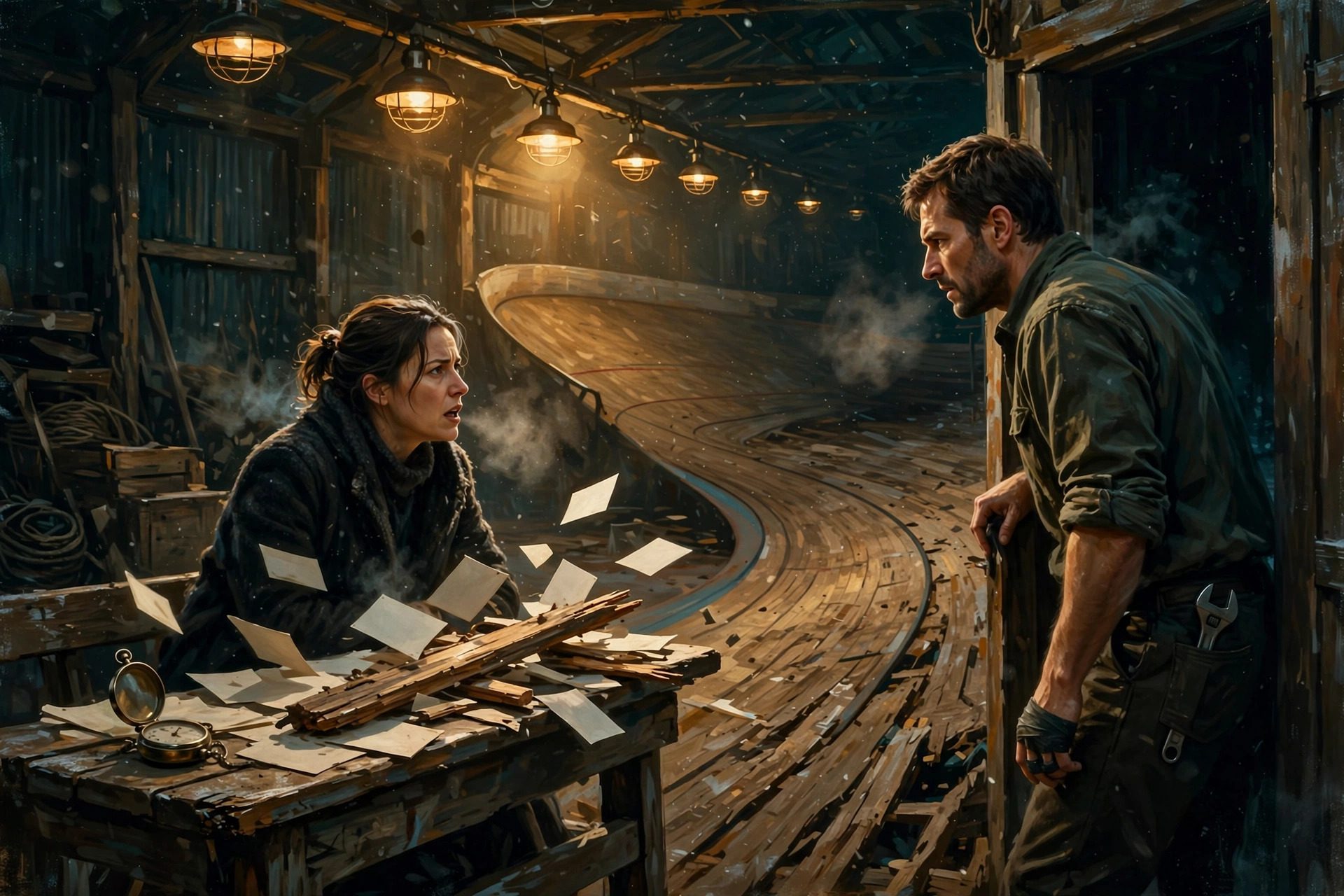
"The low line through turn two is unrideable." Cressida laid her palm on the timing bench and it rocked, the short leg knocking the concrete. "There's a step at the joint. It drops when you load it."
"It's the only fast line we have."
"It's the only one you trust."
He stopped smiling. Beyond the open door, Wesley came up out of the corner with his head down, and Silas shouted at him to hold his swing, and their voices arrived thin and flat, the way voices did in a shed built for freight.
Cressida had spent the morning at the bottom of that bend with a straightedge and a feeler gauge. She'd found a lip at the joint she could catch a fingernail under, and pine that gave beneath her heel like a floor over a joist gone soft. She'd written it up in block capitals and underlined the recommendation twice, underlining being the only kind of shouting she was any good at.
"Use the red," she said. "Higher through the corner. You'd lose less than you think."
"Higher is longer."
"Longer is measurable. A tire coming apart isn't."
Gideon had a spanner in his back pocket and tape on two fingers and a way of standing that made the doorway seem narrower than it was. "Longer is losing. You'd have me give away meters to a plank."
"I'd have you finish the effort."
The leg knocked again when she leaned. She pulled a discarded start order off the spike, folded it into a wedge, and drove it under the short leg with her thumb until the rocking stopped. It was a good fix. She was proud of it in a small, stupid way, and she kept her face still so nobody could see that.
The draft kept lifting her split cards, so she took the piece of pine out of her coat and laid it across the stack. A hand-span of old track board, splintered at one end, worn smooth and dark everywhere else by years of her thumb.
Gideon nodded at it. "What's that?"
She squared the papers against the stopwatch and didn't answer.
Four riders, four kilometers, sixteen laps of the two-fifty, and the clock stopped on the third wheel over the line. That was the whole assignment, and she could have drawn it in her sleep. Where the seconds went. Which exchange bled them. Whose swing up the banking came early and stole speed from the man behind him.
Silas was steady in the changes, steady the way a hinge is steady. Kip could sit third and finish on nothing but temper. Wesley had a pull in him like a door coming off its hinges, if only he'd stop leaving it half a lap before he should. Gideon led out and set the pace and expected the rest of them to live at it, and mostly they did.
At the national championship the four of them had to go under four minutes six. Under it, the federation kept the boards and the development squad here in Nettleford. Over it, the lease went to the central program at Aldergate, and these four became four names on four different rosters, and the velodrome became a shed with a good roof.
"You know what I've still got," Gideon said. "Not a photo. Two lines out of a report. 'Rider demonstrates no measurable progression. Recommend support be withdrawn.' I could recite the paragraph. I've had it longer than I've had the shop."
Cressida turned the stopwatch face down on the bench.
"I know what I wrote."
"You'd never met me."
"I had your splits." Her voice came out level and helpful, the way it did when she was frightened, and she heard it happen and couldn't stop it. "I have them now. You're giving away a tenth a lap where that pine dips. Sixteen laps. Do the sum."
"There she is," he said. "Arithmetic. That's what you had for me then, too."
Out on the banking, Wesley came round again and looked over for a signal, and she gave him one, two fingers, hold your line, and he held it. Her hands were fine. Her hands were always fine.
Gideon picked up the split card, the laminated sleeve with her penciled laps inside it, and held it toward the light in the doorway. "You've got a number for everything. Except what's in your pocket."
He folded it, creased it white, and tore it across the middle. Both halves went down onto the boards, and the draft took one of them a little way toward the door before it settled.
She picked up the pine and went out after him.
He had the bike off the rack already. Kip held him at the rail, said something that might have been a joke, and let him go, and Gideon went down the banking with that ugly, beautiful acceleration of his, the one that made her chest hurt every time she watched it. He came out of the corner and dropped to the black at the mouth of turn two, exactly where she had told him not to go.
There was a crack like a bat on a ball. Then the bang of a casing letting go. Then Gideon came down the pine on his hip with the bike clattering after him, and the noise went on much longer than it should have.
Wesley and Silas took the top of the bend to stay clear. Kip was shouting. Gideon was up before the frame finished sliding, one hand pressed to his hip, his skinsuit gray with dust and split along the seam, and no blood on him anywhere she could see.
He put his weight on the leg, tested it, and turned and looked up at the shed door. At her.
"Go on," he called. "Write it up."
Simeon came out along the pole with a pry bar in one hand and a claw hammer in the other, walking the way he did everything, as though the building owed him money and he'd come to collect. He went straight to the place without looking for it. He knelt, put two fingers on the joint, and pressed, and the wood moved under his hand like a loose tooth.
"Been going a while," he said.
"You never said."
"Said it in the spring. You were under a bottom bracket at the time."
The pins came up shrieking. Simeon worked the bar along the length, patient, taking it a finger's width at a time, and the split board came free with a sound like a knuckle cracking, and he lifted it out and laid it on the infield grass. Underneath lay a long empty slot in the low line, the batten showing dark with old glue, and the dust of decades sitting in the corners of it.
Wesley stopped his roll to look. Silas said something quiet to him and sent him round again.
Simeon sat back on his heels and his eyes went to Cressida's hand, to the piece she was holding, and stayed there a moment. He didn't ask. He got up instead, one palm on the banking, and stood a while looking at the gap he'd made.
"I'll want a length of Siberian," he said. "Not the stuff they sell now."
"I'll plane it," Gideon said.
"You'll plane it wrong the first time."
"Probably."
Cressida came down off the banking in her flat shoes, slipping a little on the dust, and stopped at the edge of the open slot. The pine was in her fist. She could feel the splintered end pressing a small dent into her palm, and she held on to it, because it was the only thing in the building she was sure of.
Gideon stood beside her with the rear wheel under his arm, the tubular hanging off the rim in ribbons. Every time he shifted his grip, a few more black crumbs came away and fell on the wood.
"Your hip," she said.
"It's fine."
"I'd like to see it."
"You'd like a number for it."
Above them, Kip asked whether anybody was going to tell him what to do next, and nobody did. The four of them were still out there somewhere, rolling, waiting, and the clock on the bench behind her had stopped at nothing at all.
The gap lay open at their feet, long and narrow and honest, and neither of them stepped back from it.
The Blue Frame
"Whatever's on that card is wrong." Gideon gave the wheel a spin in the truing stand and let it tick itself quiet. "You came all the way down Ferry Street for numbers. Ask me for them."
"Pressure. Rim depth. Tire width." Cressida counted them off, which was a thing she did when she was being made to feel like a visitor. "And the gear you actually pushed, not the one you told the timing bench."
"Wesley."
Wesley lifted his head from the far end, the tension meter still hooked over a spoke. He told her. It was nothing like what she had built the opening lap on, and she felt the whole first minute of her arithmetic sag under her.
"Say it again."
He said it again, apologetically, as if he'd broken something of hers.
She reached for her pencil and remembered the card was in two pieces in her coat. She took them out, and the pine offcut came with them, and she set the wood down on the bench to free her hands. Then she laid the halves edge to edge and held them with her thumb.
"Tape."
Gideon pushed a roll along the top with two fingers and went back to the wheel. She tore a length with her teeth, stuck the halves down, and smoothed the join with the side of the pencil. The laminate had gone white along the tear. It was never going to lie flat again.
"Your bike's been behind my door since morning," he said, not looking up.
"I know. I've been walking round it."
"It's in the way."
"That's why I brought it. Sell it, scrap it, I don't mind which."
He wiped his hands down his thighs, went to the door, and came back carrying the blue steel out from his body like something wet. The two hooks from her hallway were still caught over the top tube, swinging, tapping the down tube each time they came round. Dust sat in the lugs. Nobody had touched it in years, her least of all.
He dropped the hooks into a tin of dead bolts, opened the jaws of his stand, and clamped the seat tube.
"That isn't scrapping it."
"No."
"Gideon."
"You'll write my efforts. All of them, properly, with the numbers I actually run." He turned the crank a quarter turn and listened. "That's what I pay with."
"I haven't agreed to anything."
"You came for my wheel data. You're getting my wheel data. It comes with a bike in a stand."
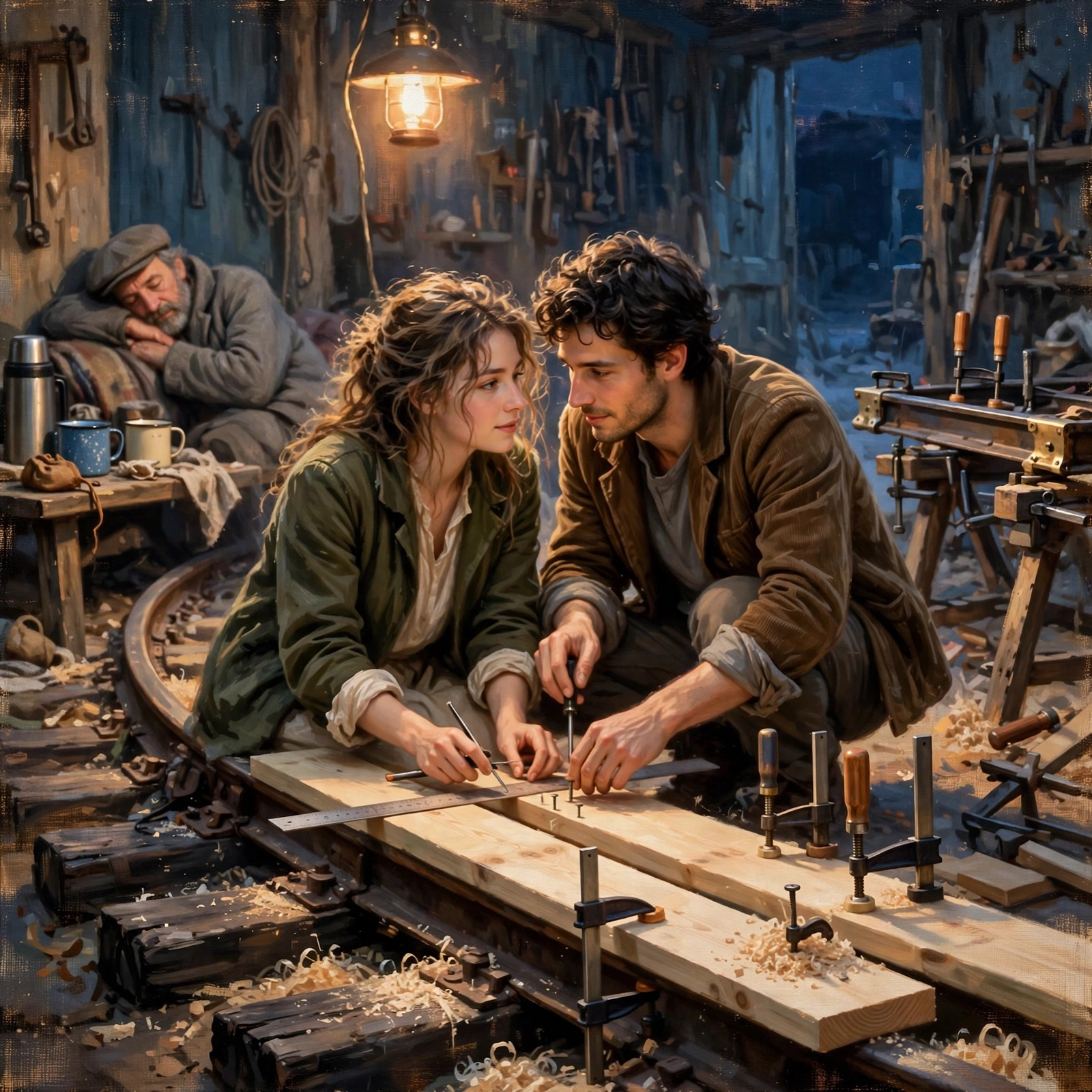
The crank turned again, gritty, a sound like a boot on gravel. He fetched a pin spanner and a face wrench, and while she watched he unthreaded the cup and let the bottom bracket spindle come out into his palm, and tipped the bearings one by one into a jar lid. They were the colour of old pennies. He counted them into the lid with a screwdriver tip and set it where the light was.
"Those have been dry since before you came here," he said.
"Probably longer."
Simeon came in sideways through the door with clamps stacked along his forearm, shuffling, breathing through his mouth. He put them down on the bench end and looked up, and stopped looking at anything else.
"Ah," he said. "You've got her up."
Cressida's hand went still on the taped card.
"Filed every one of those lugs." Simeon was cheerful, and deaf to the room. "Brazed it for a junior girl used to ride the shed every summer. Wouldn't take anybody's hand-me-down. Had to have her own, she said. Sprayed it blue out back, took the whole afternoon and half my patience."
Nobody spoke. Wesley found something to do with a spoke key.
Gideon looked at the blue steel in his stand. Then he looked at the hand-span of pine lying on the bench beside her card, splintered at one end, worn smooth everywhere else. He picked it up, turned it over once, and put it down again among the shavings by the vice.
He didn't ask her anything.
"Batten's sound," Simeon said, to the room in general. "Dry glue, not soaked. You'll want these back before dark, and you'll want more than these."
"It's an old frame," Cressida said.
"It is that." Simeon patted the top tube as he went past it, the way you'd pat a horse you'd sold years ago.
Gideon took the pencil out of her hand, which she allowed because she was still watching Simeon, and looked at the card. He crossed two of her figures and wrote his own underneath, in a hand like fence wire.
"He can't hold that."
"He can hold it if the wood lets him. You've had him riding a slot with a soft board under his front wheel and calling him slow."
"I've had him riding what's there."
"Then come and hear what's there when it's finished." He put the pencil down on the tape. "A week. My efforts, your voice, at the rail. Not a report. Not a card you post to Halden."
"The card is what they read at Halden."
"The card is what took my funding."
The shop ticked. Wesley stopped pretending to work.
"I write things down," Cressida said, "because writing can be corrected before anybody hears it."
"And out loud it can't." He wiped the grease off his fingers, one at a time. "Out loud it can be corrected right then, by the man on the bike, who is the only other person who knows."
She looked at the two figures in his hand, sitting under hers like a second opinion nobody had asked for. She thought about how much of her life had been spent being right on paper, in rooms where nobody had to look at her.
"A week," she said. "And the low line rebuilt properly. To the thickness I give you, not the thickness you can get."
"Deal."
He put the plane iron bevel down on the water stone and set her two fingers on the back of it.
"Hold that. Don't move it."
"Then what moves?"
"The stone. I do the stone. You keep the angle."
She kept it. He drew the stone back and forth under the blade, unhurried, the water going grey, his knuckles brushing her wrist on every pass. She could feel her own pulse in the fingers he was trusting.
"Lower," he said. "A hair."
She lowered. The bevel brightened along its whole width, a thin silver line coming up out of the dull steel.
"There. Hold that forever." He tested the edge on his thumbnail, nodded, and locked the iron into the plane body.
The Siberian length went between the dogs. He planed it and the shavings came off in long curls that fell over her shoes, and Simeon stood at his shoulder saying nothing, which from him was a lecture. Twice Cressida took the offcut out of the shavings and held it against the end grain, matching the rings, checking the thickness with her thumbnail across the join.
"Same tree, near enough," Simeon said. "That's as good as you'll get in this country."
She left the offcut lying among the curls when Wesley came to help carry.
At the velodrome the maintenance lamps threw everything long and yellow. Simeon knelt at the open slot with a brush and the glue pot, working the old batten, and Wesley held the lamp and tried to hold it steady. They laid the fresh length in dry, took it out, mixed, buttered the batten and the back of the pine, and set it home. It went in with a sound she felt in her knees.
Gideon ran the clamps from the middle outwards, a hand's width at a time, and she kept her palm under the banking to catch the squeeze-out before it ran down the boards.
"Pins tomorrow?" Wesley asked.
"Tomorrow it's still wet. Leave it be."
The clamps tightened along the fresh pale strip, one after another, the low line of turn two whole for the first time since Simeon pried it open. Cressida wiped her hands on her jeans and left a long grey smear.
"A week, then," she said. "At the rail. My voice, not my paper."
Gideon looked up at her from his knees, and for once he didn't have anything sharp ready.
Across town, under his bench lamp, her blue steel stood stripped bare in his jaws, its bearings in a jar lid, its hallway hooks in a tin of dead bolts, waiting for somebody to decide what it was for.
Infield Boards
"Don't load it yet," Cressida said.
Gideon kept turning the wrench. The first clamp came free of the pale length let into turn two and went into the bucket with a knock, and he worked from the ends back towards the middle, laying each one down instead of dropping it. "It's cured."
"It's cured and it isn't pinned."
"Then I'll ride it like a man who knows the difference."
She crouched at the slot and ran her thumbnail across the join. The seam barely caught it. New pine met old in a line thin as a pencil stroke, flush, sealed, the grain running the same way because she had stood in his workshop matching rings while he planed. He took a sanding block to the last high spot, three passes, and blew the dust off, and it settled into the creases of his palms and stayed there.
"First lap gentle," she said. "Gentle means gentle."
"Write it on my hand."
She held out the clipboard instead. The split card had been torn and taped and torn again, two of his numbers written over hers in pencil that pressed harder than hers ever did. He looked at it, then peeled it off the board, folded it in half, and pushed it into the back pocket of his jersey.
"That's my working copy."
"I'll keep it dry. You talk. That was the trade."
Kip came round on the motorbike with the throttle rolled on a fraction at a time, and the three of them tucked behind the little screen, Gideon first, Silas second, Wesley third and too close. Cressida stood at the rail with the stopwatch face down on the wood beside her elbow.
She had spent years turning riders into columns. It took her half a lap to stop doing it. The sound came up off the banking, the hum of tubulars on Siberian pine, and she heard the effort go sour before any watch could have told her.
"Down a hair. Wesley, sit in, don't fight it. Gideon, you're pushing the bike, let it pull you."
He let it pull him. The line tightened. She called the next change and it happened under her voice like something she was building with her hands, and when Kip swung off and dropped down the apron the three of them kept the speed for a full lap on their own.
Then standing starts, which were worse. Wesley's front wheel wandered out of the gate and he wrestled it back with his shoulders, and Silas, behind him, said nothing at all and simply held the line until the boy found it.
"Sorry. That was me. Sorry."
"Everybody's first hundred are ugly," Kip called from the apron. "Mine were an insult to the sport."
They put the bike away and rode it as four.
She called them by feel, the way she had promised him, no paper, the watch lying face down and forgotten. Gideon went through the low line of turn two gently the first time and harder every time after, and the fresh length took him without a sound she could hear over the rest. Wesley came through his exchanges hungry. Silas came through his like a man posting a letter.
On the closing laps Wesley swung up too early and too steep, hung at the top of the banking with nowhere to go, and dropped straight back down into Silas's front wheel.
Silas feathered, drifted a hand's width, and took him back on his hip. "Got you. Breathe. Next one's mine."
They came off the last bend in a line so tight it looked rehearsed, and Cressida turned the watch over.
She looked at it. She looked away. She looked back.
"Say it," Gideon said. He was still rolling, hands on the drops, chest going.
"You were knocking on it. With a boy who's never had a proper lead-out and a strip of wood we glued in a shed."
He came round and stopped at the rail and put his forearms on it. "Under four minutes six or the boards go to Aldergate. Knocking isn't under."
"Knocking is a week old. That's what knocking means."
"Wesley rides it. Nationals. Him, not a loan."
"Gideon."
"Silas can carry him through the exchanges. You just watched him do it."
She had watched him do it. She had also watched Wesley's front wheel wander, and she knew exactly which sentences a selection report could survive and which ones it could not, and the safe paper would not agree with her, and she was not going to say the rest of it out loud on a night this good.
"The safe paper won't say what I'd say," she told him, and let that sit on the rail between them.
He wiped his face with his forearm. "Then say it in whatever paper you like."
Lorna came down through the stand with a tray held level like a woman crossing a river, two foil parcels and a stack of bowls, and she did not stop until she reached the shed under the banking.
"Eat. All of you. I'm not driving that hill twice."
There were four benches. Cressida took the end of one and Gideon took the end of the other, and Lorna set the tray down, pointed at the space beside her son, and waited with her arms folded.
"You. There. I've not carried food down a velodrome to watch two grown people eat at opposite ends of a shed."
Kip laughed into his bowl. Cressida sat. Gideon sat closer than the bench required, and Lorna went away satisfied, and the parcels were chicken and rice and something with cinnamon in it that nobody could name.
Afterwards Kip loaded the bike. Silas turned the lights off in the changing rooms and stood a moment in the doorway with his bag on his shoulder, looking at Wesley, who was still apologising.
"Stop it," Silas said. "You came back down. That's the whole job."
Then it was the two of them and one bank of lights, and Gideon jerked his head towards the apron.
They sat on the low boards edging the infield, feet on the cold apron, the banking rising away behind their shoulders. Cressida took the offcut out of her coat pocket. A hand-span of it, splintered at one end, the rest gone smooth and dark from years of being carried.
"I came off here," she said. "Not the straight. This bend, the low line, at twenty-four. I remember the noise more than anything. It went on much longer than it had any right to."
He didn't reach for it. She put it in his hand and he closed his fingers round it.
"I never raced again. I told people it was the shoulder. It wasn't the shoulder." She pressed her thumb into the seam of her jeans. "Every recommendation I've written since has a door left open in it. Provisional. Subject to review. On the evidence available. Eight years of doors, so that when I'm wrong I can say I only ever said maybe."
"Except one," Gideon said.
"Except one."
He turned the wood over, found the smooth end, and stroked it with his thumb the way she must have done a thousand times without noticing.
"Not suited to the demands of the elite programme." He said it flatly, without heat, which was worse. "That's the line. I was young enough to believe a sentence. Funding gone at the end of the month, and my mother took in more front rooms, and I got a workshop because nobody was going to pay me to ride."
"I know what I wrote."
"You know what you wrote. You don't know what it did." He set the offcut back on her knee, gently, and left it there. "I've been riding on spite ever since. Spite and a hip that's been grinding for years. It's a good engine, spite. It just doesn't steer."
She looked at him then, at the grey in the light and the dust in his knuckles and the way he sat with his weight off one side.
"I'm not telling you it's settled," he said.
"I'd think less of you if you did."
He laughed, once, quietly, and she picked the offcut up off her knee and pressed it into his palm and folded his fingers over it, and he did not give it back.
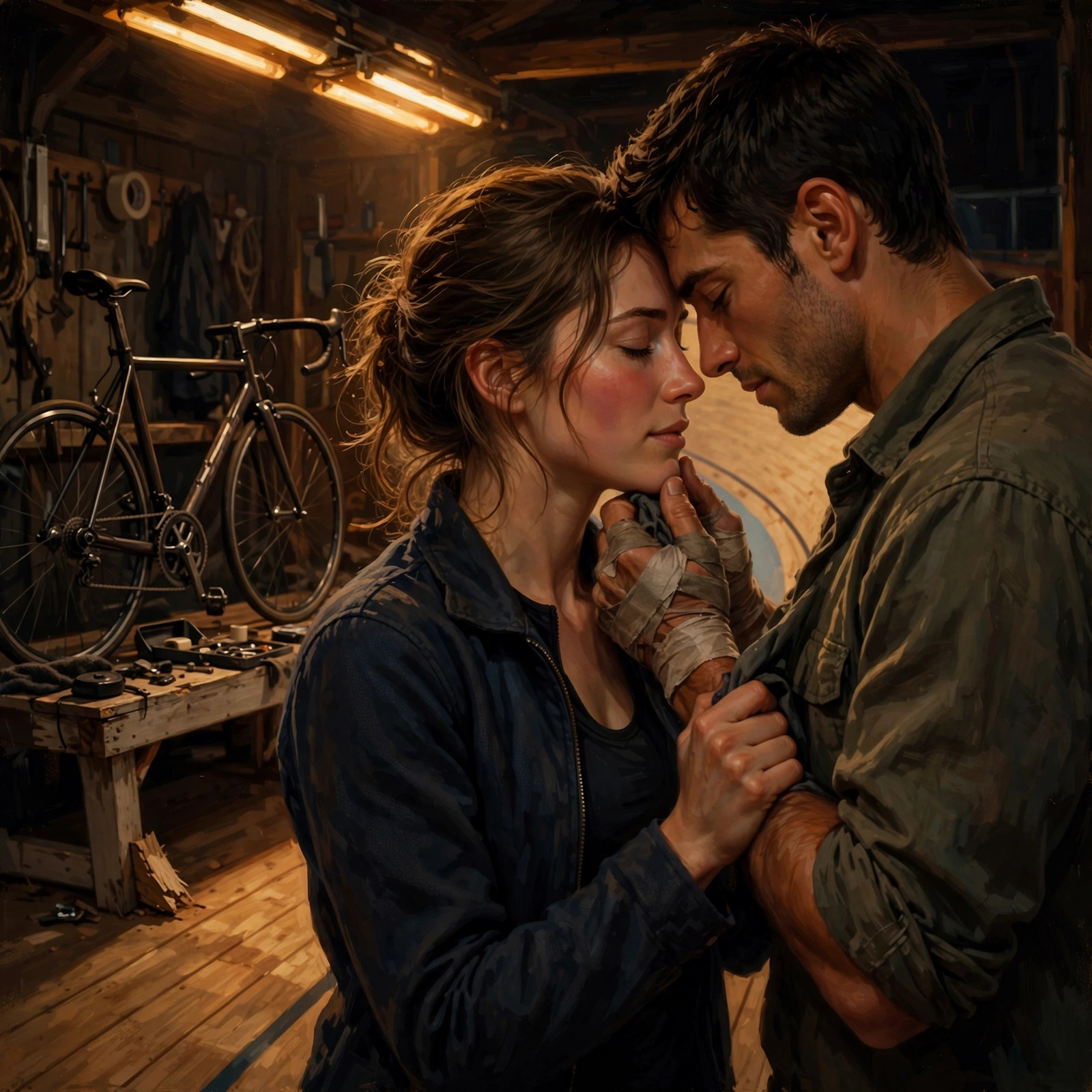
Then he kissed her, or she kissed him; afterwards she genuinely could not have written it down. His hand came up to her jaw with the wood still in it and pine dust along her cheekbone, and she got a fistful of his jersey at the shoulder, and the boards were hard under them and the banking curved away above and none of it mattered at all.
When they broke apart he stayed close, forehead against hers, breathing like a man who had just done sixteen laps and then run up a hill.
"Gentle first lap," she said, unsteadily.
"You've been calling me gentle all week."
His palms left pale prints on her shoulders. Her mouth stayed warm long after the lights went down to the last bank, and in the back pocket of his jersey the card sat folded and dry, every split on it in two different hands, and she had never once needed to look at it.
The Offer Packet
Ines Marchetti pushed the packet across the desk and kept her palm flat on the cover, as though it might get up and leave without her.
"Letter first. Then the rest of it. I'm not having you tell me in a month that I hid anything from you."
Cressida read the letter. Establishment post, central programme, based at the Halden Performance Center. Seventy-eight thousand a year, pension from the first day, a desk with her name on a drawer instead of a locker she cleared every spring. They had even spelled Ashby right.
Behind Ines, through the glass, the Aldergate car park lay in flat grey rows, and somewhere below it a trolley rattled over a threshold.
"You've been on rolling contracts since you started," Ines said. "I know what that does to a person. I've signed enough of them."
"You have."
"Then take this one and stop being frightened of April."
She turned the pages. Salary scale, relocation, notice period. And then, stapled inside the back cover, a schedule with a header she had seen a hundred times in other people's packets, and a column of venues, and Nettleford Velodrome three lines down, lease transfer to central programme, and beside it, in the status column, agreed. The date against it was in the spring. Months back. Before the clamps went on. Before she had ever stood at the rail with a stopwatch and told a man his low line was rotten.
"Nettleford's already in here."
"Nettleford's in the schedule."
"It says agreed."
"It's agreed at my level." Ines took her hand off the cover and folded it with the other one. "The panel votes on the venue. It sits the week of the championship. If your four go under the standard, the panel has something to weigh. If they don't, nobody has to weigh anything at all."
"That's not what this column says."
"No," Ines said. "It isn't."
Cressida put her thumb on the word until the paper dented.
"I'm sorry. I've been sorry since the winter, and being sorry hasn't moved a single line on that page. Sign the letter, Cressida. It's yours whatever the panel does."
She took a pen out of the pot. The nib skipped on the first stroke and she went over it again, and her signature came out looking like a woman who had practised it on the backs of envelopes for eight years, which she had. Ines dated it, initialled it, and slid the packet into a wallet, and the staple went with it.
"Selection report," Ines said. "Before you drive back. I need a name for the fourth rider."
He had refused it out loud on the boards, with Simeon listening and his hip clicking as he walked. No loan. Nobody from Aldergate wearing his squad's numbers. She opened her laptop on the corner of Ines's desk and typed the safe report: Boyd, Aldous, Stroud, and a loaned rider from the central programme in Dodd's place. A loan would go under the standard. A loan would also make the case for consolidation so tidy that no panel could argue with it. She wrote both sentences in her head and filed the form anyway, and the confirmation came up green, and in the margin of her printout, in pencil, where nobody would ever have to read it, she wrote: fix this later.
The workshop smelled of solvent and cold tea. Gideon had the blue frame in the stand with the wheels off and the head tube bare, and he was working a bearing seat with a cloth wrapped round his thumb, and he did not look up when the door went.
"You're back late."
"Aldergate traffic."
She came round the bench to see. The lugs had been cleaned back where the paint had bubbled, bright metal showing in a fine ring, more done to it than she had ever asked him for. She reached out to steady the top tube.
"Don't."
She took her hand back. He kept working, shoulders squared to the frame, and the cloth went round and round.
"The squad's over at the track," he said. "Pins going in. Simeon's got Wesley signing his development papers on your bench, because the boy won't do it anywhere he might get glue on them." He reached into his jersey pocket, past the folded card, and held out the offcut without turning his head. "Take it. I'm not carrying your wood about any more."
It was warm from him. She put it in her coat pocket and stood there a moment longer, waiting for him to look at her, and he didn't.
Under the last bank of lights the new pine lay pale down the low line of turn two, a clean stripe in old grey, and Kip was on his knees with the sanding block, and Silas had the lamp angled so the pin heads threw shadows. Simeon sat on an upturned crate with a tin of pins in his lap.
"Two to a batten," Simeon said. "Two. It's a track, not a fence."
"Glue and the pine came out of the shop," Gideon said, to nobody in particular, kneeling with the hammer. "I'll earn it back on wheel builds. Don't anybody offer me money."
Wesley looked up from the timing bench, pen in his teeth, papers spread and weighted with a spanner. "Do I sign the bit at the bottom or the bit on the back?"
"Both," Simeon said. "That's how they know you meant it."
Cressida stepped up onto the boards to see the line, and the new strip took her weight, solid, no give at all, and Kip sanded round her shoes and apologised to her ankles. Gideon drove a pin, and the sound went flat and full through the wood into the soles of her feet.
"Right," he said, standing, wiping his palm down his thigh. He said it to all of them, loud enough for the banking. "She's staying. Federation can post her where it likes. She's coaching this squad through the championship and after, and you'll all do what she says on the low line, including me."
Kip whooped. Wesley's spanner slid off the papers and hit the boards.
"Gideon."
He turned, still smiling, and she watched the smile stay on his face a second after it had stopped meaning anything.
"I signed a permanent post at Aldergate this morning."
The sanding block stopped.
"There's a schedule stapled inside the offer. Nettleford's lease transfer is on it. Marked agreed, dated in the spring." She kept her feet where they were, on the pine, because moving seemed worse. "I read it before I signed. Not after. Before."
"Before," he said.
"And I filed the selection report an hour ago. Silas, Kip, you. And a loaned rider from the central programme, in Wesley's place."
Wesley had the pen out of his mouth. Nobody looked at him. Simeon set the tin of pins down on the crate very carefully, the way you put something down when you don't trust your hands.
"You said no," Gideon said.
"You said no. I filed it anyway." Her voice came out level, which was the worst thing about it. "I told myself I'd fix it later. I wrote that down, actually. In pencil."
"Were you standing on this board," he said, "when I said you were staying?"
"I've been standing on it the whole time."
"That's not what I asked." He looked at the pin heads, and at Kip, and at the strip running away pale into the dark of the bend. "Did you know while we were pinning it?"
"Yes."
Kip stood up with the block still in his hand and then, awkwardly, sat back down. Gideon crouched, took the block off him, and set it on the fresh pine.
She took the offcut out of her coat pocket. It had gone cool. She set it on the timing bench beside Wesley's unsigned papers, square to the edge, the splintered end towards the track, and left it there, and walked out along the boards with pine dust on her shoes.
Behind her the block began to move, long strokes, back and forth, and he did not look up.
The Panel Table
She laid the signed acceptance on Ines's desk face up and kept her palm flat on it.
"I'm giving it back."
Ines took her glasses off. "You signed that in front of me."
"I did."
"There's a start date on it. I moved a woman out of that office for you."
"Move somebody back into it." Cressida turned the page so the signature faced her employer, and let go. "I read the schedule before I signed. That's the part I can't put down. So I'm not taking the post."
"The schedule is a recommendation." Ines said it the way she said everything, like a line item. "Nothing on that lease is executed. It's a recommendation with a date on it, and the panel can decline it."
"Then decline it."
"Give me something to decline it with." Ines pulled a pen from the tray, wrote withdrawn by candidate across the corner, initialled it, and dropped the page face down beside the phone. "You're on the rolling contract until it lapses. After that I have nothing for you. I'm sorry, and I'm not going to pretend otherwise."
"I know."
"Wednesday. Bring numbers, not feelings."
She drove back with the window open and the cold coming in over her knees.
Lorna gave up the kitchen table and a tablecloth to write on, which Cressida hadn't asked for and didn't dare remove. Simeon came in with three notebooks bound in gaffer tape and set them down like a man laying bricks.
"Lease is nominal," he said. "Always has been. What they've got us on is upkeep. Every winter I've had hands for it, it's in there. Hours, timber, sealant, what the roof took."
She read his columns. He had written the price of pine in the margin and then crossed it out and written it again, higher, because he'd been honest about inflation before anybody asked him to be.
"I can feed four riders through a season on what this place throws out in a week," Lorna said, dropping the tea tray hard enough to make the pencils jump. "Rooms upstairs are empty from October. Put them down. Don't argue with me about it, I've got a ladle."
Cressida costed the boards at Simeon's hours, the machining at workshop rates, the rooms at what the inn would otherwise lose, the pine and the sealant and the insurance and the lights. Then she wrote her own line and put nothing beside it.
Simeon looked at it a long time. "That's not a plan, that's a haircut."
"It's a year."
"It's you, going cheap." He capped his pen. "I've watched this shed eat people who came in cheap."
At the shed nobody said anything to her that wasn't necessary. Gideon called the low line safe to Wesley and Silas and Kip, and he called it in the voice she had taught him to use, and he did not once look at the rail while she stood at it. She timed the efforts. She wrote the splits. He took his bottle and went into the workshop and shut the door, and through the glass she could see her frame in the stand with the cables going on, and the wheels going in, and the tape coming out of its box.
She had agreed to a week of calling his efforts aloud. He was giving her the whole squad and keeping his mouth shut, and she understood that this was the shape of what she'd done, and she stayed anyway.
On Wednesday she put the plan on the panel table with her name typed at the bottom of every page.
"You've costed yourself at nil," Ines said.
"Yes."
"That won't hold for a decade."
"It'll hold for a year. That's what I'm asking for."
She slid the selection form across, the withdrawal written in ink and signed, and then she kept her hand on the second sheet because there was more.
"Before you vote, I need to correct something into the record. My first year, I wrote a funding recommendation on Gideon Stroud. I wrote that his results were limited by temperament rather than capacity." Her voice went thin and she made it come back. "That was wrong. He had a hip that needed money he didn't have, because I took the money away. The wording should read that the assessment was unsound and the rider was under-supported. I'd like it amended, with my name on the amendment."
One of the panel members asked whether she was withdrawing the recommendation.
"I'm withdrawing the sentence. The rest of the file can stand."
Ines wrote for a while. Then she turned the plan around so it faced the room.
"The lease transfer before us is a recommendation, not an instrument. There's a procedural route here. A costed maintenance schedule, a named officer accountable, and a review in the spring. I can put a probationary year as an amendment. It lives or dies on the standard tomorrow night."
"Wesley rides the early exchanges," Cressida said. "That's my selection. If he loses the wheel in the first change, it's mine, not his. Put it in the minute."
Ines looked at her over the glasses. "You understand you're spending the only thing you've got left."
"It's the only thing I've got left that's worth spending."
The amendment carried. The lease stayed with the club for a year, subject to the plan, subject to the clock. Cressida sat with her hands in her lap while they moved on to catering, and she did not trust herself to stand up.
The next evening the shed filled to the rafters and the boards went quiet under the lights.
Before the start Gideon came off the track, pulled the folded card out of his jersey, and held it out to her without a word. She took it, and pinned it to the bench post where she could read it from the rail, and he went back to his holder.
Four of them on the line. Gideon, Wesley, Silas, Kip. The countdown came down and the holders let go and the shed made the noise a shed makes when four fixed wheels bite pine at once.
"Hold the low line," she called, and then the numbers, out loud, the way he had asked for. "Gideon, one. Wesley, come through. Two, then up."
Wesley came through clean and pulled his two and swung up the banking with his elbows in, and dropped to the back, and the shed roared for him like he'd won something already. Silas took the change without a flicker. Kip went onto the tail and stayed there, buried, saving it.
They went over the new strip in turn two every lap. She could hear it, that faint change of note where fresh pine met old, and she made herself keep calling instead of listening.
Wesley's last pull was a long one and it hollowed him out. He came up off the front and let the three go, and drifted high with his mouth open, and Lorna had him by the arm before he'd finished his lap of honour.
"Kip, now," Cressida shouted. "Now, now, hold it, hold the line."
Three of them came out of the last bend in a line so tight it looked painted. The clock stopped on the third front wheel.
Simeon read it off the board with his hand cupped round his eyes. "Four minutes five," he bellowed, "and a fraction."
Under four minutes six. Under it, and no argument in it anywhere.
The shed came apart. Kip was screaming. Silas sat down on the boards and put his forehead on his knees. Wesley was being thumped on the back by half the town, and up in the stand the panel's observer closed her folder, and it was done, all of it, settled and signed for.
Cressida found Gideon at the rail with his hands on the top tube of his bike and his hip locked out straight, the way he stood when standing was cheaper than sitting.
"I read it before I signed," she said. "I knew while we were pinning that board. I'm sorry. There's nothing after that. No reason, no excuse. I'm sorry."
He looked at her for a long moment. Then he took the offcut out of his jacket, the hand-span of pine he'd picked up off the timing bench and carried since she walked out, and pressed it into her palm and closed her hand around it with both of his, hard, the splintered end sticking out past her thumb.
He didn't say anything. He lifted his chin towards the far end of the rail.
Her frame was leaning there. Built. Wheels in, tape wrapped, chain on, the blue paint Simeon had sprayed in his shed catching the one bank of lights they'd left on.
The time stayed up on the board. The shed was emptying around her, the noise going out through the doors in pieces, somebody's wheels ticking on the concrete outside. She stood with the pine in her fist and the bike a stride away, and she did not touch it yet.
The Rocking Bench
"Sit still and it'll hold you," Gideon said.
Cressida sat with her shoes in her lap and the near end of the timing bench dropped under her, then knocked back on the concrete.
"Short leg."
"Had it since before I was born."
"And nobody's fixed it."
"Simeon's got a system. He mends what's going to hurt somebody." Gideon hooked his heel round the corner and rocked it twice, the way he tested everything. "Nobody's ever been hurt by furniture."
"That's not a defence. That's a run of luck."
One bank of lights was on, the far one, and the rest of the shed went up into the dark in empty tiers. Under that single bank the track glowed like the inside of a bowl. Somebody had wiped the time off the board, and the ghost of the chalk was still there if you knew where to look.
She hung her coat on the post beside her split card. The card was pinned where she'd left it, corners gone soft, one edge lifting. The offcut in the pocket dragged the whole coat down on that side.
"You've not let that out of your pocket."
"It's a pocket. Things live in pockets."
"It's a piece of floor."
She dialled her shoes shut, a click at a time, and stood. The bench knocked. She let it.
The blue frame was leaning at the far end of the rail, exactly where he'd left it, and she made herself walk the whole length of the trackside to get to it instead of cutting across the apron like a woman with somewhere to be. She lifted it. Lighter than she remembered, or she was stronger, or nothing had changed at all and she had simply forgotten what a good bike weighed.
New tape, white, the ends tucked and finished properly. The straps were set for her shoes. Not roughly. Exactly.
"You measured them."
"I can eyeball a shoe."
"That's a horrible sentence."
"It's a trade."
She swung a leg over and he came in beside her without being asked, one hand under the saddle, the other flat at her hip.
"Don't let go till I'm in."
"I'm not letting go till you're in."
She pushed off, found the second strap, pulled it up tight, and the bike took her weight and went, and his hand was gone from her back, and she was riding.
The boards made the sound they always made, a low hum under the tyres that came up through the frame into her wrists. She stayed on the black line. Her shoulders came down out of her ears somewhere along the back straight. Above her the empty tiers went past in the dark, seat after seat after seat, nobody in any of them, no clock running, nothing to call.
Gideon walked the sprinter's line beside her, matching her easy speed with his shoes on the wood, his hip locked out straight, one shoulder dipping. He didn't say a word. He just stayed level, the way he'd stayed level through every standing start she'd ever called for him, and she could hear him breathing when the shed should have been quiet enough to hear the lamps.
Then the boards began to rise on her left and turn two came up the way it always came up, faster than memory allowed for.
Her stomach went cold and small. She kept her hands loose. She kept her chin down and went low, lower than the black line, down onto the strip of amber pine let into the old wood, and the note under her tyres changed and changed back, and it held. It held her. Nothing shifted, nothing knocked, no splintering crack came up through the bars, and the bend simply took her round and set her down on the straight.
She laughed out loud. One syllable, entirely undignified, alone in a lit shed with a man limping beside her.
She lifted her hand off the bar and waved him up.
"Get on. Walking costs you more than riding."
"I'm all right."
"You're walking like a man carrying a wardrobe. Get on your bike, Gideon."
He peeled off to the rail below the bend where his own machine leaned, and she heard the click and the scrape of him getting away, and then he was there beside her on the straight, shoulder to shoulder, sitting up, both of them rolling at the speed of a Sunday. Nobody called anything. There was nothing to call. She let the pace bleed off and they dropped down onto the apron together and coasted in to the timing bench, and she stepped out of the straps and leaned the blue frame against the rail with her own hand, and left it there.
"Well," he said.
"Don't."
"I've not said anything."
"You said 'well'. I know what your 'well' does."
He laughed, and rubbed his face, and looked at the lit bend instead of at her, which was how he did feelings.
"Halden's sent me a form," she said. "I'm unpaid technical support now. There's a box. I had to initial the box."
"There's always a box."
"There's a section for expenses and I've written 'none' in it in pen, so that's my year, that's the shape of it. No salary, no lanyard, no Aldergate car park space with my name printed on a little tent."
"Tragic."
"I'd earned that tent."
"You'd earned a lot of things." He nudged the bench with his toe and it knocked. "My mother's put you on the kitchen rota."
"She has not."
"Thursdays. She says a woman who's handed back a wage needs feeding where people can see her doing it." He scratched his jaw. "She also says I've been unbearable since the hearing and she's glad it's finished, and she'd like the both of us to stop sighing in her front rooms."
"I don't sigh."
"You sigh in numbers."
She sat down on the near end and it dropped, and this time she stayed there, frowning at the gap under the short leg.
"I've got a packer in the van," he said. "Bit of ply. Two minutes."
"No."
She got her coat off the post and took the offcut out of the pocket. It had gone warm from her, the way it always did, sanded smooth by years of her thumb going over it while she wrote things about other people's courage. The splintered end was still splintered. She hooked her knee under the seat, lifted, and slid the pine in flat, and set the weight back down.
Nothing moved.
Gideon put his palm on it and pushed, hard, the way he pushed everything, and it sat there and took him.
"Huh," he said.
"Say something nice about my engineering."
"Simeon's going to be sick."
"Simeon's going to claim he thought of it." She reached up and pressed the lifting corner of her split card flat against the post, and held it a second, and it stayed. Then she stood, and the bench stood too, quiet, level, done.
He was watching her with his head slightly down.
The old habit came up her throat wearing the shape of I think, and then probably, and then some clause about how it was early days and the review was in the spring. She swallowed the whole lot of it.
"I love you," Cressida said.
That was all. No figure attached, no range, nothing hedged round it.
Gideon let out a breath through his nose. He took her wrist, turned it, and put his mouth against the inside of it once, unhurried.
"I love you," he said. "That's the whole report. There's no appendix."
"There's no appendix."
"God, that's a relief."
They walked the few strides to the foot of turn two and sat down on the boards where the new pine ran into the old, the wood warm under them, his hip stretched out and her shoulder tucked in under his arm. She got her forehead against his jaw and stayed there. He held on with both arms, the way he'd closed her hand round the piece at the rail, hard, no space left in it anywhere.
Above them the amber strip went up into the bend and disappeared. Behind them, on the concrete, the bench stood quiet.
Get notified when new stories drop

Noah Carrington
Noah covers sports romance and forced-proximity heat: rivalries, road trips, and the quiet moment after the crowd goes home.
Leave a comment
Comments