


The Key Hook
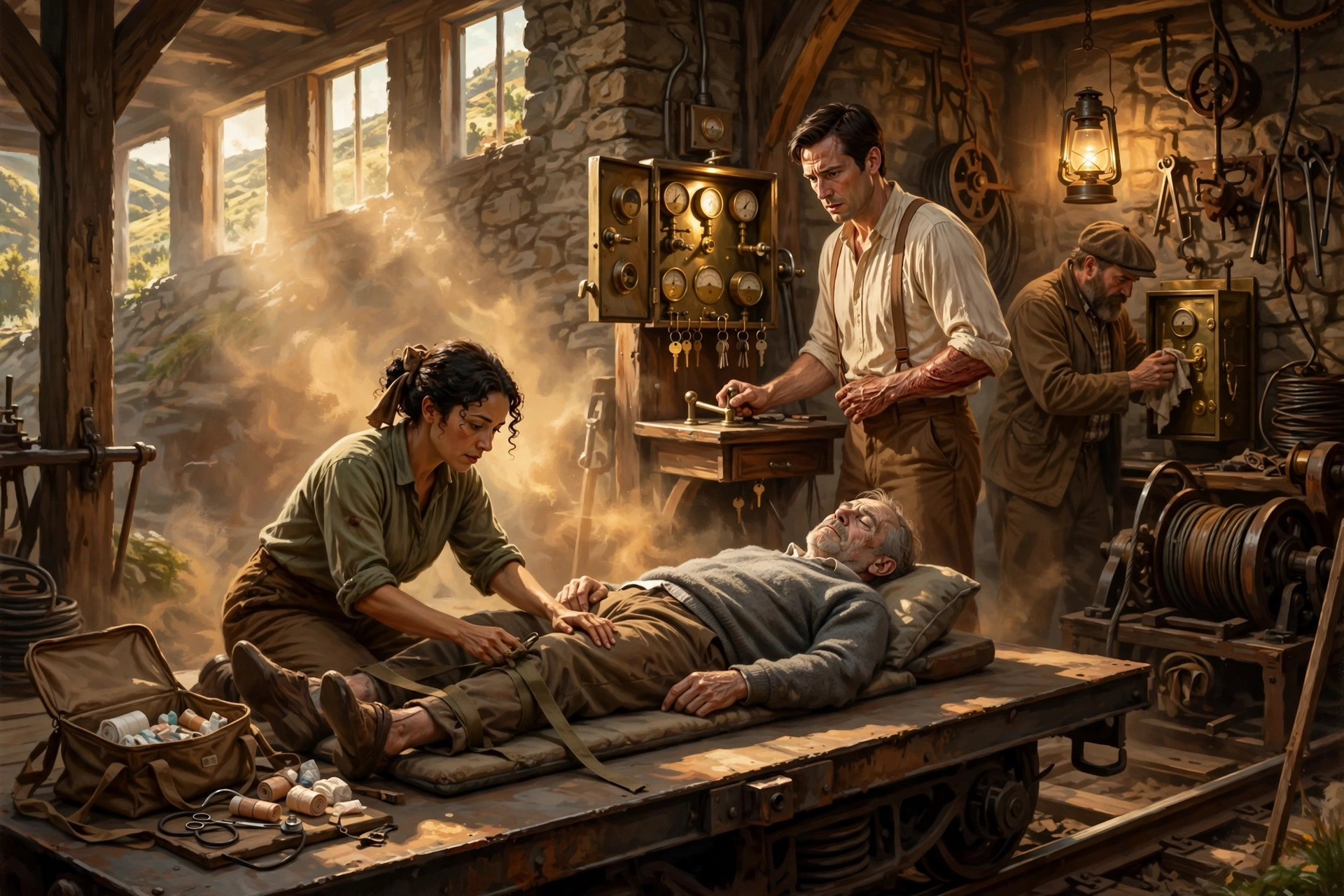
Cassian's palm came down on the call lever. "Off my deck, Coyle."
"He's flat and he's strapped. Look at him properly before you say another word."
"I'm looking at a man on a works car with no ticket."
"You're looking at a rule. Try him."
She drew the last strap across Denzil's shins and pulled it snug. Under the webbing his legs jumped twice, went quiet, jumped again. He was grey around the mouth and his shirt had gone dark at the collar, and the padded board held him level from shoulder to hip so that nothing pressed where nothing could bear pressing.
"Don't fuss," Denzil said. "I'm only the luggage."
"You're the whole reason I'm up here." She laid her palm flat on his thigh and waited the spasm out, without talking him through it, the way he preferred.
Cassian didn't take his fingers off the lever. "How long on the road?"
"Most of an hour." She kept her eyes on Denzil. "Belted upright, every switchback, the potholes at the second bend. He came up shaking. He hasn't stopped."
"And you'd send him down the rail instead."
"Four minutes. Flat and smooth, top to Kiln Row. You've timed it."
"I've timed a car that's governed to walking pace." He nodded at the shuttered ticket window. "Passenger service is shut. That deck carries tools and the men who work the rail. It doesn't carry him."
At the governor cabinet, Cyrus went on wiping a door he'd already wiped. "And I'll not lift him onto it, Verity. Before you ask me again."
"Cyrus."
"I've relined that gear twice since the spring and she'll hold, I'd swear it on my mother. But the certificate says crawl, and the certificate doesn't care what my hands can do." He shut the cabinet with his thumb. "Drusilla's board gives the variance or nobody gives it."
"Then tell the board what an hour of that road does to a hip like his."
"I have told them." He wrung the rag out over the rail. "You tell them. You've the letters after your name, and they answer letters."
She had a folder of letters at home. Every one of them written, none of them sent. It had never once occurred to her to post the folder.
Cyrus had welded the alteration to the frame for her in her first weeks back on this hill, board bolted through, straps stitched and buckled on her own kitchen table, and he had never asked her why she'd come. She had been grateful for that in a way she couldn't have said out loud.
"They'll put me back in the ward if I can't get down the hill," Denzil said, to the sky. "Review's at the month's end. I'd like to keep my own front door a while longer."
Cassian crouched then, and for a moment she thought he was going to look at Denzil instead of the paper. He looked at the rear castor, hanging a finger's width over the lip of the deck plate.
"If she moves, that drops."
Verity looked. He was right. She dragged the frame back and set the castor brake with her heel, and hated how warm her ears had gone.
"Thank you," she said, flat as a board.
"The Cornice Road van goes down at noon." He stood, brushing his knees. "I'll put his name at the top of the list. Standing booking, every week. He'll never wait for a seat again."
"He can't wait upright for a seat at all."
"Then he lies in the back and we take the bends slow."
"There's nothing to lie on. There's a wheel arch and a spare tyre. I've ridden in it twice this week."
"I'll have a board put in."
"You'll have a board put in," she repeated. "When. Before the review, or after it?"
He let that go past. When he spoke again his voice had dropped, and she felt the old stillness come over her face, the one she'd practised until it fitted like a glove.
"Your room is paid through the crews' benefit scheme. My signature goes on that payment every month. I'm not the man standing between you and your work, Coyle."
"No. You're the man signing it."
Something moved behind his eyes and went away again.
"You'd have had him aboard and halfway down before anybody knew," he said. "That's not care. That's a shortcut with a man tied to it."
"It's four minutes against most of an hour, and he's got a pressure area I dressed at Halloway Almshouses before it was light."
"And if the gear fails?"
"Then we're on the same rail with him, and I'll take that." There was nothing left to buckle, so she put her hand on the frame instead. "The safe way is only safe for people who never have to ride it."
Cassian looked at Denzil for a long moment. Denzil looked back, grey and game and still shaking, and lifted two fingers off the board in a small salute.
"I've known him since he were a lad," he told her, cheerfully. "He's not going to shift."
"Lift him off," Cassian said.
Cyrus wouldn't take his hands off the brake wheel with a body aboard, so Cassian came to the head end himself and crouched.
His left fingers curled and did not close. She saw the shine of old scar across the back of them, the way the knuckles sat wrong, the small pause while he worked out another way. He hooked his forearm under the tube and took the weight on the right.
"I've the feet," she said. "Keep his hips level. On three."
They lifted. Denzil was not a light man and the deck was a step up, and for a second the whole weight came through her wrists and she heard Cassian's breath go sharp beside her ear. Then the platform stones under her boots, and the frame down, and Denzil flat on the flat.
"Oh, that's better," Denzil said. "That's the smoothest stretch of road I've had all morning."
Verity laughed once, unsteadily, and checked the strap at his chest, and found his legs had gone quiet at last.
Cassian stood apart, flexing the left. It opened a little and stopped. He put it in his coat pocket like something he'd mislaid and meant to sort out later.
She could have told him three things that would help it. She didn't.
He crossed to the cabinet, lifted the long steel key off its hook, and dropped it into his coat with the hand that worked.
Cyrus's rag stopped. "That key's mine. I cut it."
"It's mine to hold."
"Aye," Cyrus said. "That's what your father used to say."
Nobody answered that. The hook swung, bare, beside the cabinet door, and Cyrus put his rag away and went to see to his brake.
Her bag sat by her boot. Through the canvas her thumb found the knitted scarf and the cold iron inside it, the heel where the letters were stamped, and she left it exactly where it was and said nothing at all.
Wind came up off the Shelf and went through the platform. The chair stood on the stones with Denzil in it, straps still buckled, the deck empty behind them, the hook swinging, and the key gone into his coat.
Kiln Row
"Explain the elastic band," Cassian said, coming off the last of the gallery stair with a sheet held out ahead of him. "Two pages of it. A line for band, a line for tape, and a line for a chair that isn't a chair."
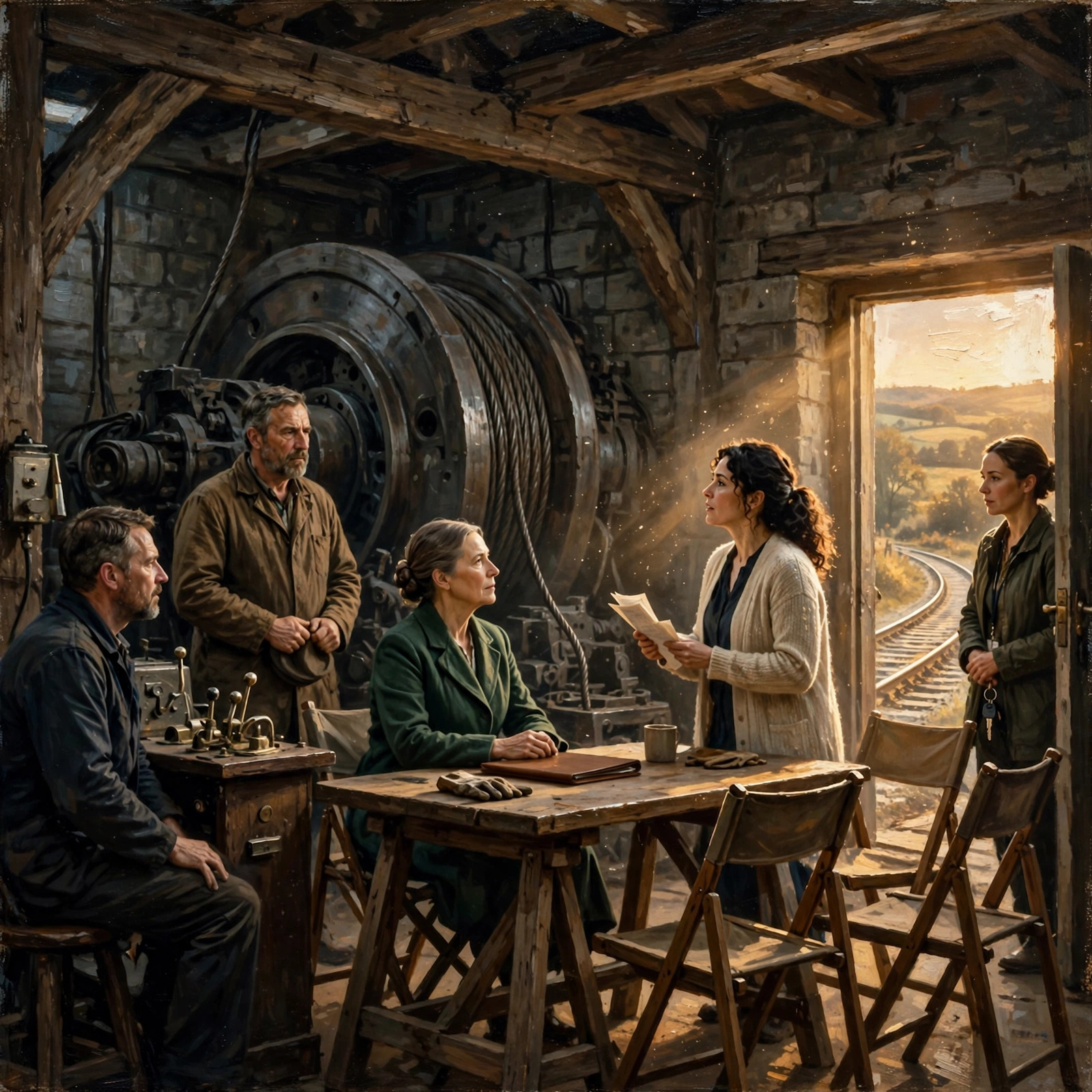
Verity had her forearm laid across a retired guard's shoulder blade, working the knot beneath it. "Breathe out. Longer than that." He breathed. "The chair's a chair. It simply doesn't ask a man to sit up in it."
"It's the same sum every month. I sign it. I'd like to know what it buys."
"Then look round you."
He looked. Both plinths were taken. The bench held a woman from the ticket office in a wrist brace, one of Cyrus's mates with his knee strapped and his socks odd, and an old haulage driver turning his cap round and round. Xiomara sat on the floor beside the folded carry-chair with a curved needle in her fingers and the webbing strap across her thigh.
"There's no chair for me," he said.
"There is now." Verity lifted her work bag off the upright by the sink and set it under the plinth. It landed heavier than canvas had any right to, a dull knock through the side, and she put her boot against the zip so it stayed shut.
"Coat," Xiomara said, holding out her free arm without looking up. "And no, you can't loom at the end of my plinth like a bailiff, and yes, the band's for the crews' thumbs, and if you've come to shut us, do it after twelve."
He put his right into the coat pocket first and brought out the long steel key. It went into his trousers. Only then did he give up the coat, and Xiomara hung it on the door hook, where it dripped on everybody's boots.
Verity finished the guard's shoulder, wrote two lines in his card, and told him to stop carrying his shopping in one trip. Then she turned round and watched the controller of the Quennel Incline try to hold a sheet of paper.
He trapped it under his right forearm against his chest. The left hung. The thumb lay along the palm instead of coming out to meet the fingers, and when he lifted the page he hitched the whole shoulder to do it, a small sideways shrug, the sort of movement a man learns and then forgets he ever learned. Old scar shone across the knuckles. They sat wrong, all of them, like a row of teeth set by somebody in a hurry.
"Give me ten minutes with the left," she said.
"No."
"Sit down."
"I came to talk about the spend."
"You can talk about the spend sitting down. Nobody's ever died of a budget."
Xiomara bit her thread. "He signs your wage with the right one. I've watched him. Looks like a man writing with a hammer."
He sat, because the room had decided it, and put the sheet on his knee, and kept the left out of the discussion by putting it in his lap.
"That's old damage," he said. "It's not your business."
"Hands are exactly my business." Verity pulled the stool across and took the wrist before he could move it, turning it palm up on her own knee. "It's most of what I do. Wrists, thumbs, shoulders, and the odd hip that's really a back."
He went very still, the way men do when they've decided not to make a fuss and are surprised by how much effort that takes.
"Tell me if anything's sharp."
"Nothing's sharp. It's stiff."
"Stiff's information too."
She worked from the forearm down, slow, thumbing along the muscle belly that had spent years doing the work of two, and the tendon at the wrist that had gone the texture of a bootlace. Under her fingers the whole thing was a map of compensations. He'd built himself a workaround and called it a recovery.
"You lift with the shoulder," she said.
"I lift with what I've got."
"You lift with the shoulder because this one won't take weight, and that shoulder's going to start waking you at three in the morning, and then I'll have two of you in here." She pressed. He breathed out through his nose. "There. That's the one."
"That's the one," he agreed, grudgingly.
Behind them Xiomara's needle went through webbing with a small leathery squeak. "This buckle's been forced twice. Somebody's been in a hurry with it."
"Somebody was," Verity said.
"I've sewn it now. Next person who forces it gets to carry him."
He glanced over his shoulder at the folded frame against the wall, the flat board bolted through the canvas, the four straps hanging. "That's what the line on the sheet is."
"That's what the line on the sheet is."
"It's a chair for lying down."
"It's a chair for a man whose legs go into a spasm every time a pothole finds his heel, and whose skin's got a place on it that we can't afford to rub." She let his wrist rest and reached for the tape. "Give me your thumb. Not the whole arm. The thumb."
He gave her the thumb.
It was an absurd thing to be doing, in a room full of people, on a stool with his knee against hers. She anchored the tape at the base and drew it up in a spiral so the joint sat where a joint should sit, out and open, and his fingers moved a fraction under the pull, surprised. He watched her hands rather than his own. He had grey coming in at the temple and a shaving cut on his jaw that he'd evidently decided to ignore, and when she looked up he was close enough that she stopped looking up.
"Try and touch your little finger."
He tried. It got halfway. Something crossed his face and went away again.
"That's further than it was," she said.
"That's not far."
"It's further." She ran the urn's tap into a bowl and dropped the shape she'd cut into the water. The plastic went from chalk to glass, and she lifted it out on the tongs and shook it, and steam came up between them and fogged the window behind his head. "This'll be warm. Say if it's too warm."
"It's fine."
She laid it over his palm and moulded it up around the thumb, holding it there with both of hers while it set, and neither of them said anything for a while. Xiomara's needle squeaked. The haulage driver asked whether anybody wanted tea and nobody answered him, so he made it anyway.
"You've done this before," Cassian said, quietly.
"Not on this one."
The plastic stiffened. She trimmed the edge with the scissors, filed it smooth, and strapped it on, two turns over the back and one round the wrist, and when she let go the thumb stayed out on its own, held open, resting.
He turned it over. Left it on.
Then he reached across with the right and took the appointment book off the shelf beside her, because it was the only thing within reach, and opened it, and stopped.
"This name's struck through more than it's kept."
"Denzil Bray. Halloway Almshouses, up on the Shelf."
"I know where Halloway is."
"Then you know the Cornice Road's the only way down for him, and the van takes most of an hour seated upright, and he pays for that ride for two days afterwards." She took the book back and turned it so he could see the columns. "So we cancel, and he loses the session, and he loses the strength, and at the month's end somebody sits in an office and decides he can't manage on his own any more."
He read the page a long time. His thumb sat out in its little shell, not fighting anything.
"How long would the car take him?"
"Less time than that urn takes to boil."
"Flat."
"Flat, strapped, and smooth. That's the whole argument."
He handed the book back. "Put me on the van."
Verity looked at him.
"The next run down," he said. "I'll sit it. All of it. I've signed that road as the safe way for a year and I've never once been in the back of the thing."
"You'll not enjoy it," Xiomara said, without lifting her head from the buckle.
"I didn't ask to enjoy it."
"Nobody does." She held the repaired strap up, pulled it hard twice, and nodded at it. Then she reached for the van book on the windowsill, licked the corner of the page flat, and wrote his name in the next empty line in her small square letters, and turned the book round so he could see it there.
He looked at his name, and at the splint strapped over his left, and flexed the right once, and left the plastic exactly where it was.
The Upper Landing
"No," Cassian said, before she had the second strap through.
"I've not asked yet."
"You were going to ask to ride down with him."
Verity threaded the tongue into the buckle Xiomara had sewn back together and hauled on it twice, hard, the way she'd been shown. Denzil lay along the padded board with a bolster under his knees and his hands folded on his chest, studying the roof of the top station.
"I was going to tell you," she said.
"One body aboard. His."
"If his legs go, somebody has to keep him flat."
"Cyrus keeps the brake. I keep the levers." He looked at her then, and the flatness went out of his voice, which was worse. "I'm not putting you on something I can't stop."
Denzil turned his head. "I'd sooner have her than either of you, and I'd sooner have tea than all three."
"Tea at the bottom," Verity said.
"There's always tea at the bottom. That's how they get you."
Cassian took the key out of his coat. Long, hand-cut, the bow rubbed bright by his pocket, the teeth still showing the file marks Cyrus had left in them. He fitted it to the governor cabinet on the winding house wall and turned it, and the door came open on a stiff hinge.
Two notches inside, and a brass plate worn soft at the edges with reading. He set the lever into the slow one and took his fingers away.
"That's the crawl," Cyrus said. "Fast one's under it."
"I can see where it is."
"Only saying. It's sat there patient since I cut this."
"The certificate says goods and tools." Cassian shut the cabinet.
"It says nowt about men."
"It says goods." He went to the desk and turned the log round and wrote in it: one passenger, lying flat, governed crawl, desk his own. He signed under it and pushed the book across so Cyrus could read the name, and Cyrus read it and said nothing, which from him was applause.
Then the drum began to turn.
Verity went down the gallery stair while the works car came down the rail beside her, and she took the iron treads two at a time with her bag knocking her hip. Below her the slope dropped away into the smoke-coloured evening, and the car kept pace with a walking man, so slowly she could see the frost lying in the rail groove, so slowly she could have stepped aboard it and stepped off again. She had known she would beat it to the bottom. She had wanted to beat it to the bottom, and she was not going to examine that too closely with her heart going like this.
At Kiln Row she got the door propped and the plinth clear and the urn on before the deck came in.
Cyrus set the brake and came along the platform with his sleeves rolled. Cassian stepped down off the deck first, boots on gravel, and stood a moment with his right hand on the rail as if the ground needed asking.
They unbuckled together. Verity took the straps off in the order she'd built them for, hips last, and slid the board out along the deck rail with Cyrus taking the weight at the head, and Denzil came into the warm room lying down, and nothing in him jumped.
She waited. She had her fingers on his calf and she waited for the telegraph to start, the ratcheting climb from ankle to hip that the Cornice Road set off every single time.
"Well," Denzil said.
"Say it."
"Nothing went." He lifted his head off the pillow to look down at himself, suspicious. "Nothing went. Not at the points, not at the flat bit, nowhere. I've not come down that hill quiet since the fall."
"Don't cry," Cyrus said. "I've only just swept."
"I'll cry if I like. It's my legs." He put his head back. "How long was that?"
"Longer than the van's worth," Verity said. "Shorter than the van."
Cassian had stayed in the doorway with the cold coming in round him. "You felt nothing at the joints?"
"I felt a man walking pace, and I felt somebody had finally listened to me." He found her hand and patted it, twice, businesslike. "Right. What are we doing about the rest of it, then, because I'm not going back up that road for a fortnight's worth of leg lifts."
She got the appointment book off the shelf and wrote him in while he watched: the whole course, twice weekly, straight through to the end of the month, no gaps, no struck-through lines.
"That's a lot of sessions."
"It's the number that works."
"And who's paying for that lot?"
"The scheme," Cassian said, from the door. "It's what it's for. I sign it."
Denzil looked at him for a while. "Aye," he said. "You do."
It was full dark before Cyrus banked the wheel and went off home to his tea, saying he'd leave the landing light on because neither of them could be trusted on the stair. Verity climbed back up with her bag on her shoulder and Cassian came behind her, and neither of them talked, and the drum stood still when they reached the top.
Out on the upper landing the cold came off the rock and went straight through her coat. Quennel lay underneath them in a scatter of orange, the Shelf a darker shelf above it, Halloway Almshouses a row of small lit squares. The rail ran down out of the light and was gone.
He took her into the winding house doorway to show her the cabinet properly, the plate, the two notches, the way the governor took the speed off the shaft and would not give it back without that piece of steel. Then he laid the back of his left hand against the rim of the great brake wheel, where the iron still held the day's warmth, and kept it there.
"It was warm like that after," he said.
"After what?"
"There was a load stalled on the grade. Somebody wanted it shifted quick." He turned the wheel a fraction under his palm, and the splint on his thumb caught the lamplight. "I had the desk. My hand went in trying to stop it. That's the whole of what I say about that night, usually."
"Usually."
"The report's public. You can read it any time you like."
She had her bag open before she knew she was doing it. The knitted scarf came up first, and then the iron heel under it, the stamps pressed into the metal where a man had finished a job at a bench and marked it done. She got it half out. The cold touched the friction lining. She pushed it back down and buckled the flap.
He hadn't seen. Or he had, and let her keep it.
"There's a pension," he said. "From that year. Goes out to a family every month, has done all along. It's on the books and it'll stay on the books." He rubbed his thumb along the wheel's rim. "I've never had anybody come to the office about it. Not once."
Verity found she had nothing at all to say. The rail was very cold under her fingers. Somewhere down in Kiln Row an urn was still boiling for a man whose legs had come down the hill quiet.
"Verity."
"Don't be decent about it," she said, and her voice came out wrong, and she heard it.
He took the key out of his coat and put it into her palm, flat, the file marks against her skin, and let go.
She looked at it. Then she folded his fingers over it, one at a time, the stiff ones with care, and closed her own fist round his, brake dust and cold iron between them, and stepped in and kissed him instead of saying anything.
He was still for half a second, the way a man is when a machine does something he has not authorised. Then his mouth moved under hers and his arm came round her back and pulled her in against the rail, and the key sat between their hands where neither of them could drop it.
There was a name she could have given him. It lay under her tongue, heavy as the iron in her bag, and she kept it there, and kissed him again in the dark with the drum standing still behind them.
Below, in the warm room at the foot of the stair, Denzil Bray's name sat in the book in her own writing, twice weekly, the whole course, right through to the month's end.
The Benefit Meeting
Verity had the scarf off before he could swing the lamp round, and the brake shoe went down on his running sheet with a thud that set the pen rolling.
"Mind your hand," she said. "You'll smudge the ink."
Cassian drew his left hand back onto his knee, the splint pale against his coat sleeve. He looked at the iron, then at her, and she watched him arrange his face into patience, which was the last thing she needed off him.
"That's off the works car. We ran that pattern until the replacement gear went in."
"Turn it over."
He didn't. So she turned it herself, the heel up, the lamp catching the little punched letters where a man had held a stamp straight and hit it twice to make it legible.
"E.N.," he read. "2004."
"He stripped it and relined it at the bench and stamped it so nobody could tell him afterwards he hadn't. Elias Ncube." She kept her hand flat on the cold iron. "That's my father. I was born Verity Ncube. Coyle is my mother's, and I've signed it since I left this town."
The drum sat still behind them. Somewhere out on the grade a chain knocked twice against a post and stopped.
"The girl who went to Portleven," he said.
"School terms. My grandmother's. Nobody here ever had to look at me."
He sat down. He did it the way he did everything at that desk, slowly, with his weight already committed, and then he put both hands on the running sheet as though the paper were the thing needing to be held flat.
"There was a load stalled on the grade," he said. "Late. My father was on the telephone from the house."
"Go on."
"He said unlock the governor and shift it before the shift changed."
"And you."
"I unlocked it." A pause with nothing in it. "Your father was riding the car."
Verity found she had sat down too, on the fitter's stool, and that the shoe was still under her hand.
"I got my hand onto the wheel when it went." He lifted the left one an inch and let it drop. "That's the whole of what I did that was any use, and it wasn't."
"The inquiry wrote maintenance."
"Poor relining. Neglected shoe."
"You were in the room."
"I was in the room." His voice went very even, the voice he used on the deck when a man was frightened and the car was moving. "They gave me a statement and I signed it. Then I sat at this desk and I signed other things."
"Say his name."
"Elias."
"All of it."
"Elias Ncube." It came out badly, cracked down the middle, and he didn't try to tidy it.
She let him have that. Then she stood, because standing was the only way she knew to go on.
"The crews meet tonight. Xiomara's put the chairs out."
"Verity." He was up too, fast for a man who moved carefully. "Leave it with me. Give me time. Drusilla's board sits at the month's end and I can put it to her myself, with the firm behind it, and it goes into the record properly. Nobody has to be pulled through an inquest twice. Nobody gets hurt again for nothing."
"You've had all of it in your two hands since that night. You'd only be moving it somewhere I can't reach."
"I'd be keeping it safe."
"That's what you said about Denzil on the deck, and you were wrong then, and you're wrong now."
He took the governor key out of his coat and laid it on the sheet beside the shoe, the file marks bright on the shank.
"It's still yours," he said.
She picked it up and put it in her overall pocket, where it hung heavy and cold against her hip all the way down the gallery stair.
By seven the therapy room was full past the door. Crewmen stood along the wall with their coats still on. Cyrus had the end of the table and both hands flat on it. Denzil lay on the plinth at the back because Xiomara had brought him down the Cornice Road that afternoon, most of an hour upright, and he had come anyway, grey and jaw set, with a folded blanket under his heels. Drusilla Quaye sat by the window with a folder on her knee and her pen already out.
Cassian was by the coat hooks. Verity did not look at him, and she did not warn him.
"Before we go through the spend," she said, "there's something the scheme has been paying for without knowing it. My name's Ncube. My father was Elias Ncube, brakesman and fitter on this incline, and he died on the car in 2005 because the governor was unlocked at that desk on a spoken instruction. The inquiry was left to write down his relining instead. That's what happened. I've been treating your shoulders and your knees and your backs for nine years under my mother's name."
Nobody moved. Then Cyrus pushed his chair back a little, and the legs scraped.
"Say it again," he said. "His name."
"Elias Ncube."
"Elias Ncube." Cyrus put his hand over his mouth for a second and took it away. "I held the lamp while he stamped that shoe. My lamp, his bench. And in that inquiry room they said the brakesman, and the brakesman, and the brakesman, like he'd come fitted to the machine."
Drusilla's pen had stopped. She looked at Cassian, and he stood very straight by the coats and gave her nothing at all, which told her plenty.
"The board suspends the scheme's payments from tonight," she said. "Pending inquiry. All disbursements, including this room."
"That's the van as well," Xiomara said, deadpan, opening the book on her knee. "Fuel, my hours, the insurance. Same signature." She drew a line through the bookings, one clean stroke, and then a second, and shut it.
"Leave Thursday," Denzil said from the plinth. "I'll get down here somehow."
"You'll get down in the van or you won't get down," Xiomara said. "I've just been told you won't."
Cassian spoke then, from the wall, quietly, in the voice he used for keeping a deck calm.
"You never came back here to heal anybody. You came to take."
The room turned to look at him, and then, worse, turned to look at her.
Verity crossed the lino. She took the key out of her pocket and laid it on the table in front of him, straight, the way she laid out a strap or a splint or anything she was finished with.
"That's yours," she said. "I'm not holding anything of yours again."
They went out around them, coats and boots and the scrape of the stacked chairs, Cyrus last with his hand briefly on Denzil's shoulder. Xiomara would drive the old man up tonight out of her own petrol and her own evening, and after tonight there was nothing written down at all. Against the wall the carry-chair stood folded and idle, its four webbing straps hanging loose, nobody booked into it.
The Board Table
"Heel up," Verity said. "She'll read the lining first, and then we'll be here till dark."
Cassian turned the shoe over on the trestle and slid it down the boards to Drusilla, his splinted thumb held clear of the edge. Above them the drum sat cold in its bearings, and Cyrus had the lamp swung round so the light fell on the stamp.
"There." Verity kept her hand on the iron until Drusilla looked. "E N, and the date under it. He relined that shoe at his own bench and stamped it himself, and he put the batch mark in the heel, because he was careful about everything except himself."
Cyrus laid the buying book beside it, open at a folded page. "Same mark. Lining bought by the gross that spring, cheaper than spec, and I signed it into stores with my own pen. I've had that page turned down since the crews' meeting and I've not slept a whole night since."
"The inquest is reopened," Drusilla said. "The coroner's officer will want the shoe itself."
"It'll go," Verity said. "Wrapped, labelled, and his name on the label. Not the brakesman. Elias Ncube."
Drusilla wrote it, then stood and pushed her chair back, and the legs went over the stone with a sound like a dropped tool. "Show me the gear before anybody says anything else."
Cyrus took her round to the brake wheel with the lamp. He talked her through the new pawl and the spring, the way the linkage sat now, and then he tripped it with the flat of his hand. The pawl came down and locked, and the noise of it went through the floor and up through the soles of Verity's boots.
"It bites on the drum," Cyrus said. "Not on a cabinet a man can unlock with a key. It'll bite whether anybody's frightened or in a hurry or being told what to do by his father."
Drusilla came back to the trestle and sat. "Mr Whitlock. You've sent nothing in writing."
"No," Cassian said. "I'll say it out loud, and you'll minute it as I say it."
He stood at the end of the table with his left hand tucked against his ribs, the way he always held it when a room was full.
"I unlocked the governor at that desk on the night of the runaway. My father told me to, to shift a stalled load quick, and I did it because he said it and because I was impatient. Elias Ncube was riding the car. I put my hand into the brake wheel and it took it. Then I let the inquiry write down his relining instead of my hand, and I signed the statement."
Nobody helped him. Verity made herself not help him.
"Write it as he said it," Cyrus told Drusilla, and his voice was perfectly level. "Every word, and then send it to the coroner's officer with the shoe."
Cassian took a long envelope out of his coat and laid it on the boards, and pushed it across with the back of his right hand.
"The controlling share. It's mine to give and I'm giving it to the crews' trust. Not to the firm, not to me, not to anybody's son. You'll hold it for the crews."
"You understand what you're handing over," Drusilla said.
"I've understood it for years. I've only just done it." He drew a breath. "And I resign the controllership. Cyrus takes the desk. I'll stay as his mate, at a mate's wage, if he'll have me."
"You'll be sweeping," Cyrus said.
"I'll sweep."
Then Cassian brought the governor key out of his pocket, the one she had laid on the therapy room table and walked away from, and he put it into Cyrus's hand and folded the man's knuckles over it with his own.
"You cut it from a blank at your bench. It should have been yours from the start."
Cyrus looked at the key a long moment. "Aye," he said, and put it in his overall pocket, and buttoned the pocket.
"Miss Coyle." Drusilla turned her pen round. "There's the damages claim lodged against the firm. Before the board votes anything, I need to know where you stand."
Verity found she had stood up. She made herself sit back down.
"Then I'll put something on the record too. I didn't come here and find out afterwards whose company paid me. I came knowing. I was on the top landing that night with my father's tea in a flask, and I heard the controller on the desk phone tell them to send it, and I have known that voice every single day since I walked into Kiln Row."
Cassian did not move. Across the table Cyrus shut the buying book very softly, as if a loud noise would break something.
"You knew," Cassian said.
"I knew."
"And you treated my hand."
"I treated your hand." She kept her eyes on Drusilla. "There's more. The pension that paid for my training, and that pays my mother's care flat in Portleven now, was signed by Wilfrid Whitlock. I never asked whose money it was. I took it and I never asked, because the one time my family asked this company for anything, my father went down that rail and got blamed for it."
Drusilla's pen had stopped. "The claim, Miss Coyle."
"The claim would take the winding house, and the scheme with it, and the room, and every man in this town who needs his back looked at. So I withdraw it. Minute that. I withdraw it entirely."
Xiomara, from the bench by the door, without looking up from the van book: "And Portleven?"
"I'll ring them," Verity said. Her mouth had gone dry. "Not from this room."
"Nobody's asking you to be a saint about it," Xiomara said. "I'm asking what you're paying with."
"Later."
Drusilla drew a line under her page. "Then we'll vote. The variance for a person aboard the works car at line speed, flat and strapped, under Mr Tandoh's rebuilt gear. All in favour." Hands went up round the trestle, and hers last. "Carried. And the therapy room is funded from this day straight out of the crews' trust, independent of the firm. No controller's signature on it. No one man can switch it off again."
"I'll want that in writing," Xiomara said, "before I put fuel in the van."
"You'll have it before you're at the bottom of the rail."
They unfolded the carry-chair on the deck. Verity bolted the flat board through and buckled the straps over Denzil's legs and chest while Cyrus checked the buckles a second time, and Denzil lay looking up at the roof beams.
"I've been strapped to fewer things than this," he said.
"Complain at the bottom," Xiomara told him. "It's warmer down there."
Cyrus went to the desk and took the key out of his pocket and unlocked the cabinet himself, and Cassian stood back from the levers with his hands empty and let him.
The car went down flat and smooth, four minutes from the top station to Kiln Row, and Verity rode the deck with two hands on the chair frame, watching the old man's jaw come unclenched somewhere on the long straight. His hand lay open on the blanket the whole way. No spasm. Nothing to hold him down but webbing.
At the bottom Xiomara had the assessor on her phone before the chair was off the deck, reading out the logged hours and the flat transfers, and then she covered the mouthpiece.
"She says the placement holds. Review's the end of the month and she'll sign it off. She says stop ringing her about it."
"Thursday," Denzil said from the board. "Twice a week. Tell her I'll be in."
They rode the empty car back up. Xiomara had brought a screwdriver in her coat, and at the winding house door she set it into the first screw of the family name board, gold letters on black, and worked all four out while Cyrus watched with the lamp.
"I'm keeping these," she said, dropping the screws into her palm. "Souvenir."
The board came away heavier than it looked. She leaned it against the wall with the letters facing in, and under it the door was bare, a paler rectangle of paint where a hundred years of weather had not been allowed.
Inside, Cyrus sat down at the controller's desk with the key still in his hand, turning it once, and did not put it in the cabinet yet.
Cassian stood out on the platform beside the rail, coat open, nothing in either hand, nothing left anywhere in the building for him to sign. Verity came and stood next to him, close enough to feel the cold coming off his sleeve, and neither of them said anything at all.
The Empty Hook
"You could have left that at the bottom," Cassian said. He had a drawer on his knee and a cardboard box at his feet, and he went on filling it without looking up.
"It folds." Verity came off the last step with the frame under one arm and the wrapped iron against her hip. "That's the whole idea of it. Xiomara tipped Denzil into his own seat at Halloway Almshouses and folded this up for me while I checked his skin."
She set it against the wall beside the doorway, canvas inward, straps buckled neat so nobody would catch a boot in them. Behind the desk the drum stood cold. No hum through the floor, no warmth off the oil, nothing turning at all. She had never heard the winding house quiet and found she didn't care for it.
"What's going in the box?"
"Rubbish. Pens that don't write. A fuse I've been meaning to test since the spring." He tipped in a bag of sweets that had become one solid lump. "Most of my working life, of not throwing things out."
Then he stopped with a card between his palms. Small, furred at the corners, the ink gone brown. He read it twice and laid it on the bare wood instead of in with the rest.
"What does it say?"
"His writing. What to do if the governor trips." He turned it so she could see the faded loop of the capitals. "Step two's wrong. It's been wrong the whole time it was pinned above this desk. Cyrus needs it for the file, so the trust can show what was hanging there."
Verity put the scarf-wrapped weight down on the corner of the desk and left it while she found her words.
"If I did it again, I'd tell you first," she said. "I'd still stand up and say it. But you'd hear it from me before you heard it from the room."
"You shouldn't have had to tell me anything." He shut the drawer with his knee and slid it home. "I've been turning it over since yesterday. I asked you for time. I wasn't going to spend it getting the board ready. I was going to spend it making the thing smaller until it fitted in a drawer."
"I know. I could hear you doing it."
"And I told you that you came here to take." He looked at the box. "You did. You came to take my father's reputation off him and put my name on it, and you were right to, and I said it like a man reading a charge sheet."
"I've never asked anybody for anything," she said. "Not since I was a girl. Asking is what killed him. He asked to be taken off the fast run and they wrote down that he'd signed the shoes out himself." She heard her own voice go flat and let it. "So I don't ask. I do it, and I tell people after. That's mine. That's not yours to fix."
"I'm not fixing it." He pushed the box a little with his boot. "I'm saying I did the same thing backwards."
She sat on the edge of the desk, which nobody had ever done while his father owned it.
"I rang Portleven this afternoon. Mother's fees go up in the autumn and the home wanted to know what I'd be paying with. I said I'd ring back."
"I've got a wage now."
"A mate's wage."
"It comes every Friday and there's nothing owed on it." He shrugged, awkward with the stiff side. "Half of it, every month, into whatever account the home takes. Don't argue with me about arithmetic, I've done it twice."
"Cassian."
"I've nothing else to spend it on. I don't drink, I don't drive, and the house came with the job and goes with it."
She pressed the heels of both hands against her eyes for a moment. Then she made herself say the next part out loud, because it was the part she had been walking up the gallery stair to avoid.
"There's a hardship line in the crews' trust. Drusilla read it out yesterday and nobody's touched it."
"That's for men off sick. Not the physiotherapist's mother."
"It's for whoever the crews vote it's for, and you've been carrying half of Halloway up that stair for years without billing a penny of it." He waited. "You'd have to ask them. In the meeting. With your name in the book."
"I know."
"Can you?"
"I'll ask." Her chin came up. "Out loud, in front of them, and I'll take the evening clinics at Kiln Row and the Saturday list, and it goes in the minute properly. And the pension goes on the trust's books too, under my father's name, spelled right, where anybody can read it. Not a quiet cheque from your father any more. I'm done with quiet money."
"It'll be tight," he said. "Even with all of it."
"It'll be tight for a long while. I may have to move her out of the room with the view." She said it steadily and it still took something out of her. "She likes the view. She won't say so, because she'd hate me to feel it, and I'll know anyway."
"Then we'll be tight together and I'll not pretend otherwise." He put his good hand flat on the wood. "That's the first honest thing I've said about money in years."
"Give me the other one."
"It doesn't hurt today."
"I didn't ask about today."
He came round the desk and sat on the bench where the fitters ate their dinners, and gave her the left. She took it across her knee, thumbs into the thick seam that ran over the back of it, working the scar soft, then the wrist, then each joint through what range it had, slow, waiting where it stuck instead of forcing it.
"Cyrus will run it right," Cassian said, to the wall.
"He will."
"That's not the part." He watched her hands instead of the wall. "I wake at the hour the shift starts and reach for levers that aren't mine. And I lie there thinking, if I'm not the one holding it, what am I for? Nineteen years of being the reason nobody got hurt, and it turns out that was mostly a way of not saying anything."
"You said it yesterday. In front of the coroner's officer and the whole board."
"Once. Out loud. It doesn't get easier for having been done."
"No," she said. "It doesn't." She turned the palm up and pressed along the tendons, and he let her, and his breath went out long. "There's another part you're not saying."
"The room's funded. Denzil's riding down in minutes and his placement holds. There's nothing left here that needs me." He looked up. "You could go back to Portleven tomorrow and nothing would stop you."
"I could." She kept working. "I'm not going."
She let go of him then and stood, and unpicked the knitted scarf from the iron, and folded the scarf into her bag. The casting was heavier than it looked, as it always was. She carried it to the rail-side window and set it on the sill where the last of the evening came up off the metals, and turned the heel until the light got into the punched marks. His initials. The year, crooked, because he'd stamped it one-handed on a cold bench and never done it again.
"Leave it there," she said. "Cyrus knows where it is. It belongs to the file now, not to my bag."
Cassian came and stood beside her, close enough that his arm touched hers, looking at the small crooked letters instead of at her.
"I love you," he said. "I'm not going to be clever about it. I've been clever about everything else and look where it got me."
"I love you." Her voice cracked in the middle of it and she let that happen too. "I came up that stair to say it and I've talked about fees for half an hour."
"Best half hour I've had in this building."
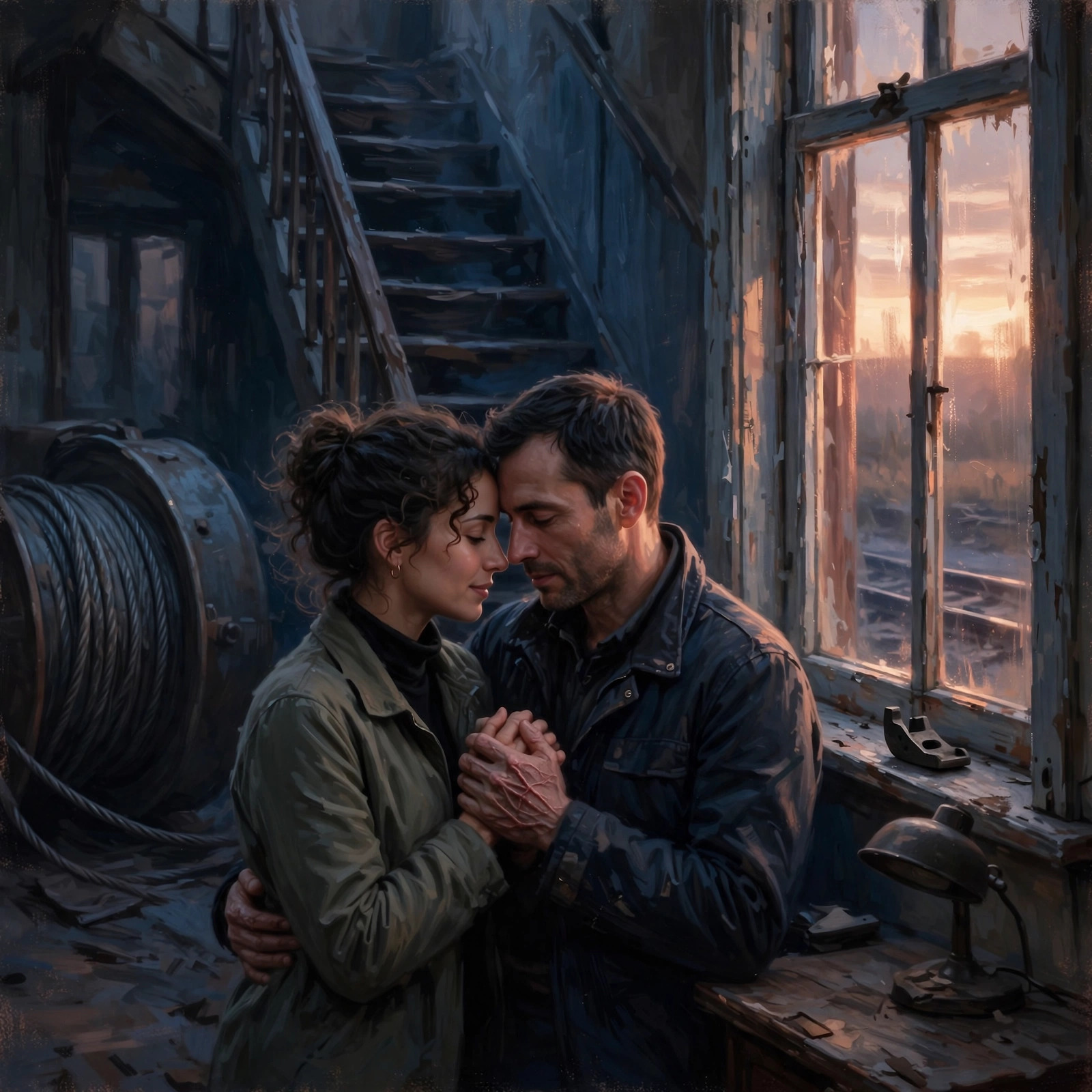
She turned into him and he held her, the stiff arm careful and the other one certain, his cheek against her hair, the rail-side glass cold at her back. When he kissed her she tasted tea and metal and the sweet lump from the box, and neither of them hurried.
After a while she reached past him and switched the lamp off.
Behind them the iron sat on the sill with the dusk on its stamp, and the key hung on its hook by the governor cabinet with a new paper tag in the trust's neat printing, and the door swung to on the two of them going down the gallery stair together in the dark, her hand on the rail, his on the small of her back, one step at a time.
Get notified when new stories drop

Serena Blake
Serena writes romantic suspense and dark romance for readers who want pulse and payoff. Her stories chase trust as hard as they chase danger.
Leave a comment
Comments