


The Mould Chest
"Open the chest."
"No."
Douwe Hiemstra took his hand off the lid and set it on the iron corner instead, which was polite and useless. "Kooistra came out from Leeuwarden to see the heron."
"Then let him look in a ream, the way buyers always have. It's in the paper. That's where it lives."
"There's no paper. There's rags under the hammers, and a dead man's tools in a box, and a gentleman standing in my yard."
She wiped her palms down her apron. "Your yard. There. That's the whole of it in two words."
The stampers came down and came down. Rag dust hung in the wet light off the water and she could taste it on her back teeth. Kooistra held his hat in both hands with his shoulders lifted, a man made to stand under a low beam.
"Could we have it quiet?" he asked. "I've a soft voice and a long road home."
Imke tipped her chin at Rients. He went along the troughs with the prop bar, lifted the heads one at a time and slid the catches under them, and the cams swept past beneath, and the hammering stopped so suddenly that the water outside sounded loud.
"Better," Rients offered, and wiped his palms on his thighs and stayed by the bar where he could reach it.
Kooistra turned his hat a quarter round. "My buyers ask for the heron by name. Not for good paper. Not for white paper. For the bird with the long leg. They know it in Leeuwarden, and they'll take nothing in its place. Sixty reams in the year, and that's this house's whole living."
"Sixty reams off my stand."
"And my contract has the maker as owner." He let it sit there without softening it. "The maker must own the mill. That's my security. If the mark disappoints me I need a man I can hold to the stones, the wind-right, the roof over them. I can't hold a bird to account."
Douwe's thumb went round the gold on his right hand, the sail cut into the bezel, round and round while the merchant talked.
"Terpstra will read the renewal and set the wax at the market sealing in Dokkum," Kooistra went on. "A week and a half off, near enough. My first delivery falls in autumn. I'd rather not be the man explaining to his buyers why their heron has no legs."
"The mill's mine," Douwe said. "My father left it me. Terpstra drew it, and I'll not stand here and pretend the paper says something kinder."
"And the frames are mine. The deckle, the tools, the right to the mark." Imke kept her voice as level as she could get it with her mother in the doorway. "Your notary. Your office. The same afternoon, as I recall. I've no quarrel with what's yours, Douwe. Have none with mine."
"Nor I with yours."
"Then we're agreed on the one thing that's no use to either of us."
Baukje Hiemstra had come through from the house with her gloves still on and her skirts gathered clear of the wet floor. "Then join them and be sensible. Hiemstra on the paper of De Wite Reager, as it has always been. There are ways of putting two halves back together that are older than any notary, and they're done in church, and nobody weeps afterward."
"If you'd only--"
"No."
"I'm thinking of you, child."
"You're thinking of the name."
Her mother stood in the other doorway with lint in her hair and her sorting-room sleeves pushed past her elbows. "Let her have a wage, then. So much a ream out of the mill account, paid regular, wet or dry. A wage doesn't care whose name is on anything. My daughter eats either way."
"She's paid by the piece already," Douwe said. "Out of my account, same as her father was."
"I buy paper," Kooistra said. "I've never paid a wage in my life. I'd not know where to begin."
"A wage is a hand held out." Imke made herself say it gently, for her mother's sake, and it came out anyway like a nail going through a board. "I've the mark. That's not a hand. That's a thing I own."
Sytske's mouth went thin. "Your father owned it, and it left me sorting rags."
Nobody answered that. The water went on outside, patient, doing its work for nothing.
"Show him one sheet," Douwe said. "Pull one. Let him hold it up to the window, and we'll all stop going round in circles."
"With what? There's a pair in that chest and one deckle between them. I dip, the coucher takes it off onto the felt, and I've the second frame ready with the deckle back on it before the first is off the pile. That's how a vat goes. Alone with one I'd stand waiting on the felt while the stuff cooled and the wind went round. One frame and no deckle isn't a sheet at all. It's a sieve with a handle."
"Then unwrap them."
"For you." She let that stand a moment. "You've spent your working life at a desk in Leeuwarden, selling my father's paper by the quire, and never once wetted your wrists to the elbow. His tools don't come out of their cloth so a man can nod at them and go home to his dinner."
He took that without flinching, which she had not expected, and it went into her somewhere and stayed.
"I knew what his paper was worth in three towns," Douwe said, quiet enough that only she and the merchant had it. "I got it for him. More than once."
"You got a price. There's a difference."
"This is not a way to speak to the master of the mill," Baukje said.
"It's the way you speak to a man asking to see inside a locked box he doesn't own."
Kooistra put his hat back on, then took it off again, which was the most feeling she had seen out of him. "I've no need to touch anything. I need to know the bird is whole, and that the two of you can put your hands to one instrument before the sealing. That's all I'm carrying home."
Imke looked at the stand, bare and scrubbed since the funeral. At the propped heads and the stuff lying under them, grey and beaten and nowhere near paper. At her mother's raw wrists.
Then she pulled the cord over her head and took the key off it.
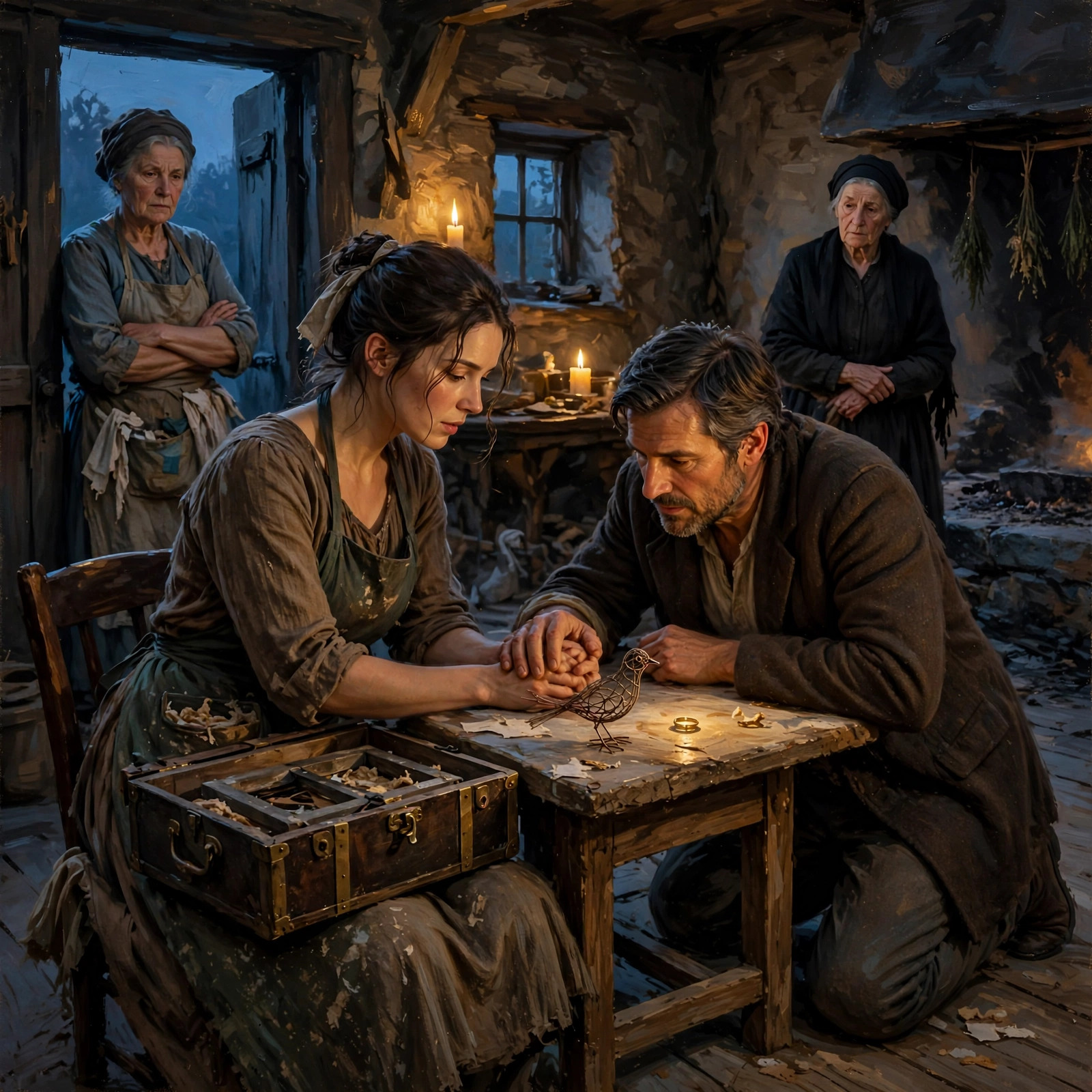
The lock turned stiff, the way it always did in damp weather, and she leaned her shoulder to the lid until it came up. Oiled cloth, folded square, her father's folding, corners tucked in like a man making a bed he meant to lie in.
"Mind the hasp," she told Douwe, and he stepped back and put both hands behind him, and something in her chest eased a half inch and then closed again.
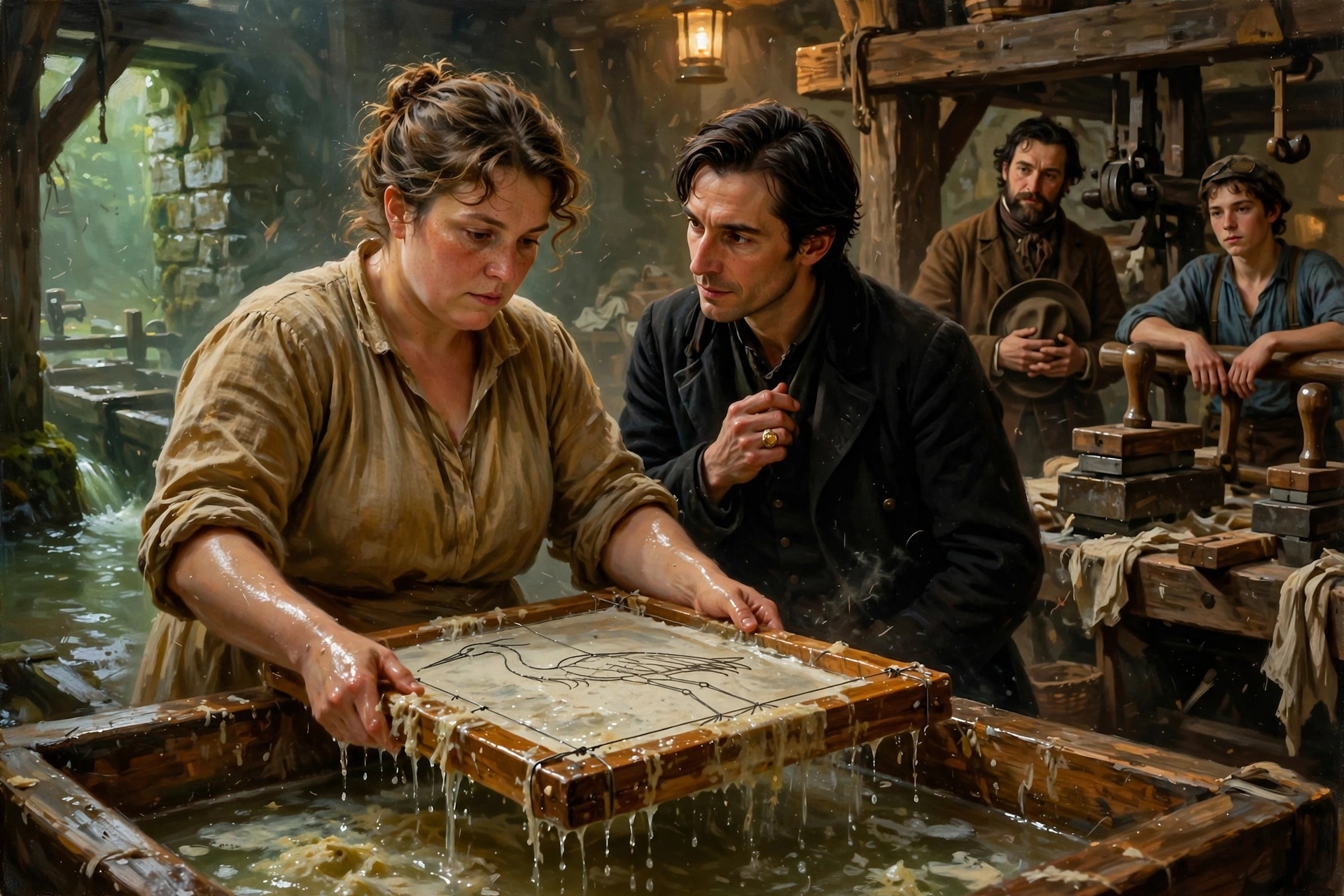
She lifted the first frame out and laid it bare on the stand. Oak ribs pegged at the corners, brass mesh laced along the edges by a hand that had known what it was doing, and the heron sitting in the wire with its long leg trailing, the copper gone dark in the bends. She ran her thumbnail along that leg out of habit, felt it firm and sound under the stitching, and told nobody why she'd checked there first.
The mate she left in its cloth. She smoothed the fold back over it and tucked the corners.
"That's the mark," she said to Kooistra. "Whole. You'll have it in your hands in autumn, in a ream, where it belongs."
He bent close without touching, and made a small satisfied noise, and stood up straight again.
Douwe reached for the mesh.
"Not the mesh."
He stopped. She took the deckle out of the chest herself, shook the cloth off it, and hung it on his forearm, and then, because he was holding it like a serving tray, she set his thumbs on the pegs and pushed his fingers under where the wood was thickest. Her hands were wet and his were dry and neither of them said anything about it. She stepped back before the quiet got any ideas.
"Now?" he asked.
"Now you know what it weighs. No sheet today. You'll not have one out of me for a man to nod at."
He stood with the deckle hanging on his arm like something he had been handed at a funeral, and one mould bare on the stand between them, and Imke with her sleeves rolled and her hands empty.
Sixty Reams
"Sixty reams a year, and my Leeuwarden buyers ask for the bird by name." Kooistra turned his hat brim down between his fingers, which meant he had no intention of going anywhere. "A will is not paper. I'll carry nothing to Dokkum that I haven't seen come off the wool. Marked, and today."
"The stuff's lain under the stampers since before the funeral," Imke said. "It's ready."
"Then we're agreed."
"You're not agreed, you're waiting." She pushed her sleeve past the elbow. "There's a difference, and it's about an hour wide."
Douwe held out the deckle, thumbs lifted off the pegs. "Teach me the couching."
"You've the counting to do. He'll ask for figures."
"I've kept figures for other men's paper most of my working life." He laid the oak across her wet palms and left his own dripping. "I'd rather be taught the felt."
Nobody had ever stood on her side of it. Not her father, not the boy. She had taken every marked pull off the brass herself since she was tall enough to reach over the stand, and she had never once explained that to anybody, and now here was a man in a good shirt asking to be shown.
"There." She nudged him with her hip until his boots found the worn place. "Heels of your hands on the far edge. Not the middle."
"The middle looks solid."
"The middle looks solid until it's dry."
She went into the vat to the wrists, lifted, and shook twice, once across and once along, and the water slid off the mesh and back into the trough. The grey film settled level. She had done that ten thousand times without thinking about her shoulders, and now she thought about them.
"The shake is the whole trade," she said. "Anybody can dip."
"You've a way of saying things that makes me feel late."
"Deckle off. Straight up, don't drag it. Now down at the far edge, over in one roll, and lift as you come. One roll. Slide it and you'll smear the bird, and then we've nothing to show him."
He bent. He rolled. He was careful the way a clerk is careful with a page he has just signed, and the far corner came away and the near corner stayed stuck to the brass, and he stopped with the whole thing hanging.
"Don't pull it."
"I'm not pulling it."
"You're thinking about pulling it." She got her fingers under his, wet knuckles against wet knuckles, and rolled with him, slow, and the wool took the paper the way it always did, greedily, all at once. "There. The felt takes it. Not you. You only ask."
He lifted the frame away and the heron stood up clear in the wet grey, long leg trailing, and neither of them said anything for a moment. Rients laughed from the stair.
"Master Hiemstra, you've got the vat on you."
"I have," Douwe said, with great dignity, and wrung his cuff out into the trough.
They fell into it after that. Dip, shake, turn, roll. She had worked with her father in that rhythm and with nobody else, and it had never once been easy, and this was easy, and she distrusted how much she liked it. Water ran back off his elbows and then down his front, and the shirt gave up altogether and stuck to him at the shoulders. Rag flecks clung to the gold on his right hand, and the little sail cut into the bezel looked drowned.
"I've been inked, splashed, and bitten by a client's dog," he said. "Nothing soaked me like this."
Her laugh came out before she could shut the door on it, loud and unlovely in the quiet mill, and he grinned at her, wet and unashamed, and she had to turn back to the trough and put her arms in it.
"You've rag in your eyebrow."
"I've rag in places I'll not name in front of Kooistra."
Kooistra bent over the wool without touching it and made his small satisfied noise. "That's one. One is luck. Two is a maker." He set his hat on. "I'll be in the yard."
"Take it up," Imke told Douwe. "Hang it straight, or it dries with a curl and he'll call that my doing too."
Boersma was at the gate with his horse's rein over his arm and a coat too good for a mill yard. He touched his hat to her with the ease of a man who had never once been refused anything that mattered.
"Roorda. I'll not dress it up. There's a vat standing empty at De Grutte Wjuk, and a master with sense enough to know what's walked past his gate this twelvemonth."
She wiped her arms on her apron, slowly, and let him wait.
"My mark, my name on the contract, your two hands. Wages every Saturday, and never a notary between you and them. No will to read, no clause about who owns what. You'd dip. That's all a body ever asked of you, isn't it."
She looked past his shoulder at the loft window, where a pair of wet shoulders went by carrying something flat and precious.
"The stuff's warm," she said. "It won't be in an hour."
Boersma laughed and gathered his rein. "Take your time. My vat's patient."
She went back in. Douwe was coming down the ladder, and she already had the deckle set square and her arms in the trough.
"I'll take the next."
"Wait for me. I'm coming down."
"Hang the other one straight first."
She could not make herself put the oak into his keeping again. Not because he had done it badly. He had done it well, and that was the trouble, and she had no words for it that she was willing to say out loud in a room with a merchant in the doorway.
One frame meant nothing to swap to. Nothing draining while she worked, no second pair of heels at the far edge, and a wet pull that could not sit waiting on the brass while a man climbed down a ladder. She had done it alone before. She had done it alone for a long time.
She dipped, shook, lifted the deckle clear, and turned to an empty felt.
Above her the sail took the wind. It came round the corner of the sorting room and hit the cloth, and the brake wheel groaned overhead, and the props under the stampers knocked out and let the hammers fall once. The floor jumped. The stand walked an inch.
"Imke, the brake--"
She threw the pull down onto the wool. No roll, no far edge, just her palms and the whole weight of it, and the paper went where it went. The corner of the frame came against the stand and something small gave inside the mesh, a sound she felt in her teeth rather than heard.
Rients was already hauling on the cord. The sail slowed. The quiet came back in a rush, and the trough went on rocking, and Kooistra came as far as the threshold, looked at the wool, and did not come any further.
"Well," the merchant said, and put his hat back on, and went out to see to the weather.
Imke lifted the frame to the window. The light came through the brass and the bird stood up in it, and the long leg was folded under the body, doubled flat where the copper had kinked, the neck bent down out of true. Behind her the marked sheet lay drying crooked on the felt, its leg thick as a straw. Douwe's hand was flat on the door frame. He did not touch her.
Copper Wire
"Lower," Imke said. "You're laying the light across the top of it. I need it underneath."
Douwe knelt and set the lamp at the end of the bench. The flame came up through the brass, and the laid lines lit like shallow water over sand, and there stood the bird in the middle of it with its long leg folded double under its body.
She had been looking at that fold since the sail took the wind. Her jaw ached from it.
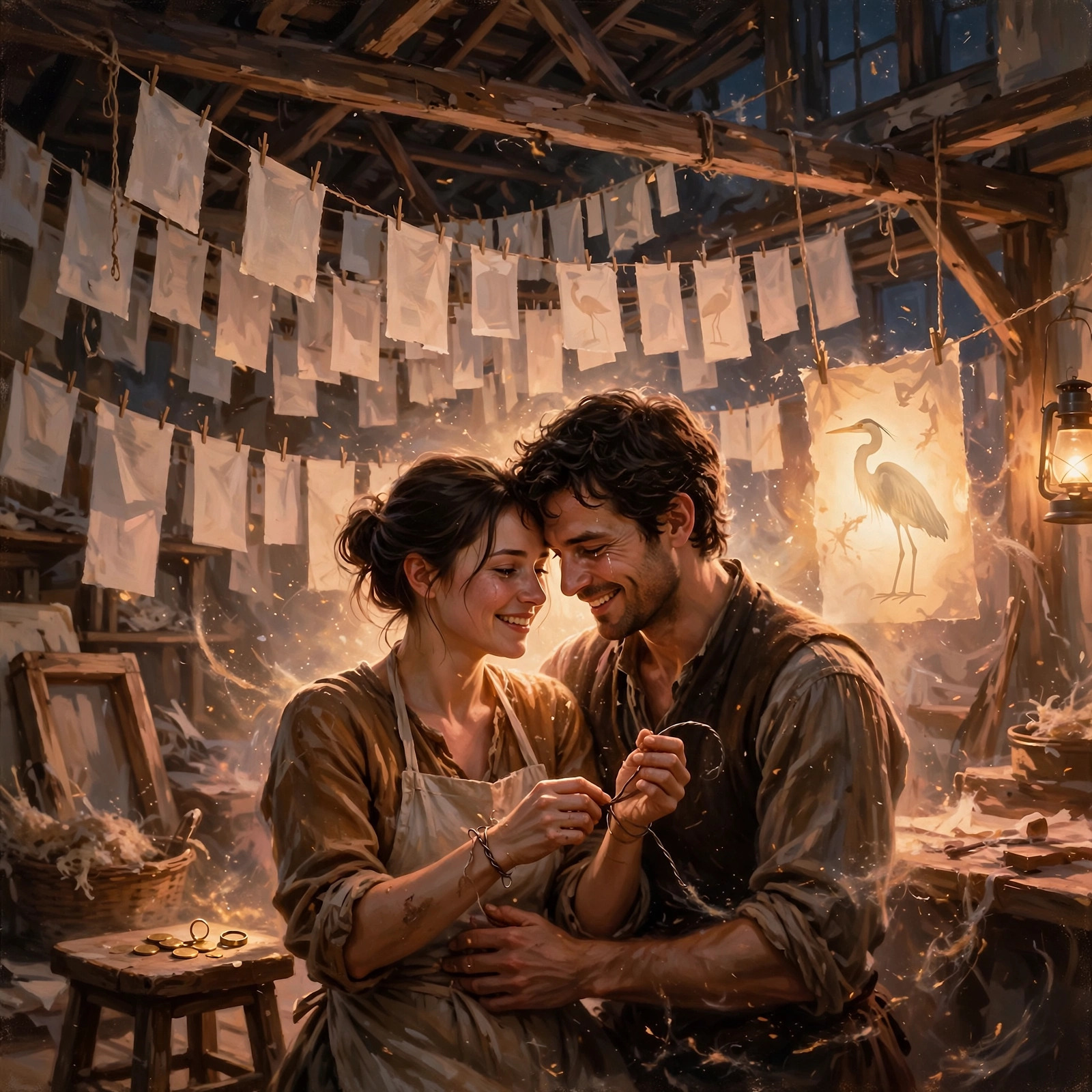
All around them the sheets hung in rows on the spars, dry now, knocking softly together whenever the shutter let the air in. The first pull was up behind her shoulder, stiff and white, its heron clean as a print in a book.
"It's past straightening," she said. "Copper keeps a bend. We cut the kinked length free and sew a new one in."
"We."
"You hold. I cut." She unrolled the tool cloth on the bench: snips, round-nosed pliers, a coil of drawn wire the colour of a new penny.
He put his hands out. She turned them over and set them under the oak ribs, well away from the field.
"Not on the mesh. Press there and you'll leave a print no water will take out."
"I'll be careful."
"Be still. Careful moves."
The ladder creaked, and her mother came up with a board of bread and a saucer of butter balanced on her forearm, the way she carried everything, as though the loft were a room she had already decided not to be impressed by.
"Eat."
"I'm not hungry."
"You're never hungry when you're frightened." Sytske put the board down beside the coil and looked at Douwe's hands. "Under the ribs. Good. Your father used to let gentlemen hold the field and then spend an hour undoing it."
"I'll try to be worth the bread, Mrs Roorda."
"See that you are." She straightened, and her voice changed, went flatter and more careful. "Imke. Kooistra pays for reams. He has never paid a wage in his life and he'll not start with you. Piecework stops when the water stops. A wage comes in a February when the canal's frozen and nothing goes to Leeuwarden. That's the whole of what I'll say for it."
"And what's against it?"
"Nothing that keeps you warm." Her mother was already at the ladder. "Your father's account died with him. I'd not have you living out of another man's account and calling it your own. Butter's there. Use it."
She went down. The boards took her weight one at a time, and then the loft was only the two of them and the small noise of paper.
Imke brought the snips in under the bird's leg. The stitches were fine wire, sewn through the brass by a girl with better eyes than she had now, and she took them out singly, laying each on the bench where she could find it again.
"Hold the field flat. Flat, not tight."
"There's a difference?"
"There's about a hair's difference, and it's the whole trade."
The last stitch gave. The kinked length came away in her fingers, crooked as a thing pulled out of a fire, the leg doubled and the neck bent down where the frame had struck the stand. She held it a moment. Then she laid it on her apron, not in the scrap tin.
"You're keeping it," Douwe said.
"It's mine to keep."
She cut a fresh length and set the pliers on it. The leg first, long and straight with the small backward joint; then the body, then the neck coming up out of the body in that particular curve she had watched a heron make in the polder below the town, standing in the mist with its patience folded around it like a cloak.
"Now your hands," she said. "The stitching wire's too fine for one pair. You hold the end against the mesh and keep it there while I sew."
He brought his hands up. She put her own over them and moved them where they needed to be, and the gold on his right hand caught the lamp and threw it about.
Then the work was only the work, and it went slowly, and at some point it stopped being slow and became something else. Her fingers were still over his. The end of the copper was held. It had been held for a while. Neither of them said anything about it, and the flame stood up straight in the still air, and she could feel the small pulse in the side of his thumb.
She took her hands away and picked up the pliers again.
"I bent it," she said.
"The new one. Yes, I'm watching."
"The old one. That bird. I bent it and sewed it into the mesh when I was a girl, at that bench, with my father's pliers and a coil of wire he brought back from Dokkum. He built the frames. He never touched the mark." She kept her eyes on the beak. "They stood up at the dinner and thanked him for it. Frisian craft, they said, and the old ways kept in one family. He came home and ate his supper and let me put the wire away."
Douwe was quiet long enough that she looked at him.
"I copied the district's letter of thanks," he said. "I remember the wording. I remember thinking it was a great deal of praise for one bird."
"It was a great deal of praise for the wrong pair of hands."
"Who have you told?"
"Not my mother. Not Terpstra, and he drew the will that gave it to me. Nobody living." She set the beak true and pressed it home. "You. Because you're holding the mesh and I'd rather say it than have you find out from a sheet."
He let out a breath through his nose. "Then the mark is yours and the mill is mine, and between us we make one whole contract and neither half of a man who can sign it." He hesitated. "There's an easy way to put both halves in one name."
"Don't."
"I haven't said it."
"You've been an hour getting round to it. Say it and I'll answer it, and then we'll both have to sit here afterwards."
He waited. She put the snips down.
"If I take a husband I stop being able to sign. A married woman doesn't contract in her own name. Whatever I put my hand to, the law reads it as his." Her voice came out very level and very quiet. "My mother sorted rags most of her life. She never once put her name to the wage book, or the lease, or the order for the felt. He signed. She was carried about in his hand like a spoon in a pocket, and she was the better half of that trade and everybody in Nijebuert knew it."
"I didn't know it stood so."
"You copied contracts for years."
"I copied them. I never had to live inside one." He turned his hand slightly under the copper. "So you'd be my wife, and the mark would be mine, and I could sell it over your head."
"And the law would call it tidy." She picked the pliers back up. "I'll not be tidy. Hold that end."
The bezel of his ring had begun to catch the stitching wire, snagging it and drawing it up in little loops. He worked the gold off his finger with his teeth, which was the least clerkly thing she had ever seen him do, and set it on the sill beside the shutter, where the sail cut into it caught the light and held a small bright edge of it.
"My father's," he said. "The goldsmith made it before I was thought of. Now I can hold your bird without ruining it."
"Now you can. Years in that office taught you something."
"They taught me to know what a man would sign before he knew it himself." He was watching her hands, not her face. "It's a useful thing in a clerk and a poor thing in a mill. There's something I did in Leeuwarden that I've never told a soul in this town."
"Then don't tell me tonight."
"No," he said. "Tonight I'll hold the wire."
She sewed the last stitch through and twisted it off, and looked up to tell him he could let go, and he was nearer than the work had any need of him to be. Close enough that she could see the rag-fleck still dried in the crease of his knuckle. Neither of them moved for a moment, and then she did, a hard small jerk back, her shoulder against a hanging sheet, the snips sliding off the bench and ringing on the floor.
"The wire's sharp," she said.
"It is." He went down after the snips and came up with them and laid them on the cloth, and did not say anything else, which she was grateful for in a way that made her angry.
She lifted the frame and held it against the lamp. The light came through the brass and the heron stood up in it, the long leg straight, the neck rising out of the body in its old true curve, the head bent forward as though it had heard something in the water.
On the sill his ring lay where he had put it, and he made no move to take it back.
Imke folded the crooked length of copper into her apron pocket and buttoned it shut.
The Sealing
"Leave it wrapped," Douwe said, low, on the turn of the stair. His hand came out toward the bundle under her arm. "Terpstra keeps a small table."
"It'll fit."
"Imke."
She went up past him. The frame knocked the newel post and she tilted it flat, and the oiled cloth slid down and showed a hand's width of oak.
Outside, the market was in full cry. Cart wheels on cobbles, harness bells, a drover swearing at a bullock, and over all of it the weigh-house bell telling Dokkum to come and buy butter.
Terpstra had pushed the good chair back for the merchant. Baukje Hiemstra sat in the hard one with her gloves folded in her lap and her chin at the angle she kept for callers, and she smiled at Imke as though Imke had come to be looked at.
On the table lay her own sheet.
She knew it before she reached it: the thick place at the lower left where the stuff had settled, the crisp edge her deckle had given it, the faint sheen of the sizing. Across it ran the notary's clerk hand, line upon line, the renewal written over the paper she had pulled to prove there was still a maker at De Wite Reager.
When the window light came through, the heron stood up in it, neck bent forward, listening to water.
"Sixty reams," Kooistra said, "and the first of them in autumn. My Leeuwarden buyers ask for the bird by name. In all the years I've carried this paper, not one of them has asked me who owns the sails."
"Then let them go on not asking," Imke said. "Put my name where the making goes."
Terpstra squared the sheet with two fingers. "The clause is the merchant's. Maker and owner in one hand, for his security. I drew your father's will, mistress, and I drew the mill to this gentleman, and I've no quarrel with either document. The clause is what it is."
"Write us both, then. Each for what we hold."
"I can't set half a maker in front of a buyer." Kooistra turned his hat a quarter turn on the table. "Who dips at that vat? You, mistress, or a hand under you?"
"I dip."
"The mill answers for the paper," Douwe said.
He had come up behind her and he did not look at her while he said it. He looked at the boy standing by the door with the wax pan, and at the merchant's gloves lying on the corner of the table, and at his mother's chin. She knew that reckoning. She had watched him make it in the loft with the wire in his hands, and it had been a kindness then.
"Write me as maker and owner, Sikke. Both, in one line. The mill stands behind every ream that goes out of that yard, and Meindert knows it, because I've sold him the paper himself."
"I have," Kooistra said, to his hat.
Douwe turned to her then, and his voice went down into the register he used when he was pleased with what he had arranged.
"You'll have your wage out of the mill account, piece for piece, same as before. The loft is yours. The vat is yours for as long as you please, and no man in this room will say a word against it, because it will be written that the mill provides for its maker."
The bell rang again below. Imke found she was holding the cloth so hard that the oak had printed a line across her forearm.
"Nothing changes at the water," he said. "Only on this table. I've smoothed a thing over quietly before now, and nobody was the worse for it."
"Whose thing?"
"It's long done."
"Handsome," Baukje said. "That's handsome, Douwe. A wage and a roof and the Hiemstra name where the buyers can look at it. There's not a mother in Nijebuert would ask for more for her daughter."
Imke thought of her mother's hands in the rag bins, red to the wrist, and of how quickly Sytske would say the same word, and how glad she would be to say it.
"I'm not married," she said. "You know what that means, Sikke, better than anyone at this table. My name can stand on a bond. My mother's couldn't. Mine can."
"It can." The notary did not soften it. "But it can't stand on this one. Not while the sails are his."
"Then there's a way to make them mine." She looked at Douwe. "You were a clerk. You know there's a way. You've known it longer than I have."
He glanced at the window, at the coach clock in the street, at the merchant's hat.
"Not on market day," he said. "Not with the coach going out at noon and sixty reams riding on it. Sign what's in front of us, and we'll talk in the winter."
"We're talking now."
"Imke. Please."
He sat. Terpstra turned the sheet to him and set the pen in his fingers, and his father's ring was on his hand again. She had left it on the loft sill by the shutter. He had gone back down for it some morning without a word to her, and now he turned the bezel under, the little sail against his palm, and wrote his name in the space where the maker went, and again in the space where the owner went, and the two lines sat one above the other like the same man twice.
The nib went over the thick place at the lower left. Under his hand the heron held still.
"Wax," Terpstra said.
The boy brought the pan. The stick hissed against the iron and the smell of it went through the room, sharp and churchlike, and Terpstra let the red fall at the foot of the sheet in a round pool. Douwe pressed the sail into it and held it there while the boy counted under his breath, and lifted, and the little mill stood up out of the wax with its four arms.
"The bird's what I sell," Kooistra said, rising. He put his gloves in his hat. "The bird's in the paper. Autumn, then, and I'll want the first cart clean."
Baukje was already smoothing her gloves, already saying something to Terpstra about the coach and the rain coming.
Imke unwrapped the deckle.
She did it slowly, folding the oiled cloth back over her wrist, and nobody stopped her, and the room got quiet enough that she could hear the drover down in the street finding a new name for his bullock. The oak was pale where the water had worn it. The pegs her father had cut stood up along the corners. Inside the frame there was nothing at all, a clean rectangle of air with the merchant's boots showing through it.
"Whose hands made the sheet under your pen?" she asked.
It came out quiet. She had meant it to come out quiet.
Douwe half rose. "I couched it. Imke, I stood at that felt with you--"
"You did."
She laid the deckle down across the contract, square to the writing, and the empty window of it settled over his two names. The wax at the foot was still bright. It dulled while she watched, going from wet red to something you could put your thumb on.
"Find someone to fill it," she said.
Terpstra's hand hovered above the frame and did not touch it. Baukje said her name once, in the voice kept for callers. Douwe came round the table with his mouth open and nothing in it, and she was already past him, past the boy with the pan, out onto the landing where the market noise came up the stairwell like water rising.
Behind her the wax cooled on a sheet with only his name on it, and the deckle lay across it, empty, waiting for a pair of hands that were not in the room.
She went down. Her thumb found the button of her apron pocket and pressed through the cloth onto the crooked length of copper inside, the leg and the neck she had cut out of her own bird, still bent, still hers. The bell was ringing when she reached the street.
The Deed
Boersma's cart stood sideways across the lane with its tailboard down, and his man sat on the shaft eating an apple, in no hurry to be anywhere else.
"Master's kept a vat warm at De Grutte Wjuk," the man offered. "He told me to ask you again."
"Then ask, and I'll answer while I'm still standing." Imke put her palm on the wheel to get past him. "No. Not under his bird. Not under any bird but the one I sewed. Tell him I said it with my feet pointed home, so he needn't lie awake wondering how I said it."
"That's a long walk back for a no."
"It's my own lane." She went up it, and the crooked copper in her apron pocket knocked against her hip bone with every step, and she let it.
The counting room smelled of hot iron and wet linen. Terpstra had his pen tray open on the table. Kooistra sat with his hat on his knee, and Baukje sat gloved and upright beside the window, and on the drying frame by the stove hung the sheet Imke had pulled at first light, still grey at the edges where the water hadn't let go.
Douwe stood at the end of the table with the sealed renewal from Dokkum flat in both hands. The shared deckle leaned against the wall behind him where he'd carried it home, pale oak, her father's pegs, nothing inside it.
"I can't pull a sheet," he said. He said it to the room, not to her, which was how she knew he'd thought about it. "I never could. I couched hers and stood where the light was flattering and let a table full of people write me down as maker. Sikke, draw a conveyance. The mill, the wind-right, my share of the house. Into her name outright. No life interest, no reversion, no corner of it left with my name on."
Terpstra set his pen down very gently, the way he did when a client began costing himself money. "You'd be a wage hand in your father's mill."
"I've been a wage hand in it since the funeral. This way I'll know whose hands I'm under."
"There's a way to keep it in the family," Baukje said, "and it doesn't require a notary."
"There isn't," Imke said. "We've had that out already."
Baukje's gloves creaked. Kooistra turned his hat a quarter turn on his knee and looked at the drying frame instead of at anybody's face.
"The duty on a conveyance is money," Terpstra said. "Not goodwill. It's paid at registration or the minute's worth nothing."
Douwe worked his father's ring off his right hand. It came hard over the knuckle; he'd worn it loose all his life and the finger had grown into it. He laid it in the notary's palm, the little windmill sail turned up, four arms and a scratch across two of them.
"Toward it," he said. "The gold's older than anything the mill owes."
Terpstra weighed it once, out of habit, and put it in his purse, and drew the purse shut. Imke watched the bare hand come back to the table and lie there, pale in a band where the ring had been, and she had to look at the stove for a moment.
"Then I'll not sleep under a roof signed away," Baukje said. She rose and shook out her skirt. "My cousin keeps a bed made up. Douwe, you'll send my boxes and the good spoons." At the door she stopped and gave Imke the parlour voice, the one for callers. "You've a clever hand for other people's things."
"I've a clever hand for my own," Imke said. "That's the whole of the trouble."
The latch went down. Wheels outside, then the yard gate, then nothing much at all, and Douwe didn't move from the table's end, and nobody in the room pretended not to notice that he didn't.
Sytske came in from the sorting room with her sleeves pinned and her forearms red to the elbow from the lye. She looked at the empty chair, and at her daughter, and put one wet hand flat on the wood beside the pen tray.
"Her name goes on it or nothing goes on it," she said. "I've sorted every rag that ever went into that bird. Sikke, you wrote my husband's will. Write this on the same sort of paper and write it plain."
"It's her paper," Terpstra said, and reached for the frame.
He wrote while the stove ticked. Mill, wind-right, house-share, in a clerk's small even hand across the linen-rag surface she had made out of her mother's rags, and Imke stood at his shoulder and watched her own name come up out of the nib three times, and the third time she had to put her fingers over her mouth and take them away again.
Douwe signed. Terpstra's wax hissed. Then Kooistra stood, took the pen without asking, and struck two lines through the clause he had brought to the vat house himself.
"Maker and owner," he said, writing it above the strike. "Imke Roorda, at De Wite Reager. Sign under it, juffrouw, and sign it the way you'd sign a receipt, so my Leeuwarden people can read it without a candle."
She signed. Then she kept the pen.
"The heron's mine," she said, loud enough for the doorway, where Rients had come in with felt over his shoulder. "I bent the wire and sewed it on when I was a girl. My father let the district thank him for it and he never once corrected them. It's my bird. It's been my bird the whole time."
"Better than I thought," Kooistra said. "I never bought a name in my life. I buy the mark, and the mark's in the wire. Sixty reams, autumn, first cart clean." He held out his hand for the wax, and Terpstra pressed his own notarial seal into it because there was no ring left in the room to press.
Douwe opened the stove with the poker. He fed the old renewal in corner first, and the wax spat and went black, and the heron in the middle of the sheet stood up bright for half a second in the draught before it curled and was gone.
"Stand's ready," Rients said, and took the deckle off the wall and carried it out under his arm like a thing he was glad to be rid of.
She dipped. The pair of moulds worked against the one deckle again, and the water ran off through the mesh and left the bird lying in the fibre where it belonged, and Douwe took the felt and couched it clean, and his bare right hand steadied the frame while she lifted.
Then he wiped his palms and went up the ladder without a word, and she let him get to the top before she followed.
The brake-wheel gallery was all moving shadow. The wind shaft turned above them, slow and enormous, and the great cogs came round through the slatted light, and the brake rope hung in its loop with the dust lifting off it. He had both hands on the rail. They were shaking. She could see it from three rungs down.
"There was a penalty," he said. "Years back, when I was still clerking in Leeuwarden. Damp reams went out under your father's mark and Kooistra fined the mill for them. I paid it out of my wages. It took them till spring." He turned his head. "Your father never knew. I told myself that was kindness."
"Same hand," Imke said. "That's the same hand that signed me out of my own bird. You did it quietly so nobody'd have to hear the ugly part, and you called it looking after me."
"Yes."
"Don't do it again."
"No."
She came up the last rungs and took his face in both her wet hands, and kissed him while the shaft went round above them and the deed lay folded in her apron against the crooked copper, and his bare right hand came up and closed on her wrist, and below them the stove kept ticking as the old contract burned.
The Drying Loft
Imke had the deed spread against the loft post with both hands full of it and the wooden peg between her teeth.
"Take the corner," she said around it.
Douwe came off the ladder with the lamp in his left hand. He set it on the sill, well back from the hanging sheets, and took the corner of the paper between finger and thumb.
She drove the peg through with her thumb. The paper gave, then held. Her name sat uppermost in the notary's clerk hand, black on her own rag paper, and under it the mill, the wind-right, the share of the house, and under all of that his signature, small and neat and going nowhere.
"Higher would've been better."
"It's above the sheets. A man has to lift a wet corner to read it."
"Let him lift it."
The loft hung full, line after line of sized sheets giving off their water into the rafters, the beginning of the autumn order. Above them the moulds hung clean on their peg, mesh washed, the shared deckle laid across beside them. She reached up and turned the nearer frame to the lamp, and the heron stood out of the brass with its leg straight.
"True again," Douwe said.
"It was always true. It was only bent."
He wiped his palms on his thighs. "Rients heard it at the bridge. They've settled what to call me."
"I can guess."
"Her hired man. The woman at the pump has me on wages and a bench in the stamper house."
"She's got the wages right," Imke said.
"She could have the rest of it right as well." He spoke to the lamp rather than to her. "There's a bar on the stamper house door. I can carry my chest over tonight and be out before your mother comes up from the sorting room. Kooistra's buyers come in autumn. They talk in Leeuwarden, and it comes back here twice as big."
"No."
"Imke."
"You'd tuck yourself into the stamper house so nobody has to look at the ugly part." She let go of the post. "That's the same hand again. The hand that paid a fine out of its own wages and never told a soul. The hand that wrote itself into my contract while I stood there with wet arms."
"I was thinking of your name."
"My name's on that post now. It can carry a man up a stair."
He turned the wick down a little, and the shadows came in off the beams. "Then tell me where to put my bed."
"In the house. The room you've slept in since you came back. You'll go down the front stairs in the morning and stand at my felt where the whole lane can see you, and when the pump woman asks me I'll say yes and let her choke on it."
"You'd enjoy that."
"I'd enjoy it very much."
She sat down on the felting stool, because her legs had gone strange under her. "I left the deckle on that table to hurt you. I knew exactly where to set it."
"I know."
"And I dropped the mould myself. The sail took the wind and I'd not let anybody hold the second one, and the bird went flat on the stand." She looked at her palms. "All those years I told myself the mark was safe because no hand but mine touched it. It wasn't safe. It was only lonely."
He came and stood by the stool. "I've spent my working life putting other people's names on things and calling it care."
"You have."
"I'm learning to ask. Slowly."
"Tomorrow you're at the felt," she said. "Not because I can't couch it. Because I'd rather have your hands there than anybody's."
He nodded once, and she saw him decide not to say anything clever about it.
"There'll be no banns," she said. "You know what a husband does to my hand on a contract. My mother's name came off her own paper the year she married and never went back on. I'll not have mine go that road."
"I'm not asking you to marry me."
"Then say the rest of it, so it's said here and not only in the gallery with the wheel going round."
He put his hand flat on the post, just under her name. "I'll stay unmarried. I'll stay here, at your vat, on your wages, and I'll not sign anything again without your hand beside mine. I love you. I loved you the day you handed me the deckle and told me not to drop it, and I loved you yesterday when you told the room whose bird it was, and I love you now, in a loft that's yours, with nothing to offer but my two hands."
"I love you." She got it out flat and hard, the way she said everything that mattered. "Don't ask me for it twice. I'm not a woman who says a thing twice."
"I heard it."
"Good."
She unbuttoned her apron pocket. The crooked copper had been in there since the night they cut it free, and she'd had it on the bench that afternoon while he was at the vat, round the oak mandrel, coaxing it with the pliers until the ends met.
She held it out on her palm. A plain band, a little oval, dull where the wire had been worked.
"Give me your right hand."
He gave it. The finger that had worn his father's gold still had a pale ring of skin round it, kept from the weather all those years.
She slid the copper on. It went over the knuckle and settled.
"It's not gold," he said.
"It's the crooked part of my heron. I bent it when I was a girl and let my father be thanked for it, and now it's on the hand that sold the gold to put my name up on that post." She turned his hand over and looked at it. "That's better than a sail."
"It'll go green under it."
"Let it. Then everybody can see where you've been."
He laughed, low, once, and then he put his arms round her and drew her up off the stool, and she went into him with her wet forearms held clear of his coat and her face against his collar. The sheets stirred where they moved. Below them the brake took the sail, and the great wheel slowed, and stopped, and the mill went quiet the way it only did at night.
The ladder trap was shut behind them. Nobody was coming up.
"We'll eat in the kitchen," she said into his collar. "The parlour can keep its manners."
"The kitchen," he said.
His bare right hand lay warm against her back with the copper band on it, and above them the deed hung on its peg with her name uppermost, and they held on among the lines while the heron-marked sheets dried in the dark.
Get notified when new stories drop

Marcus Hale
Marcus writes slow-burn and marriage-of-convenience stories where logistics become intimacy and competence is a love language.
Leave a comment
Comments