


The Wintering Shed
"Take your hands off her quilt."
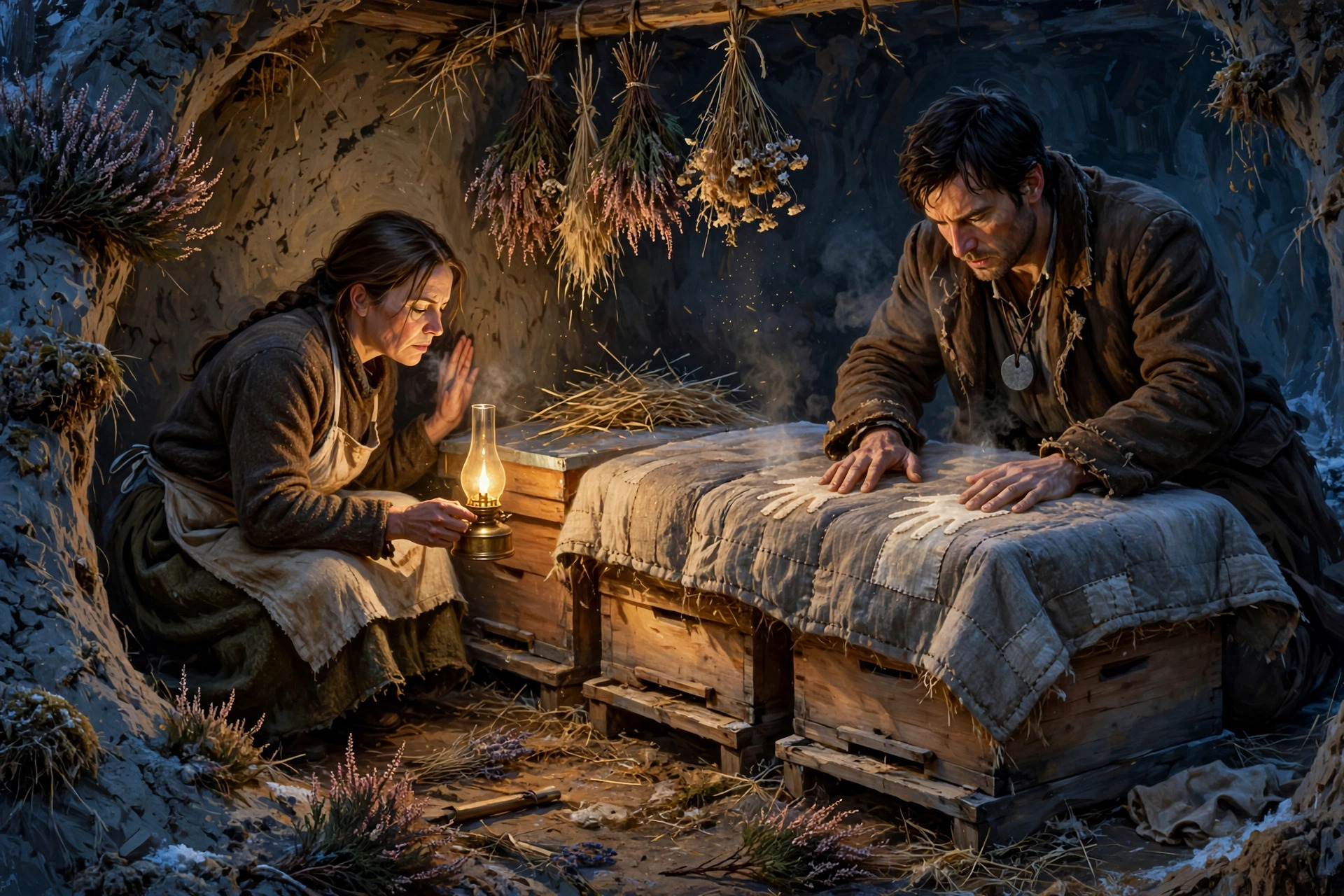
The man kneeling at the outer wall did not lift them. Bare palms, flat on the linen, fingers spread either side of the torn corner like a man pressing a door shut against wind.
"They're cold at this end," he offered, in the tone of somebody remarking that the road was muddy. "Under the straw. Put your hand here and feel it."
"I know what's under the straw. I've been listening to it since the leaves turned." Hester came down the row with her lamp held low. "The Fellowship pays you to sit with my father. Not to spend yourself on bees."
"Your father's warm."
"My father is dying."
"I know." He glanced up then, unhurried, a long face gone grey at the edges from the cold of the walk. "That's why they sent me. He's warm, though. These aren't."
She set the lamp on the bank and crouched at the next box along, and put her ear to the cedar. Under the paint, under the quilting, the drone came up thin and slow, a sound like a wet rim drawn round a glass. Eleven hives, every one of them left in the valley, and this outer box answering her half a heartbeat late.
Her mother had stitched the coverlet in her last winter, heather straw quilted into linen, and Hester had kept it dry through nine Novembers by turning it, airing it, mending it, never once letting a stranger lay a finger on it.
"Off," she repeated.
He lifted his palms. The linen where they had been was dry in two hand-shaped patches, and warm, and the hum under it had come up a little, closer to the pitch it should have been.
That was the worst of it. It had worked.
"Sedge," she read off the Fellowship's paper she had folded into her apron that morning. "You're Sedge."
"Jory."
"You've a charge up at the house who can't climb his own stairs."
"He can. He did, an hour ago, to look at the weather." Jory stood, brushing straw off his knees. His coat stayed buttoned to the throat, a bad brown thing worn through at the elbows, and a grey disc of stone swung on a leather cord where his collar had fallen open. "He'll sleep now. He told me twice to go and see to the bees and once to shut the door."
"He tells everybody everything. It doesn't make it an order."
"No," Jory agreed. "But it's a fair idea."
She turned away before her face could do anything about that, and went along the bank packing straw back into the gap where the mice had been at it, hard, with the heel of her palm. Damp had got into the earth wall at the shoulder. The linen smelled of wet heather. And the little iron stove in the corner, that her mother had built the flue for out of bank clay and fired behind the byre, was doing what it had done since the first cold snap: breathing smoke out of its seams instead of up.
"Don't come near that," she snapped, when he moved.
He stopped. Then, mildly, he stepped back a full yard, to the wall, where the cold came off the earth like a hand on the spine.
"Suit yourself."
"There's a chair by it."
"I'll stand."
She had bread in her coat and a screw of honeycomb wrapped in paper, because she had learned to carry food the way other people carried keys. She held it out. He looked at it and shook his head, once, without any fuss, and put his hands behind him against the wall.
"You've been on the road since morning."
"I'm not hungry."
"Nobody's not hungry in November."
"I'm not, though." A small dry crease at the corner of his mouth. "You can eat it while you shout at me. Save time."
The house bell went then, two flat notes, thin across the yard, and Hester was at the shed door with the cold going straight through her jumper.
Her father stood in the kitchen doorway up the slope with a blanket round his shoulders and one hand on the frame, and his voice came down the frost-hardened ground cracked but whole, the voice that had called her in off the fell a hundred times.
"Hester. Leave the man be."
"He's got no business down there. Go in, you'll take a chill--"
"I dovetailed every box in that shed with these two hands. I painted them the summer you were born and I've never once been asked leave to open one." He waited out her silence, the way he always had. "Let him warm what he likes."
"It isn't yours to give away any more."
"No," her father agreed. "It's yours. That's why I'm telling you and not him."
The door went to behind him. The bell rang once more, quieter, set down rather than rung.
Hester stood in the doorway of the Wintering Shed with her nails in her palms and the whole of Quillow Comb laid out grey and still below her, and thought about how easy it would be to send the man back down the valley with his stone and his paper and his coat, and how much quieter everything would be after.
Smoke rolled up past her shoulder.
Jory had gone to the stove while she was shouting. He had the torn corner of the coverlet held out to the flue to dry it, bare-handed, close in, his sleeve pushed back, and the smoke was coming out of the seam in a long grey rope straight into his face.
"Get back!" She caught his wrist and hauled.
He came easily, which surprised her, and then his bare skin was against hers and something in the yard went out like a snuffed wick.
Her pulse was in her wrist. His was in her wrist too, and they were the same. Not near. Not close. The same, one knock in two places, and then a second one lifting in her own throat, in step, in step, so that she stood there in the smoke with a stranger's heart going in her neck and her mouth open on nothing at all.
She let go.
"That's the cold talking," she said flatly.
Jory looked down at his own hand, and then at her, and for the first time since he had come up the valley something moved behind the calm of him.
"It's not the cold," he started.
Behind them the stove gave a tick, and another, and the flue tile cracked clean through with a sound like a plate dropped on a flag floor. Half of it came down on the earth and broke again. Smoke filled the low room in one breath, thick and sweet and awful, and Hester was coughing with her eyes streaming and her mother's clay in pieces at her boots.
Jory got the door wide and dragged the sacking off the vent. She went down on the floor with her sleeve over her mouth and gathered the pieces up while they were still hot, the long curve, the smaller curve, the maker's thumbprint her mother had left in the wet of it nineteen winters ago and never sanded out.
When she stood, the outer box had gone quiet.
She took the shed key off its nail. She put it into his hands, and the broken clay on top of it, and closed his fingers over the lot with her own, quick, before her wrist could remember anything.
"Make yourself useful," Hester said, and walked up to the house before she could take either back.
Wet Clay
"Deeper," Hester said. "You're shaving the top off. The good bed lies under the water."
"It's your ditch." Jory leaned on the spade, entirely cheerful about it.
"It's my clay. Different matter altogether."
She took the tool off him and set her boot on the shoulder of the blade. Cold came up through the sole at once. The ditch below the lane had been her mother's pit and then a ditch again, silted, full of nettle roots and one boot sole from a decade she declined to think about. She turned up a ribbon of grey-blue, slick as liver, and water crept in after it.
Jory crouched and picked roots out of the fresh face with his bare fingers. He didn't ask whether she needed help. He didn't stand back and admire her, either, which half the valley did and which she had never once found restful.
"That's the bed," she said. "Rub it. No grit."
He rolled a pinch between finger and thumb and held it out for her to test. "No grit."
"Don't sound so astonished."
"I've dug bank that was mostly small stones and optimism." He wiped his palm down his thigh, leaving a long grey stripe. "Where do you want it?"
"Bench. And don't drop any in the yard, the geese eat it."
"You've no geese."
"The Tarrs' geese. They've views about my yard."
He laughed, one short note, and went up the lane with the trug on his shoulder, and she stood a moment in the wet with her heart doing something idiotic and her spade still in the ground.
They chopped heather straw on the block by the kitchen door, her mother's billhook, the handle worn to a shine. Jory's first handful came off in lengths like string.
"Shorter. That's rope, not straw. It has to open the body so the thing dries without splitting."
He shortened it. He shortened it again, patiently, until the chaff blew up his sleeves and stuck to the clay stripe on his leg, and he looked like a man who had lost a fight with a haystack, and Hester had to go inside for the sieve so he wouldn't see her face.
On the shed bench she laid out the broken pieces of the old flue tile, the long curve, the smaller curve, the thumbprint her mother had left in the wet of it and never sanded out. She had taken the raw edges down with a whetstone that morning so she could measure off them without cutting herself. It had felt like sacrilege and also like arithmetic.
"We build to the curve," she said. "Not to a drawing. There isn't a drawing."
"Then I'll follow you."
She wedged the clay, cut it, folded it, wedged again, and the straw went in in whispering handfuls. Jory held the old curve upright while she pressed the new body against it, and then his hands were on the outside of hers, guiding the wall thinner, and she said, "No, like this," and put her palms over his, and both their thumbs went down the seam together.
Her wrist knocked. His knocked with it. One knock in two places, unhurried, like a clock in the next room, and it came up into her throat and sat there.
Hester took her hands away and went to look at the outer wall, which was sweating cold in beads along the earth bank, exactly as it had been for two days, and needed looking at, and she looked at it thoroughly.
"The wall's damp," she said, to the wall.
"It'll dry when the flue pulls." He turned the new tile a quarter turn on the board, easy, as if nothing at all had happened in the middle of the bench. "It's a good shape. It'll draw."
They fired it in the kitchen range with the firebox door open and the tea things pushed to the far end of the table. It sat propped on two firebricks, going pale, then bone, then a dull rose when Jory fed the range and the roar came up the chimney. Straw scorched out of it in thin threads of smoke. He turned it every so often with the tongs and never once looked at the clock, and Hester, who had spent nine years buying hours from anybody who would sell them, found this restful in a way she resented.
"She fired them behind the byre," Hester said. "In a turf clamp. Two days of sitting up."
"Your mother."
"Don't."
He set the tongs down. "All right."
From the back room her father coughed, and then said something too low to carry, and Jory rose and went in with the soapstone disc off his collar cord held flat in his palm, and shut it behind him. Hester stood with her arms folded and the range ticking and made herself say the rest of it aloud to the empty kitchen, because there was no one to hear her be reasonable.
"Not one bit into my hives. Whatever you've got, it's for him. That's what the Fellowship pays for."
She fitted the tile while it was still too hot to hold comfortably, with sacking round her fingers, bedding it in fresh clay at the throat of the stove. Jory held the lamp. The smoke went up. It went up and kept going, a clean pull you could hear, a low throat-sound like something drinking, and the sweet awful reek drained out of the low room in the time it took to bank the fire.
By the next evening the outer wall had gone dry to the back of her hand.
He mended the coverlet that night, kneeling on the earth floor with the heather straw quilted into its linen across his knees, the torn corner pulled together with a needle he'd found in the tea drawer. Hester came in with the lamp and stopped.
The seams wandered. They went up and over like a track made by something small and drunk. Two of them doubled back. The corner was gathered in a puckered bunch that no bee would ever forgive.
"Give it here."
"It holds."
"It's disgraceful. My mother stitched this. Give it here, I'll do it properly."
"It holds," Jory said again, and laid it over the frames himself, tucking the crooked corner down along the outer box, and the cluster inside gave a low sound, the sound of eleven cedar boxes settling for the winter, and Hester put the lamp on the bench because her eyes had gone hot and stupid.
After that there were the nights. He sat with her father from dusk until the small hours, and Hester stood in the passage with a tray going cold and heard her father laugh. Not the polite noise he made for visitors. The old one, the one from the honey house, the one that used to come up through the floor when she was small and safe and everything was somebody else's job. She hated how much she liked it. She stood there hating it and did not go in.
Twice she did go in, and twice Duncan turned his face to the wall.
"Shut the door, Hester."
"I've brought you…"
"Shut it, then."
She shut it. Jory came out later with the disc still warm in his hand, warm enough that she felt it off him at a foot's distance, and he said nothing at all, and she said, "He's being difficult," and Jory said, "He's tired," and went to see to the fire.
Barnaby Loam came up the lane with the roll book under his arm and his hat in his hand, and would not sit, and turned the pages at her kitchen table with a wet thumb.
"Winter meeting's at Amblerthwaite. I'll not name it twice, so put it in your head now." He tapped a line. "Hearthman on the roll has to show a warm stone to the room. Cold stone, off the roll. No lodging, no nights, no standing. It's not my rule, I only keep the book."
"And the hive stipend?"
"Stands while the hives stand." He shut the book. "Your father's nights are entered. Somebody's to sign for them."
Jory, at the range, lifted the disc off his cord and held it out without a word. Barnaby cupped it, grunted, handed it back, and wrote.
When he'd gone, Hester said, "There's a spare bed. Up the stairs, left. It's aired."
"I'm on the fire till morning."
"You can hear the bell from the shed."
"I can hear it from the doorway."
She stood there with the lamp and her mouth dry, and then she did the awkward thing, because she had never in her life learned a graceful way to do anything. She put out her hands.
"They're cold. That's all. Let me."
He looked at them for a moment. Then he laid his fingers in her palms, and the knock came up in both their wrists at once, one and one, and Hester felt her whole chest turn over.
He took them back. Gently, but he took them back.
"I don't take," Jory said. "Ask me for anything else."
Later she went down with the spare blanket over her arm and the lamp held low. The stove was pulling clean, that low drinking sound, and the dry wall gave back the heat instead of stealing it, and the crooked corner of her mother's coverlet was tucked snug along the outer box.
Jory was asleep in the shed doorway with his coat on and his back against the jamb, the stone loose in his open hand, close enough to the house to hear the bell and no closer. Hester laid the blanket over him. He didn't wake. She stayed until the lamp got low, listening to the fire draw, and then went up alone.
Straw and Frost
Her father pushed the water glass back at her and laughed, a dry small crack of a sound she hadn't heard out of him since the new tile went in.
"You've stood in that doorway long enough. Go and see to your bees."
"There's a black frost coming." Hester set the glass on the tray. "I'm not going past the yard."
"The yard's where I'm sending you." He got himself up against the pillows without a hand under his elbow, and there was colour in his cheeks, and his breath went down deep instead of catching at the top of his chest. "Both of you. I've a mind to lie quiet and listen to the house a while."
Jory stood at the foot of the bed with the lamp. "I can sit till the worst of it's over."
"You can go where you're put." Her father turned his face to the wall and shut his eyes.
Out in the passage she stood with her palm flat on the door frame. He had sent them out together, and he had done it easy, breathing like a man with a long night ahead of him, and she took it for a present, being short of anything she hadn't paid for first.
The yard rang under her boots. Every blade of grass stood up white and stiff. She broke the lid of ice on the water butt with the heel of her hand, and Jory swung the lamp low so the light stayed on the ground between them.
"Bank first," she said. "Fire after."
They wedged straw into the north bank where the wind had been worrying at the earth all week, Jory bringing it in armfuls from the byre while she packed it down with a length of ash. Sods on top, cut from the heap under the tarp, laid overlapping like slates. Her fingers went numb and she kept on.
Then the stove. She fed it short splits and opened the draught, and the new tile at the throat took the heat and drew, that low drinking sound, harder than she had ever heard it pull. The dry wall gave the warmth back at her instead of swallowing it. On the bench lay her mother's tile in three pieces, the edges sanded soft. She touched them going past, the way you touch a doorpost.
She went along the row with her ear to the cedar. Eleven boxes, her father's dovetails, painted the summer she was born. At the first lid the note was thin. By the middle it had thickened, and at the far end it came up broad and low through the wood into her cheekbone, a whole box of them breathing together.
"Holding," she said, and heard her own voice go strange. "They're holding."
Jory crouched with his hand on the outer box and his eyes shut, listening the way she did. "Aye. That's a full sound."
She laid the sacking straight over the frames, then lifted her mother's quilt off the top and shook it out. Straw dust came off it in the lamplight.
"That's for them."
"They've the bank, the stove, and each other. Listen to it." She sat down in the loose straw with her back to the warm brick. "All this time and I've never had it on me. Not once."
He sat. Not close. He never sat close. She pulled the quilt across her knees and let the corner hang, and after a while he took the corner, because the wintering shed was warm and the frost outside was not, and there was straw under them both and the hum going on above their heads.
"Let me give you something," Hester said.
"No."
"You've not heard what it is."
"I've heard it."
She turned toward him. "I'm not asking you to sit with anybody. I'm asking you to hold still for a minute and let me put some heat into you. That's all. That's the whole of it."
He set the lamp on the floor. Then he lifted the cord off his neck and put the disc in her left hand and folded her fingers over it, and it was warm, warm from him, smooth as a river pebble. "You know what your pulse does when you touch me," he said. "It knocks the same. That's how a pair's known."
"I know what I felt."
"Then know the rest of it. Warmth runs one way between a pair in a night. One way only. Whoever takes can't give again till they've slept a night out of touch."
"So I give tonight, and you're on the fire tomorrow."
"If I give after taking, in the same night, it goes out of me." His voice stayed flat and careful. "Not for a week. Forever. Nobody can put it back, not me, not anyone. I'd still take from you. I'd never push heat into a stone or a hand or a hive again."
The stove drew. She sat with the stone in her fist and thought of a book opened on her kitchen table, and a warm disc held up in a room full of people, and how everything she had was only ever on loan.
"There's a bothy under the fell," he said. "Langhope Bothy. My brother went up to meet me there. I'd spent myself on a woman dying two folds over, and I came to Ninian empty. I had nothing left to put in him. He froze with his back to the door, waiting on me."
"That winter I cut this off a boulder and sanded it down with wet grit, mornings and nights, till it went smooth. So I'd have it in my hand and always know what was left in me."
"And nobody's ever put anything back."
"It's not owed me."
"It's not a debt." Her throat ached. "I'm not paying you for my father. I'm asking you for something. It's a different thing, and I'm bad at it, and I'm asking."
He looked at her a long moment. Then he turned his hand over on his knee, palm up, bare, and left it there. It was the hardest thing she had ever watched anybody do.
She put her right hand in his. The knock came up in both wrists at once, one and one, and she stopped thinking about the book and the yard, and she pushed.
It went out of her palms and up her wrists, a slow draining, like bathwater leaving a tub. Her shoulders cooled. Her teeth started up. Somewhere behind her breastbone a room emptied.
Jory made a sound she had not heard from him. His shoulders came down. His mouth opened and his eyes filled and ran, and he did not wipe them, and his hand shook in hers. "Oh," he said. "That's yours. That's you."
"Don't stop." Then, "Nobody's ever..." and he gave it up and sat there with her heat going into him and his face wet in the lamplight.
"That's enough." His voice had gone rough. "Hester. That's enough, you're cold." He wrapped both hands round hers and put them against his neck, and pulled the quilt up over the two of them, crooked seams and all.
Under her mother's quilt he came close and asked her without words, and she answered by getting her hand under his open collar and laying her palm flat on his chest. Skin on skin. His heart and hers went together, one and one, and she kissed him with the hum of the hives above them and the stone still warm in her fist.
The bell went. It came thin and hard across the frozen yard from the house, and it did not stop, and she was already on her feet with the quilt falling off her shoulders.
The Kitchen Door
The bell was still going when Hester got the back room door open, her father's fingers working it against the coverlet, the clapper ticking like a nail in a tin. By the time she reached the bed he'd let it drop.
"It's got my chest." He got the words out in pieces. "Hester. It's got hold of me."
His face was the colour of wet ash. His lips were slate. There was sweat on his forehead in that cold room and the sweat was cold too, and taking his hand was like taking up something out of the ditch.
"I'm here." She dragged the blankets up over him and they did nothing at all. "I'm here, Dad."
She put a brick in the stove eye and wrapped it in flannel and laid it at his feet. His teeth went on knocking. She could hear the frost working in the window frame, a fine steady crackle, the sound of the night taking everything it could reach.
Jory stood in the doorway with his collar open and the stone in his fist. He was looking at her, not at the bed. He'd read it already.
"The brick's not touching it," he said. "That's not the kind of cold a brick touches."
"Then I'll bring the cart round. There's the doctor in Amblerthwaite."
"The ford's iced to the middle. And there's nothing in his bag for this." Jory came in and stood at the foot of the bed with his hands at his sides. "There's no other hearthman this side of the coast. You know there isn't."
"You can."
"I can." He said it flat, the way he said everything about himself. "Not after tonight. You gave me. If I push anything into him now it goes out of me and it doesn't come back. Not next week. Not ever. Barnaby takes the stone off me at the meeting and I come off the roll, and after that there's no work and no bed anywhere in Brannock Fold."
She turned back to her father and put both palms flat on his chest and pushed.
Nothing went. Her hands were only hands, laid on a thin man under blankets. She pushed until her shoulders ached and there was no more movement in her than there was in the bedpost.
"You're spent," Jory said. "Till you've slept."
"Then sleep. An hour. Lie down an hour and then do it."
"It's a night out of touch, Hester. Not an hour." His voice didn't rise. That was the worst of it. "And he hasn't got a night."
Her father's hand came up and closed on her wrist, and there was nothing in the grip, nothing at all, and she looked at the grey of him and at the flannel brick doing no good at his feet.
"Warm him," she said.
Jory didn't move.
"Please." She heard herself say it. "Go in. Warm him."
She did not step into his way. She did not put her hand on his arm. Afterwards she would go over that half minute a hundred times and find that she had done neither.
He knelt by the bed and laid the soapstone in her father's palms and folded the old fingers over it, and then he put his own bare hands over both of them.
Duncan's mouth moved. He turned his face towards Jory and said something too small to carry, three or four breaths of it, and Jory bent his head and listened with his eyes shut. His jaw set.
"I know," he said, down near the pillow. "I know."
Hester could have asked what. She went to the chest for the other blanket instead, and shook it out, and took her time about it.
When she turned round the grey was going out of her father's face. It went the way frost goes off a window when the sun gets on it, from the middle outwards. His breath came down deep and slow. The knot in his chest let go; she watched his shoulders come away from his ears. His fingers loosened on the stone.
And Jory emptied. She saw it happen and could do nothing but stand there with a blanket in her arms. The colour left his mouth first, then the backs of his hands. His lips went the blue of skimmed milk. His breath got short and shallow, and his arms began to shake, and he held on anyway, held on past the point where her father was warm and easy and half asleep.
"That's enough," she said. "Jory. That's enough now."
He took his hands away and put them in his lap and looked at them as if they belonged to somebody he used to know. Then his legs went out from under him and he sat down hard on the floor with his back against the bed chest.
She got the stone out of her father's hand and held it to her lip. Cold. Not cooling. Cold the way the doorstep was cold, all the way through, a dead piece of the fell.
She knelt and put her palm on Jory's chest, under the open collar, skin on skin. The knock came up in both wrists at once, one and one, faithful as ever, and nothing else happened. Nothing went either way. There was nothing left in him to come to her and nothing left in her to send.
"Don't," he said. "It's all right."
"It is not all right."
"He's warm." His teeth were going now, the same as her father's had been. "Listen to him breathing."
She got him up onto the chair by the stove and put the flannel brick at his feet and her own coat round him, and he let her, which he had never done before, and she hated how easy it was.
"The shed's warm," she said. "The stove's drawing. Go and lie in the straw."
"I'll sit with him. You've been out there since dark."
"I'll sit with him." She was already straightening the coverlet, tucking it, making a job for her hands. "He's my father. Go on."
She sat with Duncan until his breathing had settled into something she could count on. She put the bell up on the shelf where he couldn't reach it and tire himself. Then she went out to the Wintering Shed and kept the frost alone.
Jory lay in the straw along the wall with his coat over him and his eyes open. She worked with her back to him. She fed the stove and raked it and fed it again, and the new tile at the throat drew hard and clean, her tile, their tile, holding like it had been fired by somebody who knew what they were doing. She went along the frames and tucked her mother's quilt down over the sacking, crooked seams and all, and pressed the straw and sods tight along the bank where the wind was searching. Eleven cedar boxes. She counted them twice, touching each lid, and the thick low sound of the cluster came up through the wood into her fingers, alive, all of them alive.
She did not go near the straw. She did not put her hand on him once. She had asked for a thing and got it and she could not look at what it had bought.
At first light she went back to the house. Her father was sleeping warm with his mouth open like a child. She lifted the stone out of his hand and it was still cold, and she carried it into the kitchen.
The lamp had burned all night, yellow and pointless in the grey. She pulled the drawer and took out the deed and unfolded it on the table. Quillow Comb, the boundaries written out in the registry's dry hand, the stamp, the witnesses, her mother's name struck through with a line of ink and her own name under it. Half of everything, and the other half, and all of it hers to keep or to give.
She read it twice. Then she folded it along its old creases and put it back in the drawer and shut the drawer with her hip.
Jory came in from the yard with frost on his shoulders and his lips still blue.
"He's sleeping," she said. "You did that. It's paid for. That's what this was."
"Hester."
"A debt." Her voice came out steady and reasonable and horrible. "That's all it's been since you came up the track. I've a dying man and eleven hives and no hands to spare, and you were warm, and I used you like a stove." She heard the words leave and could not get behind them to stop them. "You should go back to Amblerthwaite. Today. Before I spend the rest of you."
He stood there with the door open behind him and the cold coming in round his boots.
"I'd do it again," he said. "Tonight, tomorrow, any night you asked me. I'd walk in there and do it again and you owe me nothing for it. Nothing, Hester. Not a thing."
And there it was, the same refusal she had been listening to all winter, the one that had let her mother go out into a frost with a quilt in her arms. Nothing owed. Nothing to hold him by. He would keep emptying himself into whatever she pointed at until there was none of him left, and he would call that kindness, and she would be the one standing in the kitchen afterwards with a cold stone in her hand.
"Then there's nothing keeping you," she said.
She took his coat off the hook and held it out, and when he had put his arms into it she pushed the stone down into the pocket and buttoned the flap over it herself, so he wouldn't have to fumble with fingers that wouldn't work.
"Hester," he said. "Look at me."
She opened the kitchen door and stood back from it.
He went. She watched him cross the frozen fold with his shoulders up and his hand in that pocket, getting smaller against the white of it, and then she shut the door and put her forehead against the wood and stood there alone with the lamp still burning.
The Meeting Table
Hester was on the registry step in Amblerthwaite before the clerk had his lamp lit, the deed folded inside her coat and knocking against her ribs with every stride of the road in.
He read the paper twice, the way she had read it by lamplight, and then looked at her over his spectacles. "You're writing half of Quillow Comb over to a man with no standing in this valley."
"I'm writing half of it over to Jory Sedge."
"Once it's stamped it can't be unstamped."
"I know what a stamp does."
She signed where he put the ruler. Another clerk came through from the back with his coat still on to witness, and the stamp came down, and the sound of it went straight through her teeth.
Jory was in the passage outside the hall, leaning on the wall with his hat in his hands. He straightened when he saw her. Neither of them managed anything at all for a moment. His lips were split from the cold and he had walked the same road she had, and sooner.
"You shouldn't be here," he said.
"Neither should you."
Inside, the stove ticked and the tea urn hissed and the forms creaked under people shifting their weight. Barnaby Loam had the roll book open in front of him with a pencil laid along the gutter, and he took the stone off Jory at the door and held it in his fist a while, the way a man tests a plum.
"Cold," Barnaby said, and set it on the table where everybody could see it. "Then I'll move it, and we'll have it done proper. Jory Sedge, hearthman, off the roll of the Brannock Fold Fellowship. All in favour."
Grizel Tarr stood up in her dairy coat with the milk still on her boots. "My man died warm last spring. That's what I've got to say and I'll say it quick. He sat with him nights on end and he never once let go of his hand, and I got my sleep because of it. Whatever's gone out of that stone, it went out doing something. I'll not have him put down like a lame beast."
"Grizel, the roll's the roll."
"Then it's a poor sort of book."
Jory had his hat by the brim, turning it. "You can save the arguing. I'll ask it myself. Strike the name off. I've nothing left to sit warm with, and I'll not take a wage for cold hands, and there's folk on that list who need the nights more than I do." He looked at the table. "It's the only thing I've got left to hand over. Let me hand it."
Hester stood up. Her chair went back against the wall behind her with a crack that made two people turn.
"I asked him," she said. "On the frost night I warmed him under the quilt, and then the house bell went, and I sent him in to my father knowing exactly what it would do to him. He told me the price first. I sent him anyway. Whatever came off that stone came off it because of me. Write the shame on my name."
Barnaby's pencil had stopped. "Hester--"
"And take my father off the hearth roll. Duncan Fenn. I'll sit the last nights myself, with bricks and blankets and my own two hands. I've been buying him with other people's, and I'm done at it."
She put the deed on the table and pushed it flat with her palm, next to the stone.
"Half of Quillow Comb, written over to Jory Sedge. Signed and witnessed at the registry this morning. He'll keep the hives with me. Put him on the hive roll."
"The hive roll's a stipend," Barnaby said. "It isn't a lodging."
"The lodging's in the paper."
Grizel sat down slowly and then stood up again. "I'll second that. Hive-keeper at Quillow Comb. Anybody against it can come and milk for me while they think it over."
Nobody laughed, but the room let out a long breath of wool and tea, and hands went up, and Barnaby drew one line through a name and wrote another under a heading he had to rule himself, pressing hard. He read it back. He asked for it settled and it was settled.
Jory had not moved. He was looking at the deed as though it might go off like a firework.
"It's a strange gift, half a farm," Barnaby said.
"It isn't a gift," Hester said. "It's a place."
Jory put his hand flat on the paper, over her name and his. "I'll take it," he said. "I'll not pay it back to you. I'll just live in it." His voice went at the end and he took it back up again. "That's harder."
"Aye," she said. "It is."
He picked the stone off the table and pocketed it. She folded the deed along its creases and slid it into his coat herself, and buttoned the flap down, and her knuckles brushed the stone through the lining, cold as a doorstep.
They walked out of Amblerthwaite together in the grey afternoon, and he was quiet past the quarry turn, and then he said, "He asked me to stop."
"Who did?"
"Your father. First week, when the tile was still in the range. He asked me to let him go his own road. He asked me every night after that, in his own words, over and over, and he was clear as a bell every time."
She stopped in the middle of the track. Somewhere below them a crow was going on about nothing.
"You never told me."
"I thought you needed the time more than he needed the choosing." Jory's hat was still in his hands. "That was mine to carry, and I carried it wrong."
And there it was, all of it, the whole winter rearranging itself behind her eyes. Her father turning his face to the wall when she came in with the lamp. The door pulled to in her hand because he was tired, because he was sleeping, because she had said he was sleeping. Jory coming out with the stone still warm and her calling that a good night, and never once asking the man in the bed a single question about what he'd like.
"I never asked him," she said. "Not once. All winter. I asked you."
"Hester--"
"Don't take that one as well. Leave me something to hold."
At the farm he went straight into the back room before she had her coat off, and took the stone out of his pocket, and put it into her father's hand, and folded the old knuckles over it.
"Is it cold?" Duncan said.
"Aye."
"Good." Her father's mouth moved into something that had been a grin once. "Then there's none of you in it. I'll not be spending anybody else."
She sat the nights herself. She brought bricks up from the range wrapped in flannel and laid them at his feet, and she piled the blankets, and when he pushed them off she let him push them off and put her hands on his cold ankles instead and kept them there. She left the door standing open because he asked her to. The cold came in along the floor and she sat in it.
"Tell me what you'd like," she said, "and I'll do it, and I'll not argue with you about it."
"The door open. You here. Nobody warming me." His breath came in small sips. "Let me go on my own road, lass. You sit and let me go."
"Aye," she said. "I'll sit."
He went quiet in the small hours, and she talked to him about the hives, the eleven cedar boxes his own hands had dovetailed, the quilt with the crooked seams, the tile she and Jory had made out of the ditch and fired in the range. She told him the shed was holding. She told him she'd open the entrance when the thaw came and stand back and let them fly.
Somewhere in the telling his hand went loose under hers, and the warmth went out of it the way heat leaves a stone, and she did not send anybody for anything. She stayed with the door open and her hands where they were until the lamp burned dry.
Then she lifted the soapstone out of her father's palm. Jory was in the doorway with the deed in his coat and his hat gone somewhere behind him, and he did not come in and he did not go away. She crossed the floor and pressed the stone into his hand and closed his fingers over it, cold and smooth and his, and left her own hand there a moment longer than she needed to.
Bees Over Snow
"Put the bucket down."
Hester had it tipped already, the broken pieces of her mother's flue tile starting to slide, and Jory's palm came flat over the rim and stopped them.
"It's rubbish," she said. "We made a new one. That one's finished."
"It drew smoke for longer than I've been at this work." He lifted the pieces out and laid them on the bench in the order they had come apart. "And you've kept them beside your sacking all winter like they were eggs."
She had. She'd shifted them twice to get at the frames and put them back both times, and she was not going to be told about it by a man who owned the coat on his back.
"Clay," he said. "Wet it for me."
She slaked bank clay in the bucket with a handful of chopped straw and worked it with the heel of her hand. He scored the wall above the bench with a nail, crosshatched, the way her mother had scored everything she ever bedded, on the cool side of the Wintering Shed where the earth stayed cold through any thaw and the stove's heat never reached.
"Higher. I'll not stoop to look at it."
"Higher's your shoulder. You'll catch it with a frame and knock the whole thing out."
"Then hip."
"Hip I'll give you."
He buttered the back of the largest piece and pressed it in, and she held the smaller ones tight against it while he wedged grit behind them and worked the joints full. It took most of the morning. The clay went slick, then tacky, then firm, and the shelf came out of the wall as if it had grown there, a hand's breadth of pit-fired bank clay with grey seams running through it.
"There." He wiped his palms down his thighs. "Now it holds something."
"She'd have stood a lamp on it."
"She'd have stood a lamp on it and told you the lamp was in the wrong place."
Hester laughed, which she had not done in that shed since the frost, and the sound of it went up into the roof straw and startled her.
He got the soapstone out of his coat and stood with it, the grey disc gone shiny at the edge from all the years of his hand. Then he set it in the middle of the shelf, square to the wall, and took his palm away.
"It's cold."
"It'll stay cold. Nothing in it, nothing coming." He looked at it a moment longer. "It's not for anything now. It's a thing on a shelf in a shed."
"Aye."
"Say the rest of it."
"I'll not be picking it up in a hurry," Hester said, "and I'll not be putting it into anybody's hand."
Then he brought the deed out of his breast pocket, gone soft along the folds, and turned it over as though he'd been caught with something he shouldn't have.
"It's wearing out in there. Where does it live?"
"Tin box, under the hive notes. Give it."
"Half of Quillow Comb, filed under a list of queens."
"Filed under my mother's handwriting. You'll not do better in this valley."
He handed it over, and she buttoned it into the tin with the queens and the frost nights and the weights, and shut the lid, and something in her chest sat down that had been standing since the meeting.
He'd been out since first light. She could see it on him: fresh earth shoved up over the roof line where the thaw had scoured the banking, the mouse guards straightened, the wet straw forked off the step. He'd taken the sacking off the boxes without being asked and folded it her mother's way, selvedge out.
"Quilt wants a stitch at the corner," he said. "The linen's pulled."
"That corner's been pulled since she made it. Leave it."
"I'll leave it." He rubbed the seam flat with his knuckle anyway, gentle, the way you'd smooth a hair off a sleeping face. "They've moved across to the wall side. All of them. Listen."
She laid her ear to the cedar. Under the paint, a dry seething, like a bow drawn slow over a string.
"You've learned my hives."
"I've learned your quilt, and your banking, and which of your seams to trust. The crooked ones hold better." His ears were red raw and his knuckles were the colour of the snow outside. "I've stood in the wet since it went calm. I'll be cold tonight, and the night after."
"Keep me," he said.
She turned round.
"I can't get warm on my own. I've sat a whole night by a range with two blankets round me and got up colder than I lay down. I'm not going to learn it. I'm done trying." He kept his hand flat on the wall beside the shelf, not touching the disc. "Keep me, Hester. Not the work. Me."
She heard herself start on the stipend, and the top field, and what a man could be put down as on paper if—
"Hester."
She shut her mouth. The stove ticked once. She had asked once and been given everything a man had, and here she was offering him arithmetic.
She took his face in both hands and warmed him, and he let her. That was the new thing. He stood in it with his eyes shut and his mouth a little open, like a man out in the sun, and he did not pull away and he did not tell her to spend it on the hives.
"You'll get nothing back off me," he said. "Not warmth. Not ever."
"I know what I've got."
She crossed to the frames and folded the linen back, straw and heather, her mother's stitching wandering where the lamp had gone low, and laid it on the bench. Sacking off. She drew the entrance block out and set it beside the quilt and stood back, the way she'd promised her father she would.
They came out slow, one, then a handful, then more than she could follow, and the sun came round the byre and caught them. Eleven cedar boxes his hands had dovetailed, and every one of them talking. The fold bees went out over the snow in a loose gold braid, low, turning, crossing the white and coming back with their legs heavy.
"There they go." Jory wiped his face with his sleeve and did not pretend it was the cold. "He'd have stood here with his hat off."
"He'd have stood here telling us the entrance was too wide."
"It's too wide."
"It's not."
"No," he said. "It's not."
"I love you," Hester said.
He turned his head.
"Not for the nights you sat with him. Not for the tile, or the banking, or half a farm I shoved at you in a room full of people. I'd have you in this shed if you never touched a frame again."
"I love you." His voice went rough at the edges. "I've said it every way but that one. I thought if I kept being useful you'd stop looking for the day you'd have to send me off."
"I stopped."
"Aye. I noticed."
She kissed him in the doorway, which was not new, and did not stop when she easily could have, which was. He got his arms round her and held her against the post, and her hands were warm inside his and stayed warm, going out of her into him with no arithmetic in it anywhere.
"Bank it and bar the door," she said, against his collar. "Then come up to the house."
"Aye."
Neither of them moved yet. The bees crossed the snow and crossed it again in the sun, and behind them on the cool wall the little grey disc sat cold on her mother's clay, and would sit there, and would never be needed, and Hester stood in the doorway with her hands held warm and let the sun get on with it.
Get notified when new stories drop

Cade Ellison
Cade specializes in romantasy and paranormal romance: magic systems with rules, courts with knives, and longing that rearranges destinies.
Leave a comment
Comments