


The Horn Speaker
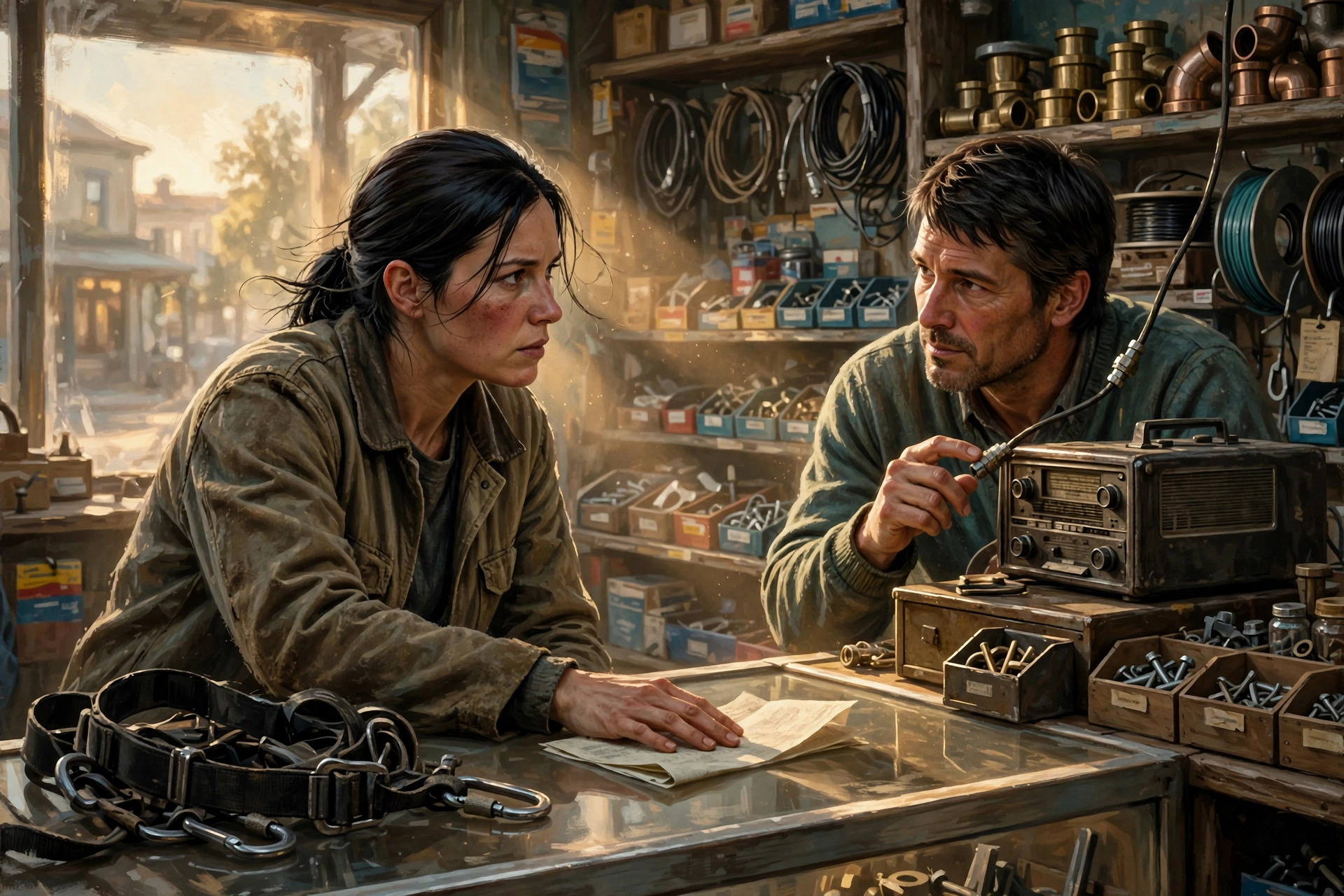
Junia flattened Tarrow's site notice on the counter and spun it so the print faced him.
"The mast comes down. That's the condition, not my opinion. They build on the Saddle or they don't build at all, and either way this canyon stays as cut off as it is right this second."
Dermot Loomis didn't look at the paper. He was folded in behind the register with his cheek against the receiver's case and one finger on the coax where it dropped out of the wall, turning the connector like a man testing a loose tooth.
"Give me a minute."
"I've got a crew sitting at the trailhead."
"A minute." He let go. The set hummed, flat and patient, the sound of a thing listening to a wire that wasn't there. "It's been off since the wind. It'll come back."
"It's not the wind."
"It's usually the wind." He straightened, wiped his palms on his jeans, and gave her the whole of his attention, which was worse than being ignored. Under the glass beside his elbow, the sign in the window threw its reversed letters across his knuckles: Loomis Hardware & Aerial, since before either of them could spell it.
Nan Teale came in with a hasp in her fist and set it on the glass, not on the notice.
"Four screws to match," she told Dermot. "Today, if you can manage today."
"Nan."
Nan looked at a point above Junia's shoulder, at the shelf of pipe fittings. "Is the surveyor going to be long? I've a feed bin to lock before dark."
"Junia Pell."
"I heard you." Nan smoothed her invoice with two fingers. "Paper that hasn't been before the Meeting is only paper."
"Then I'll bring it to the Meeting."
"You'll bring it to the chair." Nan turned back to the screws.
Junia folded the notice into her jacket before she could say the rest of it, which was fine, because the rest of it wasn't for anybody here. The envelope with the recorder's seal was out in the truck's door pocket, soft at the corners from handling, waiting on a signature that would put her in a house on a paved road somewhere nobody had a schedule for her.
Perle Voss came through from Voss Washateria with a folding chair in each hand and her reading glasses shoved up into her hair.
"Two short," she announced. "Dermot, the gray ones in your back room."
"They're spoken for."
"By who?"
"Sunday."
"It's Monday." Perle set the chairs along the wall, one, then the other, and stood back to judge the line of them. "I'm early because last week I was late and half of Umber Bend stood through the whole hour like a flock of herons. You'll be up on the ridge, won't you."
"That's the job."
"My Ruthann's up in the city at the nursing. They tell me there's a stack of her messages waiting at Kelso Junction." Perle straightened a chair that was already straight. "She writes like she's charged by the word."
Fen came in with the tripod balanced on her arm and dust to her elbows. "Boss. Junction's got the sked open. They're asking for the Bend." She looked at the humming set. "Asking a lot."
"The coax is fine," Dermot said.
Junia looked past him. The cable came down off the shelf and hung on its own weight, and the barrel had backed off the chassis by a thread's worth, barely enough to see, plenty enough to kill a valley.
She went into the back and found the stepladder standing in the flimsy stock, moved it, and climbed behind the counter without asking anybody for a hand.
"Don't lean on that shelf," Dermot said. "It isn't screwed to anything."
"I know. It never was."
From up there she could see the seam of rivets along the horn over the doorframe, her father's ugly, tidy work, the flood siren he'd cut and rolled and bolted up the winter before she enlisted. She'd handed him the rivets out of a coffee can. He'd told her to hold the can higher so he didn't have to bend.
She ran the connector down snug, then a quarter past, and felt the cable stop pulling on itself.
The set woke with a hiss like a tire letting go, and then the horn was talking, out over the threshold and into the street, loud enough to reach the pumps.
"Umber Bend, Umber Bend, Kelso Junction, traffic for you, copy when ready."
Dermot had a flimsy out and the carbon under it before the operator finished. He wrote with his shoulder over the page, the pencil going in that fast, careful hand.
"Message one. From Ruthann Voss, for her grandmother. Grandma, I passed the clinical. Tell them at the shop I passed. Don't cry into the wash. I'm coming home when this rotation's done and I'm not eating another cafeteria egg as long as I live."
Perle's hands closed on the back of the chair.
"Read it again."
"I've got it copied."
"Then read it again, Dermot."
"Sunday." He blew the eraser crumbs off the flimsy. "You'll hear it under the horn with everybody."
"I'm standing right here with my hands on my own chair."
"The hour's the hour." He folded the sheet twice and put it in the biscuit tin on the shelf, and set the lid on straight, and the tin was fuller than a tin of paper had any business being.
Perle looked at him a long moment. "You and that hour," she said, and went back next door, where a dryer started up and thumped.
"It keeps," Dermot said, to nobody in particular. "Nothing spoils in a tin."
Junia came down the ladder. That was when she looked up properly at the rack over the register.
Poplar slats, hand-planed, two nails apiece, lettered in black house paint. Everybody away from the valley, hung where the whole street could read them. A trucker out in Wyoming. Two soldiers. Ruthann, with her long last name crowded at the end of the wood. Her father's lettering, the same as on the feed bins, the same as on the shack door up on the Saddle.
One slot empty. Two bare nails. A clean rectangle in the grime where something had hung for years and then hadn't.
Her tongue went to the roof of her mouth. She had a question ready, a whole one, with a name in it.
She didn't ask.
Dermot came back with the screws, saw where her face was pointed, and shut the drawer under the counter with his hip, quick, and something wooden knocked and settled inside.
Fen had come around to look. "Whose name is missing?"
Dermot counted screws into Nan's palm. "Four. That's right, isn't it."
"Nails pull out," Junia said. "Old paint, old wood."
Fen looked at her, and kept looking, and didn't buy it, and let it go, because the tripod was heavy and the truck was waiting.
Nan pocketed the screws and dropped the hasp into her coat. She stepped past Junia close enough that her sleeve brushed Junia's arm, and went out under the horn without turning her head.
The operator at the Junction was still going, moving on to the next item, road conditions and a parts order, his voice rolling out over the folding chairs and the empty pavement and the pumps, patient as a man reading to a room he couldn't see.
Junia stood under the rack. She didn't count the rows. She looked at the gap, and at her father's handwriting on every side of it, and listened to the street get talked to.
The Boundary Stake
"Slow," Dermot said, and laid his palm flat on the dash as if the dash could do anything about it.
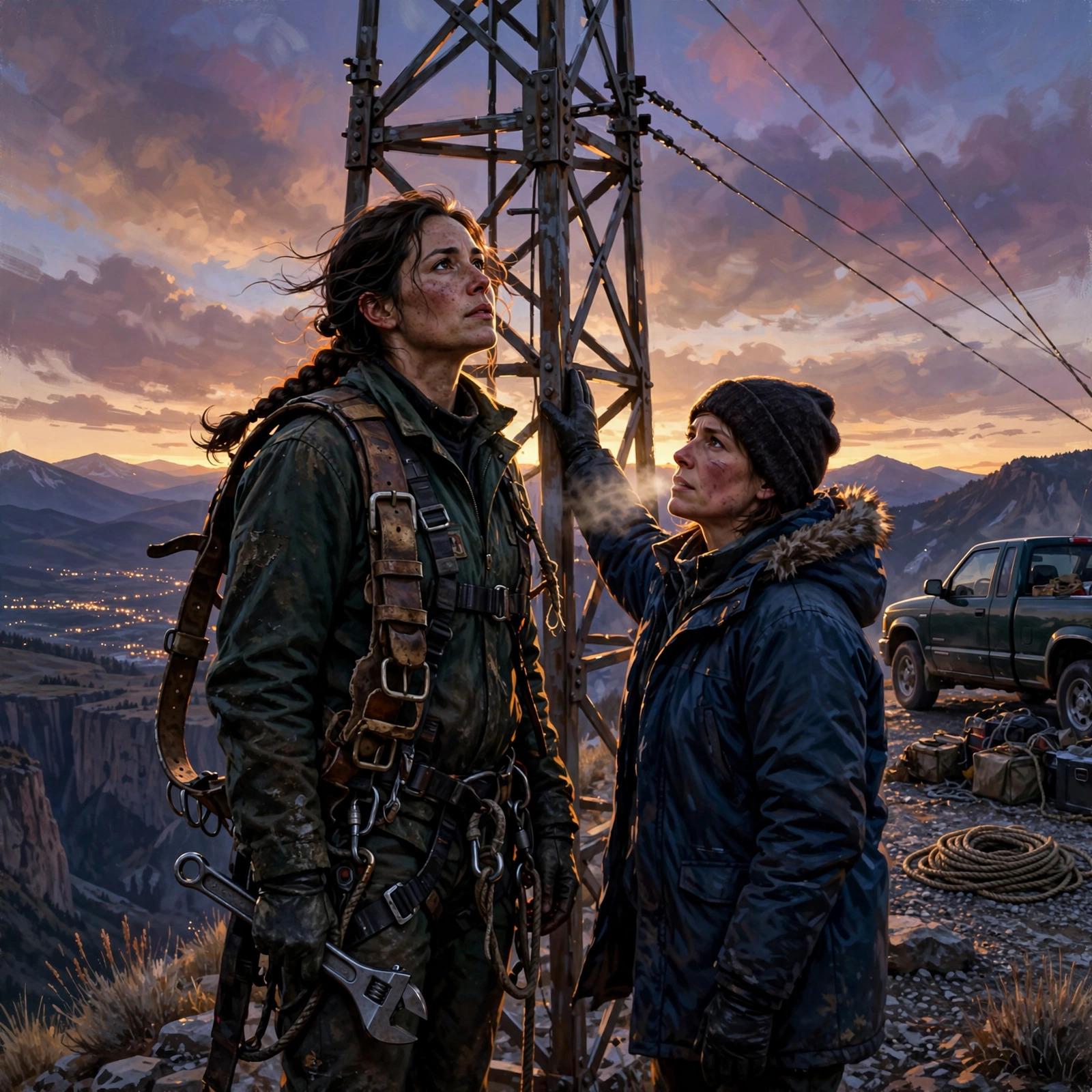
"It's a road."
"It's a creek with ideas. There's a step up there that took the mirror off a feed truck."
Junia downshifted anyway, and disliked that she'd done it because he asked. Behind her the tripod slid and knocked the gate, and Fenella said something to the tripod that Junia decided not to repeat.
"If you two are finished measuring the road," Fenella said, "some of us back here are riding on the axle."
"Nearly there," Dermot told her.
"You said that at the cattle guard."
"I was right then too."
He had a paper sack on his knees, sandwiches wrapped in wax paper, and he held it up out of the grease and gravel like it was a part he'd ordered specially. She hadn't asked him for lunch. She hadn't asked him for anything, and he'd brought it anyhow, and she looked back at the road.
"I left word with the fella at Kelso Junction," he said. "Told him I'd be off the air till afternoon."
"Nobody can reach you."
"Nobody can reach either of us. That's the whole trouble with this canyon."
The Saddle came up out of the pines with the antenna standing over it, aluminum fingers against a hard blue sky, three sets of guys running down to the rock. Junia stopped the truck by the outcrop and sat with her hands on the wheel a second longer than she needed to. She had built that. She had been small enough to be told where to stand.
Fenella went past with the tripod on her shoulder. "I'll shoot the outcrop and the pin, then check the battery bank. Yell if anything falls on you."
Dermot went straight to the base and put his hand on the mast the way you'd touch a horse's neck. Junia came around the bumper with her wrench roll and stopped.
Somebody had splinted the lower element with baling wire. Not a wrap and a prayer. Twisted pairs, four turns, ends folded flat and tucked so no sleeve would ever catch. Above it, another. Above that, a splice she could have sworn was made by a person who loved the thing and had nothing to do it with.
"Who's been up here?"
"Me."
"With what?"
"With what was in the shop." He crouched at the base plate. Where the weld had cracked, a hose clamp sat cinched over a shim of flattened conduit, and the clamp had been painted, badly, with whatever was left in a can. "That one's ugly. I know it's ugly."
"That's a felony."
"It's held since the ice year."
She followed the aft guy down to its anchor and found no deadman at all. He'd wrapped the wire rope around a shoulder of rock and pinned the turn with a truck leaf spring, three leaves still bolted, rusted the color of a barn. She put her boot against it and leaned her whole weight in. It didn't so much as tick.
"A spring," she said.
"Off my dad's flatbed. It's got eyes on both ends. It was laying right there."
"Who pays you for this?"
Dermot straightened up and brushed his palms down his thighs, and looked out over the canyon where Umber Bend was a handful of roofs and a shine of water. He didn't answer that. He said, "The elements up top are true. I never could get the low one."
Junia crouched by the base plate and ran her thumb along a burr on the boom, and the burr was filed. Filed by hand, square, patient, the way she'd been taught to file.
"I cut these," she said. "Me and my dad. On sawhorses in the shop yard, the summer before I left. He let me bolt every one and he checked them behind me and I never once caught him at it."
"I know."
"How would you know."
"Because whoever did it filed the ends and marked the lengths in pencil, and the pencil's still there under the tape." He tipped his chin at the boom. "And because he told me. Twice a week, for years, whether I asked or not."
She laughed before she could decide about it. "He named the tools. Did he ever tell you that? He'd send you for the deacon."
"The big adjustable." Dermot's mouth went sideways. "Because it wouldn't hold unless you swore at it."
"And the little hammer was the choir."
"Because it sang when it hit the anvil." He said it in her father's flat cadence, not mocking it, just carrying it, and something went through her ribs like a wire pulled tight. "He'd send me out for the deacon and I'd bring back the pipe wrench, and he'd say, that fella's a stranger, he don't testify."
She laughed again, too loud, and turned it into a cough, and wiped her eyes with the back of her wrist like the wind had done it.
"Come see the room," Dermot said, and went to the door.
Inside, the Saddle Relay Shack smelled like hot dust and old paper. One chair, cushioned with a folded feed sack. A plank desk. The receiver rack he'd wired tidy enough to pass inspection anywhere. And along the wall, pinned in rows on string, flimsies. Hand-copied, dated, carbon-blue, curling at the corners. Names of half the valley in his small square hand.
"You keep copies of everything."
"Somebody should." He touched the corner of one sheet, straightening it, then took his hand away. "They go brittle. Then they go."
By the door, a hook. Worn bright at the tip, the wood around it darker than the rest, and nothing hanging on it.
"Whose coat?"
"Nobody's, lately."
She let that sit. Then she went back out and up on the bumper with the wrench roll, and got her knee behind the bent low element and the wrench over the end of it, and pulled.
"You'll kink it," Dermot said, from below, holding the boom.
"I won't."
"You'll--"
The metal gave with a sound like a knuckle cracking, and the element came up true against the sky, and she stayed there with her knee against it, breathing hard, absurdly pleased.
"Fenella," she called. "Get me a report when the Junction comes up."
Fenella's voice came flat off the rock. "Better already. He asked what you did and I said nothing you'd approve of."
Dermot laughed, once, surprised out of him. Junia climbed down and her hands were shaking a little from the pull, and she went to the truck door pocket for the manila envelope so she wouldn't have to look at him while they settled.
The deed came out folded in thirds, seal gone soft, her father's name typed where hers was now. She spread it on the tailgate and Dermot put a rock on the corner without being asked, and she read the boundary call out loud because reading it out loud made it a document instead of a thing she was doing.
Thence along the ridge. Thence to the iron pin. Thence to the outcrop, and down.
It took in the antenna. It took in the room with the chair and the pinned rows and the bright hook.
"Give me the tape," she said.
He gave her the tape. She measured off the compound, hooked the reel on the pin, walked the offsets, and Fenella called the corners, and Junia tied the orange flagging and set the stake where the fence line would close, and drove it with the maul until the ring of it changed pitch and the pin stood.
The ribbon ran up the slope, past the guy anchor, past the door, and shut the little building inside the flagged ground.
"That takes in the relay," Fenella said.
"It takes in the parcel."
Fenella looked at her, then went to pack the tripod, and the legs went into the bag harder than they had to.
Dermot had not moved. He stood by the door with the flagging between them, on the side that would come down, and Junia waited with the maul hanging from her hand for him to say the thing. Anything. That it was his father's spring on that anchor. That there was a chair in there. That she could put the pin somewhere else.
"That enough line for your fence?" he asked.
"Plenty."
"Good."
The wind came up the canyon and the orange snapped and cracked, snapped and cracked, the whole footprint of it bright around the shack and the antenna and the hook by the door. Dermot wound the reel in, clicked the lock, and slid the tape into his coat pocket, and buttoned nothing, and kept his hand there a moment, the way a man puts something away for later.
The Name Slat
Dermot knocked on the truck glass with the flat of his hand, and Junia had the door open before the second knock landed.
"Northwest guy's let go," he said. "She's leaning on the other two."
Rain came off the canyon sideways. He had a headlamp on and no hood, and the water ran off his jaw while he waited for her to answer.
"How far off plumb?"
"Far enough that I can hear the elements talking."
She'd been asleep across the bench seat behind the shop with her coat over her. She got her boots on. Then she reached behind the seat for the harness, the tool roll, the canvas bag with the shackles and the come-along, and she did not go up the motel stairs to wake Fen. Two hands would do it. Two hands were what she had.
He drove, because his truck knew the water bars by feel. She held the bag on her knees and listened to the wipers lose their argument with the rain.
"If it comes down," he said, "the whole of Umber Bend goes quiet. Sked to Kelso Junction, the hour, all of it. Nobody in this canyon has another mouth."
"I know what it carries."
"I figured you did."
The orange flagging she'd tied at the boundary was still up there, cracking like a whip in the dark, and the headlights swung past it and onto the mast.
It stood wrong. That was the whole of it, and her stomach went down through the floor. The steel had a bend to it now, a lean toward the shack, and the loose guy hung from mid-height and whipped in the gusts, thirty feet of galvanized cable trying to take somebody's ear off.
She got out and put her light up the tower. The shackle at the collar had shaken itself apart. The pin was gone somewhere in the wet rock. Down at the deadman, the lower end still rode the truck spring he'd pinned into the granite years ago and never told anybody about.
"I need that wire back at the collar," she said. "New shackle, new pin. Then we tension from the anchor."
"You can't climb it looking like that."
"I can climb it leaning. I can't climb it lying in the road."
He looked at her a second longer than the weather required. Then he went for the rope.
She buckled in at the base, checked his knots because she checked everybody's knots, and started up. Twin lanyards, hook over hook, leapfrogging the leg bolts. Rain ran inside her collar and out her sleeves. The mast moved under her boots, a slow give and return, like something breathing that had no business breathing, and she waited out each gust with her cheek against the cold zinc and her arms locked around the leg.
At the collar she got a lanyard clipped high and sat back into the harness and let both hands go free.
"Rope!" she called down.
"Coming up."
He tied on the haul line and she brought it up hand over hand, and the thimble at the wire's end came with it, heavy, swinging out over the drop when the wind got under it. Below her his light went to the truck and the rope turned around the hitch pin.
"Tail me. Don't let it run."
"I've got it."
She hauled. He sat back into the rope with his gloves smoking on the wet fibers, and the wire came up an inch at a time, and she thought about the fact that he had been doing this alone with baling wire and a hose clamp while she was seven years and a whole career away.
The thimble reached her boots. She caught it, jammed it against the leg, and got the new shackle through.
The pin wouldn't start. Her fingers were gone, white and stupid, and the mast swung, and she heard herself say a word her father never said in front of the shop.
"Talk to me," Dermot called.
"It's fine."
"That wasn't fine."
"It's a cross-threaded pin and a bad attitude." She backed it out, wiped it on her shirt, lined it up, and it went home. She moused it with safety wire and twisted the tail down with her pliers and pulled on the link with her whole weight to feel it hold.
"Pinned," she called. "Coming down. Then we pull."
On the ground she cut his father's spring out of the line and laid it in the mud, and put a thimble and a turnbuckle and three clips in its place, and hooked the come-along to the anchor.
"Take it up slow," she said. "I'll sight her."
He cranked. The ratchet clicked and clicked. She stood back by the shack door with her light on the mast and the doorframe edge for a straight line, and called, "More. More. Hold."
The bend went out of the steel. The elements stopped their talking. The wind came up the canyon and hit it and the mast stood there and took it.
"Hold," she said again, quieter, and set the clips, and torqued them, and locked the turnbuckle with a length of wire.
Then she couldn't get her carabiner gate open.
She tried twice. Dermot took it out of her hand and worked it and it opened fine, and neither of them mentioned that. He went to thread a clip onto the tail and dropped it in the mud, and picked it up, and dropped it again, and stood there with his shoulders going.
Junia put both hands under her arms and looked at the valley, where there was nothing to see but rain and, far down, one yard light.
"Coffee," he said. "There's a stove."
The horn speaker over the shop door was working when they came down Main Street, carrier humming low, the wet cable dripping off the bracket onto the step. Inside, he went past the counter to the back room and put the lid off the stove and fed it, and their coats went onto two nails by the flue and started to steam.
He took a small key off his belt and unlocked the drawer under the roll rack.
Then he put her name in her hands.
Poplar, hand-planed, the paint chipped at one corner where somebody had set it down hard. Two nail holes. Black house paint, her father's lettering, the J with the tail he always gave it because he said a J ought to have somewhere to sit.
"You kept it," she said.
"Struck goes in the drawer. Struck don't go in the stove." He shut the drawer halfway with his knee. "Never burned a one."
She turned it over. The back was bare wood, and her thumb found the grain, and she was nineteen and standing on a ladder holding the paint can while he told her to keep her wrist loose.
"I sent word home," she said. "From deployment. Twice, and then a third time when I had a real chance at a radio. I said I was all right and I said I'd come when I could." She set the slat on the stove's warm shelf, then picked it up again because putting it down felt like something. "Nobody ever answered. Not one line. So I stopped writing."
Dermot turned to the stove. He worked the damper in and out with the poker, twice, and the fire went bright behind the little door.
"The hour is the hour," he said.
"That's not an answer."
"No." He set the poker against the brick, very exactly, the way a man does when he's putting something away for later. "It isn't."
She looked into the drawer because she couldn't look at him. Her slot stood empty in the rack above, and down in the drawer, under where the slat had lain, there was a flimsy folded in quarters, gone soft and furred at the creases, the pencil on it faded to a gray shadow. An old parts order, she figured. A list of nails.
He reached past her for the towel on the flue rail and didn't step back, and she could feel the heat coming off his shirt, woodsmoke and wet cotton and the man under it, and her hands were still shaking from the climb and now for a worse reason. He was close enough that she could see the rain drying in the hair at his temple. Neither of them moved.
The sked tone came out of the front room, flat and patient, calling the valley to listen.
She stepped back first. She always did.
"That's the Junction," she said. "You'll want to log it."
"I'll log it."
She got her coat off the nail, steaming and half dry, and put the poplar slat in the pocket where the deed envelope wasn't, and buttoned nothing. At the door she looked back. He had gone to the front with his hand already out toward the set.
The drawer stood open behind him, and she left it that way, and went out under the horn into the rain.
The Cut Mast
Junia leaned into the wrench and took up the last of the slack, and the northwest guy came alive under her palm with a low note she felt in her back teeth. Below her boots the rock dropped away into a floor of cloud. Behind her, Dermot lay flat on the deadman with his cheek against the stone, sighting up the pipe against the pale sky.
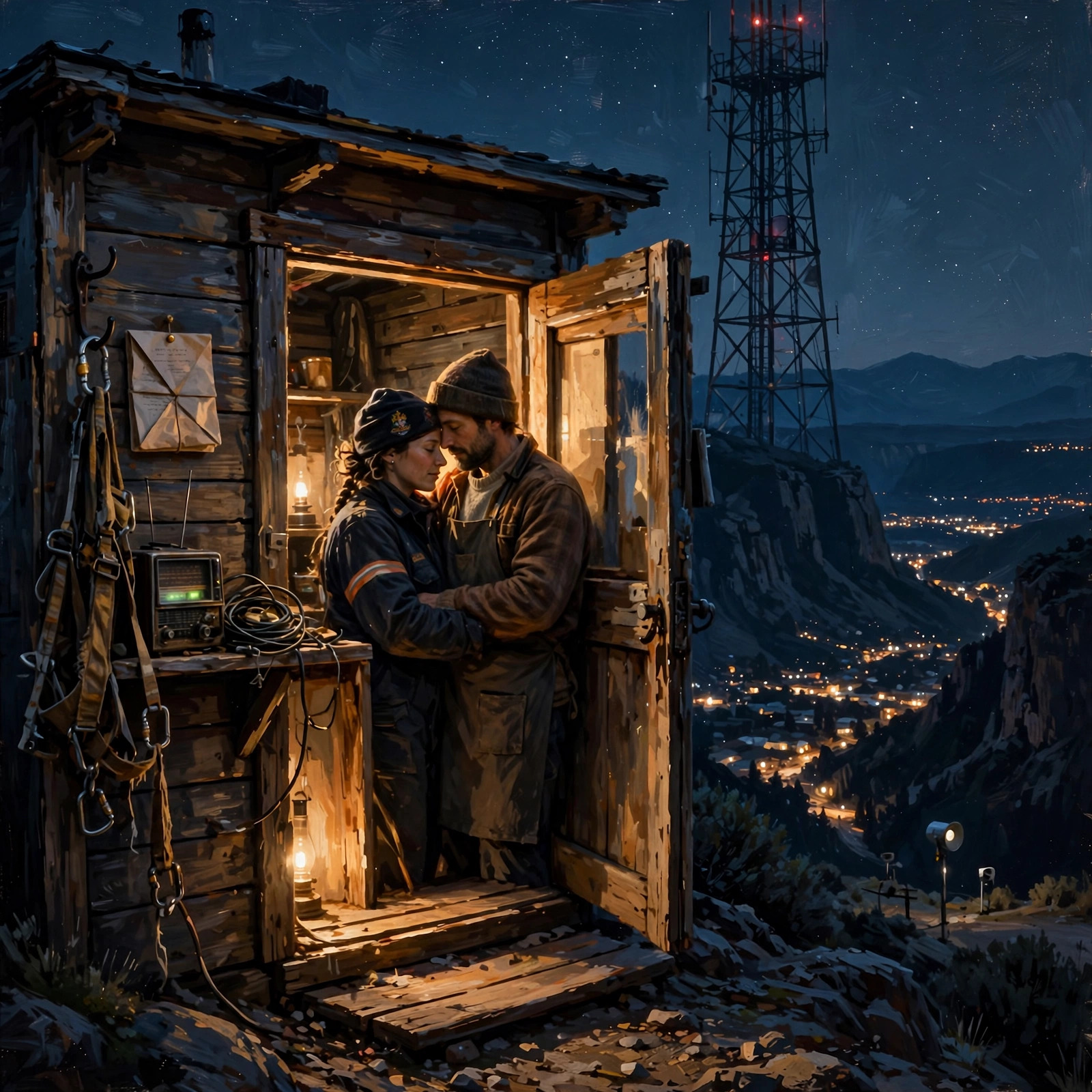
"Quarter turn," she said.
"That's what you said before the last one."
"That was a different quarter."
He grunted and shifted the level along the mast's foot, and she watched his thumbnail travel to the bubble and stop. His cuffs were dark to the elbow from the wet rock. He had been up here since the middle of the night with her, hauling the new thimble into place by headlamp, and he had not once told her to be careful.
"Plumb," he said. "Same as your father set it."
She sat back on her heels. Her hands had stopped being useful sometime around the second guy. The tape she'd wrapped at midnight had rolled into a filthy string around her wrist, and the split in her right knuckle had opened again, and both palms were burned pink where the wire had run through them.
Dermot got the thermos out of his pack and poured into the cup and held it out. Steam went sideways in the wind.
"Drink."
"I'll get it all over you."
"I'll get over it."
She took the cup in both hands because one wasn't enough, and drank, and the coffee was scalding and sweet, too sweet, the way he took it. He wiped the rim with his thumb before he drank himself, which was a thing her father used to do, and something turned over in her chest hard enough to hurt.
The cloud broke open below them. Light came up the canyon wall in a slow slide, and the whole valley lay uncovered, the roofs, the feed mill, the crooked line of Main Street with the shop awning and the little silver horn bolted over the door.
"You can see it from up here," she said. "The whole thing. I forgot you could see the whole thing."
"I come up for that." He capped the thermos. "Not for the view of the hardware store."
She laughed, and it came out wrecked, and then she set the cup on the rock and turned and took his face in both hands, raw palms and all, and kissed him.
He kissed her back like a man let out of a room he had been standing in for years. His hands came up to her wrists and stayed there, holding her broken hands against his jaw, and he made a sound into her mouth that she would hear again at odd hours for the rest of her life. When she pulled back he kept his eyes shut a moment longer, and his forehead came to rest against hers.
"Well," he said.
"Don't make it a whole speech."
"I wouldn't dare."
Her phone buzzed against the rock, which it never did in the valley. Up here on the ridge it could reach out over the canyon wall and find the world. She thumbed it and put it to her ear, and Hoyt Bramwell came through bright and clipped, standing in the Kelso Junction yard with a truck backing up behind him.
"Site's approved. Legal cleared the lease form, so put your ballpoint on it. Bonus is confirmed, eighteen thousand, same as I told you. And Junia, I need the old structure off that footprint today. Photos to me before you roll out."
"Today."
"Equipment's booked. You've got the torch in your kit, you've got the crew. It's a pipe in the ground."
She looked at the pipe in the ground. Dermot had gone very still beside her, the way a man does when he's decided not to move so the moment can't get away from him.
"I'll send photos," she said.
Down on Main Street, Perle Voss was carrying chairs out of the Washateria two at a time, knocking them open with her hip, setting them in rows under the horn.
"There she is. Sit, sit, you've been up that mountain all night, your ears are blue." Perle dropped her voice into a delighted whisper. "Nan's going to move it herself. At the gathering. Your name back on the rack, right in its old slot, and I'll be sitting where I can see her face when she does it."
Junia's hands hung at her sides. "She said that?"
"She's Nan. She'll say it flat and she'll mean it double. And there's word queued for my Ruthann, so it'll be a full hour, you'll see."
Nan Teale came out of the feed store with a receipt book under her arm and stopped at the end of the row of chairs.
"Surveyor."
"Nan."
"I'll put the motion. I'll not have it said I let the rack stay broken." Nan's eyes went over her, the boots, the split knuckle, the coil of guy wire still slung on her shoulder. "The mast stays where it is. The hour stays free to anybody in this canyon, and it stays at the hour. You stand at that table and say out loud what you've come here to do, and you sit in your chair until it's read. All of it. Then we'll see."
The street was very quiet. Perle had stopped folding chairs.
Stand at the table. Say it out loud. Sit still while seven people looked at her and decided whether she had ever been gone at all, and whether she was allowed back, and Junia felt the thing rise in her that always rose, the thing that had gotten her onto a plane, out of a marriage, off a ridge in the dark. Get out first. Get out before the room can do it to you.
"Sure," she said.
She walked to her truck and laid the manila envelope on the hood and folded the deed back under her thumb, the recorder's seal ridged and cold, and she signed the lease in ballpoint on the hood of her truck with the wind trying to take the corner of the page. She pressed hard enough to emboss the sheet beneath.
"Fen. Load the truck."
Fenella Rooke looked at the lease, and at the mast, and at the torch case in the bed.
"No."
"That's the job."
"Then write me up." Fen's chin came up. "I'll carry anything you cut. I'll haul, I'll stack, I'll drive. I won't put a flame on that."
So Junia climbed up herself. She slacked the guys and dropped them off the collars, and the wire fell in long soft loops over the rock, and she unbolted the elements her father had cut and bolted with her the summer before she enlisted, and laid them down like sleepers. Then she lit the torch and put the flame to the steel above the base collar, and the pipe went orange, and sagged, and came apart.
She lowered each section hand over hand down the slope. She cut until the concrete foot was all that stood, a stub of gray with four anchor nuts on it. Dermot's hose clamp lay in the dirt where the cracked weld had been, and she picked it up and set it on the shelf inside the shack, and shut the door on the stacked sections, and then opened it again and started carrying them down to the truck.
Fen carried too. Fen didn't say a word, and neither did she, and the two of them made six trips in the dark of the pines.
At the shop counter she set the signed lease down and laid the poplar slat beside it, face down, the bare grain up, the two nail holes empty.
Dermot looked at the page. He read enough of it. His hand came flat on the counter.
"Junia."
"Don't."
"The hour's at dusk."
"I know when the hour is." She was already at the door, and she said the rest with her back to him, because that was how she said things. "Tell them the surveyor's gone."
At dusk the chairs were full and the horn over the door gave nothing. A hiss, thin and even, like rain on a wire, and then more hiss. People waited. A baby fussed somewhere up the rows. Then the rows began to empty, one and two at a time, and Perle Voss stayed sitting in the front with her hands folded in her lap, looking up at the silver horn as though it had only cleared its throat.
Dermot stood in the doorway with a flimsy in his hand, and he did not read it. He did not read it to anybody.
Junia's truck went past the empty chairs and turned at the feed store and took the grade, and the sections rattled and knocked together in the bed behind her, all the way up.
The Meeting House
Fen braced the foot of the section against the concrete stub and Junia ran the anchor nuts down, and the wrench slipped twice on the cold steel and skinned her knuckle both times. Above them the sky had gone the color of dishwater. Nothing else had happened yet.
"Walk it," Junia said.
They walked it up. The rope sang over the gin pole, Fen's boots slid on the wet rock, and the mast came off the ground inch by inch with the two of them leaning back into it like they were pulling a calf out of mud. Then the guys, the thimbles, the turnbuckles, the clips seated and tightened, and Junia put the level on the pipe and watched the bubble crawl to center and stay there.
Inside the shack she threw the breaker. The receiver hummed. The needle lifted off the peg and stood up, and Fen made a sound that no grown woman ought to make before sunrise and then made it again.
"Don't," Junia said, and she was grinning like an idiot, and she couldn't stop.
She sat down at her father's bench and keyed the set. "Kelso Junction, Kelso Junction, this is the Saddle."
The volunteer came back sleepy and then not sleepy. She asked him for the yard. She listened to the shack fill with hiss while he went to find a telephone, and then Hoyt Bramwell's voice came through the speaker thin as paper and twice as sharp.
"You're transmitting. On a structure I ordered cleared."
"The site's off, Hoyt. I'm not delivering the Saddle."
"You signed the lease."
"Then unsign it. Tear it up. Tell them the surveyor's a liar, tell them anything, I don't care what you tell them."
He didn't shout. That was the part she'd remember. He said the site-build post was gone, the acquisition bonus was gone, the crew slot was gone, and did she understand that he was not going to hold any of it. It took less than a minute. She heard him set the phone down before the connection dropped.
Fen was in the doorway with a coil of wire over her forearm. "That was the house money."
"That was the house money."
"You could've waited till Monday and let them fire you slow."
"I've waited nineteen years for something. I'm done being early or late." Junia wiped her hands down her thighs. "You're off my crew. Go home, Fen. Get paid somewhere."
Fen set the coil on the bench. "Then I'm on my own time. There's a guy wire that wants another clip and I'm not leaving it half done for a man in Kelso Junction."
Junia went out to the truck and got the manila envelope out of the door pocket, where it had lived since spring, and laid the deed flat on the hood with the recorder's seal cold under her palm. On the back, in her block print, she endorsed the parcel over to the association of Umber Bend, with permanent free access to the relay and the ground it stood on, no term, no fee, no conditions, and she signed it and blotted it with her thumb.
"Witness that," she said.
Fen looked at it a long moment. Then she took the pen and wrote her name so hard the hood flexed.
The autumn Meeting ran long. Somebody's roof, somebody's culvert, the road grader's tires. Junia stood at the back with her cap in her hands and her boots leaving two damp prints on the floor, and nobody turned around, and she made herself stay anyway, which was harder than the mast.
Nan Teale worked her pencil down the page. "There's a motion to restore a name to the roll. It comes with conditions. The parcel stays open to the town in perpetuity, and the access is recorded, and this table holds the keeping of the relay after."
"Ma'am." Dermot was already up. He hadn't waited to be recognized and he didn't sit back down. He came along the table with a flimsy in his hand, so old and so folded it had gone soft as cloth, and he laid it flat in front of the chair.
"That's her writing. That came in on the sked from the Junction the morning before the vote. I copied it myself. She said she was alive and she said she was sorry about the flood and she said she'd come home when they'd have her."
The room got very quiet. Somebody's chair creaked and stopped.
"I held it for the Sunday hour," Dermot said. "Because that's the rule and I keep the rule. And while I was keeping it, this table struck her name out of schedule, and I stood there and let it happen with her words in my shirt pocket." He put both hands on the table's edge. "I've kept everybody's messages safe in this valley for years and I have never once said my own out loud in time to do anybody any good. So I'm done keeping. Take the roll off me. Give it to the chair."
Nan looked at the flimsy. She did not touch it. Her jaw worked and then she pushed her chair back and stood, which she did not do for anybody.
"I called that vote early," she said. "Out of schedule, and I knew it was out of schedule, and I did it because I wanted somebody to answer for that night. My brother was in the water and the town couldn't raise a soul on that ridge." She stopped and started again. "And this association refused the money to repair the mast before the flood. Refused it. I sat in that chair and let it be refused. So there's more than one name that ought to be struck today, and mine's on the list."
Junia's cap had gone out of shape in her hands. She heard herself before she decided to speak.
"I'm asking to be put back." Her voice came out wrong, too loud and then not loud enough. "That's it. That's all I've got. I cut it down and I'm putting it up and I'll keep putting it up, and I'm asking. Out loud. To your faces. Please."
She had never asked this town for anything. It went through her like cold water.
Nan called it. Five hands went up along the table and around it, and two stayed flat on the wood, and Nan counted them twice because her hands were not steady either.
"It carries," she said. "Bring me the roll."
Dermot brought it. He set the box in Nan's arms in front of everybody and stepped away from it, and Junia watched his hands come empty and hang at his sides like he didn't know what they were for now.
Junia laid the deed on the table in front of the chair. Nan read the back of it twice, and looked up at her, and for the first time in nineteen years said, "Junia."
They walked over to the shop together, the whole Meeting, boots on the boards. Perle Voss had her chairs out front in rows and her hands folded, the way she'd sat all through the dead hour. Nan went inside and took the poplar slat off the counter, the bare grain and the two empty nail holes, and hung it on the rack herself, and pressed it flat with her thumb until it sat true.
Then she came out and stood under her old neighbor's silver horn with the flimsies from the queue in her hand.
"Perle. This one's yours, and it's been waiting." Nan read it slow. Ruthann had passed her examinations. Ruthann said not to fuss about the money, she had it covered, she was coming home for the holiday and she'd take the early bus so somebody was to please be at the Junction and not argue about it.
Perle laughed and put her hand over her mouth and laughed again.
Nan read the roll then, all of them, the away names, the ones in the city and the ones overseas and the ones who only lived up the creek. She read them out under the horn her neighbor had rolled and riveted out of a flood siren, and the horn threw them down the street past the washateria and the feed store and off the canyon wall.
"Junia Pell," Nan read. "Umber Bend."
Junia stood at the back of the chairs with her ruined cap in her hands and heard her own name come out of her father's speaker. Dermot was beside her, close enough that she could feel the cold coming off his jacket, and neither of them touched the other, not yet.
The Saddle Shack
Junia held the envelope flat against the inside of the door, and Dermot passed her the hammer handle-first, the way he passed everything, as though the tool had opinions about where it ought to go.
She set the nail through one corner of the copy and drove it into an old hole below her father's hook. The recorder's seal crackled under her thumb. Nan had put the returned copy into her hands on the Meeting House steps and held on a second past letting go.
"There," Junia said. "Where anybody can come up and look at it."
Dermot tilted the flashlight. "Permanent free access, in the recorder's own hand on the back. Nobody gets to argue about the wording later."
"Nan can argue with a nail."
"She can. She'll do it in writing." He set the light on the shelf and left it aimed at the paper, which she noticed and did not mention.
They had come up the Saddle with the heater roaring and neither of them talking, which was fine for the first switchback and got unbearable somewhere near the last. Her tools were still in the truck bed under the tarp. Nothing in the truck belonged to Tarrow anymore, and she had checked twice.
Junia pulled the climbing belt off her shoulder. The leather had gone dark at the rings from her hands and pale along the tongue where the buckle bit. She hung it on the hook, a spike her father had bent hot on the shop anvil and driven into the stud, and it took the weight without a sound.
Dermot looked at it a long moment. "He kept his on that. Right up until the spring he couldn't manage the climb."
"I know. I used to hang mine underneath and he'd move it up." She straightened the strap with two fingers. "Took me years to work out that was him bragging."
"It was him bragging."
She wiped her palms down her jeans. "I'm taking the aerial work out of the shop. Chimney mounts, the television antennas half the county's got bent, the run up here every week whether it needs it or not."
"You'd need a ladder rack."
"It's in the truck. It's been in the truck the whole time."
"And a meter that doesn't lie to you."
"Yours lies about the low band."
"Mine lies about everything under the ridge." He rubbed the back of his neck. "Half of what comes in. That's the arrangement, if you're serious."
"Half, and I pick the coffee. You buy that gravel."
"It's a perfectly good coffee."
"It's a roofing material, Dermot."
He laughed, one syllable, and then he stopped and looked at her, and she made herself stand still and let him look.
"I'm staying. Perle's had that flat behind the washateria empty since I was in school, and I'm taking it. My tools go in your back room. My name's already on the rack." She shrugged, and the shrug came out wrong, too small for what she was saying. "I'm done leaving first. I've been doing it my whole life and it's never once put me anywhere I'd have chosen."
Dermot picked the hammer up, turned it over, and set it back in the box, which was what he did with his hands when they needed a job.
"I had a drawer. You know about the drawer. Things I'd written out and put away for the right hour. Sunday hour, mostly. Proper time, proper order, everybody's turn." He shut the lid. "I'm done waiting for the proper hour. There isn't one. There's the one you're standing in."
Above the roof the elements ticked as the cold came into them. Under the shelf the little monitor her father had bolted there cleared its throat of static and brought up the evening sked, the volunteer at Kelso Junction reading in his flat, careful voice.
A woman two ridges over asking had the dryer parts come. A man asking whether the creek road was open yet. A heifer that had got out twice and would get out again, and could the fellow with the trailer please stand by on the sked.
The words went over their heads and out of the canyon, ordinary as laundry, and Junia found she was smiling at a heifer she had never met.
She stepped out into the doorway. Dermot came and stood beside her, shoulder to shoulder, and below them Umber Bend was lit in its handful of pieces: the shop window, the washateria, the feed store's yard light, the road running black between them and shining where the creek crossed.
The horn over the shop door was still going, working through the queue that had stacked up while the canyon was deaf, and it came up the wall to them thin as wire, a name and a name and a name.
"I love you," Dermot said. He didn't build up to it and he didn't put anything in front of it. "I'm not saving that for a Sunday."
Junia's throat shut and opened. "I love you. I've been saying it sideways at you since the storm."
He turned and gathered her in, both arms, jacket and all, and she got hers around him under his coat because his back was cold and she was not. She put her face into his collar. He smelled of solder and cut pine and that coffee he had no business buying. He held on, and she let him, and neither of them made a joke about it.
Then she tipped her face up and he kissed her, unhurried, one hand flat between her shoulders and the other at her jaw, and she took a fistful of his jacket and kept it. The cold came off the steel above them and did not reach either of them.
Below, the horn finished a name and started another. Perle would be folding her chairs about now, and Nan would be turning the key at the Meeting House, and the whole valley would be going to bed with its messages delivered.
His thumb moved once along her jaw. "You're shaking."
"I'm not cold." She pushed her forehead into his shoulder and left it there. "I keep waiting for the part where I get in the truck. It's not coming. That's all. It's just not coming."
He put his chin on her hair. "Then don't. Stand here and be a nuisance to me every morning."
"I'll be terrible at it."
"You'll be early. You're always early."
Behind her the belt hung on her father's spike and the paper hung on its nail beneath it, and the town went on shining in its pieces far under their boots, and above the roof the mast carried the last of the ordinary words out over the ridge.
Get notified when new stories drop

Ivy Chen
Ivy writes historical and second-chance romance with period texture and modern emotional clarity. Courtship stakes, letters, and choices that cost.
Leave a comment
Comments